The tire iron hung low beside Colton Hayes’s leg as the two bodyguards separated and moved toward him from opposite sides of the yellow luxury SUV. Colton rose slowly from the concrete, his navy mechanic uniform darkened with grease and sweat, his shoulders rigid beneath the rolled sleeves. Across the garage, sixteen-year-old Ava Sterling stood beside a red tool cabinet, trying desperately to make her mother stop. Vivian Sterling continued forward in her white pantsuit, her heels striking the oil-stained floor like warning shots.
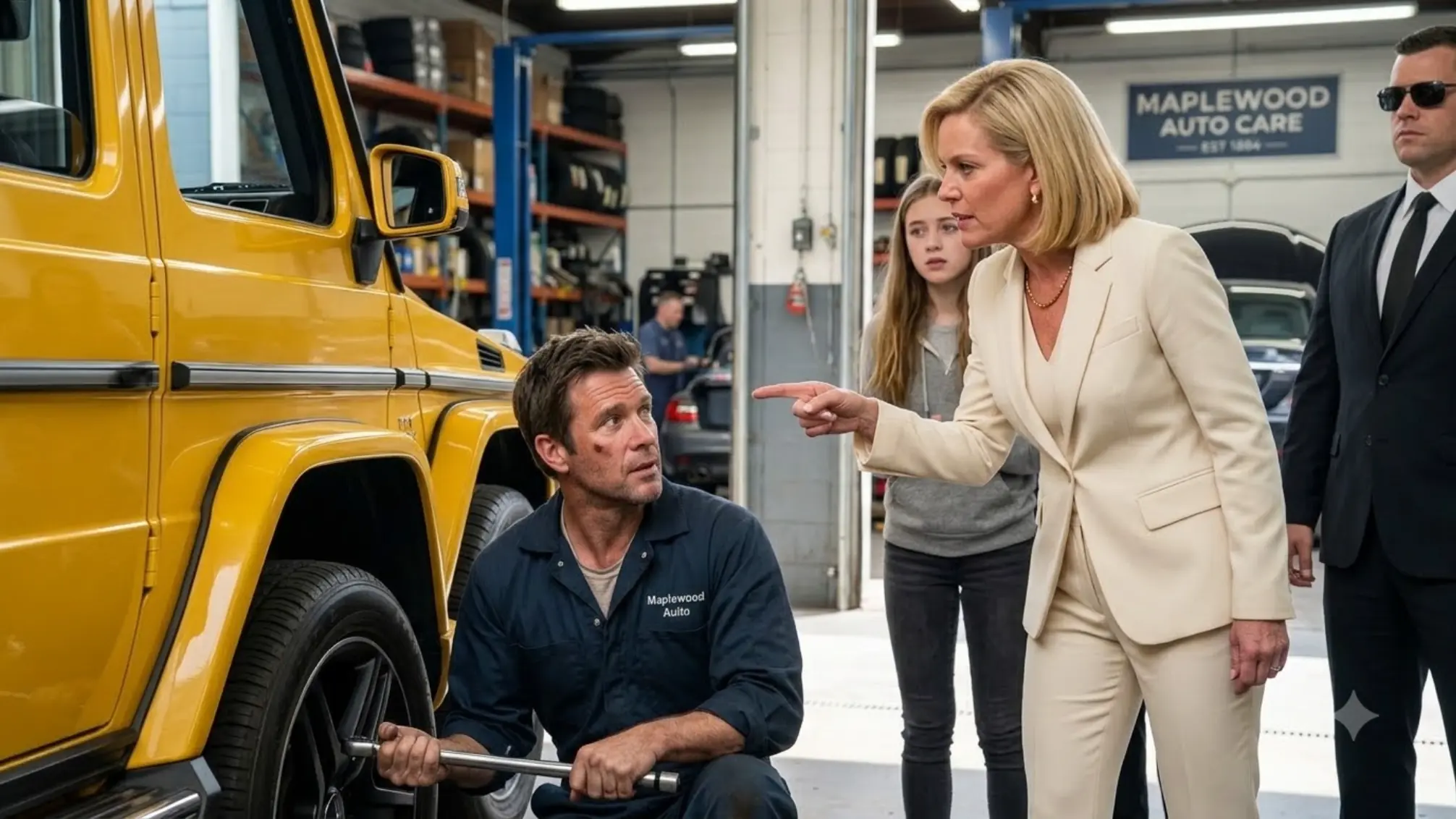
“Mom, listen to me,” Ava pleaded.
Vivian did not look at her. “I received a message saying a mechanic took your keys and refused to let you leave.”
“Because the car wasn’t safe.”
“He locked you inside this building.”
“No, the garage door jammed during the storm.”
One of the bodyguards reached for Colton’s wrist. Colton rotated the tire iron across his body, stopping it inches from the man’s forearm without striking him.
“Don’t,” Colton warned.
The guard’s expression hardened. He was larger than Colton, dressed in a black suit that fit tightly across his shoulders, but he hesitated when he saw how calmly the mechanic balanced his weight. Colton did not look like a frightened shop owner defending himself with a tool. He looked like a man who had learned long ago that panic wasted strength.
Vivian stepped between them.
“You’re finished,” she said. “Whatever this garage was worth, it belongs to my attorneys now.”
Colton glanced toward the small office at the back of the building. Through the dusty window, his nine-year-old son Rowan stood frozen beside a desk covered in homework papers. The boy’s face was pale as he watched two strangers surround his father.
Colton lowered the tire iron.
“Rowan,” he called without taking his eyes off Vivian. “Stay in the office.”
Vivian followed his gaze and saw the child.
For the first time, something interrupted her anger.
Ava hurried forward and grabbed her mother’s arm. “He has a son. He was supposed to pick him up from school, but he stayed because my wheel nearly came off.”
Vivian finally turned toward her daughter. “What are you talking about?”
Ava pointed toward the SUV’s front suspension. “Look.”
The wheel had been removed. Beneath it, the brake hose was split nearly through, and the wheel hub showed deep heat damage. Three lug studs were bent. A fourth had snapped completely.
Colton placed the tire iron on the floor.
“She didn’t have a simple flat,” he said. “Someone installed that wheel incorrectly. The lug nuts were barely holding, the bearing was overheating, and the brake hose had been rubbing against the rim.”
Vivian looked at the exposed assembly. “Could she have driven home?”
“She might have made it five miles.”
“And after that?”
“The wheel could have separated at highway speed.”
The garage fell silent.
Vivian’s face changed as she looked at her daughter. Ava had been crying when Colton found her beside the road outside the Kensington shopping district. Her phone had died, rain had begun falling, and passing drivers had continued without stopping. Colton had been on his way to a repair job worth nearly four hundred dollars when he saw her waving beside the yellow SUV.
He had pulled over despite knowing he could not afford to miss the appointment.
At first, Ava assumed he wanted money. Several people nearby had laughed when the grease-covered mechanic opened his toolbox beside a vehicle worth more than his garage. One man suggested Colton was searching for an excuse to charge a rich teenager for repairs she did not understand.
Colton ignored them.
He installed the spare tire, then noticed that the wheel moved unnaturally when he lowered the jack. Instead of letting Ava leave, he inspected the suspension and found the damaged hardware. When she insisted that her mother would be furious if she arrived late, Colton took the keys.
“You can be angry in my garage,” he told her. “You can’t be angry from inside a wreck.”
He called a tow operator he trusted, transported the SUV to his shop, and allowed Ava to use the charger in his office. She sent her mother a rushed message before the phone shut down again.
A mechanic took my keys. He says I can’t drive home. I’m at Hayes Auto.
The second message explaining the damage never went through.
Vivian had read the first while leaving a board meeting. Her daughter’s security application showed Ava inside a garage in an industrial neighborhood. Vivian called twice and received no answer because Ava’s phone was still charging from zero.
Fear had become rage before she entered the building.
One of the bodyguards moved toward the damaged wheel and crouched beside it.
“He’s telling the truth,” the man said. “The studs are destroyed.”
Vivian stared at Colton. “Why didn’t you answer the business phone?”
He pointed toward an old receiver lying in pieces beneath the wall. “The storm sent water through the front window. Phone died an hour ago.”
“And the garage door?”
“Motor burned out.”
Ava folded her arms. “I kept trying to tell you.”
Vivian closed her eyes briefly. When she opened them, the force had left her expression, replaced by the shock of a mother realizing she had nearly attacked the person who protected her child.
She faced her guards.
“Step back.”
Both men obeyed immediately.
Colton retrieved the tire iron but returned to the wheel instead of holding it defensively. “The replacement hub won’t arrive until morning. I can secure the vehicle overnight.”
Vivian looked at the SUV and then at his grease-stained hands. “How much?”
“For the tow, inspection, and temporary work? Two hundred and forty dollars, plus parts tomorrow.”
She almost laughed from disbelief. “You stopped for my daughter, missed another job, towed a vehicle worth nearly two hundred thousand dollars, and discovered a failure that could have killed her.”
“That doesn’t make the labor worth more.”
“It makes it worth whatever I decide.”
“No,” Colton said. “That’s not how my garage works.”
Vivian studied him. Most people who recognized her name changed instantly. They became excessively polite, nervous, eager, or calculating. Colton’s voice remained exactly as hard as it had been when he believed her bodyguards might attack him.
Ava walked toward Rowan’s office. The boy opened the door cautiously.
“I’m sorry my mom yelled at your dad,” she said.
Rowan glanced at Vivian. “Is she always like that?”
Ava lowered her voice. “Only when she’s terrified.”
Rowan considered this. “My dad gets quiet when he’s scared.”
Colton heard him but did not respond.
Five years earlier, Colton’s wife, Melissa, had died after an illness that moved faster than anyone expected. Their savings disappeared into medical bills, and Colton became the only parent to a four-year-old boy who woke every night asking when his mother would return. Colton learned to repair transmissions while answering school calls, prepare breakfast before sunrise, and hide overdue notices beneath grocery advertisements.
Hayes Auto had once belonged to his father. The garage was small, honest, and permanently close to failure. That month, two commercial customers had transferred their vehicles to a national repair chain offering discounts Colton could not match.
The landlord had given him eleven days to pay the overdue rent.
Colton had told no one except Rowan.
Vivian looked through the office window and saw the boy’s backpack beside a stack of unpaid invoices. A photograph stood on the desk showing Colton, Rowan, and a dark-haired woman smiling beside the garage sign years earlier.
“Your wife?” Vivian asked.
Colton continued cleaning the wheel assembly. “She died.”
“I’m sorry.”
“Most people are.”
The answer was not cruel, only tired.
Vivian removed a card from her purse. “Have the replacement parts delivered to my home. Charge whatever is necessary.”
Colton did not take it. “The vehicle stays here until I test it.”
“You expect me to leave it overnight?”
“I expect you not to put your daughter back into it until I know all four wheels were installed correctly.”
Vivian’s eyes narrowed at the challenge.
Ava stepped beside her. “Mom, please.”
Vivian handed the card to Ava instead. “Give him the information he needs.”
Colton looked at the teenager. “Keep it. I’ll send an invoice.”
“You trust us to pay?” Vivian asked.
“I trusted your daughter when she said she didn’t know the wheel was damaged.”
That answer followed Vivian after she left.
The next morning, Colton arrived before six. He ordered the new hub, replaced the broken studs, installed a brake hose, flushed the system, and inspected every wheel. What he found disturbed him.
The rear wheels showed fresh tool marks, but the fasteners had been tightened far beyond specification. The front passenger wheel had barely been tightened at all. It was not ordinary neglect. It was rushed, careless service performed by a shop that had billed for a full safety inspection.
The invoice inside the glove compartment carried the logo of Premier Motor Group, a luxury dealership owned partly by Sterling Mobility Holdings.
Vivian’s company.
Colton called the number on her card.
She answered immediately. “Is Ava’s vehicle ready?”
“Not yet.”
“What else did you find?”
He explained the mismatched wheel torque, damaged brake line, and false inspection entry.
Vivian became quiet. “Are you certain?”
“I measured every fastener twice.”
“That dealership services our executive vehicles.”
“Then you should inspect all of them.”
Vivian arrived forty minutes later without her guards. She wore a charcoal dress and carried a tablet instead of a handbag. Ava came with her, still dressed for school.
Colton handed Vivian the dealership invoice and his written findings.
“The technician signed off on a forty-point inspection,” he said. “Either he never performed it, or somebody changed the report.”
“Could road damage cause this?”
“Not all of it.”
Vivian read the document twice. “My company operates eight hundred vehicles.”
Colton nodded toward the yellow SUV. “Then this may be larger than one bad wheel.”
Vivian made three calls from the center of the garage. Her tone remained controlled, but every employee who answered understood that an internal emergency had begun. She ordered twelve randomly selected Sterling fleet vehicles removed from service and delivered to Hayes Auto.
Colton shook his head. “I can’t inspect twelve today.”
“How many can you inspect?”
“Four properly.”
“Then four.”
“I’m not your employee.”
“No. You’re the independent mechanic who found what our contracted specialists missed.”
Colton looked toward the office, where Rowan was eating cereal before school. “I charge standard diagnostic rates.”
Vivian almost smiled. “I expected nothing else.”
The first four vehicles arrived that afternoon. Two had unsafe brake wear that the dealership reported as new. One had a cracked steering component hidden beneath fresh undercoating. The fourth had mismatched tires installed despite a company invoice listing four premium replacements.
Colton photographed every defect.
Vivian stood beside him as he reviewed the evidence. “How long has this been happening?”
“I can tell you what’s wrong with the vehicles. I can’t tell you who is lying.”
“I can.”
The dealership’s maintenance contract had been approved by Sterling Mobility vice president Harold Creel. He was responsible for fleet procurement, repair partnerships, and safety compliance. For two years, he had reported that Premier Motor Group saved the company millions through negotiated service rates.
The savings existed because much of the billed work had never been completed.
When Vivian confronted Creel, he dismissed Colton’s report as the work of an unqualified neighborhood mechanic hoping to win a corporate contract. He demanded that Premier be allowed to re-examine the vehicles.
Colton refused to release them without signed authorization from Sterling’s legal department.
The following morning, Creel entered Hayes Auto with two corporate attorneys and a dealership manager. He wore a tailored gray suit and looked around the garage with open contempt.
“This is your expert?” he asked Vivian.
Colton continued examining a steering rack.
Creel approached him. “Do you understand the liability you’ve created by accusing a certified dealership of fraud?”
Colton wiped his hands on a cloth. “Do you understand the liability created by letting employees drive vehicles with failing brakes?”
“You are not licensed to conduct a corporate investigation.”
“I’m licensed to repair cars.”
Creel gestured toward the damaged components laid across a workbench. “Those parts could have come from anywhere.”
Colton pointed toward numbered evidence tags and continuous security footage from the garage camera. “Every removal is recorded.”
The dealership manager stepped forward. “You think your little camera proves anything?”
“It proves you should choose your next lie carefully.”
Creel moved into Colton’s space. “You are dealing with people who can close this garage before lunch.”
Rowan was inside the office again, listening.
Colton’s face became hard. “Men keep walking into my shop and threatening my home in front of my son.”
“This isn’t your home.”
“It became one when the rent on the house was too high and we started eating dinner in that office.”
Creel glanced toward the boy and showed no embarrassment. “Then you should consider how quickly your situation can become worse.”
Vivian stepped between them.
“Threaten him again,” she said, “and security will escort you from every Sterling property in the country.”
Creel looked stunned. “Vivian, I protected this company.”
“You protected invoices.”
“I delivered savings.”
“You placed my daughter inside a vehicle that could have lost a wheel.”
Creel lowered his voice. “This is emotional for you.”
Vivian’s expression turned colder. “That sentence just ended your career.”
The attorneys confiscated his company credentials. A forensic audit began that afternoon.
Investigators discovered that Creel received payments from a consulting firm connected to the dealership’s majority owner. Premier Motor Group charged Sterling for premium parts, installed cheaper substitutes, and skipped labor-intensive inspections.
The fraud exceeded eleven million dollars.
More importantly, seventeen Sterling vehicles had safety defects serious enough to cause crashes. Two earlier accidents classified as driver error were reopened for investigation.
Colton had uncovered the system because he refused to treat a crying teenager’s flat tire as a quick roadside job.
Vivian returned to Hayes Auto after the audit’s preliminary findings were complete. Colton was closing the garage while Rowan swept near the workbench.
She placed a thick contract on the hood of the repaired SUV.
“What’s that?” Colton asked.
“A fleet maintenance agreement.”
He did not touch it.
“We’re terminating Premier,” she continued. “Sterling needs independent regional providers. Your garage would supervise inspections and repairs for one hundred and twenty vehicles.”
“How much?”
She named an amount greater than Colton had earned in the previous two years combined.
He stared at the contract. “This is too much.”
“It is the market rate.”
“This feels like payment for helping Ava.”
“It isn’t.”
“It arrived because I helped Ava.”
“You earned the opportunity because you helped her. You earned the contract because your findings were accurate, documented, and strong enough to survive review by three engineering teams.”
Colton opened the agreement. “I only have one lift.”
“The contract includes a transition allowance for equipment.”
“I have one full-time employee. Me.”
“You may hire.”
“My roof leaks.”
“You may repair it.”
“My landlord plans to sell the building.”
Vivian placed another document beside the contract.
It was an offer allowing Colton to purchase the property through a long-term business loan guaranteed by the fleet agreement. The price was fair, the interest reasonable, and the garage would remain entirely his.
Colton looked at her. “You did all of this without asking me?”
“I created an option. You decide whether to accept it.”
He glanced toward Rowan. The boy had stopped sweeping.
“Dad,” Rowan said, “the roof really does leak.”
Vivian smiled.
Colton read every page over the next three days. He asked an independent attorney to review it and challenged several clauses he considered too favorable to Sterling. Vivian accepted nearly every revision.
He signed on Friday morning.
The first thing Colton purchased was not a new truck or expensive equipment. He repaired the office, replaced the broken heater, and built Rowan a proper homework desk away from the invoices.
Then he hired two mechanics who had been laid off by Premier.
Ava visited often, initially because Vivian’s security team insisted the yellow SUV receive follow-up inspections. Soon she came because Rowan helped her rebuild an old motorcycle engine donated to the garage’s youth program.
Vivian appeared less frequently but always stayed longer than necessary.
She and Colton continued arguing. She wanted electronic scheduling, corporate uniforms, and a polished customer lounge. He wanted tools that worked, honest invoices, and coffee strong enough to remove paint.
They compromised on scheduling.
The coffee remained dangerous.
One evening, Vivian stood beside Colton after the last fleet van left. The garage had three new lifts, repaired windows, and a sign Rowan helped paint.
HAYES AUTO — HONEST WORK, FAIR PRICE.
“You almost hit my bodyguard with a tire iron,” Vivian said.
“He almost grabbed me.”
“He says you looked pleased about it.”
“He’s sensitive.”
She laughed softly.
Colton looked toward the office, where Ava and Rowan argued over a math problem. “You almost destroyed my garage.”
“I was frightened.”
“So was I.”
“You didn’t look frightened.”
“I had my son watching.”
Vivian’s expression softened. “That day could have ended very differently.”
“It almost did.”
She looked at him. “Why did you stop for Ava when you were already struggling?”
Colton considered the question.
“Because someone walked past my wife once when she collapsed outside a pharmacy. They thought she was drunk. By the time a person finally helped, she had been alone on the pavement for twelve minutes.”
Vivian said nothing.
“She survived that day,” Colton continued. “But I never forgot how many people decided she was not their problem.”
He closed the toolbox.
“When I saw Ava crying, I didn’t see a rich kid or a luxury car. I saw somebody’s child waiting for the world to prove whether kindness still existed.”
Vivian looked through the office window at her daughter.
“You proved it.”
“No,” Colton said. “I stopped. That should not be extraordinary.”
One year later, Hayes Auto employed eleven people and maintained vehicles for three regional companies. Colton paid every debt, owned the building, and still charged ordinary customers the same fair rates.
A framed photograph hung beside the service counter. It showed Colton, Rowan, Vivian, and Ava standing beneath the expanded garage sign on opening day.
Customers often asked how a billionaire and a single father became business partners.
Colton never mentioned the contract first.
He told them about a crying teenager beside a damaged SUV, a missed repair appointment, and a choice that seemed financially foolish at the time.
Then he pointed toward the old tire iron mounted beneath the photograph.
A small metal plaque below it read:
Before you bury the wrong person, ask who stopped to help.
Vivian once entered the garage prepared to destroy the man holding that tool.
Instead, she discovered that his hands were dirty because they had been busy saving her daughter.
Colton did not become successful because a billionaire took pity on him.
He succeeded because when everyone else walked past a frightened girl, he stopped.