He had $300 million.
But the thing that stopped Nathan Sterling cold, the thing that made a billionaire stand frozen on a cracked sidewalk in a town he had spent fourteen years running from, was a piece of paper in a dusty store window.
Purple crayon. His handwriting, age eight.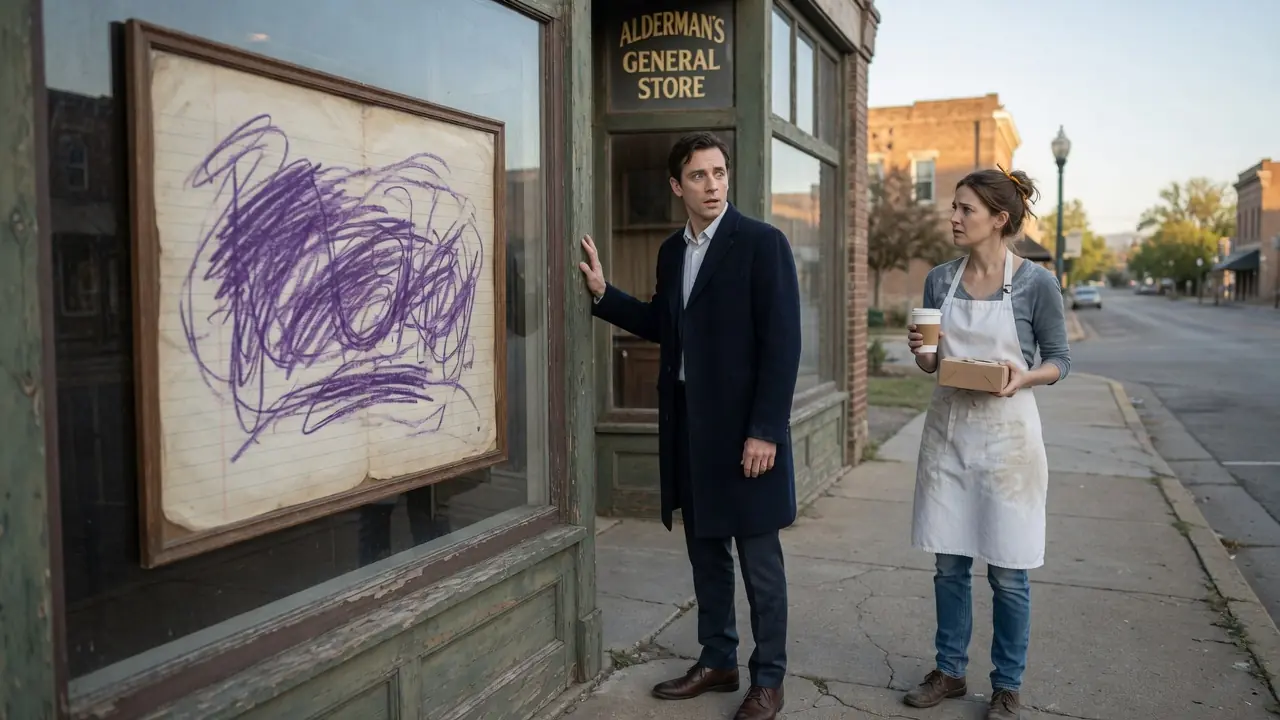
I, Nathan Sterling, promise to marry Emily Carter someday because she is the only person who never laughed at me when I cried.
The date at the bottom was his birthday.
The day his mother died.
The drive into Cedar Creek took forty minutes from the regional airport, and Nathan spent most of it staring out the passenger window while his assistant, Marcus, drove and pretended not to notice that his boss had not said a word since they crossed the county line.
The countryside looked exactly the same. That was the first thing Nathan noticed.
Fourteen years had passed, and the same gas station still sat on the corner of Route 9 with its hand-painted sign missing the second “S” in “Express.” The same grain elevator loomed at the edge of town like a concrete monument to a slower world.
Even the smell came through the air vents. Cut grass, diesel, and something warm and yeasty that Nathan could not immediately identify. It landed somewhere low in his chest.
“You want me to pull over, sir?” Marcus asked.
He was twenty-six, efficient, and had worked for Nathan for two years without once asking a personal question. He was asking one now, which told Nathan his face was doing something he was not controlling.
“No,” Nathan said. “Keep going.”
Beside him in the back seat, his daughter Lily had fallen asleep against the window. Her dark hair fanned across the glass, her mouth slightly open.
She was seven years old and had her mother’s nose, Nathan’s jaw, and a laugh that sounded like bells played back at the wrong speed.
He had not heard that laugh in four months. Not since the accident. Not since the night everything changed and the world rearranged itself around a new permanent absence.
Cedar Creek appeared gradually, the way small towns always do. First a water tower, then a church steeple, then a stretch of storefronts that ran three blocks and called itself Main Street with complete sincerity.
Nathan had grown up there from age five to eighteen. He knew every crack in every sidewalk. He knew which houses flooded in March, which neighbor kept a lavender garden, and which shortcut through the woods came out behind the old Carter place.
He had not been back once. Not for his father’s funeral. Not for holidays. Not when people called. Not when people stopped calling.
Marcus parked in front of the Riverside Inn, Cedar Creek’s only hotel. Twelve rooms, breakfast from six to nine, and a proprietor named Harold Finch, who had once given a teenage Nathan Sterling a job sweeping the parking lot for seven dollars an hour.
Nathan had arranged everything through his real estate team. He told no one he was coming and planned to stay three weeks. He did not know why three weeks. He did not know why at all, really.
Except that his therapist, a cautious woman in a glass-walled office in Manhattan, had said, “You need somewhere that existed before you became who you are. Somewhere that doesn’t know what to do with Nathan Sterling the billionaire.”
“It’ll know,” Nathan had said.
“Then find out what it does with you anyway.”
He carried Lily inside without waking her. She stirred only when he laid her on the bed, turned her face toward him with her eyes still closed, and said, with the flat certainty of a half-sleeping child, “Are we there?”
“Yeah, baby,” he whispered. “We’re there.”
She was asleep again before he finished the sentence.
Nathan could not sleep.
By six in the morning, he was showered, dressed, and standing on the sidewalk outside the inn with gas station coffee in his hand. The town was quiet. A couple of pickup trucks passed. A woman walked a dog that seemed to be walking her.
The diner on the corner had its lights on, and Nathan could see someone moving behind the fogged glass.
He walked.
There was no plan. He just walked the way you walk when you grew up somewhere, by muscle memory and the gravity of old paths.
He passed the barber shop where his father used to take him every six weeks, the library where he spent entire summers because it was air-conditioned and free, and the empty lot where the movie theater had stood before it burned down the summer Nathan turned twelve.
He remembered that fire. He remembered standing on the sidewalk beside Emily Carter while the fire department tried to save a building that was already gone.
He remembered Emily grabbing his hand without saying anything and holding it until the flames went out.
Then he turned onto Merchant Street and stopped.
Alderman’s General Store was still there. The oldest building on Main Street, according to the cedar plaque beside the door. Established 1887.
But none of that stopped him.
What stopped him was the thing in the corner of the window, mounted in a simple wooden frame behind glass.
A piece of lined notebook paper. Old. The kind with the red margin line and three holes punched along the side.
And on it, in the unmistakable all-caps print of a child who had just learned to write, were the words he had forgotten writing.
I, Nathan Sterling, promise to marry Emily Carter someday because she is the only person who never laughed at me when I cried.
Nathan, age eight.
The spelling errors were still there.
Thirty-two-year-old Nathan Sterling, who had signed contracts worth more than the economies of small countries, stood on the cracked sidewalk of Cedar Creek and stared at the misspelled promise he had made when he was eight years old.
He did not remember writing it.
He remembered Emily. He remembered third grade. He remembered the period of his life that he had quietly labeled in his mind as before.
Before his mother got sick. Before everything started pulling apart at the seams.
He remembered that Emily shared her lunch with him on days when he forgot his. He remembered the gap between her front teeth that embarrassed her and that he thought was the coolest thing he had ever seen.
He remembered that she smelled like her mother’s bakery, even at school, like vanilla and warm bread. Sitting beside her in class had been the closest thing to comfort he knew how to access at age eight.
He reached out and touched the glass with one finger, as if checking whether it was real.
The store door swung open.
“You’re going to smudge that,” a woman’s voice said behind him. “I just cleaned it yesterday.”
He turned around.
Emily Carter at thirty looked like someone who had lived hard and chosen to keep going anyway. Not damaged, exactly, but weighted. It was visible in her shoulders, in the lines near her eyes, in the way she looked at him for three full seconds before her expression shifted from professional weariness to something more complicated.
She wore jeans and a white apron already dusted with flour at the hem. Her hair, once long and loose, was pulled back with a pencil tucked through the bun.
She held a paper coffee cup in one hand and a small cardboard box in the other.
“Nathan,” she said, just his name, like she was confirming something she had suspected.
“Emily.”
He cleared his throat.
“Hi.”
“Hi.”
She looked at the window, then back at him.
“You saw the promise.”
“Yeah.”
“It’s been there for six years,” she said matter-of-factly. “The Hendersons found it in a box in the back room when they reopened the store. Old receipts, some photographs, a couple of letters, and that. They thought it was sweet.”
“It’s my handwriting,” Nathan said.
“I know. I recognized it immediately.”
She tilted her head slightly.
“I didn’t tell them who you were. Or who I was. Figured it wasn’t my story to tell.”
A beat of silence passed between them. In that silence, Nathan heard all the years he had not been there. Every Christmas. Every summer. Every unanswered phone call. His own absence had a sound now, not loud, but constant.
“I heard you were coming,” Emily said.
“I didn’t tell anyone.”
“Harold Finch.”
Nathan frowned.
“He texted the group chat,” she said.
“There’s a group chat?”
“Nathan, there’s always been a group chat.”
She shifted the box to her other arm.
“I have to get back. I’ve got croissants in the oven.”
“You have a bakery?”
“My family’s bakery. I took it over about five years ago.”
She glanced at him again, careful now.
“I heard you have a daughter.”
“Lily. She’s seven.”
“Is she with you?”
“Back at the inn. Sleeping.”
Another silence. This one heavier.
“It was good to see you, Nathan,” Emily said, and her tone sounded like someone who meant it and wished she did not.
She turned toward the door.
“Emily.”
He said it before he decided to say it.
She stopped without turning around.
“I’m sorry for…”
He stopped because sorry covered too much ground and not enough.
“For a lot of things.”
She was quiet for a moment. Her back remained to him.
“I know,” she said finally.
Then she walked inside.
The bakery was three doors down from Alderman’s General Store. It occupied the corner space that had been a pharmacy when Nathan was a boy.
When he stepped inside two days later, he understood immediately that it was already Emily’s.
The front room was small and crowded in the natural way of places that had grown organically. Mismatched chairs around four tables. A glass display case that needed replacing but held the best-looking pastries Nathan had seen outside Paris. A handwritten menu on a chalkboard. Photographs on the walls, some old family photos, some clearly left by customers and never taken down.
But the smell got him first.
It was not just bread or coffee or sugar. It was all of them together and something else beneath it. Something warm and specific.
He had smelled it before.
Every school day for ten years, sitting beside Emily Carter.
“You’re here,” Emily said, appearing from the back with her hands dusted in flour.
“Lily wanted a muffin,” Nathan said.
That was true.
Lily stood beside him, holding his hand for the first time in months, looking around the bakery with the wide-eyed seriousness of a child deciding whether a place was worth staying in.
Emily looked down at Lily, and Nathan saw her expression change. Not dramatically. Just quietly. Like a door opening a crack.
“Hi,” Emily said, crouching to Lily’s eye level. “What kind of muffin do you like?”
“Blueberry,” Lily said with authority.
“I have blueberry,” Emily replied. “I also have double blueberry.”
Lily considered this. “What makes it double?”
“More blueberries.”
“That makes sense,” Lily said.
“I thought so, too.”
Emily brought the muffin, and Lily ate it with systematic focus, working from the top down. Nathan drank coffee that was better than anything he had had in the city, though he did not say that out loud.
After a few minutes, Emily sat across from them with her own coffee.
She did not ask why he had come back. She did not ask about his company, his wealth, or Lily’s mother. She waited the way people do when they have learned not to chase information.
“She’s been quiet,” Nathan said, nodding toward Lily.
“Since January.”
Emily looked at Lily. “How quiet?”
“She talked to her teacher last week. That was the most she’s said to anyone in four months who wasn’t me or her nanny.”
He paused.
“Her mother died. Car accident. January third.”
Emily absorbed it without the overeager sympathy he had gotten from colleagues or the careful therapeutic language he had gotten from counselors.
“I’m sorry,” she said simply.
“We weren’t together,” he said quickly. “I mean, Lily’s mother and I had been separated for two years, but she was still…”
He stopped.
“It was still a loss. For Lily, obviously. For me, too, in a different way.”
Emily nodded, not trying to complete the sentence for him.
“Why Cedar Creek?” she asked.
“Therapist’s idea. She said I needed somewhere that remembered me before I had money.”
Emily’s mouth almost smiled.
“Cedar Creek definitely remembers you before you had money. Mrs. Paulson still talks about the time you tried to sell lemonade and made it with salt by accident.”
“That was one time.”
“You served it to six people before anyone said anything.”
He looked up.
“You knew?”
“I took one sip.”
“You could have said something.”
“I tried. You wouldn’t stop talking about your profit margin.”
Nathan laughed. It came out suddenly, catching him off guard. Lily looked up and stared at him as if confirming the sound had really come from her father.
“What are you drawing?” Emily asked Lily.
Lily turned her flour-dust drawing toward Emily.
“It’s a bakery,” she said seriously. “But bigger. With a second floor.”
Emily studied it with equal seriousness.
“The second floor is a good idea. You could have a reading room up there.”
“With a window seat?”
“Obviously.”
Lily looked at her drawing, then back at Emily.
“I think we should build it.”
Emily looked at Nathan. Nathan looked at Emily.
The moment felt too large for the small table.
“Maybe,” Emily said gently. “Maybe someday.”
Nathan went back the next day. Then the day after that.
Soon, he was arriving before the bakery opened. Emily gave him small jobs. Dividing cranberry scone dough into twelve pieces. Using the scale. Cleaning trays. Fixing shelves.
He was bad at first. By the twelfth scone, he was within two grams.
“Not terrible,” Emily said.
“High praise.”
“I have an apprenticeship standard. Everyone starts at not terrible.”
Lily began coming, too. Emily gave her an apron that had to be tied twice around her waist and still hung past her knees. She gave her real tasks, not pretend ones. Sorting blueberries. Stamping pastry boxes. Labeling bags.
One morning, Emily placed a miniature fruit tart in front of Lily.
“This one’s yours,” she said. “Made from leftover dough.”
Lily looked at it for a long moment.
“You made this for me?”
“Who else?”
Emily went back to work.
Nathan watched Lily’s face change. She began crying quietly, a few tears slipping down while she sat perfectly still, looking at the tart as if it was too kind to understand.
Nathan moved toward her.
Emily placed a light hand on his arm without looking at him.
Wait.
So he waited.
After a moment, Lily picked up the tart and ate it carefully, bite by bite, still crying a little.
When she finished, she wiped her face with the back of her hand and said to no one in particular, “That’s the best thing I’ve ever eaten.”
Emily, head down over her dough, replied, “I know.”
Two and a half weeks in, Nathan’s phone rang. The name on the screen was Richard Holt, which meant the board.
“Nathan,” Richard said. “We need to talk about the Meridian deal.”
“Richard, I told you—”
“The timeline moved up. Apex Group wants leadership on site. This is a $300 million deal.”
Nathan stopped walking. He was on the corner of Oak and Merchant, directly across from Alderman’s General Store. From where he stood, he could see the purple crayon promise in the window.
“I’m on personal leave.”
“I understand that. But Apex wants you in the room.”
“Send Davies.”
“Davies doesn’t have your relationships.”
“Send Davies.”
A long pause followed.
“This is the kind of absence boards notice,” Richard said carefully.
Nathan heard the warning beneath the politeness.
“I’ll be in contact by the end of the week,” Nathan said.
Then he hung up.
That afternoon, Lily asked to go to the creek.
Nathan took her, and at Lily’s request, Emily came, too.
They walked beneath old oaks carved with decades of initials until Nathan found the one he had been looking for.
NS + EC.
Badly carved into the bark at the approximate height of two twelve-year-olds.
“What does the plus sign mean?” Lily asked.
“It means we were friends,” Nathan said.
Behind him, Emily said quietly, “It means your father thought he was very clever at age twelve.”
“I was expressing a sentiment,” Nathan said.
“You expressed it in permanent form without asking me.”
“You didn’t object at the time.”
“I was twelve. I was being polite.”
Lily looked between them, enjoying the exchange more than she let on.
The creek was the same. Clear water over flat gray rocks. Shallow enough to wade through in summer. Loud enough in spring that you had to raise your voice slightly to be heard.
Lily sat on the bank, took off her shoes, put her feet in, gasped at the cold, and kept them there anyway.
Nathan and Emily sat on the fallen tree they had always sat on.
“I got a call this morning,” Nathan said eventually. “Board member. They want me back for a deal.”
“Are you going?”
“No.”
Emily was quiet.
“I wasn’t going to tell you to go,” she said. “I was going to say don’t make decisions about your company based on what’s happening here.”
He looked at her.
“That’s not how I’m making the decision.”
“Are you sure?”
He was quiet. Honest answer: he was not entirely sure.
“I’m sure enough,” he said.
The conversation they needed to have happened a week later in the empty bakery after closing.
Nathan had stayed to help clean up, something he had started doing without being asked. Emily turned off the faucet, dried her hands, and said without preamble, “Why did you leave?”
He had been waiting for this. He had also been dreading it.
“Emily—”
“I need to actually know, Nathan. Not the version you’ve told yourself. The real one.”
He leaned against the counter.
“My dad,” he said. “After my mom died, you know what he was like.”
“I know what he was like to the town. I didn’t know what he was like at home.”
“He drank. For about a year after she died, he drank and I managed it and I didn’t tell anyone. Then the scholarship came through for Boston and…”
He stopped.
This was the part he had never said out loud.
“I thought if I left, he would have to figure it out because there was nobody else.”
“Did he?”
“Mostly. Good stretches. Bad ones. He died when I was twenty-six.”
He looked at his hands.
“I wasn’t here for that, either.”
Emily said nothing.
“But that’s not the whole answer,” Nathan continued. “Being here meant being the kid whose mother died and whose father was falling apart. Boston meant being someone who was going to make something. I could be the version of myself that hadn’t lost anything yet.”
“Except you had,” Emily said.
It was not accusatory. It was just true.
“I know.”
She looked at him for a long moment.
“You left without saying goodbye,” she said.
“I know.”
“We’d been best friends for ten years. I woke up one morning and your house was empty.”
“I know,” he said again.
It was not enough. He knew it was not enough.
“I was eighteen and stupid and terrified. Leaving felt like the only way to stay alive. I’m not using that as an excuse. I’m just—”
“I’m not asking you to defend it,” she said. “I already knew it wasn’t malicious. I figured that out years ago. I just needed to hear the actual thing, not the polished version.”
“The polished version is worse,” Nathan said. “In the polished version, I had reasons.”
“You did have reasons.”
“Reasons aren’t the same as being right.”
She looked at him.
“No,” she agreed. “They’re not.”
“I’m sorry, Emily. Not just for leaving. For leaving the way I did. You deserved better from me.”
She did not say it was okay. He was grateful for that.
She only said, “Don’t do it again.”
Then she picked up the mop and went back to work.
That night, Nathan extended his stay. Not for three more days. Not for one more week. Indefinitely, though he was not ready to call it that yet.
The board called again weeks later. The Meridian deal had shifted. The board wanted him back. There were conversations about his role, leadership stability, the future of Sterling Holdings.
Nathan sat on the storage room floor of the bakery, holding a forty-dollar refrigeration seal he had just replaced for Emily’s backup cooling unit, and thought about the cost of everything he had built.
Then he thought about what it had bought him.
The cost side of the list was long.
The bought side was shorter than he expected.
He told Emily about the call while she worked on a test pie for the town fair.
“They want me back,” he said. “It’s a $300 million deal.”
Emily did not push him. She gave him room to say the whole thing.
“What do you want to do?” she asked.
“I want to stay,” he said.
It came out without hesitation.
Emily turned toward him.
“Nathan, you built that company. It’s real. It matters. If you throw it away because of whatever is happening here, the bakery, Lily, me, the creek, all of it, I can’t let you do that without saying so.”
“I’m not choosing Cedar Creek because it’s charming,” he said. “I’m choosing it because I’ve been building companies, deals, and portfolios for fourteen years, and it has given me almost nothing I actually needed. Being here has given me more in six weeks than the last three years of everything I had.”
Emily watched him, measuring whether it was true.
“I know what this town is,” he said. “I know it’s small and hard and underfunded. I know everybody’s in everybody’s business. I know it doesn’t have decent internet. I’m choosing it knowing what it is, not because I’ve forgotten what it isn’t.”
After a long moment, Emily nodded.
“Okay.”
Nathan restructured his company role. Davies closed Meridian. The final number was $280 million, not $300 million, and the board accepted it.
Nathan stayed.
He bought the old Route 9 hardware store quietly and turned it into the Cedar Creek Skills Center. A place where local kids could learn trades, culinary skills, technology, design, and practical work that gave them options.
Vic Caruso, a former apprenticeship instructor, agreed to run it.
“If it’s real,” Vic said.
“It’s real,” Nathan replied.
The first cohort opened with twelve students. Forty-three applied.
Emily came by after closing one afternoon and walked through the clean workshop, the benches, the tools, the smell of new wood and machine oil.
On the wall was a plain sentence.
This is a place to learn something real.
Below it were old photographs of Cedar Creek. Factories, farms, Main Street, people who had built and worked and stayed.
Emily stopped at one of the photos.
“My mother’s in this one,” she said.
Nathan looked. She was right. Emily’s mother stood behind the bakery counter in a photograph from the late eighties, younger and laughing at something off camera.
“I didn’t know she was in one,” Nathan said.
“I’m glad she is,” Emily replied.
Months passed.
Nathan rented a house on Maple Street, three blocks from the bakery. Lily enrolled in Cedar Creek Elementary and began coming home with stories about school, cafeteria injustice, library books, and the proper order of baking techniques.
Emily came to dinner twice a week. Sometimes she brought cranberry preserves. Sometimes a book for Lily. Once, a replacement dish towel after Nathan destroyed one handling a hot pan.
They moved slowly, deliberately. Emily had said “not yet,” and Nathan had promised he could do not yet.
He meant it.
One evening in October, after dinner, Lily fell asleep on the couch with a book open on her chest. Nathan and Emily sat on the back steps under the orange leaves of the oak tree.
“I went to see my father’s grave,” Nathan said.
Emily was quiet.
“I keep thinking about what I owe people who are gone. Whether there’s a math to it.”
“There isn’t,” Emily said.
“I know. But my dad and I had a complicated thing. He wasn’t easy. He wasn’t bad, either. He was a man with problems and some good qualities, and I left before we figured out how to be okay with each other. Now I can’t fix it. I can just make sure I don’t do the same thing with the people who are still here.”
Emily reached over and put her hand on top of his.
Not lightly. Not briefly.
Deliberately.
He turned his hand over beneath hers.
They sat in the October cold, holding hands for the first time since they were children.
Spring came gradually, then all at once. The trees went green. The creek banks softened. The skills center enrolled its second cohort. Lily grew steadier, louder, more herself.
One April morning, Nathan drove to the creek before the bakery opened. He carried something wrapped in cloth under his arm.
At 7:30, Emily came with him.
They walked the path beneath the oaks, past the carved initials, down to the bank where the water ran clear over flat gray rocks.
He unwrapped the frame.
It was the purple crayon promise from Alderman’s window. The Hendersons had given it to him two weeks earlier when he asked.
Emily looked at it for a long time.
“I’ve been thinking about what I wanted to say,” Nathan said. “I wrote it in my head six times. I had a version that was more eloquent. But you know me well enough that I don’t think you want the version where I make a case. I think you want the real one.”
“Yes,” she said.
“The real one is that I’ve been choosing you every day for a year. Not because of this promise. Not because of what we were when we were eight. Not because Cedar Creek is small and you’re the best thing in it. I’ve been choosing you because you tell me true things and you don’t make it easier than it is.”
Emily’s eyes were bright.
“You taught my daughter that double blueberry means more blueberries, and somehow that was exactly what she needed. You’re the person I want in the room when something goes wrong. When I stood on that sidewalk looking at this promise, I wasn’t thinking about a childhood crush. I was thinking that I had spent fourteen years building the wrong life, and the right one had been here the whole time.”
“I’ve been watching closely enough to know it’s true,” Emily said.
“I’m going to make mistakes,” he said. “I’m going to be wrong about things. I’m going to suggest the wrong sequence for the culinary curriculum again.”
“Nathan,” she said.
“I want you to know what you’re getting.”
“I know what I’m getting,” she said. “I’ve been watching it walk into my bakery at six in the morning for a year.”
She set her coffee down on a nearby rock and looked at him with no neutrality, no distance.
“So ask me.”
He did not get down on one knee. The creek bank was muddy, and the moment did not require theater.
He stood in front of her, held the frame, and said, “Marry me, Emily. Not because of this promise, but because I’ve spent a year choosing you every single day, and I want to keep doing it every day after this.”
She was quiet long enough for the creek to move several inches over its rocks.
Then she said, “Yes.”
Just that.
Simple, direct, hers.
The way she said everything true.
The wedding was the following April, in the park by the creek.
Emily wanted small. Nathan wanted everyone who mattered to be there. In Cedar Creek, those turned out to be nearly the same thing.
Harold came. Marcus came. Dr. Reyes, Vic Caruso, Joe Abrams, Sue Briggs, Ray from the diner, Mrs. Patterson, Gerald from the hardware store, Thomas Carter, and the whole Cedar Creek web of people who had woven themselves into the past year.
Lily walked beside Emily, not in front of her with flowers, because that had been Lily’s request.
“I want to walk beside you,” she had said. “Not in front. Beside.”
So she did.
She wore a blue dress, navy shoes, and carried the quartz-striped rock in her pocket because she had decided it was a good luck object, and no occasion could possibly need more luck than this.
Nathan’s vows were short.
“I spent fourteen years building things I thought would make me feel something,” he said. “Then I came home and spent a year learning that the feeling was here the whole time. I’m not going to be perfect at this. I’ll be wrong sometimes, stubborn sometimes, and I may suggest the wrong sequence for the culinary curriculum more than once. But every day, the way I’ve been doing for a year, I’m going to choose you. That’s what I’ve got. It’s everything I’ve got.”
Emily’s words were shorter.
“You came back. You stayed. You showed up every day for a year when you didn’t have to. That’s the most anyone has ever done. I don’t need a promise. I need exactly what you’ve already been doing.”
They said yes to each other.
Lily pressed the rock in her pocket with both hands and looked at the sky with the expression of someone deciding everything had worked out the way it was supposed to.
Later, in the kitchen of the Maple Street house, the purple crayon promise hung in its frame beside the window where morning light came through.
It was not on the best wall. It was not displayed like a trophy.
It was in the kitchen because that was where most of the real things happened.
The cooking. The arguing. The homework. The ordinary days that turned out to be the whole point.
When Lily asked about it, Nathan would take it down and let her read it, misspellings and all.
“Did you really promise this?” she asked one evening.
“I wrote it,” Nathan said. “I don’t remember writing it, but it was mine.”
“But you meant it?”
Nathan looked at Emily, who stood at the counter, not quite listening and absolutely listening.
“I meant something by it,” Nathan said. “I didn’t know the word for what I meant yet. I just knew the feeling, and the closest word I had was that one.”
Lily looked at the paper, then handed it back.
“The most important part wasn’t making the promise,” Nathan said, putting it back on its nail.
“It was keeping it,” Lily said.
He looked at her.
“You’ve said that before,” she said. “Or maybe I just knew you were going to say it.”
Emily glanced over.
“Obviously she knew,” Nathan said. “She’s your kid.”
Outside, Cedar Creek made its evening sounds. The diner closing. The creek running somewhere at the edge of town. The last light moving from gold to dark in the ordinary way of days that add up, one by one, into something worth keeping.