The six crumpled bills landed beside Whitney Sanders’s shoes beneath the largest chandelier in Manhattan. Forty diners turned toward the sound, but no one spoke as the money slid across the marble floor beneath a table covered with crystal glasses, imported silverware, and a dinner that cost more than Whitney earned in a week. The white-haired man seated before her watched without blinking, one hand resting beside a glass of twenty-year-old wine. Whitney bent down slowly, collected each dollar, smoothed the bills against her apron, and placed them beside his plate.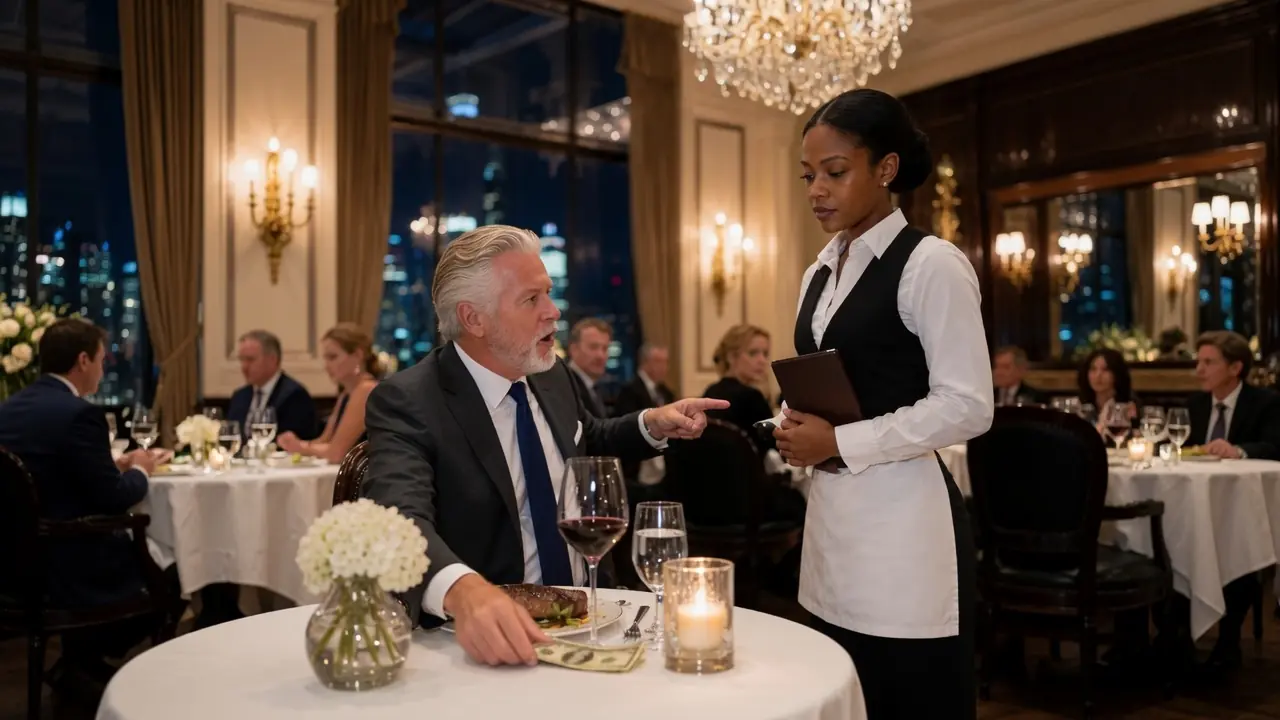
Her manager reached the table before she could step away. Derek Whitmore wore a tailored gray suit, a gold restaurant pin, and the impatient expression he reserved for employees who embarrassed wealthy customers. He seized Whitney’s arm just above the elbow and smiled apologetically at the man.
“Mr. Ashford, I assure you this is not how our staff normally behaves.”
Whitney pulled her arm free. “He threw money at me.”
Derek leaned close enough that only she could hear him. “That six dollars could buy your daughter dinner. Pick it up, say thank you, and stop pretending pride pays rent.”
The billionaire’s expression changed slightly.
Whitney saw it, but she did not understand it yet. She only knew that every diner at The Sterling was watching to see whether she would bow, apologize, or accept humiliation as part of the uniform. Her daughter needed an inhaler. Her landlord had delivered an eviction notice. Her checking account contained eleven dollars and forty cents.
She still left the six dollars on the table.
“My daughter needs many things,” Whitney said quietly. “She does not need to watch me become grateful for disrespect.”
Derek’s smile vanished. “Go to the kitchen.”
Whitney lifted her order book. “My section is still eating.”
“Not anymore.”
The billionaire raised one hand. “Let her finish the table.”
Derek immediately softened. “Of course, Mr. Ashford. Whatever you prefer.”
Whitney looked at the man more carefully. His name was Jonathan Ashford, though she had not recognized him when he entered. At sixty-two, he was a billionaire investor whose company controlled luxury hotels, food distributors, commercial real estate, and several private dining clubs. He had reserved the restaurant’s center table under another name and arrived without assistants, bodyguards, or the publicity that usually followed him.
The Sterling’s owners had spent months asking Ashford Capital to invest in a national expansion.
Jonathan had not come to enjoy dinner.
He had come to decide whether the restaurant deserved his money.
Twelve hours earlier, Whitney had awakened in a one-bedroom apartment in Queens before the sun rose. Her seven-year-old daughter, Lily, slept behind a curtain dividing the living room from the mattress they shared on alternating nights. Whitney sat beside the window holding an almost-empty inhaler and shaking it gently, hoping the plastic might produce medicine through determination alone.
It produced only a hollow rattle.
The pharmacy wanted three hundred and forty dollars for the replacement. Whitney’s insurance had stopped covering the prescribed brand, and the clinic could not see Lily for another nine days. She had called every assistance program listed online, but each one required documents, appointments, or waiting periods that did not match the urgency of a child struggling to breathe.
Whitney placed the inhaler inside Lily’s backpack and prepared oatmeal with the last of the brown sugar. She gave her daughter two full servings and told her she had already eaten. Lily studied the nearly empty bowl in Whitney’s hands but did not argue.
Children who grow up around unpaid bills learn when adults are lying for love.
At the school entrance, Lily hugged her tightly. “Will you bring home the bread with the seeds?”
“I’ll try.”
The Sterling discarded dozens of untouched dinner rolls after every shift. Whitney sometimes wrapped several inside a clean napkin and carried them home in her apron pocket. Derek called it theft, even though he ordered the kitchen to throw the bread away.
Whitney kissed Lily’s forehead and watched her enter the building before walking toward the subway.
The Sterling occupied the top floor of a limestone building overlooking Central Park. Its dining room contained crystal chandeliers, dark wood walls, and windows framing the Manhattan skyline. Guests entered through brass doors beneath a canopy. Employees entered through an alley beside the garbage containers.
Whitney had worked there for four years.
She arrived early, stayed late, remembered allergies, learned anniversaries, and treated every table with the same patience whether the guests tipped generously or left nothing. Regular customers requested her by name. New employees asked her for help before they trusted management.
Yet Derek never assigned her to the most profitable tables unless another server called out.
The best sections went to employees who gave Derek part of their cash tips after every shift. Whitney discovered the arrangement months earlier when a young server named Maria accidentally left an envelope inside a locker. The front read D.W.—FRIDAY SHARE.
Maria begged Whitney not to mention it.
“If I stop paying him, I lose the window tables,” she whispered. “I have two kids.”
Whitney understood too well.
Derek controlled schedules, sections, overtime, and performance reviews. Employees who challenged him received fewer shifts or were assigned to private events where gratuities disappeared into an unexplained service pool. He called the system motivation.
Whitney called it theft, but she had no proof strong enough to survive his denial.
That evening, pre-shift assignments placed Whitney in the least desirable section near the kitchen doors. Then a server from the center section became ill, and Derek reluctantly moved Whitney to Jonathan Ashford’s table.
Before service began, Derek gathered the staff.
“The gentleman at table twelve matters more than every other guest tonight,” he said. “His investment could open six new locations. Do not improvise. Do not argue. Do not embarrass me.”
He looked directly at Whitney.
She did not know why.
Jonathan arrived at seven-thirty wearing a black suit, white shirt, and navy tie. His swept-back silver hair, trimmed white beard, and expensive watch made his wealth visible even without recognition. He ordered the tasting menu but asked detailed questions about employee training, supplier origins, kitchen waste, and turnover.
Whitney answered honestly.
When he asked whether servers received the full service charge listed on private-event checks, she paused.
“The restaurant can explain its policy better than I can.”
“That was careful.”
“It was accurate.”
Jonathan watched her face. “Do you enjoy working here?”
“I enjoy serving people.”
“That is not the same answer.”
“No, sir.”
Jonathan had spent thirty years buying businesses that looked polished from the outside and rotten beneath the surface. Executives rehearsed answers when they knew who he was. Employees revealed more when they thought he was merely another demanding customer.
That was why he had reserved the table under a private name.
It was also why he decided to test Whitney.
The decision did not begin as cruelty in his mind. He wanted to know whether her kindness depended on money. He had seen servers transform instantly after recognizing his name, offering free dishes, personal stories, and exaggerated attention in exchange for a larger tip.
He wanted an unscripted answer.
But wealth had protected Jonathan from understanding the difference between a test and humiliation. He believed six dollars would measure Whitney’s character. He did not consider that the money might represent medicine, transportation, or food to the woman standing before him.
After dessert, he folded six one-dollar bills and dropped them deliberately.
Then he made the comment that silenced the room.
“Six dollars is generous for service from someone like you.”
The moment the words left his mouth, Jonathan heard how they sounded. He saw the nearby diners turn, the manager hurry forward, and Whitney’s expression harden without becoming emotional. What he intended as pressure carried an insult shaped by race, class, and every assumption a wealthy white man could make about a Black waitress.
Whitney’s answer struck harder because she did not shout.
“A tip doesn’t decide how I treat people.”
Jonathan had entered expecting to test her dignity.
Instead, he exposed his own.
Derek ordered Whitney into the service corridor after the table’s main course was cleared. He followed her through the swinging kitchen doors and shut them behind him.
“You just cost this restaurant millions.”
“He insulted me.”
“He is Jonathan Ashford.”
“That doesn’t make the insult smaller.”
“It makes your response more expensive.”
Derek removed a printed disciplinary form from his clipboard. He had prepared it before speaking to her. The charge read INSUBORDINATION AND GUEST HARASSMENT.
“You’re suspended for two weeks.”
Whitney stared at the paper. “I won’t be able to pay rent.”
“That is not the restaurant’s problem.”
“My daughter needs medication.”
Derek leaned closer. “Then you should have picked up the money.”
Whitney’s eyes burned, but she refused to cry in front of him. “You were going to punish me no matter what I did.”
“I was going to teach you how employment works.”
Behind Derek, the kitchen door opened.
Jonathan stood there holding the six bills.
“No,” he said. “You were going to teach her that desperation makes abuse acceptable.”
Derek turned immediately. “Mr. Ashford, I can explain.”
“Start with why you grabbed her.”
“I was protecting the guest experience.”
“I was the guest. I did not ask for protection.”
Derek forced a laugh. “She overreacted to a harmless misunderstanding.”
Jonathan looked at Whitney. “Did it feel harmless?”
“No.”
He nodded once. “Then it wasn’t.”
Whitney expected an apology, perhaps a larger tip offered to ease his guilt. She did not expect him to ask Derek for the restaurant’s payroll records, gratuity policy, and employee handbook.
Derek’s face tightened. “Those documents are confidential.”
Jonathan removed a slim phone from his jacket. “Your owners invited me to review this business before investing forty million dollars. Nothing connected to employee compensation is confidential from the potential buyer they have been begging to impress.”
He made one call.
“Nina, postpone the Sterling transaction. Bring the audit team tonight.”
Derek stepped forward. “That is unnecessary.”
Jonathan looked at the disciplinary form. “You prepared this before asking for her account. That makes it necessary.”
The restaurant’s owners arrived within an hour.
So did Jonathan’s general counsel, Nina Patel, an employment auditor, and two financial investigators from Ashford Capital. The dinner service continued because Jonathan refused to create a public spectacle that would punish hourly employees for management’s conduct.
Whitney finished her tables.
Some guests apologized for remaining silent. Others left money on the table and avoided her eyes. One woman handed Whitney a hundred-dollar bill, but Whitney returned it.
“I appreciate the thought,” she said. “Please leave the normal amount for the service you received.”
The woman nodded, embarrassed but respectful.
At midnight, the staff gathered in the private dining room. Derek sat beside the owners while Nina displayed payroll reports on a screen. She explained that the restaurant charged automatic gratuities on private events but distributed less than half to servers.
The missing portion had been classified as an administrative coordination fee.
No such fee appeared in employee contracts.
Over three years, more than six hundred thousand dollars had been withheld from workers.
Derek claimed the owners approved the arrangement. The owners denied it and blamed an outside payroll company. Nina then displayed emails showing Derek personally ordered the deductions.
Another file revealed tip assignments by server.
Employees who paid Derek privately received higher-value tables. Those who refused were assigned low-traffic sections, shortened shifts, and negative reviews. Whitney’s name appeared repeatedly beside the code NR, meaning non-reliable.
“What does non-reliable mean?” Jonathan asked.
Derek stared at the table.
Maria answered from the back of the room. “It means she wouldn’t give him part of her tips.”
Derek stood so quickly that his chair fell backward. “She’s lying.”
Maria held up her phone. “I saved every message.”
One message from Derek read:
Window section is earned. Bring my share before Friday or go back near the kitchen.
Other servers began speaking.
One described losing weekend shifts after refusing to pay. Another said Derek deducted money from her check for a guest who left without paying, though restaurant policy prohibited the charge. A dishwasher revealed that Derek sold unopened food inventory to a catering business and blamed kitchen waste for the shortages.
Whitney had believed she was alone because everyone remained quiet.
The truth was that fear had isolated all of them separately.
Jonathan listened without interrupting. When the room finally became silent, he turned toward Derek.
“You told Whitney that six dollars could buy her daughter dinner.”
Derek looked confused by the change of subject.
Jonathan placed the bills on the table.
“You used poverty as a weapon because you believed the people working for you could not afford dignity.”
“I managed a difficult staff.”
“You stole from a trapped staff.”
One owner attempted to distance the business from Derek, but Nina displayed quarterly reports showing unusually high staff deductions and turnover. The owners had praised Derek for reducing labor costs without asking how he accomplished it.
Jonathan closed the acquisition folder.
“Ashford Capital will not invest under current ownership.”
The owners protested that hundreds of jobs depended on the transaction. Jonathan replied that jobs were already being used to silence the people performing them.
He offered a different arrangement.
The owners could sell The Sterling under a court-supervised agreement that reserved money for stolen wages, tax obligations, and employee restitution. If they refused, Ashford Capital would provide its evidence directly to labor authorities and withdraw permanently.
They accepted two days later.
Derek was removed from the restaurant that night. He attempted to delete messages and payroll files remotely, but the audit team had already frozen the systems. Investigators later discovered he transferred more than two hundred thousand dollars in stolen tip money through accounts controlled by his brother.
He faced charges connected to wage theft, fraud, falsifying records, and retaliation.
The restaurant closed for one week during the transition.
Whitney expected to lose the income completely, but every hourly employee received full pay. Jonathan also arranged an emergency wage advance program without interest or repayment penalties.
Whitney did not apply.
Nina found her sitting alone in the empty dining room after a staff meeting.
“You need the money,” Nina said.
“I do.”
“Then why didn’t you submit the form?”
“I don’t want Mr. Ashford thinking I’m accepting payment for what happened.”
“This is not a gift from him. It is compensation from a company that failed its workers.”
Whitney looked toward table twelve. “He threw money at me to see what I would do.”
“Yes.”
“And now everyone acts like he saved us.”
Nina sat across from her. “Jonathan is not the hero of the moment he created. He knows that.”
“Does he?”
“He asked me to tell you he will not speak with you again unless you request it. He does not want an apology to become another demand placed on you.”
Whitney considered that.
The next morning, she requested the meeting.
Jonathan arrived without assistants and sat at the same table. Whitney remained standing until he stood too.
“I was cruel,” he said. “I called it a test because that sounded better than admitting I believed my money gave me the right to provoke you.”
Whitney said nothing.
He continued. “My comment was degrading. Your race and your position made the meaning worse, whether I intended it or not.”
“You wanted to know whether I treated rich people differently.”
“Yes.”
“And you treated me differently because you thought I needed your money.”
Jonathan lowered his eyes. “Yes.”
“My answer did not make me exceptional. Most of the people working here have dignity. They simply have bills powerful men know how to use against them.”
“I understand that now.”
“No. You are beginning to.”
Jonathan accepted the correction.
Whitney removed the six bills from her order book and placed them between them. “I kept these because I wanted to remember the moment I almost picked them up.”
“What stopped you?”
“My daughter.”
Jonathan expected Whitney to explain that Lily inspired courage. Instead, she said she imagined Lily watching her apologize to a man for being insulted.
“I could not teach her that hunger decides what treatment we deserve.”
Jonathan pushed the bills back. “Keep them.”
“No.”
“Then tell me what should happen to them.”
Whitney thought for a moment. “Frame them in the staff room beside the new tip policy.”
That was where they remained.
Beneath the frame, a plaque carried Whitney’s sentence:
A TIP DOESN’T DECIDE HOW I TREAT PEOPLE. IT ALSO DOESN’T DECIDE HOW PEOPLE MAY TREAT ME.
The Sterling reopened under new ownership and a different structure.
All stolen gratuities were calculated by an independent accounting firm. Current and former workers received restitution with interest. Schedules and table assignments became visible to the entire staff, preventing managers from secretly rewarding favored employees.
Private-event service charges went directly to the workers listed on each event.
Employees elected two representatives to attend management meetings. Complaints went to an outside hotline rather than the manager accused of misconduct.
Jonathan offered Whitney a management role immediately.
She declined.
“I know how to serve guests,” she said. “That does not automatically mean I know how to manage a restaurant.”
The answer impressed him more than quick acceptance would have.
He funded formal hospitality training open to every employee, but Whitney insisted the program belong to the restaurant, not to her personally. She completed the same applications, coursework, and evaluations as everyone else.
Six months later, she became guest-services director.
Her first policy prohibited managers from punishing workers for a guest’s discriminatory conduct. Employees could transfer a table, request assistance, or end service when personal safety or dignity was threatened.
The restaurant also partnered with a local family clinic after Whitney explained how many workers delayed medical care because of unstable schedules and high costs. The clinic provided low-cost prescriptions, evening appointments, and pediatric care.
Lily received her new inhaler through that program.
Whitney paid the reduced price herself.
One year after the incident, Jonathan returned to The Sterling. He sat at table twelve without announcing his visit. A new server greeted him, explained the menu, and treated him professionally without recognizing his name.
At the end of dinner, Jonathan left a standard twenty-percent tip.
Whitney noticed while reviewing the closing reports.
“No test tonight?” she asked.
Jonathan looked toward the framed six dollars in the staff room.
“No.”
“What changed?”
“I finally learned that service workers are not auditioning for humanity.”
Whitney nodded. “That lesson cost more than six dollars.”
“Yes,” he said. “It should have.”
The story spread online because people enjoyed the reversal: a billionaire humiliating a waitress, only to be silenced by her response. But the real change did not happen when Jonathan lost the argument at table twelve.
It happened when the restaurant stopped treating respect as a reward customers could purchase.
Whitney never became grateful for the insult. She did not call it a blessing, a hidden opportunity, or the moment a billionaire rescued her. The humiliation was wrong before anyone discovered the stolen tips, and it remained wrong afterward.
Her courage simply prevented powerful people from hiding behind it.
Jonathan thought six dollars would reveal the waitress’s character.
Instead, they exposed the billionaire, the manager, the owners, and the system that had taught all of them to confuse wealth with worth.