“You embarrassed me in front of everyone. Now prove you’re brave enough to face me.”
Seventeen-year-old Bryce Carter stood in the middle of Maple Ridge Lane wearing an expensive black training jacket and the confident expression of a young man who had rarely been told no. A black-belt academy bag hung from one shoulder, and several championship patches covered the fabric like advertisements for his victories. Behind him, neighbors gathered beside the veterans’ fundraiser while phones rose to record what they assumed would become the most exciting moment their quiet Georgia subdivision had seen in years.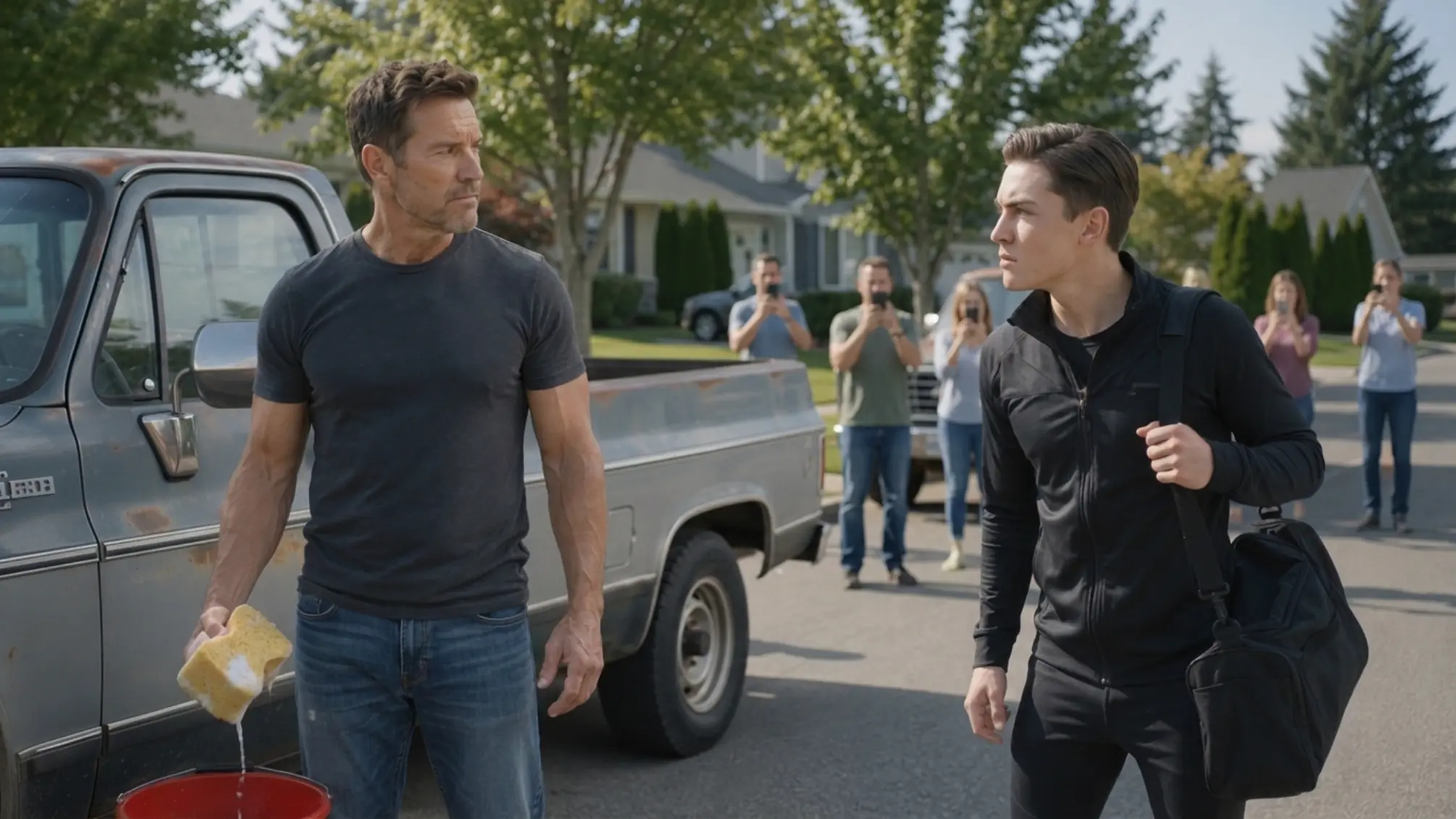
Across from Bryce, fifty-six-year-old Malcolm Reeves calmly placed a wet sponge on the hood of his weathered pickup truck.
Malcolm was a handsome Black American widowed father with deep-brown skin, steady dark eyes, short hair touched with gray, and the powerful build of a man who remained disciplined without needing anyone to notice. He wore a charcoal henley shirt, faded jeans, and brown work boots. Nothing about him appeared threatening, but he carried himself with a stillness that made the air around him feel heavier.
“A black belt should teach control,” Malcolm said. “Not give you permission to intimidate people.”
Bryce’s jaw tightened.
“Keep lecturing me, and everyone here will watch you back down.”
Malcolm looked toward the fundraiser signs Bryce had knocked across the grass while parking his sports car. Children were collecting them near the curb. Malcolm’s sixteen-year-old daughter, Tessa, stood beside the lemonade table, watching her father with concern.
Malcolm returned his attention to Bryce.
“Spend one afternoon with me,” he said. “Then decide whether you still understand what strength means.”
Laughter moved through the crowd.
Bryce expected Malcolm to refuse, apologize, or retreat into his modest house. Instead, the older man offered a challenge that did not sound like one. Bryce looked around at the recording phones and knew that walking away would feel like defeat.
“One afternoon,” he agreed. “Then you stop hiding.”
Malcolm nodded.
“Tomorrow at noon.”
Bryce climbed into his red sports car and accelerated down the street harder than necessary. His father, Victor Carter, watched from the driveway of the largest home on Maple Ridge Lane. Victor did not intervene. He simply gave Malcolm a cold look suggesting the older man had created a problem he would soon regret.
Tessa approached after the crowd dispersed.
“Dad, what are you doing?”
“Giving him a chance.”
“He challenged you to fight.”
“He challenged the person he imagines I am.”
“What happens tomorrow?”
“Hopefully, he meets someone else.”
Tessa studied her father.
She knew more about Malcolm’s past than most people, but even she had never heard every detail. His medals remained locked inside an old wooden box beneath his bed. Photographs from his military service were stored in envelopes rather than framed on walls.
Malcolm had served almost twenty years in the United States Navy. He eventually led a respected SEAL team through difficult rescue and recovery missions overseas. He never discussed the operations in public, and when neighbors asked about his career, he usually said he had worked in military logistics.
That answer was not entirely false.
It was simply incomplete enough to protect memories he preferred not to disturb.
Malcolm’s wife, Nora, had understood the silence. She never demanded stories from places he was trying to leave behind. After Malcolm retired, they built a quieter life around Tessa, weekend fishing trips, church picnics, volunteering, and mornings when the most urgent decision involved pancakes or waffles.
Then Nora became ill.
The diagnosis arrived quickly, but the months that followed felt endless. Malcolm had once coordinated teams through dangerous territory, yet he could not command the illness to leave his wife’s body. Nora died when Tessa was eleven.
Malcolm’s greatest mission became raising their daughter alone.
He taught Tessa how to change a tire, manage money, apologize sincerely, and recognize when someone’s anger was actually fear. They volunteered at a food pantry twice a month and repaired fences for elderly neighbors who could no longer manage the work themselves.
Malcolm believed discipline was valuable only when it served someone else.
Bryce had learned a different lesson.
The Carter family moved to Maple Ridge Lane four years earlier. Victor Carter owned several automobile dealerships and a regional construction company. Luxury vehicles filled his driveway, professional landscapers maintained every hedge, and the family hosted gatherings where business connections mattered more than friendships.
Bryce was naturally talented.
At twelve, he began martial arts training. At fourteen, he won his first regional tournament. By sixteen, he had earned a black belt and enough trophies to cover an entire wall of his family’s private gym.
Victor celebrated every victory as evidence that the Carter name belonged above everyone else.
“You weren’t born to follow,” he often told Bryce. “You were born to dominate.”
Bryce absorbed the message.
He stopped seeing martial arts as discipline and began treating it as proof of superiority. He mocked classmates who avoided confrontation, challenged younger students to demonstrate techniques they were not ready to perform, and made sure everyone knew how quickly he could defeat them.
His instructors noticed the change.
Several tried to correct him, but Victor dismissed their concern as jealousy.
“Winners always make ordinary people uncomfortable,” he told his son.
By the morning of the fundraiser, Bryce had begun believing respect and fear were the same thing.
Tessa organized the event to support a regional treatment program for veterans dealing with trauma, physical injuries, and difficult transitions into civilian life. Children sold lemonade and homemade cookies while volunteers collected donations beside the neighborhood entrance.
Malcolm helped build the tables before returning home to wash his pickup.
Bryce arrived in his sports car, saw the handmade signs near the curb, and parked directly over two of them. When a ten-year-old boy asked him to move, Bryce laughed.
“They’re cardboard.”
“They took us all morning to make,” the boy replied.
Bryce opened the car door carelessly, knocking another sign into the road.
Malcolm walked over.
“Move the car, son. Children are crossing here.”
Bryce looked at the old truck in Malcolm’s driveway, then at Malcolm’s faded clothes.
“Who asked you?”
“I did.”
“You think you control the street?”
“No. I think you should show consideration.”
The word consideration sounded like an accusation to a young man who viewed correction as humiliation. When neighbors began watching, Bryce’s pride took control.
That was when he issued the challenge.
The following day, Bryce arrived at Malcolm’s house five minutes early. He wore athletic clothes and expected Malcolm to take him to a gym, park, or training room.
Instead, Malcolm waited beside the old pickup holding two cups of coffee.
“You’re driving that?” Bryce asked.
“It still moves.”
“My father would call that thing a financial warning.”
Malcolm handed him one cup.
“Your father says many things.”
Bryce frowned but climbed into the passenger seat.
They drove almost forty minutes without discussing the challenge. Malcolm did not ask about tournaments or compliment Bryce’s black belt. He listened to a local radio station and drove at the speed limit.
The silence irritated Bryce.
“Where are we going?”
“You’ll see.”
“You know I’m not afraid of you.”
“I didn’t ask whether you were.”
“You keep acting like you know something I don’t.”
“Everyone knows something someone else doesn’t.”
Bryce turned toward the window.
The pickup entered the parking area of the Southeastern Veterans Rehabilitation Center. A long brick building stood behind carefully maintained gardens, therapy spaces, and a broad exercise pavilion.
Bryce stared at the sign.
“What is this?”
“The first stop.”
“I thought we were settling what happened yesterday.”
“We are.”
Inside, Malcolm greeted several staff members by name. None addressed him by rank or mentioned his military record. They treated him like a familiar volunteer who knew where supplies were stored and which patients preferred quiet conversations.
Malcolm introduced Bryce to a former Army medic named Marcus Hill.
Marcus was thirty-two and learning to walk with a prosthetic leg. He balanced between parallel bars while a therapist guided him through each controlled step. Sweat covered his forehead, but he smiled when Malcolm approached.
“You brought competition?” Marcus asked.
“I brought a student,” Malcolm replied.
Bryce looked uncomfortable.
“I already have instructors.”
Marcus adjusted his grip on the bars.
“Best students usually have more than one.”
Malcolm asked Bryce to stand near the end of the walkway. Marcus took another step, then another. Each movement required more effort than Bryce had used during some entire tournament rounds.
When Marcus reached the end, Bryce expected celebration.
Marcus only turned around and began again.
“How long have you been doing this?” Bryce asked.
“Eleven months.”
“You’ve been practicing one walk for eleven months?”
Marcus smiled.
“I’m practicing the rest of my life.”
In another room, Bryce met a Navy veteran learning to use his left hand after a neurological injury. The man spent nearly twenty minutes fastening three buttons on a shirt. Every failed attempt required him to start over.
Bryce watched silently.
No one laughed.
No one rushed him.
When the final button passed through the fabric, two other veterans quietly applauded.
The man looked embarrassed.
“It’s just a shirt.”
Malcolm shook his head.
“It’s today’s victory.”
They moved to a therapy room where patients worked with counselors. Malcolm did not share private details, but he explained that some veterans carried injuries no scan could display. A person could appear physically strong while struggling to sleep, trust others, or tolerate ordinary sounds.
“Strength doesn’t always look impressive,” Malcolm said.
Bryce folded his arms.
“I understand people struggle.”
“Do you?”
“I’m not stupid.”
“No. But intelligence and understanding are different.”
Bryce looked sharply at him.
“You talk down to everyone like you’re some wise old man.”
Malcolm remained calm.
“I’m asking you to notice what’s in front of you.”
“I noticed injured people.”
“You noticed their injuries. Did you notice how they treated one another?”
Bryce looked back through the glass wall.
A veteran with limited movement in one arm was helping another patient adjust a wheelchair. Neither seemed concerned with appearing powerful.
“They help each other,” Bryce said.
“Even while they’re struggling themselves.”
“That doesn’t mean they’re weak.”
“I never said they were.”
Bryce realized the trap too late.
Malcolm had not needed to argue. He simply allowed Bryce’s own words to contradict the beliefs he had carried into the building.
They ate lunch in the rehabilitation center cafeteria. Malcolm sat with veterans, nurses, and volunteers. Nobody asked Bryce about his trophies.
For the first time in months, he occupied a room where his black belt carried no social value.
A former Marine named Luis noticed the academy logo on Bryce’s jacket.
“You train?”
“Since I was twelve.”
“Good discipline.”
“I’ve won three regional titles.”
Luis nodded politely.
“Excellent.”
Bryce waited for admiration.
It did not come.
Luis turned to Malcolm.
“Food pantry still short on volunteers?”
“Always.”
“I can take the early shift next Saturday.”
“You have therapy.”
“I can go afterward.”
Bryce looked between them.
“You volunteer after doing this all week?”
Luis shrugged.
“Other families need help.”
“But you’re dealing with your own problems.”
“That doesn’t make theirs disappear.”
Malcolm said nothing.
He did not need to.
After lunch, they drove to the community food pantry. The building occupied a converted grocery store near the edge of town. Volunteers packed rice, canned vegetables, cereal, and hygiene products into boxes for families experiencing financial difficulty.
Malcolm gave Bryce a pair of work gloves.
“What am I supposed to do?”
“Follow instructions.”
Bryce gave him an irritated look.
Malcolm raised one eyebrow.
“You agreed to the afternoon.”
A volunteer assigned Bryce to load boxes onto carts. At first, he treated the work like a demonstration, lifting two boxes at once and moving quickly whenever anyone watched.
An elderly woman named Dorothy stopped him.
“Slow down, young man. If you damage the food trying to impress us, you’re creating more work.”
Bryce stared at her.
“I can handle it.”
“I’m sure you can. The question is whether you can help.”
The distinction frustrated him.
Bryce placed the boxes down more carefully.
Over the next hour, families entered one at a time. Some appeared embarrassed. Others brought children who tried not to stare at the food.
Bryce recognized a boy from the elementary school near Maple Ridge. The boy looked away immediately.
Bryce could have announced that he knew him.
Instead, he quietly placed an extra box of cereal in the family’s cart and continued working.
Malcolm noticed but said nothing.
Near the end of the shift, a single father arrived wearing a warehouse uniform. He explained that his hours had been reduced and apologized repeatedly for needing assistance.
Luis, the former Marine from the rehabilitation center, had arrived after therapy and was working at the registration table.
“You don’t owe us an apology,” Luis told him. “Take what your children need.”
Bryce watched the man’s shoulders relax.
The interaction lasted less than a minute.
It changed something in him.
Outside, Bryce leaned against Malcolm’s pickup while volunteers closed the pantry.
“What was the point of all this?”
“Tell me.”
“You wanted me to feel guilty.”
“No.”
“You wanted to prove you’re better than me.”
“No.”
“Then what?”
Malcolm looked toward the sunset.
“You challenged me because you believed the strongest person was the one most capable of defeating someone else.”
“I earned my belt.”
“I never questioned that.”
“You think I’m a bully.”
“I think you’re becoming one.”
Bryce’s face tightened.
“You don’t know me.”
“I know what I saw yesterday.”
“You corrected me in front of everyone.”
“I asked you to move a car away from children.”
“You made me look weak.”
“Only because you believe admitting a mistake is weakness.”
Bryce stepped closer.
“You promised we’d settle this after the afternoon.”
Malcolm met his eyes.
“I promised we would continue the conversation.”
“You’re twisting your words.”
“No. You heard what your pride wanted.”
Bryce’s hands closed into fists.
For one moment, Malcolm saw the teenager standing at a crossroads. One direction led toward another challenge, more public anger, and the exhausting need to prove himself. The other required him to admit that the entire day had exposed something he did not want to see.
Malcolm opened the truck door.
“One more stop.”
They returned to Maple Ridge after sunset. Instead of taking Bryce home, Malcolm drove into his garage.
An old wooden box waited on a workbench.
Malcolm opened it.
Inside were photographs, unit patches, folded letters, and medals arranged carefully beneath a dark cloth. Bryce recognized several decorations immediately because he had seen similar ones in military documentaries.
His confidence disappeared.
“Those are yours?”
Malcolm removed a photograph.
It showed a younger version of him standing beside seven American servicemen in desert uniforms. Malcolm’s face was leaner, but his eyes carried the same steadiness.
“What did you do?”
“I served.”
“You were a SEAL?”
“Yes.”
Bryce looked through the photographs.
“You never told anyone.”
“Most people never asked correctly.”
“How many fights did you win?”
Malcolm closed the box halfway.
“That is the wrong question.”
“Then what’s the right one?”
“How many people came home?”
Bryce looked down at the photograph again. Small stars had been drawn beside two faces.
“What do those mean?”
“They didn’t return.”
The garage became very quiet.
Malcolm explained that leadership had not been about becoming the most dangerous man in a room. It had been about making decisions that allowed others to survive. Sometimes that required force. More often, it required patience, judgment, preparation, and the willingness to carry responsibility when no option was good.
“Could you have beaten me yesterday?” Bryce asked.
Malcolm looked at him honestly.
“Yes.”
The answer was neither boastful nor cruel.
That made it harder to hear.
“How fast?”
“That doesn’t matter.”
“It matters to me.”
“That is the problem.”
Bryce’s eyes lowered.
Malcolm placed the photograph back into the box.
“I had teammates who were faster, stronger, and more skilled than anyone you’ve faced in a tournament. Some of them never raised their voices. None needed to humiliate a teenager to prove what they could do.”
Bryce swallowed.
“My father says people respect winners.”
“Your father may be confusing attention with respect.”
“He built everything we have.”
“I’m not questioning his success.”
“You are questioning him.”
“I’m questioning what he taught you to do with it.”
Bryce’s anger returned briefly, but it no longer had the same certainty.
“You think you can fix me in one afternoon?”
“No.”
“Then why did you bring me?”
“Because one afternoon can show you that another path exists.”
Bryce stared at the medals.
“What happens if I still want to fight?”
Malcolm closed the box.
“Then I’ll know you saw all of this and chose pride anyway.”
Bryce looked toward the garage door, but he did not leave.
“What would happen to me?”
“You might win tournaments. People may fear you. Your father may praise you.”
“That doesn’t sound like losing.”
“You’ll eventually meet someone who cannot be frightened, bought, or impressed. By then, you may have forgotten who you were before winning became your identity.”
Bryce sat on the edge of the workbench.
For the first time since the confrontation began, he looked seventeen rather than invincible.
“My father tells everyone I’m special.”
“You probably are.”
“He says weakness ruins families.”
“Humility is not weakness.”
“He doesn’t believe that.”
“You’re old enough to decide what you believe.”
Bryce’s eyes became wet, and he quickly looked away.
Malcolm gave him privacy by turning toward the shelves.
“My mother used to say my father was different before his business became successful,” Bryce said. “She says he started treating every room like something he had to win.”
Malcolm nodded.
“And you’ve been trying to become the son he respects.”
Bryce said nothing.
“You can love your father without repeating every mistake he makes.”
The following morning, the veterans’ fundraiser resumed. Tessa and several children began replacing the damaged signs when a red sports car stopped near the curb.
Bryce stepped out carrying newly printed signs, wooden stakes, and a box of supplies.
Conversations stopped.
Victor watched from his driveway.
Bryce walked toward Tessa.
“I replaced everything I damaged.”
She looked at him cautiously.
“Thank you.”
He turned toward the assembled neighbors.
“I acted like an arrogant idiot yesterday.”
Victor’s face hardened.
Bryce continued.
“Mr. Reeves asked me to move my car so children could cross safely. I treated that like an insult because I cared more about looking powerful than doing what was right.”
Nobody laughed.
Bryce faced Malcolm.
“I’m sorry.”
Malcolm offered his hand.
“Apology accepted.”
Bryce shook it.
Then he spent the entire day carrying tables, delivering donation boxes, and helping elderly residents move supplies. He did not mention the rehabilitation center, the pantry, or Malcolm’s military history.
That story was not his to tell.
Victor confronted Malcolm later that evening.
“What did you say to my son?”
“Not enough to control him.”
“He embarrassed himself publicly.”
“He took responsibility publicly.”
“You’re turning him against his family.”
“No. I’m encouraging him to become a man who can choose his own character.”
Victor looked toward Bryce, who was helping Tessa pack the final donation boxes.
“I taught him to win.”
“You forgot to teach him what winning is for.”
Victor’s anger remained, but the words followed him home.
Weeks passed.
Bryce returned to his martial arts academy with a different attitude. He bowed to younger students instead of ignoring them. When one nervous boy struggled with a basic technique, Bryce stopped the class and demonstrated it slowly rather than mocking him.
He continued competing.
He still wanted to win.
The difference was that victory no longer required another person’s humiliation.
Months later, the academy invited Malcolm to speak during its annual leadership ceremony. Students expected stories of combat and elite military training.
Malcolm discussed none of that.
“Anyone can learn to strike,” he told them. “The harder lesson is recognizing when your strength is becoming someone else’s fear.”
The room became silent.
“Technique gives you options. Character determines which option you choose. If your training makes weaker people feel unsafe around you, then your training has failed.”
Bryce sat in the front row.
Victor sat beside him.
After the ceremony, Victor approached Malcolm privately.
“I taught him that the world respects power,” he admitted.
“The world notices power.”
“That isn’t the same thing.”
“No.”
Victor looked toward his son.
“I didn’t realize how much of me he was copying.”
“Children learn what we celebrate.”
Victor nodded slowly.
“I celebrated the wrong things.”
It was not a complete transformation. Men who spent decades equating money with authority did not abandon the belief in one evening. But Victor began attending Bryce’s volunteer shifts.
Eventually, the Carter family funded martial arts scholarships for children whose families could not afford lessons. Each scholarship included community service, not as punishment, but as part of the training.
Years later, Bryce opened his own academy.
No championship trophies stood near the entrance.
The first thing every student saw was a framed sentence hanging above the front desk.
TRUE STRENGTH PROTECTS. IT NEVER HUMILIATES.
Bryce taught discipline, control, humility, and responsibility before advanced techniques. He reminded students that a black belt did not make them superior.
It made them accountable.
A photograph of Malcolm hung in Bryce’s office. It did not show him in uniform or surrounded by medals. It showed the quiet widowed father standing beside volunteers at the neighborhood fundraiser, holding a cardboard donation sign while Tessa laughed beside him.
Most students never knew Malcolm had led a Navy SEAL team.
Bryce preferred it that way.
When people asked who taught him the academy’s philosophy, Bryce always gave the same answer.
“A man I once challenged because I mistook his calmness for fear.”
Then he would smile.
“He defeated me without throwing a single punch.”