Commander Adrian Vale tore Sean Reagan’s badge from his uniform beneath the fluorescent lights of Boston’s Twenty-Seventh Precinct. The metal clasp ripped through the navy fabric before the badge struck the desk with a hard, humiliating crack. Officers, clerks, and detectives watched from every corner of the crowded operations floor, yet not one person stepped forward. Vale looked at Sean as though he had finally removed a stain from the department.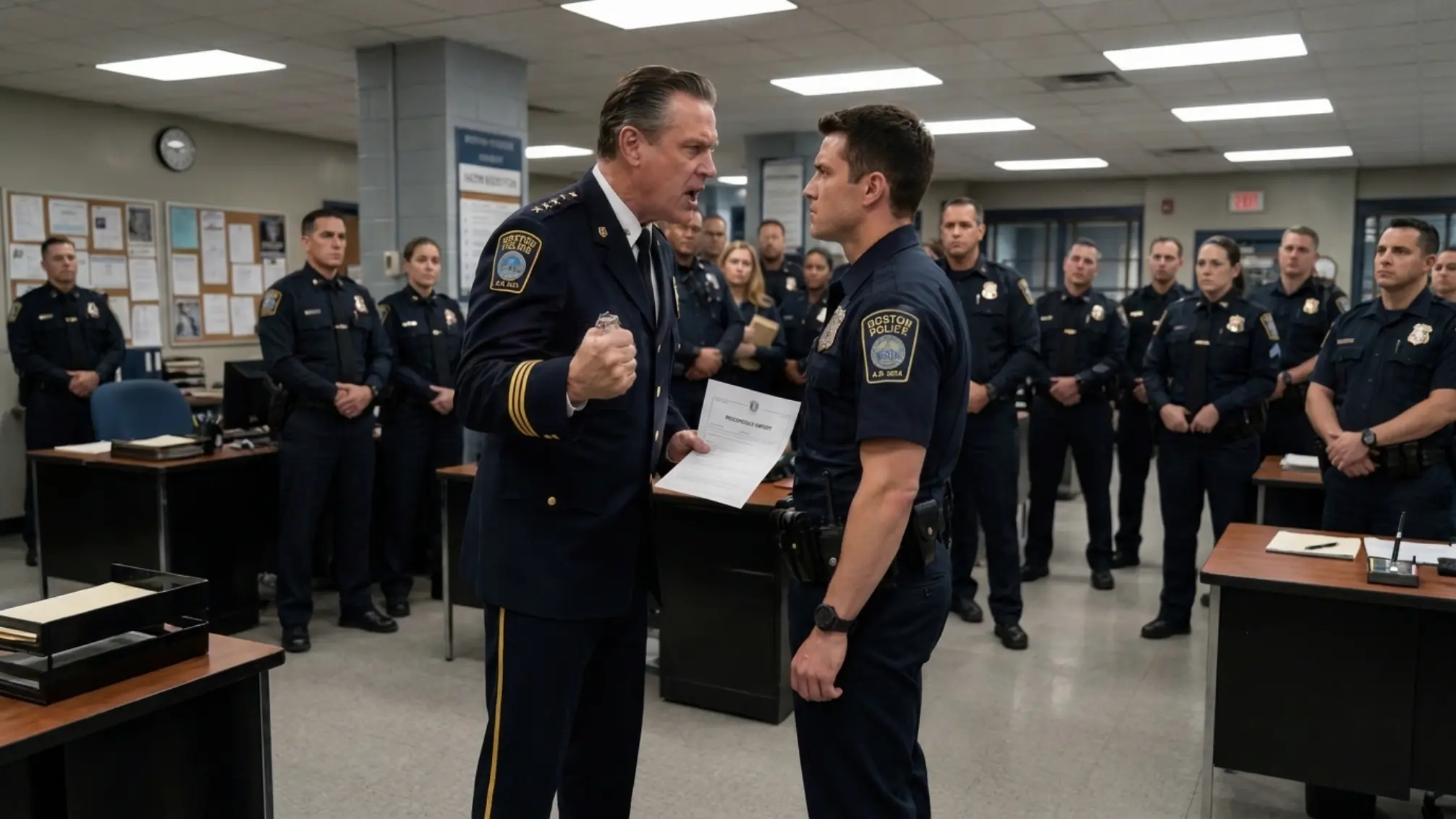
“Your family name won’t save you here.”
Sean’s jaw tightened, but his posture remained rigid. He was twenty-nine years old, athletic and clean-cut, with intense blue eyes and short dark-brown hair. Until that morning, the officers on the floor had known him as a disciplined patrolman who arrived early, volunteered for difficult assignments, and refused every shortcut offered by men who thought his father’s reputation could protect him.
Now they watched him being publicly destroyed.
Vale dropped a misconduct report beside the badge. “You abandoned your assigned position during an armed warehouse raid, disobeyed a direct order, and allowed a dangerous suspect to escape.”
“I followed an emergency call,” Sean replied.
Vale smiled without warmth. “There was no call.”
He tapped the report with one finger.
“Dispatch has no record of it. Your partner says you left without explanation. Three officers nearly died because you wanted to play hero.”
Sean looked across the room at Officer Evan Mercer, his partner during the raid. Evan stared at the floor with both hands clenched against his sides. He had been beside Sean when the secondary channel came alive with a young officer’s terrified voice, but the man now behaved as though he had heard nothing.
That was when Sean understood.
This was not confusion created by smoke, gunfire, or a damaged communication system. Someone had prepared the report before he returned from the warehouse. Dispatch records had been altered, his partner had been frightened into silence, and Vale had assembled an audience to make resistance look like desperation.
A quiet voice came from Sean’s right.
“Tell them what really happened.”
The speaker was a rookie patrol officer named Lena Ortiz. She had joined the precinct six months earlier and still believed truth could win simply by being spoken clearly enough. Sean appreciated her courage, but he knew Vale was waiting for him to explain himself publicly.
Anything he said would reveal what evidence he possessed.
“I followed the call for help,” Sean repeated.
Vale leaned closer. “And I’m telling you there was no call.”
“There was.”
“Then where is it?”
Sean did not answer.
The warehouse operation had begun shortly after nine the previous night. Intelligence indicated that an armed robbery crew was using an abandoned shipping facility near the harbor to store weapons and stolen vehicles. Vale personally supervised the operation from a mobile command post while tactical teams entered through separate loading bays.
Sean and Evan were assigned to protect the eastern corridor.
Their order was simple: hold the position, prevent suspects from escaping, and do not advance unless directed by command.
For the first twelve minutes, everything unfolded as expected. Officers cleared the front offices, tactical teams moved toward the central storage floor, and two suspects surrendered near the northern loading dock. Then gunfire erupted from the western side of the building.
The primary radio channel filled with overlapping voices.
An officer reported smoke near the maintenance corridor. Another called for medical assistance. Vale ordered every eastern unit to remain in place because one suspect was believed to be moving toward the loading bay.
Then Sean heard the second transmission.
It came through an old emergency frequency most officers no longer monitored. The voice was weak, broken by static, and nearly buried beneath the noise of the raid.
“Officer trapped… steel door… west corridor… radio damaged… I’m bleeding.”
Sean looked at Evan.
“You heard that?”
Evan nodded.
Sean immediately reported the transmission on the primary channel. No one responded. He tried again, but command traffic overwhelmed him.
The emergency voice returned.
“Smoke’s getting worse.”
Sean made a decision.
He told Evan to maintain the eastern position and moved toward the west corridor. The abandoned warehouse was dark, filled with rusting equipment, hanging wires, and smoke spreading from an electrical fire near the loading machinery. Sean followed blood droplets across the concrete until he reached a locked steel door.
Behind it, Rookie Officer Tyler Nash was trapped beneath a collapsed shelf.
Sean fired two shots into the damaged lock, forced the door open, and dragged Tyler into the corridor. The young officer had a deep wound in his thigh and was beginning to lose consciousness. Sean applied a tourniquet, carried him through the smoke, and delivered him to medics near the southern entrance.
By then, one suspect had escaped through the eastern loading bay.
Vale blamed Sean.
The preliminary review ignored the wounded rookie and focused exclusively on the abandoned position. The official report claimed Sean left because he believed he had seen movement near the western corridor. It described his actions as reckless improvisation, not a response to an emergency call.
When Sean requested the secondary-channel recording, communications supervisors told him no transmission had been logged.
That answer did not surprise him.
The black phone in Vale’s hand did.
Sean had seen the commander holding it outside the warehouse minutes before the report appeared. The device was not department-issued. Vale carried it separately from his official phone and kept it inside his coat whenever anyone approached.
Now he held the same black phone while demanding Sean’s badge.
Vale turned toward Detective Danny Reagan, who stood near the desk with his face unreadable.
“Detective Reagan, escort your son from the precinct.”
The command produced a murmur across the room.
Sean looked at his father.
Danny had spent decades walking into interrogation rooms where liars believed they were safe. His reputation reached far beyond Boston, built on relentless instincts and a refusal to abandon victims simply because a case became inconvenient. Sean had watched suspects lose confidence the moment Danny entered a room.
Now his father said nothing.
That silence hurt more than losing the badge.
“Sean,” Danny said quietly, “hand over your service weapon.”
Sean stared at him. “You believe this?”
Danny’s jaw tightened. “Your weapon.”
Vale folded his arms, satisfied.
Sean removed the sidearm carefully, cleared it, and placed it on the desk. Then he unclipped his radio and set it beside the badge. Officers watched as each piece of his authority disappeared.
Vale stepped closer. “You came to Boston believing you could build a career on your father’s name. Let this be your first lesson. In my department, Reagan means nothing.”
Sean reached for the suspension form.
The first page stated that he acknowledged leaving his assigned position without receiving an emergency transmission. The language had been written to transform a disputed event into a confession. If he signed it normally, Vale could bury the recording even if it later appeared.
Sean picked up the pen.
Vale relaxed.
Sean turned the document over and wrote one sentence across the blank back page:
Request preservation of all secondary-channel recordings from 21:40 to 22:05.
He signed beneath that sentence only.
Vale snatched the paper away. “What is this?”
“A preservation request.”
“There are no recordings.”
Sean glanced at the black phone. “Then preserving them shouldn’t worry you.”
The entire precinct became still.
Vale’s expression hardened. “Get him out.”
Danny gripped Sean’s arm and guided him toward the elevators. To everyone watching, it appeared that a father was removing his disgraced son from the building. Sean did not resist until the elevator doors closed.
Then he pulled free.
“You could have said something.”
Danny pressed the emergency stop button.
The elevator jolted between floors.
“I couldn’t,” he said. “Vale needed to believe we had nothing.”
Sean stared at him.
Danny reached inside his coat and removed a sealed evidence envelope. A red chain-of-custody label ran across the flap, marked with the time, location, and signature of an independent evidence technician.
“What’s inside?” Sean asked.
“The recording Vale says never existed.”
Sean’s anger shifted into confusion. “How?”
“Tyler’s damaged radio kept a local buffer. The main system lost the transmission, but the radio stored the final thirty-seven seconds internally.”
“Who found it?”
“The hospital technician who inspected his equipment.”
“Why didn’t Vale know?”
“Because I reached the technician first.”
Danny looked toward the camera in the corner of the elevator and lowered his voice.
“The recording doesn’t just contain Tyler’s call.”
Sean understood before his father finished.
“It contains Vale.”
Danny nodded.
The emergency stop light suddenly went dark.
The elevator began moving on its own.
“Did you release it?” Sean asked.
“No.”
Someone outside had overridden the controls.
The elevator descended one floor and stopped at the restricted evidence level. The doors opened onto a gray corridor lined with secured rooms and surveillance cameras.
Commander Vale waited beside a metal evidence table.
Two Internal Affairs officers stood with him.
The taller investigator introduced himself as Captain Helen Brooks. Beside her was Lieutenant Paul Jensen, whose hand remained close to his jacket as though he expected someone to run.
Vale’s smile returned when he saw the envelope.
“Detective Reagan, surrender that evidence.”
Danny stepped from the elevator. “You first.”
Vale lifted the black phone. “You removed department property connected to an active investigation and concealed it from command. That is obstruction.”
“The radio belongs to Officer Nash,” Danny replied. “The recovered recording was entered into an independent chain of custody before you knew it existed.”
“Give it to me.”
Captain Brooks held out her hand instead. “Place it on the table.”
Danny set down the envelope.
Vale moved toward it, but Jensen blocked him.
“No one touches the evidence except me,” Brooks said.
For the first time, Sean saw uncertainty enter Vale’s eyes.
Brooks photographed the seal, read the chain-of-custody label aloud, and opened the envelope with a clean evidence blade. Inside was a small digital storage module removed from Tyler’s damaged radio.
Jensen connected it to an isolated playback system.
A waveform appeared on the monitor.
Vale straightened. “This material may contain sensitive tactical information.”
Brooks looked at him. “That’s why Internal Affairs is here.”
She pressed play.
Static filled the room.
Then Tyler’s frightened voice emerged.
“Officer trapped… west maintenance corridor… steel door… radio damaged… I’m bleeding.”
Sean closed his eyes briefly. Hearing the call again returned him to the smoke, the blood trail, and the young officer struggling beneath collapsed metal.
A second voice followed.
It was quieter but clear.
Commander Vale.
“Do not acknowledge that transmission.”
A dispatcher answered. “Sir, the officer is requesting assistance.”
“Remove it from the active log. Eastern units hold position.”
“What about the trapped officer?”
“We cannot compromise the operation for one man.”
Sean opened his eyes.
Vale’s face had gone pale.
The recording continued.
Another voice asked whether medical rescue should be sent through the southern entrance. Vale refused. He ordered dispatch to erase the call and instructed someone to mark Tyler’s radio as nonfunctional before the operation began.
Then came the sentence that destroyed every explanation Vale might have offered.
“If Nash survives, Reagan takes the blame for leaving his post. If he doesn’t, the fire explains everything.”
The audio ended.
No one moved.
Captain Brooks replayed the final sentence.
Vale stared at the monitor as though repetition might change his voice into someone else’s.
“This recording is manipulated,” he said.
Jensen checked the file information. “The module is hardware-locked. The timestamp matches the warehouse operation, and the system signature is authentic.”
“Reagan altered it.”
“I didn’t know it existed until ten minutes ago,” Sean replied.
Vale turned toward Danny. “You are protecting your son.”
Danny’s expression finally changed.
“No,” he said. “I’m protecting the rookie you left to die.”
Brooks stepped closer to Vale. “Place the black phone on the table.”
“It is personal property.”
“You used it during an operation now under investigation.”
“You do not have authority to seize it.”
She removed a folded document from her jacket. “We obtained an emergency warrant forty minutes ago after Detective Reagan provided the radio technician’s statement.”
Vale looked toward the elevator.
Jensen moved into his path.
“Don’t.”
Vale’s hand tightened around the phone.
Sean watched him calculate. The commander had built his career on controlling the story before anyone else entered the room. He understood procedure well enough to know that surrendering the phone might expose far more than one falsified report.
Suddenly, he threw it against the concrete floor.
The screen shattered.
Jensen forced Vale against the wall and secured his wrists before he could crush the device beneath his boot. Brooks collected the broken phone with gloved hands.
“Destroying evidence in front of two Internal Affairs officers,” she said. “That was an interesting decision.”
Vale twisted toward Sean. “You disobeyed a direct order.”
“I answered a trapped officer.”
“You let a suspect escape.”
“You ordered dispatch to leave a rookie inside a burning warehouse.”
“The suspect was connected to something bigger.”
“Bigger than Tyler’s life?”
Vale stopped speaking.
Brooks ordered him placed in a secured interview room. As Jensen led him away, the commander looked at Danny.
“You let your son walk into this without warning.”
Danny held his gaze. “You needed to believe he was alone.”
Within an hour, the precinct became a crime scene.
Internal Affairs locked Vale’s office and seized department computers, dispatch records, operational logs, and every personal device connected to his command. A forensic technician recovered the black phone’s internal storage despite the shattered screen.
The messages inside revealed the real purpose of the warehouse raid.
Vale had spent eighteen months protecting a theft network operating through the harbor. Stolen weapons, vehicles, and narcotics moved through abandoned industrial buildings before being sold outside Massachusetts. In exchange for payments, Vale supplied the network with enforcement schedules and redirected patrols away from active shipments.
The warehouse raid had not been intended to dismantle the operation.
It had been designed to eliminate evidence after one member threatened to cooperate with federal investigators.
Tyler Nash accidentally discovered a locked room containing shipping ledgers and cash. When armed suspects found him there, they shot at him and collapsed a metal shelf across his legs. Before losing his primary radio, he heard Vale speaking with one of the suspects through a secondary frequency.
Vale could not allow Tyler to survive long enough to repeat what he heard.
He ordered dispatch to ignore the call.
Sean ruined that plan.
The escaped suspect had fled because Vale instructed an officer to leave an exit unguarded several minutes before Sean moved from the eastern corridor. Sean’s departure merely provided a convenient explanation.
Evan Mercer’s statement had been coerced.
Internal Affairs interviewed him before sunrise. Evan admitted that Vale summoned him privately after the raid and showed him photographs of his younger brother purchasing narcotics from an undercover officer. Vale promised to make the case disappear if Evan signed a statement claiming Sean left without explanation.
“I heard the call,” Evan confessed. “I knew why Sean moved.”
“Why didn’t you say anything when they removed his badge?” Brooks asked.
Evan covered his face. “I was afraid.”
His brother’s drug charge had never been filed. Vale had fabricated the photographs using an unrelated surveillance operation.
By morning, six other officers had provided information about suspicious orders, altered reports, and evidence removed from active cases. Vale’s control had depended on each person believing they were the only one compromised.
Once the first officer spoke, the silence collapsed.
Sean’s suspension was rescinded at eight-thirty.
The entire precinct was called onto the operations floor, the same place where Vale had humiliated him. Captain Brooks stood beside the desk holding Sean’s badge and service weapon.
Danny remained near the elevators.
Brooks addressed the room.
“The preliminary evidence establishes that Officer Reagan responded to a legitimate emergency transmission, rescued a wounded officer, and acted according to department policy permitting immediate intervention when a life is at risk.”
She looked toward Evan.
“The misconduct report contained fabricated statements and altered dispatch records. Commander Vale has been suspended and detained pending criminal charges.”
Brooks handed Sean his weapon.
Then she held out the badge.
“You can pin it on yourself.”
Sean looked at the officers who had watched it being torn away. Some appeared ashamed. Others looked relieved.
He shook his head.
“Officer Ortiz.”
Lena stepped forward.
Sean handed her the badge. “You were the only person who told me to speak.”
Her hands trembled as she pinned it back onto his uniform.
“I should have done more,” she whispered.
“You did more than most.”
Evan approached after the room began clearing.
“I’m sorry.”
Sean studied him.
“You let Vale accuse me in front of everyone.”
“I know.”
“You knew Tyler would have died if I stayed at the door.”
“I know.”
“And you still signed the report.”
Evan lowered his eyes. “He had my brother.”
“No. He had your fear.”
The words landed harder than anger would have.
Sean did not forgive him immediately. He also did not demand his dismissal. Evan would face a disciplinary review, mandatory testimony, and the knowledge that his silence nearly destroyed an innocent officer.
Some consequences required time.
Tyler regained consciousness two days later.
Sean visited him at Massachusetts General Hospital. The rookie’s left leg had required surgery, but doctors expected him to walk again after months of rehabilitation.
“I heard you came,” Tyler said.
“I almost didn’t reach you.”
“You did.”
Tyler looked toward Danny, who stood near the doorway. “Commander Vale told them to ignore me?”
Sean nodded.
The young officer swallowed. “Why?”
“Because you found something he needed hidden.”
Tyler closed his eyes.
“I thought I imagined his voice.”
“You didn’t.”
“Will I have to testify?”
“Yes.”
Tyler looked afraid.
Sean pulled a chair beside the bed. “You won’t do it alone.”
The investigation expanded for seven months. Federal prosecutors charged Vale with conspiracy, obstruction, attempted murder, evidence tampering, corruption, and participation in organized theft. Three harbor officials and nine members of the criminal network were also arrested.
Vale refused to plead guilty.
At trial, his attorneys portrayed the secondary-channel recording as incomplete and claimed operational pressure explained his language. Prosecutors played the full audio, including his order to erase Tyler’s call and blame Sean if the rookie survived.
Evan testified about the coercion.
Dispatchers described Vale standing behind them while records were deleted.
Danny presented the evidence chain and explained why he remained silent during Sean’s public suspension.
“You allowed your own son to believe you doubted him?” Vale’s attorney asked.
“For nine minutes.”
“Why?”
“Because Commander Vale had already destroyed records and threatened witnesses. If he believed Sean and I were working together, he would have destroyed the only evidence we had left.”
“And how did Officer Reagan react?”
Danny glanced toward Sean.
“Like my son.”
Vale was convicted on every major charge.
Before sentencing, he addressed Sean directly.
“You disobeyed me.”
Sean remained seated behind the prosecution table. “I saved the officer you abandoned.”
“A commander has to consider the entire operation.”
“A corrupt commander considered only himself.”
Vale received a sentence that ensured he would never lead another officer.
Months later, Sean returned to the warehouse with Tyler. The building had been cleared, but smoke damage still marked the corridor walls. Tyler walked with a cane as they approached the steel door.
“This is where you found me?” he asked.
Sean nodded.
Tyler touched the damaged lock.
“What would have happened if you followed the order?”
Sean did not answer.
They both knew.
Back at the precinct, the operations floor looked much the same. The fluorescent lights still buzzed, phones rang, reports accumulated, and officers hurried between assignments. Vale’s name had been removed from the commander’s office.
Sean’s badge carried a small scratch where it struck the desk.
The department offered to replace it.
He declined.
People often believed courage meant acting without fear. Sean had learned something different inside the warehouse and beneath the precinct lights.
Courage meant hearing the call everyone else was ordered to ignore.
It meant walking toward the locked door before knowing what waited behind it.
And sometimes it meant allowing the person you loved most to appear silent long enough for a liar to believe he had already won.