The Bouncer’s cruel smile remained on his face for another second because he assumed the Single Dad was bluffing. Behind him, the headlights of a black Mercedes SUV washed over the entrance of the exclusive executive lounge, illuminating the polished velvet posts, the waiting guests, and the Woman in Red standing near the curb. The Single Dad did not struggle against the hand gripping his jacket. He simply stared through the SUV’s windshield at the teenage passenger slumped sideways against the door.
The Club Owner had just stepped from the driver’s side when he heard the Single Dad’s warning. He turned toward the rear seat and called to the Teen Boy, but there was no response. The boy’s head rolled forward, his face pale beneath the streetlights, and one hand twitched weakly before falling still. The Club Owner tore open the rear door and shouted for someone to call an ambulance.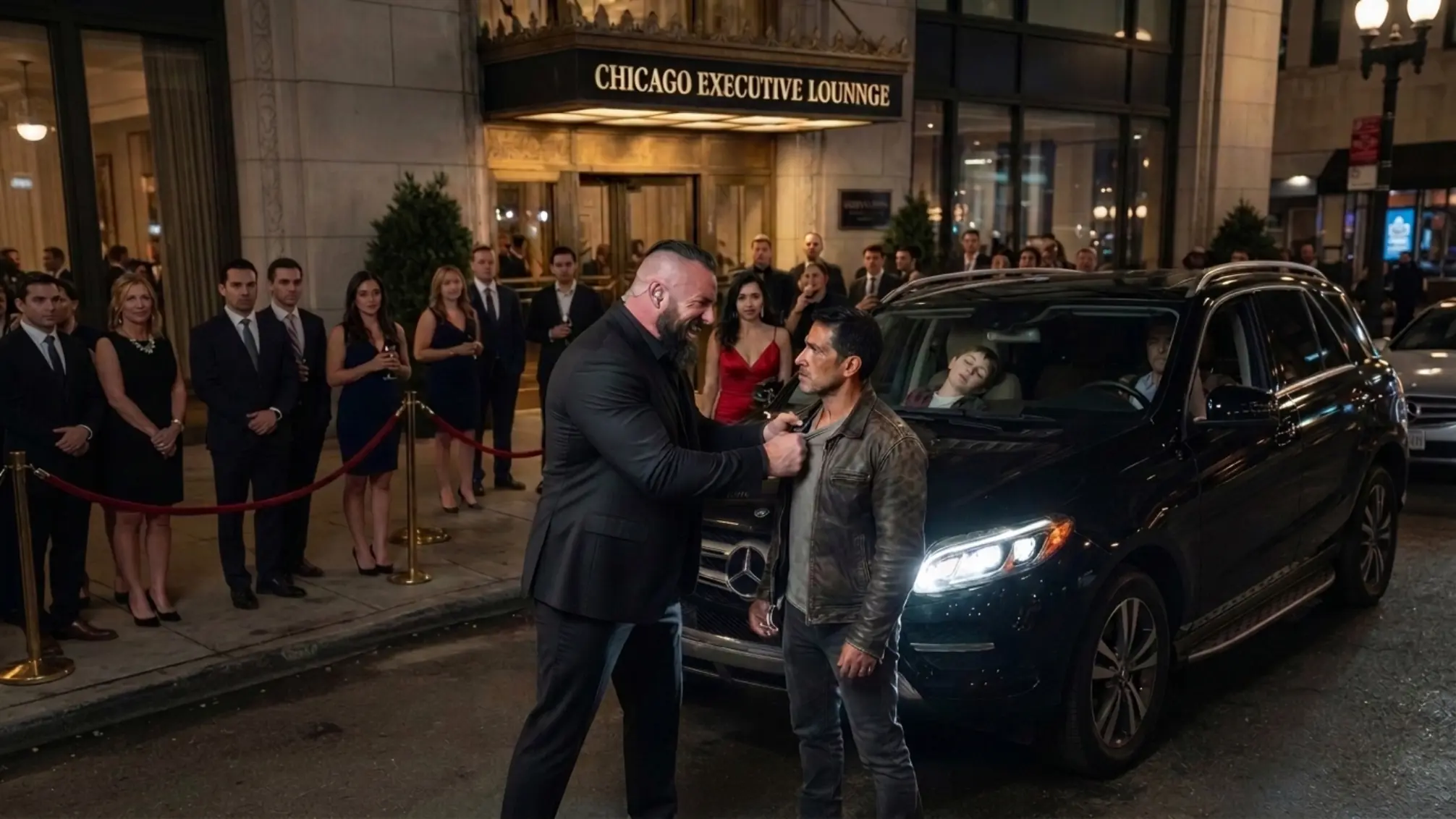
The Bouncer released the Single Dad’s collar. For the first time that evening, the massive man looked uncertain about what he was supposed to do. He had spent years controlling doors, lines, and people, but the emergency in front of him did not care about his authority. The Single Dad pushed past him and dropped beside the open SUV.
“Give me room,” the Single Dad ordered.
The Club Owner stared at the worn jacket he had watched the Bouncer mock only moments earlier. “Who are you?”
“Right now, I’m the person keeping your son alive.”
The Single Dad checked the boy’s airway, breathing, and pulse. The heartbeat beneath his fingers was dangerously fast and irregular, then suddenly weak. He loosened the seat belt, lowered the boy across the rear seat, and asked whether there had been chest pain, dizziness, medication, or previous fainting. The Club Owner could barely answer.
“He said he felt hot,” the Club Owner whispered. “He had basketball practice earlier. He was talking to me two minutes ago.”
The boy’s breathing stopped.
The Single Dad began chest compressions immediately. His hands found the correct position without hesitation, his rhythm measured and controlled. He counted silently while guests gathered near the velvet rope, their expensive drinks forgotten. Several of them recognized him as the man they had laughed at and now watched him perform the one task no one else knew how to begin.
The Bouncer finally lifted his voice. “Everyone move back! Give him space!”
The Single Dad did not look up. “Get the emergency defibrillator from inside.”
The Bouncer hesitated.
“Now.”
The command cut through him more effectively than a shout. The Bouncer ran through the glass doors, nearly knocking over one of the velvet posts he had guarded so proudly. The Woman in Red removed her heels and rushed to the curb, telling the crowd to stop recording and move away. The Club Owner knelt beside the SUV, his hands trembling so violently that he could not hold his phone.
“Please,” the Club Owner said. “Don’t let him die.”
The Single Dad continued compressions. “Talk to him. Tell him you’re here.”
The Club Owner reached for his son’s hand. His voice cracked as he repeated the boy’s role in his life rather than his name, telling him he was his only child, his reason for building everything, and the person who still owed him a fishing trip. The Single Dad listened for breathing between compression cycles. A faint gasp finally escaped the Teen Boy’s lips.
“That’s it,” the Single Dad said quietly. “Stay with us.”
The Bouncer returned carrying the automated defibrillator. He placed it on the pavement but stared at the device as if it were written in another language. The Single Dad opened it, attached the pads, and followed the analysis. The machine advised a shock.
“Everybody clear.”
The Single Dad made certain no one was touching the boy before pressing the button. The Teen Boy’s body jerked once. The machine resumed its instructions, and the Single Dad returned to compressions while sirens grew louder in the distance.
The ambulance reached the lounge less than six minutes after the emergency call. To the Club Owner, it felt like an hour. Two paramedics rushed toward the SUV carrying equipment, and the Single Dad gave them a concise report: sudden collapse after exertion, irregular rapid pulse, loss of breathing, immediate compressions, one shock delivered, weak spontaneous breathing restored. One paramedic paused when she heard the precision of his assessment.
“Medical background?” she asked.
“Emergency physician,” the Single Dad replied. “I left hospital practice several years ago.”
The paramedic nodded and began treatment without asking why a doctor was dressed like a maintenance worker outside an elite lounge. Inside the ambulance, titles and clothing meant nothing. The monitor showed an unstable rhythm, but the Teen Boy had a pulse. Oxygen was placed over his face while the paramedics prepared transport.
The Club Owner climbed into the front of the ambulance, then turned back. His eyes found the Single Dad standing in the old jacket with his hands shaking slightly now that the emergency had passed.
“You saved my son,” the Club Owner said.
“I bought him time,” the Single Dad replied. “The hospital has to do the rest.”
The ambulance pulled away, leaving flashing reflections across the glass building. Silence settled over the entrance. The guests who had laughed earlier now avoided the Single Dad’s eyes, and the velvet rope seemed suddenly ridiculous beside the empty space where a child had almost died.
The Single Dad turned toward an old sedan parked across the curb. Inside sat his nine-year-old Daughter, watching him through the windshield with frightened eyes. She opened the door before he reached her and ran into his arms.
“Is the boy alive?” she asked.
“He is.”
“You fixed him.”
“I helped until more help arrived.”
The Daughter looked past him toward the Bouncer. “Why was that man holding you?”
The Single Dad glanced at the crowd. He could have humiliated the Bouncer in return. He could have repeated every insult loudly enough for every guest to hear. Instead, he crouched beside his Daughter and told her the truth without teaching her cruelty.
“He thought he understood me because of what I was wearing,” he said. “He was wrong.”
The Daughter touched the cracked sleeve of his jacket. It had belonged to her mother, in a way. She had bought it for the Single Dad years earlier when they were both young doctors struggling through night shifts and student debt. After she died, he could never bring himself to replace it.
The Bouncer approached slowly. His shoulders no longer looked powerful. They looked heavy.
“You said you left something inside,” the Bouncer said.
“My Daughter’s medicine pouch.”
The Single Dad explained that he had repaired a damaged emergency light near the private lounge earlier that evening. He had brought his Daughter because her babysitter canceled, and he had allowed her to sit in the service office while he worked. During the repair, the small pouch containing her inhaler and her mother’s silver locket had fallen from his tool bag.
When he returned to retrieve it, the Bouncer refused to believe he had worked inside. The worn jacket and old sedan had told a story the Bouncer preferred over the truth. He had mocked the Single Dad loudly enough to entertain the waiting guests, then grabbed him when he tried to move closer to the entrance.
The Bouncer lowered his eyes. “I’ll find it.”
“You should have found it when I asked.”
There was no anger in the Single Dad’s voice, and that made the words harder to escape. The Bouncer entered the lounge. Guests parted without speaking as he searched near the service hallway.
The Woman in Red remained near the Single Dad and his Daughter. She introduced herself only by her role as the Club Owner’s foundation director. She had witnessed the entire confrontation and had also seen the Single Dad transform from a humiliated worker into the calmest person on the street.
“You really were an emergency physician?” she asked.
“I still renew my license,” the Single Dad answered. “I just don’t work full-time in a hospital anymore.”
“Why not?”
The Daughter leaned against her father’s side. The Single Dad hesitated before explaining that his wife had died in a highway accident six years earlier. He had been working an overnight shift when the police called. By the time he reached the trauma center, another medical team had done everything possible, but nothing could save her.
Afterward, hospital corridors became unbearable. Every emergency reminded him of the one person he could not bring home. More importantly, his Daughter needed a parent who was present, so he left the demanding position and began repairing electrical systems for businesses around the city. The work paid less, but it allowed him to collect his Daughter from school and be home when nightmares woke her.
The Woman in Red looked toward the road where the ambulance had disappeared. “You walked away from medicine, but medicine didn’t walk away from you.”
The Single Dad gave a tired smile. “Skills stay. Careers change.”
The Bouncer returned carrying a small canvas pouch. The Daughter immediately recognized it and hugged it to her chest. She checked the inhaler first, then opened the inner pocket and touched the silver locket.
The Bouncer watched her reaction. The object he had treated as an excuse was clearly more important than anything inside the lounge.
“I’m sorry,” he said.
The Single Dad looked directly at him. “Are you sorry because you were wrong about me, or because powerful people watched you being wrong?”
The question left the Bouncer speechless.
The Single Dad opened the car door for his Daughter. “Figure that out before you judge the next person.”
They had driven less than three blocks when the Single Dad’s phone rang. The Woman in Red was calling from the hospital on behalf of the Club Owner. The doctors needed a clearer account of the Teen Boy’s symptoms and response before the ambulance arrived.
The Single Dad glanced at his Daughter. She was exhausted, but she nodded.
“We should go,” she said. “His father looked scared.”
At the hospital, the Club Owner met them beside the emergency department. Without the SUV, tailored coat, and private lounge behind him, he looked like any terrified parent waiting for news. He thanked the Single Dad again, but the doctor leading the case quickly interrupted and asked for the exact sequence of events.
The Single Dad described the boy’s rapid pulse, overheating, sudden respiratory failure, and response to the defibrillator. He suggested testing for an inherited structural heart condition, particularly after the Club Owner admitted that his younger brother had died suddenly at twenty-three. The death had been dismissed as an unexplained accident.
Tests revealed thickening in the wall of the Teen Boy’s heart. The condition could cause dangerous rhythm disturbances during physical activity. It had gone unnoticed during routine medical examinations, but the collapse outside the lounge had exposed it before a future episode occurred somewhere without immediate help.
The hospital doctor told the Club Owner that the Single Dad’s rapid intervention had protected the boy’s brain and other organs from prolonged oxygen loss. Had compressions begun several minutes later, the outcome might have been devastating. The Club Owner sat beside his son’s bed and wept.
When the Teen Boy regained consciousness, he asked who had helped him. The Club Owner pointed toward the Single Dad standing near the doorway with his Daughter.
“That man,” he said. “The one my own staff tried to throw into the street.”
The Teen Boy studied the cracked leather jacket. “Why did you help me after they treated you like that?”
The Single Dad pulled a chair closer. “Because you weren’t the one who insulted me.”
“What if I had been?”
“I still would have helped you.”
The Teen Boy frowned as if the answer were difficult to understand.
“Saving someone isn’t a reward for good behavior,” the Single Dad explained. “It’s what you do when a life is in front of you.”
The Club Owner heard every word. He had built his business around exclusivity, status, and the promise that certain people would never have to share a room with anyone they considered beneath them. For years, he called it luxury. That night, it began to look like organized arrogance.
Before the Single Dad left, the Club Owner asked him to return to the lounge the following evening. The Single Dad immediately refused any private reward, cash payment, or public spectacle.
“I don’t need applause,” he said.
“This isn’t about rewarding you,” the Club Owner replied. “It’s about correcting what happened in front of the people who participated.”
The Single Dad considered the waiting guests who had laughed while his Daughter watched from the car. Humiliation experienced publicly could not always be repaired privately. He agreed to return, but only if his Daughter could stand beside him.
The next evening, the Single Dad wore the old leather jacket again. He could have chosen a suit, but he did not want anyone believing dignity had appeared only after better clothing. His Daughter held his hand as they approached the entrance.
The crowd recognized them immediately. Conversations weakened into whispers. The Bouncer stood beside the velvet rope, but there was no grin on his face.
He unclipped the rope before the Single Dad reached it.
“Good evening,” the Bouncer said.
The Single Dad stopped. “Are we allowed in because of what I did, or because you finally understand clothes don’t tell you who deserves respect?”
The Bouncer accepted the question without defending himself. “Both, honestly. But I’m working on the second one.”
The Single Dad nodded once and entered with his Daughter.
Inside, the Club Owner stood before employees, executives, and guests who had been present during the confrontation. The Woman in Red waited beside him with the hospital doctor who had treated the Teen Boy. There was no music and no attempt to make the gathering feel like entertainment.
The Club Owner described the medical emergency without exaggeration. He explained that his son survived because the person mocked outside the building possessed the skill, discipline, and humanity that everyone else lacked when the crisis began. Then he addressed what had happened before the collapse.
“This man was judged by his jacket, his car, and the work he performed for us,” the Club Owner said. “My establishment created an environment where cruelty was mistaken for standards. That failure belongs to my leadership.”
The room remained silent.
The Bouncer stepped forward without being forced. “I insulted the Single Dad in front of his Daughter. I refused to listen when he explained why he needed to enter. Then I grabbed him because I believed my position made my judgment unquestionable.”
He turned toward the Single Dad. “I was wrong. I’m sorry.”
The Single Dad did not smile triumphantly. “An apology matters only if the next person receives better treatment.”
“They will,” the Bouncer said.
The Club Owner announced that the lounge would end appearance-based screening immediately. Entry would be confirmed through reservations, identification, and conduct rather than clothing, perceived wealth, or a staff member’s personal judgment. Employees would receive new training, and complaints would be reviewed by an independent service team instead of disappearing into management files.
Then the Club Owner reached for the velvet rope.
“This was supposed to organize a doorway,” he said. “We allowed it to become a measurement of human worth.”
He unclipped it and handed it to the Bouncer. The Bouncer carried it away without protest.
The Daughter looked up at her father. “Does that mean anyone can come in now?”
“It means the door has rules,” the Single Dad answered, “but the rules aren’t allowed to decide who matters.”
The Club Owner offered the Single Dad a paid advisory position with his charitable foundation. Instead of accepting immediately, the Single Dad asked what the foundation actually accomplished. The Club Owner admitted that most of its events had focused more on donor visibility than community needs.
“Then change that first,” the Single Dad said.
He proposed cardiac screenings for students in public schools, especially teenagers participating in sports. The condition found in the Teen Boy could run in families and often remained hidden until a collapse. Families without strong insurance rarely received specialized testing unless symptoms had already become dangerous.
The Club Owner approved the program that evening.
Within a month, the first screening event opened inside a public-school gymnasium. Doctors, nurses, and technicians volunteered while the foundation paid for equipment and follow-up appointments. The Bouncer stood near the entrance, not deciding who belonged, but guiding parents toward registration tables.
The Single Dad did not return to full-time hospital work. He continued caring for his Daughter and repairing electrical systems, but he volunteered at each screening event. His emergency license, once maintained only because he could not bear to surrender it, became useful again without taking him away from the child who needed him most.
During the third event, doctors identified two teenagers requiring further heart testing. Neither had experienced a collapse. Both received treatment before an emergency could happen.
The Club Owner stood beside the Single Dad and watched the families leave with information that might save their children.
“You changed my entire organization,” the Club Owner said.
The Single Dad shook his head. “Your son’s emergency showed you what was broken. You decided whether to repair it.”
His Daughter ran toward him carrying a heart-shaped sticker from the nurses. The old medicine pouch rested safely inside her backpack, along with the silver locket that had brought them to the lounge that first night.
She touched her father’s worn sleeve. “Are you ever going to buy a new jacket?”
The Single Dad looked down at the cracked leather, then toward the open gymnasium doors where no rope separated one family from another.
“Maybe someday,” he said.
“But not because anyone told you this one was ugly?”
He smiled. “Definitely not for that reason.”
They walked toward the parking lot together while the Bouncer held the door for an Old Woman using a cane. He did not inspect her clothes, her bag, or the age of the car waiting for her. He simply treated her like someone whose dignity existed before he noticed it.
The story people remembered was not that a black SUV arrived at the perfect moment or that an important man’s son collapsed in front of an exclusive club. They remembered the Single Dad who had every reason to walk away but stepped forward instead.
His jacket had never revealed his worth.
The emergency had only revealed everyone else’s judgment.