Mason “Gravel” Mercer had spent thirty years perfecting the art of looking like a man nobody should approach. At fifty-two, he stood six feet five with a shaved head, tattooed arms, a long gray goatee, and shoulders broad enough to make his sleeveless black leather vest look small. That morning outside St. Vincent Medical Center in Dayton, Ohio, his polished black Harley was already running when ten-year-old Eli Parker wrapped one hand around the chrome handlebar. Mason looked down at him and said, “Kid, move your hand. I need to leave before anyone asks questions.”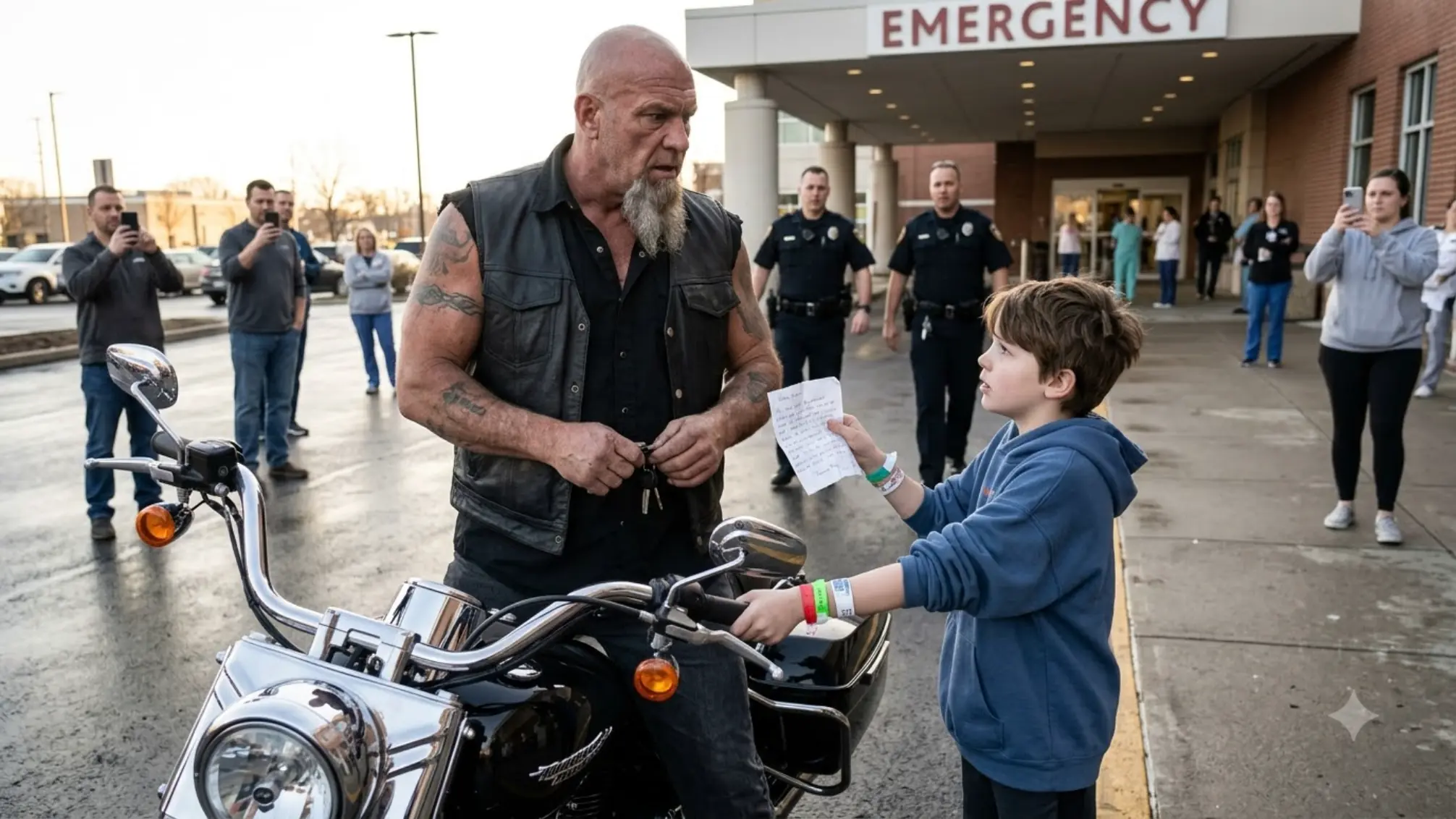
Eli did not move. He was thin, pale from too many nights sleeping badly in hospital waiting rooms, and still wore several colorful visitor wristbands around his right wrist beneath an oversized blue hoodie. In his other hand he held a folded piece of paper covered in his mother’s handwriting. “Then tell me why your name is on the payment that saved my mom.”
Mason’s face changed. The hard expression that had frightened strangers for years vanished so quickly that Eli knew he had found the right man. Mason glanced toward the hospital entrance, then toward two security officers crossing the sidewalk. “Put that paper away. You don’t understand what you found.”
“Then don’t run,” Eli said, stepping directly in front of the motorcycle. “The officers are coming, and I’m telling them everything.” Several people near the entrance raised phones because, from a distance, the scene looked completely different: a gigantic biker towering over a frightened child beside a motorcycle. Mason could already see exactly what story strangers had decided to believe.
Security Officer Paul Benton arrived first. “Sir, step away from the boy.” Mason immediately raised both hands and stepped backward. Eli spun toward Benton and shouted, “No! Don’t make him leave.”
Everyone stopped. Benton looked from the boy to Mason, suddenly uncertain. Eli grabbed Mason’s vest with both hands. “Please. Just one more minute.”
A second security officer approached while hospital visitors continued recording. Mason looked down at Eli’s fingers clutching the leather. “You need to go back inside.” Eli shook his head violently. “Not until you tell me why.”
Mason exhaled slowly. “Because some questions don’t help anybody.” Eli unfolded the paper. “My mom wrote your name.”
The note had been hidden inside a paperback book beside his mother’s hospital bed. Eli found it while searching for her phone charger after doctors moved her into surgery shortly before dawn. Most of the page contained practical instructions: where insurance documents were stored, the password to her laptop, which neighbor could take care of their dog if she stayed hospitalized longer than expected. But near the bottom was a single sentence Eli had read over and over until the words stopped making sense.
If anything happens to me, find Mason Mercer and tell him I finally know who paid the balance.
Beneath the sentence was a phone number. Eli had searched the number on his mother’s phone and discovered several missed calls from someone saved only as M. Mercer. Then he remembered the enormous biker he had seen twice near the hospital café and once sitting alone in the parking lot, always leaving whenever Eli’s mother appeared.
Eli had waited beside the main entrance until he saw Mason walking toward the Harley. He ran after him before the motorcycle could leave. Now Mason stood surrounded by security officers and staring at the note like it contained a confession.
“What balance?” Benton asked. Mason’s expression closed immediately. “Private matter.”
Eli turned toward the officer. “My mom needed surgery today. Insurance wouldn’t cover everything.” He pointed toward Mason. “Someone paid the hospital last night.”
Mason said nothing. Eli looked up at him. “It was you.”
The biker slowly removed his sunglasses. His eyes were unexpectedly tired. “Your mother is in surgery. That’s what matters.”
“Why did you pay?”
Mason looked toward the hospital windows. “Because somebody needed to.”
“That isn’t an answer.”
“You sound like your mother.”
Eli froze.
“You know her.”
Mason immediately regretted the words.
Benton lowered his hands, realizing there was no apparent threat. He told the second officer to give them room while remaining nearby. Mason sat on a concrete bench beside the Harley and stared at the folded note in Eli’s hand.
“What did she tell you about your father?” Mason asked.
Eli’s expression hardened. “That he died before I was born.”
Mason nodded slowly.
“What else?”
“That he was a good man.”
“Anything about how?”
Eli hesitated. “Car accident.”
Mason rubbed both hands across his face. For decades, those hands had repaired motorcycles, hauled engines, built frames, and once broken another man’s jaw outside a bar in Cincinnati. Now they trembled.
“Your mother shouldn’t have written my name down.”
“Why?”
“Because she knew I’d try to disappear.”
Eli sat beside him.
“Why are you trying to disappear?”
Mason looked at the boy for a long moment. He had promised himself he would never have this conversation. He had promised someone else too.
Twenty-four years earlier, Mason Mercer and Daniel Parker had been inseparable. They met while working nights at an auto plant outside Dayton, two young men who spent paychecks too quickly, rode motorcycles too fast, and believed consequences were things that happened to older people. Daniel was quieter, smarter, and far better with numbers, while Mason could rebuild almost any engine from memory.
They eventually opened a small custom motorcycle shop together. Daniel handled books and customers while Mason handled repairs. Business grew quickly enough that, for several years, they believed they had escaped the factory forever.
Then Daniel met Sarah Bennett.
Sarah was studying nursing and worked evenings at a diner near their shop. Daniel fell in love almost immediately. Mason teased him mercilessly until Sarah started appearing at the garage with coffee for both men, after which Mason stopped pretending he disliked her.
Daniel married Sarah three years later. Mason served as best man. When Sarah became pregnant, Daniel spent weeks talking about cribs, schools, and whether his child would inherit his terrible eyesight.
Then everything collapsed.
One rainy night, Daniel and Mason were returning from a motorcycle auction in Columbus. Daniel was driving the truck because Mason had been drinking at dinner. A tire blew on Interstate 70, sending the vehicle across two lanes and into a concrete barrier.
Mason survived.
Daniel did not.
The police report called it a mechanical failure. Mason knew the tire had been worn badly enough that it should have been replaced before the trip. Daniel had suggested changing it that week.
Mason had said it could wait.
That sentence followed him for twenty-four years.
Sarah was seven months pregnant when Daniel died. Mason tried visiting after the funeral, but grief poisoned every conversation. Sarah never blamed him directly, which somehow made it worse.
One evening she finally said, “Every time I see you, I see the truck.”
Mason understood.
He stopped coming.
Eli listened without interrupting. He had never heard any of this. His mother had always described his father as someone kind who died in an accident, but she never mentioned motorcycles, a garage, or a friend named Mason.
“Why didn’t Mom tell me?”
“Because she wanted your father remembered without turning his death into a courtroom.”
“What does that mean?”
Mason looked toward the pavement.
“Daniel’s parents wanted to sue me.”
Eli stared.
“They believed I should’ve replaced the tire. They weren’t wrong.”
“Did Mom sue?”
“No.”
“Why?”
“She said losing Daniel was enough.”
Mason swallowed.
“That made me feel worse.”
Eli’s voice became quiet. “So you disappeared.”
“For a while.”
Mason sold his half of the motorcycle business and left Ohio. He spent years drifting between construction jobs, repair shops, and long motorcycle trips that never really took him anywhere. Eventually he joined a loose brotherhood of riders who volunteered for charity runs, escorted funeral processions, repaired homes for injured workers, and raised money for families who could not cover medical expenses.
People saw the tattoos and leather.
They rarely saw where the money went.
Fifteen years earlier, Mason returned to Dayton after his mother became ill. He rebuilt his life slowly, opening another motorcycle repair shop and buying a modest house outside the city. He occasionally searched Sarah’s name online but never contacted her.
Then six months ago he saw her by accident.
She was leaving St. Vincent Medical Center.
Mason recognized her immediately despite the years.
Sarah did not recognize him.
She looked exhausted, thinner than he remembered, with a scarf covering hair lost during chemotherapy.
Mason followed at a distance only long enough to learn she was undergoing treatment for an aggressive heart complication caused partly by earlier cancer therapy. He hated himself for following her, but once he knew, he could not ignore it.
Through a hospital charitable foundation, he began making anonymous payments.
Five hundred dollars.
Then two thousand.
Then another four.
When Sarah’s condition deteriorated and doctors recommended a procedure not fully covered by insurance, the remaining balance reached nearly $48,000.
Mason sold a restored 1948 Indian Chief he had spent nine years rebuilding.
Collectors had offered money for it before.
This time he accepted.
The sale covered most of Sarah’s remaining medical balance.
The rest came from his savings.
Eli stared at him.
“You sold your motorcycle?”
“Not this one.”
“The special one?”
Mason looked surprised. “How do you know it was special?”
“You look like somebody who thinks motorcycles are people.”
Benton laughed softly several feet away.
Mason almost smiled.
“Yeah. It was special.”
“Why didn’t you tell Mom?”
“Because she would’ve refused.”
“Why?”
“She doesn’t owe me forgiveness.”
Eli folded the note carefully.
“Maybe it wasn’t forgiveness.”
Mason looked at him.
“Maybe she just wanted to know.”
The hospital doors opened.
A nurse in blue scrubs walked toward them. “Eli Parker?”
Eli shot upright.
Mason stood too.
The nurse smiled.
“Your mother is out of surgery.”
Eli’s entire face changed.
“Is she okay?”
“The procedure went well. She’s stable and being moved to recovery.”
Eli closed his eyes.
For several seconds, he looked like a child again instead of someone carrying secrets far too large for ten years old.
Then he grabbed Mason around the waist.
Mason froze.
His arms remained at his sides.
Eli hugged tighter.
“Thank you.”
Mason looked helplessly toward Benton.
The security officer simply nodded.
Slowly, Mason put one hand on the boy’s shoulder.
“You don’t owe me thanks.”
“Yes, I do.”
“No.”
“You paid for Mom.”
“I paid a bill.”
“You saved her.”
“Doctors saved her.”
“You helped.”
Mason could not argue with that.
The nurse looked toward him. “Are you family?”
Mason immediately answered, “No.”
Eli said, “Yes.”
Both men looked at him.
“He’s coming upstairs.”
Mason stepped backward.
“No, kid.”
“Yes.”
“Your mother doesn’t want to wake up and see me.”
“You don’t know that.”
“I know Sarah.”
“No.”
Eli held up the note.
“You knew her twenty-four years ago.”
The sentence hit harder than the boy intended.
Mason stared toward the hospital doors.
“I shouldn’t.”
Eli’s expression hardened with the same stubbornness Daniel had possessed whenever he believed he was right.
“You told me my dad was your best friend.”
“He was.”
“Then stop running.”
Mason looked away.
“Eli.”
“You’ve been running longer than I’ve been alive.”
Benton turned his head to hide a smile.
Mason sighed.
“You really are her kid.”
He followed Eli inside.
Sarah remained asleep when they entered recovery. Machines hummed softly around the bed while afternoon light reached through partially closed blinds. Her face looked pale but peaceful.
Mason stopped in the doorway.
Twenty-four years disappeared.
For one terrible moment, he saw Sarah standing beside Daniel’s coffin again, pregnant and silent.
“I can’t do this.”
Eli grabbed his hand.
“You already did.”
Mason stayed.
Sarah woke forty minutes later.
Her eyes moved first toward Eli.
Then toward Mason.
Every monitor in the room suddenly sounded louder.
She stared.
“Mason?”
He swallowed.
“Hey, Sarah.”
Her expression shifted through confusion, anger, disbelief, and something he could not identify.
Eli leaned close.
“Mom, I found the note.”
Sarah closed her eyes.
“Oh, Eli.”
“And I found him.”
“I can see that.”
Mason stepped toward the door.
“I’ll leave.”
“No.”
Sarah’s voice was weak but unmistakable.
He stopped.
She looked at him.
“Sit.”
He obeyed.
For several seconds nobody spoke.
Then Sarah asked, “You paid it?”
Mason looked toward the floor.
“Most of it.”
“Why?”
He gave the same answer he had given Eli.
“Because it needed paying.”
Sarah almost smiled.
“That excuse worked better when we were twenty-five.”
Mason looked up.
“I didn't expect you to find out.”
“I spent three months trying.”
“You shouldn’t have.”
“Why?”
“Because the point was helping.”
“No.”
Sarah shook her head slowly.
“The point for you was punishment.”
Mason stared at her.
Eli looked between them.
Sarah continued.
“You’ve been punishing yourself for Daniel longer than Daniel was alive.”
Mason’s eyes became wet.
“I told him to wait on the tire.”
“Yes.”
“It killed him.”
“The tire failed.”
“Because I told him it could wait.”
“And Daniel chose to drive.”
Mason shook his head.
“Don’t.”
“I spent years doing exactly what you’re doing.”
Sarah’s voice weakened but remained firm.
“I blamed you. Then I blamed Daniel. Then I blamed myself because I asked him to be home early.”
Mason looked at her.
“There was always another person to blame.”
She paused.
“But none of it brought him back.”
Mason rubbed his eyes roughly.
“I should’ve been the one driving.”
“You were drinking.”
“Exactly.”
“So Daniel drove.”
Silence.
Sarah looked toward Eli.
“I never told him because I didn’t want his father’s story to become a lesson about one bad tire.”
Eli sat beside her bed.
“Was Dad like Mason?”
Sarah laughed softly.
“No.”
Mason smiled.
“Absolutely not.”
“Daniel was patient,” Sarah said.
Mason nodded.
“Very annoying.”
“He liked terrible music.”
“True.”
“He cried when the Browns lost.”
“Every time.”
Eli smiled.
For the first time, his father sounded like a person rather than a photograph.
Sarah looked toward Mason.
“You should’ve told him these things years ago.”
“I thought you didn’t want me around.”
“I didn’t.”
Mason nodded.
“At first.”
He looked up.
Sarah continued.
“Then enough years passed that neither of us knew how to undo it.”
Mason looked toward Eli.
“The kid solved that.”
“He usually does.”
The hospital door opened.
Two officers entered.
Mason stiffened immediately.
Officer Benton appeared behind them.
“It’s okay,” he said.
One of the officers smiled.
“We got a strange call about a biker holding a kid near the hospital.”
Eli groaned.
“I told everyone he wasn’t hurting me.”
The officer looked toward Mason.
“Multiple witnesses now say the boy was actually stopping you from leaving.”
“Unfortunately.”
Eli folded his arms.
“He runs away a lot.”
Sarah laughed despite the pain.
Mason pointed at the boy.
“See what I’m dealing with?”
The officer nodded toward Sarah.
“Glad everything turned out okay.”
Then his tone became slightly more serious.
“There is something we need to clarify.”
Mason’s expression changed.
“What?”
“The hospital reported possible financial fraud connected with the payment.”
Sarah looked alarmed.
Mason immediately stood.
“There’s no fraud.”
The officer raised a hand.
“Probably not. But the payment came through a charitable trust using an inactive business account associated with Mercer Custom Cycles.”
Mason stared.
“That account was closed years ago.”
“That’s why finance flagged it.”
Eli looked toward Mason.
“Did you steal money?”
“No.”
Sarah said, “Eli.”
The officer explained that a $48,000 transfer had been routed through a dormant account before reaching the hospital foundation. The payment itself was legitimate, but the bank had requested verification because somebody attempted to redirect part of it two days earlier.
Mason’s face hardened.
“Redirect?”
“Yes.”
“To where?”
“A different medical account.”
“Whose?”
The officer hesitated.
“That’s what investigators are trying to determine.”
Mason reached for his phone.
“I know who.”
Everyone looked at him.
Years earlier, Mercer Custom Cycles had belonged equally to Mason and Daniel. After Daniel’s death, the company was dissolved, but one dormant account remained open while insurance and estate matters were settled. Mason believed it had eventually been closed.
Only three people had known about it.
Mason.
Daniel.
And Daniel’s older brother Ray Parker.
Sarah’s expression changed immediately.
“Ray?”
Mason nodded.
“Did he contact you recently?”
Sarah looked uncomfortable.
“He came to the hospital last month.”
“Why?”
“He said Daniel’s estate might still contain money I was entitled to.”
Mason’s jaw tightened.
“There wasn’t any money left.”
“I told him that.”
“What did he ask for?”
“Old documents.”
Mason closed his eyes.
Ray had always blamed him for Daniel’s death more openly than anyone else. He also handled part of the estate after the accident.
If Ray still possessed old banking credentials, he might have seen the account reactivate when Mason transferred money through it.
The investigation moved quickly after that.
Mason willingly provided transaction records showing the sale of his motorcycle and the legitimate origin of every dollar used for Sarah’s medical expenses. Bank investigators discovered someone had attempted to redirect $12,000 from the payment before it reached the hospital.
The request originated through old account credentials.
Those credentials were tied to Ray Parker.
Police interviewed him.
At first, Ray denied everything.
Then records emerged.
Ray had suffered significant gambling losses and believed money passing through the old business account belonged partly to Daniel’s estate.
He convinced himself Sarah owed him.
So he tried taking it.
The attempt failed before any money disappeared.
But the investigation revealed something else.
Ray had known Mason was paying Sarah’s expenses.
He had discovered the payments months earlier.
Instead of telling Sarah, he watched them accumulate while searching for a way to access the funds.
When Sarah eventually found Mason’s name through a billing representative, she wrote the note Eli discovered.
That explained why Mason had become so desperate to leave.
He thought Sarah had finally uncovered the secret.
He never imagined somebody else was trying to steal from it.
Ray was eventually charged over the attempted transfer.
Sarah refused to let the case become another family war.
“He answers for what he did,” she told investigators. “Nothing more.”
Mason admired that.
He had spent years confusing guilt with responsibility.
Sarah seemed determined not to repeat the mistake.
Weeks passed.
Sarah recovered slowly.
Mason visited twice.
Then four times.
Eventually he stopped asking whether he was allowed to come.
Eli started spending Saturday mornings at Mercer Motor Works.
The first time he arrived, Mason handed him safety glasses.
“You touch nothing without asking.”
Eli nodded.
“And motorcycles are not toys.”
“I know.”
“And if you scratch that Harley—”
“I know.”
Mason narrowed his eyes.
“You don’t know.”
Within months, Eli could identify basic tools, clean parts correctly, and explain enough about motorcycle engines to annoy adults.
Sarah watched the friendship with complicated emotions.
One afternoon she found Mason teaching Eli how to adjust a chain.
For half a second, the sight hurt.
Daniel should have been doing that.
Then she realized something.
Daniel being gone did not require everyone who loved him to disappear too.
Mason noticed her watching.
“You okay?”
Sarah nodded.
“Yeah.”
Eli looked up.
“Mom, Gravel says Dad was terrible at carburetors.”
Sarah smiled.
“Your father was terrible at everything mechanical.”
Mason looked offended.
“He owned half a motorcycle shop.”
“And you fixed everything.”
“True.”
Eli laughed.
Sarah stepped closer.
“Tell him about the wedding.”
Mason groaned.
“No.”
“What wedding?”
“Nothing.”
Sarah smiled.
“Your father forgot the rings.”
“He didn’t forget them.”
“He left them in Mason’s motorcycle saddlebag.”
Eli stared.
Mason sighed.
“We were twenty-eight.”
“You were idiots.”
“Yes.”
The stories continued.
Small ones.
Good ones.
The kind grief had buried.
Mason slowly stopped being the man connected only to Daniel’s death.
He became the person who remembered Daniel alive.
A year after Sarah’s surgery, they returned to St. Vincent for a follow-up appointment.
Her scans looked good.
The doctor said recovery remained stable.
Outside, Mason waited beside his Harley.
Eli ran toward him.
“You’re coming to dinner.”
Mason shook his head.
“I have work.”
“No, you don’t.”
“How would you know?”
“I called your shop.”
Mason stared.
“You called my employees?”
“Yes.”
“You’re terrifying.”
Sarah walked behind him smiling.
“He gets that from me.”
Mason looked toward her.
“You planned this.”
“Maybe.”
Eli grabbed the motorcycle keys from Mason’s hand.
“Dinner first.”
“Give those back.”
“No.”
“Kid.”
Sarah folded her arms.
Mason looked between them.
“You two are criminals.”
Eli smiled.
“Call the police.”
All three laughed.
A security officer standing near the entrance recognized them.
It was Benton.
He shook his head.
“Not again.”
Mason called back, “He’s stealing my motorcycle!”
Eli held up the keys.
“You gave them to me.”
“I absolutely did not.”
Benton smiled.
“I’m staying out of this one.”
Mason eventually retrieved the keys.
Then he looked toward the hospital doors.
A year earlier he had stood in that exact place planning to disappear before Sarah discovered what he had done.
Instead, a frightened ten-year-old boy had grabbed his Harley and refused to let him leave.
The strangers watching that morning thought Mason was trapping Eli.
They had it backward.
Eli had trapped Mason.
Not beside the motorcycle.
Inside the truth he had spent twenty-four years running from.
Mason had believed paying Sarah’s medical bills anonymously was the only kind thing he had left to give.
Money required no conversation.
No forgiveness.
No risk.
He could sell something valuable, transfer the money, and disappear.
But Eli had demanded something harder.
Stay.
One minute became an hour.
An hour became a hospital visit.
A hospital visit became Saturday mornings at the shop, dinners with Sarah, stories about Daniel, and eventually a place inside a family Mason once believed he had lost forever.
He never stopped carrying guilt completely.
Sarah never asked him to.
She only taught him that guilt did not have to become a life sentence.
Years later, the old Harley still sat inside Mason’s shop.
Eli was sixteen by then and tall enough to look Mason nearly in the eye.
One afternoon he pointed toward it.
“When do I get to ride?”
Mason laughed.
“When I’m dead.”
“That could be soon.”
Mason stared at him.
“You've been spending too much time with your mother.”
Eli smiled.
On the wall behind them hung a framed photograph.
Daniel Parker stood between Mason and Sarah outside the original Mercer Custom Cycles shop, all three young, laughing, and completely unaware of what life would eventually ask from them.
Beside the photograph was the folded note Eli had carried outside the hospital.
Mason had wanted to throw it away.
Sarah insisted he keep it.
Not because of the money.
Because of the final sentence.
Find Mason Mercer.
Eli had.
And when Mason tried to leave, the boy simply refused to let him disappear again.