On a cold, quiet night on a deserted hill, a poor college student was rushing home to care for his paralyzed mother after a long delivery shift.
Suddenly, he saw an elderly woman struggling with her broken wheelchair in the middle of the road.
Without hesitation, he stopped and knelt down to help.
Just a few minutes later, the wheelchair was working again, to the woman’s relief and joy.
Not stopping there, he pushed her all the way home.
What he didn’t know was that this small act of kindness that night would open a door that would change his life forever.
The streetlights on Hillcrest Avenue flickered yellow against the darkness, casting long shadows that stretched and disappeared into nothing.
Darius pushed harder on the pedals, his thighs burning with each rotation.
The delivery bag on his back felt heavier than usual tonight.
Or maybe he was just more tired than usual.
Just get home.
Just get home.
His breath came out in white puffs, visible in the cold November air.
The wind cut through his worn jacket, the one with the tear near the left pocket that he kept meaning to sew but never did.
His hands, stained with bike grease and smelling faintly of engine oil from his earlier shift at the repair shop, gripped the handlebars tighter as he began the climb up the slope.
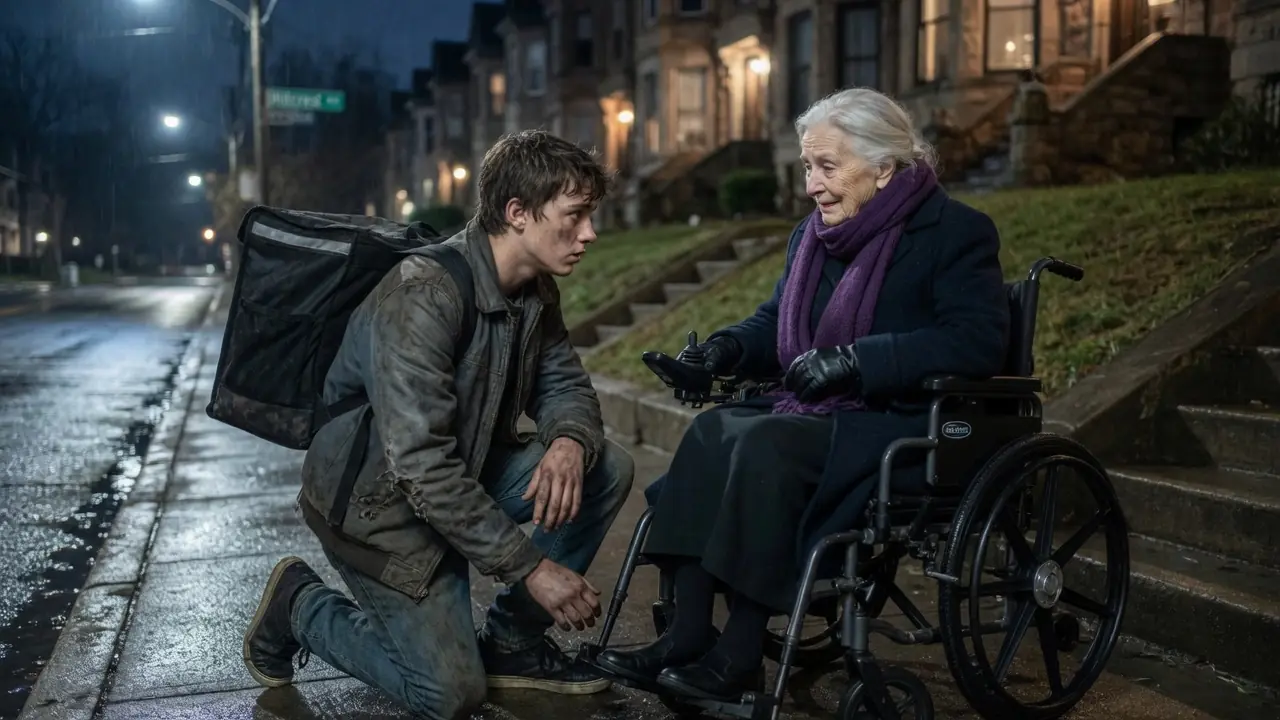
Then he saw her.
A wheelchair was just sitting there in the middle of the road.
Its occupant, an elderly white woman, was leaning forward, pushing at the controls with increasing frustration.
Darius slowed, his tired mind processing the scene.
The smart thing would be to keep going.
He was exhausted.
He still had a fifteen-minute ride home.
His mother was waiting.
But his feet were already on the ground before he had fully decided.
“Ma’am.”
His voice came out rougher than he intended, raw from the cold.
“You okay?”
The woman looked up, and even in the dim light, he could see the relief flood her face.
She was older, maybe seventy, maybe more, wrapped in a purple knit scarf that the wind kept pulling at.
Her white hair caught the streetlight, making it glow almost silver.
“Oh, thank God,” she said, her voice trembling slightly. “The wheelchair just stopped right here in the middle of…”
She gestured helplessly at the road around them.
“I’ve been trying for ten minutes.”
Darius propped his bike against the curb and walked over, already assessing the chair with the same eye he used on broken bikes and busted delivery trucks.
The control panel lights were on, but the motor was not engaging.
“May I?” he asked, gesturing toward the chair.
“You know about these contraptions?”
“A little.”
He pulled out his phone and turned on the flashlight.
“Please,” she said.
He knelt down, ignoring the cold asphalt seeping through his jeans.
His fingers found the motor housing, checking the connections.
The wind picked up, and he had to blink against the sudden sting in his eyes.
“How long have you been out here?” he asked, more to fill the silence than anything else.
“Too long,” she said, pulling the scarf tighter. “I was visiting my daughter. She lives just down the hill, but I insisted I could make it home on my own. Stubborn old fool.”
Darius felt along the base of the chair, his fingers catching on something.
A wire was partially disconnected there.
The vibration from the slope must have jostled it loose.
“I got it,” he murmured, more to himself than to her.
He pressed the connection back firmly, then twisted the housing back into place.
“Try it now.”
She pressed forward.
The wheelchair hummed to life.
The woman’s mouth opened.
“Oh, my word. You actually fixed it.”
Darius stood, wiping his hands on his jeans.
“Should get you up this hill, though these motors aren’t great on slopes.”
“I live three blocks up.”
He looked at the steep incline ahead, then at her frail frame.
“I’ll push you.”
“Young man, I can’t ask you to.”
“You’re not asking. I’m offering.”
He moved behind the wheelchair and gripped the handles.
They were cold metal, worn smooth from years of use.
The hill was steeper than it looked.
His legs screamed.
His lungs burned.
But he kept pushing, one step at a time.
The wind cut through his jacket.
His stomach growled.
He had skipped dinner to make an extra twenty dollars.
“What’s your name, son?” the woman asked.
“Darius.”
“I’m Evelyn.”
She paused.
“You’re very kind, Darius.”
He didn’t know what to say to that.
“It’s just the right thing to do.”
Three blocks felt like three miles.
When they finally reached her building, a nice brownstone with clean steps, she turned in her chair to face him.
“Let me pay you, please.”
“No, ma’am.”
“But you’ve gone out of your way.”
“I didn’t help you for money.”
He was already backing toward his bike.
“I just didn’t want to see anyone stuck out here in the cold like that.”
She reached into her purse anyway and pulled out what looked like a hundred-dollar bill.
Darius shook his head.
“Really, I can’t. My mom would kill me if she knew I took money for helping someone.”
Evelyn’s expression softened.
Something shifted in her eyes.
“Your mother raised you well.”
“She did her best.”
He grabbed his bike.
“You get inside safe now, okay?”
“Wait. At least tell me where you go to school. I’d like to send a thank-you note.”
“It’s fine, really.”
He was already climbing onto his bike.
“Just glad you’re okay.”
He pedaled away before she could say anything else.
His legs felt like concrete.
His stomach was a tight knot of hunger.
But something in his chest felt warm.
He didn’t see Evelyn watch him disappear into the darkness.
He didn’t see her pull out her phone with trembling fingers.
He didn’t know she had spent forty years building the largest mobility device company in America.
And he definitely didn’t know she had just decided to find him.
The alarm screamed at 5:47 a.m.
Darius’s hand shot out and slapped it silent.
His eyes felt like sandpaper.
Three hours of sleep, maybe four.
He sat up in the tiny bedroom, barely big enough for a twin mattress and a desk he had found on the curb two years ago.
The walls were thin enough to hear his neighbor’s television.
The radiator clanked, but barely worked.
He pulled on yesterday’s jeans.
They smelled like bike grease and cold air.
His cleanest shirt was wrinkled, but it would have to do.
The apartment was quiet.
Good.
Mom was still asleep.
In the kitchen, more like a hallway with appliances, he started the coffee maker.
It sputtered and hissed.
While it brewed, he checked the fridge.
Half a carton of eggs.
Bread that would go stale tomorrow.
A container of leftover rice from three days ago.
He took one egg and left the rest.
The coffee finished.
He poured it into two chipped mugs.
One said, “World’s Best Mom,” with half the letters faded.
The other was plain white with a crack running down the side.
He carried both mugs to his mother’s room.
She was already awake, sitting up in bed, her legs motionless under the blanket.
Her wheelchair sat three feet away, the old manual one with the wobbly left wheel.
Getting from bed to chair took her fifteen minutes on good days.
“Morning, baby.”
“Morning, Mom.”
He set her coffee on the nightstand.
“You sleep okay?”
“Like a rock.”
A lie.
He had heard her shifting all night, the bed creaking.
Monica was forty-three but looked older.
Her hands trembled slightly as she reached for the coffee, a side effect of the medication she took for the nerve pain.
“You got class today?” she asked.
“Yeah. Eight a.m. lecture, then work at two.”
“You eating breakfast?”
“I’ll grab something at school.”
Another lie.
She narrowed her eyes.
“Darius.”
“Mom, I’m fine.”
“There’s bread. Make yourself something.”
“I’m saving it for your lunch.”
He moved to her wheelchair and rolled it closer to the bed.
“Here, let me help.”
“I can do it myself.”
“I know you can.”
He positioned the chair and locked the wheels.
“But I’m here, so why not?”
She sighed, but let him help.
He had done this a thousand times.
Slide one arm under her legs.
One behind her back.
Lift gently.
Pivot.
Lower into the chair.
Adjust her position.
Make sure her feet were on the footrests.
“You’re getting too good at this,” she said quietly.
“Had a good teacher.”
He tucked the blanket around her lap.
The apartment was always cold.
Monica looked up at him.
Her eyes were the same dark brown as his.
“You know, you don’t have to do all this. School and work and taking care of me.”
“Mom.”
“I’m serious. You’re twenty years old. You should be out with friends, going to parties, being young.”
Darius knelt beside her chair and looked right at her.
“Mom, listen to me. You are not a burden. You’re not holding me back. You’re the reason I work hard every single day.”
He took her hand.
“Everything I do, I do because you showed me how to keep going even when life knocks you down.”
Her eyes got shiny.
She squeezed his hand.
“How’d I get so lucky?”
“Pretty sure I’m the lucky one.”
He stood and checked his watch.
“Shoot. I gotta go. You need anything before I leave?”
“I’m fine, baby. You go ace that test.”
He grabbed his backpack, held together with duct tape in three places, and headed for the door.
“Darius.”
He turned.
“I love you.”
“Love you too, Mom.”
The door closed behind him.
Monica sat alone in the quiet apartment, looking at the half-full coffee mug her son had made for her.
She knew he was lying about eating breakfast.
She knew he was exhausted.
But she also knew she had raised a good man.
Evelyn Whitmore’s office was on the forty-second floor.
Floor-to-ceiling windows overlooked the city.
A mahogany desk.
Leather chairs.
Photos on the wall.
Her late husband, David.
Her daughter, Katherine.
The first wheelchair prototype they had built in their garage in 1983.
She sat in her own custom mobility chair, top-of-the-line, with all the features.
It glided silently across the hardwood floor as she moved to the window.
Below, the city hummed with morning traffic.
Thousands of people.
Thousands of stories.
She couldn’t stop thinking about the boy from last night.
“Miss Whitmore.”
Her assistant, James, appeared in the doorway.
Thirty-five, efficient, always wearing gray suits.
“You wanted to see me.”
“Come in, James. Close the door.”
He did, concern crossing his face.
“Is everything all right?”
“Last night, my chair broke down on Anderson Hill. A young man stopped and fixed it, then pushed me three blocks home.”
She turned to face him.
“I need you to find him.”
James pulled out his tablet.
“Did you get his name?”
“Darius. Early twenties. Rides a beat-up bike. Works delivery. I think his jacket had grease stains and food smells.”
She paused.
“He refused payment. Said his mother taught him better.”
“That’s unusually kind.”
“Exactly.”
Evelyn rolled back to her desk.
“I want to know more about him. Check the local colleges. He mentioned studying. Be discreet. I don’t want him to think I’m stalking him.”
“Of course. I’ll start with the universities in the area.”
James hesitated.
“May I ask why?”
Evelyn looked at the photo of her husband.
David had died eight years ago.
Heart attack.
Sudden and cruel.
Their daughter had moved to Seattle for work.
The big house felt empty most nights.
“Because, James, in forty years of running this company, I’ve met thousands of people. Investors, engineers, politicians, celebrities.”
She picked up a pen and turned it in her fingers.
“And last night, a broke college kid with an old bike saw an old woman in trouble and didn’t hesitate for a second. Didn’t ask for anything. Didn’t take photos for social media. Just helped.”
She set the pen down.
“That boy reminded me why we started this company in the first place. Not for profit. Not for awards. For people.”
James nodded slowly.
“I’ll find him.”
“Thank you.”
As James turned to leave, Evelyn added, “And James, when you do find him, I want to offer him something real. Not charity. Opportunity.”
“What kind of opportunity?”
She smiled.
“Let me worry about that.”
Three days later, James returned with a thin folder.
“His name is Darius McKinley. Twenty years old. Second-year student at Metro Tech, studying mechanical engineering. Works part-time for Quick Deliver, the food delivery app. Lives in a one-bedroom apartment in the Riverside District with his mother, Monica McKinley.”
Evelyn opened the folder.
Inside was a student ID photo.
Darius looked tired, even in the picture.
There was also basic information.
“His mother?” Evelyn asked.
James glanced at his notes.
“Paralyzed from the waist down. Car accident seven years ago. Father left shortly after. No other family in the area.”
Evelyn closed her eyes.
“He takes care of her.”
“Appears so. His school records show mostly B’s with a few A’s. Professors say he’s bright but often exhausted in class. One noted he sometimes falls asleep during lectures because he’s working himself to death.”
Evelyn felt something tight in her chest.
She had been there once.
After David’s first business failed.
After Katherine was born premature and they had no insurance.
Those years of working three jobs, sleeping four hours a night, surviving on coffee and hope.
She had promised herself that if she ever made it, she would remember what it felt like to drown.
“Miss Whitmore?”
She opened her eyes.
“Send him an email. Official Whitmore Mobility letterhead. Invitation to interview for our internship program. The one with the scholarship component.”
“We don’t have an internship with a scholarship component.”
“We do now.”
She looked at James.
“Full tuition coverage for the remainder of his degree. Paid internship, twenty hours a week, flexible schedule around his classes. Starting salary forty thousand annually, prorated for part-time.”
James’s eyebrows shot up.
“That’s quite generous for an intern.”
“That’s quite necessary for a young man taking care of his paralyzed mother while putting himself through engineering school.”
She handed back the folder.
“Send it today. Mark it high priority. And James?”
“Yes?”
“Make it clear this is a legitimate opportunity based on merit. I don’t want him to think it’s charity.”
“Of course.”
James headed for the door.
“Oh, and one more thing.”
He paused.
“Don’t mention that we met. Not yet. Let’s see if he shows up.”
That evening, Darius got home at eleven p.m.
His phone buzzed as he unlocked the apartment door.
New email.
Subject line: Whitmore Mobility Internship Opportunity.
He almost deleted it as spam, but something made him click.
Dear Darius McKinley,
Whitmore Mobility is pleased to inform you that you have been selected as a candidate for our engineering internship program.
His hand started shaking.
Full scholarship.
Paid position.
Flexible hours.
This had to be fake.
Nobody just gave away opportunities like this.
But the email signature had a phone number and a real office address.
Darius read it three times.
Then he walked into the living room, where his mother was watching TV.
“Something wrong, baby?”
He held out his phone.
“I think I just got the weirdest email of my life.”
Monica read it.
Her eyes widened.
“Darius. Darius, this is real. Whitmore Mobility. They’re huge. They make the chairs we couldn’t afford when I…”
She looked up at him.
“How did you get this?”
“I have no idea.”
He took the phone back.
“It has to be a mistake.”
“Or it’s not.”
She grabbed his hand.
“You respond to this email right now. You tell them yes. You take this interview.”
“Mom—”
“Listen to me. I didn’t raise you to be afraid of good things happening. You’re smart. You work hard. Maybe somebody finally noticed.”
Her grip tightened.
“You go to this interview. You see what happens.”
Darius looked at the email again.
Interview scheduled for Monday, 10:00 a.m.
“Okay,” he whispered. “Okay, I’ll go.”
Monica smiled.
“That’s my boy.”
But as Darius went to his room to respond to the email, one thought kept circling his mind.
Why me?
Monday morning, Darius stood outside the Whitmore Mobility Tower downtown.
Glass and steel.
Thirty-two floors reaching toward the sky.
People in suits walked past him like he was invisible.
He wore his cleanest shirt, white and wrinkled despite his best efforts with the iron.
Black pants that were slightly too short.
Shoes he had scrubbed with a wet cloth the night before.
His backpack was at home.
He carried a borrowed leather folder from his mother’s closet.
His hands would not stop sweating.
“You can do this,” he muttered. “Just don’t say anything stupid.”
Inside, the lobby was all marble and modern art.
The security guard glanced at him and frowned slightly, but checked his ID and gave him a visitor badge.
“Elevator to the eighteenth floor.”
The doors opened to pristine white walls, glass conference rooms, and the hum of expensive air conditioning.
Everyone wore business casual.
Everyone looked comfortable.
Darius felt like he had walked onto another planet.
“Can I help you?” the receptionist asked politely.
Her name tag said Rachel.
“I’m here for… I have an interview. Darius McKinley.”
She typed on her computer.
“Ah, yes. Have a seat. Someone will be with you shortly.”
He sat in a leather chair that probably cost more than his bike.
He tried not to touch anything.
He watched employees walk past, confident, purposeful, belonging.
“Mr. McKinley.”
A man in a gray suit approached.
Neat hair.
Calm expression.
“I’m James, Miss Whitmore’s assistant. Thank you for coming. Follow me, please.”
They walked down a hallway lined with photos.
Wheelchair designs through the decades.
Newspaper headlines about accessibility laws.
Pictures of smiling users.
“Miss Whitmore will see you in her office.”
James opened a door.
The office was bigger than Darius’s apartment.
And there behind the massive desk sat the woman from the hill.
Darius froze.
Evelyn smiled.
“Hello again, Darius.”
His brain stuttered.
“You… You’re…”
“Evelyn Whitmore. CEO of this company, though I suppose I didn’t introduce myself properly that night.”
She gestured to the chair across from her desk.
“Please sit.”
He sat because his legs forgot how to work.
“You look surprised,” she said gently.
“I didn’t… I mean, you’re the person from the hill.”
“I am.”
“So this interview is because I helped you.”
“Let me ask you something first.”
Evelyn leaned forward.
“When you stopped that night, did you know who I was?”
“No, ma’am.”
“Did you help me hoping for a reward?”
“No, ma’am.”
“Why did you help me?”
Darius met her eyes.
“Because you needed help and I could do it. That’s all.”
Evelyn nodded slowly.
“Do you know how rare that is? True kindness with no expectation of return.”
“I just did what my mom taught me.”
“Your mother is a wise woman.”
Evelyn opened a folder on her desk.
“I know about your situation, Darius. I know about your mother’s accident. About your father leaving. About you working yourself into exhaustion while maintaining decent grades in a difficult program.”
His chest tightened.
“How do you—”
“I did my research. I hope you don’t mind.”
She looked at him directly.
“I also know what it’s like to struggle. My husband and I started this company in our garage with eight hundred dollars and a dream. There were years I ate ramen for dinner so we could buy parts. Years I worked until three a.m., then woke up at six to take our daughter to daycare.”
She paused.
“So when I say I see something in you, I’m not speaking as some wealthy CEO looking for a feel-good story. I’m speaking as someone who recognizes real character.”
Darius did not know what to say.
“This internship is real,” Evelyn continued. “Full scholarship for your remaining tuition. Paid position, twenty hours per week, flexible around your class schedule. You’ll work with our engineering team on accessibility solutions, starting immediately if you accept.”
“Why?”
The word burst out.
“Why would you do this?”
“Because the world needs more people like you. People who stop to help strangers on dark hills. People who put family first. People who understand that our work isn’t about building products. It’s about giving people their freedom back.”
She smiled.
“And frankly, because I can.”
Darius felt like he might cry.
“I don’t know what to say.”
“Say yes.”
“I… Yes. Yes. Thank you. I’ll work harder than anyone. I promise I—”
“Darius.”
Her voice was calm.
“I know you will. That’s why you’re here.”
She stood, walked around the desk, and extended her hand.
“Welcome to Whitmore Mobility.”
He shook her hand.
His grip was probably too tight.
His eyes were definitely wet.
“James will handle the paperwork. You’ll start next Monday. That gives you time to adjust your work schedule. You’ll report to Marcus Chen, our head of engineering. He’s tough, but fair.”
She paused.
“One more thing.”
“Yes, ma’am?”
“Stop calling me ma’am. Miss Whitmore is fine. Or just Evelyn when we’re not in formal settings.”
He nodded, overwhelmed.
As James led him out to sign papers, Evelyn watched through her office window.
The boy looked shell-shocked, grateful, terrified.
Good.
The comfortable rarely changed the world.
Darius’s first day arrived fast.
He arrived fifteen minutes early, wearing the same white shirt, freshly washed this time, and his best attempted business casual.
The engineering department was on the twenty-third floor, an open space with drafting tables, computer stations, and prototype wheelchairs scattered throughout.
Marcus Chen met him at the elevator.
He was in his mid-forties, graying at the temples, wearing a polo shirt with the company logo.
“Darius McKinley?”
“Yes, sir.”
“Marcus. Head engineer.”
He shook Darius’s hand firmly.
“Welcome. We’ll get you set up at a workstation, introduce you to the team. You have CAD experience?”
“A little. Took an intro course last semester.”
“Good. We use SolidWorks here. I’ll pair you with someone to show you the ropes.”
Marcus walked toward the main floor.
“Fair warning, this team works hard. We’re on deadline for three projects right now. I need you to pull your weight.”
“I will. I promise.”
They reached a cluster of desks.
Five people looked up.
Four men, one woman.
“Everyone, this is Darius McKinley, our new intern. Darius, this is the team. That’s Rob, Steven, Jessica, Tom, and Ava.”
A chorus of hellos followed, mostly polite.
Tom barely glanced up from his screen.
“Ava, you’re on mentoring duty this week.”
A young woman stood, maybe twenty-five, black hair in a neat braid, bright smile.
“Hey, Darius. Welcome aboard.”
“Thanks.”
Marcus left them.
Ava gestured to an empty desk beside hers.
“You can set up here. This station has everything you need. Computer access to our shared drives, some basic tools.”
As Darius sat down, he heard whispers from the other desks.
Low voices that were not quite low enough.
“Is that the intern from the charity thing?”
“Yeah. Heard he got in because he helped someone important.”
“So we’re doing pity hires now?”
Darius’s face burned.
He kept his eyes on the computer screen as Ava logged him into the system.
She leaned close and spoke quietly.
“Ignore them. Tom’s always like that. Steven, too.”
“They’re not wrong, though,” Darius muttered. “I did get this because of circumstances.”
Ava looked at him.
“You got an interview because of circumstances. You got hired because Miss Whitmore thinks you’re capable. There’s a difference.”
“How do you know?”
“Because she doesn’t do charity. Everything’s about the mission here. Making mobility devices better, more accessible. If she thought you couldn’t do the work, you wouldn’t be sitting here.”
Ava pulled up a design file.
“Now, let me show you what we’re working on.”
The first week was brutal.
Darius learned SolidWorks by watching tutorials until two a.m.
He studied the company’s existing designs.
He sat in meetings and tried to follow conversations about torque ratios and battery optimization.
Tom and Steven kept their distance, polite but cold.
In the break room, conversations would pause when Darius walked in.
Jessica was neutral, professional but not warm.
Rob was friendly enough, but clearly uncomfortable.
Only Ava treated him like he belonged.
“You’re doing fine,” she said during lunch on Thursday.
They sat in the cafeteria, Darius with his packed sandwich, Ava with a salad from the fancy salad bar.
“Your CAD models are getting better. Marcus said your measurements on the footrest project were accurate.”
“He did?”
“Yeah. He doesn’t give empty compliments.”
She took a bite.
“How’s your mom doing?”
Darius had mentioned his mother briefly on day one.
“She’s okay. Tired. I worry about her being alone all day while I’m here.”
“Does she have help? Like home care?”
“We can’t afford that.”
Ava was quiet for a moment.
“I’m sorry. That must be hard.”
“It’s just how it is.”
He changed the subject.
“What about you? How long have you been here?”
“Three years. Started right out of grad school.”
She smiled.
“Best decision I ever made.”
“You always wanted to work in accessibility?”
“My grandmother had MS. Spent her last five years in a wheelchair.”
Ava’s expression softened.
“I watched her lose independence bit by bit. Every time we went somewhere, it was a battle. Stairs, narrow doorways, broken elevators. I decided then that I wanted to fix that. Make things better.”
Darius understood that feeling.
“That’s why I went into engineering. After Mom’s accident, I realized how much these devices matter. Like really matter.”
“Exactly.”
Ava pointed her fork at him.
“That’s real motivation. That’s why you’ll be good at this.”
Friday afternoon, there was a team meeting about a new project.
A lightweight manual wheelchair for developing countries.
Lower cost.
Durable.
Easy to repair.
Tom led the presentation.
“We’re aiming for under three hundred dollars per unit. Challenge is maintaining quality while cutting costs.”
“What about the wheel bearings?” Steven asked. “The cheap ones wear out too fast.”
“We’re testing alternatives.”
Marcus nodded.
“Good. Any other input?”
Silence.
Darius raised his hand hesitantly.
Everyone looked at him.
“Yes, Darius?” Marcus said.
“I was just thinking about the slope assistance. Most manual chairs struggle on inclines, right? Especially if the user doesn’t have full upper body strength.”
Tom crossed his arms.
“We know that. That’s not new information.”
“Right. Sorry. I just… My mom’s chair has this problem. She can’t get up the ramp to our building without me pushing. So I added these small ratchet locks to the wheels. They only engage when the chair is on an incline. Prevents rolling backward.”
The room was quiet.
Marcus leaned forward.
“You modified your mother’s wheelchair?”
“Yeah. Just with some hardware store parts. Cost about twelve bucks.”
“Does it work?”
“Most of the time. It’s rough, but the concept works.”
Ava was grinning.
“That’s actually brilliant.”
Tom frowned.
“It’s a nice idea, but integrating that into a design is—”
“Worth exploring,” Marcus interrupted.
He looked at Darius.
“Can you sketch out what you did? Show me the mechanism.”
“Um, sure. Yeah.”
“Good. We’ll review it Monday.”
Marcus moved on to the next agenda item.
After the meeting, Darius packed up quickly.
He could feel Tom’s glare from across the room.
As he waited for the elevator, Ava appeared beside him.
“That was good. Really good.”
“Tom looked like he wanted to kill me.”
“Tom’s been here six years and hasn’t had a design implemented. You’ve been here one week and just pitched something Marcus actually wants to see.”
She grinned.
“Get used to it.”
The elevator arrived.
Darius stepped in.
“Hey, Darius.”
He turned.
“Keep showing up. Keep speaking up. You belong here.”
She smiled.
“Even if you don’t believe it yet.”
The doors closed.
Darius rode down alone, replaying the meeting in his head.
Maybe, just maybe, he could do this.
The weekend was a blur.
Darius worked his delivery shifts, slept four hours a night, and spent every spare moment sketching the ratchet mechanism.
He sat at the tiny kitchen table Saturday morning, papers spread everywhere, trying to remember exact measurements.
His mother rolled into the kitchen.
“You’re up early.”
“Couldn’t sleep.”
She looked at his drawings.
“What’s all this?”
“The thing I told you about for work. They want to see a detailed version.”
Monica picked up one of the sketches.
Her engineering knowledge was limited, but she understood enough.
“This is the thing you put on my chair.”
“Yeah. If I can show them how to make it cheaper and better, maybe they’ll actually use it.”
She set the paper down and looked at her son.
Exhausted.
Determined.
Covered in pencil smudges.
“Darius, when did you sleep last?”
“I’m fine.”
“That’s not what I asked.”
He rubbed his face.
“I got like three hours Thursday night. Maybe four last night.”
“Baby.”
“Mom, I can’t mess this up. This job, it’s everything. It’s tuition. It’s money for rent. It’s…”
He trailed off.
“It’s proof that I deserve to be there.”
Monica rolled closer and took his hand.
“Listen to me. You already deserve to be there. Not because of what you do, but because of who you are.”
“They don’t see it that way.”
“Some people will never see it. That’s their problem, not yours.”
She squeezed his fingers.
“But you cannot kill yourself trying to prove them wrong. You hear me?”
“I hear you.”
“Good.”
She released his hand.
“Now eat something, please. You look like a ghost.”
Monday morning, Darius arrived at eight a.m. with a folder full of detailed sketches and notes.
Marcus had asked him to present to the team at nine.
The conference room felt too big, too bright.
Darius set up his papers on the table.
His hands shook slightly.
The team filtered in.
Ava gave him an encouraging smile.
Tom sat in the back, arms crossed.
Marcus took the head of the table.
“Okay, Darius. Show us what you’ve got.”
Deep breath.
“Right. So, the core problem is that manual wheelchairs roll backward on slopes. Existing solutions are heavy or expensive.”
He pointed to his first sketch.
“This is a simple ratchet system. It attaches to the wheel hub here. When the chair is on flat ground, it doesn’t engage. But as soon as there’s a backward tilt, these pawls lock into place.”
Steven interrupted.
“Pawls will wear out fast with constant use.”
“Yes. That’s why I’m suggesting hardened steel for the pawls and a beryllium copper spring. More durable.”
Darius flipped to another page.
“Total added weight per wheel is about three ounces. Cost per unit roughly nine dollars in materials.”
Jessica leaned forward.
“How does it disengage for going downhill?”
“Manual lever. Simple thumb release on the wheel grip.”
Marcus was studying the drawings carefully.
“You tested this on your mom’s chair?”
“Yeah. For six months. It’s held up pretty well, considering I made it from hardware store parts.”
“And it actually works?”
“It prevents rollback on slopes up to about fifteen degrees. Beyond that, you still need assistance, but that’s true of any manual chair.”
The room was quiet.
Then Ava said, “This is really smart.”
Rob nodded.
“The cost is reasonable.”
Jessica tapped her pen on the table.
“We’d need to test extensively, but the concept is solid.”
Tom said nothing.
Marcus collected the sketches.
“I want to build a prototype. Darius, you’ll work with Rob on this. He handles fabrication. Let’s see if we can have something testable by the end of the week.”
“Really?”
Darius couldn’t help the hope in his voice.
“Really.”
Marcus stood.
“Good work. Meeting adjourned.”
As people filed out, Ava caught up with Darius in the hallway.
“See? I told you.”
“It might not work once we actually build it.”
“But it might. And even if it doesn’t, you just contributed something valuable in your second week.”
She bumped his shoulder.
“That’s huge.”
He allowed himself a small smile.
“Thanks.”
The rest of the week was intense.
Darius and Rob worked in the fabrication lab, a space filled with tools, machinery, and the smell of metal and grease.
Rob was in his mid-fifties, quiet and methodical.
He didn’t talk much, but he showed Darius how to use the machines, how to measure precisely, and how to test for weaknesses.
By Thursday evening, they had a working prototype.
Darius attached it to a test wheelchair.
Rob set up a ramp at fifteen degrees.
“Here goes nothing,” Darius muttered.
He released the brake.
The wheelchair rolled backward an inch, then stopped.
The ratchet engaged with a soft click.
“Huh,” Rob said.
He pushed it forward.
It rolled smoothly.
“Try the release.”
Darius pressed the thumb lever.
The pawls retracted.
The chair could roll backward again.
Rob tested it five more times.
Same result each time.
“It works,” Rob said simply.
Darius felt like his chest might explode.
“It actually works.”
“You did good, kid.”
Rob started cleaning up.
“Marcus will want to see this tomorrow.”
Friday’s presentation was in the bigger conference room.
Not just the engineering team this time.
Executives from other departments were there, too.
And in the back, in her customized chair, sat Evelyn Whitmore.
Darius didn’t know she would be there.
His stomach dropped when he saw her.
Marcus gave the introduction.
“Two weeks ago, our new intern identified a problem and proposed a solution. He and Rob built a working prototype in four days. Darius, walk us through it.”
This audience was different.
Older.
More skeptical.
But Darius thought about his mother struggling up the ramp to their building.
He thought about every person in a manual chair who had ever been stuck on a hill.
He explained the mechanism, showed the cost breakdown, and demonstrated the prototype on the ramp.
The wheelchair didn’t roll backward.
The release worked perfectly.
When he finished, there was a pause.
Then someone clapped.
Then someone else.
Evelyn was smiling.
“Questions?” Marcus asked.
A woman from marketing raised her hand.
“What’s the timeline to integrate this into our existing manual chair line?”
Marcus looked at Rob.
“Assuming further testing goes well, six months to production.”
“This could be a major selling point,” the marketing woman continued. “Accessibility feature at low-cost increase.”
Others nodded in agreement.
Tom sat with his arms crossed, face unreadable.
After the meeting, people approached Darius.
Executives introduced themselves.
Someone from PR wanted to interview him for the company newsletter.
Evelyn waited until the crowd thinned.
Then she rolled over.
“Well done, Darius.”
“Thank you, Miss Whitmore.”
“You know what impressed me most?”
She looked at the prototype wheelchair.
“You didn’t design this for us. You designed it for your mother. That kind of personal investment is where real innovation comes from.”
He didn’t know what to say.
“Keep going,” she said simply.
Then she rolled away.
Ava appeared at his elbow.
“You realize you just nailed your first project, right? Two weeks in.”
“I had a lot of help.”
“Yeah, and you earned that help by showing up and working hard.”
She grinned.
“Dinner. My treat. You look like you haven’t eaten real food in days.”
“I can’t. I have to—”
“If you say delivery shift, I’m going to be very disappointed.”
Darius hesitated.
“I do, though.”
“When does it start?”
“Six.”
“It’s three-thirty. We have time. Come on.”
She was already walking toward the elevator.
“There’s a good Vietnamese place two blocks away.”
He followed her, still processing everything.
As they left the building, Darius glanced back up at the tower.
Maybe he really could do this.
Three weeks later, Darius had fallen into a rhythm.
Classes in the morning.
Work in the afternoon.
Delivery shifts at night.
Sleep in the gaps between.
He had gained respect from most of the team.
Even Steven had started asking his opinions on designs.
Tom still kept his distance.
The ratchet mechanism was in advanced testing, looking good for production.
Everything was going well.
Too well.
It was a Wednesday.
Darius had worked until seven and skipped his delivery shift to study for a thermodynamics exam.
He got home around nine, exhausted but satisfied with the day.
The apartment was dark.
“Mom?”
No answer.
He flipped the light switch.
His mother was on the floor beside her wheelchair.
The chair was tipped on its side.
Her face was pale.
One arm was bent at an odd angle beneath her.
“Mom!”
He dropped his backpack and rushed to her side.
“Mom, can you hear me?”
Her eyes fluttered open.
“Darius.”
“What happened? How long have you been here?”
“I don’t know. I tried to transfer from the couch and the wheel slipped and…”
She gasped as he gently moved her arm.
“It hurts.”
His hands were shaking.
“Okay. Okay. Don’t move. I’m calling 911.”
“No, we can’t afford—”
“I don’t care.”
He was already dialing.
The ambulance took twelve minutes.
The longest twelve minutes of Darius’s life.
He sat on the floor beside his mother, holding her good hand, talking to her to keep her conscious.
“I’m sorry,” she kept saying. “I’m so sorry.”
“Stop. This isn’t your fault.”
“I tried to be careful.”
“Mom, please save your energy.”
The EMTs arrived.
Professional.
Efficient.
They checked her vitals, stabilized her arm, and loaded her onto a stretcher.
Darius rode with her to County General.
The ER was fluorescent lights and antiseptic smells.
They took her back immediately.
Darius sat in the waiting room, head in his hands.
His phone buzzed, reminding him about his exam tomorrow.
He almost laughed.
An exam like that mattered right now.
Two hours later, a doctor appeared.
Young guy.
Tired eyes.
“Darius McKinley?”
“Yes.”
“Your mother has a fractured ulna and a dislocated shoulder. We’ve set the shoulder and casted the arm. She’ll need to stay overnight for observation. She hit her head in the fall.”
“Is she okay?”
“She will be. But she’s going to need help for the next few weeks. The cast will make self-care difficult.”
Darius nodded numbly.
“Can I see her?”
“Room 314. She’s resting, but awake.”
His mother looked small in the hospital bed.
Her arm was in a cast up to the elbow, a bandage on her forehead.
Monitors beeped softly.
“Hey, baby,” she said when he walked in.
He pulled a chair close and took her good hand.
“Hey.”
“I messed everything up, didn’t I?”
“You fell. Accidents happen.”
“But now you’ll have to take more time off work and school and—”
“Mom.”
His voice cracked.
“I don’t care about work. I don’t care about school. I care about you.”
She squeezed his hand.
“I know you do. But I also know that job means everything to you.”
“You mean everything to me. Everything else is just everything else.”
He wiped his eyes.
They sat in silence for a while.
“The doctor said I can go home tomorrow,” Monica finally said. “But I’ll need help with… well, everything.”
“I’ll be there.”
“You have class.”
“I’ll figure it out.”
She looked at him, her boy who had become a man too fast.
“How’d I get so lucky?”
“I’m pretty sure it’s the other way around.”
Darius spent the night in the chair beside her bed.
He couldn’t sleep.
He just watched her breathe, making sure she was okay.
Around three in the morning, his phone vibrated.
Email notification.
He almost ignored it, but curiosity won.
Sender: Evelyn Whitmore.
Darius,
James informed me of your mother’s accident. I’ve taken the liberty of covering her hospital bills. Please don’t argue. It’s already done.
Focus on her recovery. Take whatever time you need. Your position here is secure.
Evelyn.
Darius read it three times.
Then he put his head down on the edge of the bed and cried.
Not from sadness.
From relief.
From gratitude.
From the overwhelming weight of someone actually caring.
When he finally composed himself, he typed a response.
Miss Whitmore,
I don’t know how to thank you. This means more than I can express.
Darius.
Her reply came minutes later, like she had been awake too.
You already thanked me on a dark hill when you didn’t have to. Get some rest.
The next morning, they discharged his mother with instructions, pain medication, and a follow-up appointment.
Darius took her home in a medical transport.
Back in the apartment, he helped her into bed, set up water and pills within reach, and made sure her phone was charged.
“I’ll be back by lunch,” he said.
“You’re leaving?”
“Just for a few hours. I have to talk to my professors, arrange some things at work.”
“Darius, you should be here.”
“I will be, but I need to handle some logistics first.”
He kissed her forehead.
“I’ll be back soon. Call me if you need anything.”
At school, he met with his academic adviser and explained the situation.
They worked out a plan.
Temporary reduced course load.
Extensions on assignments.
Recorded lectures he could watch at home.
“You’re not the first student dealing with family medical issues,” the adviser said kindly. “We’ll make this work.”
At Whitmore Mobility, he went straight to Marcus’s office.
“Darius, I heard about your mom. Is she okay?”
“She will be, but I need to adjust my schedule for a few weeks. I can still work twenty hours, just different times. Some from home, if possible.”
Marcus nodded.
“We can do remote work. Most of your current tasks are computer-based anyway.”
He paused.
“Take care of your family first. The job will be here.”
“Thank you.”
As Darius turned to leave, Marcus added, “Hey, for what it’s worth, the way you’re handling this, that’s character. That matters more than any technical skill.”
That night, Darius sat on the couch beside his mother’s wheelchair.
She was asleep in her room.
The apartment was quiet.
His phone showed unread messages from Ava checking if he was okay.
He would respond tomorrow.
Right now, he just needed to sit.
To breathe.
To process the fact that in twenty-four hours, his world had almost collapsed and people he barely knew had caught him.
Not just people.
Good people.
Maybe his mother was right.
Maybe good things could happen to good people.
Sometimes.
The next three weeks were the hardest of Darius’s life.
Morning routine.
Wake up at 5:30.
Help Mom transfer from bed to wheelchair.
Make breakfast.
Set out her medications.
Make sure she could reach everything she would need while he was gone.
Day routine.
Remote work from the apartment when possible.
Quick trips to campus for exams only.
Back home by two p.m. to check on Mom.
Evening routine.
Help with dinner.
Help with bathroom transfers.
Help with everything.
Night routine.
Homework.
Client calls with the engineering team.
Sleep around one a.m.
Repeat.
He was running on fumes, coffee, and determination.
But something strange happened.
The work, despite being done from a cluttered apartment instead of a state-of-the-art office, got better.
Darius couldn’t go to the lab, so he learned to design in CAD more efficiently.
He couldn’t attend in-person meetings, so he became better at presenting his ideas clearly in emails and video calls.
And every design he worked on, he tested in the only way he could.
On his mother’s wheelchair.
One evening, he was adjusting the brake resistance on her chair.
Monica watched from the couch.
She was getting better at transfers.
Slowly regaining independence.
“You’re going to wear that poor chair out,” she said.
“Just testing something.”
He tightened a bolt.
“The brake lever position is awkward. Most people can’t reach it comfortably.”
“I’ve always thought that.”
“Right. So I’m trying different angles.”
He helped her into the chair.
“Try the brake now.”
She reached for it.
“Oh, that’s much better. Easier. Way easier.”
“More natural grip.”
Darius made notes on his tablet.
“Good. I’ll send this to Marcus.”
His mother watched him work.
“You know what’s amazing?”
“What?”
“You’ve turned the situation into an advantage. You’re doing real-world testing right here.”
He hadn’t thought of it that way.
“I guess.”
“Other designers work in labs with fancy equipment. You work in a cramped apartment with your disabled mom.”
She smiled.
“But you understand what users actually need. That’s worth more than any lab.”
By week four, Monica’s shoulder was healing well.
The cast would come off in two more weeks.
She could do more for herself.
Darius started going back to the office part-time.
His first day back, Ava ambushed him with a hug.
“You’re back!”
“Temporarily. Still need to be home most days.”
“How’s your mom?”
“Getting better. Stubborn as hell, which is a good sign.”
They walked to his desk together.
Tom glanced over, then quickly away.
Steven nodded a greeting.
Jessica said, “Good to see you, Darius.”
Rob walked over and handed him a coffee.
“Welcome back, kid.”
Marcus appeared from his office.
“Darius. Conference room. Five minutes.”
Ava raised her eyebrows.
“Uh-oh. What’d you do?”
“No idea.”
In the conference room, the whole team sat around the table.
Plus Evelyn Whitmore.
Darius’s stomach dropped.
“Am I in trouble?”
Marcus almost smiled.
“Sit down.”
He sat.
Evelyn spoke first.
“Darius, while you’ve been working remotely, you’ve submitted seven design improvements. All of them practical, cost-effective, and user-focused.”
She gestured to Marcus.
Marcus pulled up a presentation on the screen.
“The brake lever repositioning you suggested based on your mother’s feedback. We tested it with a user group. Ninety-three percent preferred it over our current design.”
Darius blinked.
“Really?”
“Really. We’re implementing it across three product lines.”
Marcus clicked to the next slide.
“Your modifications to the armrest padding. Users with limited upper body strength found it significantly more comfortable for pressure relief. We’re also moving forward with the ratchet system.”
Evelyn added, “It’ll be ready for production in six weeks.”
Ava was grinning.
Rob nodded approvingly.
Even Tom looked impressed, grudgingly, but still impressed.
“Here’s the thing,” Marcus continued. “Most interns focus on theoretical design. You’ve focused on real-world application. That’s rare. That’s valuable.”
Evelyn leaned forward.
“Which is why we’d like to offer you a full-time position upon graduation. Not as an intern. As a junior engineer.”
The room tilted.
“I… what?”
“Contingent on completing your degree, obviously,” Evelyn said. “But we want you on this team permanently.”
Darius couldn’t breathe.
“I don’t know what to say.”
“Say you’ll think about it,” Marcus said. “You’ve got time.”
“I… yes. Yes, I’ll think about it. Thank you.”
Ava kicked his foot under the table.
“Translation,” she whispered. “Say yes, you idiot.”
After the meeting, people congratulated him.
Even Tom approached and offered a handshake.
“Good work, McKinley.”
“Thanks.”
Rob clapped him on the shoulder.
“Told you you did good.”
When the room cleared, Evelyn rolled over to Darius.
“How’s your mother?”
“She’s doing better. Thanks to you. The hospital bills…”
Evelyn waved it away.
“I’m glad she’s recovering. And I’m glad you’re back. This team needs people who design with empathy, not just engineering degrees.”
“I’m just trying to do good work.”
“You’re doing more than that. You’re remembering why the work matters.”
She smiled.
“Don’t lose that. No matter how successful you become, remember the people you’re designing for.”
“I will.”
That night, Darius got home to find his mother doing physical therapy exercises in her chair.
She looked tired but determined.
“How was work?” she asked.
“They offered me a full-time job.”
She stopped mid-exercise.
“What?”
“After graduation. Junior engineer position.”
Monica’s face broke into the biggest smile he had seen in months.
“Darius. Oh, baby, that’s wonderful.”
“I couldn’t have done it without you.”
“All I did was fall out of my wheelchair.”
“You showed me what these devices mean to people. You gave me a reason to care.”
He sat beside her.
“Every design I work on, I think, would this help Mom? Would this make someone’s life easier? That’s because of you.”
She took his hand.
“I’m so proud of you.”
“I’m proud of you, too. You didn’t give up. Even when things got hard.”
“We’re not a family that gives up.”
“No, ma’am. We’re not.”
They sat together in the small apartment, the evening light fading through the window.
Things weren’t perfect.
Money was still tight.
Monica still had hard days.
Darius was still exhausted most of the time.
But they were okay.
They were going to be okay.
Six months later, the Whitmore Mobility annual product launch filled the downtown convention center.
Five hundred people packed the room.
Investors.
Journalists.
Disability advocates.
Customers.
Backstage, Darius adjusted his tie for the tenth time.
He wore a suit, his first real suit, purchased with his intern salary.
It fit perfectly.
“Stop fidgeting,” Ava said.
She stood beside him, also dressed up, wearing heels that made her three inches taller.
“You look great.”
“I’m terrified.”
“You’re about to present to five hundred people. Terror is appropriate.”
She grinned.
“But you’ve got this. Just talk like you’re talking to me.”
“Easy for you to say. You’re not about to go on stage.”
“True, but I’ve seen you present in meetings. You’re good at this.”
Marcus appeared.
“Five minutes. Darius, you ready?”
“No.”
“Perfect. Best presentations come from nervous energy.”
Marcus squeezed his shoulder.
“Just remember, you’re not selling a product. You’re telling a story.”
Out in the audience, Monica sat in the front row.
Her cast had been off for months.
Her shoulder was healed.
She wore a nice dress and gripped her armrest tightly.
Beside her sat Evelyn Whitmore.
They had met several times over the past months.
They had even had lunch once.
Monica found the CEO surprisingly down to earth.
“Nervous?” Evelyn asked quietly.
“Terrified. How do you think he feels?”
“Probably ready to pass out.”
Evelyn smiled.
“But he’ll be wonderful.”
The lights dimmed.
A spotlight hit the stage.
Marcus walked out to applause.
He gave the opening remarks, talked about the company’s mission, its commitment to accessibility, its belief that mobility is a human right.
Then he said, “Today, we’re launching three new products. But before we show you the technology, I want to introduce you to the person who reminded us why we do this work. Ladies and gentlemen, Darius McKinley.”
Applause.
Bright lights.
Darius walked onto the stage.
He could barely see past the spotlight.
He could hear his heartbeat in his ears.
Deep breath.
“Hi, everyone. I’m Darius. Eight months ago, I was a broke college student who didn’t think people like me got opportunities like this. Then I met Miss Whitmore on a dark hill, and she changed my life.”
He clicked to the first slide.
A photo of his mother’s old wheelchair appeared.
“This is my mom’s wheelchair. It’s old. The left wheel wobbles. The brakes are difficult to reach. It struggles on slopes.”
He paused.
“My mom was paralyzed seven years ago. Since then, I’ve watched her fight for independence. Every single day, I’ve seen how a poorly designed wheelchair doesn’t just limit mobility. It limits dignity.”
Click.
Next slide.
The ratchet mechanism diagram.
“So when I had the chance to work here, I didn’t think about fancy technology or award-winning designs. I thought, what would help my mom? What would make her life easier?”
He walked the audience through the development process.
The testing.
The user feedback.
The iterations.
“Here’s what I learned. Good design isn’t about making something that looks impressive. It’s about making something that works for real people in real situations.”
Click.
Next slide.
The new manual wheelchair with integrated ratchet system.
“This is the Whitmore Mobility M-Series. It includes slope-assist technology that prevents rollback, redesigned brake levers for easier reach, improved armrests for better pressure distribution, and it costs only sixty dollars more than our previous model.”
He paused and looked out at the audience.
He could see his mother now, wiping her eyes.
“I didn’t come from money. I didn’t go to a prestigious school. I don’t have a fancy pedigree.”
His voice grew stronger.
“But I understand what it’s like to watch someone you love struggle with something that should be simple. I understand that every design choice we make affects real human lives.”
Click.
Last slide.
Just text.
Design with empathy.
“Miss Whitmore gave me an opportunity because I helped her on a dark night. But she kept me here because I cared about the work. Because I remembered that behind every wheelchair is a person, a parent, a friend, someone’s whole world.”
He looked directly at Evelyn.
“If one act of kindness could change my entire life, imagine what we can do as a company, as an industry, as people who refuse to accept that disability means inability.”
The spotlight felt warm.
The audience was silent.
“Thank you.”
For a moment, nothing.
Then someone clapped.
Then another person.
Then the whole room erupted.
People stood.
The applause was deafening.
Darius saw his mother.
She was standing too, leaning on her wheelchair for support, tears streaming down her face.
He saw Evelyn smiling with pride.
He saw Ava in the wings, pumping her fist.
Marcus joined him on stage and shook his hand firmly.
The applause continued.
Darius felt his eyes burn with tears, but he smiled through them.
This moment was everything.
After the presentation, there was a reception.
Champagne and catering.
Networking and congratulations.
Darius was surrounded by people.
Investors wanting to talk.
Journalists asking for quotes.
Other engineers congratulating him.
It was overwhelming.
He excused himself, needing air.
Outside the convention center, the evening was cool.
City lights reflected off the glass buildings.
He loosened his tie and took a deep breath.
“You did good up there.”
He turned.
Evelyn had followed him out, her chair humming softly across the pavement.
“Thank you. I was pretty nervous.”
“I could tell, but you channeled it well.”
She rolled closer.
“Your mother must be very proud.”
“She is. I could see it on her face.”
They stayed in comfortable silence for a moment.
“Can I tell you something?” Evelyn asked.
“When I started this company with my husband, we had nothing. Just an idea and stubbornness. There were years I wanted to quit. Years it felt impossible.”
“What kept you going?”
“Remembering why we started. David’s mother had MS. Watching her lose mobility broke his heart, so we built our first wheelchair for her. Everything after that was just continuing that mission.”
She looked up at the building.
“What you said in there about designing with empathy, that’s what this company was supposed to be about. But over the years, as we got bigger, I worried we had lost that. Become just another corporation chasing profits.”
She turned to Darius.
“Then you showed up. And you reminded me, reminded all of us, what actually matters.”
“I just did what made sense.”
“Exactly. That’s what makes you special. You don’t overthink kindness. You just act.”
Before Darius could respond, a small commotion near the entrance caught their attention.
A young boy, maybe ten years old, was struggling with an old wheelchair.
One of the wheels was stuck.
His mother was trying to help, but they were blocking the doorway.
People were walking around them, annoyed.
Without thinking, Darius walked over.
“Hey, buddy. Having some trouble?”
The boy looked up.
“The wheel won’t turn.”
Darius knelt down and examined the wheel.
“Okay, let’s see.”
He spun it carefully.
Something was caught in the mechanism.
A piece of plastic from a broken caster.
“Hold on.”
He pulled out his keys and used the edge to pry the plastic free.
“Try it now.”
The boy pushed forward.
The wheel rolled smoothly.
“It works!”
“Should be good for a while, but you might want to get that caster replaced soon.”
The boy’s mother had tears in her eyes.
“Thank you so much.”
“No problem.”
Darius stood.
The boy was grinning.
“Are you the guy from inside? The one who talked about wheelchairs?”
“That’s me.”
“That was cool. My chair is old like your mom’s.”
Darius’s heart squeezed.
“Yeah. Well, maybe someday you’ll have a newer one.”
“Maybe.”
The boy didn’t sound convinced.
“Actually, wait here a second.”
Darius jogged back to Evelyn and spoke quietly with her.
She nodded and said something into her phone.
A minute later, James appeared with a tablet.
Darius brought it back to the boy’s mother.
“Miss Whitmore would like to offer you one of our new M-Series chairs. No cost.”
The woman’s mouth fell open.
“I… We couldn’t.”
“It’s a demonstration model for user feedback.”
He smiled.
“We need real-world testers. Would you be willing to help us out?”
She understood what he was really offering.
Her eyes filled.
“Yes. Yes, thank you.”
The boy whooped.
“New chair! Mom, I’m getting a new chair!”
Inside the convention center, people had witnessed the exchange through the glass doors.
When Darius walked back in, there was another round of applause.
He felt his face flush.
“I was just helping.”
Marcus grinned.
“That’s exactly why we hired you.”
Later that night, after the reception ended, Darius drove his mother home in the used car he had finally been able to afford.
“You were amazing tonight,” Monica said from the passenger seat.
Her new lightweight wheelchair, a gift from Evelyn, was folded in the trunk.
“Thanks, Mom.”
“I mean it. I watched you up there and thought, that’s my son. That’s my boy.”
He glanced over.
She was smiling, but her eyes were wet.
“Don’t cry. You’ll make me cry.”
“Too late. I’m a mess.”
She laughed through tears.
“Happy mess, though.”
They pulled up to their apartment building, the same cramped building they had lived in for years.
Darius helped his mother into her chair, the new one, which was so much smoother than her old one.
Inside the apartment, not much had changed.
Still small.
Still crowded.
Still home.
But on the kitchen table sat Darius’s laptop.
He opened it while his mother settled onto the couch.
New email from Marcus.
Subject: Monday Morning Meeting, New Project.
He opened it.
Darius,
Great presentation today. We’ve been approved for a new initiative developing a low-cost wheelchair specifically for developing countries. Budget-friendly without sacrificing quality.
You interested in leading the design team?
Let me know.
Marcus.
Darius read it twice.
Lead designer.
Him.
A year ago, he was delivering food on a beat-up bike.
“Good news?” his mother asked.
“They want me to lead a new project. Designing wheelchairs for people who can’t afford the expensive ones.”
Monica’s face softened.
“That’s perfect for you.”
“It’s a lot of responsibility.”
“You can handle it. I’ve watched you handle everything life’s thrown at you.”
She patted the couch beside her.
“Come sit for a minute.”
He sat.
She took his hand.
“You know what the best part of tonight was?” she asked.
“What?”
“Watching you help that little boy. You had just given this big presentation to hundreds of important people. You were probably exhausted, but you saw someone who needed help and you didn’t hesitate.”
She squeezed his hand.
“That’s who you are, Darius. That’s who you’ve always been. Don’t let success change that.”
“I won’t.”
“Promise?”
“Promise.”
They sat together in the quiet apartment.
The TV played softly.
Through the thin walls, they could hear neighbors moving around.
This life was not glamorous.
It was not easy.
But it was theirs.
And tomorrow, Darius would go back to Whitmore Mobility.
He would start designing chairs for people who needed them most.
He would continue turning his experience, his pain, his struggle, and his mother’s strength into something useful.
He pulled out a notebook, the same cheap spiral notebook he had used since freshman year.
He opened it to a blank page.
At the top, he wrote:
Project goal: Design the best possible wheelchair at the lowest possible cost. Make sure everyone, everywhere, has access to mobility and dignity.
Below that, he wrote:
Remember: design for Mom. Design for the kid at the convention center. Design for people who can’t afford to wait.
He closed the notebook.
Tomorrow would bring new challenges, new projects, new opportunities to fail or succeed.
But tonight, he was just Darius, sitting with his mom in their small apartment, grateful for every hard-earned step that had led them here.
And that was enough.
Six years later, the Whitmore Mobility cafeteria was packed for the holiday party.
Darius sat at a table with his team.
Ava was director of engineering now.
Rob had retired but still consulted.
Marcus had been promoted to vice president.
Darius himself was senior design engineer, still young for the role, but his work spoke for itself.
His low-cost wheelchair design had been distributed to forty-three countries.
Over ten thousand units were in use.
Letters came regularly.
Photos of kids in rural villages.
Elderly people in refugee camps.
Accident survivors in underfunded hospitals.
All of them with mobility.
All of them with independence.
“Speech!” someone called out.
“No way,” Darius said.
“Come on. You’re the guest of honor.”
Marcus leaned over.
“They won’t shut up until you say something.”
Darius sighed and stood.
The room quieted.
“Okay, fine. But I’m keeping this short.”
He looked around at all the faces.
Co-workers who had become friends.
Mentors who had become family.
“Eight years ago, I helped an old lady on a hill. I didn’t do it for recognition. I did it because it was right. That decision changed my entire life.”
He paused.
“What I’ve learned since then is this. Kindness isn’t weakness. Empathy isn’t naive. Caring about people, really caring, is the most powerful thing we can do in design, in business, and in life.”
He raised his glass.
“So here’s to everyone who chooses kindness when it’s not convenient. Who helps when no one is watching. Who remembers that our work affects real human lives. That’s what makes us more than just a company. That’s what makes us matter.”
Everyone raised their glasses.
“To kindness,” Ava called out.
“To kindness,” the room echoed.
They drank.
Later, as people mingled and laughed, Darius stepped outside for air.
The city sparkled below, lights stretching to the horizon.
His phone buzzed.
Message from Mom.
Having fun? Don’t stay out too late.
He smiled and typed back.
Always looking out for me. Love you.
Love you too, baby. Proud of you every day.
He put his phone away and looked up at the stars, barely visible through the city glow.
Somewhere out there, someone was using a wheelchair his team had designed.
Rolling forward.
Living their life free.
That was what mattered.
Not the awards on his wall.
Not the salary that finally felt comfortable.
Not even the title.
Just helping people move forward.
He went back inside to rejoin his team, his family.
Tomorrow, he would do it all again.
Because that was what kindness looked like.
Not one grand gesture, but showing up every day.
Choosing to care.
Choosing to help one person at a time.