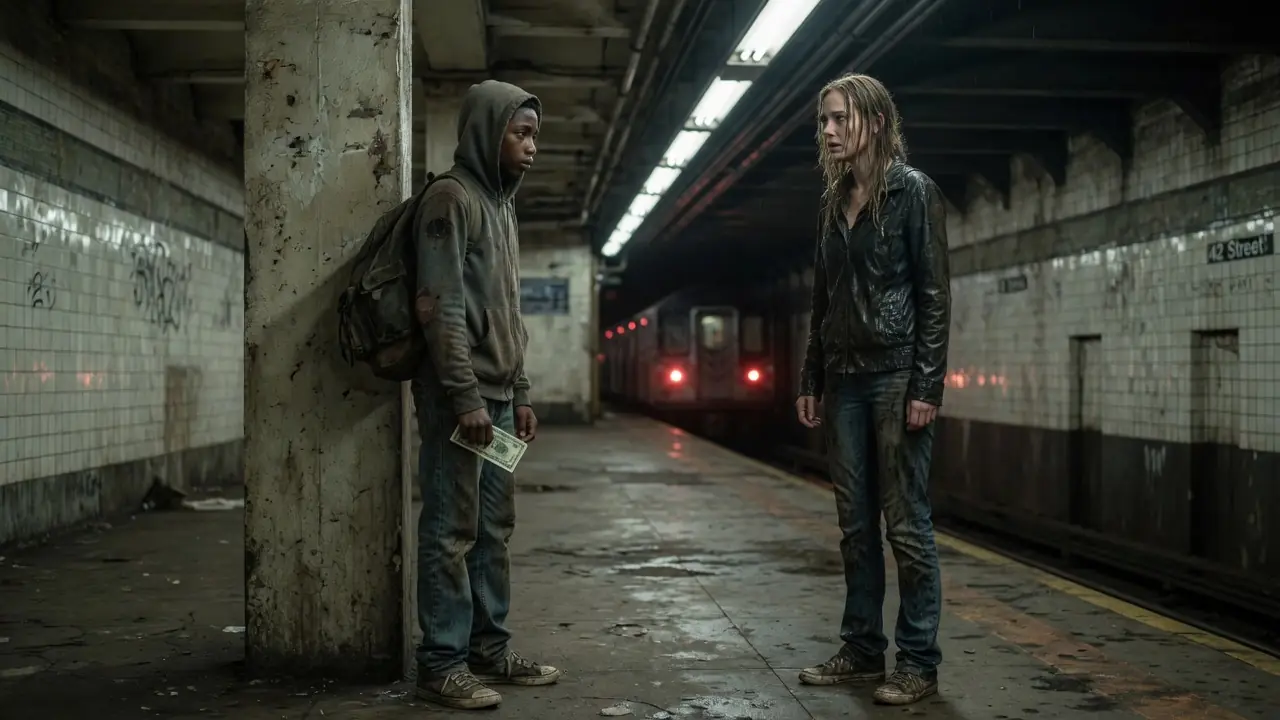
Jude Brooks, a homeless 16-year-old boy worn down by hunger, cold, and fear, clutched his last $20 in the pocket of his torn hoodie.
It was not just money.
It was his only chance to buy a bus ticket across town for a youth apprenticeship interview the next morning.
If he made it there, he might get into a program that offered paid training, school support, meals, and a safe place to sleep.
If he missed it, he did not know when another chance would come.
Then he saw her.
A girl about his age stumbled onto the subway platform, soaked from head to toe, her jeans muddy, her hands trembling, her breath breaking as she begged for help.
Her phone was gone.
Her wallet was gone.
Her last train home was pulling in.
Jude hesitated, torn between survival and compassion.
That $20 was supposed to save him.
But the fear in her eyes looked too real to ignore.
In the end, he still handed her that crumpled bill.
The girl stared at him like he had given her the whole world.
What Jude did not know was that this small act of kindness would soon upend everything and steer his life in a direction no one could have imagined.
The fluorescent lights of the subway station flickered like dying fireflies, casting restless light across the grimy tile floor.
It was half past midnight on a November Thursday, and the kind of cold that crept under your clothes and settled in your bones had driven most people into shelters, apartments, cars, or anywhere that had walls.
Jude Brooks stood near the far end of the platform, his back pressed against a concrete pillar covered in peeling advertisements and graffiti tags.
His hoodie had once been gray, maybe two years ago, but now it was faded, stained, and frayed at the sleeves. He had tried to mend one tear near the pocket with thread he found in a donated sewing kit, but the stitches were crooked.
He was sixteen years old, though most people thought he looked younger when he was scared and older when he was tired.
Tonight, he looked both.
His hood was pulled low over his forehead, not just against the cold, but against the stares.
Jude had learned that looking invisible was sometimes the only way to stay safe.
His right hand stayed buried deep in his pocket, fingers wrapped around a single $20 bill.
The edges were soft from being folded and unfolded too many times.
Twenty dollars.
That was what stood between him and a real chance at changing everything.
Jude pulled his hand out just enough to glance at the bill again, like he had done every hour for the past three days.
The green paper looked almost sacred beneath the harsh station light.
Tomorrow morning at 8:00 a.m., there was a bus that would take him twelve miles north to the Eastbridge Youth Trade Center.
They were interviewing applicants for a paid apprenticeship program.
Warehouse basics.
Electrical repair.
Carpentry.
High school completion support.
Breakfast and lunch included.
A social worker on site.
And for applicants without stable housing, a chance at a bed in the youth residence next door.
Jude had found the flyer taped to the window of a closed laundromat.
SECOND CHANCE YOUTH APPRENTICESHIP.
Ages 16 to 21.
No experience needed.
Show up. Work hard. Build your future.
Those words had stayed with him all week.
Build your future.
Jude had not thought about the future in a long time.
Most days, he only thought about surviving until night.
But when he saw that flyer, something inside him lifted.
Maybe this was it.
Maybe this was the door.
The bus fare was $18 round trip.
He would have $2 left, enough for a small coffee or a gas station muffin so he would not walk into the interview shaking from hunger.
He had rehearsed what he would say.
My name is Jude Brooks.
I am sixteen.
I want to work.
I want to finish school.
I just need one chance.
His stomach twisted, but he was not sure if it was from hunger or nerves.
Probably both.
“Last train to Riverside in five minutes,” a garbled voice announced over the PA system.
Five minutes.
Jude looked down the empty platform.
A few people waited, scattered across the space, each person wrapped in their own tired world.
A man in a business coat stared at his phone.
A woman with grocery bags sat on a bench, eyes half closed.
Two college students whispered to each other near the stairs.
Nobody made eye contact.
That was the unspoken rule of the late-night subway.
Jude checked the time on the station clock.
12:37 a.m.
He should go back to the spot behind the old movie theater where he had been sleeping.
It was not safe, exactly, but it was dry if he curled up under the broken awning near the service entrance.
A night guard had chased him away twice, but if Jude waited until after 1:00 a.m., the guard usually stopped making rounds.
Jude was about to turn toward the exit when he heard footsteps.
Fast.
Uneven.
Panicked.
They echoed through the tunnel entrance and bounced off the tile walls.
A girl burst onto the platform, her breath coming in broken gasps.
She was soaked from the rain that had started outside. Her light brown hair was plastered to her cheeks and neck. Mud streaked the knees of her jeans. One sleeve of her thin jacket was torn at the seam.
She looked around wildly.
Her hands were empty.
No backpack.
No phone.
No purse.
Nothing.
Her eyes scanned the platform with a kind of fear Jude recognized immediately.
He had seen that look before.
He had worn that look before.
Most of the waiting passengers looked away as soon as they noticed her.
The man in the business coat stepped back.
One of the college students whispered something and pulled her friend closer.
The girl’s gaze landed on Jude.
For one second, their eyes met.
He saw it clearly.
She was terrified.
She walked toward him with the desperate speed of someone who had already decided he was her only option.
Jude’s body tensed.
Every instinct told him this was trouble.
People did not usually approach him with good news.
They crossed streets to avoid him.
They held their bags tighter.
They told security guards there was a suspicious kid hanging around.
A frightened white girl running up to a homeless boy in a subway station after midnight could go wrong in too many ways.
“Please,” she said, her voice cracking.
She stopped a few feet away, close enough to talk, but not close enough to make either of them feel trapped.
Smart.
“Please, I need help.”
Jude’s hand moved instinctively to protect the pocket with his $20.
He did not say anything.
He just watched her.
“I know how this looks,” she said quickly. “I know you don’t know me, and I know it’s late, and I know this is weird, but I don’t know what else to do.”
She sucked in a shaky breath.
“My phone is gone. My wallet is gone. Some guys followed me from the bus stop. I ran, and I dropped everything. I think one of them took my bag. I just need to get home. I live in Riverside, and that’s the last train.”
She pointed toward the tunnel, where lights were beginning to appear in the distance.
“I need $20 for the fare. That’s it. I swear I’m not lying. I swear I’ll pay you back. I can meet you here tomorrow. I can give you my mom’s number. I just need to get home.”
Jude studied her face.
She was young.
Maybe fifteen or sixteen.
Her cheeks were red from the cold, her lips trembling. Even in her current state, you could tell she was not someone who spent nights on subway platforms asking strangers for money.
But Jude had been wrong before.
A month earlier, he had given his last five dollars to a boy outside a gas station who said he needed bus fare to get to his grandma’s house. Jude watched him ten minutes later buying vape cartridges from someone behind the store.
That was when Jude learned that kindness was a luxury he could barely afford.
“I don’t have money,” Jude said quietly.
His voice came out rougher than he meant.
“Please.”
Tears started rolling down her cheeks, mixing with rainwater.
“I’m not trying to trick you. I just need to get home. My mom is probably losing her mind. I told her I’d be home before midnight.”
The train was getting closer.
Jude could feel the rumble under his feet.
He looked at this girl standing in front of him, shaking from cold and fear, and something inside his chest cracked open.
She reminded him of his sister, Maya.
Maya had been three years older than him.
Back when she was alive, she used to ride the late bus home after work at a diner. Jude would stay awake waiting for her text.
Made it home, little man.
That was what she always sent.
Little man.
He hated that nickname when she was alive.
Now he would have given anything to hear it again.
Maya was gone now.
Overdose.
Three years ago.
He had been thirteen.
He had not been there to help her.
“Please,” the girl whispered one more time. “I’m begging you.”
Jude’s fingers tightened around the twenty in his pocket.
This was insane.
This was the stupidest thing he could possibly do.
Tomorrow morning, when that bus pulled away without him on it, he would hate himself for this moment.
He would miss the apprenticeship interview.
He would lose the one chance he had found in months.
He would still be sleeping behind buildings, hiding from guards, pretending not to be hungry.
But when he looked at her face, really looked, he did not see a scammer or a liar.
He saw real desperation.
He saw Maya.
“Damn it,” Jude muttered under his breath.
His hand pulled the $20 bill from his pocket.
It felt heavier than paper should feel.
The girl’s eyes widened.
“Here.”
He held it out.
She stared at the bill like she could not believe it was real.
“Are you sure?”
“No,” Jude said. “But take it before I change my mind.”
Her hand shot out and grabbed it.
For a moment, she just held the money and stared at him.
Shock.
Gratitude.
Disbelief.
All of it passed across her face at once.
“Thank you,” she breathed. “Thank you so much. I swear I’ll pay you back. I promise. What’s your name?”
The train burst out of the tunnel with a screech of brakes and a blast of hot, stale air.
The doors slid open.
“Go,” Jude said, nodding toward the train. “Just go.”
She hesitated.
“My name is Olivia,” she said quickly. “Olivia Hart.”
“Go, Olivia.”
The warning chime sounded.
Olivia turned and ran.
Her wet shoes slapped against the platform as she darted through the nearest door just before it closed.
Through the scratched window, Jude caught one last glimpse of her face.
She was looking right at him, mouthing words he could not hear.
Thank you.
Then the train lurched forward and pulled away into the dark tunnel, taking her and his last $20 with it.
Jude stood there on the empty platform, listening to the fading rumble of the train.
Slowly, he pulled his wallet from his back pocket and opened it.
Inside was nothing but an old student ID, a food stamp card with $6.40 left on it, and a faded photo of Maya from her high school graduation.
He had just given away his only way out.
The reality hit him all at once.
His knees felt weak.
Jude slumped back against the concrete pillar and slid down until he was sitting on the cold ground.
He pressed the heels of his hands against his eyes.
“What did you just do?” he whispered.
Nobody answered.
The platform was empty now except for him and the sound of water dripping somewhere in the distance.
Jude sat there for a long time, his wallet open in his hands, staring at Maya’s smiling face in the photograph.
She had been so proud that day.
Their mom had still been alive then, standing beside her in her best church dress, crying happy tears.
“I hope she gets home safe,” Jude whispered to the picture. “I hope I didn’t just ruin everything for nothing.”
But deep down, beneath the fear and anger at his own foolishness, there was something else.
Something small and warm that he had not felt in months.
He had helped someone.
He had seen another human being in trouble, and he had helped.
In a world that had spent years telling Jude Brooks that he was worthless, invisible, just another problem to be moved along, he had proven that he was still a person.
Still someone who could make a choice that mattered.
Even if that choice cost him everything.
Jude closed his wallet and pushed himself to his feet.
His legs ached from the cold.
The station felt even more empty now, wide and echoing.
He pulled his hood tighter and started walking toward the exit.
Outside, November rain came down hard.
City lights turned the wet streets and shiny, reflecting broken pieces of neon and headlights across the pavement.
Morning came cold and gray.
Jude woke behind the old movie theater at 5:47 a.m., his hoodie still damp, his body aching from concrete.
He checked the cracked screen of an old prepaid phone that no longer had service but still worked as a clock.
6:15 a.m.
The bus left at 8:00.
The interview started at 9:00.
Twelve miles.
If he walked fast, maybe three and a half hours.
He would be late.
But maybe they would understand.
He knew they probably would not.
Jude stood up, folded the cardboard he slept on, and started walking north toward the Eastbridge Youth Trade Center.
His feet hurt within the first hour.
Blisters formed by the second.
By 9:00 a.m., he was only halfway there, and the morning traffic had already thickened.
He did not stop walking.
At 10:32, Jude finally reached the building.
It was a low brick center with blue banners outside.
SECOND CHANCE YOUTH APPRENTICESHIP.
BUILD SKILLS. BUILD CONFIDENCE. BUILD YOUR FUTURE.
Jude’s shirt was damp with sweat beneath his hoodie.
Road dust covered his shoes.
His stomach was empty.
He knew exactly how he looked.
Inside the front office, a receptionist glanced up.
Her expression shifted immediately to concern, then caution.
“Can I help you?”
“I’m here for the 9:00 interview,” Jude said. “Apprenticeship program. My name is Jude Brooks. I know I’m late. I had transportation problems.”
She typed on her computer.
“Jude Brooks…”
She frowned.
“Mr. Harris already finished interviews for this round. When you didn’t arrive by 9:30, your slot was released to a walk-in applicant.”
Jude felt the floor tilt beneath him.
“Please,” he said. “I walked here. I came from downtown. I just need five minutes.”
The receptionist’s face softened.
“I’m sorry, honey. I really am. The program is full now. The next application cycle opens in three months.”
Three months.
Jude could barely imagine surviving three more days.
“Is there anyone I can talk to?”
“Mr. Harris is at the county office for the rest of the day. You can leave your name and number.”
“I don’t have a number.”
She looked at him then, really looked.
For a second, Jude thought she might do something.
Call someone.
Make an exception.
Offer food.
But then another phone rang on her desk.
She picked it up.
“Eastbridge Youth Trade Center, how may I help you?”
Jude stood there for a moment, invisible again.
Then he turned and walked out.
The return trip took even longer.
His blisters had burst.
Every step hurt.
He stopped twice at bus stops, watching buses he could not afford drive away.
By 3:00 p.m., he was back near the old movie theater.
The night guard, a heavyset man named Marcus, stood by the service entrance holding Jude’s garbage bag.
“No,” Jude said, speeding up. “Marcus, please.”
Marcus dropped the bag near the curb.
“I told you last night. You can’t sleep here anymore.”
“I wasn’t causing trouble.”
“Owner saw you on camera. Said if I let you stay again, I’m fired.”
“Just one more night.”
“You think I make the rules?”
Marcus went back inside and came out with Jude’s backpack.
He tossed it beside the garbage bag.
“That’s everything.”
“Where am I supposed to go?”
Marcus looked away.
“Not my problem, kid.”
Kid.
Jude hated that word.
Adults used it when they wanted to remind him he had no power.
He picked up his backpack and garbage bag.
Everything he owned fit in two bags.
People walked past without looking.
He was invisible again.
He wandered until he found a bus stop bench and sat down beneath an advertisement showing a smiling family around a dinner table.
Everyone in the picture looked clean and warm.
“You okay, son?”
An elderly man in a worn brown coat stood nearby holding a Bible.
His face was kind, but Jude did not trust kind faces easily anymore.
“I’m fine,” Jude said.
“You don’t look fine.”
The man sat down at the other end of the bench.
“Name’s Pastor William. I run the community center three blocks that way. We serve dinner at 6:00 if you’re hungry.”
“I’m not hungry.”
“Son, I’ve been doing this forty years. I know hungry when I see it.”
Jude did not respond.
“Pride is important,” Pastor William said gently. “But pride doesn’t fill your stomach.”
Jude stared at the street.
“I gave away my last $20 last night.”
Pastor William stayed quiet.
Jude did not know why he kept talking, but once the words started, they would not stop.
“Some girl at the subway. She needed to get home, and I gave her the money I needed for a bus ticket. I missed my interview. Lost my sleeping spot. Now I’ve got nothing because I tried to help somebody.”
Pastor William was quiet for a long moment.
“Or maybe you kept her from something terrible. You may never know.”
“Great.”
“I didn’t say it to make you feel better. I said it because it might be true.”
Jude looked at him.
“That doesn’t fix anything.”
“No,” Pastor William said. “It doesn’t. But it means your choice still mattered.”
He pulled out a card.
“Dinner at six. No questions, no judgment. We also work with youth outreach. If you’re under eighteen, we can help you find safer options than a bench.”
Jude stiffened.
“I’m not going into the system.”
Pastor William nodded slowly.
“I understand why you’d be afraid of that. But sleeping outside is dangerous too. Just come eat. You don’t have to decide anything tonight.”
He placed the card on the bench.
Then he stood and walked away.
Jude sat there until sunset.
When it got dark, he walked to an overpass near Sixth Street and curled up behind a concrete support beam.
He had come full circle in twenty-four hours.
From homeless to homeless.
From hopeful to empty-handed.
He lay down on cardboard and tried to sleep.
Tomorrow, he would figure out what to do.
Tonight, he just needed to disappear.
The cold woke him around midnight.
Jude pulled his hoodie tighter and curled into a ball, trying to preserve body heat.
Around him, he could hear the sounds of the city.
Traffic overhead.
Sirens in the distance.
Someone coughing a few yards away.
His stomach growled.
He had eaten nothing all day except a few crackers he found in the bottom of his backpack.
The hunger was a constant ache now, something he had learned to live with but never quite got used to.
Jude thought about Pastor William’s card in his pocket.
Dinner at 6:00 tomorrow.
He could go.
It would cost him nothing except pride.
At this point, pride seemed like a luxury he could not afford.
But something in him resisted.
Accepting help felt like admitting defeat.
Like proving everyone who had ever looked at him with pity was right.
He pulled out his wallet and opened it in the dim light from the highway above.
Empty except for his ID, the food stamp card, and Maya’s photo.
His sister smiled up at him in her graduation gown, full of hope and dreams that had died too soon.
“What would you tell me to do?” he whispered.
He could almost hear her voice.
Stop being stubborn, little man. Go eat.
Jude smiled despite everything.
A rat scurried past.
He did not flinch.
He had gotten used to sharing space with creatures people considered pests.
In a way, that was how society saw him too.
Something to be moved.
Swept away.
Hidden.
His feet throbbed from the long walk.
His back hurt from sleeping on concrete.
Every part of his body was telling him this could not continue.
But what choice did he have?
Tomorrow he would figure something out.
Maybe he would go to Pastor William’s community center.
Maybe he would try the youth shelter again, even though the last one had been crowded and loud and full of older boys who liked to test whoever looked weakest.
Maybe he would find a church basement.
For now, he just needed to make it through the night.
Jude closed his eyes and tried to think of better times.
His mother cooking Sunday dinner.
Maya laughing at his bad jokes.
The apartment they had before everything fell apart.
His own bed.
His own key.
A refrigerator with food in it.
How had he ended up here?
It was not one thing.
It was a thousand small disasters stacked on top of each other.
His mother getting sick.
Medical bills.
Maya spiraling after their mother died.
Jude missing too many school days.
Social workers who came and went.
A foster placement that did not last.
A group home where he never felt safe.
Running away.
Sleeping wherever he could.
Trying to survive one day at a time until survival became the whole shape of his life.
And now giving away that $20.
The final straw.
The thing that had pushed him from barely hanging on to completely lost.
But even knowing all that, Jude could not make himself regret it.
Olivia’s face had been real.
The fear had been real.
Whether he ever saw her again or not, she had needed help.
And he had helped.
Maybe that mattered.
Maybe it had to.
Three days passed.
Three days of walking streets with nowhere to go.
Three days of hunger that made his hands shake.
Three days of being invisible.
On the fourth morning, Jude went to the public library when it opened at 9:00 a.m.
The library was warm.
It had bathrooms where he could wash his face.
If he sat quietly in the back corner, sometimes nobody bothered him.
He found a table near the reference section and opened a book he did not intend to read.
For a while, he was not a homeless boy.
He was just a teenager at a table with a book.
He had been there about two hours when a security guard approached.
The guard was young, maybe twenty-five, with nervous eyes.
“Hey,” the guard said. “I need you to gather your things.”
Jude looked up.
“I’m reading.”
“You were sleeping.”
“I wasn’t.”
“Multiple people complained.”
Jude looked around.
An older woman lowered her eyes.
A college student stared at his laptop too intently.
The guard’s hand rested near his radio.
“Library policy says I have to ask you to leave.”
Jude felt heat rise in his neck.
“I’m not bothering anyone.”
“Please don’t make this difficult.”
There it was.
The warning beneath the polite words.
Easy way or hard way.
Jude knew how this ended if he argued.
The police would come.
They would see a teenage boy with a backpack and a bad attitude.
Suddenly, he would be dangerous.
“I’m leaving,” Jude said quietly.
He closed the book and walked toward the exit, feeling every eye follow him.
The security guard trailed him all the way to the door.
Outside, the cold hit immediately.
Jude pulled his hood up and started walking.
By midday, he was downtown, a part of the city he usually avoided.
Too many businesses.
Too many cameras.
Too many people ready to call someone if a kid like him sat too long.
But his feet hurt so badly he had to stop.
He found a narrow alley between two office buildings and slumped against the wall, hidden behind a dumpster.
He pulled out his backpack and searched for food.
Nothing.
Only a crushed mint wrapped in paper.
He put it in his mouth and let the sharp sweetness distract his stomach for a few seconds.
He was so focused on the empty bag that he did not hear them approach.
“Look at this. Sleeping beauty.”
Jude’s head snapped up.
Three boys stood at the alley entrance.
They looked older than him, maybe eighteen or nineteen.
One wore a college sweatshirt.
Another held a half-empty bottle in a paper bag.
The third filmed on his phone.
“Yo,” the one with the bottle said. “This is private property.”
Jude started to stand, calculating his exit.
The alley was a dead end.
He had to go through them.
“I’m leaving,” he said. “No trouble.”
“Nah,” the boy in the sweatshirt said, grinning. “You already made it trouble. People can’t just camp anywhere they want.”
“I said I’m leaving.”
“Get a job,” the one filming said.
Lazy.
The word hit even before they said it.
Jude picked up his backpack and tried to move past them.
The boy with the bottle stepped into his path.
“Say excuse me.”
Jude looked at him.
“Excuse me.”
“Say please.”
Jude’s jaw tightened.
“Please move.”
They laughed.
The boy in the sweatshirt kicked Jude’s backpack out of his hand.
It skidded across the alley and landed in an oily puddle.
“Oops,” he said. “My bad.”
Jude stared at the backpack.
Everything he owned.
His clothes.
His notebook.
Maya’s photo.
“Pick it up,” Jude said quietly.
The laughter stopped.
“What did you say?”
“I said pick up my bag.”
The boy’s smile faded.
“Who do you think you’re talking to?”
Jude knew he should back down.
Apologize.
Make himself small.
Survive.
But something inside him was too tired.
Too tired of being stepped over.
Too tired of being treated like trash.
“I’m talking to someone acting tough because he thinks nobody will stop him,” Jude said.
The first shove sent him into the brick wall.
Pain flashed through his shoulder.
The second boy grabbed his hoodie.
Jude tried to pull away, but the one with the bottle swung.
The bottle did not hit his head.
It smashed against the brick near him, spraying glass and beer.
Someone punched his ribs.
Air left his lungs.
Jude dropped to the ground and curled tight, covering his head.
“Teach him respect,” someone said.
A kick hit his back.
Another hit his thigh.
It lasted maybe twenty seconds before a voice shouted from the street.
“Hey! What’s going on back there?”
The boys scattered.
Footsteps ran.
Laughter faded.
Jude lay there waiting to make sure they were gone.
His ribs ached with every breath.
His hands shook.
A delivery driver in a brown uniform peered into the alley.
“You okay, kid?”
“Yeah,” Jude managed.
“You need me to call someone?”
“No.”
The man looked doubtful.
“You sure?”
Jude nodded.
The man hesitated, then stepped back.
“Stay safe.”
Then he left.
Jude crawled to his backpack and pulled it from the puddle.
He opened it with trembling fingers and found the plastic bag with Maya’s photo.
Still there.
Still dry.
He pressed it to his chest and closed his eyes.
This was it.
Rock bottom.
No money.
No food.
No safe place.
A missed interview.
A lost chance.
Beaten in an alley because he was easy prey.
That night, Jude went to Pastor William’s community center.
He almost turned around three times.
The building was old brick, with light spilling from the basement windows and the smell of soup drifting into the cold air.
A paper sign on the door read:
DINNER 6:00 TO 8:00.
EVERYONE WELCOME.
NO QUESTIONS.
Jude stood outside until his fingers went numb.
Then he pushed the door open.
The room inside was warm and noisy.
Long tables filled the basement.
Some people looked homeless.
Some looked like working families.
Some were elderly.
Some were kids with parents who looked exhausted.
No one stared at him for long.
A woman behind a serving table smiled.
“Grab a tray, sweetheart.”
Sweetheart.
Jude almost cried at the word.
He took a tray and received a bowl of soup, two slices of bread, and an apple.
He carried it to the corner and ate slowly, even though his body wanted to inhale everything.
Pastor William found him halfway through the meal.
“You came.”
Jude shrugged.
“I was hungry.”
“That’s a good enough reason.”
Pastor William sat across from him.
“I know someone I want you to meet. Her name is Martha. She helps with youth outreach.”
“I don’t want foster care,” Jude said immediately.
“No one is forcing you into anything tonight. But you’re sixteen. There are resources for you that don’t exist for adults. Safe ones, if we do this right.”
Jude looked down at his soup.
“People always say safe.”
Pastor William nodded.
“I know. Sometimes they’re wrong. So we move carefully.”
After dinner, Pastor William introduced him to Martha Reed.
She was in her late sixties, with silver hair in a bun and kind eyes behind wire-rimmed glasses.
She wore a long coat and carried a paper bag full of donated gloves.
“You must be Jude,” she said.
He stiffened.
“Pastor William told you about me?”
“Only that you needed dinner and maybe a little help. That is all.”
She handed him a pair of gloves.
“For the cold.”
“I don’t have money.”
“I didn’t ask for money.”
Jude took them carefully.
“Thank you.”
“You’re welcome, dear.”
Martha studied him for a moment.
Not with pity.
With attention.
“You look like someone who has had very bad luck,” she said. “But you do not look like someone who has given up. There is a difference.”
Jude did not know what to say.
Martha reached into her coat and pulled out a card.
“There’s a place called The Haven. It’s a youth residence and community kitchen about six blocks from here. They have emergency beds for young people, work training, counseling if you want it, and no one there will treat you like a criminal for needing help.”
“I don’t need charity.”
“Good,” Martha said. “Because I’m not offering charity. I’m offering a door.”
She placed the card on the table.
“The director’s name is Ben. Tell him Martha sent you. He will listen.”
Jude picked up the card.
“Why are you helping me?”
Martha smiled, but there was sadness in it.
“Because someone helped me once when I needed it. And because you look like someone who deserves a chance.”
That evening, Jude found himself standing in front of The Haven.
It was a two-story brick building between a laundromat and a bodega, with a faded sign and warm light in the windows.
He could hear voices inside.
Laughter.
Dishes clattering.
Music from an old radio.
He almost turned around again.
Then he thought of Maya.
Stop being stubborn, little man.
Jude pushed the door open.
Inside was warmer than expected.
A tall man with graying hair and broad shoulders walked between tables, stopping to talk to people.
He had the kind of presence that said he was in charge without needing to announce it.
Jude approached carefully.
“Are you Ben?”
The man turned.
“I am. And you are?”
“Jude Brooks. Martha sent me.”
Ben’s expression changed immediately.
“Martha, huh? That woman has a gift for finding people who need us.”
He extended his hand.
“Welcome to The Haven, Jude. You hungry?”
“I ate at the community center.”
“Good. Then we can talk.”
Ben led him to a small office near the kitchen.
It had mismatched chairs, a desk covered in papers, and a wall full of photos of young people at graduations, job sites, and birthday parties.
Ben gestured for him to sit.
“You’re sixteen?”
Jude nodded.
“Any family we can call?”
“No.”
“No relatives?”
Jude looked away.
“No one safe.”
Ben did not push.
“You been sleeping outside?”
“Yes.”
“How long?”
Jude hesitated.
“On and off for months.”
Ben’s face tightened, but his voice stayed calm.
“Here’s what I can offer tonight. A bed in the emergency youth room. Shower. Clean clothes. Breakfast in the morning. Tomorrow, we talk about school, paperwork, and next steps. Nothing happens without you understanding it.”
Jude looked at him.
“You’re letting me stay here? You don’t even know me.”
“Martha sent you. Pastor William trusts you enough to call ahead. And you walked through the door on your own. That’s enough for tonight.”
Ben opened a drawer and pulled out a small key card.
“We’ve all needed help sometime, Jude. There’s no shame in accepting it when it’s offered.”
That night, Jude slept in a small room with four beds.
Two were occupied by other boys who barely looked up when he came in.
The mattress was thin.
The blanket had been washed so many times it had faded.
The pillow was flat.
But the door locked.
The room was warm.
And no rain could reach him.
For the first time in weeks, Jude slept through the night.
The next three weeks passed in a blur of routine.
Jude woke every morning at 6:30.
He made his bed because Ben said the first way to take your life seriously was to take your space seriously.
He helped unload food deliveries.
He mopped floors.
He carried boxes.
He attended meetings with a caseworker named Alicia, who helped him replace his birth certificate and school records.
He started online classes through a district program for unhoused youth.
He ate three meals a day.
The first time he realized he had gone a whole afternoon without his stomach hurting, he nearly cried.
The people at The Haven learned his name.
Miss Rosa, who ran the kitchen, gave him extra cornbread when she thought he looked too thin.
Alicia found him a winter coat from the donation closet.
Ben gave him small repair jobs around the building and paid him a little cash for each one.
Not much.
But enough to buy deodorant, a notebook, and a used copy of a math workbook.
Jude started feeling human again.
Still, he thought about Olivia.
Every time he touched the empty place in his wallet where the $20 had been, he wondered if she made it home.
He wondered if she had forgotten him.
He told himself it did not matter.
He had done the right thing.
That should be enough.
On a Tuesday afternoon, three weeks after the subway station, Jude was setting up chairs in the main room for a workshop.
The Haven was hosting a session on job readiness for teenagers.
He was lining up the chairs in careful rows when the front door opened behind him.
“Sorry,” he called over his shoulder. “Workshop doesn’t start until five.”
“I’m not here for the workshop.”
The voice was familiar.
Jude turned.
A girl stood in the doorway.
For a second, he could not process what he was seeing.
She wore a clean navy school blazer, a plaid skirt, tights, and polished shoes. Her hair was brushed into soft waves. A small silver necklace rested at her throat.
She looked nothing like the soaked, terrified girl from the subway platform.
But her face was the same.
“Olivia?” Jude breathed.
Her eyes filled instantly.
“Hi, Jude.”
He just stared.
“How did you find me?”
“I’ve been looking for you for three weeks,” she said. “I went back to that subway station every day after school. I asked the workers. I put up notes. My mom hired people to search shelters and community centers. Then someone at Pastor William’s center remembered your name.”
Jude did not move.
Olivia took one careful step forward.
“I know this is strange. Can we talk?”
Jude looked toward the kitchen.
“Ben?”
Ben appeared a moment later, wiping his hands on a towel.
His eyes moved from Jude to Olivia.
“Everything okay?”
“I think so,” Jude said.
Ben studied Olivia’s face.
Then he looked back at Jude.
“Stay where I can see you through the window.”
Jude appreciated that more than he could explain.
He led Olivia to the bench outside The Haven.
The afternoon was cold but clear.
Cars moved along the street.
Someone across the road was sweeping the entrance of the bodega.
For a moment, neither of them spoke.
“You look better,” Olivia said softly.
“Better than homeless and freezing?”
She winced.
“I didn’t mean it like that.”
“I know.”
She looked down at her hands.
“I’m sorry.”
“For what?”
“For taking your money. For not getting your name fast enough. For not finding you sooner.”
Jude looked at her.
“You made it home?”
She nodded.
“Because of you.”
Her voice shook.
“I got on that train. I got to Riverside. My mom was waiting at the station with police because she had called everyone. I was so scared. I kept trying to explain that a boy helped me, that he gave me his last money, but I didn’t know your last name. I only knew Jude.”
“What happened that night?” Jude asked.
Olivia swallowed.
“I was at a tutoring session. My driver was supposed to pick me up, but I left early after an argument with my mom over the phone. It was stupid. I thought I could take the bus by myself to prove I didn’t need everyone watching me all the time.”
She wiped at her eyes.
“Some older guys followed me from the stop. One grabbed my bag. I ran. I fell. I made it to the subway, but I had nothing.”
“So you weren’t lying.”
“No,” she said quickly. “I would never lie about that. But I understand why you might have thought I was.”
Jude leaned back against the bench.
“Your driver?”
Olivia’s cheeks flushed.
“My mom runs Hart Technologies.”
Jude frowned.
“Hart Technologies?”
Olivia pulled out her phone and showed him a company page.
A woman in a sharp suit smiled from the screen.
Lauren Hart, CEO and founder.
“My mom,” Olivia said. “She’s been trying to find you too.”
Jude stared at the phone.
Of course.
Of course the girl he saved belonged to a world of drivers, private schools, and CEOs.
A world so far from his that it might as well have been another planet.
“I didn’t know,” Olivia said, reading his face. “I didn’t want anything from you because of money. I just needed help.”
“I know.”
“My mom wants to meet you,” Olivia continued. “But only if you’re okay with it. She said not to scare you. She said adults showing up with lawyers and cars is not how you thank a kid who has already been through too much.”
That made Jude laugh despite himself.
“She sounds smart.”
“She is. And terrifying.”
The door to The Haven opened.
A SUV parked at the curb.
A woman stepped out, tall and composed, wearing a dark coat over a tailored suit.
She looked like the photo from the website, but less polished now.
More human.
Her eyes went straight to Olivia first, checking her the way mothers do.
Then she looked at Jude.
She did not rush toward him.
She did not reach for him.
She stopped a respectful distance away.
“Jude?” she said gently. “My name is Lauren Hart. I’m Olivia’s mother.”
Jude stood, suddenly aware of his secondhand coat, his worn shoes, his hands shoved awkwardly into his pockets.
“Hi.”
Lauren’s eyes were bright.
“I have wanted to say thank you for three weeks.”
“You don’t have to.”
“Yes,” she said. “I do. My daughter came home because of you.”
Olivia stepped closer to her mother.
Lauren placed a hand on her shoulder.
“That night could have ended very differently. You were scared too. You had every reason to protect yourself. But you helped her anyway.”
Jude looked down.
“It was just $20.”
Lauren shook her head.
“It was not just $20. Olivia told me she saw your face when you gave it to her. She knew it mattered. She knew you were giving up something important.”
Jude swallowed.
“I missed an interview because of it.”
“I know,” Lauren said softly.
He looked up sharply.
She continued.
“Ben told me. Only after I asked what kind of help you might need, and only with your permission to continue this conversation.”
Jude glanced toward the window.
Ben stood inside, visible but not hovering.
Lauren opened a folder she carried under one arm.
“I can’t undo what you lost that morning. But I would like to help create a new chance, if you’ll allow it.”
Jude stiffened.
“I don’t want charity.”
“It’s not charity,” Lauren said. “It’s an opportunity. And it comes with choices. You can say no to any part of it.”
She handed him the folder.
Inside was a letter on Hart Foundation stationery.
Jude read the first line three times before it made sense.
The Hart Foundation Youth Fellowship.
Full educational support.
Paid internship.
Housing stipend through The Haven.
Mentorship.
Transportation pass.
Weekly counseling available but not required.
A savings account opened in his name, with financial guidance.
Jude’s hands started shaking.
“What is this?”
Lauren’s voice was steady.
“My company has a foundation. We fund education, workforce training, and housing support. After what happened to Olivia, I realized something. We build programs from boardrooms. We read reports about vulnerable youth. But we do not always listen to the people who actually know what survival looks like.”
She looked at him.
“You know. And you deserve more than survival.”
Olivia stepped forward.
“This was my idea too,” she said quickly. “Not all of it. The adults did the paperwork. But I told Mom if we just gave you money and disappeared, that would be wrong. You gave me a way home. We should help you build a home for yourself.”
Jude stared at the folder.
“I don’t have a normal school record.”
“We can work with that,” Lauren said.
“I missed a lot of classes.”
“We can work with that.”
“I’ve been homeless.”
“That is exactly why this support exists.”
“I don’t know how to be in places like your company.”
Lauren smiled a little.
“Most adults there don’t either. They just wear better shoes.”
Jude almost smiled.
Lauren continued.
“The fellowship would let you finish high school through a flexible program. You would spend ten hours a week at the foundation helping us review youth outreach ideas. Not as a symbol. Not as a charity case. As a paid youth advisor. Your voice would matter.”
Jude looked at the amount listed on the page.
Weekly stipend.
Transportation.
Clothing allowance.
Savings match.
It felt unreal.
“Why me?” he asked.
Lauren’s expression softened.
“Because when my daughter was alone and terrified, you saw her as a person. Not as a problem. Not as a risk. Not as someone else’s responsibility. That kind of judgment is rare.”
Olivia’s voice broke.
“And because I’m here because of you.”
Jude looked down at the letter again.
For three weeks, he had wondered whether that $20 had ruined his life.
Now he was holding proof that it had opened a door.
But fear still pressed against his ribs.
“What if I mess it up?”
Lauren answered without hesitation.
“Then we help you try again.”
That was the sentence that broke him.
Not the money.
Not the program.
Not the fancy letterhead.
Then we help you try again.
Jude blinked fast, but the tears came anyway.
He turned his face slightly, embarrassed.
Olivia cried too.
Lauren did not crowd him.
She simply waited.
Finally, Jude took a breath.
“I need Ben to read it.”
“Of course,” Lauren said.
Ben came outside.
He read every page carefully.
Then he looked at Jude.
“This is real,” he said. “And it’s good. We can make sure everything protects you. No one takes control away from you. No one uses your story without permission.”
Lauren nodded.
“That is already written in. Jude owns his story.”
Ben handed the folder back.
“What do you want to do?”
Jude thought of Maya.
He thought of the subway station.
The $20.
The missed interview.
The overpass.
The alley.
The hot meal.
The first safe bed.
He thought of Olivia looking at him through the train window.
He thought of all the versions of himself that had almost given up.
“I want to try,” he said.
Olivia smiled through tears.
Lauren extended her hand.
“Then welcome to the Hart Foundation Youth Fellowship, Jude Brooks.”
Jude shook her hand.
It felt like stepping onto a bridge he could not see the end of.
But this time, he was not stepping alone.
The next months changed Jude’s life slowly, then all at once.
The first change was practical.
He stayed at The Haven, but now with a longer-term youth housing plan.
His bed moved from the emergency room to a small shared apartment unit on the second floor.
He had a desk.
A lamp.
A closet.
A key.
A real key.
The first night he turned that key in the lock, he stood in the doorway for almost a full minute.
Alicia, his caseworker, smiled from the hallway.
“You okay?”
Jude nodded.
“I just haven’t had a key in a long time.”
She understood.
No speech.
No pity.
Just a quiet nod.
The second change was school.
Hart Foundation arranged a flexible education plan through the district. Jude took placement tests, then started online classes in math, English, history, and science.
At first, he hated it.
Not because he was lazy.
Because it made him feel stupid.
He had missed too much.
Fractions frustrated him.
Essays felt impossible.
The first time he failed a practice test, he shoved the laptop away and walked out of the study room.
Ben found him sitting on the stairs.
“I can’t do it,” Jude said.
“You can’t do it yet,” Ben corrected.
“That’s just something adults say.”
“Sometimes adults say true things.”
Jude looked away.
Ben sat beside him.
“You survived outside. You found food when you had none. You kept yourself alive in a city that did not make it easy. Do not tell me a paragraph is stronger than you.”
Jude hated that it worked.
He went back inside.
He tried again.
Slowly, the grades improved.
The third change was work.
Every Wednesday and Friday afternoon, Jude took the bus to the Hart Foundation office.
The first day, he stood outside the glass building for five full minutes.
It reflected the sky like a mirror.
People in suits walked in and out, badges swinging from lanyards.
Jude nearly turned around.
Then Olivia appeared at the door, waving both arms.
“You came!”
She wore her school uniform and carried a backpack covered in pins.
“What are you doing here?”
“Mom said I could be here for your first day. Also, I wanted to see your face when you saw the snack room.”
“The what?”
“You’ll understand.”
Lauren met them in the lobby.
She had a visitor badge ready for Jude and introduced him to everyone not as a rescued boy, not as a charity case, but as a youth fellow.
“This is Jude Brooks,” she said. “He will be advising us on youth outreach and access barriers. If he tells you something doesn’t work, listen.”
People shook his hand.
Some smiled too brightly.
Some looked awkward.
Some seemed genuinely interested.
Jude noticed everything.
Later, in a conference room, Lauren asked him a simple question.
“What would have helped you most the night before your missed interview?”
Jude did not answer immediately.
He thought about it.
“Transportation,” he said.
Lauren wrote it down.
“What else?”
“A place to clean up before interviews. You can’t walk into a program smelling like outside and expect people to see potential.”
Lauren nodded.
“What else?”
“Someone to text you reminders. But not like a robot. Someone who knows you might not have phone service. So maybe physical check-ins too.”
“What else?”
Jude’s voice grew stronger.
“Emergency micro-grants. Not big money. Just enough for bus fare, ID replacement, laundry, food before an interview. People lose opportunities over tiny amounts of money.”
Lauren stopped writing and looked at him.
“That’s important.”
Jude nodded.
“Twenty dollars can be the whole difference.”
The room went quiet.
Olivia looked down.
Lauren’s eyes softened.
“That will be the first pilot,” Lauren said. “The Twenty Dollar Bridge Fund.”
Jude stared at her.
“You’re naming it that?”
“If you approve.”
He looked at Olivia.
She smiled gently.
Jude swallowed.
“I approve.”
The Twenty Dollar Bridge Fund launched six weeks later.
It provided small emergency grants to unhoused and low-income youth for transportation, document fees, interview clothes, laundry, meals, and phone minutes.
No complicated forms.
No humiliating proof requirements.
A youth worker verified the need and gave immediate help.
The first month, the fund helped 212 young people.
A girl used $18 to get to a nursing assistant exam.
A boy used $12 to replace a school ID.
A young mother used $20 for bus fare to a shelter intake appointment.
A teenager bought non-slip shoes for a restaurant job.
Every report came across Jude’s desk.
Every story felt personal.
One afternoon, he saw a note from a caseworker.
Client said, “I never knew such a small thing could make me feel like someone believed in me.”
Jude printed that note and taped it above his desk.
Time moved.
Winter softened into spring.
Jude gained weight.
His cheeks filled out.
His clothes fit better.
He laughed more.
Not loudly at first.
But enough that Ben noticed.
“You sound like a kid again,” Ben said one evening.
Jude frowned.
“I am a kid.”
Ben smiled.
“Exactly.”
Olivia became his friend.
A real friend.
Not a symbol of what he had lost or gained.
Just Olivia.
She visited The Haven with her mother, helped organize book drives, and sometimes sat with Jude in the study room working on her own homework while he struggled through algebra.
She was smart, but not in a way that made people feel small.
She asked too many questions.
She talked fast when she was excited.
She confessed one day that she hated being treated like “the rich girl who should never complain.”
Jude looked at her over his math workbook.
“You do complain a lot.”
She threw an eraser at him.
He laughed so hard Miss Rosa yelled from the kitchen, “Don’t break my chairs in there.”
Their friendship became something steady.
Jude never forgot that their worlds were different.
Olivia never pretended they were the same.
But she listened.
And that mattered.
One evening, near the anniversary of the subway night, Lauren invited Jude, Ben, Martha, Pastor William, Alicia, Olivia, and the staff from The Haven to the Hart Foundation office.
Jude thought it was a small dinner.
It was not.
When he walked into the main event room, he froze.
The walls were covered with photos.
Young people receiving bus passes.
Students with backpacks.
Apprentices at job sites.
A girl holding up her nursing assistant certificate.
A boy standing beside a repaired bicycle he now used to get to work.
At the center of the room was a framed $20 bill.
Not the exact one Jude had given Olivia.
That one had been spent on the fare that got her home.
But Lauren had found another bill from the same year, same series, and placed it in a frame with a plaque beneath it.
THE TWENTY DOLLAR BRIDGE.
In honor of the night one young person helped another get home.
May we never underestimate the power of a small act of courage.
Jude stared at it.
His throat tightened.
“You did this?” he asked.
Olivia stood beside him.
“We all did.”
Lauren stepped forward.
“The fund has now helped over one thousand young people.”
The room applauded.
Jude looked around, overwhelmed.
“I didn’t do that,” he said.
Ben put a hand on his shoulder.
“Yes, you did. Not alone. But it started with you.”
Lauren handed Jude an envelope.
“What is this?”
“Open it.”
Inside was a new letter.
Eastbridge Youth Trade Center.
Acceptance into the next apprenticeship cohort, with transportation and schedule support already arranged.
Jude looked up.
Lauren smiled.
“You missed the first interview. You won’t miss this one.”
Jude’s hands shook.
“I get another chance?”
Ben’s voice was soft.
“You get as many chances as it takes.”
That was when Jude cried.
Not because he was broken.
Because for the first time, he believed he might not have to break in order to be seen.
Three years passed.
Jude Brooks grew from a frightened sixteen-year-old boy into a young man with steady eyes and a voice people listened to.
He finished high school through the flexible program.
He completed the Eastbridge apprenticeship with honors.
He learned basic electrical repair, carpentry, warehouse systems, and community project coordination.
But the thing he loved most was outreach.
He knew how to talk to kids who did not trust adults.
He knew not to stand too close.
Not to ask too many questions too quickly.
Not to say, “I understand,” unless he truly did.
He knew that a sandwich could be an opening.
A bus pass could be a bridge.
A clean hoodie could be dignity.
A locked door could be safety.
At nineteen, Jude became a full-time youth outreach coordinator at the Hart Foundation.
Not because he was a sad story.
Because he was good at the work.
The Twenty Dollar Bridge Fund expanded to five cities.
The Haven opened a second residence.
Pastor William’s community center received permanent funding.
Eastbridge Youth Trade Center partnered with the foundation to reserve slots for unhoused youth.
Martha became the unofficial grandmother of every program.
Ben served on the advisory board.
Alicia became director of youth housing strategy.
Olivia graduated high school and chose to study social policy, despite her mother joking that she had been “raised by grant proposals and stubborn teenagers.”
On the fifth anniversary of the subway night, the Hart Foundation held a community event at Civic Center Plaza.
Food trucks lined the street.
Music played.
Kids ran between tables.
Former program participants stood beside mentors, caseworkers, teachers, and employers.
Jude, now twenty-one, stood backstage holding note cards he barely needed.
Ben adjusted his tie.
“You ready?”
“No.”
“Good. Means you care.”
Jude smiled.
“You always say that.”
“And I’m always right.”
Lauren Hart introduced him to the crowd.
“Five years ago,” she said, “my daughter came home because a sixteen-year-old boy with almost nothing chose to give what he had. Today, that choice has helped build programs that have served over twelve thousand young people.”
The crowd applauded.
Jude stepped to the microphone.
For a moment, he looked out at all the faces.
Young people from shelters.
Donors in suits.
Teachers.
Parents.
Volunteers.
Formerly homeless youth now wearing work uniforms, college sweatshirts, and name badges.
He saw Olivia in the front row, smiling.
Martha beside her, crying already.
Ben standing with arms crossed, proud.
Pastor William holding his Bible.
Alicia wiping her eyes before he even started.
Jude took a breath.
“Five years ago,” he began, “I thought $20 was my last chance.”
The crowd quieted.
“I was sixteen. I was hungry. I was homeless. I had an interview the next morning for a program I believed might save my life. That $20 was my bus fare. It was my breakfast. It was my plan.”
He paused.
“Then a girl came running onto a subway platform, soaked and scared, asking for help. I did not know who she was. I did not know if I would ever see her again. I only knew she needed help.”
His eyes moved to Olivia.
“So I gave her the $20.”
Olivia wiped tears from her cheeks.
“I missed my interview. I lost my sleeping spot. I spent the next days thinking I had ruined my life by trying to do the right thing.”
Jude looked back at the crowd.
“But kindness is not a straight line. Sometimes you do not see where it is going. Sometimes it disappears into a tunnel like a train, and you think it is gone forever.”
A soft laugh moved through the crowd.
“But sometimes, kindness comes back. Not always as money. Not always as a miracle. Sometimes it comes back as a meal, a safe bed, a second chance, a person who says, ‘Try again.’”
He looked at the framed $20 bill displayed beside the stage.
“That is what this work is about. Not charity. Bridges. Small bridges. Practical bridges. Human bridges. The kind that help someone cross from one dangerous night into a different morning.”
The applause started before he finished.
Jude waited, then continued.
“To every young person here who thinks one mistake, one missed bus, one bad night, one lost home, or one broken family means your story is over, I need you to hear me.”
His voice grew stronger.
“You are not invisible. You are not disposable. You are not too late. You are still becoming.”
The plaza erupted.
People stood.
Some cheered.
Some cried.
Jude stepped back from the microphone, overwhelmed.
Olivia ran onto the stage and hugged him.
Not like the scared girl from the subway.
Not like the rich girl trying to repay a debt.
Like a friend who had walked beside him through years of becoming.
“You did it,” she whispered.
Jude hugged her back.
“We did.”
Later that night, after the crowd thinned and volunteers began folding tables, Jude stood near the edge of the plaza with Lauren and Olivia.
The framed $20 bill rested in a protective case nearby, ready to be returned to the foundation wall.
Lauren looked at Jude.
“Do you ever think about what would have happened if you had said no that night?”
Jude looked across the plaza.
A group of teenagers from The Haven were helping load supplies into a van.
One of them laughed so loudly the sound carried across the square.
“Sometimes,” Jude said.
“And?”
“I think Olivia still might have found a way home. Maybe. But I don’t know if I would have found my way back to myself.”
Olivia’s eyes softened.
“You helped me get home.”
Jude smiled.
“And somehow, that helped me find one.”
Martha joined them, carrying three cups of coffee.
“I heard that,” she said. “And it was beautiful, so I’m pretending I came over at the right time on purpose.”
Olivia laughed.
“You always come over at the right time.”
“That is because I am wise.”
Lauren rolled her eyes affectionately.
Jude took one of the coffees and looked toward The Haven van.
Ben was waving him over.
“Duty calls,” Jude said.
Lauren smiled.
“It always does.”
He started walking, then paused and looked back.
“Hey, Olivia.”
“Yeah?”
“Thank you for telling your mom to find me.”
Olivia shook her head.
“Thank you for giving me your last $20.”
Jude smiled.
“Best investment I ever made.”
He walked toward the van, toward Ben, toward the young people waiting for him, toward the work that had become his purpose.
The city still had cold nights.
There were still kids sleeping in places no kid should sleep.
There were still missed buses, empty stomachs, locked doors, and people who looked away.
But there were also bridges now.
There was The Haven.
There was the Twenty Dollar Bridge Fund.
There were people who noticed.
People who listened.
People who remembered that sometimes the smallest act of kindness could become the beginning of an entire life rebuilt.
Jude Brooks had given away his last $20 when he was sixteen years old.
He had thought he was losing his only chance.
Instead, he had planted one.
And years later, that one small choice was still growing.
One bus pass.
One warm meal.
One safe bed.
One second chance.
One young life at a time.