An elderly man collapsed in the pouring rain. Everyone walked past him. Everyone except nineteen-year-old Marcus Williams.
Without hesitation, he ran to help.
He gave him his jacket, his umbrella, his only meal of the day, even his last eight dollars for a taxi home.
Marcus had no idea who he had just helped.
For three weeks, nothing happened.
He went back to his struggling life, counting coins for bus fare, choosing between rent and food, walking miles to work in the rain.
Then everything changed.
A letter arrived.
An impossible opportunity.
A chance to transform not just his life, but his entire community.
But when he discovered the truth about that stranger’s identity, he could not believe it.
The connection was so shocking, so unbelievable, that he almost threw the letter away.
This is the story of what happened next.
Most people would have given up by now, but Marcus had something that kept him going.
Six a.m.
The alarm screamed from his phone, but Marcus was already awake. He had been staring at the ceiling for hours, doing math in his head.
Rent was due in two days.
He was exactly two hundred dollars short.
His studio apartment in East Oakland was not much. Peeling paint on the walls, a mattress on the floor, a mini fridge that hummed too loudly and barely kept milk cold.
But it was his.
The first place he had ever lived alone after his parents passed away two years ago.
Marcus rolled out of bed and opened the mini fridge. One slice of bread left, half a jar of peanut butter. He made his breakfast and packed the other half for lunch.
That was it until his paycheck tomorrow.
He counted the coins on his dresser. Enough for the bus to work, but not back.
He would have to walk home again.
At nineteen, Marcus was already exhausted by life. Two part-time jobs just to survive. Morning shifts at Murphy’s Diner on Telegraph Avenue. Evening tutoring sessions at the community center. In between, he squeezed in classes at Oakland Community College, studying social work.
He wanted to help kids like himself.
Kids who had lost everything and had to figure out how to keep going.
Marcus grabbed his small notebook from the nightstand. Every morning, he wrote down three things he was grateful for.
Today: roof over my head. Two more days until payday. The kids I’m tutoring are getting better at math.
He had started this habit after his parents died. When everything felt hopeless, he forced himself to find something good. Some days, it was just, “I’m still breathing.”
But it helped.
The bus ride to Murphy’s Diner took twenty minutes. Marcus used the time to review his notes for his social services class. He had a test next week, but between work and worrying about money, it was hard to focus.
Murphy’s Diner was the kind of place where truckers stopped for coffee at five in the morning and college kids came for cheap pancakes after midnight. Marcus had been working there for eight months. The pay was terrible, but his boss, Janet, was kind.
And Janet let him take home leftover food sometimes.
“Morning, honey,” Janet called from behind the counter.
She was sixty-something, with gray hair always pulled back in a bun and eyes that missed nothing.
“Morning, Janet.”
Marcus tied his apron and grabbed the coffee pot.
The morning rush was about to begin.
For six hours, Marcus poured coffee, served eggs, and smiled at customers even when they were rude. Even when they left no tip. Even when they looked right through him like he did not exist.
During his break, he ate half his peanut butter sandwich and saved the rest for later.
His stomach growled, but he ignored it.
“You okay, sweetheart?” Janet asked, noticing Marcus pushing food around his plate.
“Just tired,” Marcus lied.
He could not tell Janet he was choosing between rent and food. Janet would try to help, and Marcus had too much pride for that.
After his shift, Marcus walked the two miles to community college. His feet already hurt, but he could not afford the bus. He used the walk to mentally prepare for his afternoon classes.
Social work theory. Child psychology. Statistics.
Marcus loved learning, but it was hard to concentrate when his stomach was empty and his mind kept calculating bills.
In child psychology, they discussed kids in foster care, kids who had been abandoned. Marcus took detailed notes, thinking about his tutoring students. He understood their fear, their anger, their desperate need for someone to believe in them.
After classes, Marcus walked another mile to the east side community center.
This was his favorite part of the day.
The community center was old but clean. Motivational posters covered the walls. The smell of industrial cleaner mixed with the sound of kids playing basketball in the gym next door.
Marcus’s tutoring group was six kids, ages eight to fourteen, all struggling in school, all from families who could not afford private tutoring.
“Mr. Marcus!”
Eight-year-old Jordan ran up to him.
“I got a B on my math test.”
Marcus’s heart swelled.
“That’s amazing, Jordan. I’m so proud of you.”
For two hours, he helped them with homework, math problems, reading comprehension, essay writing. He bought supplies with his own money: pencils, notebooks, snacks for the kids who came hungry.
He could not afford it, but he did it anyway.
These kids needed someone who cared, someone who understood what it felt like to struggle.
At eight p.m., his tutoring session ended. The kids hugged him goodbye, and Marcus began his two-mile walk home.
At home, he ate his remaining half sandwich for dinner. He did homework until midnight, then set his alarm for six a.m.
Before bed, he wrote in his notebook.
Day 847 since Mom and Dad died. Helped Jordan understand fractions. He’s so smart when he believes in himself. Janet saved me some soup from the diner. Still short on rent, but I’ll figure it out. I always do.
Marcus closed the notebook and lay down on his mattress.
Tomorrow would bring the same struggles, the same choices between necessities, the same empty stomach and aching feet, but also the same hope, the same determination to build something better.
He had no idea that in less than twenty-four hours, everything would change.
That a stranger’s crisis would become his opportunity.
That choosing kindness over self-preservation would transform not just his life but an entire community.
All because of a storm and a decision that would define who he really was.
That Tuesday started like any other, until the storm hit and everything changed.
Marcus finished his tutoring session at 8:15 p.m. Outside, dark clouds rolled in from the San Francisco Bay. The air smelled like rain. The last bus to his neighborhood ran at 8:45. If he hurried, he could make it.
But as he stepped outside, the first drops began to fall.
Within minutes, the drops became a downpour.
Then something else entirely.
Marcus had lived in Oakland his whole life, but he had never seen rain like this. It hammered the sidewalk hard. The wind whipped his hair and made it impossible to see.
He ran toward the bus stop, backpack clutched against his chest. His shoes were already soaked through.
At the bus stop, a small crowd huddled under the shelter. The electronic sign was blank.
“Excuse me?” Marcus asked an older woman. “Are the buses still running?”
The woman shook her head.
“They’ve suspended service. Flooding on Telegraph Avenue. Nobody’s getting home without a car.”
Marcus’s stomach dropped.
He checked his phone.
Eight dollars and fifty cents.
His bus money for tomorrow and lunch money.
A taxi would cost twenty dollars.
Money he did not have.
Two miles to walk in this storm.
The weather got worse with each block. Tree branches fell across sidewalks. Street lights flickered. Cars crawled through flooded intersections. Marcus was soaked within ten minutes. His backpack felt like it weighed fifty pounds. Every step squelched in waterlogged shoes.
Halfway home, he saw him.
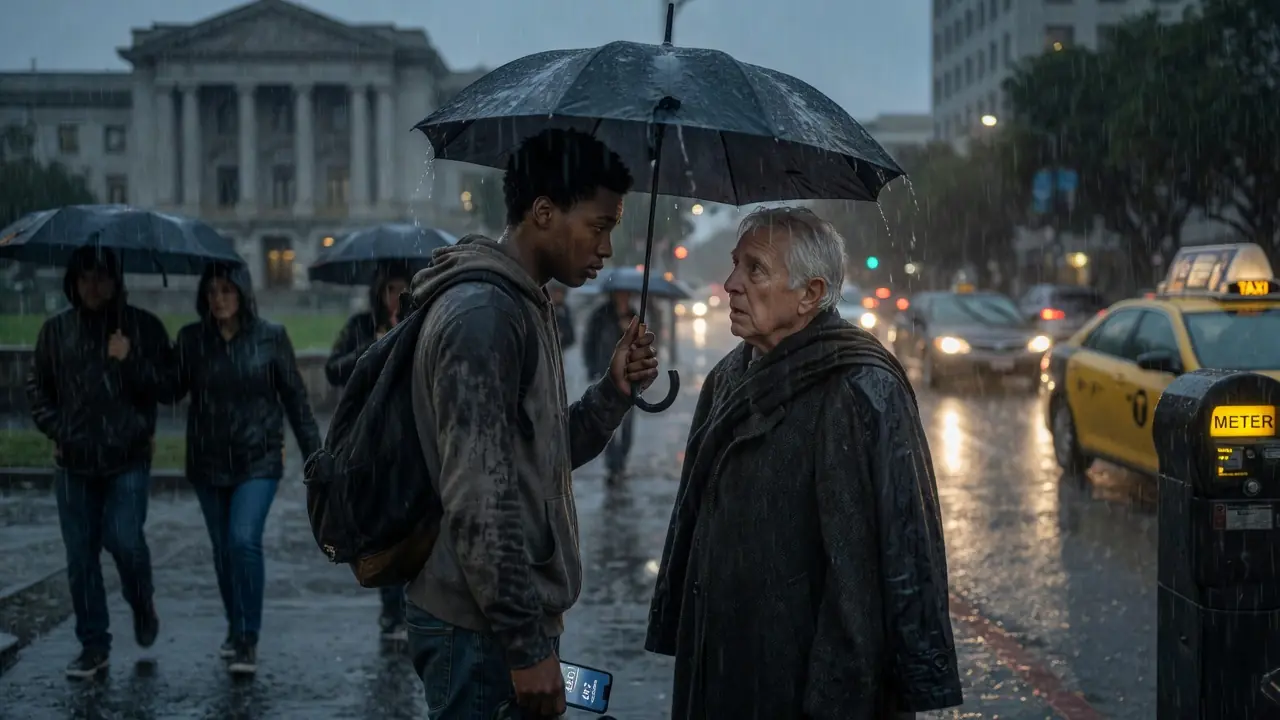
Near the civic center, an elderly white man stumbled along the sidewalk. He wore an expensive wool coat, completely soaked. His silver hair was plastered to his head. He kept stopping, looking around.
Lost.
The man pulled out his phone, shook it in frustration.
Dead.
He took another few steps and stumbled hard. His legs gave out. He crashed onto the wet pavement.
Other people hurried past with heads down.
Nobody stopped.
Nobody looked.
The man tried to get up but could not. He was shaking badly, not just from cold.
Marcus stopped walking.
He was exhausted, soaked, hungry. He had his own problems: getting home, paying rent tomorrow, surviving until his next paycheck.
But he could not leave him there.
The man looked up as Marcus approached. Even in distress, there was something dignified about him, the way he tried to compose himself, the way he apologized before asking for help.
“I’m sorry to bother you, son,” he said, voice shaking. “I think I’m lost. My phone is dead.”
Up close, Marcus could see he was probably seventy. His expensive coat suggested money, but right now, he looked vulnerable and scared. His lips had a bluish tint.
“Where are you trying to go?” Marcus asked.
“I was walking from the office,” he said, looking confused. “The building with the flag, but I can’t remember which direction.”
They were near several government buildings: city hall, the courthouse, federal offices. He probably worked in one and got disoriented.
“Sir, you need to get out of this weather,” Marcus said. “You’re too cold. We need to get you somewhere safe.”
He nodded weakly.
“I know. I just… I don’t know how to get home.”
That was when Marcus made his decision.
He looked at the elderly man shivering on the ground, then at his phone showing $8.50.
His survival money.
His tomorrow’s money.
The rain was getting worse. Emergency sirens wailed in the distance. This storm was dangerous.
He thought about his parents, how they had raised him to help people who needed help, how he would want someone to help him if he were lost and scared.
Most people would have walked away, would have said they had their own problems.
But Marcus was not like most people.
He knelt beside the stranger and helped him to his feet.
“Come on,” he said. “Let’s get you home.”
He had no idea this moment would change everything.
That the man he was about to help was not just any lost stranger.
That his act of kindness would set in motion events that would transform his entire life.
All he knew was that someone needed help, and he could not walk away.
What happened next would be remembered for years, though neither of them knew it yet.
Marcus helped William to his feet. He was heavier than Marcus expected and unsteady. His expensive coat was soaked through, offering no warmth.
“Thank you,” he said, teeth chattering. “I don’t know what came over me.”
“You’re too cold,” Marcus said. “We need to get you warm and dry.”
He looked around. The storm was getting worse. Rain came down in sheets. The wind howled between buildings. Street lights flickered on and off. No cars were stopping. The few people still on the streets hurried past with heads down, focused only on getting to safety.
Marcus made his first sacrifice.
He took off his jacket, his only jacket, and wrapped it around William’s shoulders.
It was not much, but it was something.
“No, son. I can’t take your coat,” William protested.
“You need it more than I do,” Marcus said.
The cold hit him immediately. His wet T-shirt offered no protection against the wind.
Next came his umbrella.
It was small and already battered by the storm, but he held it over William’s head instead of his own.
“Let’s get you to shelter,” he said.
They started walking, but William could barely move. His legs shook with each step. He leaned heavily on Marcus’s arm.
After half a block, he stopped.
“I’m sorry,” he said. “I don’t think I can make it much farther.”
That was when Marcus saw the taxi.
It was stopped at a red light two blocks away. In this storm, it might be the only taxi still running.
Marcus helped William lean against a building.
“Wait here,” he said. “I’ll get that cab.”
He ran toward the taxi, waving his arms. His shoes splashed through puddles. Rain pelted his face.
The taxi driver saw him and rolled down his window.
“Where are you headed?” he shouted over the storm.
“I need you to take this elderly man home,” Marcus called back. “He’s too cold and needs help.”
“It’s going to cost extra in this weather,” the driver said. “At least fifteen, maybe twenty, depending on where he’s going.”
Marcus’s heart sank.
He looked at his phone.
Eight dollars and fifty cents.
Not nearly enough.
He ran back to William. He was shivering violently now. His lips were blue.
“Sir, where do you live?” Marcus asked.
“Piedmont,” he said weakly. “Up in the hills.”
Marcus knew Piedmont. Rich neighborhood. The taxi ride would cost at least twenty-five dollars.
He looked at William, then at his phone, then back at William.
This was the moment that would change everything.
Marcus reached into his backpack and pulled out the brown paper bag.
His only meal.
His dinner for tonight, possibly tomorrow, too.
“Here,” he said, pressing it into William’s hands. “You need to eat something. Low blood sugar makes the cold worse.”
William stared at the bag.
“What is this?”
“Peanut butter sandwich,” Marcus said. “It’s not much, but it’ll help.”
“I can’t take your food.”
“When’s the last time you ate?” Marcus asked.
William paused, looking confused.
“I… I’m not sure.”
“This morning? Yesterday?”
He did not answer.
“Then it’s yours.”
William’s hands shook as he unwrapped the sandwich. He took a small bite, then another. Color began to return to his face.
While he ate, Marcus flagged down the taxi again.
“Okay,” he told the driver. “Piedmont neighborhood. How much?”
“Twenty-five,” the driver said. “Cash up front.”
Marcus looked at his phone one more time.
Eight dollars and fifty cents.
Everything he had.
He thought about walking home, about his empty stomach, about having no money for lunch tomorrow, about rent due in two days.
Then he looked at William, shivering and lost.
Marcus made his decision.
“I only have eight-fifty,” he told the taxi driver. “But please, this man needs help.”
The driver looked at William, then at Marcus. Something in the boy’s expression must have convinced him.
“All right,” he said. “Eight-fifty. But he better not make a mess in my cab.”
“Thank you,” Marcus said.
He handed over every dollar he had.
William tried to stand but stumbled. Marcus caught his arm and helped him to the taxi.
“Wait,” William said as Marcus opened the door. “I need to give you something.”
He reached into his coat pocket and pulled out a business card, but the wind caught it immediately. The card flew out of his hand and disappeared into a storm drain.
“My contact information,” William said desperately. “I wanted you to have it.”
“It’s okay,” Marcus said. “I just want you to get home safe.”
He helped him into the taxi and closed the door.
Through the rain-streaked window, he could see William watching him with an expression he could not quite read. Gratitude mixed with something else.
Amazement, maybe.
The taxi pulled away into the storm.
Marcus stood on the sidewalk, watching the red tail lights disappear.
He was soaked to the bone, shivering, hungry.
He had no money left, no food, no jacket, no umbrella, and two miles to walk home in the worst storm Oakland had seen in years.
But he felt something unexpected.
Peace.
He had helped someone who truly needed it.
He had probably saved his life.
That had to count for something.
The walk home was brutal.
Water poured from the sky like a waterfall. His clothes clung to his body. His shoes squelched with every step. Cars passed without stopping. He could not blame them. He probably looked like someone barely making it through the storm.
By the time he reached his apartment building, Marcus was exhausted. His key shook in his hand as he tried to unlock the front door.
The homeless veteran who usually sat outside was gone, probably seeking shelter somewhere. Even he had more sense than to be out in this weather.
Marcus climbed the stairs to his studio apartment. His wet shoes left puddles on each step.
Inside, he peeled off his soaked clothes and wrapped himself in his only towel. He was so cold he could not stop shaking.
He had no food, no money, no way to get to work tomorrow.
But as he sat on his mattress looking out at the storm, Marcus did not regret his decision.
He reached for his notebook and began to write.
Day 847. Helped an elderly man in the worst storm I’ve ever seen. He was lost and scared and might have died from the cold. I gave him my jacket, my umbrella, my food, and my last eight dollars for a taxi home. I hope he made it safely. Sometimes being kind is the only thing that makes sense, even when it costs everything you have.
He closed the notebook and lay down on his mattress.
Outside, the storm raged on. Thunder shook the windows. Lightning lit up the sky.
Marcus had no idea that across town William was making phone calls, that he was asking questions about the young man who had saved his life, that he was already planning something that would change everything.
All he knew was that he had done the right thing, and sometimes that was enough.
He had no idea that across town, William was making a phone call that would change everything.
Marcus woke up Wednesday morning to his alarm.
Six a.m.
His stomach was cramped from hunger. He had given away his dinner eighteen hours ago. He sat up and immediately felt dizzy.
When had he last eaten?
Yesterday’s half sandwich at lunch?
The storm had passed, but his problems remained.
No money for breakfast.
No money for the bus.
No money for lunch.
The walk to Murphy’s Diner took forty-five minutes. His legs felt weak. His stomach growled audibly. He arrived twenty minutes early, exhausted and pale.
“Jesus, Marcus,” Janet said. “You look terrible. Are you sick?”
“Just tired,” Marcus lied.
Janet studied his face.
“When’s the last time you ate?”
“Yesterday.”
“Sit down,” Janet ordered. “I’m making you breakfast.”
“I can’t pay for it,” Marcus admitted quietly.
“Did I ask you to pay?”
Janet cracked eggs on the grill.
“You think I don’t notice when one of my kids is struggling?”
Fifteen minutes later, Marcus ate scrambled eggs, toast, and bacon.
The food hit his empty stomach like medicine. Color returned to his cheeks.
“Better?” Janet asked.
Marcus nodded, fighting back tears.
“Thank you.”
“If you’re having money problems, you need to tell someone. There’s no shame in needing help.”
Marcus wanted to explain about the elderly man, about giving away his last eight dollars.
But how could he make Janet understand?
“I’ll be okay,” he said instead.
His morning shift was busy. People talked about the storm of the century. Marcus poured coffee and served pancakes, trying not to think about his empty bank account.
During his break, he walked the mile to community college.
No money for the bus.
His afternoon classes were a blur. He took notes but could not concentrate. His mind kept drifting to William.
Had he made it home safely?
After classes, he walked to the community center. His legs ached.
“Mr. Marcus!” Jordan ran up to him. “Did you see the storm last night?”
“I saw it.”
Marcus managed to smile.
For two hours, he helped kids with homework. He bought them snacks with the five-dollar bill Janet had slipped him for lunch.
At eight p.m., he began his walk home, two miles in wet shoes.
Halfway there, he saw the sedan parked outside Murphy’s Diner.
Inside, he could see two figures: Janet and an elderly white man in an expensive suit.
William.
His heart raced.
He had found him.
Marcus watched William hand Janet an envelope. Janet shook her head, but William insisted. Then they both looked toward the window, toward him.
William smiled and waved.
He walked toward the door.
“Son,” he called out. “Could I speak with you?”
Marcus approached slowly.
William looked completely different. Clean, dry, healthy, well-dressed. The vulnerable man from last night seemed like someone else entirely.
“I wanted to thank you,” he said. “What you did last night… I don’t know how to repay you.”
“You don’t need to repay me,” Marcus said. “I’m just glad you’re okay.”
William reached into his jacket and pulled out a thick envelope.
“This is for you, for your college tuition.”
Marcus stared at the envelope.
It was thick, heavy, probably more money than he had seen in his life.
His hands shook slightly.
He thought about his rent due tomorrow, about walking to work every day, about choosing between food and bus fare.
“I can’t accept this,” he said quietly.
William looked shocked.
“I’m sorry?”
“I didn’t help you for money,” Marcus said, his voice stronger now. “I helped you because you needed help. That’s not something you pay for.”
He pushed the envelope back toward him.
“Keep it,” he said. “Give it to someone who really needs it.”
William stared at him, amazement spreading across his face.
People did not usually refuse his help, especially people who clearly needed it.
As he prepared to leave, William quietly placed a business card on the table.
“In case you change your mind,” he said softly.
Marcus did not look at the card immediately. He was too focused on his customers, too tired from the long day. He slipped it into his apron pocket and forgot about it.
A card that would change everything.
Over the next two weeks, strange things started happening around Marcus’s neighborhood.
First, his boss Janet surprised him with extra weekend shifts.
“Business has been good,” Janet said. “And you’re my hardest worker.”
The extra money meant Marcus could barely make rent with one day to spare. He was still living paycheck to paycheck, but at least he was not facing eviction.
Then came the neighborhood improvements.
Marcus first noticed it walking to the community center. New LED street lights were being installed along the route he took every evening. Bright, clean lights that made the area feel safer.
“That’s weird,” he said to Mrs. Garcia, the community center supervisor. “When did the city approve funding for those?”
Mrs. Garcia looked puzzled.
“I have no idea. Someone downtown must really care about this neighborhood all of a sudden.”
The improvements kept coming.
The community center received a massive anonymous donation, enough to expand their after-school programs and hire two more tutors, enough to buy new computers and books and supplies.
The local food bank got an even bigger donation.
Marcus benefited from this himself, picking up free groceries twice that week.
He had no idea he was eating food paid for by the man he had helped.
At Murphy’s Diner, customers gossiped about the changes.
“I heard the mayor’s office has been asking questions about this area,” said Mrs. Thompson, a regular. “Community impact assessments or something.”
“About time,” replied her friend. “This neighborhood’s been ignored for years.”
“Apparently, the mayor’s father has been pushing for more social programs. Someone said he’s got a personal interest in East Oakland now.”
Marcus half listened while refilling their coffee.
Local politics did not interest him much.
He was too busy surviving to worry about city hall.
Two weeks after the storm, Marcus was cleaning out his work locker when he found it.
The business card.
It had been crumpled in his apron pocket, forgotten in the chaos of work and school and worry.
He smoothed it out on the table. The rain had smudged most of the ink, but he could make out a few things.
A name: William something.
And what looked like an official city seal.
He assumed William worked for the city, maybe in community development, which would explain his interest in the neighborhood improvements.
That same day, a formal letter arrived at his apartment.
Marcus stared at the return address.
City of Oakland, Office of the Mayor.
His hands shook as he opened it.
Dear Mr. Williams,
You have been selected to receive a community leadership scholarship in recognition of your demonstrated commitment to helping others in your neighborhood.
Marcus read the letter three times.
Twenty-five thousand dollars, plus an internship opportunity at city hall.
He had never applied for this scholarship.
Had never even heard of it.
How did they know his name?
How did they know where he lived?
The letter was signed by Mayor Rodriguez and requested his attendance at a ceremony next Friday.
But something else caught his attention at the bottom in smaller print.
This scholarship program was established through the advocacy of civic leader William Rodriguez.
The same first name as the man he had helped.
It had to be a coincidence, did it not?
The truth was about to hit him like lightning, and it would explain everything.
Marcus stared at the invitation for three days.
Scholarships this big did not just appear.
There had to be a mistake.
But twenty-five thousand dollars was more money than he had made in two years.
Friday morning, he put on his only interview outfit, the suit from his parents’ funeral. It was the nicest thing he owned.
City Hall was intimidating. Marble floors, oil paintings of former mayors, people in expensive suits walking with purpose.
Marcus felt completely out of place.
He approached reception, clutching his invitation.
“I’m here for the scholarship ceremony.”
“Third floor, Jefferson conference room.”
The room was half full when he arrived. Twenty other recipients, all looking more confident than he felt. Designer clothes, professional portfolios, people who belonged here.
Marcus found a seat in the back row.
The ceremony began with introductions: department heads, city council members, important people whose names Marcus did not recognize.
Then the moderator stepped to the podium.
“Ladies and gentlemen, please welcome Mayor Rodriguez.”
A man in his forties approached, tall, confident, with kind eyes and graying temples. He looked familiar somehow.
“This scholarship program recognizes young people who demonstrate exceptional kindness and community spirit,” Mayor Rodriguez began. “But I have to be honest. This program exists because of one person’s passion for helping others.”
He paused, scanning the room.
“My father has always believed that ordinary acts of kindness can change the world. Recent events have only strengthened that belief. So before we announce recipients, I’d like him to say a few words. Dad.”
An elderly man stood up from the front row.
Marcus’s breath caught.
Silver hair.
Kind eyes.
The same dignified bearing.
William.
The man from the storm.
The man Marcus had given his last meal to.
The man he had spent his final eight dollars to save.
William Rodriguez.
The mayor’s father.
Everything clicked into place.
The expensive coat, his quiet authority, his confusion about the building with the flag.
He had been walking from his son’s office.
William approached the podium with measured steps. Now, instead of stumbling and lost, he commanded the room’s attention.
“Three weeks ago, I experienced something that reminded me why I’ve dedicated my life to public service,” William began.
Marcus’s heart pounded.
He was going to tell his story here in front of everyone.
“I was caught in that terrible storm. Disoriented, dangerously cold. I fell, and person after person walked past me.”
Complete silence.
“But one young man stopped. A college student who barely had bus fare. He gave me his jacket in the freezing rain, his umbrella, his only meal of the day.”
Eyes turned toward Marcus.
Someone had recognized him.
Whispers spread through the room.
“And then he gave me his last eight dollars for a taxi home. Everything he had. He chose to walk two miles in the worst storm rather than let a stranger suffer.”
Marcus wanted to disappear.
“When I tried to thank him, to give him college money, he refused. He told me kindness wasn’t something you paid for.”
William’s voice grew emotional.
“That young man saved my life. But more than that, he reminded me what true character looks like. He reminded me why we need programs that recognize people who choose kindness over survival.”
He looked directly at Marcus.
“Mr. Marcus Williams, would you please stand up?”
Every person turned to stare.
Marcus felt frozen.
“Please,” William said gently. “Don’t be shy.”
Slowly, Marcus stood. His legs felt unsteady.
The room erupted in applause.
Not polite ceremony applause.
Real applause.
People were smiling, some wiping their eyes.
Mayor Rodriguez returned to the microphone.
“Mr. Williams, my father has told me your story at least a dozen times. About your selflessness, your character, your refusal to accept anything in return.”
Marcus’s mind was spinning.
The neighborhood improvements.
The food bank donations.
The community center funding.
It all made sense now.
“This scholarship program was created specifically because of what you showed my father that night,” Mayor Rodriguez continued. “That there are still people who choose to help others even when it costs them everything.”
William approached his row.
“Mr. Williams, would you join me up here?”
Marcus walked to the front on shaking legs. The applause continued. People were standing.
William took his hand.
“Thank you,” he said quietly. “For reminding an old man what goodness looks like.”
Marcus found his voice.
“I had no idea who you were.”
William smiled.
“That’s exactly why this matters so much.”
Mayor Rodriguez stepped forward.
“Mr. Williams, it’s my honor to offer you not just a scholarship, but an opportunity that could change your life forever.”
Marcus looked at William, then at his son, then at the room full of people applauding his simple act of kindness.
Three weeks ago, he had given away his last meal to help a stranger.
Now, that stranger was about to change his entire world.
But the scholarship was just the beginning of what William had in mind.
After the ceremony, William and Mayor Rodriguez asked Marcus to join them in a private conference room.
The walls were lined with books and official portraits. A mahogany table dominated the center.
Marcus felt overwhelmed.
Twenty minutes ago, he thought he was attending a simple scholarship ceremony. Now he was sitting across from the mayor and his father, who happened to be the man whose life he had saved.
“Mr. Williams,” Mayor Rodriguez began. “What my father told you about the scholarship is true, but we’d like to offer you something much bigger.”
He slid a folder across the table.
Official city letterhead.
Marcus’s name typed at the top.
“We want you to lead a new citywide initiative: the Community Connector Program. It’s based on exactly what you demonstrated that night, connecting people through acts of everyday kindness.”
Marcus opened the folder. His hands shook slightly as he read.
“Full college scholarship through graduate school,” he read aloud. “Eighty thousand dollars in total education funding.”
William nodded.
“That’s just the beginning.”
“Paid position as Community Connector Director,” he continued reading. “Forty-five thousand dollars annual salary, full benefits package.”
Mayor Rodriguez leaned forward.
“Marcus, we’ve been looking for someone to head this program for months. After what my father told me about you, we realized we weren’t looking for credentials. We were looking for character.”
“The program budget is two hundred thousand dollars,” William added. “You’d have real decision-making power. Your own office here at city hall. Administrative support.”
Marcus stared at the papers.
The numbers seemed impossible.
Six months ago, he was choosing between rent and food. Now they were offering him more money than he had ever imagined.
“I don’t understand,” he said quietly. “Why me? I’m just a community college student. I work at a diner.”
“Exactly,” Mayor Rodriguez said. “You understand what it’s like to struggle. You know what real need looks like, and most importantly, you’ve proven you’ll help others even when it costs you everything.”
William spoke up.
“Marcus, that night in the storm, you didn’t know who I was. You didn’t know if I had money or connections or power. You helped me because I needed help. That’s exactly the kind of thinking we need leading this program.”
“What would I actually do?” Marcus asked.
Mayor Rodriguez pulled out another document.
“The program would employ twenty college students across the city as community connectors. Each one would work with specific neighborhoods, identifying people who need help and connecting them with city resources.”
“Like a bridge,” William explained, “between people who are struggling and the services that can help them, but led by someone who’s actually been there.”
“The students would earn between thirty-five and forty thousand a year,” the mayor continued. “Good jobs that let them finish college without drowning in debt, just like we’re offering you.”
Marcus felt a mix of excitement and terror.
“What if I mess it up? What if I’m not qualified?”
“Let me ask you something,” William said. “That night in the storm, did you feel qualified to save someone’s life?”
“No,” Marcus admitted.
“But you did it anyway because it was the right thing to do.”
Mayor Rodriguez opened his laptop and showed him a presentation. Charts and graphs and budget projections.
“We’ve done the research, Marcus. Programs like this work. In cities where they’ve been implemented, community well-being improves across the board. Lower crime rates, higher graduation rates, more small business development.”
“But,” William added, “they only work when they’re led by someone who genuinely cares about people. Someone who understands that helping others isn’t a job. It’s a calling.”
Marcus read through the job description.
“I’d report directly to the mayor’s office.”
“Yes. This isn’t some low-level position where you get ignored. You’d have direct access to city leadership. Your recommendations would actually be implemented.”
The offer was overwhelming.
Life-changing.
Everything he had ever wanted and more than he had dared to dream.
But doubt crept in.
“What if people find out I’m just some kid from East Oakland who gave away his lunch? What if they don’t respect me?”
William reached across the table and took his hand.
“Marcus, I’ve spent forty years in public service. I’ve worked with senators and governors and business leaders. Do you know what I’ve learned?”
He shook his head.
“The people who make the biggest difference are never the ones who look most qualified on paper. They’re the ones who care enough to act when it matters.”
Mayor Rodriguez added, “We’re not asking you to be someone you’re not. We’re asking you to be exactly who you already are, the person who stops to help strangers in storms.”
“There’s one more thing,” William said.
He reached into his jacket and pulled out an envelope.
“That one thousand dollars I tried to give you at the diner. Consider it your signing bonus. You earned it that night in the rain.”
Marcus looked at the envelope, then at the contract, then at the two men who were offering to transform his life.
“When would I start?” he asked.
“Two weeks,” Mayor Rodriguez said. “That gives you time to finish the semester. We’ll arrange for you to move to a better apartment, something closer to city hall.”
“What about Murphy’s Diner? I can’t just abandon Janet.”
William smiled.
“We’ve already spoken with Janet. She’s incredibly proud of you. Says she always knew you were destined for something special.”
Marcus thought about his tiny studio apartment, his long walks to work, his empty refrigerator, and his constant worry about money.
Then he thought about the kids he tutored, about all the other kids in neighborhoods like his who needed someone to believe in them.
“This program,” he said slowly. “We’d really be helping people, making a difference.”
“That’s the whole point,” Mayor Rodriguez said. “To take what you did that night, choosing kindness over self-preservation, and scale it citywide.”
“Twenty other students would have jobs like this?”
“To start. If the program succeeds, we’ll expand it.”
Marcus looked at William.
“That night, when I gave you my food and my money, I never thought it would lead to anything like this.”
“Neither did I,” William said. “But that’s how kindness works. You never know where it will take you.”
Marcus picked up the pen.
“Where do I sign?”
Six months later, the changes were impossible to ignore.
Marcus’s morning routine looked completely different.
Instead of counting coins for bus fare, he drove his modest Honda to city hall. Instead of his cramped studio, he lived in a comfortable one-bedroom downtown.
But the biggest change was his confidence.
He sat in his fourth-floor office leading a team meeting with city department heads.
The same boy who had felt invisible at Murphy’s Diner was now presenting reports to the mayor.
“Community Connector statistics for March,” Marcus said, clicking through slides. “Twenty-three college students are employed across Oakland. Average salary: thirty-eight thousand dollars.”
The numbers told an incredible story.
“High school graduation rates are up twelve percent. Teen employment up eighteen percent. Crime rates are down fifteen percent across all five districts.”
Department heads took notes.
Six months ago, these people would not have known his name. Now they implemented his recommendations.
The real changes were happening on the streets.
Jordan, his former tutoring student, ran up during his weekly neighborhood visit.
“Mr. Marcus, my mom got that hospital job. The community connector helped with her application.”
“Yeah?”
“And my sister got into college prep.”
This was happening citywide.
College students who looked like the people they served were connecting struggling families with resources that had always existed but felt unreachable.
Local news noticed.
“Good morning from East Oakland, where a revolutionary program is changing lives,” the Channel 7 reporter said outside Marcus’s old tutoring center. “The Community Connector Program, led by twenty-year-old Marcus Williams, has produced remarkable results.”
The story featured families who had been helped, small business owners who had received grants, students who had found scholarships.
Coverage went beyond local news.
Urban Planning Magazine ran a feature: “The Oakland Model: How One Act of Kindness Created a Citywide Movement.”
The article detailed how hiring people from the communities they served was being studied nationwide.
Other cities called.
San Jose.
Sacramento.
Fresno.
All wanting similar programs.
“We’ve had requests from fifteen cities,” Marcus told William during their monthly check-in. “They want to observe our model.”
William, now a regular volunteer, joined him for Tuesday community walks, learning neighborhood needs firsthand.
“California’s best practices guide wants to feature us,” Marcus continued. “And there’s federal interest from Housing and Urban Development.”
The most meaningful changes were personal.
Marcus returned to Murphy’s Diner monthly, not as an employee, but as a customer who tipped generously.
Janet had framed a newspaper clipping about Marcus’s success behind the register.
From Struggling Student to City Leader, the headline read.
“I always knew you were special,” Janet said during one visit.
The community center where Marcus tutored now had full funding. The food bank that once helped him served twice as many families through increased city funding he had secured.
The program created ripple effects beyond Oakland.
Harvard Kennedy School featured the Community Connector model as a case study. Other cities were not just copying structure. They were adopting the philosophy that people with lived experience make the best advocates.
Colleges began teaching community-based social work courses using Marcus’s program as the primary example.
The Marcus Williams Scholarship was established at Oakland Community College for students facing financial hardship.
The first recipient was nineteen-year-old Daniel, who reminded everyone of Marcus two years earlier.
During the ceremony, Marcus presented the award.
“Two years ago, I was exactly where you are,” he told Daniel. “Choosing between rent and food, walking miles to work, believing people like us don’t get opportunities like this.”
The audience, many community connector graduates, applauded.
“But here’s what I learned. Sometimes the biggest changes start with the smallest acts of kindness. Sometimes helping one stranger can transform an entire city.”
That evening, Marcus updated his notebook.
Day 1,847 since Mom and Dad died.
Instead of just personal gratitudes, he now documented program successes.
Connected the Martinez family with housing assistance today. Their oldest daughter got accepted to UC Berkeley. Sometimes I can’t believe this is my life.
Through his window, he saw Oakland’s lights stretching to the bay.
Somewhere out there, twenty-three community connectors were doing the work he had started.
Choosing kindness.
Building bridges.
Changing lives one connection at a time.
The program exceeded every projection.
More than that, it proved something William had always believed.
Ordinary people performing acts of kindness could indeed change the world.
One year later, another storm was brewing, and Marcus faced a familiar choice.
November in Oakland.
The same month that had changed everything.
Marcus was leaving city hall after a late planning meeting when the first drops began to fall. By the time he reached his car, it was pouring.
Through his rain-streaked windshield, he saw him.
A young Latino man, maybe twenty, helping an elderly woman who had fallen on the wet sidewalk. His thin jacket was already soaked through, but he was taking it off to cover her shoulders.
Marcus watched as he helped her to her feet, then offered her his umbrella.
He could see him reaching into his pocket, pulling out what looked like his last few dollars.
The scene was heartbreakingly familiar.
Marcus pulled over and rolled down his window.
“Excuse me,” he called out.
The young man looked up, rain streaming down his face.
“Yes, sir?”
“Let me help.”
Marcus got out of his car, not caring that his professional clothes were getting soaked.
“Ma’am, are you hurt?”
The elderly woman shook her head.
“Just slipped. This young man stopped to help me when everyone else walked by.”
Marcus looked at the young man. His shoes were worn through. His jeans had holes, but his eyes held the same determination Marcus remembered feeling that night a year ago.
“What’s your name?” Marcus asked.
“David Morales.”
“David, I’m going to call you a taxi to take this lady home safely, and I want to give you something.”
He pulled out his business card.
Official City of Oakland letterhead.
Marcus Williams, Community Connector Program Director.
David stared at the card.
“I can’t accept charity, sir.”
The same words Marcus had once said to William.
“It’s not charity,” Marcus said, echoing what William had told him. “Next week, there might be an opportunity at city hall for someone with your heart.”
As they waited for the taxi, Marcus learned David’s story.
Community college student. Working two jobs. Sending money home to help his mother. Walking to save bus fare.
Exactly where he had been a year ago.
Just then, a familiar voice called out from behind them.
“Looks familiar.”
William appeared, now seventy-two, carrying an umbrella and wearing a knowing smile.
He had been volunteering late at city hall and had witnessed the scene.
“David Morales, meet William Rodriguez,” Marcus said. “He’s the reason I have the job that’s about to change your life.”
William shook David’s hand.
“Young man, do you know what you just did?”
“Helped someone who needed help,” David said simply.
“Exactly,” William smiled. “And sometimes that’s all it takes.”
The taxi arrived. As they helped the elderly woman inside, she pressed something into David’s hand.
“Judge Patterson,” she said, introducing herself. “Retired Superior Court. I’ll be expecting to hear great things about you, young man.”
David stared after the taxi, then at the business card, then at Marcus and William.
“Does this kind of thing happen often?” he asked.
Marcus and William exchanged glances.
“More often than you’d think,” Marcus said. “The circle completes itself sometimes.”
A week later, David Morales interviewed for the Community Connector Program.
Judge Patterson had already called with a recommendation.
That night, Marcus wrote in his notebook.
Day 1,212. Found our next community connector. The circle continues. Sometimes kindness creates its own weather system.
Marcus’s story is not unique because he helped a stranger.
It is unique because he chose kindness when it cost him everything he had.
That choice created ripples that were still spreading through Oakland.
Twenty-three college students with good jobs.
Thousands of families connected to resources they never knew existed.
An entire city that now believed in the power of everyday heroes.
But here is the truth: you do not need to meet the mayor’s father to change a life.
The cashier having a rough day.
The neighbor struggling with groceries.
The stranger who looks lost and scared.
They are all waiting for someone to choose kindness over convenience.
Marcus gave away his last meal because he believed helping others mattered more than his own comfort.
That single decision transformed not just his life, but an entire community.
And somewhere, right now, someone is making the same choice Marcus made in that storm.