In the heart of a bitter winter, a fifteen-year-old orphan boy rode his mother’s old bicycle, rushing to complete his final delivery of the night, his only chance to keep a place to sleep.
But when he saw a little girl crying alone at a bus stop, lost and scared, he stopped, knowing he’d lose everything if he was late.
He still chose to pedal her home through the freezing night.
What he didn’t know was that she was the granddaughter of a wealthy woman, and that small act of kindness would change his life forever.
The wind had that bitter edge that only comes at the end of winter, sharp, invisible, and constant. It slipped under jackets, clawed at exposed skin, and turned even the street lamps into stiff, shivering silhouettes.
On the east side of town, near the corner where Maple met Sycamore, the lights flickered above a rusted bus stop bench. The shops were already closed, metal gates down, signs turned to closed, and the sidewalks were nearly empty, save for the occasional dog walker or couple rushing to their warm car.
A white man in a business coat glanced up as he passed a tall, lanky teenager near the bench, but quickly looked away, clutching his briefcase a little tighter. A woman tugged her daughter to the other side of the sidewalk without a word.
None of them spoke to him.
They never did.
Malik Johnson, fifteen, stood beside his beat-up bicycle, checking the straps on the faded delivery bag slung across his back. He was tall for his age, all elbows and knees, his dark skin sharp against the gray of his hoodie and the wind-chapped red of his knuckles.
His jeans were a little too short, the hems frayed and muddy, and his shoes, held together with tape and stubbornness, had long lost any sign of a logo.
But Malik didn’t care about looks.
He cared about making that last delivery before the clock hit eight.
If he made it on time, he’d have just enough to cover his week’s rent. If not, the landlord had made it clear.
No pay, no key.
The sky was already dimming into a heavy blue, and the cold settled deeper into his bones, but Malik’s hands moved fast. He knew this part of town didn’t like him lingering. He had been stopped here before. Once by a cop who asked where he got the bike, twice by store owners who assumed he was loitering.
Just last week, a man at the sandwich shop told him, “We’re closed,” even though the sign clearly said open.
Malik had learned not to talk back.
Not here.
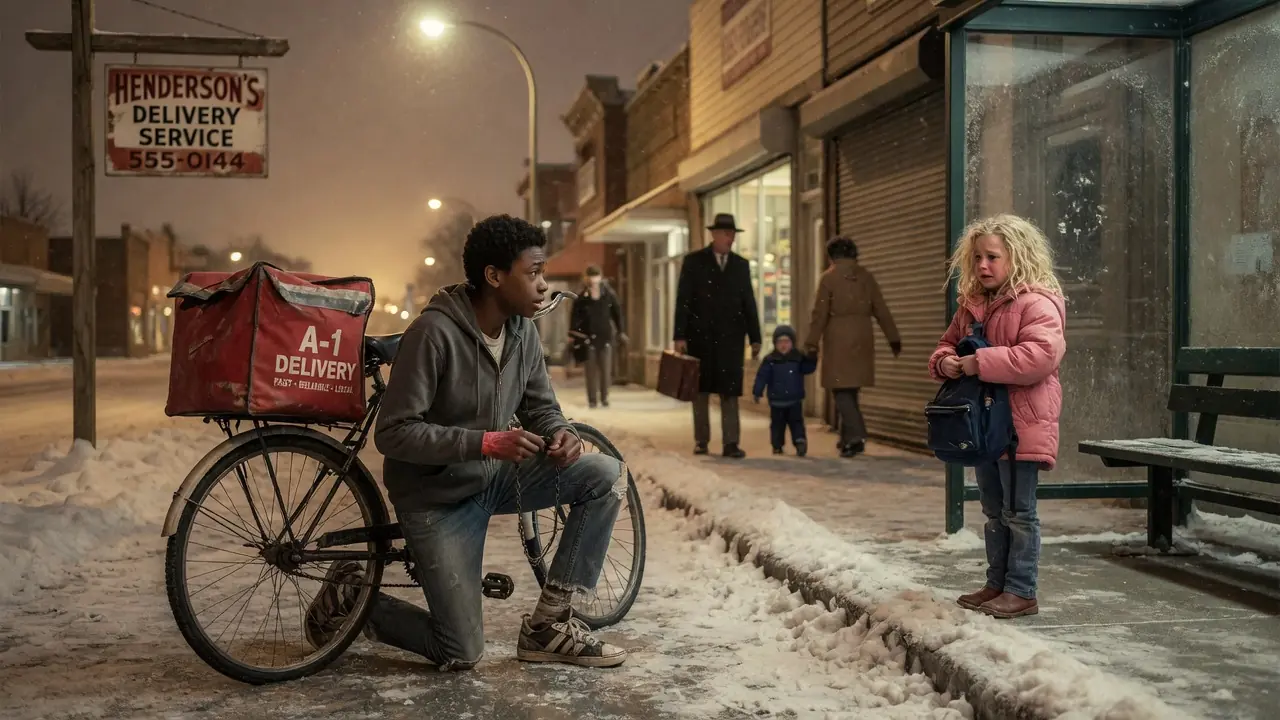
He was mounting his bike when he saw her.
A little girl, maybe six, standing all alone at the far end of the bus stop. She wore a puffy pink coat and held a small backpack in both arms like a shield. Her blonde curls were messy and her nose was running.
She stood still for a moment, then spun in a slow circle like she was looking for something she’d dropped.
Then she started to cry.
Malik froze.
He looked at the time.
7:43.
He should go.
He needed to go.
But no one else was stopping.
She sat down on the bench, legs dangling, wiping her face with her sleeve, and mumbling something about her mom and the bus and getting left. A couple walked past her, didn’t even glance. A man in a hoodie turned his head the other way.
Malik’s stomach twisted.
He looked at the bag on his back, then at the girl.
He pushed the bike toward her slowly.
“Hey,” he said, soft but clear.
She looked up, startled, her cheeks red from cold and tears.
“You lost?”
She nodded barely.
“My mom was getting tickets,” she said. “Then she said, ‘Wait by the bench.’ But she didn’t come back.”
“Do you know your address?” he asked, kneeling to her eye level.
She sniffled.
“No, but I think I have it.”
It read: Ellie Rose, Willow Heights Elementary.
Underneath was a barcode and a home address.
Malik knew that part of town.
Rich.
Gated.
Way out past the hills.
He stared at the card, then at his phone.
7:46.
If he left now, maybe, just maybe, he could still make it. Drop the bag. Take the shortcut behind the train tracks.
But if he didn’t…
He looked back at Ellie.
Her lips trembled.
“Is my mom going to come?”
Malik took off his jacket without a word and wrapped it around her. Then he tied an old scarf to the back rack of his bike like a cushion.
“Come on,” he said, patting the makeshift seat. “Let’s get you home.”
The first few minutes were the hardest.
Ellie clung to the back of Malik’s hoodie, her tiny arms barely able to wrap all the way around his waist, her breath warm against his shoulder as the wind sliced past them. The scarf he’d tied to the rack wasn’t much, but it kept her from sliding off.
He told her to hold on tight twice, but even then, he kept one hand ready behind him, just in case she slipped.
The road leading out of town narrowed quickly, trading street lights for shadows, pavement for patches of gravel and ice. Malik kept his eyes low, focused on every bump and crack, his legs already burning from the strain of pedaling two bodies uphill.
His shoes, thin-soled and soaked, offered no protection from the cold metal pedals. Every rotation stabbed up through his calves and into his back like dull knives.
But he didn’t complain.
He just kept going.
Ellie stayed quiet for a while, maybe ten minutes. Then she started asking questions in a voice that wavered between brave and scared.
“Are we close yet?”
“What if my mom’s not home?”
“How come you don’t have a car?”
Malik answered each one like it was the first time he’d heard it.
“Not yet, but we’re getting closer.”
“If she’s not home, someone will be.”
“I’m fifteen. Can’t afford a car.”
She went quiet again.
Then she said, “You talk nice. Nicer than some people.”
Malik didn’t say anything back, just pushed harder on the pedals as the first incline came into view.
The hill wasn’t steep, but it stretched long and mean, and the wind picked up with it, screaming across the open fields that flanked both sides of the road. Dry winter grass bent sideways, and the sky above went from pale blue to steel gray.
Malik’s thighs screamed with every push, and sweat beaded at the back of his neck despite the cold.
Ellie sniffled again, rubbing her face against the jacket collar he’d wrapped around her earlier.
“I’m hungry,” she whispered.
Malik bit the inside of his cheek.
He had three dollars left in his pocket, maybe less.
He’d counted earlier that day, trying to figure out if it would be enough to stretch dinner, and then gave up and hoped he wouldn’t be hungry enough to care.
But now, hearing her voice, her stomach growling loud enough that he could feel it through the back of the seat, he knew what he had to do.
“Hang on,” he said. “We’ll stop soon.”
Fifteen minutes later, they rolled up to a gas station, a dusty, quiet outpost just before the county line. One overhead light flickered. The sign on the door said open, but barely.
Malik parked the bike near the ice machine and helped Ellie off the back, her legs stiff from sitting so long.
She held his hand without asking.
Inside, the heat hit them like a wall.
The cashier, a middle-aged man with salt-and-pepper stubble and a sharp eye, looked up as they walked in. His gaze stayed on Malik longer than it needed to.
“You need something, kid?”
Malik nodded, already moving toward the back where the hot drinks sat in battered machines.
“Hot chocolate,” Ellie said softly, eyes wide.
Malik slid the last bills onto the counter without speaking.
The man took them, glanced at Ellie, then back at Malik.
“This your sister?”
“No,” Malik said steadily. “She’s lost. I’m taking her home.”
The man raised an eyebrow, but didn’t say anything else.
Malik poured the drink into a small paper cup, blew on it gently, then handed it to Ellie.
She grinned, eyes bright for the first time since they met.
“You first,” she said, holding it out.
“I’m good,” Malik replied.
But she pushed it toward him again.
“You’re shaking,” she said. “You drink.”
He took a small sip just to show her it was okay, then handed it back.
She cupped it with both hands and sat on the edge of a low shelf, swinging her legs back and forth like she was trying to make time move faster.
When they left, the man at the counter watched them go.
He didn’t say goodbye.
Outside, the cold was worse.
The sun had dipped almost entirely, and with it came the kind of chill that seeped into joints, wrapped around knuckles, and made your teeth clench without realizing it.
The second leg of the ride was harder, longer, darker, with fewer houses and more empty stretches of road. The only light came from a half moon overhead and the occasional blink of passing headlights.
Ellie leaned into Malik’s back and began to hum something, a lullaby maybe, or a song from a cartoon. He didn’t recognize it, but the sound calmed him, made the ache in his legs just a little quieter.
He stopped once near the top of a rise to stretch. She stayed on the bike this time, hugging his coat tighter around herself.
“You live far,” she mumbled.
“I don’t live out here,” he said. “I live closer to town.”
“Oh,” she said.
Then, after a beat, she asked, “Why’d you help me if you don’t live close?”
Malik looked out at the stretch of road ahead, then down at his scuffed-up sneakers.
“Because nobody else did.”
She didn’t say anything for a while after that.
When they reached the final bend before Willow Heights, Malik’s legs were trembling. Not from fear, just from the long, relentless push forward.
The houses here got bigger, brighter. Gated lawns, trimmed hedges, empty mailboxes made of stone.
It was like stepping into a different world.
He found the address easily.
Number 48.
Painted in gold on a white mailbox, surrounded by roses that had long since frozen.
He helped Ellie off the bike one last time. She stood up wobbly, blinking at the familiar driveway.
Then, without warning, she ran.
“Grandma!” she yelled. “Grandma!”
A porch light flicked on.
Then the front door opened with a burst.
An older woman with silver hair stepped out, wrapped in a shawl, her voice panicked and sharp.
“Ellie! Ellie!”
They collided at the top of the steps, Ellie jumping into her arms, the woman dropping to her knees as if her legs had given out from relief.
“Where were you? My God, we thought…”
Ellie pointed back toward the street.
“He brought me home.”
The woman looked up.
Malik stood by his bike, panting slightly, one hand still gripping the handlebar.
Their eyes met, and for a moment, the street fell silent.
Then the woman rose, brushing a tear from her cheek.
“You,” she said. “You brought her all the way here.”
Malik just nodded.
She stepped forward slowly, her voice softer now.
“Please come inside. Get warm. Let us call your family. At least let us thank you.”
But Malik shook his head.
“It’s okay. I have to go.”
He reached into his jacket, pulled out a wrinkled receipt, and scribbled something on the back in case she ever needed help again.
Then he handed it to her and turned back toward the bike.
His legs felt like lead, his hands too numb to grip the brakes, but he didn’t stop.
He didn’t look back.
Because sometimes the right thing costs more than you have.
And you do it anyway.
The ride back into town was slower.
Not because Malik didn’t want to get there.
He did.
But because his legs were failing.
They’d given him everything on that hill. Every turn of the pedals now felt like pushing against the ocean. His breath came in short bursts, each one cutting his throat from the inside. The wind had changed direction. Colder now, more direct, like it was punishing him for being out this late.
His jacket was still wrapped around Ellie when he left, and without it, the cold didn’t just bite.
It burrowed.
By the time the blinking yellow light at the edge of town came into view, his hands had gone stiff, and he was shaking in a way he couldn’t control.
But he kept going because he still believed, just barely, that he might make it back in time.
He pulled into the narrow street where the boarding house sat, an old two-story squeezed between a liquor store and a vacant building with plywood windows. The porch light was out, like always, but Malik didn’t need it. He knew exactly how many steps there were, how the third creaked louder than the others, how the screen door always stuck just a little before the latch gave.
He climbed the steps slowly, parked his bike like he always did, and reached into his back pocket for the key.
It wasn’t there.
He paused, checked his jacket.
Nothing.
Checked the inner pocket of his jeans.
Still nothing.
A sudden tightness spread in his chest, cold and sharp.
He tried to stay calm, tried to retrace his steps. He remembered taking the key out earlier in the day to show the old landlord he’d have rent by tonight. Maybe he’d put it in the delivery bag, but that was gone now, returned to the shop before he’d seen Ellie.
His heart started to pound faster than it had on the ride uphill.
He knocked softly on the door just once at first.
Nothing.
He waited, knocked again, louder this time.
Still nothing.
He stepped back, peered up at the second-floor window where the landlord’s light usually glowed until midnight.
Dark.
Then he noticed the plastic bag.
It was sitting off to the side of the door, leaning against the railing.
His spare shirt.
His towel.
The cracked phone charger held together with tape.
It was all there, tied up like trash.
There was a note taped to the door, scrawled in thick marker.
Three words.
Past due. Locked.
No name.
No explanation.
No grace.
Malik stood there a long moment, the cold forgotten, the ache in his legs drowned out by something heavier.
Not shock exactly.
He had known this could happen.
But still, something in him had hoped.
Hoped that maybe, just this once, the world might wait.
Might give him one more hour.
One more chance.
He stared at the door, at the dim reflection of his own face in the dusty glass.
Part of him wanted to knock again, louder this time. Maybe the landlord was still in there, just pretending not to hear. Maybe if Malik explained what happened, the girl, the ride, the fact that he did the right thing, maybe then the door would open.
But he knew better.
People didn’t open doors for kids like him.
He picked up the bag and slung it over one shoulder. The plastic dug into his skin, stiff and awkward. His already frozen fingers struggled with the weight.
He reached for the bike and turned, not sure where to go, but knowing he couldn’t stay.
The town looked different now, harsher. The same sidewalks, the same tired buildings, but colder somehow, more closed off.
His breath came in clouds, each one swallowed by the dark.
He didn’t go toward the main road.
He took the back streets instead.
Familiar alleys where the wind didn’t cut quite as deep.
By habit, his wheels turned toward the market.
Johnson’s Market sat behind the church parking lot, half its sign missing and the other half barely lit. Mr. Leonard had owned it forever. An old man with thick glasses, a bad back, and a strange way of caring too much and not at all.
Malik had swept floors there sometimes, stocked shelves, cleaned up spills no one else wanted to touch. In return, Mr. Leonard gave him whatever was left at the end of the day: a bruised banana, a dented can of beans.
Once, even a whole bag of bagels someone forgot to pick up.
Malik rolled around to the back. The dumpster smelled sharp even in the cold.
He leaned his bike against the brick wall and knocked once on the side door.
Waited.
No answer.
He knocked again, this time with his knuckles, letting the sound carry.
A light came on above.
Then the door creaked open an inch, just enough for a sliver of warmth to slip out.
Mr. Leonard squinted through the gap.
“You again,” he muttered, voice thick with sleep. “It’s almost midnight.”
Malik didn’t explain. He just looked at him.
Something about his silence must have said enough.
Mr. Leonard sighed, rubbed his face.
“Didn’t make rent, huh?”
Malik shook his head once.
The man looked up at the sky like he was expecting a lightning bolt to drop.
Then he opened the door wider.
“Don’t touch the wine crates. Don’t leave the heater on all night, and don’t freeze to death.”
Malik stepped inside.
The store room smelled of cardboard and oranges. Boxes were stacked to the ceiling, narrow aisles between them. There was a cot in the far corner, folding legs, a thin mattress, one itchy blanket. The radiator beside it clicked and hissed like it had a personality.
Malik dropped his bag beside the cot and sank down slowly.
He didn’t take off his shoes, didn’t unwrap the scarf from his neck, just pulled the blanket over his shoulders and curled in on himself, the cold still clinging to his skin like a second coat.
He wasn’t crying.
He didn’t feel like crying.
He just felt empty.
Not broken.
Just used up.
But as he lay there, eyes open, staring at the underside of a metal shelf lined with paper towels, something settled in him.
A quiet certainty.
He’d made the right choice.
He didn’t have a room, didn’t have dinner, didn’t even have his jacket anymore.
But that little girl was home.
Safe.
Warm.
And that, he told himself, was worth it.
Even if nobody else thought so.
Outside, the wind howled against the metal siding, but Malik closed his eyes and let the sound wash over him.
Sleep didn’t come easy.
It never did.
But this time, for the first time in weeks, it wasn’t fear that kept him awake.
It was the memory of Ellie’s voice in the dark, whispering, “You talk nicer than most people.”
And somehow, that was enough to carry him into the next morning.
By the time Malik opened his eyes, the light seeping through the high, dust-frosted window was soft and gray.
Not yet full morning, but enough to mark the end of night.
The store room was quiet, except for the low hum of the ancient radiator clinking softly as it tried to breathe out heat.
Malik didn’t move for a while.
His back ached from the cot’s metal bars pressing through the thin mattress, and his fingers were stiff from gripping the blanket all night.
Still, it was better than the sidewalk.
He lay there staring at the ceiling, replaying the night ride again.
Ellie’s arms around his waist.
Her small voice in the dark.
The way she had smiled when he handed her the hot chocolate and whispered, “You’re the nicest stranger I ever met.”
Those words had followed him into sleep, curling in the space between exhaustion and something like peace.
Eventually, he forced himself up.
He folded the blanket neatly, propped it against the wall like Mr. Leonard preferred, and shuffled toward the front of the store.
The cold linoleum floor chilled his feet, even through his shoes, but the smell of fresh bread and brewed coffee was already hanging in the air.
Mr. Leonard stood behind the counter, pouring something into a chipped mug. He didn’t look up, just slid a banana and a cup of coffee toward Malik without a word.
Malik took them both with a quiet thank you, sat down on the low stool near the window, and peeled the banana slowly.
Outside, the town was beginning to stretch awake. Cars idled in driveways, breathy clouds rising from exhaust pipes. Kids in jackets too big shuffled toward the bus stop, heads down.
And then the car appeared.
It didn’t belong on their street.
Not with its polished paint, smooth glide, and windows tinted just enough to make it seem important. It rolled to a slow stop at the curb like it had known exactly where to go.
Malik stared at it, the coffee forgotten in his hand.
When the passenger door opened, a tall white man stepped out, sharply dressed, his wool coat lined with something that glimmered faintly in the light. He moved with precision, like someone used to rooms where people paused to hear him speak.
He walked directly toward the door, opened it gently, and stepped inside.
The bell above jingled softly.
The warmth in the store suddenly felt smaller.
“Excuse me,” he said, voice even but full. “I’m looking for someone named Malik Johnson.”
Malik stood slowly.
“That’s me.”
The man offered a small smile, relief flickering across his face.
“I’m Charles,” he said. “Miss Evelyn Rose sent me. She asked me to find you.”
Malik blinked, unsure what to say.
“She remembers everything,” Charles added. “She said you brought her granddaughter home last night. She insisted we find you.”
Mr. Leonard said nothing, but Malik could feel the old man watching from behind the counter.
Charles gestured politely.
“She’d like to thank you in person. She’s waiting, if you’re willing to come.”
Malik looked down at his shoes, scuffed and stained from slush and oil. His mind raced, not from fear, but from disbelief. He thought she might remember, might be grateful, but he never imagined this.
“I just wanted to make sure Ellie got home safe,” Malik said.
“And you did,” Charles replied. “But you also gave her comfort. Miss Rose said you didn’t treat the girl like a problem. You treated her like a person. That mattered to her. It matters now.”
Malik hesitated.
The store room was behind him.
The cot already cold.
But something inside him whispered to go.
He nodded once.
Charles opened the car door, waited for him to climb in, and then slipped behind the wheel.
The interior smelled like clean leather and something pine-scented. It was warm, not just from the heaters, but from the absence of hunger and worry.
The town blurred behind them. Malik watched through the window as they passed the cracked sidewalks, the shuttered storefronts, the same gas station where he bought Ellie that drink with the last of his money.
Willow Heights looked different in daylight, less like a fortress and more like a photograph, a place too still, too neat, like no one had ever shouted or cried there.
The houses were framed by bare trees and soft lawns dusted with frost.
When they arrived, Charles parked beside a trimmed hedge. The same white house from last night stood tall and still, but this time, the porch light was on.
He led Malik through a side entrance into a sitting room filled with sunlight and polished wood.
Evelyn Rose sat by the window.
She looked nothing like the terrified woman from last night. Her silver hair was neatly pinned, her eyes sharp behind gold-rimmed glasses.
When she saw Malik, she stood slowly, a softness breaking across her face.
“You,” she said. “You brought her home.”
Malik opened his mouth, then closed it.
He nodded.
She stepped forward and took his hands in hers.
They were warm.
“I remember it all,” she said. “Every turn, every word. You made her feel safe when I couldn’t. You didn’t ask for anything. You just acted.”
“I didn’t do it for anything,” Malik said quietly.
“I know,” Evelyn replied. “That’s why I wanted to see you. To ask, what’s your story?”
He didn’t answer right away.
He wasn’t sure how.
How do you explain living between beds and jobs and minutes that always feel like they’re running out?
She must have seen something in his eyes.
She squeezed his hand gently.
“You don’t have to tell me now,” she said. “But I have a home with too many rooms and not enough kindness in them. If you don’t have a place to go, I’d like to offer you one. Not just for the night. Longer, if you’ll stay.”
Malik stepped back instinctively.
“That’s kind of you, but I don’t want charity. I didn’t help Ellie so I could get something.”
Evelyn didn’t move.
She nodded once, not offended.
“And that,” she said, voice calm, “is exactly why I want you here.”
The silence that followed wasn’t awkward.
It was full.
Malik looked around the room at the books, the light, the picture of Ellie on the mantle.
“I need time to think,” he said.
Evelyn smiled.
“Take it. The door is open. Whether it’s tomorrow or next week, just know it stays open.”
Charles walked him back to the car.
This time, Malik sat quieter, less stunned. He didn’t speak on the ride back to the market, not because he was afraid, but because something had shifted.
Something new had been planted, and he wasn’t quite ready to touch it.
When he stepped out of the car, Mr. Leonard was sweeping the sidewalk with a stiff broom. He looked up, squinting at the fancy ride, then at Malik.
“You get adopted or something?” he asked flatly.
Malik shook his head, almost smiled.
“Not yet.”
The old man grunted and kept sweeping.
“Well, cot’s still where you left it.”
Malik nodded, walked past him, pushed open the back door of the market, and stepped inside.
The store room was still cold.
Still smelled like cardboard and oranges.
But this time, it didn’t feel like the end.
It felt like a pause.
A place to catch his breath before he decided what to do with the invitation in his hands.
The morning came quieter than usual, wrapped in a pale mist that softened the sharp edges of the storefront and made everything feel slightly unreal.
Malik had been up since before the sun, restacking boxes, sweeping aisles, trying not to think too much, but of course failing.
Evelyn’s words from the day before echoed through his chest like a low drumbeat.
Not just for the night.
Longer, if you’ll stay.
He hadn’t answered her then.
Not really.
He’d nodded politely, thanked her, and stepped back into the cold, carrying the weight of something he didn’t yet know how to name.
Now, as he arranged cans of soup on a metal shelf near the window, he heard the familiar jingle of the front doorbell. He expected Mr. Leonard coming in from his usual smoke break.
But when he looked up, his breath caught.
It was her.
Evelyn Rose.
No driver.
No car.
Just a wool shawl draped neatly over her shoulders and a small leather handbag clutched with both hands.
She didn’t hesitate. She looked straight at him, her expression soft and purposeful, like she’d come for only one reason.
“I hope I’m not intruding,” she said gently.
Malik shook his head, set the last can in place, and stepped out from behind the shelf.
“Did you need help with something?”
She smiled.
“I needed to see you.”
He didn’t know how to respond to that, so he stayed quiet.
She looked around the store, nodded once, then walked toward him until they stood just a few feet apart.
“I couldn’t sleep,” she said. “Last night after you left, I walked past every room in that house. It’s strange how space can feel like both a gift and a burden, depending on how empty it is.”
Malik watched her carefully, unsure where she was going.
She reached into her bag and pulled out a folded sheet of stationery, worn at the edges like she’d held it too tightly.
“This is not a contract,” she said. “It’s not charity. It’s simply an invitation.”
She handed it to him, and he unfolded it slowly.
Inside was a note written in her careful script, offering a room in her home, a place to stay as long as he needed.
Tucked beneath the last paragraph was a final line.
We’ll find a way for you to return to school if you still want that.
Malik held the letter for a long moment.
His throat tightened, not from fear or doubt, but from something deeper, something unfamiliar.
“I don’t want to be someone’s project,” he said quietly.
Evelyn stepped closer, her voice just above a whisper.
“You’re not. I don’t want to fix you. I want to walk beside you. That’s all.”
Something inside him loosened just slightly.
He looked up, met her eyes, and for the first time in days, let the wall drop.
“I’d like to come,” he said.
Later that afternoon, a car pulled up once more.
And this time, Malik climbed into it with no hesitation.
His backpack held everything he owned.
Mr. Leonard handed him a paper bag with two sandwiches and a bottle of orange soda, grunting as he turned away.
“Don’t forget where you came from.”
“I won’t,” Malik said.
At the estate, the room Evelyn gave him wasn’t extravagant.
It was warm, clean, sunlit.
A desk stood by the window, a blanket folded at the edge of the bed. On the dresser sat a small note with two words in her handwriting.
Welcome home.
Weeks passed.
Malik returned to school with Evelyn’s help.
He started volunteering at the community center nearby.
Eventually, together, they founded the Willow Light Fund, named after the street where Ellie had been lost and where Malik’s life had quietly begun again.
And sometimes, when he rode past the old bus stop on that same creaky bike, he would slow just a little, look up at the sky, and smile.
Because kindness doesn’t end with one ride.
It begins there.