At the end of a harsh winter in a small town where the cold seemed to outlast everyone’s patience, an eighteen-year-old boy named Andre Carter rode his late mother’s old bicycle through streets that had forgotten how to be gentle.
The bicycle was too small for him now.
The paint had faded from blue to something closer to tired gray. The chain clicked every few rotations.
The right pedal squeaked whenever the air got damp.
The back rack had been bent twice and straightened with a hammer three times. A strip of tape held one brake cable in place, and the handlebar grips were worn smooth where his mother’s hands had once held them.
Still, it moved.
And as long as it moved, Andre could work.
He delivered groceries, envelopes, pharmacy bags, restaurant orders, forgotten school supplies, phone chargers, flowers, medicine, and once, a birthday cake with blue frosting that nearly ruined his whole jacket.
He rode in rain.
He rode in snow.
He rode after dark through streets where porch lights flickered and people looked through him as if hardship made a person transparent.
Every day, he woke up needing to earn enough money for that night’s bed.
Not tomorrow.
Not next week.
That night.
That was how his life had narrowed. One delivery at a time. One dollar at a time. One locked door away from sleeping outside.
And on the evening everything changed, he had one final delivery left.
One package.
One address.
One payment that would mean he could keep his room for another week.
He was tired down to the bone, but he could still make it.
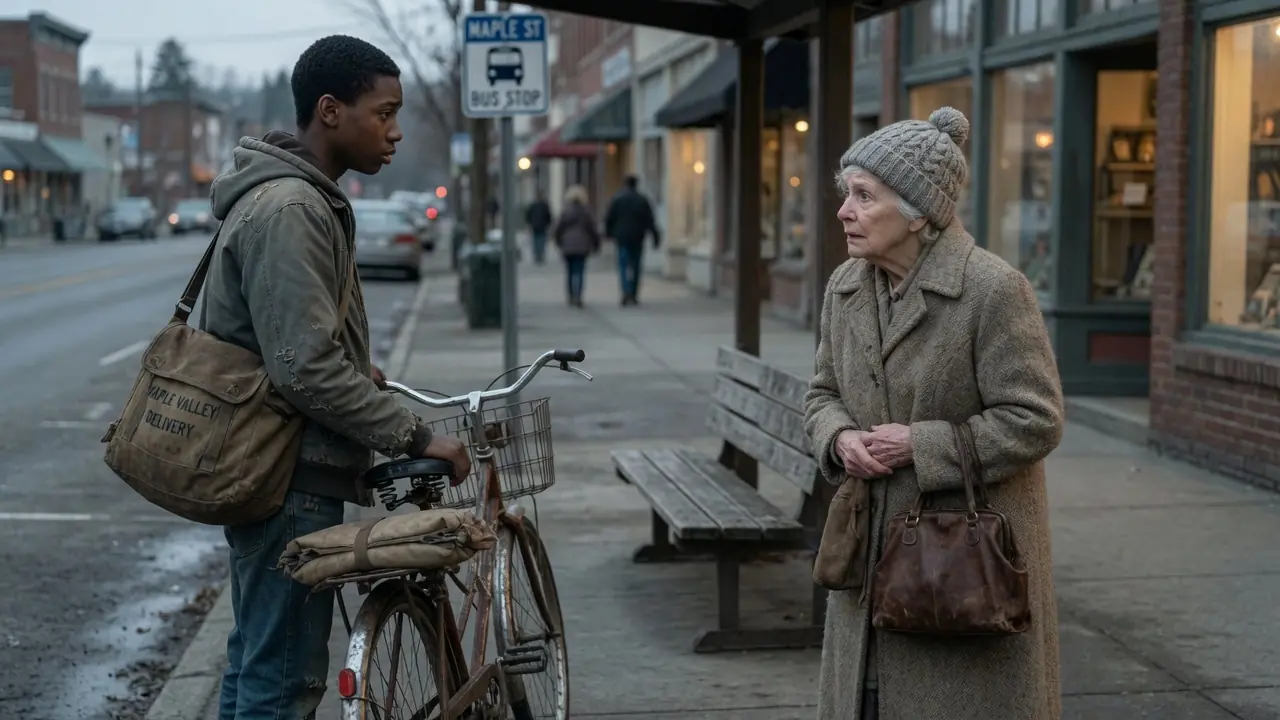
Then he saw the old woman at the bus stop.
And the decision that should have been impossible took him less than ten seconds.
The wind had begun to turn colder that evening, the kind that nipped at your ears and slid quietly down the back of your neck even if your coat was buttoned up tight.
The town was called Brookhaven, a place small enough that people claimed to know one another, but large enough that those who were struggling could disappear in plain sight.
It sat near a bend in a river that froze at the edges in winter, between a row of old factory buildings and a stretch of neighborhoods that had changed names three times depending on who could afford the rent.
At the far end of town, where the sidewalks cracked and the bus routes thinned, the old stop on Mercer Avenue stood beneath a leaning sign and a cloudy plastic shelter scratched by years of weather, keys, and boredom.
People passed it like they always did.
Some with grocery bags tugging at their wrists.
Some with collars turned up against the wind.
Some with eyes locked to phones.
Some simply hurrying home before the dark settled in fully.
But none of them looked at her.
The old woman stood alone, wrapped in a beige wool coat that had seen better decades. Her silver hair poked out from beneath a once-white bonnet. Her small hands clutched a tattered leather purse as she turned toward every car that passed, hoping it might be the one she was waiting for.
Her mouth moved.
She was murmuring something.
Route 12.
Willow.
Or Garden.
Maybe Oak.
Maybe home.
Every few moments, she stepped toward the curb, then shuffled back as confusion clouded her face again.
Not far from her, Andre Carter had stopped beside the bus shelter to drink from a dented metal water bottle.
He was barely eighteen, with a frame stretched thin by hunger, work, and years of learning not to ask for much. His hooded jacket had once been dark green, but too many winters had faded it. His jeans were patched at one knee. His shoes held together more out of habit than craftsmanship, the left one wrapped near the sole with electrical tape he had taken from a discarded toolbox.
His bicycle leaned against the bench behind him.
That bicycle had belonged to his mother.
Before illness bent her life into hospital rooms and bills, she had ridden it to work at the laundry on Hawthorne Street. She had ridden it to church on Sundays when the weather was mild. She had balanced groceries on the handlebars and Andre, when he was small, on a little seat behind her, telling him to hold tight because the world moved fast and he had to learn how to keep his balance.
When she died, the bicycle was one of the few things left that no one wanted to take.
The landlord had taken the apartment.
The hospital had taken what little savings remained.
A pawn shop had taken her sewing machine, her radio, and the gold earrings she had kept from her own mother.
But the bicycle stayed because it looked like junk to everyone except Andre.
To him, it was memory with wheels.
He tightened the strap of the delivery bag across his chest and glanced at the cracked screen of his phone.
7:11 p.m.
The final delivery had to be dropped off by 7:45.
It was a medication package from Harlow Pharmacy, wrapped in brown paper and sealed in a plastic pouch to protect it from damp air.
The customer lived three miles away in an apartment complex near the high school.
Andre knew the route.
If he rode hard, he could make it in fifteen minutes.
Get the signature.
Return to the delivery counter.
Collect the bonus.
Pay Mr. Granger before nine.
Keep his room.
If he missed the delivery window, the app would mark him unreliable. The pharmacy might refuse to use him again. The bonus would vanish. And without that money, Mr. Granger had already made clear what would happen.
No payment.
No bed.
No exceptions.
Andre took one last swallow of water, capped the bottle, and reached for his bike.
Then the old woman spoke loudly enough for the wind to carry her voice.
“Willow Lane. Or was it Garden? No, no. Bus 12 goes home. It always goes home.”
Her words tumbled like loose leaves.
Nobody else seemed to hear.
Andre looked at the bus stop.
The old woman had turned in a small circle, her face tightening with panic. She opened her purse, looked inside, closed it, opened it again, and then pressed one hand to her chest as though trying to steady her own heart.
Andre looked at the time again.
7:12.
His breath fogged in front of him.
Do not get involved, a hard voice inside him said.
You cannot afford to be kind tonight.
He hated that voice because it was often right.
Kindness had a cost. Andre knew that better than most people. It cost time. It cost money. It cost safety. It cost energy you might need later when no one came to help you.
But then the old woman stepped too close to the curb as a pickup truck sped past, and the gust of air made her wobble.
Andre moved before he finished thinking.
“Ma’am,” he called gently.
She did not turn.
He pushed his bike closer.
“Excuse me, ma’am. Are you all right?”
The old woman blinked at him as if he had appeared out of fog.
Her eyes were pale blue, watery and uncertain, but not empty. There was intelligence in them, buried beneath confusion, flickering in and out like a lamp fighting wind.
“I was trying to get home,” she said. “But I think I missed the bus. Or maybe it missed me.”
Her laugh was small and brittle.
Andre set the bike beside the shelter.
“Where do you live? Maybe I can help you figure it out.”
“Oh, I know where I live.”
She frowned.
“I do. I certainly do.”
She opened her purse and searched inside without purpose.
A folded handkerchief came out first.
Then a lipstick with no cap.
A peppermint wrapped in clear plastic.
A few coins.
A bus transfer from two days ago.
No phone.
No address card.
No wallet that Andre could see.
“What’s your name?” he asked.
She looked up.
“Evelyn.”
“Evelyn?”
“Yes. Evelyn Rose.”
She said the name clearly, almost proudly, then immediately looked embarrassed as if she had forgotten why names mattered.
Andre softened his voice.
“All right, Miss Evelyn. Do you remember the street?”
“Oak something.”
“Oak Street?”
“No.”
“Oak Avenue?”
She shook her head, frustrated.
“Oak Hill. Yes. Oak Hill Drive. Or perhaps that was my sister’s house. Did Margaret live on Oak Hill? No, Margaret is gone.”
Her face folded.
“She’s gone, isn’t she?”
Andre did not know how to answer that.
A bus hissed past on the opposite side of the street without stopping.
Evelyn turned toward it too late, lifted one hand, then lowered it.
“That was mine.”
“I don’t think so,” Andre said gently. “That one was going the wrong direction.”
“Was it?”
“Yes, ma’am.”
She looked at him again, and this time fear came through clearly.
“I don’t know where I am.”
Andre felt something tighten in his chest.
He had seen that kind of fear before.
He had seen it in his mother during her final month, when medication and pain made her wake in the night unsure which year she was in. She would look at Andre, fourteen then, and call him by his father’s name, then cry when she realized.
Andre had hated the fear more than the sickness.
7:15.
Thirty minutes to make the delivery.
He could call someone.
Who?
The police?
They might come in an hour.
An ambulance?
Maybe, but Evelyn did not seem injured. Just lost.
A shelter?
A hospital?
He looked around at the people passing. A man in a coat stepped around them without slowing. A woman with a shopping bag glanced over once, saw Evelyn, saw Andre, and kept walking faster.
Andre swallowed.
“Do you have any family I can call?”
Evelyn looked down at her purse.
“My grandson used to call.”
“Do you know his number?”
“He liked bicycles,” she said.
Andre waited.
“He rode too fast. Always too fast. His shoes were always scuffed.”
A cold gust moved through the bus shelter.
Evelyn shivered.
Andre saw something then.
A delicate silver chain around her neck, half hidden by the collar of her coat. At the end of it was a small oval pendant.
He hesitated.
“Ma’am, can I look at your necklace? Just for a second. Maybe there’s a number on it.”
She touched the pendant protectively.
“My husband gave me this.”
“I won’t take it. I promise.”
She studied his face.
Whatever she saw there made her nod.
Andre gently lifted the pendant and turned it over.
On the back, engraved in elegant cursive, were the words:
Evelyn Rose
48 Oak Hill Drive
North Side
Andre’s breath caught.
Oak Hill.
He knew the area. Everyone knew Oak Hill.
Way out past the edge of town, up beyond the old road, where houses sat behind gates and trees were trimmed by people who did not live in them.
It was nearly two hours by bicycle, maybe longer with someone riding on the back, and most of it uphill.
His delivery route was the other direction.
His phone buzzed.
Delivery reminder.
Harlow Pharmacy package due by 7:45 p.m.
Andre stared at the screen.
Then at Evelyn.
Her hands were trembling.
Her lips were pale from cold.
She looked at him now with the fragile trust of someone who had found one steady thing in a world suddenly turned unfamiliar.
Some choices weigh more than others, even when they make no sense on paper.
Andre put the phone away.
“That’s far,” he said gently. “But I know where it is.”
Evelyn looked relieved.
“You do?”
“Yes, ma’am.”
“I don’t want to be trouble.”
Andre forced a smile.
“You’re not trouble. You’re just a little far from home.”
He took the delivery package out of his bag and looked at it.
Medicine.
Someone needed it.
He could not simply abandon it.
Andre dialed the number listed on the label.
A woman answered on the fourth ring, annoyed.
“This is Lena.”
“Hi, ma’am. I’m Andre, the delivery rider. I’ve got your pharmacy package.”
“You’re late?”
“No, ma’am, not yet. I’m calling because I found an elderly woman lost at Mercer bus stop, and I need to get her home. I’m sorry, but I can’t make your delivery on time.”
There was silence.
Then, “That’s not my problem.”
“I know. I’m sorry. I can take it back to Harlow, or maybe they can send someone else.”
“My son needs that medicine tonight.”
Andre closed his eyes.
He could hear a child coughing faintly in the background.
“What’s your address?”
She told him.
It was near the high school, not far from the road north if he cut through Lincoln Park.
“I can drop it off first,” he said. “Then take her home. I’ll be later getting her there, but I’ll do both.”
Evelyn watched him, confused but quiet.
“You better not steal it,” Lena said.
“I won’t.”
“Hurry.”
Andre hung up.
The delivery app would still mark him late if he returned after the window, but the package would reach the person who needed it.
That mattered.
He looked at Evelyn.
“We need to make one stop first, all right? Then I’ll take you home.”
“Are we going to Henry’s house?”
“No, ma’am. Just a quick stop.”
“Henry liked bicycles.”
Andre swallowed.
“Then he had good taste.”
The back rack on the bike had never been meant to carry a grown person, even a small elderly woman, but Andre had carried heavier loads badly balanced. He tied his spare scarf over the metal rack to make it softer and helped Evelyn sit sideways, her feet resting carefully on one side.
He took off his jacket and wrapped it around her shoulders.
She objected.
“You’ll freeze.”
“I’ll be pedaling. I’ll stay warm.”
That was only partly true.
He tightened the delivery bag across his chest.
“Hold on to my shoulders, okay? Not too tight, but don’t let go.”
Evelyn placed her gloved hands lightly on him.
“You remind me of someone.”
“Your grandson?”
“Yes. Henry. Always scuffed shoes. Always proud.”
Andre looked down at his shoes.
The left one had electrical tape around it.
“Sounds like Henry and I would’ve gotten along.”
Evelyn chuckled softly.
Andre pushed off.
The bike wobbled under the extra weight.
For one sharp second, he thought they would fall.
Then he corrected, steadied the handlebars, and began to pedal.
The town moved around them in evening fragments.
Storefront lights.
Cars.
A dog barking behind a fence.
A woman smoking outside the laundromat.
A church sign with missing letters.
Andre rode hard at first, careful but quick, cutting through side streets toward Lena’s apartment.
Evelyn hummed behind him.
Sometimes she asked where they were.
He answered every time as if it were new.
“We’re on Parker Street.”
“Are we near home?”
“Not yet. But we’re going there.”
“Did I miss the bus?”
“Yes, ma’am. But that’s all right. We found another way.”
The pharmacy delivery was fourteen minutes late when he reached Lena’s building.
He helped Evelyn stay steady while he ran up the stairs, got the signature from a young mother holding a feverish boy against her hip, and placed the package in her hands.
Lena’s face changed when she saw him.
Maybe she had expected someone older.
Maybe she had expected someone careless.
Maybe she had not expected a skinny eighteen-year-old boy with wind-reddened eyes, no jacket, and an old woman waiting on the bicycle below.
“You really found an old lady?” she asked.
“Yes, ma’am.”
The little boy coughed against her shoulder.
Lena looked down at the medicine, then back at Andre.
“I’m sorry I snapped.”
“It’s okay.”
“No, it’s not. Wait.”
She disappeared inside and came back with a granola bar and two dollars in quarters.
Andre hesitated.
“Take it,” she said. “For her. Or you.”
He took the granola bar but not the quarters.
“I can’t. I’m working.”
“You’re late.”
“I know.”
“Then you’re not getting paid right.”
Andre gave a tired half-smile.
“Probably not.”
He ran back downstairs.
Evelyn looked relieved when he returned.
“I thought you left.”
“No, ma’am. I’m here.”
She touched his shoulder.
“I knew you would be.”
That nearly broke him for reasons he did not have time to examine.
Andre ate half the granola bar in two bites and tucked the rest into Evelyn’s coat pocket.
“For later.”
She smiled.
“Bossy.”
“My mother said that too.”
The sky turned lavender, then gray, then darker still.
Andre pedaled north.
The road sloped upward after town, passing warehouses, then small houses, then fields sleeping under frost. Streetlamps grew rarer. The air sharpened. His breath became smoke. His legs burned.
Behind him, Evelyn hummed an old song.
Sometimes she forgot where they were.
Sometimes she asked if Andre was Henry.
Sometimes she apologized for being heavy, though she was not heavy at all compared to the weight of the choice he had made.
He answered gently each time.
“No, ma’am. I’m Andre.”
“We’re going home.”
“We’re getting closer.”
“Just over the next hill.”
The next hill was never the last hill.
Still, he said it.
He said it because hope sometimes needed repetition more than accuracy.
At 8:37, his phone buzzed.
Mr. Granger.
Andre did not answer.
At 8:42, another buzz.
Then another.
At 8:50, a text came through.
No payment by 9. Room cleared. Don’t test me.
Andre stared at the message while stopped at a red light on an empty road.
The old woman behind him murmured, “Is something wrong?”
Andre put the phone away.
“No, ma’am.”
“You sound sad.”
“I’m just tired.”
“My grandson sounded tired sometimes.”
“I bet he did.”
“He carried too much.”
Andre smiled faintly.
“Maybe we all do.”
They stopped at a roadside gas station near the foot of Oak Hill.
Evelyn was shivering hard now, despite Andre’s jacket.
Andre had one dollar and thirty-seven cents in his pocket. Lena’s quarters would have helped, but he had left them behind out of pride or stubbornness or some mixture of both.
He bought the cheapest cup of hot tea the machine offered.
The cashier watched him count coins.
“That all?”
“Yes, sir.”
The man glanced outside and saw Evelyn sitting on the bicycle near the window.
“Your grandma?”
Andre looked at her through the glass.
“No.”
The cashier frowned, then reached under the counter and added a second cup.
“Machine made extra.”
Andre knew it had not.
“Thank you.”
He brought both cups out.
Evelyn insisted he drink first.
“You need it more,” she said with a tender sternness that reminded him of his mother.
Andre took a sip.
The tea was too hot, too sweet, and tasted faintly like paper.
It was wonderful.
When they started again, the road became steeper.
Andre had to stand on the pedals, body leaning forward, hands gripping the handlebars until his fingers ached.
The bicycle chain clicked angrily.
The back rack rattled.
His legs trembled.
Evelyn’s hands tightened on his shoulders.
“I can walk,” she said.
“No, ma’am.”
“You’re tired.”
“Yes, ma’am.”
“You can stop.”
“No, ma’am.”
A pause.
Then she said, quietly, “Your mother raised you well.”
Andre’s foot slipped off the pedal.
He caught himself, steadied the bike, and kept going.
For a few seconds, he could not speak.
Then he said, “She tried.”
“She did more than try.”
The gate of 48 Oak Hill Drive finally appeared at 9:31 p.m.
Whitewashed iron, chipped in places, with ivy curling around the bars. Behind it sat a large house with warm windows and a long drive lined by bare trees. The porch lights were on. Several cars were parked near the entrance. Someone had been looking for her.
Andre coasted to the gate and stopped.
His legs shook so badly he nearly dropped the bike.
Evelyn looked at the house and blinked.
“Oh,” she said. “That is mine.”
“Yes, ma’am.”
He pressed the call button beside the gate.
No answer.
He pressed again.
A voice crackled through.
“Yes?”
“I found Miss Evelyn,” Andre said. “She’s here.”
For a second, there was silence.
Then shouting from the other side.
The gate buzzed and opened.
Andre pedaled slowly up the drive, every muscle burning.
Before he reached the porch, the front door opened and an elderly man in a housecoat rushed out, followed by a middle-aged woman in scrubs, a tall man in a sweater, and another woman holding a phone to her ear.
“Miss Evelyn!”
The elderly man reached them first.
His face transformed from panic to disbelief to relief so powerful it made him look younger.
“Oh my Lord. Miss Evelyn, where have you been? We’ve been calling hospitals.”
Evelyn looked around, then smiled at Andre.
“I went for a walk. Or a ride, I suppose.”
The man helped her from the bike.
The woman in scrubs wrapped a blanket around Evelyn and began asking questions.
Are you hurt?
Are you dizzy?
Do you know where you are?
Evelyn answered some, missed others, and kept looking back at Andre.
“He brought me home,” she said. “On his bicycle.”
All eyes turned to Andre.
He suddenly became aware of his missing jacket, his thin hoodie, his taped shoe, his rusted bike, the sweat drying cold on his back.
The man in the housecoat stepped closer.
“I’m Charles. I manage the house. Son, please come inside. Warm yourself. Have something to eat. Let us give you a ride back.”
Andre shook his head.
“No need. I should get back before it gets colder.”
Charles looked at him as if that made no sense.
“At least let us pay you.”
“No, sir.”
“You rode her all the way from town?”
“Yes, sir.”
“With that bicycle?”
Andre glanced at the bike.
“It’s better than it looks.”
That was not entirely true.
Evelyn reached for his hand.
Her grip was cool but firm.
“What is your name?”
“Andre Carter.”
“Andre.”
She said it carefully, as if placing it somewhere safe.
“Do you have a telephone?”
Andre hesitated.
“Sort of.”
His phone worked when there was Wi-Fi and sometimes with prepaid minutes if he could afford them.
He found an old receipt in his pocket, scribbled his number on the back, and handed it to Charles.
“In case she ever needs help again.”
Charles looked at the receipt, then at Andre.
“You should let us help you tonight.”
Andre backed toward his bicycle.
“I’m all right.”
He was not all right.
But he had spent years saying it, and sometimes the words came out from muscle memory.
Evelyn’s eyes fixed on him.
“You’ll come back?”
Andre smiled.
“Maybe.”
“Promise?”
He could not promise.
So he said, “Get warm, Miss Evelyn.”
Then he climbed onto his bike and rode back down the long drive into the dark, unaware that by the time he returned to town, his room would be locked and his belongings left outside.
He was also unaware that in the house behind him, Evelyn Rose was beginning to remember enough to understand exactly what he had given up.
By the time Andre reached the edge of town again, the streetlights had thinned out, and the warmth from the gas station tea had long faded from his hands.
His knuckles were stiff.
Every bump in the road rattled through the handlebars and into his bones.
The ride back felt quieter, lonelier without Evelyn’s voice behind him.
The wind had picked up, whistling through bare trees and carrying the deep smell of winter: wood smoke, cold metal, frozen dirt, and something bitter that always seemed to hang in the air after nine.
Andre coasted the last block to the boarding house.
It was a narrow two-story building with peeling paint, crooked porch steps, and a porch light that had not worked since October.
Mr. Granger rented rooms by the week to men who worked too hard, drank too much, or had nowhere better to go.
Andre had been there nineteen days.
Long enough to know the radiator clanged at midnight.
Long enough to learn the man in Room 3 coughed in his sleep.
Long enough to feel grateful for a door that locked, even if the mattress sagged and the wallpaper peeled.
He parked his bike quietly and climbed the steps.
He reached into his pocket for the key.
Empty.
At first, he thought he had reached into the wrong pocket.
Then he checked the next.
Then the small pocket inside his jacket, which he remembered he was not wearing because Evelyn had worn it home.
He patted down his jeans.
His hoodie.
The delivery bag.
Nothing.
The key was gone.
He knocked gently.
No answer.
He knocked again, louder.
A light came on upstairs.
A window opened.
Mr. Granger looked down, bald head shining in the cold.
“You got my money?”
Andre looked up.
“I can pay tomorrow. I had an emergency.”
“You had a deadline.”
“I know, sir, but there was an old woman lost, and I had to get her home.”
Mr. Granger stared at him.
Then he laughed once.
Not loudly.
Worse.
Without surprise.
“You kids always got stories.”
“It’s true.”
“Money is true. You got that?”
Andre swallowed.
“No, sir.”
“Then you don’t got a room.”
“Please. Just one night. I’ll work tomorrow. I can pay half.”
“No.”
“Mr. Granger.”
“Your stuff’s on the porch.”
Andre looked down.
Only then did he see the small bundle beside the door. His spare shirt. A towel. A cracked phone charger. His mother’s old photograph in a plastic grocery bag. Everything left like trash.
“There’s supposed to be rules,” Andre said.
“There are. Pay rent.”
The window slammed shut.
Andre stood there for a long minute, bike at his side, unsure whether to curse or cry.
He did neither.
He picked up the grocery bag, tucked it carefully into the delivery bag, and turned back toward the center of town.
His legs ached from riding to Oak Hill and back, but he did not let them rest.
He pedaled slowly because there was nowhere left to go, but moving was better than standing still. The cold was settling into his chest now, and stillness would only make it worse.
It was nearly midnight when he passed the back alley of Johnson’s Market.
Johnson’s was a small corner store with a green awning, crooked shelves, and an owner who had known Andre’s mother.
Mr. Johnson was kind in the way older men sometimes were to kids they saw struggling but did not want to embarrass.
Gruff.
Practical.
Never soft in public.
But he had given Andre day-old bread, paid him five dollars to unload crates, and once pretended not to notice when Andre fell asleep sitting on a flour sack in the storeroom.
Andre parked his bike behind the dumpster, knocked once on the side door, and waited.
A light flickered on inside.
A few seconds later, the door creaked open.
Mr. Johnson stood there wearing a heavy robe and holding a steaming mug of something strong.
He took one look at Andre, shivering and hollow-eyed.
“Didn’t make rent, huh?”
Andre shook his head.
Mr. Johnson looked up at the sky like he was waiting for some higher authority to intervene.
Then he stepped aside.
“Storeroom’s dry. Cot in the corner. Don’t touch the wine crates, and don’t freeze to death on me.”
Andre nodded.
“Thank you.”
“Don’t thank me. Sweep before you leave.”
“Yes, sir.”
The storeroom smelled of cardboard, citrus, onions, and old wood. The only heat came from an old radiator that groaned like it had a grudge.
Andre did not mind.
He leaned the bike near the back wall, set his bag under the cot, and pulled the thin blanket around his shoulders.
His body was heavy.
His chest was sore.
But his heart, strangely, was quiet.
For the first time in weeks, he was not afraid to close his eyes.
Something about the ride, about Evelyn’s hands on his shoulders and her laughter in the dark, had made the world feel a little less jagged.
He drifted to sleep thinking not of Mr. Granger’s locked door, but of the silver pendant, the soft hum of wheels on gravel, and a voice that had said, “You remind me of someone I love.”
Outside, the wind howled against the store walls.
Inside, Andre slept soundly, unaware that miles away, in a mansion on Oak Hill, Evelyn Rose sat awake at her kitchen window.
Her beige coat lay across her lap.
Andre’s old jacket was folded on the chair beside her.
In her hand was the torn receipt with his phone number scrawled in uneven blue ink.
Her mind, clear now after rest and medicine, returned to the evening piece by piece.
The bus stop.
The cold.
The boy’s face.
His jacket around her shoulders.
The way his legs had trembled going uphill.
The tea he bought with coins.
The phone buzzing again and again while he pretended nothing was wrong.
Evelyn pressed the receipt to her chest and whispered his name like a prayer.
“Andre Carter.”
Charles stood in the doorway.
He had worked for Evelyn Rose for twenty-eight years, first as a driver, then as estate manager, and finally as the closest thing to family she had allowed herself after grief stripped the house quiet.
“We should call him in the morning,” Charles said.
Evelyn looked out into the dark.
“No.”
Charles frowned.
“No?”
“We should find him in the morning.”
The morning arrived with a hush, pale and hesitant.
Soft gray light crept across the back room of Johnson’s Market, filtering through the small dust-frosted window and settling over Andre, still curled beneath the thin blanket.
The cold clung to the walls and slipped through the cracks in the old frame.
But Andre did not stir until Mr. Johnson banged once on the storeroom door.
“Up, boy. If you’re breathing, you’re sweeping.”
Andre sat up, stiff and aching.
“Yes, sir.”
He folded the blanket carefully, tucked it against the wall, washed his face in the small sink, and moved quietly toward the front of the store.
Mr. Johnson was already opening, his movements steady and practiced.
He pushed a banana and a half-warmed cup of coffee across the counter.
No speech.
No pity.
Just breakfast.
Andre took the banana.
“Thank you.”
Mr. Johnson grunted.
“Don’t make a habit of sleeping here.”
“I won’t.”
“You will if you need to.”
Andre looked up.
Mr. Johnson did not meet his eyes.
“Now sweep.”
Andre smiled faintly and picked up the broom.
He was stacking canned peaches when the car pulled up.
It did not belong on that street.
Too polished.
Too quiet.
It glided to the curb like it was answering a summons.
The man who stepped out was tall and lean, wearing a dark wool coat too fine for Brookhaven’s cracked sidewalks. His shoes were polished. His posture deliberate. He glanced at a slip of paper in his hand, then looked through the store window.
His eyes found Andre.
The bell over the door chimed.
Mr. Johnson looked up from behind the counter and narrowed his eyes.
“Help you?”
“Good morning,” the man said. “I’m looking for Andre Carter.”
Andre froze near the shelf.
“That’s me.”
The man’s expression softened with relief.
“My name is Charles Bennett. Miss Evelyn Rose sent me.”
Mr. Johnson paused mid-sip of his coffee.
Andre’s grip tightened on the can in his hand.
“She okay?”
“Yes. Because of you.”
Charles took a step closer.
“She remembers everything. She asked me to find you. She wants to thank you in person.”
Andre looked from Charles to Mr. Johnson.
“I just wanted to make sure she got home safe.”
“And you did,” Charles said. “But she believes you gave her more than directions. She said you gave her back a sense of herself.”
Andre looked away.
Praise always made him uneasy.
It felt like clothing borrowed from someone richer.
Charles held up Andre’s jacket, folded neatly over one arm.
“You left this.”
Andre took it slowly.
It had been cleaned.
Not just dried.
Cleaned.
The torn seam near the elbow had been mended.
The zipper, which had not worked right in months, slid smoothly when he tested it.
He looked up.
Charles smiled slightly.
“Miss Evelyn insisted.”
Andre’s throat tightened.
“She didn’t have to.”
“No,” Charles said. “She did not. She wanted to.”
That distinction mattered.
Charles gestured toward the car.
“She’s waiting, if you’re willing.”
Andre hesitated.
The idea of returning to Oak Hill in daylight, stepping into a world that did not belong to him, felt like standing barefoot at the edge of a polished ballroom floor.
He was just a delivery boy with nowhere to sleep.
He had done what was right.
That was all.
Mr. Johnson watched him.
“Go,” he said.
Andre looked at him.
“Work?”
“I’ve got shelves older than you. They can wait.”
Charles added, “We’ll bring him back.”
Mr. Johnson snorted.
“You better. He owes me a swept floor.”
Andre almost laughed.
He nodded, followed Charles outside, and climbed into the car.
The ride to Oak Hill felt unreal in daylight.
The trees that had loomed like shadows the night before now stood tall and bare, their branches silvered by frost. The turns felt shorter. The hills less impossible. But Andre still remembered every slope in his legs.
When they reached 48 Oak Hill Drive, the house no longer looked like a monument.
It looked like a place that had been waiting too long.
Charles led him through a side entrance into a sunlit room filled with old books, framed photographs, and quiet warmth.
Evelyn sat near the window.
Not the dazed, wandering woman from the night before.
Someone entirely different.
Her silver hair was neatly pinned. A pale blue shawl rested over her shoulders. Her eyes were sharp now, though ringed with exhaustion.
When she saw Andre, her smile broke over her face like morning over mountains.
“You,” she breathed. “You brought me home.”
Andre stood awkwardly near the door.
“Yes, ma’am.”
“Come here.”
He obeyed because her voice had the softness of a grandmother and the authority of someone used to boardrooms, though Andre did not know that yet.
She reached for his hands.
Her grip was gentle but insistent.
“I remember every street,” she said. “Every word. The tea. Your jacket. The delivery you still made because a child needed medicine.”
Andre looked down.
“You remember that?”
“I remember enough to know what kind of boy you are.”
“I just did what anybody should’ve done.”
Evelyn’s eyes sharpened.
“But not what anybody did.”
Andre had no answer.
She studied his face.
“Charles tells me you slept at Johnson’s Market.”
Andre stiffened.
“I’m all right.”
“That is not what I asked.”
“You didn’t ask anything.”
“No,” she said. “Because I knew you would say that.”
Despite himself, Andre smiled.
Evelyn leaned back, watching him with an expression he could not quite name.
“My husband used to say the most stubborn people are usually the ones most afraid of needing anyone.”
Andre’s smile faded.
“My mother said something like that.”
“Tell me about her.”
The request was gentle.
Still, it caught him off guard.
No one asked about his mother anymore.
People asked where his parents were, or who was responsible for him, or why he was on his own. They asked questions that treated her absence like a problem to solve.
Evelyn asked as if his mother were still a person.
Andre looked toward the window.
“Her name was Denise Carter. She worked at the laundry on Hawthorne. Then at the diner sometimes. Then cleaning offices at night when she got sick and needed extra money.”
“What was she like?”
Andre swallowed.
“She sang when she cooked. Badly. She said if God wanted her quiet, He shouldn’t have given her lungs.”
Evelyn smiled.
“She sounds wonderful.”
“She was.”
“What happened?”
Andre looked at his hands.
“Cancer. By the time they found it, it was everywhere. She kept working longer than she should’ve. Said bills didn’t pause because bodies hurt.”
Evelyn closed her eyes briefly.
“I’m sorry.”
Andre nodded.
“She left me the bike.”
“And courage.”
He looked up.
Evelyn’s voice was steady.
“Do not forget that part.”
They spoke for nearly an hour.
Andre did not mean to tell her everything.
But one answer became another.
The apartment lost after his mother died.
The months with an aunt who had too many children and not enough patience.
The shelters.
The delivery work.
Mr. Granger.
Johnson’s storeroom.
The bicycle.
His dream of going back to school, though he spoke of that as if it belonged to a different boy.
Evelyn listened without interrupting.
Not with pity.
With attention.
That was harder to endure than pity.
At last, she said, “Andre, this house has twelve bedrooms.”
He looked up.
“Why?”
She smiled faintly.
“Because my husband believed empty space was a sign of success. I have since learned it is mostly a sign of poor heating decisions.”
Andre almost laughed.
She leaned forward.
“I want you to stay here.”
The words dropped into the room like a stone into still water.
Andre stood.
“No, ma’am.”
“Not forever if you do not wish. But for now. Until we arrange something steady. A room, meals, rest, school if you want it. Work too, if you need to feel useful, though I suspect you will whether I need you to or not.”
Andre shook his head.
“That’s kind of you, really. But I didn’t do this to get anything.”
“I know.”
“I just wanted you safe.”
“I know.”
“Then you don’t have to pay me back.”
Evelyn’s eyes did not waver.
“That is exactly why I am not trying to pay you back.”
Andre frowned.
“I don’t understand.”
“I am trying to honor what you did. Payment ends a thing. Honor lets it keep living.”
He looked toward the door.
His body wanted to run before wanting became dangerous.
Evelyn seemed to understand.
“You do not have to decide now. Charles will take you wherever you want to go.”
Andre looked at her.
“You’d let me leave?”
“Of course.”
“Even if I say no?”
“Yes.”
“Why?”
“Because kindness that traps a person is not kindness. It is a cage with clean curtains.”
Andre stared at her.
No one had ever said anything like that to him.
He returned to Johnson’s that evening.
He slept again in the storeroom.
He told himself he had made the right decision.
The cot was familiar.
The radiator groaned.
Mr. Johnson gave him soup and said nothing about the car.
But when Andre lay down, the storeroom felt smaller than before.
Not worse.
Just smaller.
Because now he knew there was a room on Oak Hill with a real bed, a window, and someone who had asked about his mother as if she mattered.
The next morning came with a gentler sky.
Andre rose early, swept the floor, organized crates, and tried not to think about Evelyn’s offer.
He failed.
At 9:15, the bell over the door chimed.
Andre looked up.
Evelyn Rose stood in Johnson’s Market.
No driver beside her this time, though Charles waited outside near the car. She wore a wool shawl and carried a small leather handbag. She looked entirely out of place between the canned beans and lottery tickets, but somehow not uncomfortable.
Mr. Johnson’s eyebrows rose.
“Morning.”
“Good morning, Mr. Johnson.”
“You know my name?”
“I make a point of knowing the names of people who help boys sleep indoors.”
Mr. Johnson grunted, which for him was almost a blush.
Evelyn turned to Andre.
“I hope you don’t mind me coming again.”
Andre straightened.
“No, ma’am.”
“I’ve been thinking about you all night.”
She paused.
“I suppose that sounds strange, but I mean it kindly.”
Andre nodded, not trusting his voice.
She walked closer, not with the authority of someone used to commanding space, but with the gentleness of someone asking permission from it.
“I lived in that house with my husband for forty-one years,” she said. “After he died, it became too quiet. After my grandson died, it became something else entirely. A museum, perhaps. Or a very expensive echo.”
Andre listened.
“You remind me of him,” she continued. “Not because you look like him. You don’t. But because of your kindness. Your eyes. The way you listen before deciding what to do.”
She drew a breath.
“When you helped me without asking, without expecting, something in me woke up. Something that had been sleeping for years.”
Andre looked down at the counter.
Evelyn reached into her bag and pulled out a folded piece of paper.
“This is not a contract,” she said. “It is not a deal or arrangement. It is simply an invitation.”
Andre took it.
The paper was thick, the handwriting slightly trembling but elegant.
Andre Carter,
You are invited to stay at 48 Oak Hill Drive for as long as you need while we help you find stable ground.
You will have your own room, your privacy, and your freedom.
You will be welcome at the table but not required to perform gratitude.
If you wish, we will help you return to school, repair your bicycle, replace your documents, and plan your future.
No debt.
No conditions beyond honesty, respect, and the understanding that help is not shameful.
Evelyn Rose
Beneath it, in softer script, was one line:
Sometimes the person who brings us home deserves to find one too.
Andre stared at the note.
The world outside the store window moved as usual.
Cars passed.
A child dropped a mitten and his mother picked it up.
A delivery truck blocked traffic.
Brookhaven had no idea that inside Johnson’s Market, Andre Carter’s life was quietly shifting.
He looked at Evelyn.
“What if I don’t know how to live in a house like that?”
“Then we learn.”
“What if I mess up?”
“We talk.”
“What if people think I’m taking advantage?”
Evelyn’s face changed.
It became sharper, almost amused.
“My dear boy, I have been a woman with money for a very long time. People think all sorts of foolish things. It has rarely stopped them from asking me for donations.”
Mr. Johnson coughed to hide a laugh.
Andre looked down at the note again.
His voice came out small.
“I don’t want to lose my bike.”
“You will not.”
“It was my mother’s.”
“Then it comes with you.”
That decided something no amount of money could have.
Andre folded the paper carefully.
“I’d like to come.”
Evelyn’s eyes filled.
She did not reach for him.
She only nodded.
“I am very glad.”
That afternoon, Charles came with the car, not out of ceremony but because Evelyn insisted Andre not ride that old bicycle up the long hill again.
Andre packed his few belongings into a backpack.
Mr. Johnson handed him a paper bag of sandwiches.
“About time,” he muttered.
Andre looked at him.
“Thank you for the cot.”
“Thank me by coming around to sweep when you’re rich.”
Andre laughed.
“I’m not getting rich.”
“Living on Oak Hill, sleeping in clean sheets, eating food with names? Rich enough.”
Andre hugged him before either of them could think better of it.
Mr. Johnson stiffened, then patted his back once.
“Go on,” he said roughly. “Don’t make the lady wait.”
Charles loaded the bicycle carefully into the back of a larger vehicle.
Andre watched like a nervous parent.
“I’ll be careful,” Charles said.
“She’s old.”
“So am I.”
Andre smiled.
Life at the estate was not extravagant in the way Andre expected.
It was peaceful.
The house was large, yes, with polished floors, high ceilings, and rooms that seemed designed for people who had never worried about heating bills.
But Evelyn did not live grandly inside it.
She used only a few rooms regularly: the library, the sunroom, the kitchen, the greenhouse, and her bedroom upstairs.
The rest of the house held covered furniture, framed portraits, old books, clocks that ticked too loudly, and the faint feeling of lives paused mid-sentence.
Andre’s room overlooked the garden.
The bed was wide enough that the first night he slept curled on one edge because using the whole thing felt rude.
There was a desk.
A lamp.
A dresser.
A small bookshelf.
A blue quilt folded at the foot of the bed.
On the wall hung a painting of the river in summer.
Andre stood in the doorway for a long time.
Charles placed his backpack on the chair.
“Bathroom is across the hall. Towels are in the cabinet. Dinner at six, unless Miss Evelyn forgets she is hungry, which she often does. In that case, dinner at six-thirty after I remind her.”
Andre nodded.
Charles hesitated.
“You may lock the door if you like.”
Andre looked at him.
“From inside?”
“Yes.”
The first thing Andre did after Charles left was test the lock.
Then he sat on the bed and cried without making sound.
Not because he was sad.
Because his body did not know what to do with safety.
Dinner was soup, roasted chicken, potatoes, and bread warm enough to steam when broken open.
Andre tried to eat politely.
Evelyn pretended not to notice how hungry he was.
Charles noticed and kept serving more.
After dinner, Evelyn asked if he wanted to see the greenhouse.
Andre said yes because he was still afraid that refusing anything would be ungrateful.
The greenhouse stood behind the house, glass fogged at the edges, filled with rows of herbs, winter greens, orchids, citrus trees in pots, and one stubborn tomato plant Charles considered a personal enemy.
Evelyn touched a rosemary plant.
“My husband built this for me after our son was born. I wanted flowers in winter. He said it was impractical. Then he built it anyway.”
“What was his name?”
“Arthur.”
Andre smiled faintly.
“Did he always pretend to disagree before doing what you wanted?”
“Only when he wanted credit for surrendering.”
Andre laughed.
Evelyn looked pleased.
They walked slowly between the plants.
“My grandson Henry loved this place,” she said. “He used to hide behind the lemon tree when he was little. As if the smell of cookies did not give him away.”
“What happened to him?”
The question slipped out before Andre could stop it.
Evelyn’s hand paused over the rosemary.
“He died at nineteen. Car accident. Seven years ago.”
“I’m sorry.”
“Yes,” she said. “So am I.”
There was no bitterness in her voice.
Only a grief worn smooth by years of touching it.
“That was when the house became quiet?” Andre asked.
“Yes.”
They stood among the plants in the warm glass room while winter pressed against the outside.
Evelyn looked at him.
“I cannot replace him.”
Andre stiffened.
“I know.”
“And you cannot replace your mother.”
His throat tightened.
“No.”
“So we will not ask impossible things of each other.”
Andre nodded.
“What can we ask?”
Evelyn smiled gently.
“That we not be alone if we do not have to be.”
The first weeks at Oak Hill were both easy and hard.
Easy because there was food.
Heat.
A bed.
Clean clothes.
A bathroom with hot water whenever he needed it.
Hard because Andre did not know how to accept any of it without waiting for the bill.
He woke early and tried to work.
He cleaned his room until it looked untouched.
He swept hallways.
He carried firewood.
He helped Charles polish silver until Charles finally took the cloth from his hand and said, “Andre, you are allowed to sit down here.”
“I don’t want to be lazy.”
“You are eighteen and have been working like a mule for years. Sitting ten minutes will not ruin your character.”
Andre sat.
For seven minutes.
Then he fixed a loose cabinet handle.
Evelyn watched this pattern with quiet sadness.
She did not scold.
She invited.
Morning tea in the sunroom.
Walks in the greenhouse.
Reading in the library.
At first, Andre felt out of place among books with gold lettering and chairs that looked too expensive to sit in.
Then Evelyn asked him to read aloud because her eyes tired easily in the evening.
He chose a book of poems because it was nearest.
His voice was uncertain at first.
By the third evening, it steadied.
By the fifth, Evelyn closed her eyes and listened as if the words were music.
“Your mother read to you?” she asked.
“Sometimes. When she wasn’t too tired.”
“What did she read?”
“Anything. Library books. Mail flyers. Recipes. She said words were free if you knew where to find them.”
Evelyn smiled.
“She was right.”
Within the month, Evelyn’s attorney helped replace Andre’s documents. Birth certificate. Social Security card. State ID. School transcripts.
Andre learned that paperwork was another kind of gate, and that people with money had keys to gates that poor people were told were walls.
He hated that.
Evelyn did too.
A tutor named Mrs. Bell came twice a week.
Andre was embarrassed by how far behind he felt.
He had dropped out during his mother’s illness, intending to return after things settled.
Things had never settled.
The first time he failed a math assessment, he pushed the paper away.
“I’m stupid.”
Mrs. Bell looked offended.
“You are undereducated. That is different.”
Andre stared.
She tapped the paper.
“Stupid is permanent. Undereducated is a problem with a schedule.”
He did not like her at first.
Then he trusted her.
Slowly, his days formed a new shape.
Breakfast with Evelyn.
Study in the morning.
Helping Charles in the afternoon.
Reading in the library.
Part-time work at Johnson’s Market twice a week because Andre insisted on earning something himself and because Mr. Johnson claimed the shelves had become arrogant without him.
On Saturdays, Andre rode his mother’s bicycle into town.
It had been repaired by a man Evelyn hired, but only after Andre stood beside the mechanic the entire time to make sure nothing original was replaced unless absolutely necessary.
New brake pads.
New chain.
Straightened rack.
Proper tires.
The frame remained his mother’s.
That mattered.
He rode past the old bus stop often.
Each time, he slowed.
Not out of sadness.
Out of recognition.
That was where one life had ended and another had begun.
As spring thawed the last of winter from the ground, Evelyn began speaking of something larger.
At first, it was only conversation.
A comment over breakfast.
A question after reading the newspaper.
A thought while walking in the greenhouse.
“What happens to elderly people who wander and have no one looking for them?” she asked one morning.
Andre buttered toast.
“I guess some get found. Some don’t.”
“That is not acceptable.”
“No, ma’am.”
“And young people like you? Those who need one small thing at the right time?”
Andre looked up.
“You mean money?”
“Sometimes. But not only money.”
He thought about it.
“A safe place. A bus pass. A phone that works. Someone who believes you’re not lying just because you need help.”
Evelyn nodded slowly.
“Exactly.”
The idea grew.
Evelyn had wealth, but wealth alone had never healed her loneliness. Andre had lived the cracks in the town’s systems, but survival had left him no resources to change them.
Together, they began designing something neither could have built alone.
They called it the Willow Light Fund.
Willow for the street Evelyn had misremembered at the bus stop.
Light for what Andre had carried into the dark without knowing it.
Its mission was simple.
To support young people with potential but no path.
To protect elderly people slipping through gaps in care.
To provide immediate, practical help before small crises became life-breaking disasters.
Evelyn insisted the foundation start quietly.
“No gala,” she said.
Charles looked disappointed.
“I was hoping to wear my good suit.”
“You may wear it to the grocery.”
Andre laughed.
The first program was called Ride Home.
Volunteer drivers, trained staff, and a 24-hour phone line for elderly residents who became lost, stranded, or confused.
Evelyn funded medical ID bracelets and pendants for seniors in town, not the cheap kind that broke easily, but sturdy ones with engraved addresses and emergency contacts.
The second program was Andre’s idea.
The Last Mile Fund.
Small emergency grants for young workers, students, and unhoused youth who needed immediate help with transportation, rent gaps, work clothes, phone minutes, school fees, or emergency meals.
“No long forms,” Andre said during the planning meeting.
The attorney frowned.
“We need safeguards.”
“Yes,” Andre said. “But if someone needs twenty dollars by eight o’clock and the form takes three days, the form is just a polite way to say no.”
Evelyn looked at the attorney.
“He is correct.”
The attorney adjusted his glasses.
“We can design a rapid approval process.”
“Good,” Evelyn said.
The third program was housed in an old building near Johnson’s Market, a former laundromat Evelyn bought and renovated.
The front became a small community center with tables, computers, lockers, showers, laundry machines, and a kitchen.
The sign outside read:
WILLOW LIGHT CENTER
A Place To Start Again
Mr. Johnson attended the opening and complained the coffee was too fancy.
Then he drank three cups.
Andre spoke at the opening only because Evelyn asked him privately and promised he could keep it short.
He stood before a small crowd of town officials, neighbors, social workers, teachers, senior volunteers, and people who had come mostly because they heard there would be food.
Andre wore a clean shirt and his mother’s locket tucked under it. Evelyn had found it among his things and had the broken clasp repaired.
He looked toward the back of the room and saw Mr. Granger, his former landlord, standing near the door.
Andre almost lost his words.
Then he saw Evelyn seated in the front row, hands folded, eyes steady.
He took a breath.
“I used to think help was something you had to earn by proving you were desperate enough,” Andre said. “But the night I met Miss Evelyn, I learned something. Sometimes the person giving help needs it too. Sometimes bringing someone home brings you home also.”
The room went quiet.
“I don’t know much about foundations,” he continued. “But I know what it feels like to be twenty dollars short and one locked door away from sleeping outside. I know what it feels like to be hungry and still have work to do. I know what it feels like when people look at you and decide your whole story before you say a word.”
He looked around.
“This place is for people who need one chance before everything falls apart. Not pity. A chance.”
Applause came slowly at first.
Then stronger.
Evelyn wiped her eyes.
Charles pretended not to.
The center changed Brookhaven in ways that did not look dramatic at first.
A seventeen-year-old girl used the Last Mile Fund to buy non-slip shoes for a diner job.
A young man paid for a bus pass to attend welding classes.
An elderly widower received a medical pendant after being found confused outside the post office.
A mother used the laundry machines before a custody hearing.
A high school student with no quiet place at home came to study three afternoons a week and passed algebra.
Small things.
But small things, Andre knew, were often the hinges on which entire lives turned.
Andre returned to school through a flexible program.
He worked hard.
Harder than he had ever worked on the bicycle, because school asked a different kind of endurance.
There were days he hated it.
Days he felt behind everyone.
Days he sat at the desk in his room, staring at an essay prompt until the words blurred.
On those nights, Evelyn would knock gently.
“Tea?”
“I’m busy.”
“That was not no.”
She would bring tea and sit near the window, saying nothing until he spoke.
One night, he shoved the essay away.
“I can’t write about future goals when I don’t even know what next month looks like.”
Evelyn considered that.
“Then write about that.”
“That’s not the assignment.”
“Perhaps the assignment is wrong.”
Andre laughed despite himself.
She smiled.
“Write the truth first. We can teach it manners later.”
He wrote about his mother’s bicycle.
About delivery work.
About the bus stop.
About the night he chose to help Evelyn and lost his room.
About how he had thought kindness cost him everything until it returned wearing an old woman’s face and carrying a second chance.
Mrs. Bell read the essay and cried.
Andre pretended not to notice.
He graduated the following spring.
Not at the top of his class.
Not with perfect grades.
But with a diploma in his hand and Evelyn, Charles, Mr. Johnson, Mrs. Bell, and half the Willow Light Center staff cheering like he had won a championship.
After the ceremony, Andre rode his bicycle to the cemetery where his mother was buried.
He wore his graduation gown over his shirt.
The cemetery grass was bright from recent rain.
He stood before Denise Carter’s modest stone and placed the diploma carefully against it.
“I did it,” he said.
The wind moved through the trees.
“I know it took longer than it should’ve. I know I messed up some. But I did it.”
He touched the stone.
“Your bike still works.”
A laugh broke through his tears.
“You probably know that.”
He sat beside her grave for nearly an hour, telling her about Evelyn, the house, the foundation, the center, Mr. Johnson’s terrible coffee, Charles’s dry jokes, Mrs. Bell’s war against bad grammar, and the way life had somehow become bigger than survival.
When he returned to Oak Hill, Evelyn was waiting on the porch.
She did not ask where he had been.
She knew.
He sat beside her.
For a while, they watched evening settle over the lawn.
“I got into the community college program,” he said.
Evelyn smiled.
“I know.”
Andre turned.
“How?”
“The envelope came at noon. I did not open it. I simply guessed from the way you tried not to smile when you came up the drive.”
He laughed.
“Social work track. Part-time at first.”
“That suits you.”
“I want to work at the center too.”
“Of course.”
“And keep delivering sometimes.”
Evelyn raised an eyebrow.
“Delivering?”
“Not like before. But the bike gets restless.”
“Ah. We must consider the bicycle’s emotional life.”
“It’s been through a lot.”
“So have you.”
Andre leaned back in the chair.
“Yeah.”
Evelyn looked at him.
“And look at you now.”
Years passed.
Not many.
Enough.
Andre became one of the most trusted faces at the Willow Light Center because people believed him when he said he understood.
He did not understand everyone’s pain.
No one can.
But he understood the edge.
The moment when one missed payment, one lost ride, one broken phone, one confused evening, one unanswered door could change the course of a life.
He trained volunteers not to speak down to people.
He helped design intake forms that used plain language.
He insisted the center keep emergency food by the front desk.
He created a bicycle delivery program for seniors who needed groceries or prescriptions but could not leave home.
The bicycle program started with three bikes.
Then eight.
Then twenty.
Andre’s mother’s bike hung on the wall inside the center, cleaned and restored but not polished beyond recognition.
A plaque beneath it read:
Denise Carter’s Bicycle
The first Willow Light ride began here.
Andre objected to the plaque at first.
Evelyn overruled him.
“Your mother deserves a place in this.”
He could not argue with that.
Evelyn’s memory continued to shift.
Some days she was sharp enough to correct the foundation’s financial statements and terrify accountants.
Some days she called Andre Henry.
The first time it happened after he moved in, he froze.
Evelyn realized a moment later and covered her mouth.
“I’m sorry.”
Andre sat beside her.
“It’s okay.”
“It is not. You are Andre.”
“Yes.”
“I know that.”
“I know you do.”
She took his hand.
“I do not want to lose the names of people I love.”
Andre’s throat tightened.
“Then when you forget, I’ll remind you.”
“And if I forget again?”
“I’ll remind you again.”
That became their way.
On clear days, they talked about policy, programs, books, and whether Charles was secretly feeding the neighbor’s cat.
On foggy days, Andre answered the same question as many times as needed.
Where are we?
At home.
What day is it?
Tuesday.
Did Henry call?
No, ma’am. Not today.
Who are you?
Andre.
Oh yes. You brought me home.
Yes, ma’am.
You always do.
And he did.
When Evelyn’s health declined further, Andre stayed.
Not because he owed her.
Because love had grown where obligation might have been.
The legal papers had long since been arranged. Evelyn had made Andre a beneficiary of a trust, though he did not know the full extent until later. More importantly, she had made sure the foundation would continue regardless of family disputes, market changes, or anyone’s desire to turn kindness into publicity.
Her distant relatives appeared when they heard.
A nephew from Boston.
A cousin from Palm Beach.
A woman who called Evelyn “Aunt Evie” though Charles swore she had not visited in fifteen years.
They looked at Andre with suspicion polished into politeness.
One afternoon, the nephew pulled him aside near the staircase.
“You understand this arrangement has raised concerns.”
Andre looked at him.
“What arrangement?”
“You living here. Being involved in her affairs. A vulnerable elderly woman with considerable assets.”
Andre felt old anger rise.
The kind he had swallowed at bus stops, delivery counters, landlord doors, and grocery lines.
Before he could answer, Evelyn spoke from the sitting room doorway.
“My mind may wander, Martin, but my judgment has not died.”
The nephew turned red.
“Aunt Evelyn, we’re only trying to protect you.”
“No,” she said. “You are trying to protect an inheritance you did nothing to earn from a young man who gave me his jacket when I did not know my own address.”
The room went silent.
Evelyn stepped closer, leaning on her cane.
“Andre is my family because he behaved like family before he had any reason to. If that troubles you, be troubled elsewhere.”
Charles, standing behind her, looked deeply satisfied.
The relatives left the next morning.
They did not return often.
When Evelyn died, it was late autumn.
Not winter.
Andre was grateful for that.
She passed in her own bed, with the window open slightly because she liked cool air, Charles seated near the door, and Andre holding her hand.
For most of that final day, she drifted in and out.
Near sunset, her eyes opened clearly.
“Andre.”
“I’m here.”
“I know.”
He leaned close.
“You brought me home,” she whispered.
Tears slid down his face.
“You brought me home too.”
She smiled.
“Good.”
Her hand tightened weakly around his.
“Keep the light on.”
“I will.”
She died as the last light left the garden.
The funeral filled the church.
Not because Evelyn was wealthy, though she was.
Not because she had influence, though she had plenty.
People came because the Willow Light Fund had touched the town in quiet, practical ways.
Seniors wearing medical pendants.
Students who had received emergency grants.
Workers who had found jobs through the center.
Mothers.
Teachers.
Drivers.
Volunteers.
Mr. Johnson came in his best suit, uncomfortable and proud.
Mrs. Bell brought a stack of handkerchiefs and used most of them.
Charles sat beside Andre.
Andre gave the eulogy.
He stood at the front of the church, no longer the hollow-eyed delivery boy from Mercer Avenue, but still carrying him inside.
“When I met Evelyn Rose,” he said, “she was lost at a bus stop.”
A soft murmur moved through the church.
“I thought I was the one helping her. I thought I was giving up one delivery, one night’s rent, one little piece of the future I was trying to hold together.”
He paused.
“But kindness is strange. Sometimes you hand someone a way home, and without knowing it, you draw a map for yourself too.”
He looked at the faces before him.
“Evelyn did not save me by giving me money. She saved me by seeing me. She asked my story. She learned my mother’s name. She gave me a room with a lock and a place at a table. She gave me chances, but she never made me feel like a project.”
His voice trembled.
“She taught me that dignity is not something people earn after they recover. It is something they need in order to recover.”
Charles bowed his head.
Andre continued.
“She told me once to keep the light on. That is what we will do. Through the Willow Light Fund, through the center, through every ride home and every small bridge we build for someone standing at the edge of losing everything, we will keep it on.”
By the time he finished, half the church was crying.
So was Andre.
He did not hide it.
Years later, Andre would still ride past the old bus stop on Mercer Avenue.
The sign had been replaced.
The shelter cleaned.
A small plaque had been added to one side.
At this stop, one act of kindness began the Willow Light Fund.
If you are lost, ask.
If you see someone lost, stop.
Andre always slowed there.
Sometimes he stopped completely.
He would rest one foot on the curb, hands on the handlebars of his mother’s bicycle, and remember the cold evening when his whole life had balanced on a single delivery.
He had lost that room.
He had lost that payment.
He had lost the last thin plan he had made for survival.
But he had not lost himself.
That was what mattered.
On one particular evening, five years after he first met Evelyn, Andre saw a boy at the bus stop.
Maybe seventeen.
Thin jacket.
Backpack held together with safety pins.
Eyes scanning the street with the practiced caution of someone who had learned not to expect help.
Andre stopped.
“You all right?” he asked.
The boy stiffened.
“I’m fine.”
Andre smiled gently.
“I used to say that too.”
The boy looked at him, suspicious but tired.
Andre nodded toward the community center van parked nearby.
“Willow Light Center is two blocks over. Warm food tonight. Showers. Phone chargers. No speeches unless Mr. Johnson is there, and then unfortunately there may be speeches.”
The boy almost smiled.
“I don’t need charity.”
“Good,” Andre said. “We don’t give charity.”
“What do you give?”
Andre looked at the bus stop.
Then at the boy.
“Bridges.”
The boy frowned.
Andre swung one leg over his bike.
“Come on. I’ll walk with you.”
The boy hesitated.
Then he came.
They walked together down the cracked sidewalk as the streetlights flickered on, one by one, against the early winter dark.
Andre thought of his mother.
Of the bicycle.
Of the locked boarding house door.
Of Mr. Johnson’s storeroom.
Of Charles at the market.
Of Evelyn’s hand holding his.
Of Oak Hill.
Of the greenhouse.
Of the first night he slept in a room where the door locked from the inside.
He thought of all the ways a life can break.
And all the ways it can be repaired.
Not at once.
Not magically.
Not by money alone.
But by being seen.
By being trusted.
By being given one safe place to begin again.
Sometimes you do not find home.
Sometimes you pedal straight into the dark to bring someone else back to theirs.
And somewhere along the way, without realizing it, you find the road to your own.
Andre Carter had thought kindness was a risk he could not afford.
He had been right.
It was a risk.
It cost him his delivery.
His room.
His last plan.
But it gave him something survival never had.
A future.
And long after Evelyn Rose was gone, that future kept widening.
One bus stop.
One bicycle.
One warm room.
One young life.
One light at a time.