In the quiet stillness of an early morning on the east side of Detroit, a young boy rode his old bike through streets that had been worn down by winters, factory smoke, unpaid bills, and people who had learned to keep going even when life gave them no reason to.
His name was Terrence Moore.
He was fifteen years old, though hunger and worry sometimes made him look older in the eyes.
He rode a scuffed-up Schwinn with a rusted chain, one crooked handlebar, and a rear crate tied down with bungee cords and faith.
The bicycle had once belonged to his uncle, then to his mother, then to him, passed down not because it was valuable, but because nobody in his family could afford to throw away something that still moved.
That bike was how Terrence helped keep his family alive.
Not in some grand way.
Not in a way anyone would write an article about.
He delivered groceries after school and on weekends. Sometimes before school too, if an elderly customer needed medicine or milk.
He carried paper bags full of discount cereal, canned soup, frozen chicken, laundry soap, and off-brand shampoo to people who were too old, too tired, too sick, or too busy to make it to the store themselves.
The pay was small.
The tips were smaller.
But every few dollars mattered.
Every dollar could be bread.
Every tip could be bus fare.
Every delivery could mean his mother ate dinner instead of pretending she had eaten at work.
Terrence lived with his mother, Carmen, and his seven-year-old sister, Layla, in a narrow brown house with peeling paint, a front step that leaned to one side, and windows that rattled whenever trucks passed too fast.
The house was not really theirs. They rented the lower half from a landlord who lived out in the suburbs and sent text messages instead of fixing things.
But Carmen called it home because mothers sometimes have to bless places before those places deserve it.
Carmen Moore worked mornings cleaning offices downtown and evenings at a nursing facility, where she helped feed people who had outlived most of their families.
She came home with sore feet, swollen fingers, and a smile she put on before opening the door so Layla would not learn too early what exhaustion looked like.
Terrence knew anyway.
He knew the way her shoulders dropped when she thought no one was watching.
He knew how she watered down juice to make it last.
He knew how she counted change twice before buying milk.
He knew how she put the best piece of chicken on Layla’s plate, the second-best on his, and took whatever was left for herself.
He also knew she hated that he worked.
Every time he came home late, she looked at him with that particular mother’s pain, the kind made of pride and guilt twisted together.
“You should be doing homework,” she would say.
“I did it.”
“You should be with boys your age.”
“They don’t pay.”
“You are not grown yet, Terrence.”
He always answered the same way.
“I know, Ma.”
But they both knew childhood had become a luxury in their house.
Layla still had some of it.
That was the point.
That was why Terrence rode until his legs burned and his hands stiffened around the handlebars.
So Layla could keep coloring stars on the backs of grocery receipts.
So she could still believe pancakes were breakfast and not a special event.
So she could ask for library books without watching her mother calculate bus fare.
So she could sleep through the night without hearing Carmen cry softly in the bathroom.
The summer had been especially hard.
Detroit heat did not simply sit in the air.
It pressed down.
It rose from pavement.
It clung to brick walls.
It settled inside houses with broken air conditioners and turned rooms into boxes of damp breath.
The sun had not even reached its highest point that Saturday, but already the east side was sweltering in heat that wrapped around the neighborhood like a damp wool blanket.
It clung to the faded bricks of old apartment buildings, seeped into cracked sidewalks, and settled deep into every breath.
The air smelled of tar, dry earth, hot metal, and the faint trace of oil lifting from the roads.
It was the kind of heat that made everything move slower.
Cars rolled by with windows down.
Old men sat under porch awnings with towels around their necks.
Kids ran through the spray of an open hydrant two blocks over, laughing like the water belonged to them.
Terrence wiped the back of his neck with the hem of his shirt as he coasted down Tuxedo Street, knees pumping lazily at the pedals of his Schwinn.
The crate strapped to the rear frame bounced with every pothole.
Inside were two full grocery orders.
One was for Mrs. Ellison on Harper Avenue, who always ordered oatmeal, bananas, cat food, and one small bottle of ginger ale.
The other was for Mr. Green in the senior apartments, who tipped exactly one dollar every time and apologized for it as if Terrence had not already learned that apologies sometimes weighed more than coins.
It was not glamorous work.
But it kept the lights on most weeks.
Or almost did.
That morning, Carmen had stood at the kitchen counter with three bills spread in front of her.
Electricity.
Water.
Rent balance.
She had not said much.
She did not have to.
Terrence had seen the numbers.
He knew what they had in the coffee can above the refrigerator. He knew what he had earned that week. He knew what was missing.
Twenty-eight dollars.
Twenty-eight dollars was the difference between a full grocery trip and another week of creative meals.
Rice with beans.
Beans with rice.
Eggs if they were lucky.
Toast if the bread had not gone stale.
Terrence had promised himself he would make enough before nightfall.
He had four deliveries.
Maybe five if the app kept offering.
A good tip from one customer could change the whole evening.
He had learned to think like that.
Not in years.
Not in months.
In evenings.
If they got through the evening, they could face tomorrow when it came.
His phone buzzed against the cracked plastic holder taped to his handlebar.
Delivery window closing.
He clenched his jaw.
Not today.
He leaned forward, pedaling harder.
The street changed as he turned onto a quieter block.
The houses here were older, wider, with porches that had once been handsome and yards that showed signs of people trying. A row of aging homes sat beneath thick-limbed trees. Some had fresh flowers in coffee cans near the steps. Some had grass gone brown from heat. Some had windows boarded with plywood that had been there so long it looked permanent.
At the corner, one house sagged at the roofline, shaded by the heavy arms of an overgrown maple tree.
The porch was half-repaired.
Or half-broken.
It was difficult to tell.
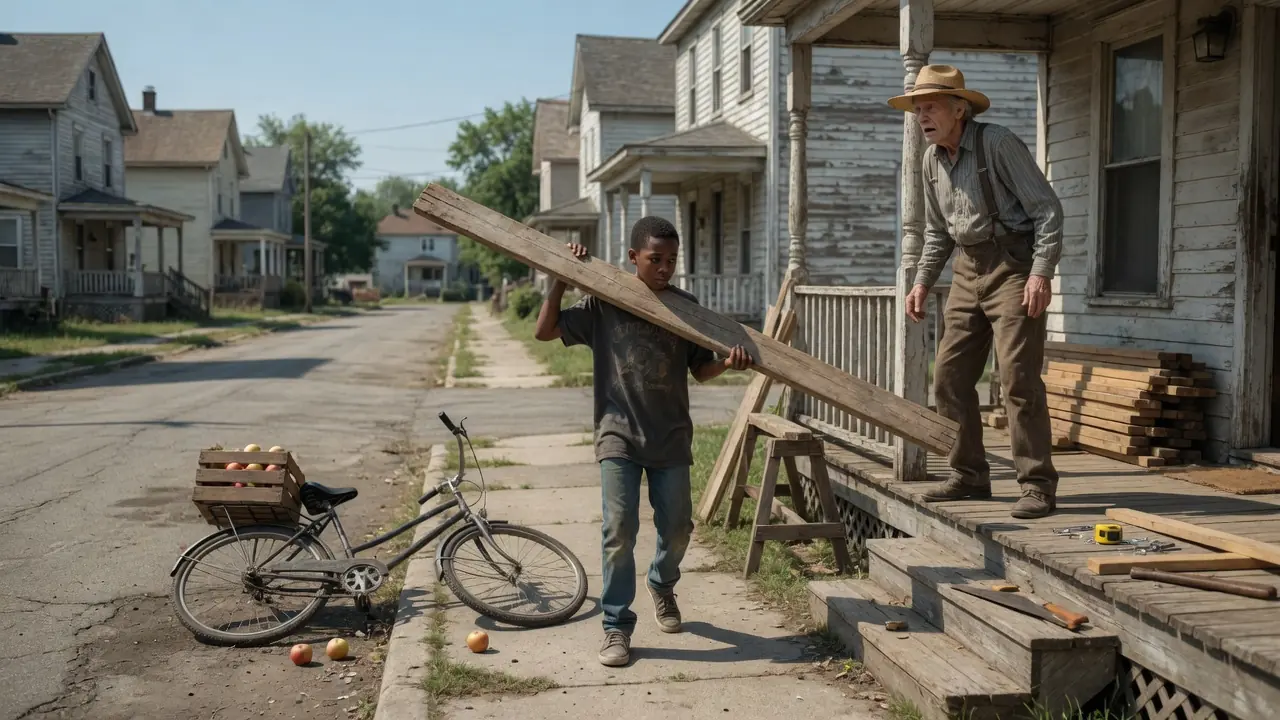
Wide wooden planks lay scattered across the patchy grass. A ladder leaned crookedly against the rail. A rusted hammer glinted beside a pile of screws. A workbench stood under the eaves like someone had started a project with hope and run out of strength halfway through.
Then Terrence saw the old man.
He stood at the top of the porch steps, gripping the edge of a long board, maybe ten feet in length, trying to lower it onto a sawhorse below.
The man was thin and tall, with brown skin weathered by age, a gray beard trimmed close, and a straw hat pushed back on his head. Sweat had darkened the collar of his shirt. His arms were trembling.
His face was twisted in pain.
The board shifted.
One wrong move, and it was going to fall fast, hard, and directly onto his legs.
Terrence dropped his bike without a second thought.
The crate toppled sideways.
Apples rolled into the gutter.
A bag of cereal split open at one corner.
His phone buzzed again from the pavement.
He ignored it.
“Sir!” Terrence shouted, sprinting across the lawn. “Let it go!”
But his reaction was too slow.
The board tilted.
Terrence lunged.
In one motion, he threw his body between the man and the falling plank, catching the bulk of its weight across his left shoulder.
Pain exploded down his arm.
The impact knocked the wind from his lungs, but he held long enough to guide the board down instead of letting it crash across the old man’s knees.
His own knees buckled when the plank hit the grass.
The old man grabbed the porch rail, panting, one hand clutching his chest.
For a second, neither of them moved.
The neighborhood seemed to hold its breath.
A fly buzzed near the porch light.
Far off, a dog barked twice and fell silent.
Terrence winced, rubbing his shoulder.
“You all right?”
The old man nodded slowly, though his face had gone pale beneath the shadow of his hat.
“Good Lord,” he rasped. “Thought I was about to be sawdust.”
Terrence let out a breath that was almost a laugh.
“You almost were.”
The man lowered himself onto the top step.
“Don’t suppose you got a license for catching lumber like that?”
“No, sir.”
“Then you might’ve just committed a miracle illegally.”
Terrence smiled despite the pain.
He looked back toward the street.
His bike lay on its side.
Groceries spilled across the sidewalk.
His phone kept flashing.
His stomach dropped.
The delivery window.
He ran back, gathered what he could, righted the bike, and checked the screen.
Late warning.
Rating penalty possible.
He cursed under his breath.
Then he looked back at the old man still sitting on the porch, one hand pressed to his chest.
The man tried to stand.
His knees shook.
Terrence shoved the phone into his pocket.
“Don’t get up yet.”
“I’m fine.”
“You don’t look fine.”
“That is because you are young and have cruel eyesight.”
Terrence walked back to him.
“You need water?”
The man considered arguing, then pointed toward the open front door.
“Kitchen sink works if the pipes feel generous.”
Terrence stepped inside.
The house was hot but shaded, smelling of old wood, dust, lemon oil, and something deeper, like years of closed rooms being opened again.
He found a glass by the sink, rinsed it twice, filled it with water, and brought it back.
The old man drank slowly.
Some color returned to his face.
“Name’s Walter,” he said. “Walter Bishop.”
“Terrence Moore.”
Walter looked at him over the rim of the glass.
“Terrence Moore. That’s a strong name.”
“My mother picked it.”
“Then your mother has taste.”
Terrence glanced around the yard again.
“You doing all this yourself?”
Walter looked at the planks, the tools, the sagging porch rail.
“Trying to.”
“Not going great.”
Walter laughed, then coughed.
“No. Not going great, clearly.”
“You live here alone?”
“For now.”
Walter leaned back against the porch post.
“Just moved back, actually. This was my family’s house when I was a boy. My father built most of this porch with his own hands. My mother planted that maple tree the year I turned nine.”
He looked up at the heavy branches shading the porch.
“After my wife passed, my son tried to convince me to sell. Buy some fancy place in the suburbs with crown moldings, granite counters, and neighbors who call the police if your grass grows wrong.”
He scoffed softly.
“But I told him no. This place has history. Got soul. I wanted to fix it myself.”
Terrence looked around at the peeling paint, drooping gutters, cracked windowpanes, and porch boards that had clearly been losing their argument with time for years.
It did have soul.
It also had problems.
Walter, thin and breathless in the heat, did not look like he should be carrying a gallon of milk, let alone rebuilding a porch.
“Why not just hire someone?” Terrence asked.
He already knew it was probably the wrong question.
Walter tilted his head, eyes narrowing thoughtfully.
“Because there is a difference between having something done for you and doing it with your own hands. I’m not ready to let go of that just yet.”
Terrence understood more than he expected to.
His mother could have asked the church for more help than she did.
She could have gone to the food pantry every week instead of once a month.
She could have let people see the full shape of their need.
But pride, when it was all you had left, became something like shelter.
Not warm shelter.
Not easy shelter.
But yours.
His phone buzzed again.
Terrence pulled it out.
Final delivery warning.
He had to go.
He should go.
He looked at Walter.
The old man had started reaching for another board.
Terrence closed his eyes briefly.
“You got more boards to move?”
Walter raised an eyebrow.
“That wasn’t a hint for me to pay you, was it?”
Terrence grinned.
“No, sir. Just figured you might kill yourself out here if I don’t stick around.”
A pause.
Then Walter laughed, deep and scratchy, full of disbelief.
“All right, then. If you’re offering.”
“I’m offering for maybe thirty minutes.”
“Thirty minutes is more than I had.”
The thirty minutes became an hour.
Terrence hauled boards into neat stacks beneath the shade.
He carried the longest planks two at a time despite the ache in his shoulder.
He swept debris away from the porch steps.
He helped Walter measure supports for the railing.
Walter gave instructions from the top step, sometimes standing to demonstrate, then sitting again when his breath shortened.
“You know your way around tools?” Walter asked.
“A little. My mom’s cousin used to fix things around our place before he moved to Cleveland.”
“Cleveland. That where hope goes to get lost?”
Terrence laughed.
“Don’t let him hear you say that.”
“If he left Detroit for Cleveland, he already knows.”
Sweat soaked through Terrence’s shirt.
Splinters worked into his palms.
His phone buzzed twice, then stopped.
The app stopped warning after it decided the damage was done.
Terrence did not check it.
Walter noticed.
“Job?”
“Delivery.”
“You missing it?”
“Already missed.”
Walter’s face changed.
“Boy.”
“It’s okay.”
“No, it isn’t.”
Terrence lifted another board.
“You were about to get crushed. Groceries can wait.”
“Customers don’t always see it that way.”
“No, sir.”
“Boss?”
“An app.”
Walter frowned.
“That sounds worse than a boss.”
“Sometimes.”
By the time they finished, the porch no longer looked like it might collapse under the weight of memory.
It was not rebuilt.
Not yet.
But it was safer.
Boards stacked.
Tools gathered.
Loose nails picked up.
The long planks leaned flat against the wall instead of waiting to fall.
Walter stood slowly, one hand on the rail, looking over the yard.
His eyes had softened.
“My father would cuss me for letting it get this bad.”
“Would he thank you for trying to fix it?”
Walter looked at Terrence.
Then nodded.
“Maybe after the cussing.”
Terrence smiled.
Walter reached out a weathered hand.
“You saved an old fool twice today.”
Terrence shook it.
Walter’s grip was thin but firm.
“Least I can do is remember your name.”
“Terrence Moore.”
“Terrence Moore,” Walter repeated. “If you ever need anything, you come knock. This porch might not look like much, but it owes you.”
Terrence nodded, backing away toward his bike.
His legs felt heavy with heat and fatigue.
He gathered the salvageable groceries, repacked the crate, and mounted.
Walter called after him.
“Terrence.”
He turned.
“Your mother raised you right.”
The words landed in a place Terrence did not know was sore until they touched it.
He gave a small nod and rode off.
As he turned the corner, the notification hit his phone.
Order cancelled.
Rating dropped.
Earnings cut.
Account performance under review.
Terrence looked at the screen for one second.
Then he shoved the phone away.
He should have felt only panic.
Instead, somewhere beneath the fear, he felt something quiet and steady.
He had done something good.
Something decent.
And even if the world did not pay boys like him for decency, he had not forgotten how to be human.
That mattered.
He hoped it mattered.
Terrence’s legs felt like soaked concrete as he pushed his bike up the cracked sidewalk toward home.
The late afternoon heat had taken on a drier bite. The sky hung low and yellow with humidity, threatening storms that might never come.
His shoulder throbbed where the board had hit him. His palms stung from splinters. His T-shirt clung damp and stained to his back.
The crate on his bicycle was lighter now, not because the groceries had been delivered, but because half the order had been spoiled by sun or bruised from the fall.
He had tried calling support.
There had been no person on the other end.
Only a menu.
Only a form.
Only a message saying the review could take up to seven business days.
Seven days without delivery work.
Seven days without tips.
Seven days in a house already counting coins.
When he opened the front door, the familiar scent of warm rice and beans greeted him, along with the sound of his mother’s voice.
“Terrence?”
Carmen Moore’s head peeked out from the kitchen.
Her apron was smudged.
A worn rag was slung over her shoulder.
Her eyes instantly scanned his face.
“You late, baby. I was getting worried.”
Terrence forced a tired smile and leaned the bike near the door, its tires thudding softly against the hardwood floor.
“Yeah. Sorry. Got caught up.”
Carmen stepped into the living room.
Her expression shifted from concern to careful calculation.
“Caught up how?”
He hesitated, glancing toward the kitchen table where a few unpaid bills sat like silent sentinels.
“One of the orders spilled. Took longer than expected.”
Her brow furrowed.
“And the tips?”
He looked down.
“Didn’t get that far.”
The silence stretched.
Not angry.
Just tired.
Tired in that way only a mother can be.
Tired of stretching pennies.
Tired of rationing laundry soap.
Tired of making dinner without asking who was still hungry afterward.
Carmen walked past him, wiped her hands on the rag, and exhaled deeply through her nose.
“Well,” she said softly, “we’ll figure it out. We always do.”
From the hallway came the quick patter of feet.
Layla appeared, her seven-year-old face lighting up as soon as she saw him.
“Gabby!”
She called him that because when she was small, Terrence had been too difficult to pronounce. No one knew how she got Gabby from Terrence, but it stuck because Layla had a way of naming things and making the rest of the world accept it.
She ran toward him with her arms open wide.
Terrence knelt as she crashed into him.
Pain shot through his shoulder, but he hid it.
“I missed you,” Layla said.
“I missed you too, Squirt.”
He ruffled her hair.
“You eat?”
“Not yet. Mommy said wait for you.”
Carmen turned from the kitchen.
“I said wash your hands first.”
Layla gasped as if this were a shocking accusation.
“I was about to.”
“About to is not soap.”
Layla giggled and ran back toward the hall.
Terrence watched her go.
For a moment, his chest hurt worse than his shoulder.
Carmen leaned against the doorframe, arms crossed, her gaze softening now that Layla was out of earshot.
“You want to tell me what really happened out there?”
Terrence hesitated.
He could lie.
He often did, not because he enjoyed it, but because mothers did not need every worry delivered to them whole.
But the image of Walter flashed in his mind.
His trembling hands.
The board falling.
The old man’s breathless laugh.
The way he had said, Your mother raised you right.
“There was this old man,” Terrence began slowly, eyes on the floor. “He was trying to move this big board on his porch. I thought he was going to get crushed, so I stopped.”
Carmen’s mouth opened slightly.
“I helped him move the rest of the boards. Clean up his yard some. I know I missed my delivery window. I know I shouldn’t have.”
“You should have,” Carmen interrupted gently.
Terrence looked up.
She was not angry.
She was proud.
Sad, but proud.
Her face was lined with exhaustion from too many double shifts, but her eyes were full of something he rarely saw directed at him so openly.
Admiration.
“You did something kind,” she said, walking over to place her hand on his cheek. “This world doesn’t pay you for that, but it should.”
His throat tightened.
“The app suspended me.”
Carmen closed her eyes for one second.
When she opened them, the worry was there.
So was the pride.
“We will figure it out.”
“Ma.”
“We will.”
“How?”
She did not answer right away.
That was worse than a lie.
Then she said, “Beans taste better when they’re hot. Come eat.”
They sat at the kitchen table.
Layla talked about the picture she had drawn at summer camp: a purple house, a green dog, and a sun wearing sunglasses.
Carmen asked questions in all the right places.
Terrence chewed slowly, the weight of the day settling into his bones.
He had lost income.
Maybe his job.
Maybe the little bit of financial balance they had tried to build.
But he kept hearing Walter’s voice.
This porch might not look like much, but it owes you.
That night, lying on the worn couch mattress in the front room, Terrence stared at the ceiling.
The fan in the corner turned slowly, clicking once every rotation.
Outside, someone’s music thumped faintly from a passing car.
Layla coughed once in her sleep.
Carmen moved around in the kitchen long after dinner, though there was nothing left to clean.
Terrence should have felt regret.
He should have felt panic.
He did feel panic.
But beneath it was strange, quiet clarity.
He had done what his mother would have done.
What she had taught him to do.
What poverty had tried to make impossible.
He had helped.
And though he did not know it yet, it mattered to someone else too.
Miles away, in that old house shaded by the maple tree, Walter Bishop sat on his newly cleared porch with an old rotary phone in his hand.
The number he dialed was one he had not called in months.
His son answered on the fifth ring.
“Dad?”
Walter looked out at the porch boards Terrence had stacked neatly in the yard.
“Marcus,” he said, his voice gravelly but urgent. “I need you to meet someone.”
There was a pause.
“What happened?”
“I almost got myself killed by a plank of wood.”
“Dad.”
“I’m fine.”
“You are clearly not fine if the sentence starts like that.”
Walter smiled faintly.
“A boy stopped it. Young kid. Couldn’t have been more than fifteen. Dropped his own work, caught the board, stayed to help me clean up. Lost money because of it.”
Marcus was quiet.
Walter knew that quiet.
His son had built an empire out of listening before speaking.
“What’s his name?”
“Terrence Moore.”
“Do you know where he lives?”
“No. But I know he works grocery delivery around here. Rides an old Schwinn. East side.”
“Dad, there are thousands of kids on bikes.”
“Not like this one.”
Walter leaned back in the chair.
“He had tired eyes, Marcus. Not lazy. Tired. The kind people get when they’ve been carrying grown folks’ weight too young.”
Marcus said nothing.
Walter’s voice softened.
“He reminded me of you before money got between you and knowing what things cost.”
That landed.
Walter could hear it in the silence.
“I’ll find him,” Marcus said finally.
“Don’t send somebody with a clipboard.”
“I won’t.”
“And don’t make him feel bought.”
“I know.”
“Do you?”
Marcus exhaled.
“I’ll try.”
“Good.”
Walter looked at the porch rail, newly braced.
“He saved me, son. Not just from the wood.”
The next morning broke slow and gray, with clouds hanging low over the rooftops like the sky had not made up its mind whether to rain or simply hover heavy all day.
Terrence sat by the window, elbows resting on the chipped sill, watching the street stir awake.
His body ached in all the places hard labor remembered.
His phone lay beside him on the sill.
The red notice still blinked at the top of the delivery app.
Temporary suspension in effect.
He had checked it six times since waking.
Nothing changed.
Carmen moved behind him in the kitchen, quiet, her slippers shuffling against the linoleum as she stirred a pot of grits and tried not to let worry show.
Layla hummed at the table, coloring on the back of a grocery receipt with a green marker that had almost dried out.
The knock came soft but certain.
Three solid wraps.
Not the hurried beat of a neighbor.
Not the bored tap of a delivery.
Deliberate.
Terrence’s head turned.
No one knocked like that unless something was wrong.
Carmen stepped toward the door, wiping her hands on a dish towel.
“Stay back,” she murmured without looking at Terrence.
She opened the door cautiously and froze in the frame.
Standing on the porch was a man in a tailored charcoal-gray suit who looked like he belonged on the cover of a business magazine rather than a broken Detroit stoop.
He was in his late forties, with sharp features, close-cropped hair, and not a thread out of place. His shoes were polished. His watch was understated but clearly expensive. He carried himself with the calm confidence of someone used to walking into rooms where people already knew his name.
Behind him, parked half on the curb and gleaming like sin itself, was a limousine with tinted windows.
“Good morning,” the man said, voice smooth but careful. “I’m looking for Terrence Moore.”
Carmen’s eyes narrowed.
“Who’s asking?”
“I’m Marcus Bishop.”
He extended a business card.
Carmen did not take it.
“My father, Walter Bishop, told me about a young man who helped him yesterday. Saved him, really.”
Terrence had already stepped into the hallway, heart pounding.
“It’s all right, Ma,” he said quietly. “That’s him. The old man.”
Marcus’s gaze shifted to him.
His expression changed.
Softened.
“You’re even younger than my father said.”
Terrence did not know what to do with that.
“Is he okay?”
“He’s fine. Sore, embarrassed, and pretending he’s not either.”
Terrence smiled despite himself.
Marcus looked around the porch, then back at Terrence.
“He told me what you did. Said you put your own work aside, risked your time, maybe your money, just to help a stranger. That you stayed even when he couldn’t pay you.”
Terrence felt his stomach twist.
“I didn’t do it for thanks. Or money.”
“I know,” Marcus replied. “That’s why I’m here.”
Carmen’s face remained stone-still.
“What do you want with my son?”
Marcus looked at her directly.
“Nothing from him. I’d like to talk with both of you, if you’re willing. Somewhere private. My driver can bring you back.”
Carmen crossed her arms.
“We can talk right here.”
Marcus nodded.
“Of course.”
That impressed Terrence.
A little.
Men with limousines probably were not used to being refused.
Marcus did not seem offended.
He stepped back slightly from the door, giving Carmen space.
“My father is Walter Bishop,” Marcus said. “But he is also the reason my company exists. Bishop Logistics began with one truck he bought in 1978 after working twenty years loading freight. He built the foundation. I expanded it.”
Terrence had heard the name Bishop Logistics.
Everyone had.
Trucks with that blue-and-silver logo moved across Detroit, Chicago, Cleveland, Cincinnati, and half the Midwest. Terrence had seen them on highways and loading docks. He had never imagined they had anything to do with an old man fixing a porch alone.
Marcus continued.
“Dad moved back to his childhood home after my mother died. I argued with him about it. I wanted him somewhere safer, easier. He told me comfort without history felt like a hotel.”
Carmen’s face softened by a fraction.
“That sounds like something an old man would say.”
Marcus smiled.
“Yes, ma’am. It does.”
He looked at Terrence.
“When he told me what you did, I asked around. Found out your delivery account was suspended after yesterday. Found out you missed work because you helped him.”
Terrence stiffened.
“How did you find that out?”
“I have contacts at several local delivery partners. I asked carefully.”
Carmen’s eyes hardened again.
“Carefully still sounds like digging.”
“It was,” Marcus admitted. “I apologize for that.”
That stopped her.
Marcus did not defend himself.
“I wanted to understand what my father’s rescue cost. I should have asked first.”
Terrence glanced at his mother.
Carmen studied Marcus for a long moment.
Then she opened the door wider.
“Come in. But if you start talking like a man trying to buy forgiveness, we’re done.”
Marcus nodded.
“Fair.”
The living room suddenly felt very small with Marcus Bishop inside it.
Not because he made it small.
Because his suit, his shoes, his calm, and the limousine outside made the room’s worn couch, patched curtains, and chipped coffee table stand out in a way Terrence hated.
Marcus seemed to sense it.
He did not look around too much.
He sat where Carmen pointed.
Layla peeked from the kitchen doorway, eyes wide.
Marcus smiled at her.
“You must be Layla.”
She hid behind the doorframe.
“Maybe.”
“That is a strong maybe.”
She giggled.
Terrence sat beside Carmen.
Marcus placed two folders on the coffee table.
“I’m not here with charity,” he said. “My father would throw me off his porch if I tried that.”
Carmen did not smile, but something in her eyes flickered.
“I am here because a boy showed character under pressure. That is rare. And because my father believes I’ve spent too many years investing in systems and not enough in people.”
Terrence looked down at the folders.
“What is that?”
“Opportunity,” Marcus said. “Not obligation.”
He opened the first folder.
“Bishop Logistics is opening a youth apprenticeship program. It was planned for next year. We can start early with one apprentice if you are interested.”
Terrence stared.
“A job?”
“A structured part-time position after school hours. Paid. Real training. Logistics, routing, warehouse operations, inventory systems, professional development.”
“I don’t know any of that.”
“That’s why it’s called training.”
Terrence looked at Carmen.
She was silent.
Marcus opened the second folder.
“Your school records show strong grades before your attendance dropped last year.”
Carmen’s eyes snapped to him.
Marcus lifted one hand.
“I know. Digging. Again, I apologize. But I needed to know whether educational support would matter.”
Terrence’s throat tightened.
His attendance had dropped because Layla got sick twice, Carmen’s work schedule changed, and someone had needed to walk Layla home, cook, clean, work, and survive.
“I want to finish,” he said quietly.
“Good,” Marcus said. “Then we help make finishing easier. Tutoring. Transportation. Supplies. If you qualify, private scholarship placement.”
Terrence blinked.
“Private school?”
“Possibly. Or a stronger public placement with support. That depends on what you and your mother want.”
Marcus turned to Carmen.
“And you, Ms. Moore.”
Carmen stiffened.
“What about me?”
“My downtown office needs a scheduling coordinator. Full training. Benefits. Stable hours. No nights unless you choose overtime.”
The room went silent.
Carmen looked at him as if he had offered her a door out of a burning house and she suspected fire on the other side too.
“I clean offices,” she said.
“That is honest work.”
“I didn’t say it wasn’t.”
“No, ma’am.”
“I haven’t done office work in years.”
“Can you manage schedules?”
“I manage two jobs, one teenage boy, one seven-year-old girl, bills, school papers, groceries, and a landlord who lies about repairs.”
Marcus nodded once.
“Then you are overqualified.”
Carmen looked away.
Her mouth tightened.
Terrence knew that look.
It meant she was trying not to cry and furious about it.
“What do you get out of this?” she asked.
Marcus leaned forward.
“My father alive.”
The answer came too quickly to be polished.
He continued.
“And maybe a chance to build something better than a thank-you check. My company has money. Money is useful. But my father reminded me last night that useful is not the same as good.”
He looked at Terrence.
“I cannot repay what you did. Payment would make it too small. But I can honor it by opening a door and letting you decide whether to walk through.”
Terrence’s hands rested on his knees.
He felt Layla watching from the kitchen.
He felt Carmen beside him, tense and protective.
He felt his own fear rising.
“What if I mess up?” he asked.
Marcus’s face softened.
“Then we teach. Then you try again.”
“What if I don’t belong there?”
“At first, you probably won’t feel like you do.”
“That’s not comforting.”
“It’s honest.”
Terrence studied him.
Honesty mattered.
Marcus added, “Belonging is sometimes built after arrival.”
Carmen took the business card at last.
“We’ll read everything.”
“Please do.”
“No signing today.”
“I would prefer you didn’t. Have someone you trust look it over.”
Carmen’s suspicion shifted again, not gone, but unsettled.
Marcus stood.
“My father asked if you would come by when you can. He wants to thank you properly. Also, he has been told he is not allowed to lift boards, and he would like someone sympathetic to complain to.”
Layla stepped fully into the room.
“Is your daddy old?”
Marcus looked at her.
“Yes.”
“Does he listen?”
“No.”
Layla nodded gravely.
“Old people be like that.”
Carmen closed her eyes.
Terrence laughed.
Marcus laughed too, genuinely.
When he left, the limousine seemed even more unreal pulling away from their curb.
The house remained quiet for several seconds after.
Then Layla ran to the window.
“Gabby, you got a rich friend?”
“No.”
Carmen sank slowly onto the couch, business card in hand.
Terrence looked at her.
“Ma?”
She covered her mouth.
For a moment, she was not the unbreakable mother, not the woman who always figured it out, not the shield between her children and the world.
She was just tired.
Terrence sat beside her.
“We don’t have to do it.”
Carmen shook her head.
“No, baby.”
Her voice broke.
“That’s the thing. I think maybe we do.”
The next morning felt different.
The air, still thick with summer heat, carried a strange charge, like the world had shifted slightly and Terrence could feel it humming beneath his skin.
He woke before dawn, not to the harsh vibration of the delivery app, but to silence.
No orders to chase.
No timer counting down his worth by the second.
He dressed slowly, buttoning the cleanest shirt he owned, one of the few without a frayed collar. Carmen had pressed it the night before without a word, but her hands had lingered on the fabric a moment longer than usual.
Now it smelled faintly of lemon starch and hope.
They took the bus downtown because Carmen said arriving in a limousine once was already more than enough gossip for one block.
The Bishop Logistics office stood inside a renovated brick building near the river, not a glass tower like Terrence expected. The lobby had polished concrete floors, exposed beams, and photographs lining the wall.
Old Detroit freight yards.
Men loading trucks in the snow.
Women at typewriters.
Walter Bishop standing beside a blue truck in 1978, younger, broad-shouldered, and smiling like a man who had purchased not a vehicle but a future.
Terrence stopped in front of the photo.
“That’s him?”
Marcus, who had come down to meet them, nodded.
“That’s him.”
“He looks strong.”
“He was.”
“Still is,” Carmen said.
Marcus smiled.
“Try telling him otherwise.”
A woman with tightly coiled curls and a real smile greeted them at the reception desk.
“You must be Terrence and Ms. Moore,” she said. “I’m Nina. Mr. Bishop told us you were coming.”
Her voice was warm, not the clipped tone people used when pretending to be polite.
That mattered more than Terrence could explain.
Marcus led them to a small conference room.
Not too grand.
Not intimidating.
Papers were laid out, explained carefully, nothing hidden in small print.
Carmen read every page.
Her eyes scanned like they were hunting traps because years of being burned had taught her fine print often meant a door that slammed shut.
Marcus did not rush her.
Terrence noticed.
So did Carmen.
“This position,” Marcus said, gesturing toward Terrence’s folder, “starts with observation and support. No heavy warehouse labor. You are fifteen. I’m not interested in violating labor laws or your mother’s trust.”
Carmen looked up.
“Good.”
“You’ll come three afternoons a week. Two hours each. Paid. A mentor assigned. You keep school first.”
Terrence touched the page.
“What if my grades slip?”
“Then work pauses until grades recover.”
Terrence frowned.
Marcus leaned forward.
“The job is meant to support your future, not swallow it.”
That sentence stayed with him.
Then Marcus turned to Carmen.
“The scheduling coordinator role is full-time if you want it, but we can begin with training hours while you transition from your current jobs. Benefits begin after probation, but I can arrange temporary coverage gap support.”
Carmen stared.
“Health insurance?”
“Yes.”
“For both kids?”
“Yes.”
She looked down.
Terrence saw her fingers tremble.
Layla had asthma.
They had gone to urgent care twice that year and left with bills Carmen kept folded in a drawer under dish towels.
Marcus slid the final envelope across the table.
“This is the education support package. It does not require private school if you don’t want that. We work with partner schools, tutoring programs, transportation support, supplies, summer enrichment.”
Carmen opened it slowly.
Terrence watched her eyes move across the page.
Then stop.
“Layla too?” she whispered.
“If you approve, yes.”
Terrence’s chest tightened.
Layla.
He thought of his sister reading old library books until the pages peeled. He thought of her hand-me-down shoes and the way she sounded out big words like she was climbing mountains.
“Why?” he asked.
The word came out smaller than he wanted.
Marcus looked at him.
“Because someone helped my father when no one was watching. Because character should open doors. Because my father told me if I turned your kindness into a single check, he would disown me from the porch he almost died fixing.”
Terrence laughed once, shaky.
Marcus smiled.
“Mostly because it’s right.”
Carmen covered her face.
For years, she had been strong because there was no alternative.
Now someone had offered an alternative, and strength had nowhere to go.
Terrence put his hand over hers.
She gripped it tightly.
“All right,” she said at last.
Her voice shook.
“But we work. We don’t get carried.”
Marcus nodded.
“That is exactly what I expected you to say.”
The first weeks at Bishop Logistics were overwhelming.
Terrence learned that offices had their own language.
Routing.
Dispatch.
Inventory variance.
Delivery windows.
Chain of custody.
Efficiency reports.
Compliance.
Words he had heard only in pieces now became systems. Systems became maps. Maps became decisions.
Mr. Lewis, his mentor, was a stocky man with a shaved head, deep voice, and kind eyes that hid behind gruffness.
On Terrence’s first day, Mr. Lewis handed him a clipboard.
“Rule one. Ask questions before pretending you know.”
“Yes, sir.”
“Rule two. If you mess up and tell me, we fix it. If you mess up and hide it, we have two problems.”
“Yes, sir.”
“Rule three. No sir. Makes me feel old.”
Terrence hesitated.
“Yes, Mr. Lewis.”
“Better.”
Nina at reception saved him a seat in the break room.
Carmen trained two floors above with a woman named Denise, who said she had seen many people learn office systems and Carmen was faster than most because mothers already understood crisis management.
By the end of the first week, Carmen was answering phones with a voice that made people sit up straighter.
At home, she slept harder.
Better.
Layla noticed first.
“Mommy don’t cry in the bathroom no more,” she told Terrence one night while brushing her doll’s hair.
Terrence froze.
“You knew?”
Layla looked at him like he was slow.
“I’m seven, not a baby.”
He sat beside her.
“No. You’re not.”
“Are we okay now?”
Terrence looked toward the kitchen, where Carmen was humming while packing lunches for the next day.
“Getting there.”
Layla nodded.
“Good. I like getting there.”
So did he.
The moment everything shifted came at the end of Terrence’s second full week.
He was reviewing shipment logs under Mr. Lewis’s supervision, comparing route codes against delivery zones.
At first, the numbers were just numbers.
Then one line bothered him.
He did not know why.
He scanned it again.
Shipment 8842-B.
Medical supply pallets.
Destination: East Side Health Partners.
Route assignment: West depot.
That could be right if the west depot was handling overflow, but the delivery time looked too tight. He checked the map. Then the dispatch note. Then a second pallet with a similar code.
His stomach tightened.
“Mr. Lewis?”
Lewis looked up.
“What you got?”
“I might be wrong.”
“Best way to start being right.”
Terrence pointed to the screen.
“These two pallets. The route says west depot, but the delivery address is east side. And this note says temperature-sensitive. If it goes west first, it gets delayed.”
Lewis leaned over.
His brow furrowed.
“Damn.”
Terrence’s pulse jumped.
“What?”
“You’re right. That’s a misroute.”
“Is that bad?”
“That is a five-figure fine and a hospital screaming by morning bad.”
Terrence sat back.
“Oh.”
Lewis clapped one hand on his shoulder.
“Don’t ‘oh’ me. You caught it.”
“I just saw the address.”
“No. You paid attention.”
That afternoon, Marcus called Terrence into his office.
The office was not as fancy as Terrence expected a CEO’s office to be. Bookshelves. Framed photos. A model truck on the desk. A worn baseball signed by someone Terrence did not recognize. A photo of Walter and Marcus together at a ribbon cutting.
Marcus stood by the window, looking out over the city.
“I heard what you caught.”
Terrence shifted.
“I didn’t mean to cause trouble.”
Marcus turned.
“You prevented trouble.”
“I just didn’t want to mess up.”
“That mindset is the difference between someone doing a task and someone taking responsibility.”
Terrence did not know what to say.
Marcus picked up an envelope and handed it to him.
“Open it.”
Inside was a revised apprenticeship plan.
Higher hourly pay.
Additional mentorship.
A formal recommendation for the scholarship board.
Terrence looked up, stunned.
“Why?”
“Because you earned it.”
“I’ve only been here two weeks.”
“And in two weeks, you showed me what my father saw in fifteen minutes.”
Terrence’s throat tightened.
Marcus’s voice softened.
“My father built this company with his hands. I made it bigger with systems. Both matter. But systems fail when people stop caring. You care.”
Terrence looked at the letter again.
The words blurred.
“I won’t let you down.”
Marcus shook his head.
“Don’t make that promise.”
Terrence blinked.
“Why not?”
“Because it puts all the weight on perfection. Promise me you’ll learn. Promise me you’ll ask. Promise me you’ll keep showing up.”
Terrence nodded slowly.
“I can do that.”
“Good.”
When Terrence left the office, rain had begun tapping against the windows.
A late summer storm broke over Detroit, cooling the baked streets, washing dust from glass, sending people running for shelter.
Terrence stepped outside and did not run.
He let the rain hit his face.
His shoulders.
His hands.
The same hands that had caught a falling plank now held the shape of something larger than survival.
A future.
Over the next two months, the Moore household changed in small ways first.
A new inhaler for Layla before the old one ran empty.
Fresh fruit in the refrigerator.
Laundry done before the basket overflowed.
Carmen sleeping through the night.
Terrence doing homework at the kitchen table instead of balancing it between deliveries.
Then bigger things.
Carmen left one of her cleaning jobs.
Then the second.
She started wearing blouses she had not touched in years, clothes saved for an occasion that had never arrived until work gave her one.
Layla entered an after-school reading program funded through Bishop’s education partners. She came home talking about science experiments and a teacher named Ms. Alvarez who said she had “a mind like a firecracker.”
Terrence kept working three afternoons a week.
He learned spreadsheets.
He learned how routes were built.
He learned why one delayed truck could affect forty deliveries.
He learned to speak up in meetings even when his voice wanted to disappear.
Mr. Lewis began calling him Hawkeye.
Nina saved him the good coffee, though Terrence mostly drank hot chocolate because coffee still tasted like burned responsibility.
Carmen’s laughter came back slowly.
At first, once every few days.
Then daily.
The sound changed the whole house.
One Thursday afternoon, after a full shift, Marcus stopped Terrence in the hallway.
“Got a second?”
Terrence followed him into the corner conference room where the city spread behind the glass.
Walter was there.
Sitting in a chair by the window, cane across his knees, wearing a pressed shirt and a look of wicked satisfaction.
“Mr. Walter.”
“Boy.”
Terrence smiled.
“You look better.”
“I was handsome before.”
“No comment.”
Walter barked a laugh.
Marcus shook his head.
“He’s impossible.”
“Runs in the family,” Walter said.
Marcus handed Terrence a sealed envelope.
“Scholarship results.”
Terrence’s heart climbed into his throat.
He sat down because his legs suddenly felt unreliable.
He peeled open the envelope.
His eyes moved across the page.
Full tuition support.
Academic mentoring.
Transportation stipend.
Technology grant.
Summer leadership program.
He read it twice before understanding.
Then a third time because understanding felt too dangerous to trust.
“It’s real,” he whispered.
Walter leaned forward.
“Of course it’s real.”
Terrence looked up.
“For me?”
Marcus smiled.
“For you.”
Before Terrence could speak, Marcus slid a second envelope across the table.
“And this is for Layla. Her placement package came through too.”
Terrence stared.
“Layla?”
“Reading enrichment, school support, supplies, and tuition coverage if your mother approves the partner academy.”
Terrence stood too fast.
The chair scraped behind him.
He turned toward the window, trying to hide the tears that had already come.
Walter’s voice softened.
“Let them fall, son. Tears don’t make a blessing smaller.”
That undid him.
Terrence cried.
Not loudly.
Not dramatically.
But fully.
For the first time since he had dropped his bike on that hot street, since the board struck his shoulder, since the app suspended him, since Marcus knocked on the door, since the world cracked open just wide enough to let light in.
Marcus waited.
Walter waited.
No one rushed him.
That night, Terrence walked home through the dusky quiet, sky streaked orange and purple after rain.
He did not ride his bike.
He pushed it beside him because he needed to feel the ground beneath his feet.
When he stepped through the front door, Carmen was folding laundry, humming softly.
Layla sat cross-legged on the floor cutting stars from old cereal boxes.
Terrence dropped his bag and stood there looking at them.
His family.
His reasons.
Carmen noticed the envelope in his hand first.
“Well?”
He nodded slowly, voice thick.
“We’re in. All of us.”
Carmen’s hand flew to her mouth.
Layla jumped up, still holding a half-cut star.
“Even me?”
Terrence knelt and pulled her into his arms.
“Especially you, Squirt.”
Carmen wrapped both of them in her arms.
It was not loud.
It was not dramatic.
It was quiet, holy, raw.
A moment that settled into their bones and whispered, this is the start of something better.
Word spread through the neighborhood the way word always did.
By porches.
By corner stores.
By church ladies.
By men pretending they did not gossip while leaning against car hoods.
People noticed that Terrence no longer delivered groceries every hour of the day.
They noticed Carmen leaving for work in clean pressed clothes.
They noticed Layla in a new backpack, walking with her chin high.
Some asked questions with curiosity.
Some with doubt.
Some with envy.
Some with genuine joy.
Mrs. Ellison, the old woman who used to order bananas and cat food, cried when Terrence stopped by to explain why he would not be delivering as much.
“I’m proud of you,” she said, pressing two dollars into his hand.
He tried to refuse.
She slapped his fingers.
“Don’t rob old women of joy.”
He accepted.
Mr. Johnson from the corner store gave Carmen a nod and said, “About time something good happened to somebody worth it.”
Even Mr. Granger, their landlord, suddenly became friendlier when he learned Carmen had steady income and a CEO’s office number in her contacts.
Carmen did not enjoy his friendliness.
But she did enjoy paying rent on time and requesting repairs in writing.
The first day at the new school came in early September.
Terrence stood in front of the mirror wearing a navy polo shirt and khaki pants, tugging at the collar like it might accuse him of pretending.
Carmen stood behind him, hands on his shoulders.
“You look handsome.”
“I look like somebody else.”
“You look like you with more options.”
He looked at her in the mirror.
She smiled, though her eyes were wet.
Layla appeared in the hallway wearing her new uniform, spinning once with her backpack.
“Do I look smart?”
Terrence turned.
“You look dangerous.”
She beamed.
“Good.”
They stepped outside into a morning already warm but not cruel.
Walter was waiting at the edge of the sidewalk, leaning on his cane beside his freshly repaired porch.
The house behind him looked different now.
Not fancy.
Restored.
Paint scraped and redone.
Rail straight.
Steps solid.
The maple trimmed but still wide enough to shade half the yard.
Terrence walked over.
“You didn’t have to come.”
Walter looked offended.
“I would not miss this for the world.”
Marcus stood beside him in a suit, checking emails on his phone until Walter smacked his arm with the cane.
“Be present.”
Marcus put the phone away.
“Yes, sir.”
Carmen laughed.
Terrence looked at Walter.
“You finish the porch?”
“We finished the porch.”
Terrence smiled.
“We?”
Walter pointed his cane at him.
“That porch owes you, remember?”
Terrence looked at the boards.
Straight and solid.
He remembered the falling plank, the heat, the canceled order, the fear in his chest.
He remembered thinking he had lost something important.
Maybe he had.
But not everything lost is a loss.
Sometimes what falls away is only the small life you were clinging to because you had not yet seen the larger one waiting.
Walter extended his hand.
Terrence shook it.
Two generations met in a quiet understanding that went beyond words.
Marcus handed Carmen a small envelope.
“What is this?” she asked suspiciously.
“Emergency contact information. School liaison. Transportation schedule. Nothing dramatic.”
Carmen opened it and checked anyway.
Walter grinned.
“She doesn’t trust you.”
“Smart woman,” Marcus said.
The car arrived to take them to school.
Layla climbed in first, then leaned out.
“Gabby! Hurry up!”
Terrence turned back once to look at the street.
The cracked sidewalk.
The old houses.
The maple trees.
The place that had raised him hard but had not managed to make him cruel.
Then he climbed into the car beside his sister.
As they pulled away, Walter stood on the sidewalk, one hand lifted.
Carmen sat in the front seat, looking forward, not back.
Terrence watched Detroit move past the window.
For the first time, the city did not look like a wall.
It looked like a map.
Years later, when people asked Terrence Moore how his life changed, they expected him to begin with Marcus Bishop.
The CEO.
The scholarship.
The job.
The office.
The school.
The opportunities.
But Terrence always began with Walter’s porch.
He began with heat.
A falling board.
A canceled delivery.
A decision made in less than a breath.
Because the truth was not that a rich man had saved him.
The truth was that Terrence had already chosen who he was before anyone with power noticed.
That choice mattered.
Everything else came after.
Kindness had built a bridge.
Opportunity had crossed it.
But character laid the first plank.
Terrence would learn that again and again as he grew.
He would finish school.
He would study logistics.
He would work summers at Bishop Logistics and later help design a youth employment program for teenagers who reminded him of himself: tired-eyed, careful, carrying too much too young.
Carmen would become one of the most trusted scheduling managers in the company because she knew how to solve problems before they became emergencies.
Layla would thrive in school, reading books faster than teachers could recommend them.
Walter would keep sitting on his porch, now safe and painted, calling out advice to kids who did not ask for it and feeding half the neighborhood lemonade in summer.
Marcus would tell the story at board meetings whenever someone questioned the cost of community programs.
“My father was saved by a boy who had every reason not to stop,” he would say. “If that does not tell us where to invest, nothing will.”
But on that first morning, none of them knew all that.
They only knew the door had opened.
And this time, Terrence had the key.
He was not just surviving anymore.
He was rising.
Not because life had suddenly become easy.
It had not.
But because one act of kindness had been seen clearly by the right person.
Because a mother’s teaching had lived in her son’s hands.
Because an old man on a porch had been saved not only from falling wood, but from believing the world had grown too cold for goodness.
Because a CEO had listened to his father.
Because a boy who could not afford to lose wages had stopped anyway.
The future did not arrive like thunder.
It arrived like a bicycle tire over cracked pavement.
Like a knock at the door.
Like a folder slid across a table.
Like a little girl asking, “Even me?”
Like a mother finally able to breathe.
Like an old porch standing straight again beneath the shade of a maple tree.
And if you passed that house years later, you might see Walter Bishop sitting there with a glass of lemonade, watching the neighborhood with bright old eyes.
You might see Terrence stop by after work, taller now, dressed clean, still riding a bike sometimes because some things that carry you through hunger deserve to be ridden in better days.
You might see Layla sitting on the steps with a book.
You might see Carmen laughing in the yard.
You might not know the story.
You might only see a porch.
But that porch remembered.
It remembered the board falling.
It remembered the boy running.
It remembered that the smallest mercy, offered at the costliest moment, can become the first beam in a whole new life.