On a freezing winter night, a poor white American boy walked out of work, exhausted and shivering.
Suddenly, he saw a luxury car stalled in the fog, its elderly female driver sitting helplessly inside.
Most people would have just kept walking, but he stepped forward, gently convinced her to leave the freezing car, and sheltered her inside a nearby diner while she waited for roadside assistance.
What he didn’t know was that the elderly woman was a billionaire, and what happened next would change his family’s life forever.
The wind cut through Millbrook like a knife that Tuesday night.
February in upstate New York did not mess around.
Ethan Miller pulled his thin jacket tighter as he stepped out of Tony’s Diner, the bell giving one last tired jingle behind him.
The neon sign for St. Mary’s Hospital across the street flickered through the falling snow, a reminder that even on cold nights, some people dealt with worse than sore feet and long shifts.
At sixteen, Ethan had gotten used to these nights.
Standing on cracked linoleum for six hours after school.
Wiping tables until his fingers smelled like bleach.
Carrying trash bags heavier than his backpack.
Listening to grown men complain about cold fries while his stomach growled because he had skipped dinner to save money.
But Ethan never complained.
Not out loud.
His breath formed white clouds as he walked toward the bus stop.
His boots were old, the left one split near the toe, and every step pushed cold slush against his sock.
He kept his hands in his pockets because he had lost one glove last week, and wearing only one made him feel more foolish than cold.
The town was quiet, the kind of quiet that made every small sound seem too loud.
The hiss of snow under tires.
The buzzing of a streetlight.
The far-off wail of an ambulance heading toward St. Mary’s.
That was when he saw it.
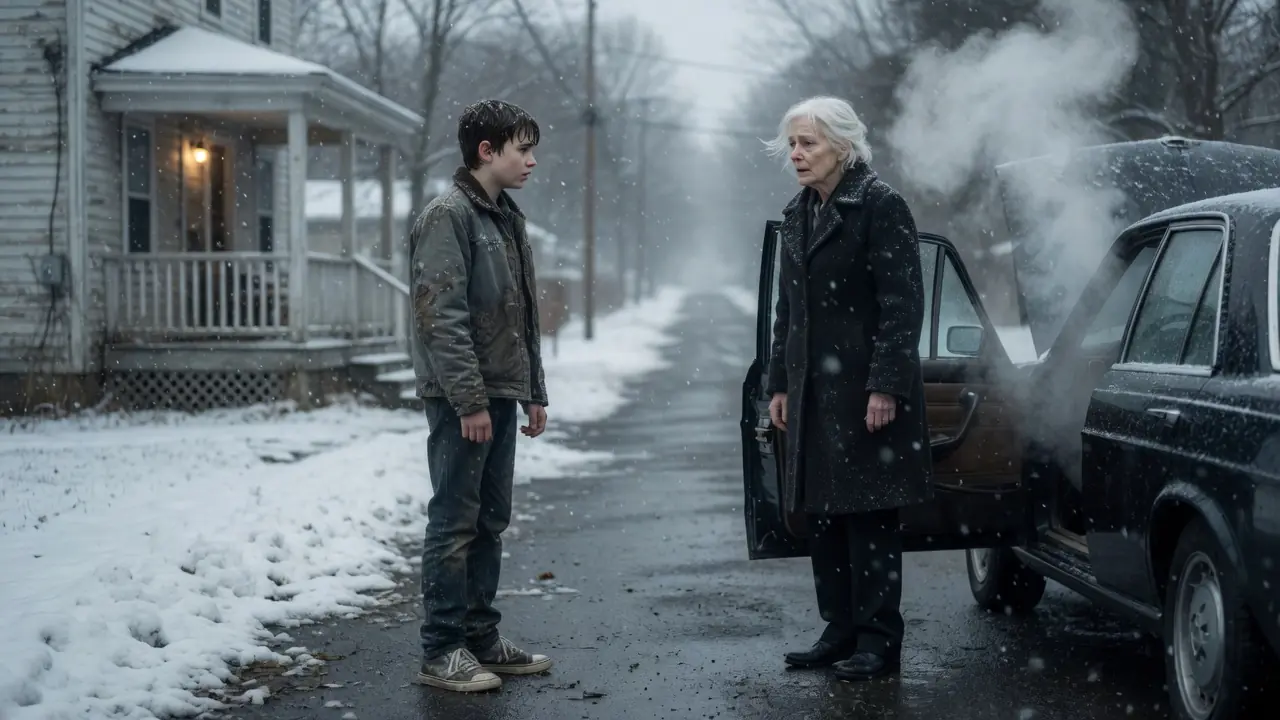
A black Mercedes-Benz sat dead on Maple Street, half-hidden in a thick patch of fog near the curb.
Its hazard lights blinked weakly.
Steam curled from beneath the hood, disappearing into the snow like breath from a wounded animal.
Through the driver’s window, Ethan saw an elderly white woman in an expensive wool coat sitting stiffly behind the steering wheel.
Her hands gripped the wheel, but she was not driving anywhere.
She looked trapped.
Most people would have kept walking.
Ethan knew that.
Getting involved with strangers was not always smart.
His mother told him that at least twice a week.
“Don’t go looking for trouble, Ethan. Trouble already knows our address.”
But she also told him something else.
“When you see someone hurting, you help. That’s what makes us human.”
Ethan stopped.
The bus stop was only half a block away.
The last bus would come in eight minutes if it was on time, which it almost never was.
His mother would be waiting at home, probably pretending she was not in pain.
His little sister, Lily, would be doing homework at the kitchen table, wearing her winter hat indoors because the heat never worked right.
He could keep walking.
He should keep walking.
Instead, Ethan stepped toward the car.
The woman inside noticed him immediately.
Her eyes widened.
The doors locked with a sharp click.
Ethan heard it even through the snow.
He stopped several feet away and lifted both hands, palms out.
“Ma’am,” he called gently, raising his voice over the wind. “Your car broke down?”
The woman rolled down her window only an inch.
“I’m fine.”
Her voice was controlled, but Ethan could hear the tremor beneath it.
“Doesn’t look fine,” he said. “There’s steam coming out, and it’s freezing out here.”
“I’ve called for assistance.”
Ethan looked up and down the empty street.
No tow truck.
No police car.
No other drivers slowing down.
Just fog, snow, and the weak blinking hazard lights.
“How long did they say?”
The woman hesitated.
“Forty-five minutes.”
Ethan winced.
“In this weather, that usually means an hour and a half.”
The woman looked annoyed, but not because he was wrong.
“I’ll wait here.”
Ethan glanced at the car.
The engine was off.
The inside of the vehicle was probably getting colder by the minute.
“You shouldn’t stay in there.”
“I’m perfectly capable of waiting in my own car.”
“I’m sure you are,” Ethan said. “But that car’s dead, and if the heat’s off, it’s not really shelter anymore. Tony’s Diner is right there. It’s still open for cleanup. I can ask my manager to let you wait inside until the tow truck comes.”
The woman stared at him.
This was not what she had expected.
No demand.
No scam.
No aggressive push.
Just a skinny teenage boy in a thin jacket, standing in the snow, pointing out the obvious truth.
“What’s your name?” she asked.
“Ethan Miller.”
“How old are you, Ethan Miller?”
“Sixteen.”
Her eyebrows lifted slightly.
“You work at the diner?”
“You are walking home alone at this hour?”
“I’m walking to the bus.”
The woman looked past him toward the diner.
The sign buzzed in the snow.
Tony’s Diner looked like the kind of place rich people drove past without seeing.
Faded red booths.
A cracked front window.
A sign promising all-day breakfast even though the pancakes tasted like cardboard after nine at night.
Still, it was warm.
And warm mattered more than fancy when the weather turned cruel.
“I don’t want to be a bother,” the woman said.
“You won’t be,” Ethan replied.
Then he added, because honesty came easier when he was tired,
“Also, if I leave you here and something happens, my mom would somehow know and lecture me from across town.”
The woman blinked.
Then, to Ethan’s surprise, she gave a small laugh.
It was brief.
Almost rusty.
But real.
“What about my car?”
“The tow truck can still find it,” Ethan said. “Leave the hazards on. Lock the doors. Bring your phone and purse. You can watch from the window.”
She looked uncertain.
The wind struck hard enough to shake the bare branches above them.
Snow blew sideways across the windshield.
That made the decision for her.
“All right,” she said quietly.
Ethan stepped back as she opened the door.
The woman moved carefully, one hand braced against the frame.
She was older than he first thought, maybe seventy-two or seventy-three, tall but fragile-looking, with silver hair tucked beneath a dark hat and a face that carried both wealth and exhaustion.
Her coat was beautiful, but even beautiful wool could not fight February forever.
Her polished shoes slipped on the icy curb.
Ethan moved closer, but did not grab her.
“Careful, ma’am.”
She reached for his arm anyway, her gloved fingers gripping his sleeve.
For one second, Ethan felt how badly she was shaking.
Not just from cold.
From fear.
“I’ve got you,” he said softly.
The woman looked at him with surprise.
Like nobody had said that to her in a long time.
Together, they crossed the snowy street toward Tony’s Diner.
Ethan held the door open.
Warm air rushed out, carrying the smell of coffee, fryer oil, dish soap, and pie crust.
The woman stepped inside and closed her eyes for half a second.
The relief on her face was immediate.
Tony, the owner, looked up from behind the counter where he was counting receipts.
“Ethan, I thought you left.”
“I was leaving,” Ethan said. “Her car broke down outside. Tow truck’s coming, but it’ll be a while. Can she wait in here?”
Tony looked at the woman.
Then at the snow blowing against the window.
Then back at Ethan.
“Booth three,” he said. “Coffee?”
The woman opened her mouth, probably to refuse.
Ethan answered first.
“Yes, please.”
Tony grunted.
“Kid’s bossy after midnight.”
Ethan led the woman to booth three, the one closest to the heater.
She sat down slowly.
Her hands were still trembling.
“I can pay for the coffee,” she said.
“I know,” Ethan replied. “But Tony gives away bad coffee for free after closing.”
From behind the counter, Tony called,
“I heard that.”
“It’s still true,” Ethan said.
The woman smiled faintly.
“What is your name, ma’am?” Ethan asked.
She hesitated, as if she was not used to being asked gently.
“Eleanor Whitmore.”
Ethan nodded.
“Nice to meet you, Mrs. Whitmore.”
“Eleanor is fine.”
“I think my mother would smack the back of my head if I called you Eleanor.”
This time, her smile stayed a little longer.
Tony brought coffee in a thick white mug.
He also set down a small bowl of soup.
Ethan looked at him.
Tony shrugged.
“It was going to get tossed.”
It was not true.
Ethan knew it was not true.
Tony was cheap in almost every way except the ways that mattered.
Eleanor looked at the soup.
“Oh, I couldn’t.”
“Yes, you can,” Tony said. “It’s soup, not a marriage proposal.”
Ethan slid the spoon closer.
“You should eat something warm.”
Eleanor looked between them, then quietly picked up the spoon.
For a while, nobody said much.
Outside, the Mercedes sat under the streetlight, hazards blinking steadily through the snow.
Inside, the diner hummed with old heat and late-night tiredness.
Ethan stood near the booth, unsure if he should sit.
Eleanor noticed.
“You don’t have to stand guard.”
“I’m not.”
“You are.”
He looked embarrassed.
“My bus comes soon.”
Tony glanced at the clock.
“Last bus probably already passed early because of the storm.”
Ethan’s stomach sank.
“Great.”
Eleanor looked up sharply.
“You were going to take the bus home?”
“Yes, ma’am.”
“How far?”
“Not bad.”
Tony snorted from the counter.
“Three miles.”
Eleanor stared at Ethan.
“In this weather?”
“I’ve done it before.”
“That doesn’t make it wise.”
Ethan gave a small shrug.
“When you don’t have a car, wise and possible are different things.”
Something in his tone made Eleanor grow quiet.
She studied him more carefully.
The thin jacket.
The wet boots.
The red hands.
The tired face of a boy who had learned too early how to sound older than he was.
“You’re very young to work this late,” she said.
“My family needs the money.”
Eleanor folded her hands around the mug.
“Your parents?”
“My mom. My little sister.”
“And your father?”
Ethan looked out the window.
“Gone.”
“I’m sorry.”
“Don’t be. He left before I was old enough to miss him properly.”
Eleanor’s face softened.
“That is a very sad sentence for a sixteen-year-old.”
Ethan shrugged again.
He did that a lot when things hurt.
“It’s just a sentence.”
The tow truck did not arrive in forty-five minutes.
Or an hour.
At 12:40 a.m., Eleanor called again and was told the driver was delayed by multiple accidents on the interstate.
At 1:10 a.m., Tony turned off half the diner lights.
At 1:30 a.m., Ethan’s mother called.
He answered quickly.
“Hey, Mom.”
“Ethan James Miller, where are you?”
He winced.
“When you use the middle name, I feel like I should already apologize.”
“Where are you?”
“Still at Tony’s.”
“Why?”
“There’s a woman whose car broke down. She’s waiting on a tow truck, and I didn’t want to leave her alone.”
There was a pause.
His mother sighed.
Not angry.
Tired.
So tired it made Ethan’s chest ache.
“Are you safe?”
“Yes.”
“Is Tony there?”
“Yes.”
“Put him on.”
Ethan handed the phone to Tony.
Tony listened for a moment, then said,
“Yes, Linda, he’s here. No, I won’t let him walk. Yes, I’ll send him in a cab if I have to. No, I’m not arguing with you. You’re scarier than the health inspector.”
He handed the phone back.
Ethan brought it to his ear.
“Mom?”
“You better come straight home when you’re done.”
“I will.”
“And Ethan?”
“Yeah?”
There was a softer pause.
“You did right.”
He looked down.
“Thanks.”
Eleanor watched him quietly.
When he hung up, she asked,
“Your mother is ill?”
Ethan stiffened.
“What makes you say that?”
“The way your face changed when she spoke.”
He hesitated.
Then sat across from her.
The diner felt too quiet, and the night had already become strange enough for honesty.
“She has heart disease,” he said. “Valve problem. Doctors say she needs surgery soon.”
Eleanor’s hand tightened around the mug.
“I’m sorry.”
“Yeah.”
“Can they do the surgery?”
“They can. We just can’t pay for all of it.”
“How much?”
Ethan laughed once, without humor.
“More than I can make washing dishes.”
Eleanor did not press.
She only looked at him with a kind of attention that made him uncomfortable.
“You work after school to help with bills.”
“And weekends.”
“Do you still go to school?”
“Most days.”
“Most?”
“If Mom has appointments, I take her. If Lily gets sick, I stay home. If the diner calls, sometimes…”
He stopped.
He had said too much.
Eleanor’s voice was gentle.
“You are carrying a lot.”
Ethan looked down at his hands.
“Somebody has to.”
The tow truck finally arrived at 2:05 a.m.
A mechanic in a heavy coat came in to get Eleanor’s keys.
“Radiator hose split,” he said after checking the car. “Can’t fix it here. I’ll tow it to Hartley’s Garage. You got a ride home?”
Before Eleanor could answer, Tony said,
“I’ll call her a cab.”
Eleanor stood, then swayed slightly.
Ethan was on his feet instantly.
“You okay?”
“I think I’m just tired.”
“You should sit back down.”
“I’m fine.”
“You rich people say fine the same way poor people do,” Ethan muttered. “Like it means something.”
Eleanor gave him a look.
Then, unexpectedly, she laughed.
Tony called a cab for Eleanor and another for Ethan.
Eleanor tried to pay for Ethan’s.
He refused.
Tony said,
“You both are annoying. I already paid.”
Ethan stared at him.
Tony pointed a finger.
“Don’t get emotional in my diner. I just mopped.”
Eleanor turned to Ethan before leaving.
“You sheltered me tonight,” she said. “That matters.”
Ethan looked embarrassed.
“I didn’t do much.”
“You did enough.”
She reached into her purse.
Ethan immediately shook his head.
“No.”
“You don’t know what I’m offering.”
“If it’s money, no.”
“Why?”
“Because I helped you because you were cold. Not because you could pay me.”
Eleanor paused.
There was something in her eyes then.
Something like surprise.
Maybe even grief.
“All right,” she said softly.
“No money.”
She took a business card from her purse instead.
“Take this. If you or your mother ever need help, call me.”
Ethan looked at the card.
Eleanor Whitmore
Whitmore Holdings
He did not know what that meant.
But the card felt expensive.
Thick paper.
Raised letters.
He slipped it into his pocket mostly to be polite.
“Thank you.”
Eleanor touched his shoulder lightly.
“Get home safely, Ethan Miller.”
He watched her climb into the cab.
He had no idea that the woman he had sheltered in a failing diner while she waited for a tow truck was one of the wealthiest women in New York.
He had no idea that Eleanor Whitmore owned buildings, hospitals, hotels, and half the companies whose names appeared on the billboards outside the city.
He had no idea that the card in his pocket could open doors his family had never even seen.
He only knew she had looked cold.
So he helped.
Three days later, Ethan forgot about the card.
Not completely.
It stayed in the back pocket of his school notebook, tucked between a math worksheet and a cafeteria menu.
But real life did not leave much room for mysteries.
His mother had another appointment at St. Mary’s Hospital.
His sister Lily needed new boots because hers had cracked down the side.
The landlord wanted rent.
Tony asked if he could pick up an extra Sunday shift.
And the guidance counselor at school wanted to talk about missed assignments.
“You’re bright, Ethan,” Mrs. Collins said, folding her hands on her desk. “But you can’t keep missing days.”
“I know.”
“Your teachers say when you’re here, you do well. But you’re exhausted.”
“I’m fine.”
“Ethan.”
He looked away.
She sighed.
“You’re sixteen. You’re not supposed to be the adult in your house.”
He almost laughed.
“Can you tell the bills that?”
Mrs. Collins did not smile.
“If you need support, there are programs.”
“We’re already on programs.”
“I mean for you. Academic support. Transportation help. Counseling.”
“I don’t need counseling.”
“Everyone says that until they do.”
The bell rang.
Ethan stood.
“I have to get to work.”
“Ethan, wait.”
But he was already gone.
That afternoon, he walked to Peterson’s Hardware, his second job.
He stocked shelves for three hours, then left early to drive his mother to the hospital in their 2004 Honda Civic.
The car made a rattling sound every time it turned left.
His mother, Linda Miller, noticed.
“This car sounds like it’s praying.”
“It should,” Ethan said. “It needs Jesus and a transmission.”
Linda laughed, then coughed.
The cough made Ethan glance over.
“You okay?”
“I’m fine.”
There it was again.
Fine.
That word everyone used when they were trying not to scare someone.
Linda Miller was thirty-nine, though sickness had aged her beyond that.
She had soft brown hair she wore in a loose braid, tired blue eyes, and the kind of beauty that still showed even under exhaustion.
She had raised Ethan and Lily alone since Ethan was seven.
She cleaned offices at night until her heart got worse.
Then she cleaned when she could, apologized when she couldn’t, and cried only when she thought Ethan was asleep.
At St. Mary’s, Dr. Chen reviewed the test results.
“The medication is helping,” she said, “but the valve is deteriorating faster than we hoped.”
Ethan felt the familiar tightness in his chest.
“What timeline?”
“Six months, maybe less. It’s not an emergency today, but we don’t want to wait until it becomes one.”
Linda clasped her hands in her lap.
“And the financial side?”
“The insurance coordinator will go over everything again. There are payment plans, charity care options, assistance programs.”
Ethan had heard those words before.
Programs.
Plans.
Options.
None of them meant free.
Driving home, Linda was quiet.
Forty thousand dollars out of pocket.
Maybe more.
Even with insurance.
Even with help.
It might as well have been forty million.
“We’ll figure it out,” Ethan said.
His mother looked at him.
She smiled because mothers smiled when they were trying to protect their children from truths already sitting in the room.
“I know, baby.”
But for the first time, Ethan was not sure that was true.
That night, after Lily fell asleep at the kitchen table over her spelling words, Ethan opened his notebook.
The business card slipped out.
Eleanor Whitmore.
Whitmore Holdings.
He stared at it.
Call me if you or your mother ever need help.
He almost laughed.
People said things like that all the time.
Not people like him.
People like her.
People who felt generous for one moment and then returned to houses with gates and forgot the names of boys from diners.
Still, he did not throw the card away.
He tucked it carefully into the drawer beside his bed.
Monday morning brought news that changed everything.
At 5:30 a.m., Ethan’s phone rang.
It was Lily.
Her voice shook.
“Ethan, Mom’s on the floor.”
He was out of bed before she finished the sentence.
By the time he reached the kitchen, Linda was pale, sweating, one hand pressed to her chest.
“I’m okay,” she whispered.
“No, you’re not.”
He called 911.
The ambulance came in seven minutes.
It felt like seven years.
At St. Mary’s, Ethan sat in the emergency waiting area with Lily curled against him, her small hands clutching his sleeve.
She was eight years old and too quiet.
That scared him more than crying would have.
“She’s gonna be okay,” he said.
Lily nodded without believing him.
Doctors moved fast.
EKG.
Blood work.
Chest X-ray.
More words Ethan knew too well.
Atrial fibrillation.
Valve deterioration.
Cardiac stress.
By ten in the morning, Dr. Chen came out.
“Your mother is stable,” she said.
Ethan exhaled.
“But this episode was serious. The surgery cannot wait six months. We’re looking at weeks, not months.”
“How many weeks?”
“Two to four, ideally.”
Lily started crying then.
Quietly at first, then harder.
Ethan pulled her close.
Dr. Chen’s face softened.
“The social worker will meet with you. We’ll explore every option.”
Ethan nodded.
He knew the language.
Explore meant search.
Options meant maybe.
Maybe meant no unless a miracle happened.
He hated miracles because they always seemed to happen to other people.
At noon, while Lily slept with her head in his lap, Ethan reached into his backpack for a granola bar.
His fingers brushed the business card.
He pulled it out.
Eleanor Whitmore.
He stared at it until the letters blurred.
Then he stood, walked down the hall, and found a quiet corner near the vending machines.
He dialed the number.
A woman answered.
“Whitmore Holdings executive office.”
Ethan almost hung up.
“Hello?” the woman said.
“My name is Ethan Miller. I’m trying to reach Eleanor Whitmore.”
“One moment.”
There was a click.
Then music.
Fancy music.
Too fancy for a hospital hallway that smelled like antiseptic and burnt coffee.
A different voice came on.
“This is Patricia Hale, Mrs. Whitmore’s assistant. How may I help you?”
Ethan swallowed.
“I helped Mrs. Whitmore the other night when her car broke down outside Tony’s Diner. She gave me her card.”
The woman went silent for half a second.
“Ethan Miller?”
“Yes.”
“Mrs. Whitmore has been expecting your call.”
His breath caught.
“She has?”
“Yes. Please hold.”
Thirty seconds later, Eleanor’s voice came through the phone.
“Ethan?”
He gripped the phone tighter.
“Hi, Mrs. Whitmore. I’m sorry to bother you.”
“You are not bothering me. Are you all right?”
He opened his mouth.
Nothing came out.
For some reason, that simple question nearly broke him.
“My mom’s in the hospital,” he said finally. “Her heart. They said surgery has to happen soon, and I know you said to call if we needed help, but I don’t even know what I’m asking for. I just…”
His voice cracked.
“I don’t know what to do.”
Eleanor did not hesitate.
“What hospital?”
“St. Mary’s.”
“I’m coming.”
“No, you don’t have to—”
“I’m coming,” she repeated.
“Stay where you are.”
Forty minutes later, Eleanor Whitmore walked into St. Mary’s Hospital.
She wore a dark coat, simple but expensive, and moved with the calm authority of someone used to doors opening before she touched them.
But when she saw Ethan near the waiting room, her face softened.
She was not the stranded woman from the snow anymore.
And yet she was.
“Ethan,” she said.
He stood awkwardly.
“This is my sister, Lily.”
Lily looked up at Eleanor with red eyes.
“Are you the lady Ethan helped?”
Eleanor knelt carefully so they were closer to eye level.
“Yes, I am. Your brother was very kind to me.”
Lily sniffed.
“He’s always kind. It gets him in trouble.”
Eleanor glanced at Ethan.
“I’ve noticed kindness often does.”
Dr. Chen arrived a few minutes later after Eleanor requested a meeting.
Ethan expected rich people arrogance.
Demands.
Threats.
Instead, Eleanor listened.
She asked clear questions.
She took notes.
She asked about the surgery, the risks, the timeline, and the financial barriers.
Then she turned to Ethan and Linda, who had been awake long enough to understand something unusual was happening.
“I would like to pay for the surgery,” Eleanor said.
Linda blinked.
Ethan froze.
“No,” Linda said immediately.
Eleanor nodded as if she had expected that.
“May I explain?”
Linda looked uncertain.
Ethan sat beside his mother.
Eleanor pulled a chair closer.
“Your son sheltered me on a freezing night when he could have walked away. He gave me warmth, dignity, and safety while I waited for help. He refused money. He asked for nothing.”
Her voice softened.
“I have lived a long life, Mrs. Miller. I have more money than I could spend, and still there have been nights when I felt poorer than your son ever could, because I had no one who would sit with me simply because I was cold.”
Linda’s eyes filled.
“This is too much.”
“No,” Eleanor said gently. “It is not enough. But it is what I can do now.”
Ethan looked down.
“I didn’t help you for this.”
“I know.”
“Then why?”
“Because you reminded me what help is supposed to look like.”
The room went quiet.
Linda reached for Ethan’s hand.
“What do you think?” she asked.
Ethan looked at his mother.
He thought about pride.
Bills.
Cold nights.
Lily crying into his coat.
The possibility of losing the only parent who stayed.
“I think,” he said slowly, “that I’d rather have you alive than have my pride intact.”
Linda started to cry.
So did Lily.
Eleanor looked away politely, but her own eyes shone.
The surgery was scheduled for the following week.
Eleanor handled the payment through proper hospital channels.
No envelope.
No secret check.
No shame.
Just paperwork, signatures, approvals, and a hospital billing department suddenly very eager to be helpful.
She visited every day.
Sometimes she brought flowers.
Sometimes soup.
Sometimes books for Lily.
Once she brought a thick winter coat for Ethan.
He tried to refuse it.
She gave him the look.
He took it.
“This is not charity,” she said.
“You always say that.”
“Because you always need reminding.”
On the morning of the surgery, Eleanor sat with Ethan and Lily in the waiting room.
Lily leaned against her side and fell asleep.
Ethan noticed Eleanor go very still.
“You okay?” he whispered.
“Yes.”
But her hand rested lightly on Lily’s hair.
“My daughter used to sleep like this,” she said.
Ethan looked at her.
“You have a daughter?”
“Had.”
The word changed the air.
“She died fifteen years ago. Cancer. She was thirty-four.”
“I’m sorry.”
“So am I.”
Eleanor looked down at Lily.
“After she died, I gave money to hospitals, research centers, charities. Millions. But I stopped letting people close. Giving money was easier than loving anyone. Money can’t die in your arms.”
Ethan did not know what to say.
So he said nothing.
Eleanor seemed grateful for that.
After three hours, Dr. Chen came out.
“The surgery went well,” she said.
Ethan’s knees almost gave out.
Lily woke up crying.
Eleanor held her while Ethan covered his face with both hands.
For the first time in years, he let himself break.
Not because something terrible happened.
Because something terrible did not.
Linda Miller came home ten days later.
Eleanor sent a car.
Linda complained.
“I do not need a luxury car to go three miles.”
Eleanor said,
“Of course not. But the luxury car needs somewhere to go.”
Linda laughed.
From then on, Eleanor became part of their lives in a way none of them expected.
At first, she was Mrs. Whitmore.
Then Eleanor.
Then, to Lily, Miss Ellie.
The name stuck.
She came for Sunday dinners in the Millers’ small apartment.
She sat at the wobbly kitchen table and ate Linda’s chicken stew like it was served in a five-star restaurant.
She listened while Lily explained school drama in great detail.
She asked Ethan about homework, work, college, and whether he had slept.
He hated that last question.
Because she always knew the answer.
One evening, while Linda rested and Lily colored at the table, Eleanor found Ethan washing dishes.
“You should go back to full-time school activities,” she said.
He snorted.
“What does that even mean?”
“It means no more night shifts six days a week.”
“That sounds expensive.”
“I want to help.”
He turned off the faucet.
“Mrs. Whitmore.”
“Eleanor.”
“I can’t keep taking.”
“You are not taking. You are allowing people to invest in someone worth investing in.”
“I’m sixteen.”
“Exactly. You should be studying, making friends, sleeping, annoying your mother, not calculating hospital bills.”
He looked down at the sink.
“I don’t know how to stop being responsible.”
Eleanor’s voice softened.
“Responsibility is admirable. But a childhood buried under responsibility is still a burial.”
That stayed with him.
Two months later, Eleanor invited Ethan, Linda, and Lily to a small office downtown.
A folder sat on the conference table.
Ethan narrowed his eyes.
“Is this another surprise?”
“Yes.”
“I hate those.”
“No, you don’t. You fear them.”
“I fear rich people folders.”
Linda smiled.
Eleanor opened the folder.
“I am starting a foundation program. Emergency roadside and shelter assistance for stranded drivers, elderly travelers, and families caught in dangerous weather.”
Ethan blinked.
“What?”
“The night my car broke down, the tow truck was late. I had money, a phone, a vehicle, and still I was vulnerable. Imagine how much worse it is for people without those things.”
Linda nodded slowly.
“So the program helps people wait safely.”
“Yes. Partner diners, gas stations, churches, community centers. If someone is stranded in extreme weather, they can be brought inside, given heat, food, phone access, and help contacting proper repair services.”
Ethan stared at her.
“You built a program because I brought you into Tony’s Diner?”
“I built a program because you showed me a gap I had never bothered to see.”
She slid another page toward him.
“I want to name it the Miller Safe Stop Initiative.”
Ethan’s mouth fell open.
“No.”
“Yes.”
“No way.”
“Too late. The paperwork is already in motion.”
Linda laughed through tears.
“Ethan, hush and let the woman honor you.”
Eleanor smiled.
“I also want you involved. Not now as a full employee, because you are finishing school. But as a youth advisor. Paid, part-time, flexible. You know what young people and working families face better than any consultant I could hire.”
Ethan stared at the papers.
For years, adults had told him he was too young.
Too poor.
Too distracted.
Too behind.
Now a billionaire was asking for his opinion.
“What would I do?”
“Tell us when we are being foolish.”
Linda laughed.
“He’s good at that.”
Ethan looked at Eleanor.
“You really think this could help people?”
“I know it could.”
“Then I’ll do it.”
The Miller Safe Stop Initiative launched the next winter.
Tony’s Diner was the first official partner.
Tony pretended he was annoyed by the new sign in the window.
SAFE STOP LOCATION
Heat, Phone, Coffee, Shelter While Help Arrives
But he polished the glass around it every morning.
The program spread quickly.
Gas stations.
Libraries.
Church basements.
Small diners.
Mechanic shops.
Any place willing to keep the lights on a little longer when the weather turned dangerous.
Eleanor funded it.
Linda helped coordinate community outreach after her recovery.
Ethan helped design the youth volunteer part.
Lily drew the first poster.
It showed a little yellow diner glowing in blue snow.
The caption read:
Nobody waits alone.
By spring, the program had helped over three hundred people.
A pregnant woman whose car died on an icy road.
An elderly couple stranded after a flat tire.
A college student whose phone died during a snowstorm.
A delivery driver who nearly passed out from cold after his van broke down outside town.
Each story came back to Ethan through reports and thank-you notes.
Each one made him think of that first night.
The fog.
The Mercedes.
The woman gripping his arm with a hand that would not stop shaking.
The diner heater rattling beside booth three.
Sometimes, the smallest shelter was enough to keep a person alive until help arrived.
Sometimes, that was all kindness needed to do.
Buy time.
Hold space.
Keep someone from being alone in the worst hour.
Ethan still worked at Tony’s, but only weekends now.
He returned to school full-time.
His grades rose.
Mrs. Collins, the guidance counselor, nearly cried when he told her he was applying to college.
Eleanor offered to pay.
Ethan refused at first.
Then Linda said,
“Boy, if you make me listen to another speech about pride, I will throw this slipper.”
He accepted.
Not because it was easy.
Because he was learning that help was not always a trap.
Sometimes it was a bridge.
At the first Safe Stop fundraiser, held in the town community hall, Eleanor asked Ethan to speak.
He said no.
Then Lily said,
“If you don’t, I will tell everyone you cried during that dog movie.”
So he said yes.
He stood at the podium wearing a borrowed blazer and shoes that still felt too stiff.
Eleanor sat in the front row beside Linda and Lily.
Tony stood in the back with his arms crossed, pretending not to be proud.
Ethan looked out at the crowd.
Town officials.
Mechanics.
Diner owners.
Hospital workers.
Volunteers.
People who had come because one cold night had turned into something bigger.
“I didn’t do anything special,” Ethan began.
Eleanor shook her head slightly from the front row.
He smiled.
“Okay. Miss Ellie says I’m not allowed to start that way.”
People laughed.
“The truth is, I was just walking home from work. I saw someone whose car had broken down. I couldn’t fix the car. I didn’t know how. I didn’t have tools, and honestly, I was freezing too.”
He looked at Eleanor.
“But I knew where it was warm. So I offered what I had. A booth. A bad cup of coffee. A place to wait.”
Tony called from the back,
“Coffee’s not bad.”
“It’s very bad,” Ethan said.
The room laughed again.
Then his voice softened.
“I used to think helping meant solving the whole problem. Paying the whole bill. Fixing the whole car. Saving the whole life. But sometimes helping means staying with someone until the person who can fix the problem gets there.”
He looked at his mother.
“Sometimes it means keeping someone warm while they wait.”
Linda wiped her eyes.
“And sometimes the person you shelter turns around and shelters you back.”
Eleanor’s face trembled.
Ethan took a breath.
“So if you ever think you don’t have enough to help, remember this. You might not have money. You might not have answers. You might not have tools. But maybe you have a warm room. A phone charger. A cup of soup. A chair beside a heater. A little time.”
He looked around the room.
“And sometimes, that is the difference between someone giving up and someone making it home.”
The applause came slowly at first.
Then grew.
Loud.
Full.
Ethan stepped back, embarrassed, but Eleanor stood.
Then Linda.
Then everyone.
Afterward, Eleanor hugged him.
He stiffened at first, then hugged her back.
“I’m proud of you,” she whispered.
For some reason, those words hit deeper than he expected.
“My mom says that too.”
“She should.”
“She also threatens me with slippers.”
“As she should.”
They both laughed.
Years later, people in Millbrook still told the story.
Some said a poor boy saved a billionaire in a snowstorm.
Some said a stranded woman changed a family’s life.
Some said the Safe Stop Initiative began with a broken Mercedes outside a failing diner.
Ethan always corrected them.
“I didn’t save her car,” he would say.
“I didn’t fix anything under the hood. I didn’t have the tools.”
Then he would smile.
“I just got her out of the cold.”
And maybe that was the real lesson.
Not every act of kindness needs to be heroic in the way people expect.
A sixteen-year-old boy did not need to be a mechanic to help a woman whose car had stalled.
He did not need money, power, or a plan.
He only needed to notice that she was cold.
He only needed to open a door.
That winter night, Ethan Miller sheltered Eleanor Whitmore while she waited for someone else to repair the car.
But in the warmth of a run-down diner, something else began to repair itself too.
A lonely billionaire remembered how to trust.
A tired boy learned how to accept help.
A sick mother got a second chance.
A little girl got to keep her family whole.
And a town learned that even when you cannot fix the engine, you can still keep someone warm until help arrives.
Sometimes, that is where miracles begin.
Not with grand gestures.
Not with perfect solutions.
But with a simple sentence in the snow.
“Come inside. You shouldn’t wait out here alone.”