A 10-year-old boy named Dustin stood in line at Target, watching a stranger’s card get declined.
Once, twice, three times.
The man looked desperate.
The people behind were getting angry.
The cashier did not know what to do.
Dustin had $5 in his pocket.
His last $5.
Three months of saving.
He did not hesitate.
He did not think about what he would lose.
He just stepped forward and gave it to him.
The man tried to refuse.
Dustin insisted.
He took it, thanked him, and disappeared.
Dustin walked home empty-handed that night.
No money.
No idea what he had just done.
He had no clue that the stranger he helped was someone powerful, someone who never forgot a debt.
And he definitely did not know that his $5 would come back to change his life in ways he could not imagine.
This is what happened next.
Dustin Johnson was 10 years old when he learned that being poor meant making impossible choices every single day.
He lived with his mom, Sarah, in a small apartment on the south side of Chicago.
Two bedrooms.
Thin walls.
A heater that only worked sometimes.
His dad left when he was three.
No calls.
No birthday cards.
No child support.
It was just the two of them now.
Sarah worked as a waitress at a diner downtown, from 4:00 p.m. to midnight, six days a week.
The tips were barely enough to cover rent, groceries, and bills, which meant Dustin spent most of his time alone.
Every morning, he woke himself up at 6:30.
No alarm needed.
His body just knew.
He would get dressed in his school uniform, the same one he had been wearing for two years.
It was getting small now, the sleeves too short, but new uniforms cost money they did not have.
Breakfast was simple.
Cereal with milk that his mom left in the fridge the night before.
Sometimes there was toast.
Sometimes there was not.
Then he would grab his backpack, held together with duct tape, and walk to school.
Fifteen minutes on foot.
Rain or shine.
Winter or summer.
Other kids took the bus, but the bus fare was $2 each way.
Four dollars a day.
Twenty dollars a week.
That was $20 they needed for other things.
So Dustin walked.
At school, he was quiet, not because he was shy, but because he had learned early that being poor made you different.
The other kids had new shoes, new backpacks, phones, and tablets.
Dustin had a notebook and a pencil.
But he was smart.
Really smart.
His teachers noticed, especially Mr. Davis, the art teacher.
He saw something special in him.
The way Dustin drew.
The way he saw the world and put it on paper.
“You have a gift, Dustin,” he told him once. “Real talent.”
Dustin smiled, but did not say what he was thinking.
Talent does not pay bills.
His sketchbook was old, the pages worn from use.
He had filled every inch with drawings, characters he invented, stories he imagined, worlds he wished he could visit.
At lunch, he ate the free meal the school provided.
A sandwich, an apple, a carton of milk.
It was not much, but it was something.
He noticed other kids throwing food away, wasting it.
He never wasted anything.
After school, he walked home again.
3:30, like clockwork.
The apartment was always empty.
Mom would not be home for nine more hours.
Dustin did his homework at the kitchen table.
Math, reading, science.
He finished everything quickly.
He liked learning, liked the way solving problems made him feel in control of something.
Then came the hard part.
The rest of the evening.
He would make himself dinner, usually pasta with butter.
Sometimes rice with canned beans.
Whatever was cheap and easy.
Then he would draw.
Hours and hours of drawing.
It was the only thing that made him forget how quiet the apartment was, how lonely it felt.
But Dustin did not just sit around feeling sorry for himself.
He found ways to help.
Mrs. Rosa, the elderly woman next door, had a small dog named Charlie.
Every evening at six, Mrs. Rosa would struggle to walk him down the stairs.
Dustin started offering to do it for her.
“Oh, honey, you don’t have to,” Mrs. Rosa would say.
“I want to,” Dustin always replied.
After a few weeks, Mrs. Rosa started giving him $2 each time.
Dustin tried to refuse, but Mrs. Rosa insisted.
“You’re helping me, baby. Let me help you, too.”
On weekends, Dustin found other small jobs.
Mr. Carter down the hall needed his car washed.
Mrs. Thompson needed her yard cleaned.
Three dollars here.
Five dollars there.
It added up slowly.
He kept all of it in a small jar on his dresser, a clear glass jar where he could see every dollar, every coin.
He had been saving for three months.
His goal was a set of colored pencils from the art store.
Twelve colors.
$6.99.
With those pencils, he could make his drawings come alive, add color, make them real.
He was so close.
He had $47 saved.
But then his shoes fell apart.
The sole separated from the bottom, flapping when he walked.
He had to use $15 to get them fixed at the shoe repair shop.
Then his mom needed $12 for a textbook Dustin needed for school.
Then $8 for his best friend Aiden’s birthday present.
Then $7 for a school field trip everyone else was going to.
Now he had $5 left.
Just five.
He looked at that jar every night before bed.
Five dollars felt like nothing and everything at the same time.
But Dustin did not complain.
Complaining never helped anyone.
His mom always told him, “Baby, we don’t have much, but we have each other, and we have something more important than money. We have good hearts.”
Dustin believed that.
He believed that being kind mattered.
That helping people was the right thing to do, even when it was hard.
He had learned it from watching his mom.
How Sarah would share her tips with co-workers who had a bad night.
How she would pay for a customer’s meal if they could not afford it.
“When you can help, you help,” Sarah would say. “That’s just how we do things.”
Dustin carried that lesson with him everywhere.
On Friday afternoon, he got a text from his mom.
“Baby, can you run to Target for me? We need milk for the morning. Check the jar in the kitchen. I left money there.”
Dustin checked the jar.
It was empty.
His mom must have forgotten she had used it yesterday for gas money.
Dustin looked at his own jar.
Five dollars.
He could use it for the milk.
Milk was $3.50.
He would have $1.50 left over.
It meant starting over with his savings.
Another few months of walking dogs and washing cars.
But his mom needed milk.
Dustin grabbed the $5 bill, put it in his pocket, and headed out the door.
He had no idea that the next 30 minutes would change everything.
He had no idea that the stranger he was about to meet would turn his $5 into something impossible.
He just knew his mom needed milk.
And sometimes, that is all that matters.
Target was crowded for a Friday evening.
Dustin walked through the automatic doors at 6:15, the $5 bill clutched in his pocket.
He grabbed a gallon of milk, $3.29, and headed to the checkout.
That was when he saw him.
A man in an expensive gray suit stood at the register.
Mid-fifties.
Polished shoes.
A watch that caught the light every time he moved.
The kind of watch that looked important.
But right now, he did not look important.
He looked worried.
The cashier scanned his items.
Pain reliever.
Orange juice.
A protein bar.
$12.47.
He handed over a black card.
Heavy-looking.
Matte finish.
The machine beeped.
Declined.
“Could you try again?” he asked.
Second swipe.
Declined.
“That’s impossible. One more time, please.”
Third swipe.
Declined.
His face went pale.
He checked his phone.
Eight missed calls.
Multiple texts.
“I’m sorry,” he said quietly. “I don’t have cash. I’ll just come back.”
Behind Dustin, people started complaining.
“Come on, man. Some of us have places to be.”
The man’s face flushed with embarrassment.
He started to leave his items on the counter.
But Dustin noticed something.
The way he kept touching his temple, wincing.
His mom got headaches like that, bad ones.
He was not just embarrassed.
He was in pain.
He needed that medicine.
Dustin looked at his $5 bill, then at the man’s items.
The medicine alone was $4.99.
If he helped him, Dustin would have no milk, no money, and he would be back to zero.
But his mom’s voice echoed in his head.
When you can help, you help.
Dustin made his choice.
“Excuse me,” he called out. “Sir, wait.”
The man turned, surprised.
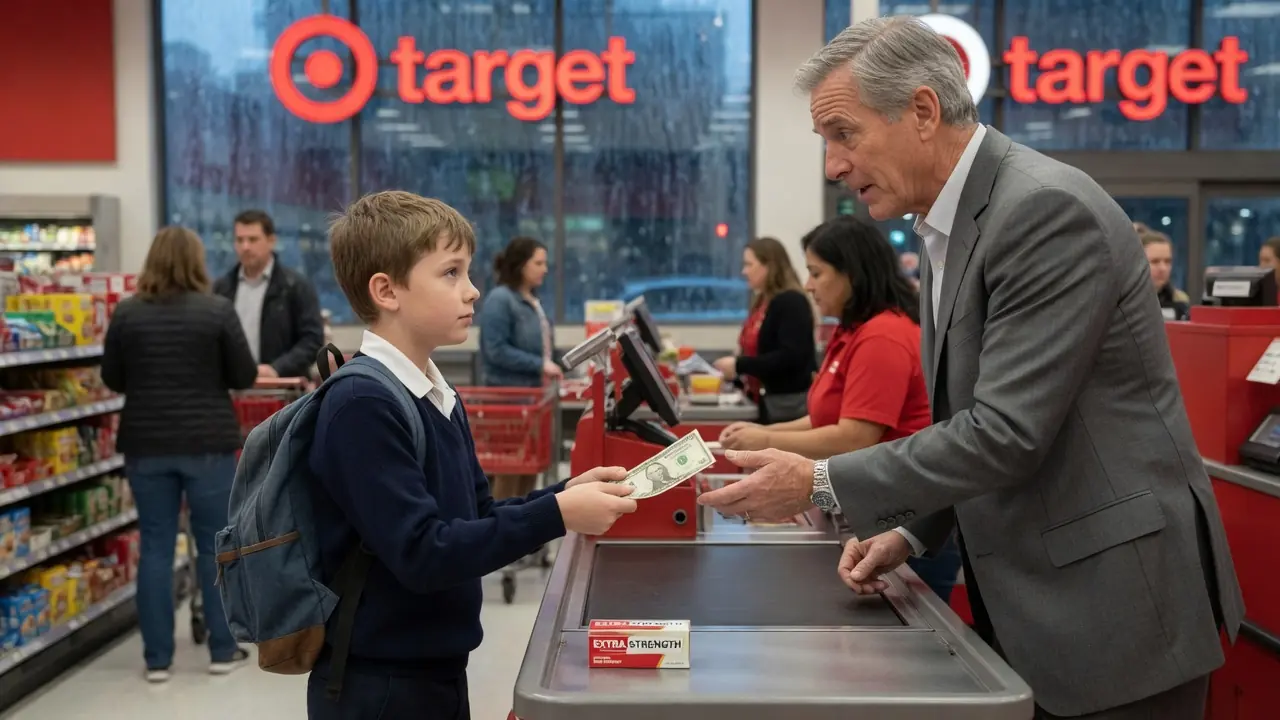
Dustin stepped forward and put his $5 on the counter.
“You need the medicine for your headache, right?”
The man blinked.
“How did you…”
“I can see it,” Dustin said. “My mom gets them, too.”
He looked at the cashier.
“Can you just ring up the medicine?”
$4.99.
The entire checkout lane went quiet.
“Son, I can’t take your money,” the man said.
“You need it more than I do,” Dustin said simply.
The cashier slowly scanned just the pain reliever.
$4.99.
Dustin handed over his $5 and got one penny back.
He gave the bag to the man.
“Here. Feel better.”
His eyes were wet.
“I don’t know what to say.”
“You don’t have to say anything.”
Dustin picked up his milk from the belt.
“I don’t have enough for this now. I’ll come back later.”
He started to walk away.
“Wait,” the man called. “Please. Your name?”
Dustin turned.
“Dustin. Dustin Johnson.”
“Dustin,” he repeated carefully. “I’m William.”
He pulled out a leather card holder from his jacket, engraved and expensive-looking.
He handed Dustin a business card.
“Please take this. I need to repay you when my bank fixes this mess.”
Dustin glanced at it.
Fancy logo.
Words he did not understand.
He pocketed it politely.
“Okay. Feel better, Mr. William.”
“Just William. And thank you. You have no idea what you just did.”
Dustin smiled and walked out into the evening air.
Behind him, whispers rippled through the line.
“Did that kid just give him his last money?”
“Where are his parents?”
William stood at the checkout holding the medicine, tears on his face.
He pulled out his phone with shaking hands.
“Michael,” he said to his assistant, “find everything you can about a boy named Dustin Johnson, 10 years old, near this Target on 63rd Street.”
“Sir, now?”
“And clear my schedule tomorrow. All of it.”
He looked toward the door where Dustin had disappeared.
That little boy had just reminded him of something he had forgotten.
Why he built his company.
What really mattered.
And he was going to make absolutely sure Dustin knew it.
The walk home felt different.
Dustin’s pocket was empty.
No $5 bill.
No milk.
Just one penny and a business card from a stranger.
But he did not feel bad about it.
Actually, he felt light, like he had done something that mattered.
The evening air was cool.
The sun was setting, painting the sky orange and pink.
Dustin usually loved sunsets.
But tonight, he barely noticed.
His mind kept replaying what had happened.
The man’s embarrassed face when his card declined.
The way his hands shook.
The pain in his eyes.
And the way he looked at Dustin when he helped him, like Dustin had given him more than $5.
Like he had given him something he desperately needed.
Hope maybe.
Or just the reminder that kindness still existed.
Dustin wondered if he would really pay him back.
Adults said things like that all the time, and then forgot.
But it did not matter.
He did not help him to get something back.
He helped him because it was the right thing to do.
When he got home, his mom was already there early.
That never happened.
Sarah was sitting at the kitchen table, still in her work uniform, staring at her phone.
“Mom,” Dustin said, surprised. “You’re home.”
Sarah looked up.
Her eyes were red.
Had she been crying?
“Baby, come here.”
Dustin’s heart jumped.
“What’s wrong? Did something happen at work?”
“No, nothing’s wrong,” Sarah said, her voice shaky. “Something happened. Sit down.”
Dustin sat, nervous now.
Sarah held up her phone.
“Did you meet a man at Target tonight? A man named William?”
Dustin’s eyes went wide.
“How do you know that?”
“Because 20 minutes ago, a man in a suit knocked on our door. He said his name was Michael Carter. He works for someone named William Sterling.”
“He came here?”
Dustin could not believe it.
“He brought this.”
Sarah placed an envelope on the table.
A nice envelope.
Heavy paper.
Dustin stared at it.
“Open it,” Sarah said softly.
With trembling fingers, Dustin opened the envelope.
Inside was money.
A lot of money.
Five $100 bills.
$500.
And a note handwritten in beautiful cursive.
Dustin,
Thank you for reminding me what truly matters. The $500 is not repayment. Your kindness cannot be measured in money. This is simply a small token of gratitude from someone whose day you saved. I would very much like to meet you and your mother properly. Would you join me for dinner Monday evening? My assistant will arrange everything.
With deep respect and appreciation,
William Sterling
Dustin looked up at his mom, confused.
“Mom, I only gave him $5. Why would he…”
“Baby, I need you to tell me exactly what happened.”
So Dustin did.
He told his mom everything about the man’s card declining three times, about seeing his pain, about making the choice to help him even though it meant losing the milk money.
When he finished, Sarah was crying again.
“Mom, please don’t be mad. I know you needed the milk, but he really needed…”
“Mad?”
Sarah laughed through her tears.
“Baby, I’m not mad. I’m so proud of you, I can barely breathe.”
She pulled Dustin into a tight hug.
“You did exactly what I taught you. You helped someone who needed it, even when it cost you.”
“But $500 is too much,” Dustin said into his mom’s shoulder. “For just $5.”
Sarah pulled back, holding Dustin’s face in her hands.
“Dustin, listen to me. That man didn’t give you $500 because of the money you gave him. He gave it to you because of who you are. Because you showed him something rare.”
“What?”
“Pure kindness. The kind that doesn’t expect anything back.”
Dustin looked at the note again.
“He wants to meet us for dinner.”
“Yes. Monday night.”
“Should we go?”
Sarah picked up her phone.
“I looked him up, baby. After his assistant left, I Googled William Sterling.”
She turned the phone to show Dustin.
The screen showed a Forbes article.
William Sterling, the billionaire who invests in people.
There was a photo.
The same man from Target.
But in this photo, he was standing in front of a huge building, shaking hands with important-looking people.
“That’s him?” Dustin whispered.
“That’s him.”
Sarah scrolled down.
“More articles. More photos. Net worth, $8.7 billion.”
“Billion?”
Dustin had never even thought about numbers that big.
“He runs a company called Sterling Ventures. He invests in startups, helps people build businesses.”
Sarah kept scrolling.
“But look at this part.”
She pointed to a paragraph.
Sterling is known for his philanthropy, particularly in education. His foundation has provided scholarships to over 500 underprivileged students. When asked about his giving philosophy, Sterling said, “I don’t invest in ideas. I invest in character. Show me someone with integrity and heart, and I’ll show you someone worth betting on.”
Dustin felt dizzy.
“I gave a billionaire $5.”
“You gave a human being $5 when he needed help,” Sarah corrected. “You didn’t know who he was. That’s what makes it special.”
They sat in silence for a moment.
Then Dustin noticed something.
“Mom, look at his watch in this picture.”
Sarah zoomed in.
It was the same watch from Target.
The one that caught the light.
“And his shoes,” Dustin continued. “Those are the same shiny ones.”
“You noticed all that?”
“I notice things,” Dustin said quietly. “I just didn’t know what they meant.”
Sarah set down the phone and picked up the envelope again.
“So, Monday dinner. Should we go?”
Dustin thought about it.
“What if he just wants to give us money and then forget about us?”
“Maybe. Or maybe he wants something else.”
“Like what?”
Sarah looked at her son.
Really looked at him.
This incredible 10-year-old who had given away his last $5 without hesitation.
“Maybe he wants to help you the way you helped him.”
“But I don’t need…”
“Dustin,” Sarah said firmly. “Baby, you are so talented, so smart, so kind. But you’re growing up in a world that doesn’t give boys like you enough chances.”
Dustin looked down.
“This man,” Sarah continued, “he has the power to open doors. Real doors. The kind that lead to real opportunities.”
“You think he wants to help me?”
“I think we should find out.”
Dustin picked up the business card from his pocket, the one William had given him at Target.
For the first time, he really read it.
William R. Sterling.
Founder and CEO.
Sterling Ventures.
And below that, in smaller letters.
Investing in potential wherever we find it.
“Mom.”
“Yeah, baby?”
“When you were my age, if someone offered you a chance, would you take it?”
Sarah’s eyes filled with tears again.
“In a heartbeat. And I wish someone had.”
Dustin made his decision.
“Then let’s go.”
Monday night.
Sarah smiled and pulled her son close again.
Neither of them could sleep that night.
Sarah kept thinking about what this could mean.
A billionaire interested in her son.
It felt like a fairy tale, too good to be true.
But that note, the way it was written, the respect in every word, maybe it was real.
Dustin lay in bed staring at the ceiling.
He kept thinking about William’s face at Target.
How relieved he looked when Dustin helped him.
How grateful.
He did not seem like someone who was just throwing money around.
He seemed like someone who understood what it meant to need help.
And maybe, just maybe, someone who remembered what it was like to be in his shoes.
The business card sat on his nightstand.
Investing in potential wherever we find it.
Dustin wondered what that meant for him.
He wondered what Monday night would bring.
He wondered if $5 really could change everything.
Outside, the city hummed with its usual nighttime sounds.
Cars.
Sirens.
Distant voices.
But inside their small apartment, something had shifted.
Hope had walked through their door, and it smelled like possibility.
Saturday morning, Dustin woke up wondering if last night had been a dream.
But the business card was still on his nightstand.
The envelope with $500 was still on the kitchen table.
Real.
His mom was already awake, making coffee.
“Morning, baby. Sleep okay?”
“Not really.”
Dustin sat down.
“Mom, should we keep this money? It’s so much for just $5.”
Sarah picked up William’s note again.
“He said it’s not repayment. It’s gratitude.”
“What’s the difference?”
“Repayment makes things even. Gratitude acknowledges something meaningful.”
Sarah looked at her son.
“You gave him something meaningful.”
They agreed to save $400 for emergencies.
One hundred dollars would go toward art supplies Dustin needed.
After breakfast, they went to the library.
They needed to know who William Sterling really was.
The library computers revealed everything.
Sterling Ventures announces $100 million education fund.
The billionaire who started in a garage.
William Sterling, from food stamps to Forbes list.
Article after article painted the same picture.
William had grown up poor with a single mother and government assistance.
He taught himself coding at 12 using library computers, the same way Dustin taught himself to draw from library books.
A teacher noticed his talent and helped him get a scholarship.
He built his first company at 23 and sold it for $50 million at 28.
Then he started Sterling Ventures, investing in others with potential.
But the foundation work interested Dustin most.
Over 500 scholarships given, mostly to low-income kids with talent but no opportunity.
One article included quotes from recipients.
Mr. Sterling changed my life. He believed in me when no one else did. He doesn’t just give money. He mentors. He cares.
Sarah read these aloud, her voice thick.
“Dustin, do you understand what this could mean?”
“He gives scholarships.”
“He finds kids with potential and helps them reach it.”
Sarah gripped his hand.
“Baby, you have so much potential. Your art, your grades, your kindness.”
“But I’m just 10.”
“He has given scholarships to kids as young as 11 for art schools, special programs.”
They found another article from two years ago.
Sterling: I look for three things: talent, character, and grit.
William’s quote read, “Anyone can have one quality, but when you find someone with all three, that’s rare. That’s worth investing in.”
Sarah looked at Dustin.
“You have all three.”
“What if I disappoint him?”
“Impossible. You already impressed him just by being yourself.”
On the walk home, Dustin was quiet.
“What are you thinking?” Sarah asked.
“He wrote that my kindness can’t be measured in money. If that’s true, why does money matter so much?”
Sarah stopped walking.
“Heavy question for a 10-year-old.”
“Money doesn’t buy happiness, but it opens doors. It gives you choices, freedom to chase dreams instead of just surviving.”
Dustin nodded slowly.
“Mom, whatever happens Monday, I’m glad I helped him. Even if nothing comes from it.”
Sarah hugged him right there on the sidewalk.
“That’s exactly why he noticed you.”
Sunday was preparation day.
They went through Dustin’s closet for the Peninsula Hotel.
He needed something nice.
They found his best white shirt and dark pants from last year’s school concert.
The sleeves were a little short now, but still presentable.
Sarah ironed them carefully.
Dustin polished his school shoes until they shined.
“We’ll hold our heads high,” Sarah said. “We were invited. That’s all that matters.”
Sunday evening, Dustin could not focus on anything.
He kept taking out the business card.
Investing in potential wherever we find it.
Did William see potential in him?
Real potential?
He wanted to believe it.
Because as much as he loved what they had, Dustin wanted more.
Not fancy things.
Just possibilities.
The chance to become everything he could be.
And maybe William Sterling could help him do that.
Monday could not come fast enough.
Monday arrived like a storm of butterflies in Dustin’s stomach.
He could not focus at school.
Could not eat lunch.
The clock moved too slowly.
At 3:30, he ran home.
Sarah was already there preparing.
She had taken the evening off, something she never did.
“The car comes at 6:30,” Sarah said.
“The car?”
“They’re sending a driver.”
By 6:15, they were ready.
Sarah in her one good dress.
Dustin in his best white shirt, dark pants, and polished shoes.
They looked at themselves in the mirror.
“We’ve got this,” Sarah whispered.
At 6:25, a black sedan pulled up outside.
Long, sleek, impossibly clean.
A professional driver in a suit opened their door.
“Miss Sarah. Master Dustin. I’m Marcus.”
Dustin had never been in a car like this.
Leather seats.
Perfect silence.
As they drove, Marcus said, “Mr. Sterling has been talking about you all weekend, Master Dustin. He’s very excited to meet you properly.”
“He talked about me?” Dustin asked.
Marcus smiled in the rearview mirror.
“He said you reminded him of something important. Something he had almost forgotten.”
The city changed around them.
Buildings got taller, fancier, cleaner.
Then they arrived at the Peninsula Hotel.
Dustin’s breath caught.
Glass and marble and lights everywhere.
A doorman in uniform.
“This way, Mr. Johnson,” the doorman said. “Mr. Sterling is expecting you.”
The lobby was like something from a movie.
Crystal chandeliers.
Marble floors.
Everything gleamed.
An elevator attendant pressed the button for the 20th floor.
“Presidential suite,” he said.
Dustin looked at his mom.
“Presidential.”
The elevator rose smoothly.
When the doors opened, there was only one door in the entire hallway.
One floor.
One apartment.
Before Sarah could knock, the door opened.
William Sterling stood there smiling.
He looked more relaxed than at Target.
Blue shirt.
No jacket.
But those same kind eyes.
“Dustin.”
He knelt to his level.
“I’m so glad you came.”
He stood, shaking Sarah’s hand.
“Miss Johnson, thank you for trusting me. Please come in.”
The suite was enormous.
Floor-to-ceiling windows showed the entire city lit up.
A dining table was set with beautiful dishes.
“Please sit.”
William gestured to the couch.
They sat.
Dustin’s hands trembled.
William sat across from them, leaning forward.
“I’m sure you have questions about why I asked you here.”
Sarah nodded.
“We’re very curious.”
“Good,” William smiled, “because what I’m about to propose will sound impossible, but I promise it’s real.”
He looked directly at Dustin.
“Friday night, you gave me $5 without knowing who I was, without expecting anything back.”
“I just wanted to help,” Dustin said softly.
“I know. That’s what makes it extraordinary.”
He paused.
“Dustin, do you know what I look for when I invest in people?”
Dustin shook his head.
“Character. Kindness. People who do the right thing when it’s hard.”
His voice was warm.
“You showed me all of that in five seconds.”
Sarah spoke.
“Mr. Sterling, what are you saying exactly?”
William took a breath.
“I’m saying I’d like to invest in Dustin. In his future, in his potential.”
Silence filled the room.
Dustin’s heart pounded.
“What? What does that mean?”
William stood and walked to the window, looking out at the city.
Then he turned back with a smile that held a promise.
“Let me show you something.”
William walked to a cabinet and pulled out an iPad.
“Before I explain, I want to show you something.”
He sat back down.
“Dustin, may I see your drawings?”
Dustin froze.
“My drawings?”
“Your mom mentioned you love art. I’d love to see.”
Slowly, Dustin pulled out his worn sketchbook.
He handed it over, feeling exposed.
William opened it carefully and turned each page.
Really looking.
Characters.
Scenes.
Stories in pencil.
“Remarkable,” he said quietly. “Self-taught?”
“YouTube. Library books.”
“Incredible.”
He looked up.
“I see talent, but more than that, discipline. Every page is filled. That takes dedication.”
He set the sketchbook down gently.
“Let me tell you a story. When I was 10, I lived in a small apartment with my single mom. My father left when I was three.”
Sarah and Dustin listened intently.
“My mom worked two jobs. I was alone most of the time. I discovered computers at the library. I taught myself to code from books.”
His voice softened with memory.
“One day, my teacher, Mr. Mitchell, noticed. He saw me working during recess. Asked what I was doing.”
“What happened?” Dustin asked.
“He changed my life. Bought me a computer with his own money. Tutored me after school for free for three years.”
William’s eyes glistened.
“Without him, I wouldn’t be here. He saw potential and invested everything. Time, money, belief.”
He paused.
“He died 10 years ago. I never fully repaid him, but I promised him something. I would do for others what he did for me.”
Sarah squeezed Dustin’s hand.
“So I started Sterling Foundation. Twenty years. Five hundred thirty-seven scholarships.”
He turned the iPad toward them.
Photos appeared.
Kids graduating.
Kids succeeding.
“Maya. Now a pediatric surgeon. She came from public housing.”
He swiped.
“James. Software engineer at Google. His family was homeless.”
He swiped again.
“Elena. Art director in New York. Makes six figures now. Started exactly where you are, Dustin.”
Dustin’s eyes widened.
William set down the iPad.
“Friday night, I was having my worst professional day. I had spent hours in meetings about a $50 million deal everyone wanted me to sign.”
“Wanted you to?” Sarah prompted.
“But something felt wrong. The founder was talented but arrogant. Only cared about profit, not people.”
He shook his head.
“I was heading to finalize it. That’s why I needed aspirin. Headache from knowing I was making the wrong choice.”
“What happened?” Dustin whispered.
“My card declined. Security lockout. I stood there embarrassed, helpless.”
His voice cracked.
“Then a 10-year-old boy gave me his last $5. Didn’t know who I was. Didn’t care. Just saw someone needing help.”
Tears formed in his eyes.
“I called my assistant from the parking lot and canceled the $50 million deal because you reminded me what matters.”
“What?” Dustin asked.
“That character beats credentials. That kindness is rarer than talent. That a good heart is the best investment.”
He wiped his eyes.
“You gave me $5, but you gave me something priceless. You reminded me of Mr. Mitchell, of why I started this work.”
Silence filled the room.
William pulled out a folder.
“So here’s my offer, Dustin.”
He opened it.
“First, full scholarship to Northside Academy for the Arts.”
Dustin gasped.
The best art school in Chicago.
“Twenty-five thousand per year. Sixth grade through 12th. Everything covered. Tuition, supplies, books.”
Sarah’s hand flew to her mouth.
“After high school, full scholarship to any art college. RISD, Pratt, CalArts. Your choice.”
Dustin could not speak.
“Because you have something special. Not just talent. Character. That’s what I invest in.”
He pulled out another document.
“Second, I’m purchasing a building on 63rd Street, four blocks from you.”
They looked confused.
“I’m converting it to a community arts center. Free classes for neighborhood kids. Drawing, painting, sculpture, digital design.”
“A whole center?” Dustin breathed.
“Yes. Called the Dustin Arts Center.”
Time stopped.
“The what?”
“The Dustin Arts Center. Named after you. You inspired it.”
Tears streamed down Dustin’s face.
“You gave $5 expecting nothing. I’m giving you education and legacy. A place where hundreds of kids can discover their gifts.”
William knelt before him.
“You showed me small acts of kindness change everything. Now I’ll show you what happens when kindness multiplies.”
Sarah sobbed.
“This is too much.”
“No. This is investment.”
William’s voice was firm but kind.
“In Dustin. In your community.”
He stood.
“Two conditions only.”
“What?” Dustin wiped his eyes.
“One. Work hard. Take education seriously. Develop your talent.”
“I will. I promise.”
“Two. When you’re successful, and you will be, help someone else like you helped me.”
Dustin nodded hard.
“I promise.”
William extended his hand.
“Deal?”
Dustin stood shakily and shook it.
“Deal.”
He pulled them both into a hug.
They clung together, this stranger who had just transformed their lives.
When they separated, William smiled.
“Now, let’s have dinner. We have much to plan.”
As they moved to the table, Dustin looked at the city lights.
Twenty-four hours ago, he had $5 and impossible dreams.
Now, full scholarship.
A building with his name.
A future so bright it almost hurt.
All because he chose kindness over convenience.
All because $5 turned out to be worth everything.
The twist was not just that William was rich.
It was that he understood exactly what Dustin had given him.
And he was giving it all back, multiplied a thousand times.
Dinner was surreal.
They sat at a table set with fine china and crystal glasses.
Food arrived.
Beautiful dishes Dustin had only seen in magazines.
But the conversation mattered most.
William pulled out a leather portfolio.
“Let me show you the details.”
He opened the first page.
“The scholarship to Northside Academy starts next fall. Sixth grade.”
“Next fall?” Dustin’s voice shook.
“Nine months. We will submit your application this month. Don’t worry. I sit on their board. Your acceptance is guaranteed.”
Sarah looked concerned.
“Is that allowed?”
William smiled.
“When a board member offers a full scholarship, they trust my judgment on character.”
He showed the academy brochure.
Beautiful building.
Art studios with natural light.
Students creating paintings, sculptures, digital designs.
Professional equipment.
Drawing tablets.
Cameras.
Editing software.
Everything you need.
Dustin’s hands trembled as he touched the brochure.
“Classes are small. Fifteen students maximum. Teachers are working artists. People doing this professionally.”
“Real artists,” Dustin whispered.
“One illustrated for Pixar. Another designs for Marvel Comics.”
Dustin felt dizzy.
William turned the page.
“After school, you can stay for studio time as long as you need. Transportation provided.”
“Transportation?”
“Car service. Door-to-door. No more walking in bad weather.”
Sarah’s eyes filled with tears.
“Summers, intensive workshops. Art camps with students worldwide.”
He showed photos.
Kids painting outdoors.
Creating installations.
Working with mentors.
“This is serious art education. How you develop from talented to exceptional.”
William moved to the next section.
“Now, the Dustin Arts Center.”
He pulled out architectural renderings.
A three-story building, modern and renovated.
“This is 63rd Street now.”
A photo showed an abandoned building, boarded windows, crumbling brick.
“This is what it becomes.”
The rendering showed glass windows, colorful murals, and kids inside creating.
“Three floors. First, open studio. Second, classrooms. Third, gallery and performance space.”
Sarah leaned forward, studying the images.
“We break ground in six weeks. Construction takes six months. Opens next September.”
“That fast?” Sarah asked.
“When you have resources? Yes. Contractors already hired.”
William showed the next page.
“Programs. Drawing, painting, sculpture, digital art, photography, graphic design, animation.”
“All free?” Dustin asked.
“Completely. Ages five to eighteen. No income requirements.”
“Anyone attends?”
He smiled.
“Talent doesn’t care about zip codes.”
“How many kids?” Sarah asked.
“Two hundred first year. Five hundred by year three.”
Dustin’s mind spun.
Five hundred kids because of him.
“Each class is limited to 20 students, professional teachers. Sterling Foundation covers operating costs for five years.”
“How much?” Sarah could not help asking.
“$2.5 million.”
Sarah’s jaw dropped.
“It’s an investment, not charity. I’m investing in this community’s future.”
He turned another page.
“Dustin, your role.”
“My role?”
“The center is named after you. You’re not just a namesake. You’re part of it.”
He showed a drawing, a logo with a hand holding a paintbrush, colors swirling.
“Preliminary logo. But I want you to redesign it. Make it yours.”
“Me? Design it?”
“Who better? You’re the inspiration. You should shape its identity.”
Dustin stared, his mind already reimagining it.
“You’ll be a junior ambassador once a month. Visit, talk to younger kids, show what’s possible.”
“I can do that,” Dustin said, finding his voice.
“I know, because you understand something adults forget. Small acts of kindness matter.”
William closed the portfolio.
“One more thing. The biggest.”
He looked at them seriously.
“This isn’t just about Dustin. It’s about creating a model.”
“A model?” Sarah asked.
“Other investors are watching. If this works, if Dustin Arts Center succeeds, I’ll recruit them. Build more centers. Chicago, LA, New York, Atlanta.”
His eyes lit with vision.
“My goal is 10 Dustin Centers in three years, serving 2,000 kids.”
Dustin could not breathe.
“Your $5 could eventually help thousands discover their gifts.”
He let that sink in.
“But it starts with you. Succeed at Northside. Develop your art. Be proof this model works.”
“That’s pressure,” Sarah said quietly.
“It is. But I wouldn’t offer it if I didn’t believe Dustin could handle it.”
He looked at Dustin directly.
“Can you?”
Dustin thought about his tiny apartment, his walks to school, his jar of saved dollars.
Every time he felt invisible.
Every time he wondered if dreams were too big.
He looked at his mom, who had worked exhausted to give him chances.
At William, who had built an empire but remembered what needing help meant.
“Yes,” Dustin said firmly. “I can.”
William smiled.
“I knew you’d say that.”
He pulled out one final document.
“The scholarship agreement. Your mom signs as guardian.”
Sarah took it, reading carefully.
“It’s binding?”
“Sterling Foundation commits full funding. You commit to good grades and good behavior. Simple.”
Sarah looked at Dustin.
“Baby, your decision. What do you want?”
Dustin did not hesitate.
“I want this. All of it.”
Sarah signed.
William countersigned.
“Congratulations. Your new life starts now.”
They finished dinner discussing logistics, application deadlines, construction timelines, and opening ceremonies.
By dessert, Dustin’s head spun with possibilities.
When they prepared to leave, William walked them to the door.
“One last thing.”
He handed Dustin a phone.
A new smartphone in a box.
“You’ll need this for school communication. My number is programmed. Call anytime.”
Dustin held the box, overwhelmed.
“Thank you,” he whispered. “For everything.”
William knelt down.
“No, Dustin. Thank you. You saved more than my day Friday. You saved my purpose.”
He hugged him.
“Now go build something beautiful.”
Marcus drove them home in comfortable silence.
When they walked into their small apartment, everything looked the same.
But everything was different.
Dustin sat on his bed holding the scholarship agreement.
His name in print.
Official.
Real.
Tomorrow he would still wake here, still have his worn sketchbook.
But now he had a future.
A real, tangible, impossible future.
All because of $5 and a choice.
Sarah came in and sat beside him.
“You okay, baby?”
“I think my life just changed.”
“It did.”
They sat together in silence.
Outside, the city hummed.
Same sounds.
Same streets.
But inside this small apartment, hope bloomed.
Tomorrow would be different.
Next month would be different.
Next year, Dustin would walk into Northside Academy in a uniform with supplies, ready.
Not the poor kid who could not afford things.
Just Dustin.
The artist.
The student.
The boy who gave $5 and got a miracle back.
He looked at his mom.
“Thank you for teaching me to be kind.”
Sarah hugged him tight.
“Thank you for listening.”
They held each other as the city sparkled outside.
Tomorrow the real work began.
Tonight, they just breathed and believed.
Six months passed like a dream.
September had arrived.
Dustin stood in front of his mirror wearing the Northside Academy uniform.
Navy blazer.
White shirt.
Dark trousers.
He barely recognized himself.
His first day was overwhelming.
The building was massive.
Hallways lined with artwork.
Studios filled with equipment he had only imagined.
His art teacher, Ms. Rodriguez, reviewed portfolios the first week.
When she reached Dustin’s, she stopped.
“Class, look at this. Raw talent, self-taught. And look at this composition.”
Dustin’s face burned.
“Dustin, you belong here. Don’t doubt that.”
He did not doubt again.
By October, Dustin thrived.
Straight A’s.
His artwork improved daily with professional instruction.
He learned techniques he had never known.
Perspective.
Color theory.
Digital illustration.
On weekends, he still helped Mrs. Rosa.
Still said hi to Mr. Carter.
He had not forgotten where he came from.
The big day arrived in mid-September.
The Dustin Arts Center grand opening.
Six months ago, this building was abandoned.
Broken windows.
Graffiti-covered walls.
Now it gleamed.
Fresh paint.
New windows.
A massive mural covered one wall, painted by local kids.
The mural showed hands reaching toward a bright sun.
Unity.
Hope.
Possibility.
Three hundred people gathered for the ribbon cutting.
Neighbors.
City officials.
Press.
And kids.
So many kids.
William stood at the microphone.
“Today we open something special. Not just a building, a promise.”
He gestured to Dustin.
“Come up here.”
Dustin’s legs shook as he climbed the steps.
“This center is named after Dustin Johnson, a 10-year-old who reminded me what matters.”
The crowd applauded.
“Dustin, would you say something?”
Words came without planning.
“Six months ago, I had $5 and a dream. Today, I have this.”
He gestured to the building.
“But this isn’t mine. It’s ours. For everyone.”
His voice grew stronger.
“If you love art, come here. If you want to learn, come here. If you need a safe place, come here. This is for all of us.”
Thunderous applause.
Together, they cut the ribbon.
The doors opened.
Kids poured inside, faces lit with wonder.
First floor, open studio space.
Tables with supplies.
Drawing paper.
Paint.
Clay.
All free.
Kids grabbed materials and immediately started creating.
Second floor, structured classrooms.
Computers with design software.
Photography equipment.
Professional-grade everything.
Third floor, gallery space, currently displaying local artists.
Soon it would showcase student work.
By the end of the day, 180 kids had registered.
The waiting list had 50 more.
William pulled Dustin aside.
“You see that?”
He pointed to kids laughing, creating, belonging.
“This is what $5 became.”
A little boy, maybe seven, painted his first canvas.
Pure joy on his face.
“It’s perfect,” Dustin whispered.
The first three months exceeded expectations.
Two hundred twenty kids enrolled.
Classes ran six days weekly.
Morning, afternoon, evening sessions.
The center served free snacks.
Sometimes the only food kids ate outside school.
Dustin visited every Saturday, taught younger kids, and showed basic techniques.
He told his story about $5, about helping strangers, about how kindness opens doors.
Kids listened like he was magic.
“You’re just like us,” one boy said.
“Exactly,” Dustin said. “That’s the point. If I can do this, you can, too.”
Success stories emerged quickly.
Marcus, 12, designed a logo for his uncle’s restaurant, earned $300, and helped his mom with rent.
Emma, seven, was autistic and struggled with communicating.
Through art, she found her voice, started speaking more, connecting more.
Aiden, Dustin’s best friend, got accepted to a summer art intensive in New York.
Full scholarship from Sterling Foundation.
Local news covered the center extensively.
Community art center transforms South Side.
Dustin’s $5 gift keeps giving.
The Chicago Tribune ran a feature.
Full-page spread.
Dustin’s story.
The center’s impact.
The story went viral.
Social media exploded.
#DustinArtCenter started trending.
Videos of kids creating.
Parent testimonials.
“My daughter has somewhere safe after school.”
“My son discovered photography. Now he wants college.”
“This center saved my family.”
Ripple effects extended beyond art.
Neighborhood crime dropped 12%.
Kids had somewhere to go.
Purpose.
Local businesses thrived.
Foot traffic increased.
Property values rose 8%.
The neighborhood was transforming.
Most importantly, hope replaced despair.
People believed in their community again.
It started with one boy giving $5.
By December, William had recruited two other billionaires.
They committed to Dustin Centers in Los Angeles and Atlanta.
Construction would begin in spring.
The model was working.
Dustin’s $5 was multiplying across the country.
On Christmas Eve, Dustin stood inside the center alone.
Quiet.
Empty.
Tomorrow it would be filled with kids again.
He thought about that Friday at Target.
The stranger with a declined card.
His choice to help.
He never imagined this.
A scholarship.
A building.
Hundreds of kids learning.
All because he chose kindness.
William’s words echoed.
Small acts change everything.
He was right.
Five dollars changed his life.
Through him, it was changing hundreds more.
The center lights glowed warm in the winter darkness.
Tomorrow, more kids would create.
More dreams would spark.
All starting from $5 and a choice.
One year later, the Dustin Arts Center celebrated its first anniversary.
Five hundred people gathered.
Double last year’s crowd.
The center now served 250 kids.
Waiting list, 100 names.
Success beyond dreams.
Dustin, now 11 and in seventh grade, stood at the microphone.
“One year ago, we opened these doors. Today, I want to introduce someone special.”
A small boy stepped forward.
Nine years old.
Shy.
“This is Mateo Rodriguez. He started here six months ago.”
Mateo clutched a portfolio.
“Mateo’s family came from Mexico last year. He didn’t speak much English. He felt alone.”
The crowd listened.
“But he found art. Through art, he found his voice.”
Dustin opened Mateo’s portfolio.
Stunning paintings.
Vibrant colors.
Stories without words.
“Tonight, Mateo wins our Young Artist Award, a $500 scholarship.”
Applause erupted.
Mateo’s eyes filled with tears.
Dustin handed him the check and trophy.
Mateo whispered, “Thank you. But my mama is sick. She needs medicine. I use the money for her.”
Dustin’s heart stopped.
He saw himself one year ago.
The same choice.
Help someone loved or keep the money.
Dustin knelt to Mateo’s level.
“Mateo, keep the $500 for college. For your future.”
He reached into his pocket and pulled out a $5 bill.
The original one.
William had returned it.
Dustin had kept it all year.
“Take this for your mama’s medicine.”
Mateo looked confused.
“But only $5.”
Dustin smiled through tears.
“Five dollars can be magic. Trust me.”
He pressed it into Mateo’s hand.
“Someone taught me that giving is receiving. Today, I’m passing it forward.”
Mateo hugged Dustin tight.
Silence.
Then someone clapped.
The applause grew.
A standing ovation.
William stood in the back, tears streaming.
After the ceremony, he approached Dustin.
“You gave him the $5 bill.”
“I had to. He needed it.”
William hugged him.
“You’ve learned everything I hoped.”
“You taught me well.”
“No. You already knew. I just gave you the platform.”
They watched Mateo show his mother the $5.
The mother cried with relief.
“The cycle continues,” William said. “Mateo will remember. One day, he’ll help someone else.”
“That’s the point.”
“Exactly. One act creates infinite ripples.”
Dustin looked around.
Kids creating.
Families laughing.
The community thriving.
All from $5.
“Mr. Sterling.”
“Yes?”
“Thank you for believing in me.”
“Thank you for reminding me why I do this.”
He paused.
“You changed my life, too.”
“I did?”
“You brought me back to my purpose. That’s priceless.”
Dustin found a quiet corner as the celebration continued.
He thought about that Friday at Target one year ago.
A stranger with a declined card.
A choice to help.
Five dollars that became everything.
He had started with nothing and gave anyway.
Now he had everything and still chose to give.
That was the lesson.
Kindness was not about having enough.
It was about caring enough.
Outside, the city sparkled.
Inside, hope bloomed.
The Dustin Arts Center would keep growing.
More kids.
More dreams.
More futures.
Mateo would remember tonight.
The night a boy gave him $5 and a promise.
That kindness wins.
That small acts matter.
That anyone can change the world.
One choice at a time.
One heart at a time.
One $5 bill at a time.
The story that started with $5 would never end.
It would multiply forever.
William and Dustin stood together, watching kids create.
“Ready for what’s next?” William asked.
“Always,” Dustin said.
Because the journey was not over.
It was just beginning.
And this time, hundreds of kids were on it with him.
All because one boy chose kindness.
All because $5 became hope.
All because believing in people always pays off.
The lights glowed warm.
Music played softly.
Laughter filled the air.
This was what $5 built.
Not just a building.
A movement.
A legacy.
A promise kept.