Noah Collins was twelve years old when he walked into the Rust Fangs clubhouse alone.
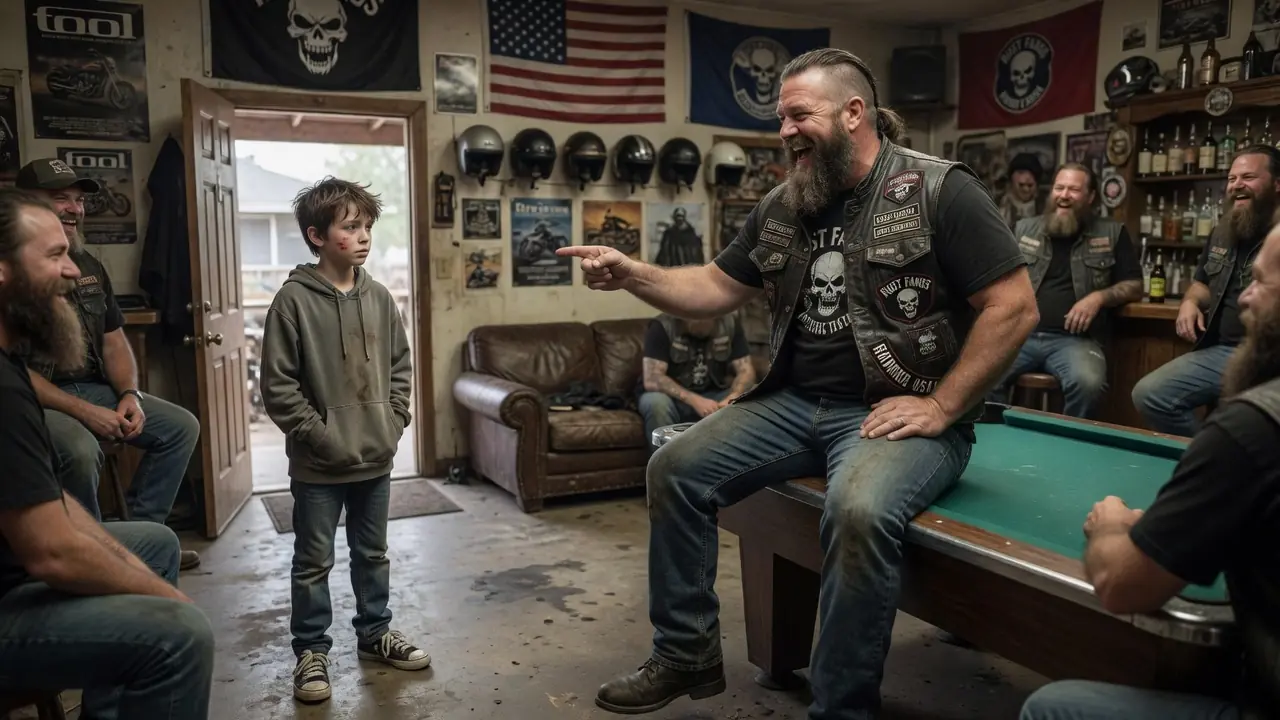
The heavy wooden door groaned on rusty hinges, and every man in the room turned toward him. Conversations stopped. Pool cues froze over green felt. Someone reached over and turned the music down until the whole place went silent.
Noah stood in the doorway wearing a gray hoodie two sizes too big. His sneakers were patched with duct tape, and his hands stayed buried deep in his pockets.
He kept his face angled down, but not low enough to hide the purple-yellow mark across his left cheekbone.
“Wrong address, kid,” someone called from the back.
A few men chuckled, expecting him to turn around and leave. Most grown men avoided the Rust Fangs clubhouse unless they had business there. It smelled like motor oil, black coffee, old leather, and years of hard living baked into the walls.
But Noah did not leave.
He stepped inside and let the door close behind him.
“I’m looking for work,” he said quietly.
That got another round of laughter.
A big man named Razor leaned back in his chair and slapped his knee. “You hear that? Kid wants a job.”
Noah did not smile. “After school,” he said. “I can sweep floors, clean tools, organize parts, take out trash. Whatever needs doing.”
The laughter faded.
In the corner, Keller watched him without saying a word. Keller was the club’s sergeant at arms, a broad-shouldered man in his late forties with a shaved head and a long scar running from his temple to his jaw. He had lived long enough to know the difference between a kid looking for trouble and a kid trying to survive.
Noah was not looking for trouble.
He was standing there with shame in his eyes and stubbornness in his spine, trying very hard not to look afraid.
Keller stood. When he moved, everyone paid attention.
“What’s your name?” Keller asked.
“Noah.”
“Noah what?”
The boy hesitated. “Noah Collins.”
“You live around here?”
Keller’s expression changed slightly. He knew that house. A foster home run by Clive and Barbara Henderson. It had a reputation, though nothing official ever seemed to stick. Kids came and went from that place, and people in town had learned not to ask too many questions.
“How old are you?” Keller asked.
“Twelve. Thirteen in March.”
Keller stepped closer. Noah’s shoulders tightened, but he did not back away.
“That’s a rough mark on your face.”
“I fell.”
“Off what?”
“My bike.”
“You ride a bike to school?”
“Sometimes.”
“Where’d you fall? Street? Sidewalk? Gravel?”
Noah’s jaw tightened. For half a second, his eyes flickered with calculation, as if he were weighing truth against consequence.
“Does it matter?” he asked.
Keller looked at him for a long moment. “Yeah,” he said quietly. “It does.”
The room stayed silent.
Finally, Keller nodded toward an old couch near the window. “Sit there. Don’t touch anything. Don’t talk to anyone. I’m going to see what kind of work we’ve got.”
Noah walked to the couch and sat with his hands still in his pockets, eyes fixed on the floor.
Keller did not go to the garage. He went to his office and made a phone call.
Two hours passed.
The clubhouse slowly returned to life around Noah, but no one bothered him. Men came and went. A woman named Tina, who cooked for the club and ran the diner down the road, brought him a sandwich and a soda. She set them on the armrest beside him without a word.
Noah stared at the food for nearly ten minutes before eating. When he finally picked up the sandwich, he ate slowly and carefully, like someone who had learned not to waste even one bite.
When Keller returned, Noah was exactly where he had been left.
“All right,” Keller said, crouching so they were eye level. “Here’s the deal. We’ve got work. Sweeping, sorting tools, cleaning up around the garage. Ten dollars an hour, three days a week after school. Tuesdays, Thursdays, and Saturdays. Two hours each day.”
Noah looked up, barely breathing.
“You show up on time,” Keller continued. “You work hard. You don’t steal. You don’t lie. Ever. Can you do that?”
Something fragile moved across Noah’s face. Not joy exactly. Not yet. Something smaller and more careful.
“Yes, sir.”
“Good. Tuesday. Four o’clock. Don’t be late.”
Noah stood and walked toward the door. His hand was already on the handle when Keller spoke again.
“Noah.”
The boy turned.
“That mark didn’t come from a bike.”
Noah’s face closed instantly, the mask sliding back into place.
Keller did not push. “Tuesday,” he said. “Four o’clock.”
The door closed behind the boy, and the clubhouse seemed to exhale.
Razor looked at Keller. “What was that?”
Keller watched Noah disappear down the street, shoulders hunched against the cold.
“That,” he said quietly, “was a kid asking for a lifeline. And we’re going to throw him one.”
Noah showed up Tuesday at 3:47.
He stood outside the clubhouse door for a full minute before knocking, as if giving himself one last chance to run. Keller opened the door before the second knock.
“Early,” Keller said. “Good.”
He led Noah through the main room and out back to the garage. The place was bigger than Noah expected, with bikes in different stages of repair, tools arranged on pegboards, and the sharp smell of gasoline and metal in the air.
“This is Lucky,” Keller said.
Lucky was a wiry man in his forties with faded tattoos on both arms and grease permanently embedded beneath his fingernails. He was leaning over a motorcycle engine, hands moving with steady confidence.
“The kid’s helping with cleanup,” Keller said. “Show him what needs doing.”
Lucky looked Noah over. “Broom’s in the corner. Start there.”
Noah started sweeping.
He worked like the broom weighed more than it did. He got into corners, under tables, around toolboxes. He did not complain. He did not ask when he could stop. He simply worked, methodical and quiet.
Lucky pretended not to watch, but he noticed everything.
After an hour, he called Noah over and set a cardboard box on the floor. It was full of mixed bolts, washers, screws, and engine parts.
“Razor knocked over three boxes last week like a bull in a furniture store,” Lucky said. “Sort these by size and type.”
Noah sat cross-legged on the concrete and dumped the box carefully in front of him. Twenty minutes later, Lucky walked back and found the parts arranged in neat rows, lined up by size and purpose with surprising precision.
Lucky raised an eyebrow. “You’re good with your hands.”
Noah looked down. “My dad used to fix cars.”
“Before what?”
The boy’s face shut again. “Before he left.”
Lucky did not push. “If you keep showing up, I’ll teach you some basics. Engines, tools, repairs. Useful stuff.”
Noah looked up so fast Lucky almost regretted pretending it was no big deal.
“Really?”
“Really. But only if you work.”
“I will,” Noah said. “I promise.”
That evening, Moose Joe walked Noah home.
Joe was sixty-two, white-bearded, broad, and quiet in the way men get when life has taken something from them and left the lesson behind. He had lost a son years earlier, a boy who had passed through too many homes and too many broken promises before slipping beyond anyone’s reach.
Joe had heard about Noah. He had seen the mark on the boy’s face. And old pain had started moving in him again.
They walked in silence for two blocks before Joe spoke.
“You like working in the garage?”
“Yes.”
“Lucky’s good people. Hard to understand sometimes, but good people.”
Noah nodded.
When they turned onto Oak Street, Noah’s pace changed. The yellow house sat four doors down, its chain-link fence leaning, its porch light flickering. Through the window, Joe saw a large man pacing inside.
“That your place?” Joe asked, though he already knew.
“Yes.”
Noah’s body had changed completely. His shoulders curled inward. His head dropped. His hands disappeared into his pockets as if he were trying to shrink.
Joe stopped one house away and pulled out a card.
“This is the clubhouse number,” he said. “If things ever get bad, you call. Day or night. Someone will answer.”
Noah stared at the card. “Why are you doing this?”
Joe swallowed hard. He could have said because he had once watched another boy disappear while the world looked away. Instead, he said, “Because you asked for work instead of pity. That takes guts. People with guts deserve someone at their back.”
Noah tucked the card deep into his pocket.
“Thank you.”
Joe waited until the boy went inside before walking away.
By the third week, Noah had become part of the garage’s rhythm. He arrived early, worked quietly, and absorbed everything Lucky taught him. He learned the names of tools, the order of parts, the difference between cleaning something and caring for it.
There were still bad signs.
Some days he moved stiffly. Sometimes he wore long sleeves when the weather was too warm for it. Once, he flinched when Razor slammed a toolbox shut, then looked embarrassed by his own reaction.
The men noticed, but Keller told them not to make him feel watched like a suspect. They documented what they saw. Dates, times, visible marks, changes in behavior. Keller had already contacted a woman named Molina at Child Protective Services, someone he trusted. She told him evidence mattered.
So they gathered it carefully.
Then Clive Henderson came to the clubhouse.
The door slammed open one Thursday evening, and Noah froze before he even saw him.
“Where is he?” Clive shouted. “Where’s the kid?”
He was tall and heavy, with red eyes and a shirt stained down the front. His anger seemed to enter the room before he did.
Lucky stepped in front of Noah without thinking.
“Can I help you?” he asked.
“You can mind your business,” Clive snapped. “That’s my foster kid, and he’s coming home.”
Keller came out of the office, calm as stone.
“Mr. Henderson,” he said. “Noah’s shift ends at six. It’s five-thirty. He’ll be home when his work is done.”
“I didn’t give him permission to be here.”
“His caseworker approved the work program,” Keller said.
That was not entirely true yet, but Clive did not know that. Keller said it with enough certainty that the man hesitated.
“You people think you can fill his head with ideas,” Clive said. “He’s got responsibilities.”
“What responsibilities?” Keller asked.
Clive’s face darkened. “That’s between me and the kid.”
Keller took one slow step forward. Behind him, Razor, Lucky, and two other men appeared in quiet support.
“From where I’m standing,” Keller said, “Noah shows up here with new marks every few days. He flinches when someone raises their voice. He eats like he doesn’t know when the next meal is coming. So I’m very interested in these responsibilities.”
Clive opened his mouth, then closed it. Even angry, he could count the men in the room.
“You have him home in an hour,” he said, pointing at Noah. “Don’t make me come back.”
After he left, the garage stayed silent.
Noah stared at his shaking hands. “I should go.”
“Not alone,” Keller said.
Joe walked Noah home that night, with another biker riding slowly around the block to make his presence known. When they reached the yellow house, Clive was visible through the window, pacing with a bottle in his hand.
“You don’t have to go in,” Joe said quietly.
“I do,” Noah whispered. “If I don’t, he’ll call and say I ran away. Then they’ll send me somewhere worse.”
“How do you know?”
Noah’s voice went flat. “Because I’ve been somewhere worse.”
Joe wanted to put the boy on the back of his bike and never bring him back. But he knew that would only make things harder. There had to be a legal way.
He called Keller the moment Noah went inside.
“We’re out of time,” Joe said. “That kid is not safe.”
“I know,” Keller answered. “Meet me at Tina’s.”
Tina’s diner sat on the edge of town, small, warm, and open late. Tina had been feeding the Rust Fangs for fifteen years. When Keller and Joe walked in, she poured coffee without asking.
“Heard about the foster kid,” she said. “How bad?”
“Bad enough,” Keller said. “We need proof.”
Tina stared into the coffee pot for a moment, then seemed to remember something. “His last name is Collins?”
“Noah Collins.”
She disappeared into the back and returned with a dusty cardboard box.
“I kept old employee files,” she said. “Tax records mostly. Twenty years ago, I had a waitress named Emma Collins. Sweet girl. Young. Had a baby boy. Worked here a few months after he was born, then vanished. Never picked up her last check.”
Keller went still. “The baby’s name?”
Tina searched the box and pulled out a faded Polaroid.
A young woman with Noah’s eyes held an infant wrapped in a blue blanket. On the back, in looping handwriting, it read:
Noah, four months. My whole world.
Joe looked away, jaw tight.
Keller took a careful breath. “I need copies of everything.”
The next few days moved quickly.
Molina reviewed Noah’s file, the documented injuries, the school concerns, and Tina’s old records. Then she found something worse. Noah’s original intake paperwork said Clive Henderson had found him abandoned at a gas station as an infant and volunteered to foster him.
But the timing matched Emma Collins’s disappearance.
No one had followed up properly. No one had asked why a young mother who kept a photograph of her baby in her work locker would leave him behind without taking a single possession. No one had checked too deeply because Clive seemed helpful and the system was already overwhelmed.
“This needs an emergency hearing,” Molina told Keller. “Immediately.”
Noah had no idea.
On Friday morning, Moose Joe picked him up at seven. Clive watched from the porch with suspicious eyes as Noah climbed onto the back of Joe’s motorcycle.
“Where are we going?” Noah asked.
“Courthouse,” Joe said.
Noah went rigid. “Did I do something wrong?”
“No, kid.”
“Then why?”
Joe looked ahead at the road. “Because someone finally needs to ask where you want to be.”
Noah was silent for several blocks.
Then, barely loud enough to hear, he asked, “Do I have a choice?”
Joe’s throat tightened.
“Yes,” he said. “For the first time, you do.”
The hearing was not dramatic. It was small, formal, and painfully real.
Molina presented the records. Teachers testified that they had seen warning signs but had not understood the full picture. Tina provided Emma Collins’s employee file and the photograph. Keller and Joe gave statements about Noah’s condition and his work at the garage.
Clive’s attorney tried to argue that Noah was simply difficult and that the bikers had interfered with a legal placement. But the room changed when Molina placed Emma Collins’s file on the table.
“This child’s mother disappeared under unresolved circumstances,” Molina said. “Mr. Henderson was later listed as the person who found her infant son. That connection was never properly investigated. I am recommending immediate removal from his custody and a full criminal inquiry into his history as a foster parent.”
When the judge asked Noah if he wanted to speak, the boy nodded.
He did not cry. He did not exaggerate. He answered every question clearly, carefully, and with the tired honesty of a child who had learned the cost of telling the truth.
Then the judge asked where he wanted to go.
Noah looked back at Moose Joe, sitting in the second row with both hands clenched in his lap.
“With them,” Noah said. “The Rust Fangs. They’re the only people who ever gave me a choice.”
The judge granted emergency temporary guardianship to Joseph “Moose Joe” Mancini, pending background checks and home evaluation. Clive was escorted out while shouting about lawyers and rights.
Noah did not look back once.
The clubhouse changed in two days.
The storage room became a bedroom. Razor painted the walls. Lucky built a small desk from spare lumber. Tina bought clean sheets and a comforter with motorcycles on it, which Noah pretended was embarrassing but secretly loved. Barker hung a corkboard over the desk. Keller placed a lockbox inside the closet and handed Noah the key.
“For your things,” Keller said. “Everyone deserves somewhere private.”
Noah stared at the key in his palm like it was made of gold.
That Sunday night, the club gathered in the main room. Noah stood in the center, uncomfortable with everyone looking at him.
Keller raised a bottle of root beer because Tina had banned speeches over alcohol with a child present.
“To Noah Collins,” he said. “The kid who walked into a biker clubhouse asking for work and ended up reminding all of us what work is really for.”
“To Noah,” the room echoed.
Noah tried to speak, but no words came. His eyes filled, and he looked down fast.
Later, Joe found him sitting on the front steps, staring at the stars.
“You okay?” Joe asked.
Noah thought about it for a long time. “My mom,” he said. “Do you think we’ll ever find out what happened to her?”
“I don’t know,” Joe answered honestly. “But we’re going to try. And whatever we find, you won’t face it alone.”
Noah leaned against Joe’s shoulder, a small gesture that would have been impossible weeks earlier.
“Thank you for seeing me,” he whispered.
Joe closed his eyes for a second.
“Thank you for walking through that door.”
The legal case against Clive took time. Real life always does. Investigators found other children who had passed through the Henderson house and carried stories similar to Noah’s. Some were grown now. Some still trembled when they spoke. Emma Collins’s case was reopened, and though the truth came slowly, it finally came into the light.
Noah stayed.
He went to school. He worked at the garage. He learned engines from Lucky and patience from Joe. He learned that food could be eaten without fear of someone taking it away. He learned that adults could raise their voices in laughter instead of anger.
The town changed too.
People who had ignored the yellow house for years had to face what silence had allowed. Teachers received new reporting training. The diner started a fund for foster kids aging out of care. The Rust Fangs opened a youth garage program where kids could learn basic mechanics after school, not as charity, but as a place to belong.
Noah helped design the sign.
Collins Community Garage — Every Kid Deserves a Chance.
Years later, when Noah was older, people would ask what saved him.
He never gave the answer they expected.
Not the court. Not the system. Not even the bikers, exactly.
“I asked for work,” he would say. “And for once, someone understood I was really asking for someone not to give up on me.”
The clubhouse that had once terrified people became the place parents called when a kid needed direction. Lucky taught engine repair. Tina brought food. Keller handled paperwork. Moose Joe sat on the front steps every afternoon, watching kids come and go, making sure every one of them knew the same thing Noah had learned.
Family is not always the people who share your name.
Sometimes family is the person who opens the door, sees the hurt you are trying to hide, and says, “You can work here. You can eat here. You can be safe here.”
Noah Collins walked into the Rust Fangs clubhouse asking for a job.
What he found was a home.