Hazel Lyndon stood at the front of the little white church in Bonham, Texas, wearing her mother’s remade wedding dress while the whole town watched her wait.
The church was small, but on that day it felt enormous. Every pew was full. Women sat with gloved hands folded neatly in their laps.
Men shifted in their Sunday coats, pretending not to look too often toward the empty space beside the preacher. Children were warned into silence by sharp looks from their mothers, though even they seemed to understand that something was wrong.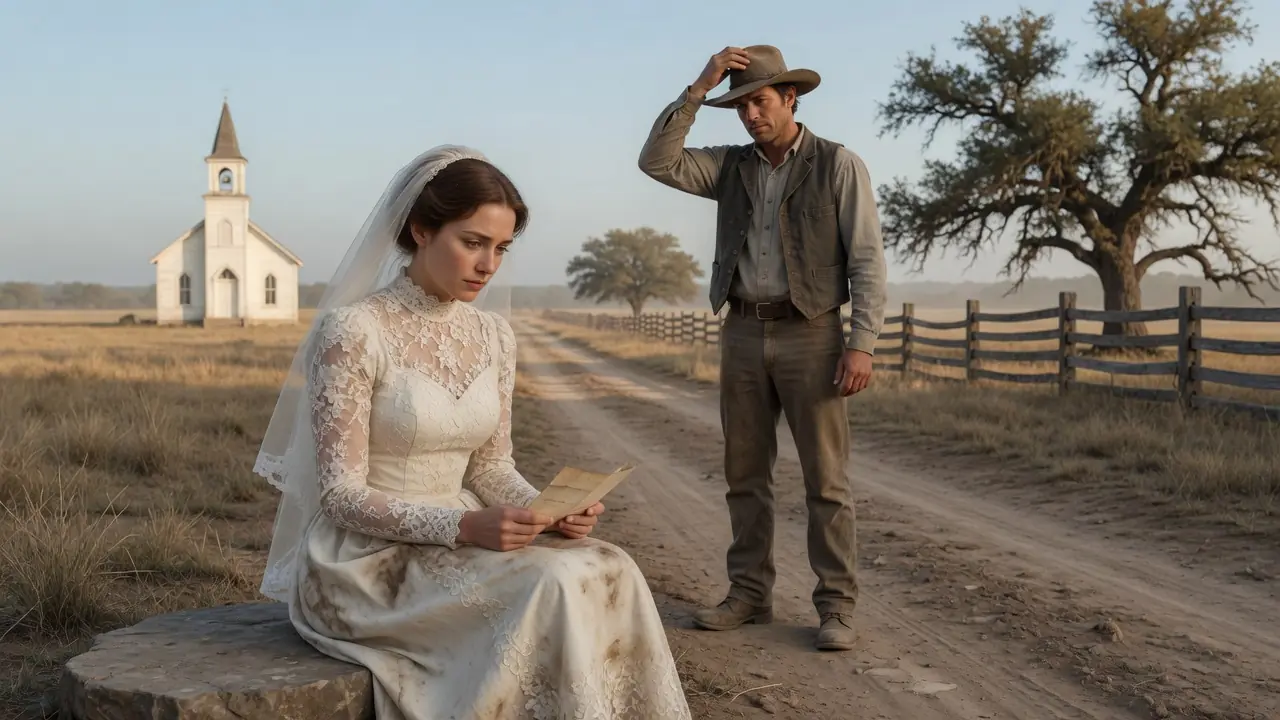
The church smelled of pine polish, old hymnals, and the late spring flowers arranged in jars along the aisle. Someone had tied white ribbons to the ends of the pews.
Someone had laid fresh cloth over the altar table. Someone had placed a small bouquet of yellow wildflowers near the front because Hazel had once said yellow made even hard days look softer.
She stood beneath all of it, holding a bouquet of cream roses she had not been able to afford but had accepted from Mrs. Avery at the mercantile, who said every bride deserved roses at least once.
The dress was old, but Hazel had worked on it for weeks.
Her mother, Abigail Lyndon, had worn it twenty-six years earlier, before sickness took her young and left Hazel with only a few memories and a cedar trunk full of fabric that still carried the faint scent of lavender. The dress had yellowed with age. The lace had torn along one sleeve. The waist had been too narrow and the hem uneven from years folded away.
Hazel had taken in the bodice, let out the sleeves, mended the lace, and pressed the fabric again and again until it looked almost new. She had worked by lamplight after long days helping at the mercantile, pricking her fingers, undoing crooked stitches, and whispering apologies to a mother who was no longer there to tell her whether she was doing it right.
When she first tried it on, she had looked into the cracked mirror in Mrs. Avery’s back room and felt her breath catch.
For one moment, she had not felt poor.
She had not felt alone.
She had felt carried.
She imagined walking down the aisle in that dress would be like bringing her mother with her. A blessing made of thread and memory. A quiet hand at her back. A reminder that even though her father was gone and the cottage was gone and nearly everything she had known had been sold piece by piece, some part of her still belonged to love.
But now the dress felt heavier with every passing minute.
Ten minutes became twenty.
Twenty became thirty.
At forty minutes past the hour, Preacher Elias Boone cleared his throat for the fifth time. He looked toward the church door, then toward Hazel, then down at his Bible as though the answer might be written somewhere between the pages. His wife, Martha Boone, sat in the front pew with her mouth pressed into a thin line, her eyes full of a pity Hazel could not bear to meet.
Behind Hazel, the guests whispered.
At first, softly.
Then less softly.
A woman coughed to hide a sentence. Another leaned close to her neighbor, her bonnet brushing the other woman’s shoulder. The men near the back kept glancing toward the door, then toward one another, exchanging looks that said more than words could have.
Hazel stood still.
Her hands did not shake.
She would not give them that.
Dorsey Lott was late.
That was what everyone had told themselves for the first twenty minutes. A horse could throw a shoe. A wagon wheel could stick in mud. A man could get delayed by a hundred ordinary troubles. Dorsey owned land south of town and a fine gray horse with a nervous temperament. Perhaps it had refused the saddle. Perhaps a fence had broken. Perhaps there was some explanation that would arrive with him, breathless and apologetic, and the wedding would still happen.
By thirty minutes, even the kindest women had stopped believing that.
By forty, everyone knew.
Hazel knew too.
There are moments when the heart understands a thing before the mind can bear it.
Then the church door opened.
Every head turned.
For one terrible second, Hazel’s body reached for hope without her permission.
But it was not Dorsey.
A boy came up the aisle holding a folded note.
He could not have been more than twelve. His brown cap was twisted in both hands, and his face was red with embarrassment. He walked with the awkward stiffness of someone who had been given a task he did not want and did not know how to escape. The church watched him as he came forward, his boots striking the wood floor one careful step at a time.
He would not meet Hazel’s eyes when he handed her the paper.
“I’m sorry, Miss Lyndon,” he whispered.
Hazel took the note.
She knew before she opened it.
Still, she unfolded it.
The handwriting was neat. Dorsey always did have neat handwriting. It was one of the things people praised about him, as if fine penmanship proved a fine character.
Miss Lyndon,
I have thought better of our arrangement. I will not be marrying today or any day. I hope you will understand. I wish you well.
Dorsey Lott
Five lines.
One year of courtship destroyed in five lines.
He had not even written her given name.
That was the part that entered Hazel like cold water.
Not Hazel.
Miss Lyndon.
As if she were a bill being declined, a notice being returned, a transaction politely ended.
He had courted her for a year. Walked her home from church. Sat at Mrs. Avery’s table drinking coffee while Hazel embroidered tea cloths. Brought her apples from his south field and once a ribbon from Coldwater, pale blue and wrapped in paper. He had spoken of a house, of respectability, of a future that would not be grand but would be safe.
And then he had sent a child.
Bonham would remember that longest.
Not that Dorsey Lott had broken his promise. Men broke promises often enough. Not that he had likely found a better match with the banker’s daughter over in Coldwater. That rumor had already begun to crawl through the county weeks before, and by supper it would have legs.
No, what Bonham would speak of for years was that Dorsey had let Hazel dress herself, stand at the altar, wait before everyone, and then sent a boy with a note.
Hazel folded the paper carefully.
The church was so quiet she could hear the loose floorboard creak beneath Preacher Boone’s shoes.
She lifted her chin.
Then she turned and walked back down the aisle alone.
Nobody stopped her.
Nobody spoke.
She passed every face in town. The pitying ones. The curious ones. The satisfied ones. The women who had once envied her because Dorsey Lott owned land and wore a pressed coat on Sundays. The men who would later shake their heads and call it a hard thing, as if they had not watched it happen without lifting a finger.
Mrs. Gantry stared at her over the edge of her handkerchief, eyes bright with the kind of pity that always seemed to enjoy itself.
Hazel did not lower her gaze.
At the last pew, the boy who had brought the note stood pressed against the wall, close to tears.
Hazel stopped beside him.
“It was not your shame to carry,” she said quietly.
The boy looked up, startled.
Then she continued walking.
She reached the church doors and stepped into the afternoon light.
Outside, the sky was wide and pale. A spring wind moved dust along the road. The horses tied near the fence shifted and stamped, sensing the strange quiet behind her. Somewhere, a meadowlark called from the pasture beyond the churchyard, its song so bright and ordinary that it felt cruel.
Hazel kept walking.
She walked past the mercantile, where Mrs. Avery had hung blue calico in the window. Past the feed store, where three men stopped talking as she went by. Past the blacksmith’s yard, where the hammering ceased just long enough for silence to become another witness. Past the last painted fence at the edge of town.
She walked until the road turned dusty and empty.
She walked until the church bell behind her sounded small and far away.
Only then did she stop.
There was a flat stone beside the road under a scrub oak. Hazel sat down on it in her wedding dress because she had run out of places to go.
That was the true cruelty of it.
Dorsey had not only taken a promise from her.
He had taken her last piece of ground.
Hazel’s father, Samuel Lyndon, had been a beekeeper.
He was a gentle man with weathered hands and patient eyes, the sort of man who could stand among thousands of bees and never make them panic. He had kept hives behind their cottage and sold honey in clear glass jars with neat paper labels. The labels had been Hazel’s job when she was little. She would sit at the kitchen table, tongue caught between her teeth, writing Lyndon Honey in her careful child’s script while her father washed jars at the sink.
Samuel taught Hazel how to listen to bees.
“Don’t go in thinking you know more than the hive,” he would say. “A hive tells the truth if you have sense enough to hear it.”
He taught her to smell when a colony was healthy, to see when a queen was failing, to recognize the restless pitch of a hive about to swarm. He taught her how to move slowly enough that the world did not panic around her. He taught her that fear was not the same thing as danger, and patience was not the same thing as weakness.
After Abigail died, the bees became the sound of home.
Morning light on wooden boxes.
Her father’s hat tilted low.
Honey warming in the kitchen.
Bread on the table.
A little girl growing up under the hum of wings.
Then Samuel died the winter before Hazel’s wedding.
It had been a hard winter, with freezing rains, thin woodpiles, and coughs that lingered too long. By the time Samuel took to bed, the debts had already begun collecting at the door. He had borrowed against the cottage after two poor seasons. He had taken credit for sugar, lumber, medicine, and feed. He had never told Hazel the full sum because fathers like Samuel tried to keep fear off their daughters’ shoulders until the fear became too heavy to hide.
After he passed, the debts came with a speed grief could not match.
The cottage was sold.
The hives were sold.
The honey house behind the garden was emptied.
Hazel watched strangers carry away the wooden boxes her father had built by hand. She stood near the gate and counted each one until her vision blurred. The last hive box had a blue mark on the side where she had spilled paint at age thirteen. She remembered her father laughing when it happened.
“That colony will think itself royalty now,” he had said.
By spring, all Hazel had left was a trunk, a few dresses, her mother’s wedding gown, and Dorsey Lott’s proposal.
Marriage had not been romance to her.
Not entirely.
It had been shelter.
A place.
A future.
Now even that was gone.
Hazel sat on the stone and stared across the dry road. Her mother’s dress gathered dust at the hem. The late sun pressed against her face. Her bouquet lay beside her, roses already beginning to droop in the heat.
She would not cry.
Not in church.
Not on a public road.
Not where some wagon might pass and take word back to Bonham that Hazel Lyndon had finally broken.
So she sat dry-eyed and empty, waiting for nothing.
That was where Micah Hart found her.
He was thirty-four, a rancher with an orchard north of Bonham, a quiet man with a plain face, a brown hat, and boots that looked as if they had crossed every acre he owned. He was not handsome in the polished way Dorsey Lott tried to be. Micah’s face was sun-browned and serious, his hands rough, his clothes practical, his manner so restrained that some people mistook it for coldness.
But Hazel’s father had liked him.
For years, Micah had bought Samuel Lyndon’s honey by the crate.
“Mr. Hart pays when he says he will,” Samuel once told Hazel. “That is more character than most men put in their whole Sunday coat.”
Micah had attended the wedding, though not as Dorsey’s friend. He sat in the back pew because he never knew where else to put himself at public gatherings. He had watched the whole ugly scene from that back corner.
He saw the boy carry the note.
He saw Hazel read it.
He saw her walk out with her chin raised while every coward in that church let her leave alone.
For a while, Micah stayed where he was.
He told himself it was not his place. A woman had a right to privacy after a humiliation like that. People had already taken enough from Hazel Lyndon that day. He had no wish to become another set of eyes on her pain.
But after ten minutes, he stood.
After fifteen, he left the church.
After twenty, he found her sitting on the stone beside the road, looking like a person who had reached the edge of the world and found no bridge there.
He stopped several steps away and removed his hat.
“Miss Lyndon,” he said quietly.
Hazel looked up.
The sun was behind him, so at first he was only a shape: broad shoulders, hat in hand, the dusty road stretching behind him. Then her eyes adjusted, and she recognized him.
“Mr. Hart.”
“It’s no business of mine,” he said. “And I’ll go if you tell me to.”
She waited.
“But evening’s coming on,” he continued, “and I find I can’t ride off and leave you sitting on a rock in your wedding dress without asking one thing.”
Hazel said nothing.
“Do you have anywhere to go?”
The question was so plain that Hazel could not defend herself against it.
A polite woman would have lied.
A proud woman would have said she had arrangements.
Hazel was too tired for both.
“No,” she said.
The word came out flat.
Micah did not move.
“My father is dead,” Hazel continued, staring at the road. “The cottage is gone. The bees are sold. Dorsey was the place I was meant to go. Now there is no place.”
Her voice caught once, but she steadied it.
“I have been sitting here trying to think what a person does when she has run out of places. I have not worked it out yet.”
Micah looked at her for a long moment.
Then he said, “Now you do.”
Hazel blinked.
“What?”
He stepped closer, still keeping a respectful distance.
“I have an orchard north of town. My father planted it the year I was born. Apples mostly, with some peach trees along the east fence. It has not borne a decent crop in six years.”
Hazel stared at him, confused.
“I do not know why,” Micah went on. “I have pruned it, watered it, fed the soil, cut out rot, hired advice I could hardly afford. Nothing has worked. Your father once told me an orchard without bees is like a church without hymns.”
At the mention of her father, something moved behind Hazel’s ribs.
Micah held his hat at his side.
“I watched you with his hives when you were younger. You had a gift. Your father knew it. Anyone with eyes could see it.”
Hazel looked away.
“The hives are gone.”
“Then we start with poor ones and build them back.”
“This is charity.”
“No,” Micah said firmly. “It is work. Honest work. I need bees. You know bees. I have a room with a lock, a wage I can pay weekly, and land where hives could stand under trees that have been waiting too long.”
Hazel did not speak.
“You would keep your own accounts,” he added. “You would answer to no one but the work itself.”
The road went quiet between them.
Somewhere in the grass, a cricket started up. The sound was small, but alive.
Hazel looked down at her wedding dress, at the dust on the hem, at the hands she had folded in her lap because she did not know what else to do with them.
That morning, she had walked toward a man who did not want her.
That evening, a different man was offering her something better than being wanted.
He was offering her use.
Purpose.
A wage.
A door that locked.
She stood slowly.
“If I come,” she said, “I come as a beekeeper.”
Micah nodded.
“Yes, ma’am.”
“Not as something people may whisper over.”
“I cannot stop people from whispering,” Micah said. “But I can make sure they do it from outside my gate.”
For the first time that day, Hazel almost smiled.
“Then I will come.”
Micah did not offer his arm as if she were weak. He simply walked beside her back toward town, where his wagon waited near the livery. He put her small trunk in the back, helped her climb up, then drove north as the sky turned purple behind them.
Hazel did not look back at Bonham.
The Hart place sat beneath a low ridge, with a weathered house, a barn, two pastures, and the saddest orchard Hazel had ever seen.
Even in the falling dark, she could tell the trees were alive but tired. They stood in rows behind the house, limbs thin, leaves dusty, fruit scarce. Some branches stretched toward the sky like hands asking for something no one had given them. The peach trees along the east fence looked a little better than the apples, but not by much.
Micah tied the horse near the barn and lifted Hazel’s trunk down.
The house itself was plain but clean. A stone chimney rose along one side. The porch boards creaked but held. There were no lace curtains, no painted flower boxes, no feminine touches except for one blue bowl on the kitchen shelf that looked as if it had survived from someone else’s life.
Micah showed her to the room.
It was small but clean. There was a bed, a washstand, a chest, a braided rug, and a window facing the orchard. The key sat on the table.
“This is yours,” he said.
Hazel picked up the key.
The weight of it in her palm nearly undid her.
“Thank you,” she said.
Micah nodded once.
“Supper is beans and cornbread. Nothing fine.”
“I have no appetite.”
“I will leave some on the stove in case that changes.”
He stepped away and closed the door behind him.
Hazel stood in the room alone.
A door.
A lock.
A window.
A morning with work in it.
Two nights earlier, she had gone to sleep as a bride-to-be. That morning, she had woken as a woman about to be publicly discarded. Now she stood in a ranch room with a key in her hand and the title of beekeeper waiting for her like a name she had almost forgotten.
She sat on the bed in her mother’s dress.
Only then did she cry.
Not long.
Not loudly.
But enough to let the church, the note, the stares, and the road leave her body.
The next morning, Hazel rose before dawn.
She folded the wedding dress carefully and put it at the bottom of her trunk. Then she put on her plainest work dress, pinned her hair back, washed her face, and stepped outside.
The world smelled different at the Hart place.
Less dust.
More grass.
A faint sweetness from the few blossoms that had opened in the orchard despite their neglect. Morning light lay pale across the ridge. A rooster called from somewhere behind the barn, sounding personally offended by the sunrise.
Micah was already outside, tightening a strap on a harness.
He looked at her once, then looked toward the orchard.
“I thought you might want to see it proper.”
“I do.”
They walked among the trees while the sun rose.
Hazel touched the bark, examined the leaves, crouched near the roots, and watched the stillness between branches. She looked at the blossoms that had opened but not set fruit. She studied the weed growth, the spacing, the health of the soil. Micah followed without interrupting.
“No bees,” she said at last.
“I told you.”
“No, I mean none. Not even wild ones.”
Micah frowned.
“Is that unusual?”
“For an orchard this size, yes. Something happened here. Disease, drought, maybe clearing land nearby. The trees are blooming, but no one is carrying the pollen.”
“So they are not dying?”
Hazel looked down the rows.
“No. They are lonely.”
Micah turned toward her.
The word had struck him.
Hazel realized it as soon as she said it.
For a moment, neither spoke.
Then Micah cleared his throat.
“What do we do?”
“We find bees.”
The first two hives came from a farmer named Amos Bellamy, who had given up on them.
His farm lay twelve miles east, and the road there was poor. Hazel and Micah rode out in a wagon after breakfast, and by noon they were standing behind Bellamy’s barn looking at two cracked hive boxes beneath a weak patch of shade.
Bellamy scratched his beard.
“They ain’t worth much,” he said. “One queen’s failing, I think. Other colony’s thin. I was going to burn the boxes come winter if they didn’t die first.”
Hazel’s expression changed.
Micah noticed.
Not anger exactly.
Something colder.
“You were going to burn living hives?”
Bellamy shrugged.
“Bees are trouble if they ain’t useful.”
Hazel stepped closer to the boxes.
“They are useful. You stopped listening.”
Bellamy laughed, but it faded when Hazel looked at him.
Micah paid him more than the hives were worth because he wanted the transaction done before Hazel said something sharper.
When they unloaded the hives near the orchard, he looked doubtful.
“They look worse off than my trees.”
Hazel lifted one lid carefully.
“So did I yesterday.”
Micah said nothing after that.
Hazel worked slowly.
She repaired the boxes, cleaned the frames, fed the weaker colony sugar water, and moved brood from one hive to strengthen the other. She spoke to the bees under her breath the way Samuel had taught her.
“Steady now. I see you. We’ll sort it out.”
Micah watched from a distance at first.
Then from closer.
Then, after several days, he began handing her tools before she asked for them.
By the end of the second week, he knew the smoker from the hive tool, the frames from the supers, and when Hazel said, “Hold this steady,” he did.
The bees did not sting her.
They crawled over her wrists, along her sleeves, once even onto her cheek near the place where tears had dried days before. Hazel stood calm among them.
Micah noticed.
Among people, she still flinched at sudden sounds. She stiffened when a wagon came up the road. She went quiet whenever anyone mentioned town. She ate sparingly and kept to the edges of rooms as if still uncertain she had permission to take up space.
But among bees, Hazel Lyndon became whole.
Her hands were sure.
Her voice was low.
Her fear disappeared.
Micah found himself watching her more than the hives.
Not because she was beautiful in the way Bonham liked to measure beauty. Something quieter than that. Something stronger.
Hazel moved among thousands of small wings without asking them to trust her. She simply behaved in a way that made trust possible.
Micah had never seen anything finer.
Word reached town quickly, of course.
A jilted bride living on a bachelor’s ranch would have been gossip enough. Add bees and a failing orchard, and Bonham had meat for a month of conversation.
Mrs. Gantry came first.
She arrived in a small buggy wearing a hat too fine for a dusty road and an expression sharpened by righteousness. Hazel was working one of the hives when the woman stopped near the fence.
“Miss Lyndon,” Mrs. Gantry called.
Hazel did not hurry.
She set the frame back, adjusted the lid, and turned.
“Mrs. Gantry.”
“I came to see how you were settling.”
“No, you didn’t.”
Mrs. Gantry’s mouth opened.
Hazel removed her gloves slowly.
“You came to speak of appearances.”
Micah, who was mending a fence nearby, stopped working.
Mrs. Gantry drew herself up.
“Well, since you mention it, there is concern. A young unmarried woman living on a bachelor’s place after being left at the altar.”
“Jilted,” Hazel said.
Mrs. Gantry blinked.
“Pardon?”
“Say it plainly. Dorsey jilted me.”
“That is not a word I would use in polite conversation.”
“It was not a polite event.”
Micah lowered his head, but Hazel saw his shoulders move once.
Mrs. Gantry flushed.
“I only mean that your reputation has already suffered. You must think of how things look.”
Hazel picked up a frame heavy with comb.
“Mrs. Gantry, I stood at the front of your church in my mother’s wedding dress while a boy delivered a note from a coward. Then I walked past every person in Bonham while they watched me carry a shame I did not make.”
The bees hummed around her.
Her voice remained even.
“So I have learned what this town’s opinion is worth. Mr. Hart gave me work, a wage, and a door that locks. Bonham gave me whispers. I know which one I prefer.”
Mrs. Gantry took one step back as a bee drifted near her sleeve.
Hazel glanced at it.
“Careful. That hive is touchy in the afternoon. She has a gift for knowing who means well.”
Mrs. Gantry left quickly.
Micah waited until the buggy had disappeared before speaking.
“You handled that better than I would have.”
Hazel slid the frame back into place.
“No, Mr. Hart. You would have stood between us.”
“Maybe.”
“I needed to stand for myself.”
He looked at her, then nodded.
“Yes, ma’am.”
That became the way of things between them.
Micah offered space.
Hazel used it to become herself again.
By late summer, the orchard began to change.
At first, it was only small signs. More blossoms held. More leaves thickened. The trees seemed less brittle. Bees moved through the rows from morning until dusk, carrying life from flower to flower with the humble devotion of creatures who do not need applause.
Hazel built two hives into four.
Then four into seven.
She ordered new queens with money from her wages and from honey sold in small jars at the mercantile. She mended old boxes, painted them pale blue and white, and placed them near the east rows where the sun came gently in the morning. She kept notes in a ledger that Micah had bought for her without making a ceremony of it.
When she saw it on her table, she opened the cover and found one line written inside.
For the accounts that are yours.
She traced the words with one finger.
Then she cried again, but only a little.
Micah bought fresh lumber when she needed it and never once asked if she was sure. If Hazel said the bees needed shade, he built shade. If she said the orchard needed water channels, he dug. If she said a tree was past saving, he cut it down and mourned it later.
They worked side by side.
Not like employer and employee.
Not exactly like friends either.
Something quieter grew between them, like roots beneath ground.
One evening, Micah found a jar of the first honey cooling on Hazel’s windowsill. It was dark, with a red-gold shine from apple bloom and wild clover.
“I thought you might want to taste it,” she said.
Micah held the jar carefully.
“My father would have cried to see this.”
Hazel looked toward the orchard.
“Tell me about him.”
So he did.
They sat on the porch while the sky dimmed, and Micah told her about Aaron Hart, who had planted every tree by hand the year Micah was born. He had imagined children running under the branches, baskets of fruit, pies cooling on windowsills, a house full of noise.
But Micah’s mother, Lillian Hart, died young. His father grew quiet. The orchard bore well for a while, then less, then almost nothing. By the time Aaron Hart passed, Micah had kept the orchard not because it paid, but because he could not bear to cut down his father’s dream.
Hazel listened.
Then she told him about Samuel Lyndon and his bees. About childhood mornings filled with humming. About honey on bread. About her father lifting a frame and saying, “Watch close, Hazel. A hive will tell you what it needs if you stop thinking you already know.”
Micah looked out at the rows of trees.
“Sounds like our fathers left us two halves of the same hope.”
Hazel followed his gaze.
“Your orchard and my bees.”
“And both nearly gone.”
“But not gone.”
“No,” he said softly. “Not gone.”
After that, Micah began leaving a jar of honey on Hazel’s windowsill every time she harvested a new batch. He never said anything. He simply placed it there like an offering.
Hazel began saving him the best apple from each tree that bore.
She would leave it on the table near his coffee.
He never thanked her out loud.
He just ate it slowly.
By autumn, Micah Hart’s orchard bore fruit for the first time in six years.
Not a little.
Not enough to be polite.
The branches bent with apples until Micah had to prop them with boards. The peach trees along the east fence gave enough to fill baskets. Neighbors came to stare. Then they came to buy. Then they came to ask Hazel questions as though she had always been someone worth consulting.
The orchard had not been dead.
It had only been waiting for bees.
Hazel understood that more deeply than anyone.
Some parts of a life do not die when neglected. They simply stop bearing. Give them the right attention, the right patience, the right small daily care, and one morning the branches are heavy with proof that barrenness was never the truth.
It was only a season.
The harvest gathering happened on a Saturday.
Micah had not intended it to become an event, but people came anyway. Wagons lined the lane. Children ran beneath the apple trees. Women bought honey from Hazel’s table and asked how to use it in cakes, tonics, and winter preserves.
Hazel stood behind the table in a clean blue dress, her hair pinned neatly, her hands steady around jars of dark orchard honey.
She looked nothing like the woman on the stone by the road.
Micah stood nearby, loading crates into wagons and watching her whenever he thought she would not notice.
She noticed.
Then Dorsey Lott rode in.
Conversation thinned as his horse came up the lane.
He had lost some of the polish he once wore so proudly. The banker’s daughter in Coldwater had not married him after all. The dowry had come with conditions, and Dorsey had neither the discipline nor the character to meet them. Bonham knew it. Coldwater knew it. Dorsey knew that everyone knew it.
What he could not stand was Hazel.
Not ruined.
Not hiding.
Not grateful for whatever attention he chose to toss her way.
Happy.
Respected.
Needed.
Dorsey dismounted with a smile too wide to be sincere and walked straight to the honey table.
“Hazel,” he said warmly, loud enough for those nearby to hear. “You look well.”
Hazel put one more jar into Mrs. Daley’s basket before looking at him.
“Dorsey.”
“I was hoping we might speak.”
“We are speaking.”
A few people nearby stopped pretending not to listen.
Dorsey’s smile faltered, then returned.
“I have done a great deal of thinking.”
“That must have been difficult.”
Someone coughed into a sleeve.
Micah, who had been carrying a crate, stopped several feet behind her.
Dorsey saw him and lifted his chin.
“I came to make things right.”
Hazel looked at the man who had left her in a church with a note and a town full of witnesses. She felt the old pain rise, but it no longer ruled her. It was a bruise, not a chain.
“Make what right?” she asked.
Dorsey spread his hands.
“I was a fool. I see that now. I let others influence me. I was thinking of prospects, not the heart. But I never stopped thinking of you.”
Hazel stared at him.
“You did not think enough of me to come to the church yourself.”
His face reddened.
“I handled that badly.”
“You sent a boy.”
The crowd had gone silent.
Hazel placed both hands flat on the honey table.
“You left me standing at the altar in front of this town. You traded me for a dowry that would not have you. And now you have heard that I am doing well, so you have come to collect what you threw away.”
Dorsey’s mouth tightened.
“That is not fair.”
“No. What you did was not fair. What I am doing is naming it.”
Micah remained behind her, silent.
Hazel felt him there.
She did not need him to step forward.
That made his presence better.
Dorsey lowered his voice.
“You belong with someone of standing. Not buried out here keeping bees.”
Hazel smiled then.
It was small, but sharp enough to cut.
“I belong where I am valued. That was never with you.”
A murmur went through the crowd.
Dorsey’s face went pale.
Hazel lifted a jar of honey and held it to the sunlight.
“You asked once by note to be rid of me, and I have been grateful for it every day since. Being jilted by you was the road to everything good I have now.”
She set the jar down.
“There is the lane, Dorsey. I suggest you take it before the bees decide you have stood too close to their honey.”
This time, the laughter was not cruel.
It was clean.
And it was not aimed at Hazel.
Dorsey Lott turned red, then white. He looked around for one friendly face and found none. Then he mounted his horse and rode away.
Bonham never spoke of him the same way again.
When the gathering ended and the last wagon rolled out, Hazel stood under the apple trees with her sleeves rolled up and honey on her fingers. The sun had begun to drop. Bees moved home through the golden air.
Micah came to stand beside her.
“You did not need me for that,” he said.
“No,” Hazel answered. “But I was glad you were there.”
He looked at her.
“There is a difference.”
“Yes. There is.”
They walked deeper into the orchard where the propped branches hung heavy with fruit. Micah picked an apple, turned it in his hand, and seemed to study it for courage.
“Six years I looked at these trees and thought they were dying,” he said. “Turned out they only needed what they had lost put back.”
Hazel watched the bees moving between leaves.
“I think about that too.”
Micah’s voice grew rougher.
“I was content alone. Or I told myself I was. Same as this orchard was content barren, which is to say not at all. Only used to it.”
Hazel’s heart began to beat faster.
“Micah.”
“I am saying this poorly.”
“You usually do.”
He glanced at her, and she almost smiled.
“But you understand me anyway?” he asked.
“I am trying.”
He took a breath.
“You did not only save my orchard, Hazel.”
She looked down.
The bees hummed around them.
Micah held the apple out.
She took it from his hand and bit into it.
For a moment, he simply stared.
Then he smiled.
It was the first full smile she had ever seen from him.
They let the unsaid thing ripen a little longer.
He asked her properly that evening under the same trees.
“I asked you once if you had anywhere to go,” Micah said. “And when you told me no, I said, ‘Now you do.’ Back then, I meant a room, a wage, and your bees back. That was all I had the right to offer.”
Hazel stood before him with her hands still sticky from honey.
“I have wanted to offer more for months,” he continued. “But I would not have you think it was the bargain all along. It was not. I gave you work because you deserved work. I gave you a locked door because you deserved safety. I waited because you deserved a choice.”
His voice softened.
“Now you have one. You could keep bees for any orchard in this county, and men would line up to hire you. You do not need me. So I can ask freely.”
He took her hands.
“I do not want a beekeeper for my orchard, Hazel. I want you for my life. Marry me. Not because you have nowhere to go. Marry me because this place is yours, because I am yours if you want me, and because I would like ‘now you do’ to mean home for as long as we both live.”
Hazel’s eyes filled.
“I stood once in a church to marry a coward,” she said. “He sent a boy with a note. Then a decent man found me on a road and asked the only question that mattered.”
Micah’s fingers tightened around hers.
“You gave me bees,” she whispered. “You gave me work. You gave me time to remember that I was worth something before asking for anything more.”
She smiled through tears.
“You want to know what the apple meant?”
“I was hoping.”
“It meant yes.”
Micah laughed once, breathless and disbelieving.
“It has meant yes since harvest,” she said. “Ask me again and hear it properly.”
So he did.
And Hazel said yes under the loaded apple trees while the bees went home around them.
They married that autumn.
Not in the church where Hazel had once been left waiting, but in the orchard her bees had brought back to life. Preacher Boone stood beneath the oldest apple tree. Mrs. Gantry came and behaved herself. Half the county attended. The tables were covered in pies, honey cakes, fresh bread, preserves, and jars of the dark orchard honey that had become famous three towns over.
Hazel wore a new dress she had sewn herself.
No borrowed hope.
No old promise.
No trembling at the door.
When she walked toward Micah, she did not walk toward shelter. She walked toward partnership.
Years passed.
Hart Orchard became known across the county for its heavy fruit and rich honey. People came from Bonham, Coldwater, and farther to buy jars labeled in Hazel’s own hand. She trained every motherless girl, castaway girl, widowed girl, and unwanted girl who came to her gate with hunger in her face and fear in her hands.
She taught them how to tend bees.
More than that, she taught them how to stand still when the world tried to shame them into shrinking.
“Bees know fear,” she would say. “But they also know purpose. Keep your hands steady. Know what you came to do.”
She and Micah raised children beneath the apple trees. Some were born to them. Some simply arrived and stayed. Their house grew louder every year. The orchard no longer felt like a monument to a dead man’s dream. It became a living place full of work, laughter, stings, sweetness, and second chances.
Hazel told her children the story when they were old enough.
The church.
The note.
The road.
The stone.
The man who found her and asked, “Do you have anywhere to go?”
She never told it as a tragedy.
She told it as the strangest mercy of her life.
“The worst day I ever stood through,” she would say, “became the road to the best thing I ever found.”
And if any child asked whether she hated Dorsey Lott, Hazel would shake her head.
“No,” she would say. “A locked door is sometimes a kindness. He closed one I was never meant to walk through.”
Then she would look toward the orchard, where Micah often stood checking the propped branches in the evening light, and her voice would soften.
“And another man opened one without asking anything in return.”
That was the story of Hazel Lyndon.
The bride left at the altar with nowhere on earth to go.
The beekeeper’s daughter who sat on a stone in her wedding dress and thought her life was over.
The woman who heard a quiet orchard man say, “Now you do,” and found at the end of that road her bees, her worth, her work, and a home she was never once jilted from.