“One dollar.”
Eli Mercer’s voice carried across the dry Kansas field with less strength than the wind moving through the dead wheat. He stood beside a rusted tractor half buried in weeds, holding his final crumpled bill between two dirt-darkened fingers. Behind the auction platform, a dozen neighboring farmers laughed as though his bid had been the finest entertainment offered all afternoon.
Silas Vale leaned over the wooden railing in his black three-piece suit. At forty-seven, the auctioneer had slick dark hair, a narrow mustache, and the polished confidence of a man who had never worried about losing his home. “One dollar bought you a dead tractor,” he announced. “Perfect machinery for a bankrupt farmer.”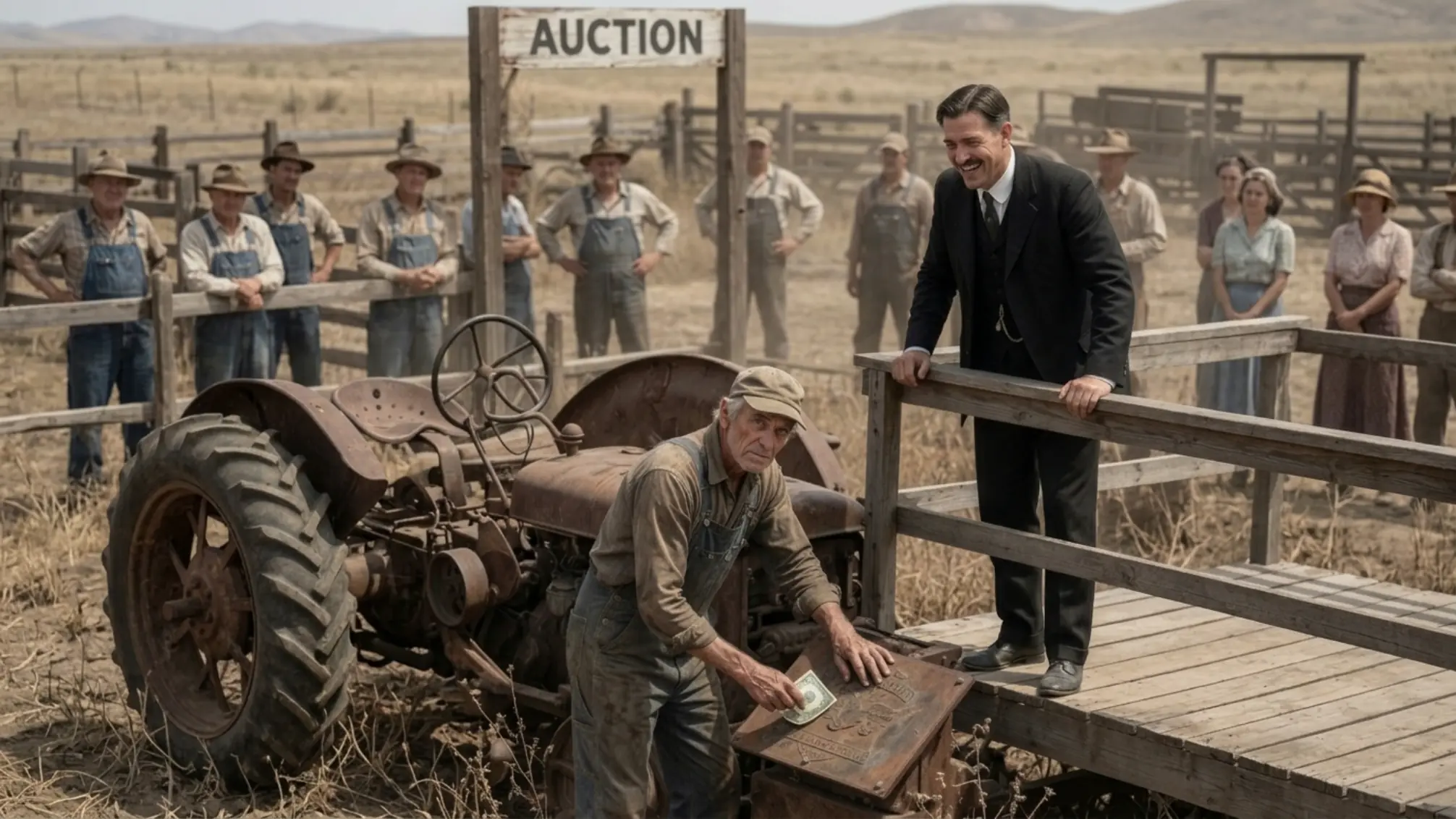
More laughter followed.
Eli did not answer immediately. At fifty-eight, he had learned that anger spent energy without planting anything useful. His patched overalls hung loosely from a body sharpened by hunger and labor, while his faded canvas cap concealed hair that had turned gray during three years of drought.
The tractor beside him appeared worthless. Its iron wheels had sunk into the earth, weeds climbed through the broken seat, and rust covered the hood so completely that no original paint remained. Yet a rectangular steel plate had been welded over part of the engine housing, and beneath one scraped corner, Eli had seen the outline of an old banking crest.
He rubbed more dirt from the metal.
“Then why was this bank mark welded shut?” he asked.
Silas stopped smiling.
Only for a second.
Then he descended one step from the platform and pointed at Eli. “Break that plate, and I’ll have you arrested for theft.”
Eli held up the hidden crest. “Call the sheriff. He may want to know what your family buried inside.”
The laughter died.
Silas’s father had owned Vale Agricultural Bank before it failed during the market collapse. The bank had taken mortgages from nearly every farmer in Arlen County, including Eli, and sold many of those debts to outside investors when crop prices fell. Families who had trusted the Vale name for generations now watched their land pass into the hands of distant companies.
The rusted tractor had belonged to the bank’s estate.
That fact alone made Silas’s sudden fear worth remembering.
The auctioneer straightened and forced a smile. “The machine is yours for one dollar, Mercer. Drag it off before sunset, or I charge storage.”
Eli gave him the bill.
It was the last dollar he possessed.
His wheat had failed twice, his cattle were gone, and the bank had posted a foreclosure notice on the farmhouse his grandfather had built. In nine days, unless Eli produced $380, the Mercer land would be auctioned beside the tractor he had just purchased.
His daughter, Ruth, waited near their old truck with both arms crossed. She was thirty-one, widowed, and had returned home with her ten-year-old son after her husband died in a grain elevator accident. When Eli approached, she looked from the tractor to his empty hand.
“You spent our last dollar on that?”
“I did.”
“Does it run?”
“No.”
“Can it be repaired?”
“Possibly.”
Ruth closed her eyes. “Papa, we needed flour.”
“I know.”
“We needed lamp oil.”
“I know.”
“And in nine days, Vale takes the house.”
Eli looked back toward the sealed engine. “That tractor frightened him.”
“Silas Vale is frightened of losing money, not machines.”
“Then there is money in it.”
Ruth studied her father’s face and realized he was not joking. Eli had never gambled, exaggerated, or chased rumors of hidden treasure. If anything, caution had cost him opportunities because he refused to promise what he could not prove.
She looked again at the steel plate.
“What did you see?”
“A crest from First Territorial Trust of St. Louis.”
“That bank has been gone longer than you’ve been alive.”
“Exactly.”
They could not move the tractor with the truck, so Eli borrowed chains from the blacksmith and persuaded two neighboring farmers to help drag it home. The men agreed partly out of friendship and partly because they wanted to see whether Eli’s one-dollar purchase contained anything beyond rust and field mice.
Silas watched from the auction platform until the tractor disappeared down the road.
His face no longer carried amusement.
By dusk, the tractor rested inside the Mercer barn. Ruth lit two lanterns while Eli cleaned the engine housing with kerosene and an old wire brush. Beneath layers of rust, the welded plate emerged more clearly.
The crest showed an eagle above three wheat stalks.
Around it were the words:
FIRST TERRITORIAL TRUST — ESTABLISHED 1834
Ruth ran one finger along the lettering. “That makes no sense. This tractor cannot be more than twenty years old.”
“The plate is older than the tractor.”
“Why weld it onto an engine?”
“To hide what was behind it.”
Eli examined the edges. The welds were rough but deliberate, added long after the tractor had left the factory. Someone had also driven steel pins through the plate from inside the housing, making removal impossible without opening the engine compartment.
Ruth’s son, Samuel, appeared in the barn doorway holding a blanket around his shoulders. “Is there gold in it?”
Ruth turned. “You should be asleep.”
“Grandpa bought a treasure tractor.”
“He bought a broken tractor.”
Samuel came closer, eyes fixed on the crest. “Can it be both?”
Eli almost smiled. “Most things are more than one thing, boy.”
He spent the night studying the tractor instead of cutting into it. The engine itself had been altered, with parts from several different manufacturers and a reinforced oil reservoir larger than any practical design required. The sealed plate covered the reservoir’s side.
By morning, Eli had formed a theory.
The tractor had never been intended to run normally. Someone had used the engine housing as a strongbox, then made the machine look abandoned so no thief would consider it valuable.
Ruth brought coffee into the barn. “You have not slept.”
“Neither did Vale.”
“How would you know?”
“He drove past twice before sunrise.”
She set down the cup. “Then we should call Sheriff Dalton.”
“Not yet.”
“Why?”
“Because Vale’s brother-in-law appointed him.”
Ruth stared toward the barn doors. “You think the sheriff is involved?”
“I think we should know what we have before telling anyone who may want it.”
They waited until afternoon, when Silas was occupied with another auction ten miles south. Eli invited Walter Dunn, the county blacksmith, to witness the opening. Walter was seventy, nearly deaf in one ear, and trusted because he had argued with every powerful man in Arlen County at least once.
He inspected the welds and whistled. “Someone wanted this shut forever.”
“Can you open it without destroying what is inside?” Ruth asked.
“I can open anything built by a man. Question is whether I should.”
Eli showed him the banking crest.
Walter’s expression changed.
“My father hated that mark,” he said.
“Why?”
“First Territorial Trust came through Kansas before state banks existed. They held land claims, railroad certificates, and settlement money for eastern investors.” Walter wiped the metal with his thumb. “Then a branch office burned in 1887. Records vanished. Families lost proof of deposits and ownership.”
“My grandfather lost two hundred acres after that fire,” Eli said.
“So did mine.”
Walter looked toward the farmhouse. “Open the barn doors. If something happens to us, I want the neighbors to hear.”
He used a narrow saw to cut along the plate’s welded edge. Sparks fell across the dirt floor, and the smell of hot metal filled the barn. After nearly an hour, Walter drove a chisel beneath one corner.
The plate moved.
Behind it lay an inner wall of copper.
Eli’s heartbeat quickened.
Walter pried harder until the plate broke free and struck the floor with a heavy clang. Inside the oversized reservoir sat a cylindrical copper container sealed with waxed leather.
Samuel whispered, “Treasure.”
Ruth reached for him before he could touch it.
Eli lifted the container with both hands. It weighed nearly forty pounds.
The lid was secured by three brass locks, but age had weakened them. Walter broke the first two with a hammer. The third opened when Eli pressed the bank crest stamped into its face.
Inside were leather packets, metal boxes, and bundles wrapped in oilcloth.
No one spoke.
Eli opened the smallest box.
Gold coins filled it to the rim.
Ruth gripped the workbench.
Walter removed his cap.
Samuel began counting aloud until his mother placed a hand over his mouth.
The second box contained more gold, along with silver certificates and several uncut sheets of bank notes. The leather packets held railroad shares, government bonds, mineral-rights deeds, and promissory documents bearing signatures from families still living in Arlen County.
The final bundle contained a ledger.
Its first entry was dated May 4, 1836.
For nearly one hundred years, First Territorial Trust had managed land, investment funds, and migration accounts across several western territories. The ledger documented deposits made by settlers, war widows, freed laborers, merchants, and farmers who trusted the institution to preserve their savings.
Many accounts had never been paid.
Beside those names, someone had written a single word in red ink.
CLAIMED
Others carried a different word.
SEIZED
Eli turned pages slowly until he found the Mercer name.
His grandfather, Amos Mercer, had deposited $1,140 and the title to 200 acres in 1884. Three years later, after the branch fire, the bank declared there was no record of either deposit.
Yet the ledger showed the truth.
The account had been seized by banker Horace Vale.
Silas Vale’s great-grandfather.
Ruth read the entry twice. “The Vales stole our land.”
“Not only ours,” Eli said.
The Dunn family appeared on the next page. So did the Harpers, the Coles, the Whitneys, and more than forty families spread across three counties. The money had grown through bonds, railroad shares, and mineral leases while descendants of the original owners struggled through droughts, foreclosures, and bank failures.
Walter lifted one government certificate. “These may still be valid.”
“How much?” Ruth asked.
“I cannot say.”
Eli examined the gold. “Enough for Vale to kill over.”
A horse stopped outside the barn.
All four of them froze.
Sheriff Dalton entered with Silas behind him.
The sheriff carried a shotgun.
Silas had abandoned his polished auction coat for a long dark overcoat. Dust covered his shoes, and fury had stripped the charm from his face.
“I warned you not to open that engine,” he said.
Eli stepped between them and the workbench.
“You sold it to me.”
“I sold you the tractor, not the contents of property stolen from my family.”
Walter laughed harshly. “Your family stole it first.”
Sheriff Dalton raised the shotgun. “Step away from the table.”
Ruth pulled Samuel behind her.
Eli did not move. “Do you have a warrant?”
“I do not need one to recover stolen bank assets.”
“The bank no longer exists.”
“Silas represents the estate.”
Silas looked at the open ledger and the coins scattered beneath the lantern. Hunger entered his eyes. “Pack everything into the container.”
Ruth spoke from behind Eli. “The ledger proves your family robbed this county.”
Silas turned toward her. “That ledger proves nothing unless it reaches a courtroom.”
The meaning beneath his words settled over the barn.
Walter shifted closer to his hammer. The sheriff aimed the shotgun directly at him.
“Do not be foolish, old man.”
Walter’s jaw tightened. “Too late for that.”
Eli looked toward the open barn doors. Several neighbors had gathered outside after hearing the horse arrive. Silas noticed them too.
His voice softened.
“Eli, consider what this could do. Old disputes, false claims, families tearing one another apart over land that changed hands decades ago.” He gestured toward the gold. “Let me secure the assets. I will cancel your mortgage and pay you five thousand dollars.”
Five thousand dollars was more money than Eli had ever held.
It would save the farm, feed Ruth and Samuel, replace the dead wheat, and purchase enough cattle to begin again. For one moment, he saw the life the offer could buy.
Then he looked at the ledger.
His grandfather had died believing he failed his family. Walter’s father had worked until his hands twisted from arthritis because the bank erased his savings. The neighbors outside carried debts inherited from theft they never understood.
Eli closed the ledger.
“You are offering me my own money,” he said.
Silas’s expression hardened. “I am offering you survival.”
“At everyone else’s expense.”
“That is how survival works.”
“No,” Eli said. “That is how your family works.”
Sheriff Dalton stepped forward.
From outside the barn came the sound of rifles being cocked.
The sheriff stopped.
A dozen farmers stood beyond the doorway. They had heard enough. Some carried hunting rifles, others pitchforks or shovels, but none looked amused now.
Walter’s son called from the yard. “Put down the shotgun, Dalton.”
The sheriff glanced at Silas.
For the first time, the auctioneer looked uncertain.
Eli lifted the ledger. “Every family named here gets to see this before a single coin moves.”
Silas reached inside his coat.
Ruth shouted.
Eli threw himself forward as Silas drew a small revolver. The gun fired, the bullet striking the barn beam above Walter’s head. Eli slammed into Silas, driving both men against the tractor.
The revolver fell beneath an iron wheel.
Sheriff Dalton swung the shotgun toward Eli, but Walter struck the barrel aside with his hammer. Farmers flooded into the barn and pulled the sheriff to the ground before he could fire.
Silas fought until Eli pinned him against the rusted engine.
“You were starving,” Silas hissed. “I offered to save you.”
“You offered to make me like you.”
Eli released him only after Walter’s son tied the auctioneer’s wrists with baling wire.
The farmers guarded the barn through the night.
At dawn, Ruth drove to the federal courthouse in Wichita carrying copies of the ledger’s first twenty pages. Walter accompanied her, along with three armed neighbors. They returned two days later with a federal marshal, two treasury agents, and an attorney representing the state banking commission.
Silas Vale and Sheriff Dalton were arrested.
The fortune inside the tractor was transferred temporarily to a guarded vault, but Eli insisted the ledger remain visible during the investigation. The government verified the gold, bonds, and certificates over the following months.
Their total value exceeded $182,000.
In 1934, it was enough to purchase thousands of acres, rescue dozens of farms, and make one man wealthy for the rest of his life.
The documents proved Horace Vale had hidden the assets after state investigators began examining First Territorial Trust in 1887. He moved the fortune between several locations before concealing it inside the tractor decades later with help from his son.
Silas had inherited a coded note mentioning “the iron field horse,” but he never discovered which machine contained the fortune. He kept the tractor in storage for years, afraid to destroy it and unable to identify the hiding place.
When Vale Agricultural Bank collapsed, the tractor accidentally entered the public auction.
Silas had laughed when Eli bid one dollar because he believed the machine was another worthless relic. The moment Eli exposed the crest, Silas understood his family’s secret had found the worst possible owner: an honest man with nothing left to lose.
The court spent nearly a year identifying descendants and validating claims. Not every family could be located, and some documents were too damaged to enforce. Yet enough survived to restore property, cancel fraudulent debts, and distribute money to thirty-eight families.
The Mercer claim was among the strongest.
Eli received the value of the stolen deposit, accumulated bond earnings, and compensation for the missing acreage. The payment totaled $14,600.
He used $380 to stop the foreclosure.
Ruth expected him to replace the farmhouse, buy a modern tractor, and retire from the fields. Instead, Eli repaired the roof, purchased seed, and paid off the debts of three neighbors whose claims were still trapped in court.
“You cannot save everyone,” Ruth told him.
“No.”
“Then why keep trying?”
“Because Silas was right about one thing.”
She looked at him.
“Survival always has an expense,” Eli said. “I would rather pay mine than send the bill to someone weaker.”
The families formed the Arlen County Cooperative Trust using part of the recovered funds. It offered fair loans, transparent records, and emergency seed without demanding land as collateral. Walter Dunn became its first chairman, though he protested that he could barely hear meetings.
Ruth managed the accounts.
She insisted every customer receive a copy of every signed document.
The rusted tractor remained in the Mercer barn.
Eli could have sold it to a museum, but he refused. Over the winter, he dismantled the engine, cleaned each component, and discovered that beneath the hidden reservoir, the original machinery was mostly intact.
Samuel helped by organizing bolts and asking questions without end.
By spring, grandfather and grandson had rebuilt enough of the engine to attempt a start. Ruth stood beside the barn doors while neighbors gathered in the yard.
Eli turned the crank.
The tractor coughed.
He turned it again.
A cloud of black smoke burst from the exhaust. The engine shook violently, sputtered, and then settled into a rough but steady rhythm.
The neighbors cheered louder than they had when the fortune was announced.
Samuel climbed onto the seat. “Is it ours now?”
Eli rested one hand on the rusted hood. “It was always ours.”
“The money?”
“The truth.”
Years later, people would tell the story as though Eli Mercer had purchased wealth for one dollar. They spoke of the sealed engine, the gold coins, and the ancient bank ledger as if fortune had simply waited for the right man to claim it.
Eli always corrected them.
“The gold belonged to many people,” he would say. “I only bought the box that kept it hidden.”
Silas Vale was convicted of attempted murder, evidence theft, and conspiracy to conceal banking fraud. Sheriff Dalton lost his badge and received a prison sentence for armed obstruction. The Vale estate was liquidated to cover additional claims.
The old auction platform was dismantled.
In its place, the cooperative built a small public records office where anyone could inspect their account without permission from a banker, auctioneer, or powerful family. Above the entrance hung the steel plate Eli had cut from the tractor.
The banking crest remained visible beneath the rust.
Below it, Ruth added a new inscription:
WHAT IS HIDDEN BY POWER MUST BE OPENED BY TRUTH.
Eli lived long enough to see wheat return to his fields.
The first strong harvest after the drought came three years later. Golden grain moved beneath the Kansas wind, and the rebuilt tractor pulled a binder across land the Vales had nearly taken.
Samuel rode beside his grandfather.
At the edge of the field, Ruth watched the machine pass against the evening sky. Its body was still rusted, its wheels still scarred, and its engine remained louder than any sensible farmer would tolerate.
But it worked.
Like the farm.
Like the family.
Like a county that had finally learned the difference between charity and justice.
Eli had entered the auction carrying one dollar and nine days of hope. Silas Vale believed poverty made him easy to humiliate, easy to buy, and easy to silence.
He was wrong.
A desperate man might sell his dignity to survive.
But Eli Mercer had spent his last dollar purchasing the one machine capable of proving that his family’s poverty had never been an accident.
It had been engineered.
And when the sealed engine finally opened, it did more than expose a century-old fortune.
It exposed every powerful man who had prospered by keeping honest families too poor to ask where their wealth had gone.