Georgia Bartlett knew precisely how long a loaf of bread could remain inside the brick oven before the crust turned from brown to black. She knew how much flour the bakery used on a busy Saturday, which customers wanted cinnamon in their morning rolls, and which floorboard near the back door squeaked loudly enough to warn her that someone was approaching. At twenty-six, she understood every sound made by Bartlett’s Bakery in Virginia City, Montana Territory, because for most of her life those sounds had formed the boundaries of her world. Yet on that morning in the summer of 1887, Georgia forgot the bread completely because her father had struck her hard enough that her left ear was still ringing.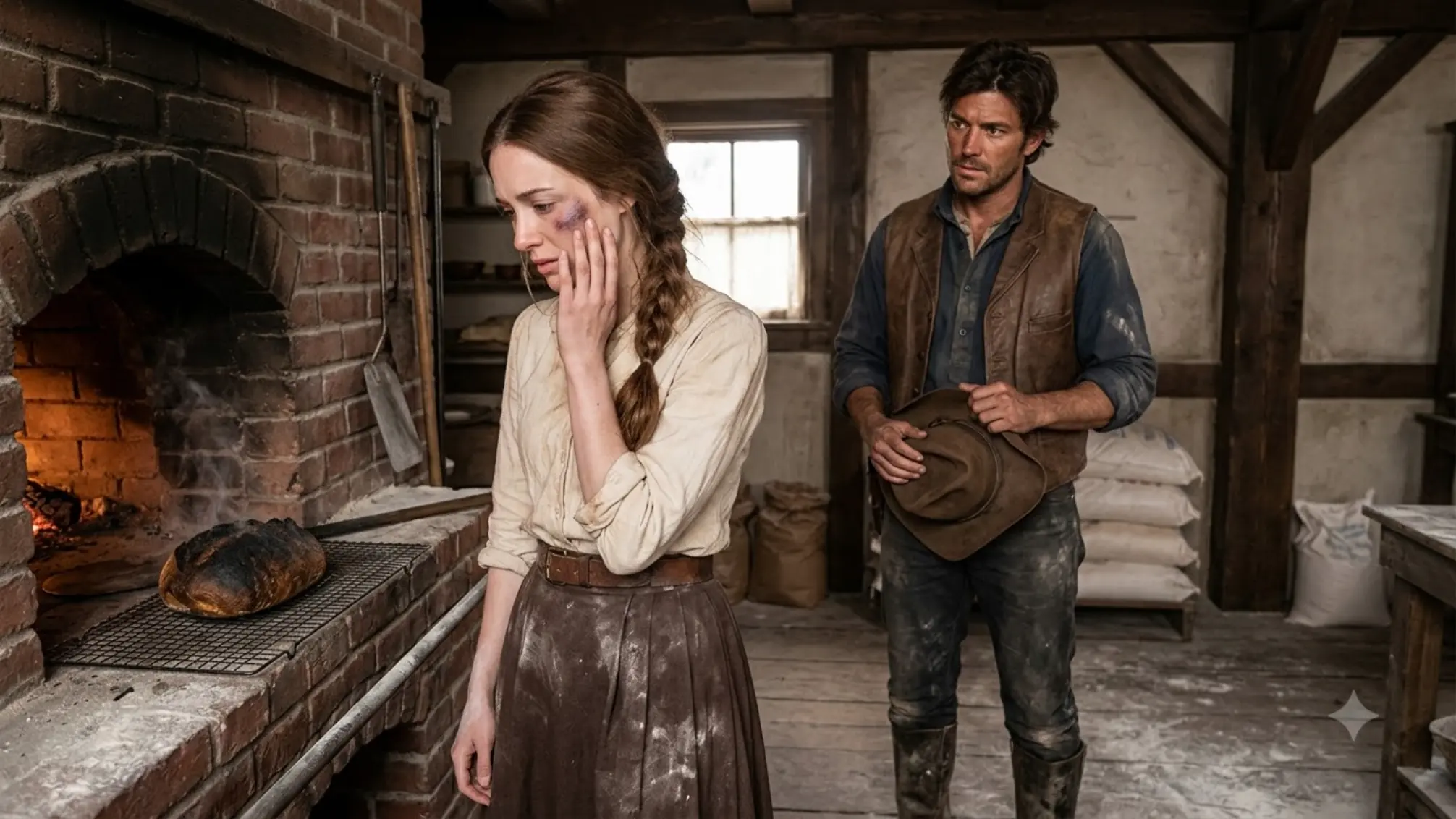
The bruise had begun as a red mark before sunrise and had darkened steadily beneath her eye throughout the morning. Georgia tried covering it with loose strands of chestnut-brown hair, but flour kept sticking to the dampness where tears had dried against her cheek. She wore her oldest cream blouse and a faded brown work skirt because Thomas Bartlett had told her she did not deserve to ruin anything nicer. Every time a customer entered through the front door, Georgia smiled and pretended the pain came from a toothache.
Nobody challenged the explanation. Mrs. Colby bought two loaves and stared at the bruise for almost five seconds before lowering her eyes. Reverend Haskins asked whether Georgia had been sleeping well, accepted her answer before she finished giving it, and left with a bag of biscuits. Virginia City knew Thomas Bartlett had a temper, but people preferred transforming what they knew into something they could politely avoid discussing.
Georgia had spent years helping them.
She called bruises accidents. She called broken dishes clumsiness, locked doors concern, and screaming arguments disagreements. When her wrist broke at nineteen, she told the doctor she had slipped while carrying flour upstairs, even though Thomas had thrown her against the pantry door because she refused to hand him the money her mother had hidden for winter coal.
Her mother, Eleanor, had been dead three years now.
After Eleanor died, Thomas stopped pretending there was anyone in the house whose opinion mattered besides his own. He drank more, worked less, and reminded Georgia almost daily that the bakery belonged to him, the upstairs rooms belonged to him, the food she ate belonged to him, and therefore Georgia herself owed him obedience. If she mentioned leaving, Thomas laughed and asked where a woman with no husband, no property, and no money intended to go.
The cruelest part was that Georgia had begun believing him.
She had sixty-three dollars hidden inside an old flour tin behind a loose brick near the oven. It had taken almost two years to save, one nickel or dime at a time whenever customers left extra money on the counter. Sixty-three dollars sounded enormous when counted secretly by candlelight, yet embarrassingly small whenever Georgia imagined boarding a stagecoach, finding lodging, and surviving somewhere Thomas could not reach her.
So she remained.
Then Marcus Hammond walked through the back door.
Georgia did not hear him approach because Thomas was outside hammering on the locked front entrance, furious that Georgia had bolted it after their argument. Every impact rattled the window glass, and the burned loaf inside the oven had filled the kitchen with smoke. Georgia was reaching for the iron oven door when a male voice behind her said, “Ma’am?”
She spun so quickly that the baking tray struck the counter.
The man standing near the rear doorway immediately raised both hands. He was perhaps thirty-five, tall and lean, with dark-brown hair disordered from travel, rough stubble along his jaw, and a weathered brown leather vest over a charcoal shirt. Dust covered his trousers and riding boots, and instead of wearing his hat indoors, he held the battered thing carefully in both hands.
“I’m sorry,” he said. “Didn’t mean to startle you.”
Georgia backed toward the oven.
“You shouldn’t be here.”
The stranger looked toward the smoke.
“Your chimney looked like something was burning.”
“It is.”
Georgia pulled the loaf from the oven.
Black smoke rolled upward.
She dropped it onto the counter, coughing.
The stranger moved instinctively as if to help, then stopped himself before entering her space.
That hesitation caught Georgia’s attention.
Most men simply moved where they pleased.
He waited.
“My name is Marcus Hammond,” he said. “I’m passing through from the Carter ranch north of town.”
Georgia touched her cheek without realizing it.
Marcus saw the bruise.
His entire expression changed.
Not disgust.
Not curiosity.
Concern.
“Ma’am,” he said softly, “who did that to your face?”
Georgia looked away.
“Please don’t ask.”
Marcus remained near the door.
“It only gets worse when someone tries to help,” she whispered.
Outside, Thomas slammed his fist against the front door.
“Georgia!”
Marcus looked toward the sound.
Georgia’s shoulders tightened instantly.
“I’m not asking you to trust me,” Marcus said quietly. “I’m asking if you’re safe here.”
She looked at him.
Her mouth opened.
Nothing came.
Another violent удар shook the door.
“Open this damn door!”
Georgia closed her eyes.
Marcus understood.
“That your father?”
She nodded.
“How long?”
Georgia looked toward the burned loaf.
“All my life.”
Marcus’s jaw tightened.
Georgia almost expected him to begin making promises. Men in stories always made promises because stories rarely needed to explain what happened after the rescue. Marcus said nothing for several seconds.
Then he pulled out the wooden chair nearest the door.
He turned it around.
And sat.
Georgia stared.
“What are you doing?”
“Waiting.”
“For what?”
“For you to tell me what you want.”
That answer confused her more than if he had offered to fight Thomas.
Georgia had never been asked what she wanted in a moment when her father was angry. The question seemed almost absurd. She glanced toward the front door and heard Thomas pacing across the boardwalk outside.
“I want him to stop.”
Marcus nodded.
“What else?”
“I want…”
She swallowed.
The words felt dangerous.
“I want to leave.”
Marcus looked toward her.
“But?”
“He’ll find me.”
“Maybe.”
Georgia’s face fell.
Marcus continued before fear could consume her.
“But finding you and owning you aren’t the same thing.”
She almost laughed.
“You don’t know my father.”
“I know men who mistake fear for obedience.”
“He has friends.”
“So do I.”
“He’ll tell everyone I ran away.”
“You’re twenty-six.”
“He’ll say I stole from him.”
“Did you?”
Georgia glanced toward the loose brick near the oven.
Marcus noticed.
“That money yours?”
She stiffened.
“I earned it.”
“Then I didn’t ask where it is.”
Something loosened inside her chest.
Outside, Thomas shouted again.
“Georgia, there’s a horse behind the building! Who’s in there?”
Her face drained of color.
Marcus stood.
“Georgia.”
She looked at him.
“You said it gets worse when someone helps.”
“Yes.”
“What happens if I leave?”
Her eyes filled with tears.
For several seconds she tried to lie.
Then she whispered, “He’ll hurt me.”
Marcus lowered his head.
“All right.”
He placed his hat on the counter.
Georgia watched him carefully.
“What does that mean?”
“It means I’m not leaving while you’re asking me not to.”
The simplicity of the sentence nearly broke her.
She covered her mouth.
Marcus did not approach.
“You don’t owe me anything for staying,” he added.
Thomas slammed against the door again.
“Georgia!”
The bolt shifted.
Marcus looked toward it.
“Does that lock hold?”
“Not forever.”
“Back way clear?”
“Yes.”
“Horse?”
“Yours?”
“Chestnut gelding.”
Georgia looked toward the back entrance.
Marcus seemed to be calculating options.
Then he surprised her.
“Do you have somewhere safe to go?”
“No.”
“Family?”
“No.”
“Friends?”
Georgia thought of Mrs. Colby and Reverend Haskins and every person who had looked at her bruises without asking the next question.
“No.”
Marcus exhaled.
“My ranch is forty miles north.”
Georgia stared at him.
“You expect me to ride forty miles with a stranger?”
“No.”
“Then why tell me?”
“Because it’s one option.”
He gestured toward the street.
“The widow McKenna runs a boardinghouse two blocks east. Another option.”
Georgia knew Mrs. McKenna.
Thomas hated her.
That alone gave the idea credibility.
Marcus continued.
“Sheriff’s office is another.”
Georgia shook her head immediately.
“Sheriff Turner drinks with my father.”
Marcus’s mouth tightened.
“Cross that one off.”
The door shook again.
Wood splintered near the bolt.
Georgia flinched.
Marcus looked toward the damaged frame.
Then back toward her.
“There’s another option.”
“What?”
He hesitated.
This was the first time Georgia saw uncertainty in him.
“Marry me.”
She stared.
Even Thomas stopped pounding long enough for the silence inside the bakery to become enormous.
Georgia laughed once, sharply, because the alternative was screaming.
“You’re insane.”
“Possible.”
“You don’t know me.”
“No.”
“You walked in five minutes ago.”
“Closer to ten.”
She stared at him.
Marcus almost smiled.
Georgia did not.
His expression became serious again.
“I’m not talking about taking you upstairs, owning you, or expecting anything from you.”
“Then why marriage?”
“Because this territory gives a husband’s claim more weight than it gives a frightened daughter trying to leave her father’s house.”
Georgia hated that he was correct.
Marcus continued.
“If you travel alone, Thomas can tell people you’re unstable, stolen, confused, or being held against your will. If you leave as my wife, he has a harder story to sell.”
Georgia looked away.
“So I trade one man controlling me for another.”
“No.”
Marcus’s answer came immediately.
“That arrangement dies the second you say it does.”
She stared at him.
“I mean it.”
He stepped backward deliberately.
“You keep your money. You choose your room. You decide whether I ever touch you. If we reach my ranch and you decide you want Helena, California, Oregon, or the other side of the world, I’ll help you get there.”
Georgia’s breathing became unsteady.
“Why?”
Marcus looked toward the front door.
Because Thomas was standing behind it, he could have invented a heroic answer.
He did not.
“My sister married a man like your father.”
Georgia became still.
Marcus’s eyes lowered.
“She kept saying she was fine.”
Georgia touched her bruise.
“What happened?”
“She died before any of us stopped believing her.”
The words settled heavily.
Marcus looked at Georgia again.
“I was twenty-three.”
“I’m sorry.”
“So am I.”
Thomas shouted from outside.
“Whoever’s in there, come out now!”
Marcus ignored him.
“I learned something too late.”
“What?”
“When somebody says they’re afraid, you don’t make them prove they deserve help.”
Georgia turned toward the window.
Thomas’s silhouette crossed the front glass.
She imagined staying.
Tonight.
Tomorrow.
Next winter.
Another bruise.
Another broken dish.
Another year saving coins inside flour tins.
Then Marcus said, “There’s one thing you need to know before you decide anything.”
Georgia looked at him.
“What?”
“I didn’t come into Virginia City by accident.”
Her stomach tightened.
“What does that mean?”
Marcus reached slowly inside his vest.
Georgia stiffened.
He stopped.
“Paper.”
She nodded.
Marcus removed a folded envelope, yellowed at the edges.
He held it out.
Georgia recognized the handwriting before touching it.
Her mother’s.
Her knees weakened.
“Where did you get that?”
“My sister.”
Georgia looked at him sharply.
Marcus explained.
His sister, Anna Hammond, and Eleanor Bartlett had known one another years earlier in Helena. Before Anna died, she left Marcus a small wooden box containing several letters from women she had helped during difficult marriages. Most meant nothing to him personally.
One carried Georgia’s name.
Marcus had found it only months earlier while clearing his family homestead.
He intended to deliver it.
That was why he came to Virginia City.
Georgia took the envelope with trembling fingers.
“My mother wrote this?”
“Your name is on it.”
“Did you read it?”
“No.”
Georgia looked suspicious.
“You carried it forty miles without opening it?”
“It wasn’t mine.”
Thomas slammed the door again.
The bolt cracked.
Georgia tore open the envelope.
Inside were two pages and a smaller folded document.
She read the first line.
My darling Georgia, if Thomas ever tells you that you have nowhere to go, he is lying.
Georgia stopped breathing.
Marcus looked toward the door and gave her privacy by turning slightly away.
She continued.
Eleanor wrote that years of bakery profits had been saved secretly through her cousin Abigail in Helena. She knew Thomas had taken money before, so she created a small account in Georgia’s name through a private arrangement with Abigail’s husband, who ran a mercantile business.
Georgia lowered the letter.
“He told me Mama left debts.”
Marcus said nothing.
Her hands shook harder.
She unfolded the smaller document.
It was a property deed.
Twenty acres outside Helena.
Transferred years earlier.
To Georgia Eleanor Bartlett.
Her vision blurred.
“This is mine?”
Marcus turned.
“That’s what it says.”
Georgia stared at the paper.
Her father had spent years telling her she possessed nothing.
Nothing.
Not the bakery.
Not her room.
Not the clothes she wore.
Certainly not a future.
Yet her mother had quietly created one.
The front bolt cracked completely.
Thomas entered.
He was fifty-eight, heavy through the chest, with gray-brown hair and a red face made redder by whiskey and rage. Splintered wood clung to one shoulder from the damaged doorframe. His eyes found Marcus first.
“Who the hell are you?”
Marcus stepped between Thomas and Georgia without touching either person.
“Marcus Hammond.”
Thomas looked toward Georgia.
“You lock me out of my own bakery for this drifter?”
Georgia clutched the letter.
Thomas saw it.
His face changed.
Not recognition at first.
Then fear.
“Give me that.”
Georgia stared at him.
“What?”
“That paper.”
Now she knew.
Marcus noticed too.
“You’ve seen it before,” Georgia whispered.
Thomas stepped forward.
“Georgia.”
“You knew.”
“Give it here.”
“Mama left me land.”
Thomas’s eyes hardened.
“She was sick.”
“She left me money.”
“Worthless promises.”
Georgia raised the deed.
“This is recorded.”
Thomas lunged.
Marcus stepped into his path.
Thomas stopped inches from him.
“Move.”
Marcus remained still.
“This is family business.”
Marcus looked toward Georgia.
“That your decision?”
Thomas turned.
“Don’t look at her. Look at me.”
Marcus’s voice remained calm.
“I wasn’t asking you.”
Georgia stared at both men.
Her entire life, every conflict had been decided by whichever man became louder.
Marcus did something revolutionary.
He waited for her.
Georgia swallowed.
“Stay.”
Marcus nodded.
Thomas laughed bitterly.
“You think this cowboy will save you?”
Georgia looked toward him.
“No.”
The answer surprised everyone.
She folded the deed carefully.
“I think I’m leaving.”
Thomas’s expression changed.
“You walk out that door, don’t come back.”
Georgia almost smiled.
“That’s the idea.”
He grabbed her arm.
Marcus moved immediately but stopped short of striking him.
“Let go.”
Thomas tightened his grip.
“She’s my daughter.”
Georgia winced.
Marcus looked at her.
“You want me to remove him?”
The question mattered.
Georgia understood why.
She nodded.
“Yes.”
Marcus caught Thomas’s wrist and peeled his hand away.
Thomas swung.
Marcus blocked the fist, shoved him backward, and released him without following.
Thomas stumbled against the counter.
“You son of a—”
“Enough.”
Georgia’s voice cut across the bakery.
Both men stopped.
She had never spoken to Thomas that way.
Georgia’s hands trembled, but she continued.
“You told me Mama left nothing.”
Thomas stared at her.
“You told me I owed you because you fed me.”
His expression shifted.
“You told me I couldn’t survive outside this bakery.”
“Georgia, listen—”
“No.”
She held up the letter.
“I’ve listened to you my entire life.”
Thomas pointed toward Marcus.
“He wants something from you.”
Georgia looked at Marcus.
Maybe he did.
Maybe all human beings eventually wanted something.
But Marcus had offered choices where Thomas offered commands.
That difference was enough for today.
Georgia walked behind the counter.
She moved the loose brick.
Thomas’s eyes widened.
She removed the flour tin.
“You’ve been stealing?”
Georgia opened it.
“My money.”
“You earned that working in my bakery.”
“Yes.”
She met his eyes.
“I did.”
The words changed meaning once spoken aloud.
Thomas started toward her.
Marcus did not move until Georgia looked at him.
Then he stepped between them again.
She took her mother’s letter, the deed, sixty-three dollars, two dresses from upstairs, and a photograph of Eleanor.
Nothing else.
At the back door, Marcus picked up his hat.
Georgia looked at him.
“I’m not marrying you today.”
Marcus nodded.
“Good.”
She blinked.
“Good?”
“You shouldn’t make a lifetime promise while somebody’s breaking down doors.”
Despite everything, Georgia laughed.
It was the first genuine laugh she had produced in months.
Marcus smiled.
“Mrs. McKenna’s boardinghouse?”
Georgia considered it.
“Yes.”
Thomas shouted behind them.
“If you leave with him, you’re dead to me!”
Georgia stopped.
Her entire body stiffened.
Then she turned.
Thomas had used that threat before.
As a child, Georgia believed being rejected by her father meant disappearing from the world.
Now she looked at the man who had spent years teaching her that fear was love.
“All right.”
Thomas stared.
Georgia opened the back door.
Marcus followed her into daylight.
Virginia City looked different from outside the bakery.
The street was wider than she remembered.
The mountains seemed enormous.
People stared because Thomas followed them onto the boardwalk shouting about kidnapping and stolen money.
Marcus never touched Georgia.
He walked beside her.
At Mrs. McKenna’s boardinghouse, Georgia rented a room herself.
Three dollars for one week.
She paid from the flour tin.
The tiny transaction nearly made her cry.
Mrs. McKenna saw the bruise and asked no unnecessary questions.
“You want him knowing which room?”
Georgia looked at Marcus.
“Yes.”
Mrs. McKenna handed her the key.
“And your father?”
“No.”
“Good.”
The older woman looked toward Marcus.
“You staying?”
Marcus shook his head.
“Hotel.”
Georgia felt unexpectedly relieved.
He had meant what he said.
That evening, she read Eleanor’s entire letter.
Her mother apologized for not leaving Thomas herself.
She wrote honestly about fear, money, social judgment, and the shame that kept women trapped long after they realized they were being hurt.
Then came the sentence Georgia read six times.
Do not mistake my failure to leave sooner for proof that you must remain.
Georgia pressed the page against her chest.
For the first time, her mother’s memory stopped feeling like a warning about what Georgia would become.
It became permission.
The following morning, Marcus accompanied Georgia to the territorial records office.
The deed was legitimate.
The Helena property remained in her name.
The clerk also confirmed documentation attached to an account held through the late Abigail Warren’s mercantile estate.
Georgia possessed more than two thousand dollars.
She sat down.
Marcus remained standing.
“That much?” she whispered.
The clerk nodded.
Thomas had known enough to suspect the money existed but apparently never managed to access it legally.
Georgia laughed.
Then cried.
Then laughed again.
Marcus quietly walked outside until she regained composure.
That afternoon Thomas filed a complaint accusing Marcus of abducting his daughter and stealing property.
Georgia appeared before the magistrate personally.
“I was not abducted.”
Thomas interrupted from the rear of the room.
“She’s confused!”
Georgia turned.
“No.”
The room became silent.
“She’s been manipulated by that man!”
Georgia looked toward Marcus.
He stood near the door, hat in his hands, exactly as he had inside the bakery.
Waiting.
Not speaking for her.
Georgia faced the magistrate again.
“I left because my father struck me.”
Thomas shouted.
The magistrate ordered him silent.
Georgia displayed her bruised cheek.
Then her mother’s letter.
Then the property documents.
Then she explained the locked doors.
Broken wrist.
Hidden money.
Threats.
Years.
She expected shame.
Instead, speaking made everything strangely solid.
Her memories were no longer private nightmares.
They were facts.
The magistrate dismissed Thomas’s accusation.
Georgia walked outside.
Marcus waited beneath the awning.
“How’d it go?”
“You know how it went.”
“I heard some shouting.”
Georgia smiled.
“That was mostly him.”
Marcus offered his arm.
She looked at it.
He immediately lowered it.
Georgia laughed.
“You really are terrified of touching me.”
“Seems healthy considering our introduction.”
She slipped her arm through his.
Marcus went still.
Georgia looked forward.
“Don’t make it strange.”
“Yes, ma’am.”
Over the next month, Georgia moved temporarily to Helena and saw the property her mother had left her.
Twenty acres.
A small neglected cottage.
Cottonwood trees.
A creek.
Sky in every direction.
Georgia stood in the middle of the field and cried because no ceiling existed above her.
Marcus visited only when invited.
He repaired the cottage roof after Georgia asked.
When he suggested replacing the stove, she told him she preferred repairing the old one.
He helped repair it.
Never once did he say he knew better simply because he was a man.
Their relationship grew slowly.
Georgia learned Marcus hated peaches but pretended otherwise because his sister had loved them.
Marcus learned Georgia woke before sunrise even when nobody required bread.
She learned he became quiet whenever thunderstorms approached because Anna died during one.
He learned Georgia could not tolerate locked bedroom doors.
So his ranch bedroom doors never locked when she visited.
Months passed before either mentioned marriage again.
It happened while they repaired a fence.
Georgia held a post steady.
Marcus hammered.
“You still willing?” she asked.
He missed the nail.
“What?”
She smiled.
“To marry me.”
Marcus set the hammer down.
“Georgia.”
“I’m asking.”
He looked toward her carefully.
“Yes.”
She raised an eyebrow.
“That easy?”
“No.”
Marcus wiped his palms against his trousers.
“I’ve rehearsed this conversation roughly six hundred times.”
Georgia laughed.
“What did rehearsed Marcus say?”
“He had a speech.”
“I’d like to hear it.”
“Gone.”
She stepped closer.
Marcus’s expression softened.
“You sure?”
Georgia looked across her land.
Her cottage.
Her fence.
Her life.
“Yes.”
Marcus touched her hand lightly.
“Then yes.”
They married two weeks later.
Not because Georgia needed Marcus’s name anymore.
That was important.
Her property had been secured legally.
Her money belonged to her.
Thomas’s accusations had failed.
Georgia could survive without marriage.
She chose Marcus after discovering she did not need him to rescue her.
That made the promise entirely different.
They married beneath cottonwood trees with Mrs. McKenna, the magistrate, and several ranch families present.
Georgia wore a simple cream dress.
Marcus looked more nervous than he had when Thomas tried punching him.
Before speaking her vows, Georgia whispered, “You can still run.”
Marcus whispered back, “Horse is tied too far away.”
She smiled.
Years later, Georgia opened a bakery of her own outside Helena.
The sign read Eleanor’s Bread & Mercantile.
No Bartlett.
No Thomas.
Women traveling alone could always find coffee there even if they had no money.
Georgia kept a small upstairs room prepared for anyone who needed somewhere safe overnight.
She never advertised why.
People simply learned.
Marcus never asked who stayed there.
Georgia never asked permission.
Their marriage survived because neither mistook love for ownership.
Thomas eventually lost Bartlett’s Bakery after debts accumulated.
He wrote Georgia twice.
The first letter blamed her.
She burned it.
The second apologized.
She kept it unopened for three months before reading it.
Thomas admitted some things.
Avoided others.
Georgia did not return.
Forgiveness, she had learned, did not require restoring access.
Years after the morning Marcus entered the smoky bakery, Georgia stood beside the oven at Eleanor’s Bread examining a loaf turning slightly too brown.
Marcus came through the back door.
He had more gray in his beard now.
Still carried his hat indoors rather than wearing it.
Georgia smiled.
“You know there’s a front entrance.”
“I remember what happened the first time I used the back.”
“You ruined my life.”
Marcus nodded solemnly.
“Tragic.”
Georgia laughed.
He walked closer.
Then stopped.
Even after years of marriage, he still sometimes stopped before touching the left side of her face.
The bruise had disappeared long ago.
The memory had not.
Georgia took his hand herself and pressed it against her cheek.
Marcus looked at her.
“You all right?”
She smiled.
“Yes.”
The answer felt different now.
Once, “I’m fine” had been a shield.
A lie designed to keep everyone comfortable.
Now it meant something simple.
Safe house.
Open sky.
Money she controlled.
Work she chose.
A husband who understood that love never required surrendering ownership of oneself.
Georgia looked through the bakery window toward the Helena road.
Years earlier, she believed her entire world ended at Thomas Bartlett’s locked front door.
She had been wrong.
The world had been waiting on the other side.
Marcus had not given it to her.
Her mother had not given it to her.
No magistrate, deed, marriage, or cowboy could do that.
They had simply helped Georgia see the truth Thomas spent years hiding.
The life beyond that door had always belonged to her.
And the first person who made her believe it was possible had not entered the bakery demanding gratitude, obedience, or love.
He had removed his hat.
Seen the bruise everyone else ignored.
And asked the question that finally gave Georgia permission to tell the truth.
“Ma’am… who did that to your face?”