“Clean it up, single dad—you look used to taking orders.”
The words carried across the Columbus café louder than they needed to. Miller stood beside the corner booth with a satisfied grin, watching hot coffee drip from the table onto Ethan Cross’s faded jeans. Nothing about the collision had been accidental. Miller had crossed an open room, turned his broad body at the final second, and driven his hip directly into the table hard enough to overturn the mug.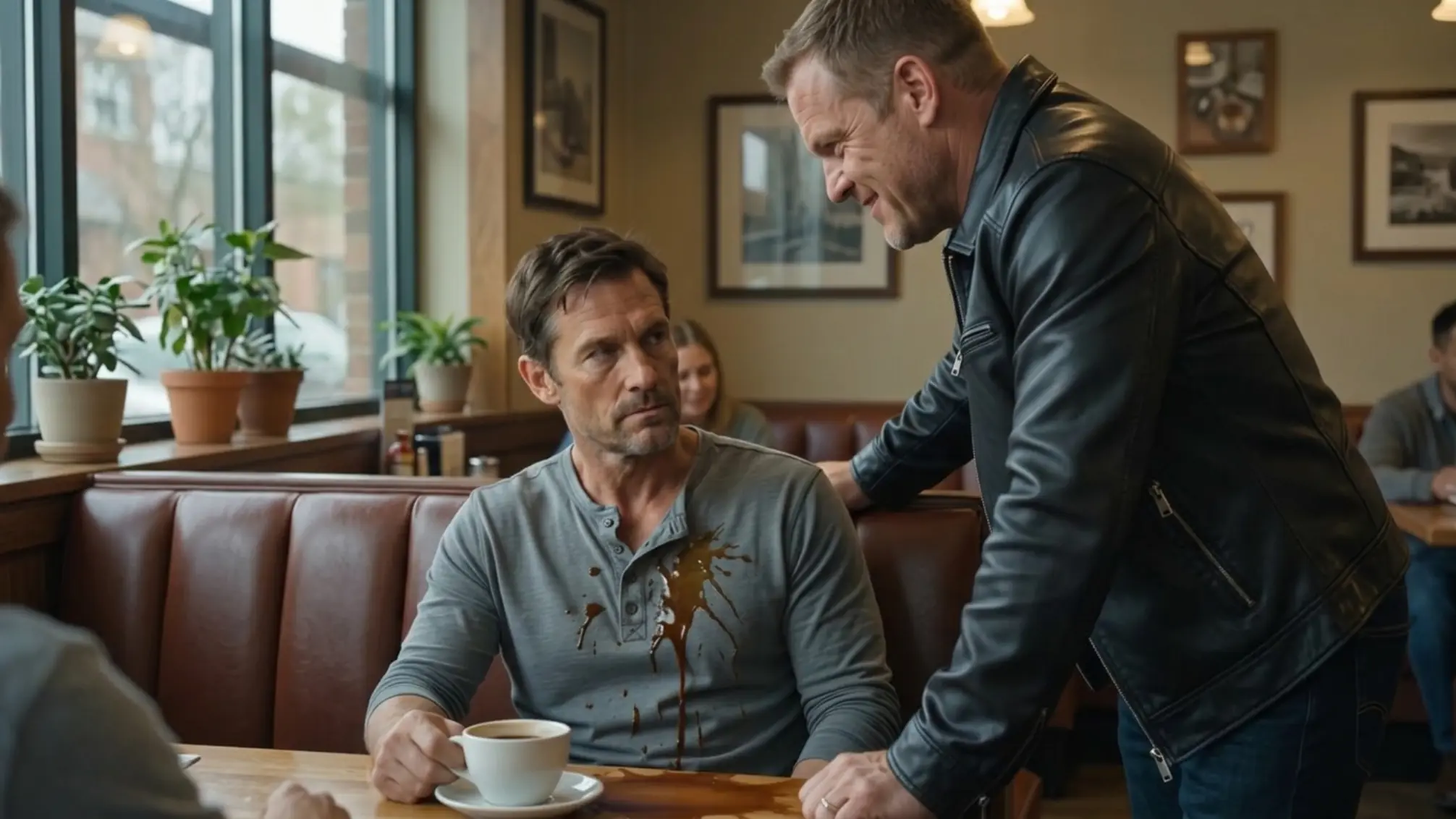
Ethan looked down at the spreading stain without speaking. He was forty-four, handsome in a rugged, understated way, with short dark-brown hair, light stubble, and steady gray eyes that rarely revealed what he was thinking. His faded gray Henley and worn boots made him look like an ordinary American father taking a quiet Saturday morning for himself. Only the scratched military watch on his left wrist suggested that his life had once been very different.
On the table, his phone displayed a message from his twelve-year-old daughter.
Don’t forget pickup at 3:15. Love you, Dad.
Ethan had already replied.
I’ll be there. Always.
That promise mattered more than the man standing over him.
Miller leaned closer, waiting for outrage. He was thirty-nine, taller and heavier than Ethan, with a thick muscular build, short sandy-brown hair, and the flushed complexion of someone who had begun drinking long before lunch. His black leather jacket strained across his shoulders as he glanced around the café, checking whether people were watching.
They were.
Miller lived for that moment—the instant when a room turned toward him and waited to see what he would do next. He confused attention with respect and intimidation with strength. Most people laughed at his insults because refusing to laugh risked becoming his next target.
Ethan had seen men like him before.
Not in cafés.
In places where bad judgment had consequences measured in lives.
“You should probably grab some napkins,” Miller said. “Unless cleaning up after other people is beneath you.”
A few uncomfortable laughs came from somewhere near the counter.
Ethan lifted his gaze.
The laughter stopped.
He did not glare or threaten. He simply looked at Miller with the complete attention of a man who had stopped pretending the encounter was accidental. The stillness in his face unsettled Miller more than anger would have.
Ethan rose slowly.
He was several inches shorter than the bully, but the difference seemed to disappear once he stood. His shoulders remained relaxed, his hands open at his sides, and his breathing steady. He did not puff out his chest or step forward.
He did not need to.
“Apologize and walk away,” Ethan said.
Miller blinked.
The response was too calm. He had expected embarrassment, shouting, or perhaps a desperate attempt at humor. Calmness denied him the performance he wanted.
“Or what?” Miller scoffed. “You’ll miss school pickup from a hospital bed?”
Ethan glanced briefly at the phone.
Something colder settled behind his eyes.
“Touch me again,” he said, “and you’ll learn why I always sit facing the door.”
The café became silent.
Miller looked toward the corner booth for the first time. Ethan’s back had been against the wall. From the seat, he could see the entrance, counter, windows, restrooms, and every path between the tables.
It could have been a coincidence.
Miller told himself it was.
He stepped forward until barely an inch remained between them. His expression hardened as he attempted to recover the control he felt slipping away. Walking away now would mean admitting that an ordinary single father had frightened him without lifting a hand.
“You think you’re tough?” Miller asked.
“No.”
The answer threw him again.
Ethan continued, “I think you want an audience more than you want a fight.”
Miller’s jaw tightened. “You don’t know anything about me.”
“I know you waited until people were watching before you knocked over my coffee.”
“That supposed to impress me?”
“It’s supposed to give you one chance to leave before this becomes the most embarrassing morning of your life.”
Miller shoved him.
The heel of his palm struck Ethan’s shoulder, but Ethan barely shifted. He absorbed the pressure through his stance, taking a small step back without losing balance.
Someone near the window raised a phone.
Miller saw it and smiled again.
“Come on,” he said. “Do something.”
Ethan’s hands remained at his sides.
He thought of his daughter, Lily, waiting at a friend’s house across town. She believed her father had served in the Army, but she knew very little about where he had gone or what he had done. Ethan wanted it that way.
She did not need stories about raids, hostage extractions, or nights when he had returned with names he could not forget. She needed the father who packed lunches, helped with homework, and stood beside the soccer field even when it rained. She needed someone predictable after losing her mother to cancer six years earlier.
Ethan had spent sixteen years learning how to enter chaos.
Fatherhood taught him how to leave it behind.
Miller shoved him again, harder.
Ethan moved with the force instead of resisting it. His back touched the wall, but his expression remained unchanged.
“Hit me,” Miller demanded.
“No.”
“Scared?”
“No.”
Miller spread his arms toward the room. “Everybody see this? Big tough guy talks like a soldier, then hides against the wall.”
Ethan looked past him toward the entrance. No immediate threat. No accomplice. No weapon visible beneath the jacket, though Miller’s right hand kept flexing and drifting toward his pocket.
“Your right hand tells me you’re thinking about throwing a punch,” Ethan said.
Miller’s hand stopped.
“Your left foot is too far forward,” Ethan continued. “You’ll lose balance when you swing. And you keep looking at the camera because you care more about how this looks than what happens next.”
The color in Miller’s face deepened.
“You think you can read me?”
“You’re not complicated.”
The insult landed differently because Ethan delivered it without emotion.
Miller had built his identity around being the most intimidating person in every room. Ethan had reduced him to a predictable set of movements and motives.
“You need to shut your mouth,” Miller warned.
“Apologize. Walk away. Pick whichever part feels easier.”
Miller leaned close enough that Ethan could smell whiskey beneath his coffee-scented breath. “You know what I think? I think your wife left because she got tired of living with a coward.”
Ethan’s expression did not change, but the room seemed to grow colder.
“My wife died,” he said.
For one second, Miller appeared uncomfortable.
It was an exit.
He could have apologized. Even a man as proud as Miller could have lowered his voice, stepped back, and claimed he had not known.
Instead, he smiled.
“Then at least she got away.”
A chair scraped somewhere behind them.
Several customers looked down, embarrassed to have witnessed the cruelty. Ethan felt anger rise, but it arrived as something clean and controlled rather than explosive. He had known rage before. Rage had been easy after his wife died.
Control had taken years.
“You have reached the end of this conversation,” Ethan said.
Miller shoved him a third time.
Ethan did not move at all.
The bully’s smile faded.
That was when Miller threw the punch.
It came from his right side exactly as Ethan had predicted: wide, heavy, and driven by anger rather than skill. The fist traveled toward Ethan’s jaw with enough force to cause serious injury if it connected.
Ethan saw every part of it.
The shoulder tightening.
The hip rotating too early.
The balance shifting away from Miller’s rear foot.
Time did not actually slow, but years of training divided the moment into manageable pieces.
Ethan stepped inside the arc of the punch.
His left hand guided Miller’s wrist past his face. His right hand secured the elbow, and a small turn redirected the bully’s entire body toward the wall. Miller’s own momentum carried him forward before he understood what had happened.
Three seconds after throwing the punch, he stood facing the brick with his arm secured behind him.
Ethan applied only enough pressure to stop movement.
Miller struggled.
“Stop,” Ethan said.
The bully tried to twist free, but Ethan adjusted the angle slightly. The hold did not depend on superior size. It used the limits of the shoulder and elbow against the person resisting it.
Miller froze.
“You’re going to hurt yourself,” Ethan told him.
“Get off me!”
“Stay still.”
“I’ll kill you!”
Ethan increased the pressure by a fraction.
Miller gasped and stopped struggling.
“I’m not hurting you,” Ethan said quietly. “Your resistance is doing that. Calm down.”
The café watched in disbelief.
No chairs had been thrown. No wild punches followed. Ethan was not breathing hard, and the bully who had dominated the room moments earlier could barely move.
Miller’s fear slowly replaced his anger.
“What are you?” he asked.
“A father who wanted coffee.”
“Let me go.”
“Will you swing again?”
“No.”
“Will you threaten my daughter again?”
Miller hesitated.
Ethan adjusted his grip.
“No,” Miller said quickly. “I won’t.”
Ethan waited until the man’s muscles relaxed, then released him and moved several steps away.
He did not keep Miller trapped against the wall. He left a clear path toward the exit, showing everyone—including Miller—that he wanted no further confrontation.
The bully turned slowly.
His face burned with humiliation. He looked at the witnesses, the raised phones, and the overturned mug still dripping onto the floor. The public attention he had wanted now felt unbearable.
“You caught me by surprise,” Miller said.
Ethan picked up his phone from the table. “You announced the punch with your entire body.”
Miller rubbed his shoulder. “You think that makes you better than me?”
“No.”
“Then what?”
“It makes me better trained.”
The blunt answer drew a few nervous breaths from the crowd.
Miller’s eyes fell to the scratched watch. “Military?”
Ethan did not answer.
“You some kind of special forces tough guy?”
“I’m someone asking you to leave.”
Miller’s pride fought against the last remaining part of his judgment. He looked toward the exit but did not move.
“You embarrassed me,” he said.
“You did that yourself.”
Sirens approached outside.
Miller’s head snapped toward the windows. The young barista had called the police as soon as the first shove occurred. Two patrol vehicles entered the small parking lot with their lights flashing.
“You called them?” Miller demanded.
Ethan shook his head.
“Tell them it was nothing.”
“You threw a punch in a room full of witnesses.”
“You didn’t get hurt.”
“That was not your decision.”
Miller stepped closer again, though less confidently. “You press charges, I’ll find out where you live.”
Ethan looked directly into his eyes.
The bully immediately regretted the threat.
“You already mentioned my daughter once,” Ethan said. “Do not make that mistake twice.”
The café door opened before Miller could answer.
Two American police officers entered and separated them. One spoke with Miller near the counter while the other approached Ethan beside the booth.
“What happened?” the officer asked.
“He knocked over my table intentionally, shoved me three times, and threw a right hook.”
“What did you do?”
“Redirected the punch and restrained him until he stopped fighting.”
The officer examined Ethan’s wet clothes, balanced posture, and military watch. “You serve?”
“Sixteen years in the United States Army.”
“What unit?”
Ethan paused.
The officer read the silence correctly. “Understood.”
Witnesses confirmed his account. Several had recorded the confrontation from the moment Miller began insulting Ethan. One video clearly showed Ethan attempting to de-escalate, offering multiple chances to leave, and using limited force only after Miller attacked.
The officer asked whether Ethan wanted to press charges.
“No.”
Miller, standing several yards away, looked surprised.
“He assaulted you,” the officer said.
“I stopped him.”
“He also threatened your daughter.”
Ethan’s eyes shifted toward Miller.
The bully looked down.
“Document the incident,” Ethan said. “Make sure the threat is included. But I don’t want to spend the next six months in court unless he comes near us.”
The officer nodded. “That’s your choice.”
Miller was issued citations for disorderly conduct and assault, then escorted outside. Before entering the patrol car, he looked back through the café window.
Ethan stood beside the table cleaning spilled coffee with a towel.
That ordinary action unsettled Miller more than the restraint had.
The man who defeated him did not seem proud. He did not celebrate, pose for the cameras, or accept praise. He simply restored the room and prepared to leave.
Miller had wanted to become the center of Ethan’s day.
He had failed.
The café owner offered Ethan free coffee for life.
Ethan paid for the spilled cup instead.
“You shouldn’t have to pay,” she protested.
“I ordered it.”
“He knocked it over.”
“That doesn’t change who sold it.”
She accepted the money reluctantly. “You could have hurt him badly.”
“Yes.”
“But you didn’t.”
“No.”
“Why?”
Ethan glanced through the window at Miller sitting in the patrol car. “Because being capable of causing harm doesn’t make it necessary.”
He walked outside and returned to his pickup truck.
For several minutes, he sat behind the wheel without starting the engine. His hands remained steady, but old memories had awakened inside him—rooms entered before dawn, voices over radios, and men moving toward danger because he told them to.
He closed his eyes.
Then his phone vibrated.
Dad, Emma’s mom says pickup is still 3:15. Don’t come early. We’re finishing a movie.
A smile softened his face.
Understood. Have fun.
The message pulled him fully back into the present.
At two forty-five, Ethan parked outside the house where Lily had spent the morning. He arrived thirty minutes early, as he always did, because being late had become one of the few fears he allowed himself.
Lily emerged at exactly three fifteen carrying a backpack and a half-empty bag of popcorn.
She stopped when she saw the stain across his jeans.
“What happened to you?”
“Coffee accident.”
She narrowed her eyes. “That sounds suspicious.”
“It involved coffee.”
“And an accident?”
“Someone else made a bad decision.”
Lily climbed into the truck. She had inherited her mother’s green eyes and direct way of asking questions. “Did you get into a fight?”
“No.”
“Dad.”
“I prevented one from becoming worse.”
“That means yes.”
“It means someone tried.”
She studied him. “Were you hurt?”
“No.”
“Did you hurt him?”
“No.”
“Did you scare him?”
Ethan started the engine. “Probably.”
Lily leaned back with visible satisfaction. “Good.”
“That is not the lesson.”
“What is the lesson?”
“The lesson is to walk away whenever you can.”
“What if someone won’t let you?”
“Then protect yourself without becoming the person who started it.”
Lily considered that as they pulled away from the curb. “Mom would say that was annoyingly wise.”
“She said most things I did were annoying.”
“She loved you.”
“I know.”
Ethan looked at his daughter, safe beside him, and understood again why he had left the Army. His old life had offered purpose, loyalty, and clear missions, but fatherhood demanded another kind of courage.
It required him to choose restraint over instinct.
Presence over pride.
The future over the satisfaction of winning one meaningless confrontation.
Miller spent that Saturday afternoon at the police station. No one arrested him formally, but the citations, statements, and recorded threat created a file that would follow him if the behavior continued.
For the first time in years, he experienced consequences he could not laugh away.
He watched the café video that evening after someone sent him a copy. Each viewing felt worse. He saw himself crossing the room deliberately, spilling the coffee, mocking a widowed father, and throwing the first punch.
Ethan did not look frightening in the footage.
That made it more humiliating.
He looked patient.
Miller saw all the opportunities he had been given to stop. Every quiet warning. Every clear exit. Every moment when Ethan could have escalated but did not.
He had mistaken mercy for fear until mercy ran out.
A week later, Miller returned to the café.
He came early, before the Saturday crowd. He wore no leather jacket and entered without his usual loud confidence.
Ethan sat in the same corner booth.
Back against the wall.
Facing the door.
Miller stopped when he saw him.
Ethan set down his coffee but remained seated.
“I’m not here to cause trouble,” Miller said.
“Good.”
The bully glanced toward the table. “I came to apologize.”
Ethan waited.
“I knocked your coffee over on purpose,” Miller continued. “I embarrassed you because I wanted people watching. Then I said something about your wife that I had no right to say.”
Ethan’s expression remained unreadable.
“And I threatened your daughter,” Miller added. “That was wrong.”
“Yes.”
“I’m sorry.”
The apology sounded rough and unfamiliar, as though Miller had rarely used the words without sarcasm.
Ethan pointed toward the empty chair across from him.
Miller hesitated, then sat.
“Why didn’t you press charges?” he asked.
“Would jail have taught you anything?”
“Maybe.”
“Did the café teach you something?”
Miller looked down. “Everybody saw me lose.”
“That’s not the important part.”
“It felt important.”
“You did not lose when I restrained you. You lost when you decided humiliating a stranger would make you look strong.”
Miller slowly nodded.
“What unit were you in?” he asked.
“That doesn’t matter.”
“It matters to me.”
“Why?”
“Because I need to know what kind of man I challenged.”
Ethan leaned back. “You challenged a father drinking coffee. That should have been enough reason to leave him alone.”
Miller absorbed the answer.
No rank, unit, or secret history justified Ethan’s dignity. He had deserved basic respect before anyone knew what he could do.
“I’ve treated people that way before,” Miller admitted.
“I know.”
“How?”
“Men don’t become that comfortable on the first attempt.”
Miller looked toward the counter. The staff watched him cautiously, ready to call the police again.
“I don’t know why I do it,” he said.
“That is something you should understand before someone less controlled answers you next time.”
Miller gave a humorless laugh. “You think I need therapy?”
“I think you need something more useful than another audience.”
For the first time, Miller smiled without cruelty.
He stood and placed money on the table. “For the coffee.”
Ethan looked at it. “You didn’t spill this one.”
“No. But I did spill the last one.”
Miller walked toward the exit.
At the door, he turned back. “Your daughter’s lucky.”
Ethan met his eyes. “So am I.”
Miller left quietly.
Ethan watched him cross the parking lot, then returned to his coffee. He did not know whether the apology marked genuine change or temporary shame. People rarely transformed in one conversation.
But Miller had returned.
He had faced the man he wronged without an audience, excuse, or performance. That was at least a beginning.
Ethan’s phone vibrated on the table.
Soccer game moved to 2:30. You better be front row.
He smiled and typed his answer.
I’ll be there. Always.
Around him, the café continued its normal Saturday rhythm. Cups clinked, milk steamed, and conversations overlapped. Most customers no longer recognized Ethan as the man from the video.
That suited him.
He had spent years learning that real strength rarely looked the way people expected. It did not always shout, threaten, or demand space.
Sometimes it sat quietly in a corner booth wearing an old gray shirt.
Sometimes it offered an angry man one final opportunity to walk away.
And sometimes its greatest victory was leaving in time to keep a promise to a daughter waiting at 3:15.