Malik Bennett had been eighteen for seventeen days when three airport police officers surrounded him at Gate B17.
He stood beneath the enormous windows of Hartsfield-Jackson Atlanta International Airport wearing a black leather jacket, charcoal T-shirt, dark jeans, and the small backpack his mother had bought him before his freshman year of college. Around him, phones lifted almost simultaneously as travelers realized something interesting was happening. In the center of the growing circle stood a fifty-two-year-old businessman named Richard Hale, gripping Malik’s grandfather’s battered brown leather duffel as though possession alone proved ownership.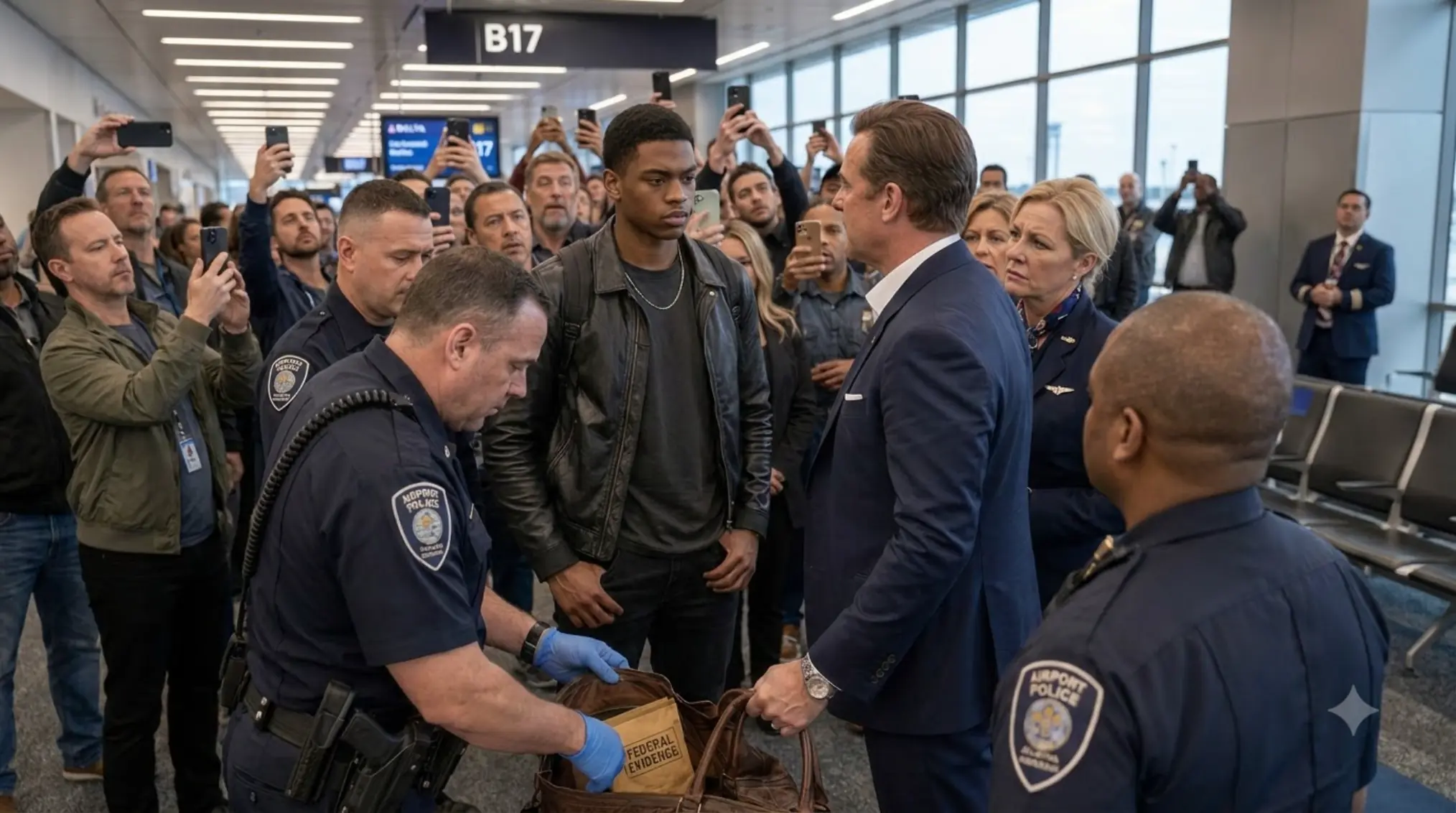
“He stole my luggage,” Richard announced. “Cuff him before he runs.”
The accusation was delivered with remarkable confidence.
Richard wore a tailored navy suit, polished black shoes, and a silver watch that probably cost more than everything Malik had packed for college. His hair was neatly combed, his voice controlled, and his posture suggested he had spent decades walking into rooms where strangers automatically assumed he belonged. Beside him stood Senior Flight Attendant Laura Prescott, a blonde woman in her late forties whose navy uniform looked almost as carefully arranged as Richard’s suit.
“I saw him with it,” Laura said.
Malik looked at her.
That was not technically a lie.
She had seen him carrying the duffel.
What she had not seen was Malik stealing anything.
That distinction seemed suddenly unimportant to the crowd.
A man near the gate whispered something to his wife.
She pulled their son closer.
Another passenger stepped backward.
Malik noticed every movement.
He had learned young that fear did not always announce itself with screaming or running. Sometimes it appeared as a purse being moved to the opposite shoulder, a door being locked when someone approached, or a stranger deciding they understood your intentions before you opened your mouth. At eighteen, Malik already knew what it felt like to enter a room and watch assumptions arrive before his name did.
He also knew anger would not help him.
So he remained completely still.
The old duffel had belonged to his grandfather, Isaiah Bennett.
Malik had grown up seeing it in the hall closet of Isaiah’s small brick house outside Augusta. The leather was cracked near both corners, one brass buckle had been replaced with a darker piece of metal, and the left handle carried a thin line of black stitching where Malik himself had repaired it at fourteen. Isaiah had laughed when he saw the crooked repair.
“Ugliest stitching I ever saw.”
“It works.”
“That it does.”
Isaiah had carried the bag for nearly forty years.
And six days before dying, he had given Malik very specific instructions about it.
Those instructions were the only reason Malik was standing at Gate B17.
Officer Daniel Reeves approached first.
He was forty-one, broad through the shoulders, with graying hair at the temples and the tired expression of someone who had already dealt with too many people before noon. Two other airport officers stood slightly behind him, one on either side, positioned carefully enough that Malik understood what would happen if he suddenly moved. Reeves looked first at Richard, then at Malik, then at the duffel.
“Who owns the bag?”
“I do,” Richard said instantly.
Malik answered at the same time.
“It’s mine.”
Richard laughed.
“You see?”
Reeves looked at him.
“See what?”
“He’s lying right in front of you.”
Reeves’s face did not change.
“That doesn't answer anything.”
Malik noticed Richard’s irritation.
It was subtle.
But it was there.
Laura stepped closer.
“Officer, we have a boarding problem developing. Mr. Hale informed me that this young man grabbed his luggage near the premium waiting area.”
Malik finally spoke.
“No.”
Laura turned.
“You were standing beside it.”
“I was carrying it.”
“Exactly.”
Malik looked at Reeves.
“It belongs to me.”
Richard shook his head.
“Listen to him.”
Then he turned toward the gathering crowd.
“This is what happens when people think nobody will challenge them.”
Several people murmured.
Malik felt heat behind his ribs.
He pushed it down.
Richard continued.
“I've been flying through this airport for twenty years. I’m a platinum-level passenger. That bag contains private business documents.”
Malik almost reacted to that sentence.
Almost.
Private business documents.
Richard should not have known there were documents inside.
Unless he was guessing.
Or unless he knew considerably more than he was admitting.
Malik looked directly at him.
Richard’s eyes shifted away.
Only for a moment.
Officer Reeves noticed.
“Sir,” he said to Malik, “can you prove the bag belongs to you?”
Malik looked toward the duffel.
“Yes.”
“How?”
“Read the luggage tag.”
Richard’s fingers tightened around the handles.
That was the first visible crack.
Officer Reeves saw it.
“Mr. Hale, set the bag down.”
Richard frowned.
“What?”
“Set it down.”
“You're actually entertaining this?”
“Yes.”
Richard looked toward Laura.
She seemed suddenly less certain.
Then he slowly placed the duffel on the floor.
Reeves crouched.
The tag was attached beneath the left handle.
Old leather.
Clear protective cover.
Two names were visible.
The first, written by hand decades earlier:
ISAIAH BENNETT.
Beneath it, printed recently:
MALIK ISAIAH BENNETT.
Reeves looked up.
“Your name?”
“Malik Isaiah Bennett.”
Richard immediately spoke.
“He could have changed it.”
Malik looked at him.
“That stitching on the handle?”
Richard stopped.
“I put it there when I was fourteen.”
He pointed.
“Black thread. Three loops on the inside because I didn't know how to finish the repair properly.”
Reeves examined the handle.
Exactly as Malik described.
Richard’s face tightened.
Laura looked toward him.
One of the officers behind Reeves removed his hand from near his cuffs.
The crowd changed.
Not dramatically.
But Malik felt it.
Suspicion was beginning to move.
People who had been staring at him now looked at Richard.
That was when Reeves reached toward the side pocket.
Richard moved immediately.
“Don't.”
The single word came too quickly.
Reeves froze.
Richard corrected himself.
“I mean, this is unnecessary. You already checked the tag.”
Reeves looked at him.
“You just claimed the bag belongs to you.”
“Yes.”
“Then why do you care whether I open it?”
Richard’s mouth opened.
Nothing came.
Laura stepped toward Reeves.
“Officer, perhaps we should handle this privately.”
“Why?”
“This is becoming disruptive.”
Reeves glanced toward the dozens of raised phones.
“Little late for private.”
Malik’s pulse accelerated.
He knew what was in the main compartment.
Three shirts.
Jeans.
A small toiletry bag.
His grandfather’s old photograph album.
A black folder.
But Isaiah had instructed Malik not to open the side pocket.
Not once.
Take the bag directly to Washington.
Do not open the smaller compartment.
Give it only to Attorney Rebecca Sloan.
Malik had obeyed.
Until now, he had assumed legal papers were inside.
Then Reeves pulled the zipper.
The sound seemed much louder than it should have been.
Metal teeth separating.
Leather shifting.
The entire gate quieting.
Reeves reached inside.
His expression changed.
He withdrew a thick kraft envelope sealed with red tamper tape.
Across the front were printed words that Malik had never seen before.
FEDERAL EVIDENCE – SEALED
Beneath them was an evidence number.
A federal case identifier.
And one handwritten surname.
BENNETT.
One of the other officers stepped closer.
“Don't open that.”
“I’m not.”
Richard’s complexion visibly changed.
Laura stared at the envelope.
Malik stared too.
Reeves looked toward him.
“You knew this was inside?”
“No, sir.”
Richard laughed sharply.
“Of course he did.”
Malik looked at him.
Then Reeves did something simple.
He turned toward Richard.
“You claimed this bag was yours.”
Richard’s confidence disappeared another inch.
“It is.”
“Then explain why federal evidence bearing his family name is inside it.”
No answer.
Reeves stood.
“Mr. Hale?”
Richard swallowed.
“I don't know what that is.”
“You said there were business documents inside.”
Richard’s face went still.
Malik had been waiting for somebody else to notice.
Reeves had.
“How did you know there were documents?”
“I assumed.”
“Why?”
“It’s a duffel bag.”
“That doesn't explain it.”
Laura stepped backward.
Malik watched her.
Reeves watched too.
Then he looked at one of his partners.
“Call supervisor. And contact federal liaison.”
The atmosphere changed immediately.
This was no longer an airport luggage disagreement.
Ten minutes earlier, Malik had been the person everyone expected to see in handcuffs.
Now Richard Hale was being asked not to leave Gate B17.
Laura Prescott was instructed to remain nearby.
Malik sat beside the windows while Officer Reeves took his identification.
“Eighteen?”
“Yes.”
“You traveling alone?”
“Yes.”
“Washington?”
Malik nodded.
“My grandfather died last week.”
“I’m sorry.”
“Thank you.”
Reeves looked toward the sealed evidence.
“He gave you that bag?”
“Yes.”
“When?”
“Six days before he died.”
“What instructions?”
Malik hesitated.
Reeves noticed.
“You don't have to tell me anything you were legally instructed not to disclose.”
Malik appreciated that.
“He said deliver it personally to a lawyer named Rebecca Sloan.”
“Federal?”
“I don't know.”
“Address?”
Malik opened his phone.
The note contained an office address in Washington, D.C.
Reeves read it.
Then his eyebrows rose.
“You know who she is?”
“No.”
Reeves did.
He did not explain.
Instead he handed the phone back.
“Don't delete anything.”
“I won't.”
Across the gate, Richard spoke angrily with another officer.
Laura stood alone now.
The polished alliance between them had fractured almost instantly.
Malik studied them.
Something his grandfather once told him came back.
People tell you who they are when the advantage changes sides.
At twelve, Malik had thought it was advice about football.
At eighteen, he understood better.
Isaiah Bennett had raised Malik nearly as much as Malik’s mother had.
When Malik was three, his father disappeared from their lives.
His mother, Nia, worked two jobs for several years, and Isaiah became the person waiting after school.
He taught Malik to tie fishing knots.
Change oil.
Balance a checkbook.
Iron a shirt properly.
And perhaps most importantly, ask one extra question before believing the obvious answer.
Isaiah had spent much of his life working in logistics and government contracting.
That was how the family described it.
Whenever Malik asked for details, Isaiah smiled.
“Moved important things from places they were to places they needed to be.”
It sounded boring.
Malik eventually stopped asking.
Only as he grew older did he notice unusual things.
Former federal officials attended Isaiah’s seventieth birthday.
A retired judge once drove four hours to have lunch with him.
At his house were framed photographs of Isaiah beside people Malik recognized from history books, although Isaiah never explained them.
And inside the hallway closet was the brown leather duffel.
Never locked.
Never treated as precious.
But never thrown away.
After Isaiah was diagnosed with pancreatic cancer, he began organizing his affairs with almost irritating precision.
Bills.
Property.
Insurance.
Funeral instructions.
Then, six days before his death, he asked Malik to sit beside his hospital bed.
“Washington.”
Malik frowned.
“What?”
“You're going to Washington after I’m gone.”
“Granddad—”
“Listen.”
That tone ended arguments.
Isaiah gave him the duffel.
“Rebecca Sloan.”
He handed Malik a card.
“Her office. You deliver the whole bag.”
“What’s inside?”
“History.”
“That tells me nothing.”
“It tells you enough.”
Malik looked at him.
“Why me?”
Isaiah smiled weakly.
“Because your mother has spent thirty-five years doing everything for everybody.”
He squeezed Malik’s hand.
“This one is yours.”
Then his expression became serious.
“If anyone tries taking that bag, don't fight over it.”
Malik remembered that sentence now.
Don't fight over it.
At the time, it seemed strange.
“Then what?”
“Make them prove it isn't yours.”
Malik had almost laughed.
Now he understood.
A woman wearing a charcoal suit arrived at Gate B17 twenty-two minutes later.
She moved quickly through the crowd with two federal agents behind her.
Officer Reeves immediately stood.
“Special Agent Monroe.”
The woman nodded.
“Officer.”
Her name was Celeste Monroe.
She looked at the envelope.
Then Malik.
“Mr. Bennett?”
“Yes.”
“Malik Bennett?”
“Yes, ma’am.”
“Grandson of Isaiah Bennett?”
Malik stood.
“Yes.”
Her entire manner changed.
Not dramatically.
But respect entered it.
“I knew your grandfather.”
Malik stared.
“You did?”
“Briefly.”
She looked at the bag.
“He said someone might bring this.”
Malik’s stomach tightened.
“You were expecting me?”
“Not you specifically.”
Monroe looked toward Richard.
“But we were expecting the material.”
Richard interrupted.
“This has gotten absurd.”
Monroe turned.
“And you are?”
“Richard Hale.”
She knew the name.
That was obvious.
Her eyes changed instantly.
“Richard Hale of Hale Meridian Logistics?”
Richard hesitated.
“Yes.”
Monroe looked toward the evidence envelope.
Then back at him.
Malik saw something connect.
Laura apparently saw it too.
She started walking away.
One of Monroe’s agents stepped directly into her path.
“Ma’am, please stay here.”
“I have a flight.”
“So does everyone else.”
Laura stopped.
Celeste Monroe requested a private airport conference room.
By then videos of the confrontation were already spreading online, although Malik had no idea.
Inside the room sat Malik, Reeves, Monroe, two federal agents, Richard, Laura, and the airport operations supervisor.
The leather duffel rested on the table.
Monroe documented the seal.
Photographed it.
Confirmed the chain-of-custody number.
Then she turned toward Malik.
“Your grandfather spent eighteen years advising a federal procurement integrity unit.”
Malik blinked.
That was considerably more specific than “logistics.”
Monroe continued.
“He retired more than a decade ago, but he remained a confidential source in several contracting cases.”
She looked at Richard.
“One of those cases involved Hale Meridian Logistics.”
Richard leaned forward.
“This is outrageous.”
Monroe ignored him.
She explained that several years earlier, investigators suspected Hale Meridian had been manipulating shipping invoices connected to airport cargo contracts.
Overbilling.
False vendors.
Duplicate freight charges.
Nothing prosecutors could prove conclusively.
The investigation stalled.
Then Isaiah Bennett contacted Rebecca Sloan.
“What did my grandfather have?” Malik asked.
Monroe looked toward the envelope.
“We’re about to find out.”
Richard immediately objected.
“My attorney needs to be present.”
Monroe looked at him.
“You aren't under arrest.”
“Then I’m leaving.”
She nodded.
“You may attempt to.”
Richard stood.
One of the federal agents remained beside the door.
Monroe continued calmly.
“But because you publicly claimed ownership of a bag containing sealed federal evidence connected to an investigation involving your company, I strongly recommend you remain available.”
Richard sat.
Slowly.
Malik understood now.
The bag had not accidentally become important.
It had always been important.
The airport accusation had simply forced the wrong people to admit they knew that.
Rebecca Sloan arrived forty minutes later.
She was sixty-three, silver-haired, direct, and carried herself with the confidence of someone who had spent decades asking questions people wished she would stop asking.
The first thing she did was hug Malik.
That surprised him.
“Your grandfather talked about you constantly.”
Malik swallowed.
“He did?”
“All the time.”
She touched his shoulder.
“He was extremely proud.”
For the first time that day, Malik nearly lost his composure.
Not when Richard accused him.
Not when police surrounded him.
Not when the evidence appeared.
But there.
Because grief could wait through danger.
Kindness was harder.
Rebecca sat.
The evidence seal was opened under documentation.
Inside were copies of freight ledgers.
Photographs.
Digital-storage devices.
Signed correspondence.
And a handwritten affidavit from Isaiah Bennett.
Rebecca read silently.
Celeste Monroe watched her.
Eventually Rebecca placed the pages down.
“This is enough.”
Richard laughed nervously.
“You haven't authenticated anything.”
“No.”
Rebecca looked at him.
“But your reaction is extremely interesting.”
He stopped.
She lifted one ledger.
“This document references Meridian subcontractor code H17.”
Richard’s eyes flickered.
Rebecca noticed.
“So does your expression.”
Laura suddenly spoke.
“I didn't know anything about documents.”
Every person turned toward her.
Richard stared.
“You should stop talking.”
Laura looked frightened.
Rebecca leaned forward.
“Why?”
“No reason.”
Laura’s breathing changed.
Monroe spoke gently.
“Ms. Prescott, why did you tell airport police you personally witnessed Malik stealing the duffel?”
Laura said nothing.
“Did you?”
Silence.
Richard looked toward her.
Not reassuringly.
Warningly.
Malik saw it.
So did Monroe.
“Laura.”
The flight attendant finally whispered:
“No.”
The room became completely still.
Officer Reeves leaned forward.
“You did not witness him taking it?”
“No.”
“Then why did you say you did?”
Laura looked at Richard.
He shook his head almost imperceptibly.
Monroe immediately said:
“Mr. Hale, don't communicate with the witness.”
Richard leaned back.
Laura covered her face.
“He told me the boy had taken something from him.”
Malik’s jaw tightened.
“The boy.”
Laura looked toward him.
“I’m sorry.”
He said nothing.
Monroe continued.
“When?”
“At the premium waiting area.”
“What exactly did Mr. Hale say?”
Laura swallowed.
“He pointed at Malik and said the duffel belonged to him.”
“Did you see Malik take the duffel?”
“No.”
“Did you see Mr. Hale possessing it before Malik?”
“No.”
“Why did you tell police you witnessed theft?”
Laura’s eyes filled.
“Because I believed him.”
Rebecca spoke quietly.
“Why?”
Laura did not answer.
She did not need to.
Everyone understood.
Richard had the suit.
The watch.
The confidence.
Malik had silence.
That had been enough.
Until evidence demanded more.
Federal investigators separated everyone.
Malik spent another hour giving a statement.
He described Richard bumping against him near the premium lounge.
Described Laura repeatedly questioning whether Malik belonged in the boarding group printed on his pass.
Described Richard later grabbing the duffel from beside Malik’s chair and immediately shouting that Malik had stolen it.
That detail mattered.
Monroe asked:
“He physically picked it up first?”
“Yes.”
“Then claimed you took it from him?”
“Yes.”
“Why didn't you grab it back?”
“My grandfather told me not to fight anyone over the bag.”
Monroe stopped writing.
“He specifically told you that?”
“Yes.”
Rebecca looked toward the table.
Isaiah had expected interference.
Maybe not Richard personally.
But someone.
Malik asked:
“Did Granddad know?”
Rebecca answered carefully.
“He suspected the investigation had been compromised years ago.”
“By who?”
“We don't know yet.”
Malik looked toward the door Richard had been taken through.
“Maybe we do.”
Rebecca gave him a faint smile.
“You really are Isaiah’s grandson.”
Richard Hale did not board his flight that afternoon.
Neither did Laura Prescott.
Malik eventually did.
But not before Rebecca personally walked him to a different gate.
The old duffel remained with federal investigators.
Malik carried only his backpack.
It felt wrong.
Like leaving part of Isaiah behind.
Rebecca noticed.
“You’ll get the personal contents back.”
“The photographs?”
“Yes.”
“And the bag?”
“When it’s released.”
Malik nodded.
At the gate, Rebecca gave him another envelope.
“What’s this?”
“A letter.”
“From you?”
“From your grandfather.”
Malik stared.
“He gave it to me in case the evidence ever reached my hands.”
Malik slowly opened it.
Isaiah’s handwriting filled one page.
Malik,
If you are reading this, then you completed the trip. More importantly, you probably learned that people will sometimes decide who you are before they ask. Do not spend your life trying to control their first assumption. Control what you do next.
Malik stopped.
His eyes blurred.
He continued.
I chose you because you listen before speaking, and because silence has never meant weakness in you. Your mother taught you dignity. I only helped reinforce it.
Whatever comes from these papers belongs to the courts. The bag belongs to our family. Bring it home when they’re finished.
And fix that ugly stitching someday.
Malik laughed through tears.
Rebecca smiled.
“He hated that stitching.”
“He mentioned it every year.”
The consequences unfolded slowly.
That mattered.
Real investigations rarely ended as neatly as airport crowds expected.
Hale Meridian Logistics was not destroyed overnight.
Richard Hale was not marched through Gate B17 in handcuffs ten minutes after the envelope opened.
Instead, federal agents executed search warrants over the following weeks.
Financial records were seized.
Several former employees agreed to cooperate.
The evidence Isaiah preserved connected suspicious invoices to shell companies whose ownership led back toward Hale executives and intermediaries.
Richard’s public claim that the duffel was his became one small but extraordinarily damaging part of a much larger picture.
Why had he wanted it?
Investigators eventually found the answer.
Someone inside Isaiah’s retirement community had leaked information after seeing Rebecca Sloan’s contact details among his papers.
That information moved through an intermediary.
Eventually it reached Richard.
He knew a courier would carry materials through Atlanta.
He apparently did not know the courier would be Isaiah’s eighteen-year-old grandson.
Richard intended to separate the bag from whoever possessed it, create confusion, and disappear into the chaos of a major airport.
Then he saw Malik.
Young.
Alone.
Black.
Quiet.
And made a calculation.
He assumed people would believe him first.
For several minutes, they did.
That was nearly enough.
Laura Prescott lost her supervisory position while the airline investigated her false statement.
She later sent Malik a written apology.
Not a public-relations apology.
A personal one.
She admitted that she had repeatedly questioned Malik’s first-class boarding status earlier because he did not look like the passengers she instinctively expected to see there.
She wrote that realizing this about herself had been painful.
Malik read the letter twice.
Then placed it inside Isaiah’s box of papers.
He never answered.
He did not hate her.
But forgiveness did not require pretending nothing happened.
Officer Daniel Reeves received considerable attention after videos of Gate B17 spread online.
Reporters called him the officer who “solved the mystery.”
He rejected the description.
During one interview, he said:
“I read a luggage tag.”
When asked what lesson he took from the incident, Reeves gave an answer Malik saved on his phone.
“The first confident person isn't automatically the truthful one.”
That was all.
No speech.
No heroism.
Just procedure.
Malik respected that.
Because what happened at Gate B17 should never have required extraordinary courage.
It required somebody to check.
Three months later, federal investigators returned Isaiah’s duffel.
Malik placed it on his mother’s kitchen table.
Nia Bennett touched the cracked leather and immediately began crying.
Malik stood beside her.
“He knew all this?”
“Apparently.”
His mother shook her head.
“That old man.”
Malik smiled.
“He left me a letter.”
Nia read it.
Then she laughed when she reached the stitching.
“He complained about that repair to me too.”
“I know.”
They looked at the black thread.
Malik considered finally replacing it.
Then decided not to.
Some imperfections became history.
A year later, Malik began studying criminal justice and public administration.
Not because of Richard.
Not entirely.
He had originally intended to study engineering.
Gate B17 changed something.
Not his belief that the system always worked.
It clearly did not.
But his understanding of how easily systems failed when people replaced evidence with assumption.
He wanted to understand that machinery.
Rules.
Procedure.
Accountability.
The small decisions that determined whether a teenager standing quietly in an airport became a passenger or a suspect.
His professors learned quickly that Malik rarely spoke first.
But when he did, everyone listened.
Isaiah would have liked that.
Two years after the airport incident, Richard Hale entered a guilty plea to multiple federal fraud charges after several executives cooperated with prosecutors.
The case returned millions of dollars tied to fraudulent freight billing.
Several airport contracting procedures were rewritten.
Hale Meridian was restructured under new ownership.
Malik attended none of the hearings.
He followed them from school.
When Rebecca Sloan called after sentencing, she asked if he felt vindicated.
Malik thought about it.
“No.”
She seemed surprised.
“What do you feel?”
“Finished.”
Rebecca understood.
Sometimes justice was not satisfaction.
It was simply the end of somebody else having power over your next step.
Malik returned to Atlanta during winter break.
His flight departed from Concourse B.
He deliberately walked past Gate B17.
Nothing remarkable was happening.
Travelers drank coffee.
Children watched airplanes.
A gate agent argued with a printer.
Nobody remembered where Malik had stood inside the crowd.
That pleased him.
He stopped beside the window carrying Isaiah’s duffel.
The black stitching remained on the handle.
A new luggage tag sat beneath the old one.
MALIK ISAIAH BENNETT.
A little boy nearby stared at the bag.
“That's old.”
Malik smiled.
“Very.”
“Why don't you buy a new one?”
Malik looked down at the cracked leather.
“Because this one knows where it’s been.”
The child considered that.
Then ran back to his mother.
Malik looked toward the runway.
Two years earlier, a wealthy man had gripped that same bag and confidently announced:
He stole my luggage.
For several minutes, almost everyone believed him.
Not because evidence supported the claim.
Because confidence did.
Authority did.
Appearance did.
And Malik’s silence had been interpreted as weakness.
But silence had given Officer Reeves enough room to ask the next question.
Read the tag.
Check the pocket.
Verify the name.
Follow the evidence.
That was how the entire story changed.
Not because Malik secretly possessed power.
Not because someone important rushed forward and announced who he really was.
He had been exactly who he appeared to be.
An eighteen-year-old college student carrying his dead grandfather’s duffel.
That should have been enough.
Richard Hale’s suit should never have counted as evidence.
Laura Prescott’s uniform should never have turned assumption into truth.
Malik’s age and skin should never have turned quietness into guilt.
Gate B17 became unforgettable because, eventually, somebody stopped asking which man looked believable.
They asked what the facts said.
And facts had a remarkable habit of changing the room.
The luggage tag carried Malik’s name.
The stitching matched his memory.
The sealed envelope carried his grandfather’s.
And the man claiming ownership knew far too much about what was hidden inside.
Malik adjusted the duffel over his shoulder when his boarding group was called.
Then he joined the line.
No crowd.
No police.
No phones held above strangers’ heads.
Just another passenger moving toward another airplane.
Before entering the jet bridge, Malik touched the crooked black stitching once.
He could almost hear Isaiah.
Ugliest stitching I ever saw.
Malik smiled.
“Still works, Granddad.”
Then he carried the old bag forward, exactly as Isaiah had taught him.
Not loudly.
Not fearfully.
Just knowing it belonged in his hands, whether strangers understood that immediately or not.