The arrogant American Captain turned toward the airport security gate just as three black government vehicles entered the private aviation ramp. Secret Service agents stepped out before the vehicles had fully stopped, forming a protective line between the motorcade and the white business jet. A medical transport van followed them, carrying two transplant specialists and a sealed preservation container marked with emergency medical labels. The Captain’s pointing hand slowly dropped.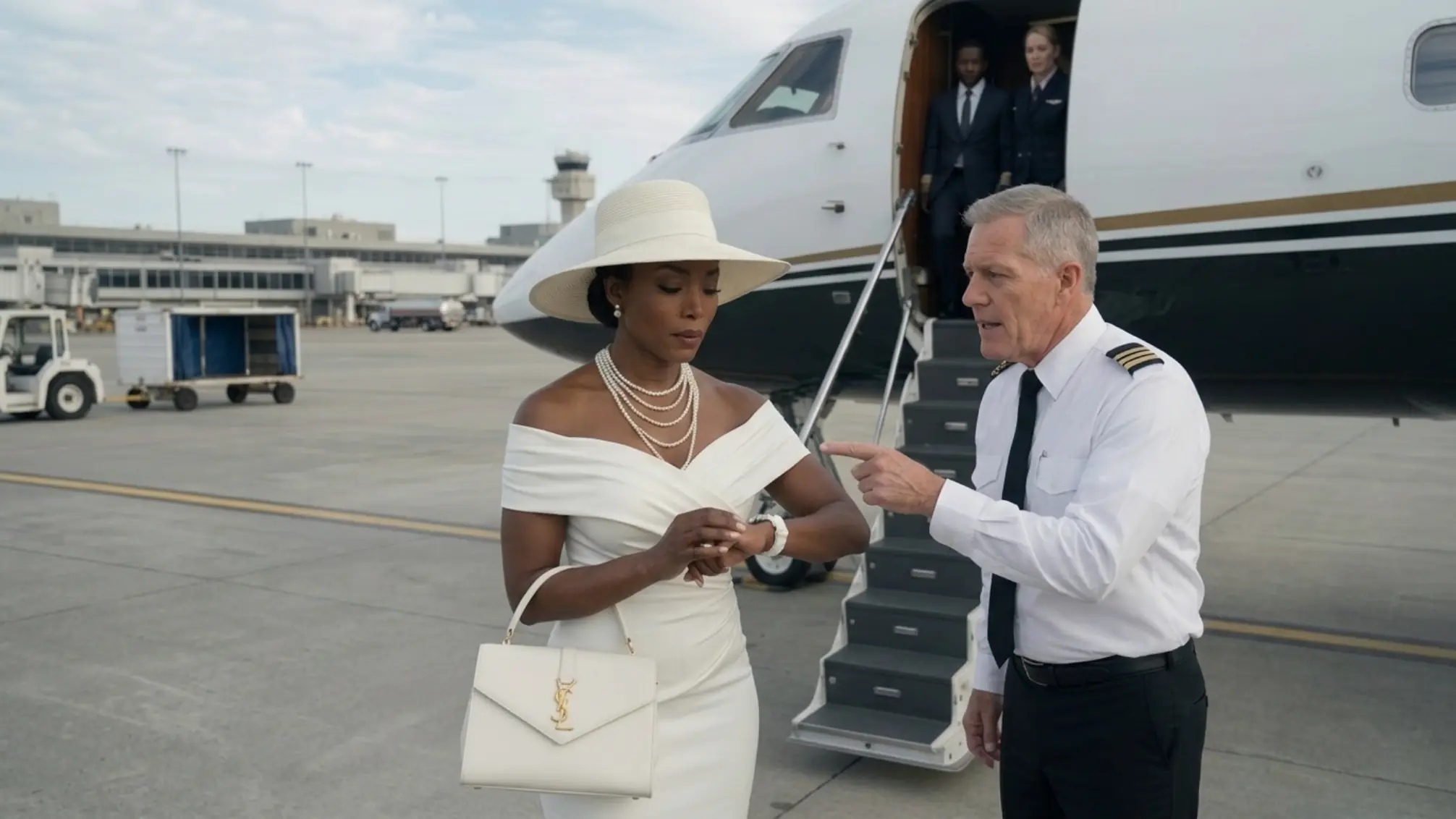
The beautiful thirty-eight-year-old Black American CEO Woman remained directly in front of the open aircraft door. Her smooth deep-brown skin, intelligent dark eyes, and elegant white off-the-shoulder dress made her appear prepared for a formal garden reception rather than an emergency aviation mission. Layered pearl necklaces rested above her neckline, a wide ivory hat framed her flawless low bun, and a structured white handbag hung from one hand. She looked composed, but every second moving across her diamond watch tightened the muscles beneath that calm exterior.
The Captain had met her less than four minutes earlier. He had seen a Black woman in an expensive white dress approaching a private jet and decided she must be an unauthorized guest seeking photographs. He had not requested identification before insulting her, nor had he checked the ownership information displayed on the tablet carried by the operations manager. He simply planted himself between her and the aircraft stairs and announced that people like her did not belong on the ramp.
When she told him the aircraft belonged to her, he laughed.
The Captain was a broad, silver-haired white American man of fifty-nine with decades of experience and the rigid confidence of someone who had rarely been challenged by the people signing his checks. His white pilot shirt displayed four gold stripes, his dark tie was perfectly straight, and his polished shoes reflected the pale afternoon sky. Behind him stood the Copilot, two Flight Attendants, and several ground employees who knew the Black CEO Woman’s identity but remained silent because the Captain controlled their schedules and recommendations. Their silence had encouraged him to become louder.
He accused her of trespassing.
He threatened to have security remove her.
Then he claimed the jet had been grounded because of a hydraulic leak discovered during the morning inspection.
The CEO Woman knew that was a lie.
She had built one of the largest emergency medical aviation networks in the United States after selling her logistics company for several billion dollars. The fleet included five long-range jets, twelve smaller aircraft, and agreements with hospitals across thirty states. Every aircraft transmitted maintenance data directly to a secure operations center, which meant she had already reviewed the jet’s systems before arriving.
There was no hydraulic leak.
There was, however, an altered maintenance report bearing the Captain’s electronic signature.
The President stepped out of the central vehicle wearing a dark navy suit without a tie. He was a handsome fifty-eight-year-old white American man with tired blue eyes, short silver-brown hair, and the controlled expression of a father forcing himself to remain functional. His sixteen-year-old daughter lay inside a Washington hospital, already prepared for heart-transplant surgery. A donor heart had become available in New York, and the CEO Woman’s aircraft was the only approved medical jet positioned close enough to deliver it within the required window.
The President walked past the Captain and stopped in front of the Black CEO Woman.
“Tell me we can still make the flight.”
Her eyes returned to her watch. “We can, but not with this crew.”
The Captain stepped between them. “Mr. President, she entered a restricted area without authorization. I was protecting the aircraft.”
The President looked toward the white jet, then at the woman standing beside its stairs. “Protecting it from its owner?”
The Captain’s face stiffened.
The CEO Woman opened the tablet in her handbag and displayed the ownership registry. Her name appeared beside the aircraft’s serial number, medical operating certificate, and nonprofit assignment. She then opened the false maintenance report. The Captain had entered a hydraulic-pressure warning at 1:06 p.m., twenty-three minutes after the aircraft’s automated system recorded a complete and successful inspection.
“You created a mechanical problem that did not exist,” she said.
“I responded to a verbal report.”
“From whom?”
“My maintenance contact.”
“Give me the name.”
The Captain glanced toward the ground crew. No one answered for him.
The CEO Woman tapped the tablet once. A recorded communication appeared between the Captain and a private charter broker. The broker offered two hundred and fifty thousand dollars for the aircraft to transport a casino owner and several celebrity guests to a boxing match that evening. The Captain promised he would create a maintenance delay long enough to cancel the medical assignment without exposing the private arrangement.
The President’s expression changed.
“You grounded a donor heart for a party flight?”
The Captain looked toward the preservation container still inside the van. “I didn’t know the recipient was your daughter.”
The President stepped closer. “Why should that matter?”
The question stripped away the Captain’s final defense. He had not endangered the President’s daughter knowingly, but he had willingly endangered someone else’s child. He had believed an unknown patient could be sacrificed because no powerful parent would arrive to challenge him.
The CEO Woman checked her watch again.
“Nine minutes remain before we lose the protected departure slot.”
The Captain straightened. “Then you need me.”
A soft electronic tone came from the badge attached to his belt. The green light changed to red. The Copilot’s badge followed, then those belonging to both Flight Attendants.
The aircraft door locked them out of its secure systems.
The Captain stared at his badge. “What did you do?”
“I removed everyone who signed or concealed the false report.”
“You cannot dismiss an entire crew minutes before departure.”
“I dismissed you twelve seconds after verifying the evidence. Your badges took longer to update.”
The Captain reached for the tablet, but two Secret Service agents stepped forward. The CEO Woman did not retreat or raise her voice. She had spent her career entering rooms where men mistook composure for weakness and confidence for permission to underestimate her. The Captain had made the same mistake on the concrete ramp, except this time a life was measured against every wasted minute.
A second crew vehicle emerged from a nearby hangar.
A replacement Captain, Copilot, two Medical Flight Attendants, and a Flight Nurse approached the aircraft. They wore dark-blue uniforms marked with the silver emblem of the CEO Woman’s medical foundation. A federal aviation inspector followed them carrying signed preflight documentation.
The original Captain stared in disbelief. “They couldn’t have inspected the jet already.”
“The inspection began while you were still explaining why a woman in white couldn’t possibly own it.”
The replacement Captain handed the CEO Woman the safety report. “Aircraft is fully operational. Fuel verified, route loaded, medical equipment secured.”
“Cabin temperature?”
“Set for organ transport.”
“Alternate landing plan?”
“Baltimore if Andrews closes.”
She signed the flight release.
The President moved toward the stairs, but the CEO Woman lifted one hand.
“You are not boarding.”
Several Secret Service agents reacted at once.
The President looked at her. “That heart is for my daughter.”
“This mission carries the transplant specialists, preservation team, Flight Nurse, and two pilots. Your security detail would add weight, delay the route, and complicate ground transfer.”
“I can travel with one agent.”
“No.”
The word landed with the same authority she had used against the Captain.
The President had been obeyed by military leaders, governors, corporate chiefs, and foreign officials. Yet the Black CEO Woman stood in front of her own aircraft and denied him without hesitation. She was not performing strength for the crowd; she was protecting a medical process designed to treat every patient equally.
“Clear the airspace,” she continued. “Secure the route from Andrews to the hospital. That is how you help your daughter.”
The President looked at the preservation container and slowly nodded.
The Captain laughed bitterly. “You’re ordering the President now?”
The CEO Woman turned toward him. “No. I’m enforcing rules that don’t change because someone powerful is watching.”
The transplant team removed the preservation container from the van. As they approached the aircraft, a coordinator rushed across the ramp holding a phone against her ear. Her expression was tense enough to stop the CEO Woman before she reached the stairs.
“We have an allocation review.”
The President froze.
The coordinator explained that a second transplant center had submitted updated medical data for an eleven-year-old boy in Baltimore. His condition had deteriorated suddenly, and the national allocation system now ranked him above the President’s daughter based on urgency, compatibility, and survival probability. The heart inside the preservation container might be reassigned.
The President’s security detail began speaking urgently into radios.
One adviser stepped toward the coordinator. “The surgical team in Washington has already prepared the First Daughter.”
“The boy is also prepared,” the coordinator answered.
The President looked at the Black CEO Woman. “Who makes the decision?”
“The transplant allocation authority.”
“How long?”
“Minutes.”
“We do not have minutes.”
“No,” she said. “We have rules.”
The President’s jaw tightened. His daughter was close enough to receiving a new heart that doctors had already begun the operation’s preliminary stage. Every parent in his position would have wanted the aircraft to depart before the allocation changed. He possessed enough authority to create a reason, close an airport, classify the mission, or pressure an official.
The CEO Woman recognized the temptation because she had once stood beside her own dying child.
Nine years earlier, her seven-year-old daughter waited in a Baltimore hospital for a donor heart. The CEO Woman was not yet a billionaire, but she had built a successful logistics company and believed she could solve any delay with intelligence, money, or determination. When a compatible heart became available in Ohio during a winter storm, the hospital arranged a private aircraft.
The jet never arrived.
Its owner reassigned it to a wealthy family offering more money for an international vacation. The charter company hid the decision behind a false mechanical report. By the time another aircraft became available, the heart could no longer be used.
Her daughter died the following morning.
The CEO Woman had spent years transforming that loss into the medical flight network now standing on the ramp. She established one unbreakable principle: no patient would receive priority because of money, fame, political power, race, or personal connection.
Today, that principle stood between the President and his daughter.
The Captain noticed the hesitation and tried to use it.
“Take the President’s daughter first,” he said. “Everyone here knows that’s the smart decision.”
The CEO Woman looked at him. “That is exactly how you justified selling this flight.”
“This is different.”
“Only because you recognize the powerful father.”
The allocation coordinator received the final determination.
The donor heart would go to the eleven-year-old boy in Baltimore.
The President closed his eyes.
His advisers began protesting, but he raised one hand and silenced them. He looked toward the Black CEO Woman, grief and anger battling behind his controlled expression.
“Can another heart be found for my daughter?”
“The hospital will keep her active at the highest appropriate priority.”
“That isn’t what I asked.”
“It is the only honest answer.”
The President looked at the aircraft again. “And if I order the flight to Washington?”
The ramp became completely silent.
The CEO Woman held his gaze.
“Then I ground the jet myself.”
The Captain stared at her, shocked that the woman he had dismissed minutes earlier was now prepared to defy the most powerful office in the country. The President’s agents shifted uneasily, but their principal did not become angry. He looked toward the medical container, understanding that the unknown boy’s parents were experiencing the same terror he felt.
“Send it to Baltimore,” he said.
The CEO Woman nodded once.
She updated the route, signed the revised authorization, and instructed the replacement crew to depart immediately. The aircraft stairs lifted, the door closed, and the engines began turning with a smooth rising sound. The jet moved away from the ramp with one minute and thirty-eight seconds remaining in the protected slot.
The President stood beside the CEO Woman as it taxied toward the runway.
Neither spoke until it lifted into the sky.
“My daughter might die,” he said.
“So might the boy.”
“That doesn’t make this easier.”
“It shouldn’t.”
The President turned toward her. “You made this system after losing your daughter?”
“Yes.”
“And today you used it to deny mine?”
“I used it to protect both of them from people deciding whose family matters more.”
Behind them, federal investigators collected the original crew’s badges, phones, and identification. The Captain attempted to leave, but the aviation inspector informed him that falsifying a maintenance report for financial gain could lead to criminal charges. The Captain looked toward the CEO Woman as if expecting satisfaction.
She felt none.
Removing him did not restore her daughter or guarantee another heart for the President’s child. His downfall was necessary, but punishment was not the same as purpose.
The investigation uncovered a wider scheme. The Captain had secretly diverted medical aircraft three times during the previous eighteen months. Each time, wealthy clients paid through companies connected to his brother. He created maintenance delays, weather concerns, or staffing emergencies to make the cancellations appear unavoidable.
One delayed mission had involved a fourteen-year-old girl whose transplant could not be completed.
The CEO Woman personally met the girl’s parents.
She did not arrive in the white dress, the ivory hat, or the pearls that had become famous after photographs from the ramp spread across the country. She wore a simple dark suit and sat at their kitchen table while they described the night they waited for an aircraft that never came. They had believed bad weather caused the delay.
Learning the truth reopened their grief.
The CEO Woman offered the foundation’s legal support and promised that the investigation would not end with one Captain. The contracted management company had ignored scheduling irregularities because executives received part of the illegal charter revenue. Several ground employees had raised concerns, but supervisors threatened their jobs.
The company lost its operating agreement.
The CEO Woman created an internal crew division for the medical network. Pilots received fixed salaries instead of charter commissions, strong whistleblower protection, and direct authority to reject unsafe pressure from donors, politicians, or executives. Every maintenance change required independent digital verification from two licensed professionals.
She also revised her own leadership practices.
The employees who remained silent while the Captain humiliated her were interviewed individually. Some admitted they feared retaliation. Others said they assumed she would reveal her identity and solve the problem herself.
“You knew who I was,” she told them. “But the next woman he humiliates may not own the jet.”
Employees who had merely frozen received training and probation. Those who signed false records lost their positions. The CEO Woman refused to confuse fear with corruption, but she also refused to pretend silence carried no consequences.
The eleven-year-old boy received the donor heart in Baltimore.
His parents were ordinary Americans: his mother worked in a public-school cafeteria, and his father drove a city bus. They had no idea the President’s daughter had initially been prepared to receive the same organ. The allocation system protected their identity until the family later chose to speak publicly.
The boy survived.
The President’s daughter remained hospitalized.
For thirty-seven days, no compatible heart became available. The President continued governing from secure rooms inside the hospital, while commentators debated whether he should have used his authority to protect his child. Some praised his restraint; others called it weakness.
He never blamed the Black CEO Woman.
On the thirty-eighth day, a second donor heart became available. The medical ranking confirmed his daughter as the correct recipient without conflict or intervention. The CEO Woman’s network transported it aboard a smaller aircraft from Tennessee.
The surgery succeeded.
Several months later, the President invited the CEO Woman to the White House. Cameras gathered in the East Room, expecting him to honor her for saving his daughter. Instead, she asked that the donor families and medical workers stand beside her.
“The President’s daughter is alive because a grieving family chose generosity,” she said. “The boy in Baltimore is alive for the same reason. Aircraft only carry what those families give.”
The President signed a national transplant aviation law that day. It established protected emergency flight corridors, criminal penalties for obstructing medical missions, and a federal dispatch network connecting hospitals with available aircraft. The legislation also prohibited political or financial influence over transport priority.
Reporters called it the CEO Woman’s law.
She insisted it carry her daughter’s first name instead.
One year after the confrontation, the white jet returned to the airport where the Captain had ordered her away. Its luxury interior had been removed and replaced with medical preservation systems, surgical equipment, and secure workstations. The exterior still looked elegant, but the tail displayed the silver symbol of the foundation—a pair of wings surrounding a child’s hand.
The CEO Woman arrived wearing a fitted white suit, pearl earrings, and the same ivory hat. No crowd waited for her, and no President stood beside the aircraft. The morning mission involved a donor liver traveling to a nineteen-year-old supermarket employee in Ohio.
Before she boarded, a newly hired ground worker approached nervously.
“Are you the woman the Captain tried to remove?”
“I am.”
“He really didn’t know you owned the jet?”
“No.”
The worker smiled. “That must have been satisfying when he found out.”
The CEO Woman looked at the open aircraft door.
“It was revealing.”
“What’s the difference?”
“Satisfaction would mean his disrespect ended when he learned I was powerful. The truth is that I deserved respect before he knew my name.”
The worker lowered his eyes, absorbing the lesson.
The CEO Woman walked toward the stairs, then stopped when she saw a young Black girl standing behind the security barrier with her mother. The girl wore a white dress and held a toy airplane against her chest.
“Are you the pilot?” the child called.
“No,” the CEO Woman answered.
“Then what do you do?”
She looked at the medical crew preparing the cabin, the ground employees checking every seal, and the aircraft that had once been delayed by a man who believed ownership should look like him.
“I make sure the right people get to fly.”
The girl smiled.
The CEO Woman boarded, and the jet departed on schedule.
The former Captain believed his greatest mistake was failing to recognize a billionaire. He spent months telling investigators that he would never have spoken that way if he had known who she was.
That defense only proved the Black CEO Woman’s point.
Her value had not begun when the President arrived, when her ownership documents appeared, or when her authority disabled the crew’s badges. She was worthy of dignity while standing silently in white, before anyone knew what she controlled.
The Captain’s prejudice cost him his career.
The CEO Woman’s response changed far more than one crew.
She made the President wait, protected an unknown child’s medical priority, exposed a corrupt charter network, and built a national system where no desperate family needed wealth or influence to make an aircraft arrive.
The most unexpected part of the story was not that the elegant Black woman owned the jet.
It was that after everyone finally recognized her power, she used it to make certain power would never decide who lived.
He believed power belonged to whoever could claim an aircraft, insult its owner, or sell its time to the highest bidder. He believed recognizing the President would have excused failing to recognize the Black Woman standing before him.
Instead, the jet left his world entirely.
It became part of a system where neither presidents nor ordinary families could purchase priority, where pilots answered to safety rather than wealth, and where every minute belonged to the patient who needed it most.
The President arrived that day for his daughter’s heart.
But the Black CEO Woman made certain the next jet would fly for someone without a President for a father.