“Priority boarding isn’t for people like you. Step aside before you hold up the real passengers.”
Layla Grant’s hand snapped up inches from the Black woman’s chest, her palm rigid like a barrier. Her smile was tight, but edged with quiet contempt.
The scanner chirped as she waved another passenger through without even checking his ticket.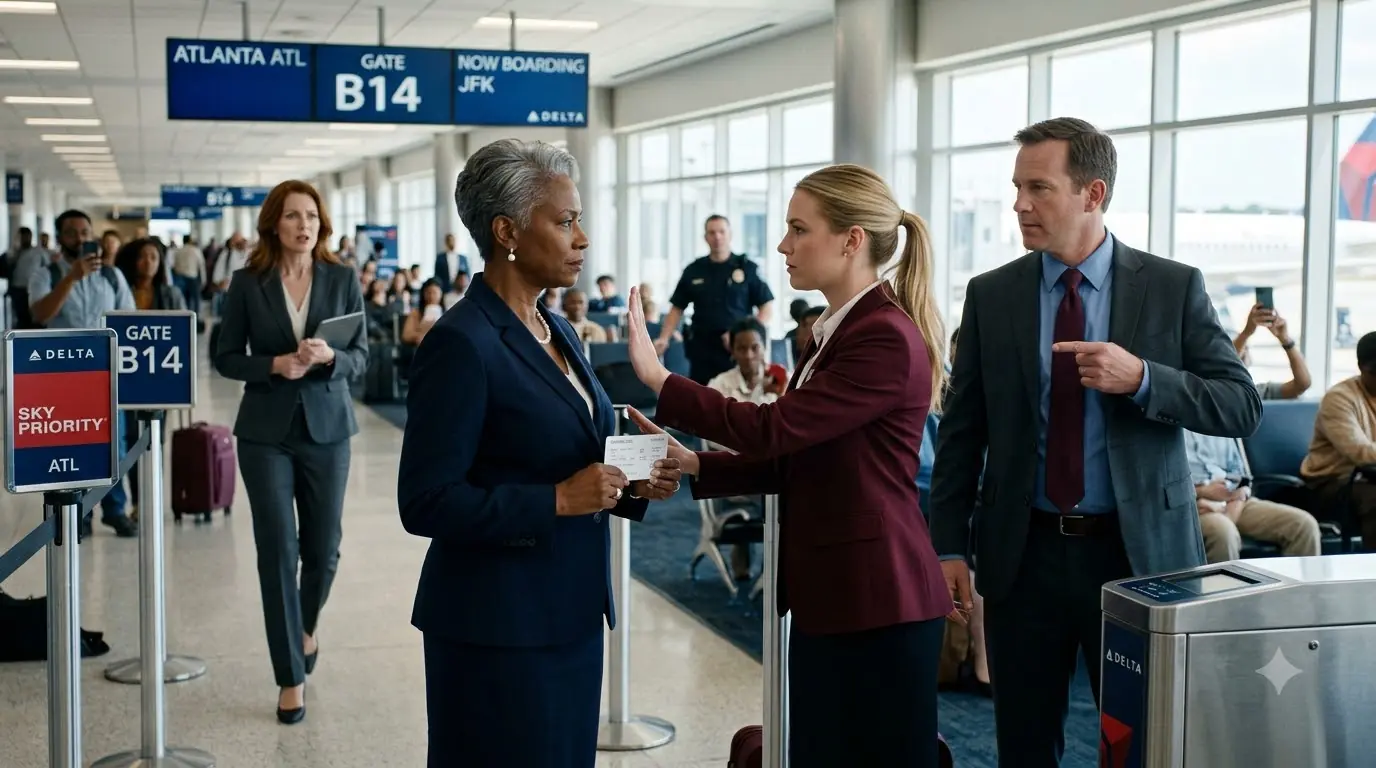
The Black woman did not move. The first-class boarding pass in her hand was clear and undeniable, but Layla pushed it back toward her as though it meant nothing.
“Don’t make this difficult.”
Daniel Reeves stepped closer, his voice rising just enough to attract attention.
“You’re already causing a scene.”
Phones lifted. A few people exchanged looks, already deciding who was right.
The Black woman felt every stare pressing against her and every assumption hanging heavily in the air. Still, her posture never shifted. Her expression remained calm and controlled.
She glanced once at the terminal clock.
Nine minutes.
That was all it would take for them to realize they had just tried to remove the one person who owned everything around them.
The morning sun streamed through the tall windows of Hartsfield-Jackson Atlanta International Airport, casting long rectangles of light across the polished floor.
Gate B14 buzzed with the usual preboarding activity. Passengers checked their phones, children squirmed in their seats, and business travelers tapped away at laptops.
Evelyn Brooks adjusted the sleeve of her navy travel suit and checked her watch. The flight to Los Angeles would begin boarding in ten minutes.
At sixty-two, Evelyn carried herself with the quiet confidence of someone who had earned her position through decades of hard work. Her short, silver-streaked hair framed a face marked by intelligence and determination.
She had deliberately chosen to travel without her usual executive assistants. There would be no VIP escort and no special treatment. She wanted to travel as an ordinary passenger.
That was the point.
How could she truly understand her airline if she experienced it only from the executive suite?
The gate agent announced priority boarding for first-class passengers and elite-status members.
Evelyn lifted her leather bag and approached the priority lane with her boarding pass ready in her hand.
“Ma’am, you need to stop right there.”
Layla Grant, the young gate agent, threw up her hand like a traffic officer, her palm flat and facing Evelyn. Her voice carried across the waiting area, drawing curious glances.
“This lane is for our priority passengers only,” Layla said, making no effort to hide her impatience.
Her eyes barely settled on Evelyn’s face before dismissing her.
Evelyn remained composed and extended her boarding pass.
“I understand. I have a first-class ticket.”
Layla took the boarding pass between two fingers, gave it the briefest glance, and handed it back with a tight smile.
“I think you’re confused about the boarding zones. Please join the regular line and wait your turn.”
Behind Evelyn, a white man in a golf shirt approached.
Layla’s demeanor transformed instantly. Her smile brightened, and her voice became warm.
“Good morning, sir. You can go right ahead.”
She waved him through without checking his boarding pass.
The man hesitated and looked from Evelyn to Layla.
“But I think she was…”
“It’s fine,” Layla interrupted. “Please proceed.”
Heat crawled up Evelyn’s neck, but decades of self-control kept her voice steady.
“Excuse me, but there seems to be some confusion. Would you please examine my boarding pass again? I am in first class.”
People were watching now.
A teenager aimed his telephone toward them. An elderly couple whispered to each other.
The space around the gate desk seemed to shrink.
Layla’s smile became thinner.
“Ma’am, I’ve already checked. If you continue holding up the line, I’ll need to call my supervisor.”
“That would be helpful, actually,” Evelyn replied calmly. “I’d like to speak with that person.”
Layla’s eyes narrowed at the challenge.
She pressed a button on her headset.
“Daniel, can you come to Gate B14? I have a situation.”
Evelyn noticed how Layla emphasized the word “situation” while staring directly at her.
The implication was clear.
Evelyn herself was the problem.
A middle-aged white man in a supervisor’s uniform appeared within minutes.
Daniel Reeves had the harried expression of someone who was perpetually behind schedule.
“What’s happening here?” he asked without addressing Evelyn directly.
Layla leaned toward him.
“This passenger insists she should be in the priority lane. She’s disrupting our boarding process.”
Daniel finally looked at Evelyn. His assessment was quick and dismissive.
“Ma’am, our gate agents are trained professionals. If she says you’re in the wrong line, you need to follow her instructions.”
“I haven’t been given the courtesy of having my boarding pass properly examined,” Evelyn replied.
She held it out again.
“I’m in first class. Seat 2A.”
Daniel barely glanced at the pass.
“Sometimes people become confused about how boarding works. Or perhaps this isn’t your ticket. The name on the pass is Brooks.”
“That’s correct. Evelyn Brooks.”
“And you can verify that you’re Evelyn Brooks?”
The skepticism in his voice was unmistakable.
More phones appeared. The priority line had stopped moving.
Passengers exchanged glances. Some looked uncomfortable, while others were merely curious about the delay.
Evelyn could have ended the entire confrontation immediately.
One sentence would have transformed their smug expressions into horrified recognition.
“I’m the chief executive officer of this airline.”
But something deeper prevented her from saying it.
This was no longer only about her personal dignity. It was about whether her company treated passengers fairly when nobody important appeared to be watching.
“I can certainly verify my identity,” Evelyn said evenly. “But I’d like to understand why the gentleman behind me was waved through without any verification.”
Daniel’s expression hardened.
“Ma’am, we have procedures.”
“Selective procedures, it seems.”
A woman nearby nodded in agreement.
“She’s right,” someone murmured.
Layla’s face flushed with anger.
“You need to step aside now,” she said, raising her voice so that everyone near the gate could hear. “You’re holding up all these other passengers who followed the rules properly.”
“Step aside and wait where, exactly?” Evelyn asked.
Layla pointed toward an area away from both boarding lines.
“Over there, until we sort this out.”
The message could not have been clearer if it had been announced over the airport speakers.
You do not belong here.
You need to be managed.
You are the problem.
Evelyn felt the weight of dozens of eyes.
This was not a misunderstanding. It was a public challenge to her dignity, a display of authority intended to put her in what they believed was her proper place, all based on a quick glance and immediate assumptions.
She took a slow breath and remained exactly where she stood.
Daniel Reeves planted his feet firmly between Evelyn and the boarding gate, creating a physical barrier.
Other passengers moved around them like a stream passing a rock, stealing glances as they continued forward.
“Ma’am, boarding is already underway,” Daniel said, speaking loudly enough for everyone nearby to hear. “You’re causing a delay.”
“I’m simply attempting to board my flight in the correct lane with my first-class ticket.”
Daniel sighed dramatically, as though explaining something to a child.
“Look, sometimes people get confused about boarding zones. It happens all the time, especially with first-time flyers.”
“I’m not confused about boarding zones, Mr. Reeves,” Evelyn said, reading his name tag. “I’ve flown more than two million miles during my lifetime.”
Whispers spread through the waiting area.
A young woman with braids made eye contact with Evelyn and gave her a small nod of solidarity.
Daniel’s eyes narrowed.
“Ms. Brooks…”
“Evelyn Brooks,” she said, keeping her voice steady despite the heat building in her chest.
“Ms. Brooks, Layla is one of our most experienced gate agents. If she instructed you to wait, there was a reason.”
“A reason she hasn’t explained,” Evelyn pointed out. “Would you please verify my seat assignment in your system? Seat 2A, first class.”
Daniel did not move toward the computer.
He did not look at her boarding pass again.
“We have procedures to follow. You’re holding up the line.”
“I’m not holding up anything. I was prevented from scanning my valid boarding pass.”
Evelyn gestured toward the electronic reader.
“Ma’am,” Daniel said, his voice taking on a sharper edge, “your tone is becoming problematic.”
Evelyn blinked.
Her tone had remained measured throughout the exchange.
“I’m speaking calmly and directly. How is that problematic?”
A middle-aged man waiting behind them muttered, “She’s being treated differently from everyone else.”
Daniel shot the man a warning look before turning back to Evelyn.
“If you continue creating a disturbance, we’ll have other options to consider.”
Evelyn noticed Daniel making a subtle gesture with his left hand toward a security officer standing near the adjacent gate.
The officer glanced over, his attention now fixed on the confrontation.
“I’m not disturbing anything,” Evelyn said. “I would simply like to board the flight for which I purchased a ticket.”
Layla stood behind the counter with her arms crossed.
“You need to follow instructions.”
A young man wearing glasses had positioned his phone discreetly and was recording the interaction.
Several other passengers were watching intently, their own boarding temporarily forgotten.
Daniel stepped closer to Evelyn and lowered his voice.
“Listen. We can make this simple or complicated. That’s your choice.”
The threat hung between them.
A cold clarity settled over Evelyn.
This was not about a boarding pass anymore. It was not even about mistaken identity.
It was about power and who was allowed to question it.
“I’d like to speak with your supervisor,” Evelyn said.
Daniel’s mouth twitched into something almost resembling a smile.
“I am the supervisor.”
“Then I’d like to speak with whoever supervises you.”
“They aren’t available at the gate,” he replied with finality. “We aren’t calling them over a boarding issue.”
An older flight attendant appeared at the entrance to the jet bridge.
She glanced toward the commotion, her eyes moving from Daniel to Evelyn with uncertainty.
For a moment, it appeared she might intervene.
Daniel noticed her hesitation and gave a small shake of his head.
The flight attendant pressed her lips together and disappeared down the jet bridge.
“Ms. Brooks,” Daniel said, his patience visibly thinning, “here are your options. You can voluntarily step aside and wait until we finish boarding, or…”
He gestured toward the security officer, who was now watching them directly.
“You can be removed from the boarding area entirely.”
The threat transformed what had begun as disrespect into open aggression.
Evelyn stood perfectly still, aware of every eye upon her and every telephone recording the scene. She understood how quickly the situation could escalate if she displayed even a hint of the anger growing inside her.
What had begun as an attempt to board a flight had become a public humiliation designed to force her into submission instead of addressing the actual issue.
“Those are my only options?” she asked quietly.
“Those are your only options,” Daniel confirmed, satisfaction evident in his voice. “What’s it going to be?”
A movement near the jet bridge caught Evelyn’s attention.
The flight attendant had returned, but this time she moved closer to the gate desk instead of retreating.
She appeared to be in her mid-fifties, with silver streaks in her dark hair. Her name tag read Marjorie Hale.
Her eyes moved from the growing crowd to Daniel’s rigid posture, then settled on Evelyn.
The security officer had begun walking toward the gate in response to Daniel’s earlier signal.
Marjorie moved behind the counter and positioned herself where she could see the boarding pass lying on the surface.
She studied it for a moment, then looked at Evelyn’s face.
Something changed in her expression.
First came recognition.
Then alarm.
She leaned toward Daniel, her voice low but urgent.
“Daniel, I think you should check the passenger record again.”
Daniel barely glanced at her.
“Not now, Marjorie. I’m handling this.”
“But the name…”
Marjorie reached toward the computer.
“I said I’m handling it.”
Daniel’s voice hardened as he blocked her access to the keyboard.
“Get back to the plane. We’re finishing boarding.”
Marjorie hesitated.
Her eyes met Evelyn’s.
In that brief exchange, Evelyn saw what she needed to see.
Someone else recognized that the situation was wrong.
The security officer was only a few steps away.
Evelyn reached into her leather bag and removed a sleek black card with the Aurora Skies logo embossed in silver.
Without ceremony, she placed it on the counter beside her boarding pass.
“Call corporate operations,” she said calmly. “Immediately.”
The executive access card gleamed beneath the terminal lights.
Layla leaned forward to inspect it, then smirked.
“Everyone has fancy credit cards,” she said. “That doesn’t change our boarding procedures.”
Daniel glanced at the card but seemed determined not to alter his course.
“Ms. Brooks, we aren’t calling anyone. The gate crew represents the company here. If you have a complaint, you may submit it through customer service after you step aside.”
“I see,” Evelyn replied.
She picked up the card and returned it to her bag.
“Then I’ll make the call myself.”
She moved away from the counter just far enough to allow the line to continue, although nobody moved.
With deliberate calmness, she removed her phone and pressed a single button connected to a direct executive line.
“This is Brooks,” she said when the call connected. “I’m at Gate B14 in Atlanta. We have a situation requiring immediate attention.”
She listened briefly.
“No names yet. Just send the protocol team.”
Evelyn ended the call and checked the large terminal clock above the gate.
It was 10:42 a.m.
“Operations will address this in nine minutes,” she said quietly.
She did not speak directly to Daniel or Layla, but her words were loud enough for the people nearby to hear.
“Ma’am, you need to…”
Daniel stopped midsentence.
His computer screen had frozen.
He pressed several keys, then began entering commands more frantically.
Nothing responded.
“What the hell?” he muttered.
Layla attempted to scan the boarding pass of the next passenger, but the machine emitted an error tone.
She tried logging in again, only to discover that her credentials had been invalidated.
“Daniel, I’m locked out,” she said, her earlier confidence beginning to falter.
The boarding process stopped completely.
Passengers whispered among themselves.
The digital display above the gate changed from “Boarding” to “Please Stand By.”
Daniel grabbed his phone and entered a number with growing agitation.
“This is Gate Supervisor Reeves at B14. We have a system failure and…”
He stopped and listened.
The color drained from his face.
“What do you mean, stand down? We have a flight to board.”
The security officer approaching Evelyn stopped abruptly.
He raised one hand to his earpiece as new instructions arrived. He nodded once, then turned away from Evelyn.
Daniel watched with visible confusion.
“Officer, we still require assistance with…”
The security officer shook his head.
“New orders, sir. I’m to remain present, but I’m not to engage with the passenger.”
He stepped back and positioned himself at a distance.
The atmosphere surrounding Gate B14 transformed.
What had been a confrontation with clear lines of authority had become something unpredictable.
Daniel’s confidence visibly weakened.
He tried his computer again and found it still locked.
“What did you do?” he demanded, looking at Evelyn.
Evelyn glanced at the clock.
It was 10:44 a.m.
“I haven’t done anything,” she said calmly. “Yet.”
The clock advanced to 10:46 a.m.
Tension hung in the air like storm clouds.
Nobody moved from their position. Daniel remained behind the counter, Layla beside him, Evelyn in front of them, and the passengers frozen in the boarding line.
The only sounds were distant airport announcements and the nervous tapping of Daniel’s fingers against the counter.
Evelyn stood perfectly still, her posture straight and dignified.
She had not raised her voice once or created a disturbance. Yet with a single telephone call, she had brought the entire gate operation to a halt.
Daniel repeatedly checked his watch, the terminal screens, and his locked computer.
Sweat formed along his hairline and dampened his collar.
He tried calling operations again.
“Operations, this is Reeves at B14. I need to speak with a supervisor immediately.”
His voice cracked slightly.
“No, I… Listen, we have a passenger claiming to be… I can’t… Just send someone here now.”
The minutes passed slowly.
10:47.
10:48.
Passengers openly recorded now.
The direction of the public humiliation had completely reversed.
Evelyn had been the target moments earlier. Now the gate employees stood exposed beneath the harsh terminal lights.
A murmur spread through the crowd as a woman in a crisp charcoal suit hurried down the corridor.
Her heels clicked purposefully against the floor.
An airport operations manager followed close behind her. Both wore the grim expressions of people arriving to handle an emergency.
“That’s Naomi Bell,” someone whispered. “She’s the regional vice president.”
Daniel straightened his tie and stepped forward.
“Ms. Bell, we’ve had a situation with…”
Naomi Bell did not look at him.
She walked directly to Evelyn and extended her hand.
“Ms. Brooks,” she said, slightly out of breath. “I apologize for the delay. We weren’t informed that you would be traveling today.”
The words struck the crowd like thunder.
Passengers exchanged shocked looks.
Phones rose higher.
Layla’s mouth fell open.
The color left her face as realization settled over her.
The passenger she had dismissed and attempted to remove from the priority line was Evelyn Brooks, the chief executive officer of Aurora Skies Airlines.
“Ms. Brooks?” Daniel repeated, his voice barely audible. “As in…”
“Your chief executive officer,” Naomi confirmed coldly.
She turned toward Evelyn.
“What happened here?”
Evelyn handed her the boarding pass that Layla had barely examined.
“I attempted to board my flight in the first-class lane, as indicated on my ticket. I was denied, dismissed, and nearly removed from the gate by security.”
Naomi examined the pass, then looked sharply at Daniel.
“This is clearly a first-class boarding pass. It hasn’t even been scanned.”
“There must have been some confusion,” Daniel stammered. “We were following procedure for…”
“For what?”
Evelyn spoke for the first time since Naomi’s arrival.
Her voice was low but crystal clear, carrying across the gate area.
“For profiling passengers? For making assumptions based on appearance? For refusing to verify information when directly asked?”
Daniel’s mouth opened, but no answer came.
Evelyn checked the terminal clock again.
10:51 a.m.
Exactly nine minutes had passed since her call.
“You had nine minutes,” she said, addressing Daniel and Layla.
“Nine minutes to treat one paying passenger with basic respect and dignity. You failed at every step. You did not verify my ticket when asked. You escalated instead of resolving the issue. You threatened instead of assisting.”
There was no heat in her words, only precision.
That made them even more devastating.
“Mr. Reeves, Ms. Grant,” Evelyn continued, using their names even though neither had properly introduced themselves, “your employment with Aurora Skies Airlines is terminated, effective immediately.”
Gasps moved through the crowd.
Layla’s face crumpled.
“The remaining gate employees who witnessed this behavior and chose to enable it rather than correct it will also be removed from duty pending review,” Evelyn added, looking at the other staff members who had remained silent.
“We cannot and will not employ people who treat passengers this way.”
Naomi nodded toward the operations manager, who stepped forward.
“Please surrender your badges and report to Human Resources.”
Daniel’s face flushed red.
“You can’t simply… This isn’t… There are procedures for…”
“Yes, there are procedures,” Evelyn agreed. “Procedures you chose to ignore when they applied to me.”
She met his eyes.
“Now we’re following different procedures. The ones for dismissing employees who violate our most basic standards of service and respect.”
Cameras continued recording as Daniel and Layla removed their identification badges with shaking hands.
There was no shouting and no dramatic escort.
There was only quiet, public accountability.
Evelyn’s face showed no triumph or satisfaction, only weary resolve.
This was not about winning.
It was about correcting something that should never have happened.
As new employees assumed control of the gate and boarding preparations resumed, Evelyn gathered her belongings.
Marjorie Hale, the flight attendant who had attempted to intervene, approached quietly.
“Ms. Brooks,” she said so that only Evelyn could hear, “what happened to you today isn’t the first time.”
Evelyn looked at her.
“Black passengers receive this treatment more often than anyone reports,” Marjorie continued. “Many times…”
The boarding announcements at Gate B14 fell silent again.
Passengers shifted awkwardly, their eyes moving between their phones and the understaffed counter.
The partially boarded aircraft remained at the jet bridge with its engines silent, as though holding its breath.
“Ms. Brooks,” Naomi said, her voice still trembling slightly, “your scheduled departure to Los Angeles is in twenty minutes. We can expedite your boarding and ensure…”
“I won’t be going to Los Angeles today,” Evelyn said firmly.
She turned back to Marjorie.
“Tell me more about these other incidents.”
Marjorie glanced nervously toward the passengers standing within earshot.
“Perhaps somewhere more private?”
Evelyn nodded.
Before they could move, a passenger stepped forward.
She was a middle-aged Black woman wearing a business suit.
“It happened to me too,” she said. “Three months ago. The same gate and the same supervisor.”
Her voice was steady, but her eyes held old anger.
“I filed a complaint. Nothing happened.”
Another passenger joined her.
“My mother was treated this way last Christmas. They made her miss her flight home.”
Evelyn’s jaw tightened.
She turned to Naomi.
“The plane remains at the gate.”
“But the schedule and the passengers…” Naomi began.
“The passengers will understand a short delay caused by an operational necessity,” Evelyn said. “Announce a thirty-minute hold because of a staffing issue. Anyone who needs to rebook may do so without penalty.”
She looked toward the aircraft.
“But we are not pushing back until I understand exactly what is happening at this station.”
Evelyn gestured for Marjorie to follow her away from the crowd.
Naomi trailed behind them, her phone buzzing constantly.
“This is more than what happened today, isn’t it?” Evelyn asked when they reached a quieter area near an empty gate.
Marjorie nodded.
The weight of years seemed to press upon her shoulders.
“There’s a pattern, Ms. Brooks. Black travelers, elderly passengers, and people who don’t look premium enough by someone’s standards are questioned, delayed, and sometimes denied boarding.”
She lowered her voice.
“It’s never officially about race or age. It’s always presented as procedure or security.”
“And the complaints?” Evelyn asked.
“People file them, but nothing happens. The reports are handled by the local supervisors, often the same people causing the problems. Then the complaints disappear.”
Evelyn turned toward Naomi.
“You’re the regional vice president. Did none of this reach your level?”
Naomi’s face reddened.
“There were rumors and occasional complaints that reached my office, but never enough documentation to establish a pattern. The reports I saw were always classified as passenger misunderstandings or security procedures.”
“Or they never reached you at all,” Evelyn said flatly.
The realization struck her like a physical blow.
If this could happen to her, the chief executive officer, what chance did an ordinary passenger have?
What chance did someone without power, connections, or the ability to make corporate operations answer immediately have?
“Cancel my Los Angeles trip,” Evelyn said decisively. “Cancel the entire itinerary. I’m staying in Atlanta until I understand exactly what is happening here.”
“What about Flight 1422?” Naomi asked, gesturing toward the waiting aircraft.
“The plane stays only long enough for crew responsibilities to be reassigned,” Evelyn instructed. “If necessary, deplane the passengers respectfully and provide complete rebooking assistance.”
She turned toward Naomi, her expression leaving no room for argument.
“That aircraft is not departing until we have a properly vetted crew in place.”
Evelyn continued.
“I need you to secure every complaint record from the Atlanta station immediately. Everything from the past two years. Do it before anyone has an opportunity to edit or delete anything.”
Naomi’s eyes widened.
“You think someone would…”
“I think people who discriminate also cover their tracks,” Evelyn interrupted. “I want those records preserved.”
“The station operations office is upstairs,” Marjorie said. “That’s where the local records are kept.”
Evelyn nodded.
“Then that’s where we’re going.”
“Right now?” Naomi asked.
The three women moved through the terminal with purpose, passing curious onlookers and busy travelers who had no idea an internal investigation was beginning around them.
Questions raced through Evelyn’s mind.
How deep did the problem go?
How many passengers had suffered in silence?
How had this happened under her leadership?
They entered an elevator marked “Authorized Personnel Only.”
Naomi used her badge to grant them access to the administrative level above the concourse.
The contrast was immediate.
They left the colorful, bustling terminal and entered sterile hallways lit by fluorescent fixtures, with blank walls and closed office doors.
Another badge swipe opened the operations office.
Employees looked up in surprise when Evelyn entered.
Few recognized her immediately because she rarely visited individual stations. However, the presence of the regional vice president made it clear that this was not a routine visit.
“This is Evelyn Brooks,” Naomi announced, her voice carrying unexpected authority. “Chief executive officer of Aurora Skies.”
The room became silent.
Evelyn wasted no time.
“I need immediate access to all customer complaints filed at this station during the past two years,” she said, walking toward the primary supervisor’s office.
“Specifically, I want every complaint connected to Daniel Reeves and his gate team. Every single one.”
A young operations manager stepped forward.
“Ma’am, those records are typically reviewed through the proper channels and…”
“I am the proper channel today,” Evelyn said.
Her calm voice carried more authority than any shout could have.
“Those files. Now.”
The station office filled with tense activity.
Three computer screens glowed with data as information technology specialists copied the local systems onto secure drives.
A printer produced page after page of archived complaint files.
Barely an hour had passed since the gate incident, but Evelyn Brooks had transformed the ordinary administrative office into the center of an investigation.
Evelyn sat at a conference table beside Naomi and Marjorie, methodically sorting through the first group of printed complaints.
Her reading glasses rested near the end of her nose.
Her expression grew darker with every document she examined.
“Look at this,” she said, sliding a paper toward Naomi. “January fourteenth. An elderly Black couple was removed from the first-class boarding line and told their tickets must have been issued by mistake. Does that sound familiar?”
Naomi’s face tightened as she read.
“Resolution status: passenger misunderstanding,” Evelyn continued. “Filed by Daniel Reeves.”
She picked up another complaint.
“And here is one from March. A woman using a wheelchair was accused of carrying someone else’s priority boarding pass.”
“That was Mrs. Watkins,” Marjorie said quietly. “I remember her. She was a retired school principal traveling to her grandson’s graduation.”
Marjorie shook her head.
“She showed her identification three times, but they still made her wait until general boarding.”
Evelyn placed the paper on a growing pile.
“The resolution was again listed as passenger misunderstanding. It was closed within four hours of being filed.”
An information technology specialist approached with another stack of pages.
“Ms. Brooks, we’ve retrieved the complaints from the past six months. There are many of them.”
“How many?”
“Forty-three matching your search criteria. All involve Atlanta gate employees and similar patterns.”
Evelyn nodded grimly.
“Continue searching back through the full two-year period.”
As they examined more files, a disturbing pattern emerged.
Certain names appeared repeatedly in the approval chain used to dismiss complaints.
One name stood out.
“Harold Pierce,” Evelyn said, tapping a signature line. “Senior operations executive.”
She turned several pages.
“He approved the dismissal of complaints across multiple hubs, not only Atlanta.”
Naomi’s hands trembled slightly as she gathered her own stack of documents.
“I’ve worked with Harold for years. He oversees service compliance throughout the entire Southeast region.”
“If he’s involved,” Evelyn said, completing the thought, “then this isn’t isolated to Atlanta.”
Marjorie leaned forward.
“It isn’t only what appears in those reports,” she said. “It’s what happens every day and is never reported.”
She looked directly at Evelyn.
“Black travelers are asked for additional identification when white passengers are not. Business-class customers are questioned about whether they truly belong there. Some gate agents speak to older Black passengers as though they are trespassers instead of paying customers.”
Marjorie paused.
“Most people simply want to reach their destinations. They don’t file complaints. They swallow the humiliation and continue traveling.”
Evelyn put down her pen.
“Not anymore,” she said. “Not on my airline.”
She removed her telephone and called her executive assistant.
“Jacob, I need an immediate internal audit arranged with complete discretion. Use external auditors who report directly to me.”
She glanced at the complaint files.
“Focus on customer complaint resolution across all stations, especially complaints involving boarding procedures and priority access.”
After ending that call, she dialed the head of corporate security.
“This is Brooks. Preserve every access log and every piece of surveillance footage from Gate B14 today. I want every camera angle and every second secured outside the local network before anyone knows we’re examining it.”
Naomi looked alarmed.
“You think someone might attempt to delete evidence?”
“I think when people hide discrimination, they often hide other misconduct too,” Evelyn replied.
The information technology specialist returned, carrying a tablet.
“Ms. Brooks, we recovered today’s security footage from the gate area. Would you like to review it now?”
Evelyn nodded.
They gathered around the screen.
The recording showed Daniel Reeves working at the gate before Evelyn approached.
The timestamp matched her arrival.
They watched Daniel smile and wave three white passengers in business attire through the priority line without examining their boarding passes.
Then Evelyn approached.
Daniel’s body language changed immediately.
He straightened, raised his hand to stop her, and demanded her documents.
“Pause it,” Evelyn said quietly.
The video froze on Daniel’s face.
His expression carried suspicion and authority as he looked at her.
“This isn’t a misunderstanding,” Evelyn said, her voice controlled but vibrating with intensity. “It was deliberate, and now we have it on video.”
Naomi stared at the screen as her professional composure finally cracked.
“I had no idea it was this blatant. I’m so sorry.”
“Don’t apologize,” Evelyn replied. “Help me fix it.”
She turned toward the specialist.
“Download everything. We’re only beginning.”
Afternoon sunlight passed through the office blinds, casting striped patterns over the growing mountain of evidence.
What had begun as a humiliating incident at an airport gate was revealing something far more serious.
It was a system designed to protect itself at the expense of passengers’ dignity.
Evelyn Brooks had become that system’s greatest threat.
That evening, Evelyn settled into a conference room at the airport hotel.
The room had beige walls and practical furniture. It felt anonymous and tense.
The Atlanta sunset painted orange streaks across the skyline beyond the windows.
Instead of traveling to Los Angeles as planned, Evelyn sat at the head of a long table facing a screen.
Naomi had arranged video interviews with passengers whose complaints had been buried.
“I’ve confirmed five interviews during the next two hours,” Naomi explained while setting up her laptop. “These passengers responded immediately when we contacted them. They’re eager to be heard.”
Marjorie placed water glasses and notepads around the table.
“Some of these incidents happened on my flights. I saw things, but I couldn’t…”
She stopped.
“I should have tried harder.”
“We’ll address that later,” Evelyn said firmly. “Right now, I need to hear their stories directly.”
The first call connected.
Walter Jenkins appeared on the screen.
He was a distinguished Black man in his seventies, with silver hair and kind eyes that could not hide lingering hurt.
“Mr. Jenkins, thank you for speaking with us,” Evelyn began. “I’m Evelyn Brooks, chief executive officer of Aurora Skies.”
The man raised his eyebrows.
“The CEO herself? That’s a first.”
“I understand you had a troubling experience on one of our flights last year. Could you tell me what happened?”
Walter adjusted his glasses.
“My daughter gave me first-class tickets so I could take my grandchildren to Disney World. It was supposed to be a special trip.”
His voice wavered slightly.
“At the gate, one of your employees, a young man named Kevin, pulled me aside. He said there was an irregularity with my ticket.”
Walter’s hands tightened in his lap.
“He asked how I obtained first-class tickets and suggested they might have been acquired improperly. My grandchildren were ten and eight years old. They heard every word and watched their grandfather being treated like a criminal.”
Evelyn felt sick.
“What happened next?”
“He made us wait while he verified the tickets. Thirty minutes. People stared at us. My grandson asked whether we were in trouble.”
Walter leaned closer to the camera.
“Eventually, Kevin said everything had been cleared. He never apologized. He simply allowed us to board after everyone else.”
Walter’s expression hardened.
“I filed a complaint. I received an email calling it a misunderstanding and offering me five thousand miles. My daughter wanted to sue, but I was too embarrassed.”
He looked down.
“I haven’t flown since.”
Evelyn took a slow breath.
“Mr. Jenkins, what happened to you was unacceptable and racist. It was not a misunderstanding.”
She looked directly into the camera.
“I apologize personally, but I understand that an apology is not enough.”
The interviews continued.
Rita Mercer, a retired nurse in her sixties, described being removed from the priority lane despite having lounge access through her credit card.
“The agent said I didn’t look like I belonged in the lounge,” Rita explained, her gray hair pulled into a neat bun. “She asked three times whether I understood how boarding worked.”
Rita shook her head.
“She made me show my identification twice while people behind me watched. I’ve been a million-mile customer with your airline for years.”
With every account, the pattern became clearer.
Patricia Wong described being questioned about her business-class ticket while her white colleagues boarded without difficulty.
James Thompson recalled a gate agent insisting that his premium boarding status had to be a system error.
Between the calls, Evelyn took careful notes. Her handwriting became tighter with every page.
Marjorie occasionally added context, recalling flight numbers, employees involved, and patterns she had noticed but had never been able to prove.
By the fifth interview, Evelyn’s composed exterior had hardened into determination.
This was not one incident.
It was not even several unrelated incidents.
It was systemic.
“These people trusted us with more than transportation,” Evelyn said during a short break. “They trusted us with their dignity, and we failed them.”
She looked at the notes spread across the table.
“Every one of these complaints was dismissed as a misunderstanding or resolved with token miles.”
Naomi displayed a flowchart on her tablet.
“I mapped the complaint-routing process. Everything goes through regional supervisors first, then to Harold Pierce’s team if it is escalated. Most complaints never reach the second level.”
Evelyn nodded.
“And the regional supervisors report to Harold.”
She turned toward Naomi.
“Create immediate compensation packages for every passenger we interviewed today. Full refunds, premium status, and personal apologies. But that is only the beginning.”
The sky outside had become completely dark. Runway lights shone in the distance.
Naomi’s phone chimed.
She read the message and looked up with surprise.
“It’s about Harold Pierce. He’s flying into Atlanta tonight. He lands in approximately an hour.”
“How did he learn what we’re doing?” Marjorie asked.
“Someone alerted him,” Evelyn said, gathering her notes. “Let me guess. He insists on meeting before we take any further action.”
Naomi nodded.
“His exact words are that it is critical for us to align on messaging before any premature action is taken.”
Evelyn straightened her jacket.
Calm determination settled across her face.
“Perfect. I’d prefer to have this conversation in person.”
The evidence remained spread across the table.
It contained accounts of humiliation, dismissed complaints, and broken trust, all exposed beneath the conference room lights as night settled over Atlanta.
Harold Pierce entered the airport hotel’s executive meeting room shortly after eight o’clock.
His charcoal suit remained perfectly pressed despite his flight from Charlotte.
His expression conveyed controlled concern.
Evelyn stood when he entered. Her posture matched his authority but lacked his carefully practiced smoothness.
“Evelyn,” he said, extending a hand. “I came as soon as I heard. This is a regrettable situation.”
She shook his hand briefly.
“Harold, thank you for coming on short notice.”
Naomi and Marjorie sat quietly at the table.
The evidence gathered throughout the afternoon was arranged strategically, but not hidden.
Harold’s eyes passed over the stacks of printed complaints before he sat across from Evelyn.
“I’ve received preliminary reports,” Harold began, using the measured tone he reserved for crises. “An unfortunate frontline mistake happened to involve you personally. These things occur in operations of our size.”
“This wasn’t only about me,” Evelyn replied.
Harold nodded sympathetically.
“Of course not. Every passenger deserves proper treatment. The public perception is particularly concerning here. A Black woman, our chief executive officer, experiencing discrimination at one of our gates.”
He placed a tablet on the table.
“I drafted a statement for tomorrow. It presents the immediate dismissals as decisive leadership while reaffirming our corporate values.”
Evelyn glanced at the tablet without touching it.
“Your statement describes an isolated incident.”
“That is the best practice in situations like this,” Harold said. “We address what happened, take visible action, and avoid language suggesting systemic misconduct.”
He folded his hands.
“The dismissals send a clear message without inviting unnecessary scrutiny.”
Evelyn pushed a folder of complaint records toward him.
“We’ve spent the afternoon reviewing similar cases. Black passengers questioned about their tickets. Older travelers removed from priority lines. Customers challenged about lounge access because of their appearance.”
She watched him carefully.
“There are dozens of cases, Harold.”
His expression did not change, although his fingers tightened slightly around his pen.
“Every airline receives thousands of service complaints. Context matters. What percentage are we discussing? How many accusations were verified?”
He leaned forward.
“Customer perceptions don’t always align with operational reality.”
Naomi watched his face.
His concern appeared focused on containing the story rather than addressing the harm.
“We personally spoke with several affected passengers,” Evelyn replied. “Their stories are not simply perceptions. They are experiences, and nearly all their complaints were dismissed at the local level.”
“That is standard procedure,” Harold said. “Local supervisors separate ordinary service concerns from serious incidents. It’s efficiency, not concealment.”
“Then why didn’t these cases reach executive review?” Evelyn asked. “A pattern this consistent should have triggered alerts.”
Harold’s smile remained, but became noticeably thinner.
“Our protocols use statistical thresholds to separate significant data from ordinary noise. Legal advisers told us years ago that every allegation of bias cannot receive senior-level attention without overwhelming the system.”
“Legal advisers?” Evelyn repeated. “Who specifically?”
“Outside counsel,” Harold replied smoothly. “It’s standard practice throughout the industry. Ask any airline.”
Marjorie, who had remained silent, cleared her throat.
“Mr. Pierce, I’ve been flying for thirty years. Crews were taught which passengers to flag as potential problems. It was never official, but it happened.”
Harold’s calm expression cracked for a fraction of a second.
“That simply isn’t accurate, Ms. Hale. We have documented service standards applying equally to every passenger.”
“On paper, yes,” Marjorie continued, refusing to be dismissed. “But supervisors like Daniel Reeves told crews which passengers deserved extra verification.”
She began listing examples.
“Young Black men traveling alone. Older passengers who might need assistance but hadn’t requested it. Anyone who didn’t appear to belong in a premium cabin.”
“That is an inflammatory accusation without evidence,” Harold snapped.
His practiced patience was slipping.
“If isolated misunderstandings occurred among employees, that is precisely why we conduct training.”
“Training you oversee,” Evelyn observed quietly.
Harold straightened his already perfect tie.
“Evelyn, I understand that you had a personally upsetting experience today. But elevating this into a company-wide crisis based on anecdotal reports would be reckless.”
He looked toward the complaint files.
“The dismissals were appropriate. A measured statement is prudent. Anything more threatens shareholder confidence and invites litigation.”
The discussion continued for almost two hours.
Harold presented statistics showing complaint rates consistent with industry averages.
Evelyn countered with evidence showing the systematic dismissal of specific categories of complaints.
The longer they spoke, the more Harold’s responses focused on protecting Aurora Skies’ reputation instead of restoring passenger dignity.
When Harold finally left, promising to review the protocols but offering no concrete commitments, Evelyn remained at the table with Naomi and Marjorie.
The digital clock on the wall showed 10:42 p.m.
“He’s going to bury this,” Naomi said quietly.
Evelyn looked at the evidence covering the table, then at Marjorie’s tired but determined face.
She pulled her laptop closer and opened a new document.
“No, he isn’t,” she said firmly. “This isn’t something we can handle quietly anymore.”
She looked toward Naomi.
“I need corporate communications on the phone within the hour. We’re addressing this across the entire company before midnight.”
Evelyn sat at the head of the small conference table in her hotel suite with her laptop open before her.
The room’s lighting felt painfully bright against her tired eyes, but her posture remained perfect.
A grid of faces appeared on the screen.
Naomi joined from the adjoining room. The company’s crisis management team, head of legal affairs, and three members of the board had also been pulled into the emergency meeting.
“I want to be absolutely clear,” Evelyn said, her voice firm despite the exhaustion weighing on her. “What happened today was not an isolated incident.”
She looked into the camera.
“It represents a failure at multiple levels, and I accept full responsibility for not discovering it sooner.”
She shared her screen and displayed a spreadsheet summarizing the complaints uncovered during the previous several hours.
“Effective immediately, we are implementing the following changes.”
She moved to a written outline.
“First, all discrimination complaints will be reviewed by an independent outside organization, not internal management.”
She continued.
“Second, every customer-facing employee will undergo mandatory retraining, beginning at our hub locations.”
“Third, station-level managers will no longer have discretion over how bias complaints are categorized and reported.”
The head of legal affairs, a sharp-eyed woman named Victoria, cleared her throat.
“Ms. Brooks, I support addressing the issue, but this timeline may create significant exposure.”
“Our exposure already exists,” Evelyn interrupted. “The question isn’t whether we will face consequences. It is whether we deserve them.”
She moved to the next point.
“I’m also creating a direct passenger hotline reporting to headquarters and bypassing local management completely.”
Naomi nodded from her screen.
“I’ve contacted three independent review firms specializing in aviation customer experience. They can begin their assessments tomorrow.”
Urgency filled the virtual meeting.
Keyboards clicked as the communications team drafted statements. Operations executives mapped out training requirements.
By 11:45 p.m., they had established the framework for a comprehensive response.
The board chair, a distinguished woman with silver-streaked hair, spoke.
“Evelyn, I’ve known you for fifteen years. The way you handled this situation today demonstrates exactly why you lead this company.”
She paused.
“The board supports these measures. We need to act before this becomes a larger public crisis.”
For the first time since that morning, Evelyn felt a small wave of relief.
The nightmare of being publicly humiliated at her own airline’s gate had been transformed into something purposeful.
They were moving forward.
“We’ve identified sixty-two passengers with similar complaints from the past year alone,” Naomi reported. “Our outreach team will begin contacting them tomorrow with personal apologies and appropriate compensation.”
Marjorie had been quietly observing from a chair against the wall.
She looked up.
“Perhaps the worst part of today will finally lead to something good,” she said softly. “I’ve watched so many problems disappear over the years. This feels different.”
Evelyn nodded.
“It is different because we are not merely repairing a procedure. We are changing a culture.”
The final participant to join the meeting was Harold Pierce.
His expression remained strangely calm as he listened to decisions that had already been made.
When Evelyn asked for his opinion regarding implementation, he nodded.
“I’ll ensure operational compliance,” he said smoothly. “Although I caution that public crises punish companies that lose message discipline.”
His tone remained careful.
“We should avoid admitting systemic problems before their full scope has been confirmed.”
Something in Harold’s voice made Evelyn uneasy, but she pushed the feeling aside.
“Our discipline will be demonstrated through transparency,” she replied.
She looked around the virtual meeting.
“Thank you for responding so quickly. We’ll reconvene at seven tomorrow morning to begin implementation.”
When the meeting ended, Evelyn closed her laptop and finally allowed her shoulders to lower.
She removed her shoes and walked toward the window.
Airport lights blinked across the darkness.
For the first time in sixteen hours, she drew a breath that did not feel trapped behind a knot in her chest.
A knock came at her door just as she was preparing to wash her face.
Evelyn tightened the belt of her hotel robe and opened the door.
Naomi stood in the hallway holding her telephone.
Her face was pale.
“What is it?” Evelyn asked, instantly alert.
“It’s the press,” Naomi said, turning the screen toward her. “They have an internal memorandum bearing your signature.”
Evelyn took the telephone.
A breaking-news headline from the Atlanta Business Chronicle appeared on the screen.
Aurora Skies CEO Knew About Discrimination. Memo Shows Brooks Ordered Complaints Buried.
Evelyn stared at the headline, unable to understand it at first.
“What is this?”
“It’s everywhere,” Naomi said, her voice tight. “Cable news, business networks, and airline industry sites are all reporting it.”
Evelyn scrolled down and saw an image of what appeared to be an internal company memorandum.
The letterhead was correct.
The formatting matched official Aurora Skies documents.
At the bottom were her name and digital signature.
The memorandum established procedures for handling passenger conflicts involving possible discrimination.
It instructed managers to reclassify those complaints as general customer service incidents unless they attracted media coverage or legal action.
The words blurred before Evelyn’s eyes as she read the passage highlighted in the article.
“While appropriate documentation must be maintained for legal purposes, publicly reported complaint statistics should include only verified service failures, not subjective passenger interpretations of employee motivation.”
“I never wrote this,” Evelyn said, her voice hardening. “I never authorized it.”
Naomi nodded.
“I know, but the digital signature chain appears authentic. It shows your approval from three months ago.”
The television in the room flashed with a breaking-news alert.
Evelyn grabbed the remote control and raised the volume.
“Breaking tonight,” the anchor announced. “The chief executive officer of Aurora Skies Airlines, who made headlines earlier today for dismissing employees who denied her boarding, appears to have known about and personally approved policies designed to minimize discrimination complaints.”
The report continued.
“Critics are accusing Evelyn Brooks of applying one standard to herself and another to ordinary passengers.”
Evelyn’s telephone rang.
It was the board chair.
“Naomi, get me everything available about that memorandum. When it was created, who accessed it, and who transmitted it. Everything.”
Evelyn answered the call.
Naomi stepped into the hallway to give her privacy, then returned seconds later with Marjorie, who looked stunned.
“Ms. Brooks,” the board chair said, her voice clipped, “I need an explanation. We supported your reform announcement, and now this document appears. The timing is catastrophic.”
“The memorandum is fraudulent,” Evelyn replied firmly. “I never wrote or approved it.”
“The digital authentication indicates otherwise. It was processed through our secured document system using your credentials.”
“Then someone used my credentials without authorization.”
There was a heavy pause.
“That is a serious accusation. Who would possess both the access and motivation?”
“I intend to find out,” Evelyn said. “I need the board’s trust for twenty-four hours.”
“Trust is in short supply tonight, Evelyn. Our share price has already dropped three percent in after-hours trading. Social media campaigns are calling for boycotts.”
Evelyn looked toward Marjorie.
The flight attendant stood uncertainly near the door.
“Do you believe this?” Evelyn asked her directly.
Marjorie hesitated.
“I want to believe you, but that memorandum explains a great deal about what has been happening. It explains how complaints disappeared and why nothing ever changed.”
The doubt in her voice cut more deeply than the public humiliation at the gate.
Evelyn ended the board call after promising to provide proof of the forgery by morning.
Her phone rang again immediately.
This time, it was Harold Pierce.
“Evelyn, I just saw the news,” he said, his voice combining concern and professionalism perfectly. “This is deeply unfortunate timing.”
“Did you know about the memorandum before tonight?” she asked directly.
“Of course not,” he replied, sounding mildly offended. “I’m calling to offer my support.”
His tone shifted.
“The board is understandably concerned about stability. It may be prudent for you to temporarily step back while we conduct the investigation. I can manage operations in the interim.”
The calculation behind his words became suddenly clear.
“That won’t be necessary, Harold,” Evelyn replied evenly. “I’ll handle this personally.”
She ended the call and turned toward Naomi.
“I need the information security team investigating this immediately. Conduct a complete audit of document access and authentication logs.”
Naomi nodded grimly.
“And if we discover tampering?”
“When we discover tampering,” Evelyn corrected her. “Whoever did this was clever enough to forge my signature, but careless enough to create a policy contradicting everything in my leadership record.”
After Naomi and the still-uncertain Marjorie left, Evelyn sat alone in the silent hotel room.
She opened her laptop and studied the memorandum with cold fury.
The language was formal, but it was not hers.
The policy described was something she would never have approved.
She knew with absolute certainty that someone inside her own executive team had orchestrated the forgery.
It had to be someone with enough access to copy her signature and enough desperation to sacrifice her reputation to protect themselves.
The clock beside the bed showed 1:07 a.m.
Less than eighteen hours earlier, she had been a respected chief executive traveling to a routine meeting.
Now she was fighting for her career, her company, and the truth.
At 1:15 a.m., Evelyn stood beside the hotel window, her reflection faint against the tarmac lights below.
Sleep was not an option.
She had changed from her travel suit into a black cashmere sweater and slacks, comfortable but still authoritative.
The remains of her room-service coffee cooled beside the laptop.
“We need everything,” she said as Naomi transformed the hotel desk into a temporary command center. “Not only the memorandum, but the structure beneath it.”
On the video screen, Aurora Skies’ head of cybersecurity, Marcus Jennings, nodded grimly.
His Chicago office was brightly lit despite the hour. Members of his team moved behind him.
“Ms. Brooks, we are creating a secure mirror of the document management system now,” Marcus said. “Metadata does not lie, even when people do.”
Evelyn approached the investigation methodically rather than emotionally.
Anger would not recover what had been stolen from her.
Evidence would.
“I want the approval-chain logs for every version of the document, creation timestamps, access records, and server authentication points.”
She leaned closer to the screen.
“If that memorandum existed anywhere on our network, I want to know when and how.”
Naomi typed rapidly while moving between telephone calls.
“The board chair wants a statement by six in the morning.”
“Tell the board I’m conducting a security investigation into document forgery before making any public statement. Ask for four hours to provide evidence of tampering.”
“They’re discussing a temporary suspension, Evelyn.”
“Then they should prepare to reverse it publicly when I prove the memorandum is fraudulent.”
Her voice was steel rather than fire.
“Four hours. That is all I need.”
A quiet knock interrupted them.
Marjorie stood in the doorway. Her face was drawn with exhaustion and regret.
“I shouldn’t have doubted you,” she said. “After all these years of watching passengers being treated unfairly, I should have known better than to believe you supported it.”
Evelyn gestured for her to enter.
“We don’t have time for apologies. I need information.”
Marjorie stepped inside, twisting her hands together.
“Something has bothered me since we began examining the records.”
She took a breath.
“Approximately six months ago, I overheard Daniel telling another gate agent that headquarters had issued specific instructions about coding passenger complaints.”
Evelyn’s eyes narrowed.
“What instructions?”
“He said certain words needed to be avoided in written reports.”
“Which words?”
“Discrimination, profiling, and race.”
Marjorie looked down.
“He said using those terms created unnecessary escalation. Employees were instructed to write ‘service failure’ instead.”
“Did he say who at headquarters issued the instruction?” Naomi asked.
“No names. He said it came from upstairs and would protect everyone’s performance reviews.”
Evelyn turned toward the screen.
“Marcus, search for every procedural memorandum related to complaint classification during the past year. Also determine who had access to templates containing my signature block.”
By 2:30 a.m., the hotel room was filled with empty coffee cups and takeout containers.
Marcus’s team had created a document timeline on a shared screen, with anomalies highlighted.
“Here is what we know,” Marcus said, circling one section. “The leaked memorandum claims a creation date eight months ago, but its digital signature uses an encryption key that was not introduced until four months ago.”
“So it was backdated,” Evelyn concluded.
“Precisely. It was also created through a privileged template account belonging to Executive Administrative Services.”
Naomi leaned forward.
“Harold Pierce’s executive assistant has access to that account.”
“More than access,” Marcus continued. “The revision history shows fragments of the memorandum being created on her workstation. However, the final document was assembled offline before being uploaded as a completed file.”
“Can you prove I didn’t create it?” Evelyn asked directly.
“Your authentication records place you in a board meeting during the final upload. Unless you can occupy two secured digital locations simultaneously, you could not have authorized the document.”
By three o’clock, the evidence was mounting.
The forged memorandum had not been created in panic after the gate confrontation.
It was part of a calculated system of concealment and had now been activated as a weapon against Evelyn.
“This isn’t only about hiding mistakes,” Evelyn said quietly. “It’s systematic.”
Marjorie nodded.
“They’ve been burying complaints for years. I never understood how high the system reached.”
Marcus interrupted them.
“Ms. Brooks, we discovered something else. During the search for complaint-classification procedures, we located a related compliance training recording in the archives.”
He looked toward another monitor.
“It was marked for deletion but had not yet been permanently removed.”
His fingers moved across the keyboard.
“I’m playing it now.”
Harold Pierce’s unmistakable voice filled the room.
“Listen, I understand your concerns, but these racial complaint categories are damaging our performance metrics. The board sees these figures. Investors see them.”
His voice became harder.
“We need the complaints reclassified as general customer satisfaction issues. Nothing specifically identifying discrimination should appear in quarterly reports.”
Another voice responded.
“But if passengers specifically report racial profiling…”
“They are misinterpreting ordinary security procedures,” Harold interrupted sharply. “Your responsibility is to protect this airline’s reputation, not validate every passenger’s perception.”
He continued.
“Downgrade the complaints, revise the language, and focus on the performance indicators that actually affect our bottom line.”
The recording ended with Harold’s final instruction.
“This conversation never happened.”
Silence filled the hotel room.
Evelyn spoke in a dangerously quiet voice.
“It appears Mr. Pierce forgot that compliance recordings are automatically archived.”
Naomi stared at the screen.
“This recording is eleven months old. It destroys his plausible deniability.”
Evelyn straightened her shoulders.
“Make a secure copy. Then wake our general counsel.”
The digital evidence had changed the nature of the confrontation.
What had begun as Evelyn defending herself had become an offensive against corruption that had been growing inside her own company.
Predawn light appeared through the windows of a private conference suite near the terminal.
The sky above Atlanta was beginning to change from black to gray.
Evelyn sat at the head of a polished table, her eyes fixed upon the screen.
Naomi stood near the door, answering urgent calls and preventing unnecessary interruptions.
Marjorie had refused to leave despite the late hour. She sat quietly with her hands folded.
“Play it again,” Evelyn said. “I want to hear every word.”
The recording filled the room once more.
Harold’s voice was confident and cold.
“Listen. I need everyone to understand something fundamental about our operations. Complaint volume directly affects quarterly performance metrics.”
He paused.
“Those metrics determine station evaluations, bonuses, and ultimately investor confidence.”
Harold continued.
“Any complaint with racial implications must be neutralized before it reaches corporate review. Reclassify it as customer misunderstanding or procedural confusion.”
His voice sharpened.
“If passengers insist, offer vouchers, but never admit discriminatory conduct.”
Someone on the recording asked, “What happens if they have evidence, such as video or witnesses?”
“Then make it worth their while to stop pursuing the matter,” Harold answered without hesitation. “Provide a first-class upgrade, bonus miles, or whatever is necessary.”
He continued.
“Keep the complaints contained at the station level. Remember, your performance reviews depend on minimizing escalations.”
Evelyn stopped the playback and looked at Marjorie.
“How long have you seen this happening?”
“Years,” Marjorie answered, regret weighing heavily on her voice. “But it was always handled quickly.”
She stared down at her hands.
“Black passengers would complain, then suddenly they would be pulled aside, given something free, and the complaint would disappear.”
Marjorie shook her head.
“I believed they were being helped. I didn’t understand that they were being silenced.”
“The entire system was designed to reward concealment,” Evelyn said, tapping her fingers against the table. “Gate agents like Daniel were only the visible part.”
She looked at the evidence.
“Behind them were supervisors, station managers, and executives who all benefited from keeping complaints buried.”
Naomi approached the table.
“The board chair is waiting on the secure line. They are concerned about the developing situation.”
“I imagine they are,” Evelyn replied, reaching for her phone.
“Tell them I’m sending the evidence directly to our outside counsel, to every board member individually, and to the Department of Transportation.”
Her eyes hardened.
“Harold will not have time to control the story.”
While Evelyn briefed the board chair, Naomi drafted language for a possible public statement.
When the call ended, Naomi placed the tablet in front of Evelyn.
“We should issue this from headquarters as soon as possible. The language is controlled and forward-looking. We acknowledge that problems were discovered, state that corrective measures are underway, and promise additional changes.”
Evelyn read it, then returned the tablet without speaking.
“That isn’t enough,” she said. “Not nearly enough.”
“What do you want to do?” Naomi asked.
Evelyn stood and walked toward the window.
The airport was beginning to awaken as the first flights of the day prepared for departure.
“This began at a public gate, where I was humiliated because of how I looked.”
She turned toward them.
“That is where the truth needs to be told.”
She looked at Naomi.
“Schedule a press conference for eleven this morning at Gate B14.”
“The same gate?” Marjorie asked.
“Exactly the same gate.”
Naomi looked alarmed.
“Evelyn, we could control the narrative more effectively from headquarters. The airport will be chaotic and unpredictable.”
“That is precisely the point,” Evelyn replied. “This isn’t about corporate control anymore.”
She returned to the table.
“It is about facing the truth where the harm occurred. No boardroom protection and no carefully constructed backdrop. Only the place where passengers stand every day.”
The following hours became a blur of preparation.
Security arrangements were made. Media organizations were notified.
Gate B14 would be temporarily removed from regular service.
The legal department prepared briefing materials while the communications team drafted key information.
Throughout the preparations, Evelyn remained focused, reviewing evidence and preparing herself for the confrontation ahead.
As the sun rose fully over Atlanta, Evelyn’s phone vibrated with a message from Harold.
Think carefully about what you’re doing. A public conflict will destroy this airline. The stock will collapse. Jobs will be lost. Your legacy will be that of the CEO who destroyed her own company because of a personal grievance. There are still ways to manage this privately.
Evelyn read the message twice.
Then she typed her response.
Harold, you misunderstand something fundamental. My public humiliation did not endanger this airline. The years of secrecy, buried complaints, and systematic destruction of passengers’ dignity endangered it. The truth is not what will break us. The lies have already done that. I’ll see you at the gate.
She placed her phone on the table and looked toward Naomi and Marjorie.
“It’s time to prepare.”
Late-morning sunlight streamed through the enormous windows at Gate B14.
Less than twenty-four hours earlier, Evelyn Brooks had stood there while employees tried to remove her from the priority lane.
Now the space had been transformed.
Portable podiums faced the boarding area.
News cameras lined the perimeter.
Reporters, curious passengers, airport employees, and serious-looking board representatives crowded around the gate.
Evelyn approached the center podium wearing a charcoal suit that conveyed quiet authority.
She carried no notes.
Her face showed neither anger nor fear, only calm determination.
Marjorie stood to one side as a silent witness to the previous day’s events.
Naomi waited near the technical equipment with her tablet ready to present the evidence.
Harold Pierce arrived five minutes before the scheduled beginning.
He walked confidently through the terminal in an expensive suit, wearing the practiced smile of a man who still believed he could control any crisis.
He nodded to several board members and shook their hands smoothly.
“Quite a spectacle,” he murmured to the board chair. “We could have handled this with a simple press release.”
The board chair gave him a measured look but said nothing.
At exactly eleven o’clock, Evelyn stepped toward the microphone.
Camera shutters clicked rapidly.
Travelers passing through the terminal slowed, and some stopped completely when they recognized the importance of the gathering.
“Good morning,” Evelyn began, her voice steady and clear. “My name is Evelyn Brooks. I am the chief executive officer of Aurora Skies Airlines.”
She gestured toward the boarding lane behind her.
“Yesterday, at this exact location, I was denied boarding on a flight operated by my own airline.”
The crowd became completely attentive.
“I was told that I did not belong in the priority lane despite holding a valid first-class ticket. I was spoken to with contempt, accused of being confused, and threatened with removal.”
She paused.
“At the same time, other passengers received courteous treatment without being asked to provide the same verification.”
Evelyn did not raise her voice, but her words carried throughout the gate area.
“What happened to me was wrong. What makes it unforgivable is that it was not an isolated incident.”
She looked across the reporters and passengers.
“After removing the employees responsible, I discovered hundreds of similar complaints from other passengers.”
She continued.
“Most involved Black travelers, elderly customers, and people who did not appear sufficiently premium to certain employees.”
Evelyn allowed the meaning of her words to settle over the crowd.
“These complaints were systematically buried. They were downgraded, reclassified, and hidden from executive review.”
Her voice remained controlled.
“This was not accidental. It was policy.”
Harold shifted his weight.
His smile faded as he glanced toward the terminal exit.
“Last night, someone attempted to sabotage our investigation by releasing a forged memorandum,” Evelyn continued. “The document falsely suggested that I knew about these practices and personally approved them.”
Her gaze swept across the crowd.
“That document was created with executive access credentials, backdated, and leaked to the press in a desperate effort to protect those truly responsible.”
Murmurs spread through the gathering.
“Ms. Brooks,” Harold called, stepping forward with practiced concern, “this is hardly an appropriate forum for unverified allegations that could damage…”
The board chair raised one hand.
“Mr. Pierce, you will have an opportunity to respond. Allow Ms. Brooks to finish.”
Harold’s jaw tightened.
He stepped back.
Evelyn nodded toward Naomi.
Naomi tapped the screen of her tablet.
“The evidence speaks for itself,” Evelyn continued. “Our cybersecurity team traced the document forgery.”
She turned slightly toward the speakers.
“More importantly, we recovered recordings revealing exactly how this system of discrimination was maintained.”
Naomi pressed another control.
Harold’s voice filled the terminal, clear and unmistakable.
“Complaint numbers affect everything. Station bonuses, performance metrics, and investor confidence.”
The recording continued.
“These discrimination claims are toxic. They need to be neutralized before they reach compliance review.”
Harold’s recorded voice sounded confident and authoritative.
“Reclassify them as customer misunderstanding or service recovery. Keep the complaints at the station level.”
The crowd listened in stunned silence.
“If passengers continue objecting, offer minimal compensation with confidentiality agreements. This needs to be handled quietly.”
His final words echoed across the terminal.
“The board does not need to see these patterns.”
The recording continued with Harold giving additional instructions for concealing evidence and discouraging passengers from pursuing complaints.
Throughout the terminal, travelers stopped walking.
Phones rose to record.
Board members turned toward Harold with hardened expressions.
The color drained from his face.
His carefully controlled exterior began to crack as his own voice condemned him publicly.
When the recording ended, the silence was overwhelming.
Harold looked around.
He had no allies and no clear path of escape.
The system of discrimination and concealment that had flourished in darkness had now been exposed in the exact public space where it operated.
“That’s impossible,” he stammered. “The recording is…”
“Authenticated by three independent experts,” Evelyn finished. “Along with your electronic signature on directives establishing the complaint-suppression system across regional offices.”
Harold’s expression emptied.
He understood the completeness of his exposure.
His carefully built system was collapsing around him in the most public way possible, inside an airport terminal and surrounded by the passengers whose dignity he had sacrificed for statistics and bonuses.
For five heartbeats, nobody moved or spoke.
Then the reaction came all at once.
Passengers gasped and whispered.
Reporters hurried to record every response.
Airport employees exchanged shocked looks.
Harold stood frozen as his world collapsed in full public view.
The board chair stepped forward.
She was a distinguished woman in her sixties, and her voice carried through the terminal with measured authority.
“In light of this evidence, the board has unanimously voted to terminate Harold Pierce from every position he holds within Aurora Skies Airlines.”
Her gaze settled heavily on Harold.
“This termination is effective immediately, pending criminal and regulatory investigations involving fraud, discrimination, and corporate misconduct.”
Harold’s face twisted.
“You can’t possibly…”
“We already have,” the board chair interrupted.
“Corporate counsel verified the forged memorandum bearing Ms. Brooks’s signature, the systematic manipulation of our complaint systems, and the deliberate obstruction of executive oversight.”
Her voice remained steady.
“The board’s decision is final.”
Two airport police officers appeared beside Harold.
Several men and women in dark suits followed and identified themselves as federal investigators.
One officer stepped forward.
“Mr. Pierce, we need you to come with us.”
Cameras captured everything.
Phones recorded the scene from dozens of angles.
The visibility of Harold’s consequences matched the visibility of Evelyn’s humiliation.
However, where her experience had been chaotic and unjust, his removal was measured, precise, and supported by evidence.
Harold’s shoulders lowered as the officers guided him away.
The man who had dismissed thousands of passenger complaints and built a system for silencing people now walked across the same terminal floor stripped of his power and facing accountability.
Evelyn watched him leave.
Her face showed no triumph, only resolution.
She turned back toward the microphones.
“What happened yesterday was not an isolated incident,” she said. “What we uncovered is not only about one executive.”
She looked across the crowd.
“It is about systems that allowed abuse to remain visible but unchallenged.”
Evelyn unfolded one sheet of paper.
“Effective immediately, Aurora Skies is implementing the following measures.”
She began with the first.
“We are establishing a fifty-million-dollar restitution fund for passengers who experienced discrimination while traveling with our airline.”
Murmurs of approval moved through the crowd.
“We will proactively contact every passenger whose complaint was improperly categorized or dismissed.”
She continued.
“Second, every discrimination complaint will automatically trigger an independent review outside the internal management structure.”
“Third, we will publish quarterly accountability reports documenting these incidents and our responses.”
Her voice strengthened.
“There will be complete transparency. No exceptions.”
Evelyn moved to the next measure.
“Fourth, we are creating a passenger advocacy department staffed by people who understand that dignity is not a premium service. It is a human right.”
She looked toward Marjorie.
“Finally, we will promote employees who demonstrated the courage to intervene ethically.”
Evelyn gestured toward the flight attendant.
“Marjorie Hale will lead the new passenger advocacy team.”
Marjorie blinked back tears as applause spread through the crowd.
“Naomi Bell will supervise the implementation of these reforms at every hub,” Evelyn added. “She will have my direct authority and an independent budget to ensure that these are actions, not merely promises.”
The people who had watched Evelyn being disrespected now witnessed the architect of that system being removed from authority.
The vindication did not occur in a private boardroom.
It unfolded in the same public space where the injustice had thrived.
One reporter called out, “Ms. Brooks, will you resign because of this scandal?”
Evelyn shook her head firmly.
“I built this airline to bring dignity to air travel.”
She paused.
“I failed to see the corruption growing beneath our wings, and I accept responsibility for that failure.”
Her gaze remained steady.
“But I will not abandon my responsibility to repair what broke under my leadership.”
Evelyn looked directly toward the reporters.
“Leadership is not only about celebrating success. It is about accepting accountability when something goes wrong.”
As Harold disappeared from view, Evelyn shifted her attention from punishment to repair.
She left the podium and moved closer to the passengers.
Her posture changed subtly.
She no longer appeared only as a chief executive protecting a corporation. She looked like a steward attempting to restore broken trust.
“To our passengers, especially those who were mistreated, I make this promise.”
She spoke slowly and clearly.
“What happened here will change not only our policies, but our culture.”
She looked around Gate B14.
“An airline is not simply aircraft, routes, or profit margins. It is a promise that when you enter our care, you will be treated with dignity, regardless of who you are.”
Her words settled across the gate where, one day earlier, she had stood alone against institutional disrespect.
Now she stood at the center of institutional renewal.
A public humiliation had been transformed into public justice.
Early-afternoon sunlight streamed through the windows of Concourse B, casting long rectangles across the polished floor.
The press conference had ended thirty minutes earlier, but the airport had already returned to its steady rhythm of departures and arrivals.
At Gate B22, a delayed Aurora Skies flight to Chicago was preparing to board after the morning’s events had disrupted the schedule.
Evelyn stood near the edge of the waiting area and observed the gate agents preparing.
She had other options.
She could have returned to the corporate offices upstairs, waited in the executive lounge, or taken a private car to headquarters.
Instead, something drew her toward the ordinary flight.
“Are you sure about this?” Naomi asked, checking her watch. “We have an emergency board meeting in two hours.”
“I’ll return in time,” Evelyn replied. “But I need to see this.”
The new gate team, assembled after the previous day’s terminations, moved with careful precision.
No passenger was allowed through without proper verification, but nobody was subjected to unnecessary scrutiny.
The lead agent was a woman with silver-streaked hair and calm eyes. She made eye contact with every traveler she assisted.
Evelyn approached the boarding area as preboarding was announced.
Conversations became quieter as passengers recognized her from the news coverage that had played on airport screens throughout the morning.
She stepped forward, not to enter the line early, but to address the waiting travelers.
“Good afternoon,” she said, her voice carrying without a microphone. “I’m Evelyn Brooks, and I want to personally assure you that what you witnessed or heard about today represents a turning point for Aurora Skies.”
Passengers lowered their phones and removed their earbuds.
“From this moment forward, dignity on our airline will never depend on appearance, race, age, or status.”
She allowed a brief pause.
“That is not a slogan. It is a promise I am here to keep.”
Her words were simple, but carried the weight of everything that had been revealed that morning.
A man in a business suit nodded.
An elderly woman held her boarding pass with slightly less anxiety.
“Thank you for your patience today,” Evelyn concluded. “And thank you for giving us an opportunity to earn back your trust.”
Near the jet bridge entrance, Marjorie Hale stood in her familiar flight attendant uniform.
A new pin identified her as interim director of in-flight culture and training.
Her promotion had been announced only an hour earlier, but she already carried herself with greater confidence.
She was the employee who had recognized something was wrong and attempted to intervene.
Now she had the authority to ensure that others did the same.
“Good afternoon, everyone,” Marjorie said as she greeted the first passengers. “Welcome aboard.”
Naomi stood behind the gate counter, carefully supervising the new team.
The agents had received specific instructions.
Verify the facts before asserting authority.
Treat confusion as an opportunity to assist rather than confront.
Understand that respect costs nothing but means everything.
When priority boarding was announced, Evelyn remained where she stood and waited with the other passengers.
Several people glanced at her questioningly, perhaps expecting the chief executive to bypass the line.
“Zone Two, Ms. Brooks?” a young man asked after noticing her standard boarding pass.
“Just like everyone else,” she replied with a small smile.
When her zone was called, Evelyn joined the line.
The gate agent, a young Black woman who undoubtedly felt the weight of the morning’s events, took Evelyn’s boarding pass and scanned it with professional efficiency.
“Seat 12A, window seat,” she said, meeting Evelyn’s eyes. “Have a pleasant flight, Ms. Brooks.”
There was no excessive deference and no spectacle.
Only simple courtesy.
It was exactly what Evelyn had been denied one day earlier.
“Thank you,” she replied.
As she moved forward, she felt the significance of crossing a threshold that had once become a barrier.
She passed through the scanner without incident, walked down the jet bridge, and stepped onto the aircraft.
Marjorie greeted her at the door with the same warm professionalism she offered every other passenger.
“Welcome aboard, Ms. Brooks.”
Evelyn nodded and walked down the aisle toward her seat.
No announcement revealed her presence.
No special accommodation disrupted the ordinary boarding process.
That invisibility was precisely the point.
It was the freedom to travel without attention, challenge, or the requirement to prove that she belonged.
Evelyn settled into Seat 12A, placed her bag beneath the seat in front of her, and fastened her seat belt.
A family with two small children occupied the seats across the aisle.
An older gentleman nodded politely as he took the aisle seat beside her.
Through the cabin window, Evelyn watched other Aurora Skies aircraft lining up for departure.
Every aircraft carried hundreds of passengers who would never know how close the airline had come to institutional failure.
They would never fully understand how hard-won that ordinary moment of respect had been.
The captain’s voice came over the intercom, welcoming everyone aboard and describing their route to Chicago.
Marjorie moved through the cabin with practiced efficiency, checking seat belts and overhead compartments.
As the aircraft pushed away from the gate, Evelyn felt the familiar vibration beneath her feet.
The plane taxied toward the runway and joined the line of aircraft waiting for takeoff clearance.
Minutes later, the engines roared.
The aircraft accelerated along the runway.
Evelyn watched through her window as the ground dropped away and Atlanta became a pattern of buildings and roads growing smaller beneath them.
In that moment of ascent, she knew with certainty that her company had changed direction because she had refused to be pushed aside.
Aurora Skies no longer belonged to her merely through title.
It had been reclaimed through principle.
The aircraft rose not only through thrust and lift, but through a fundamental understanding Evelyn intended to place at the foundation of everything that followed.
Dignity was not a luxury service.
It was the foundation of everything that mattered.