“Hey, you. Go serve.”
The crowd rippled. Some gasped, some chuckled, and a few, mostly dressed in tuxedos and floor-length gowns, laughed with her.
The sound was not casual.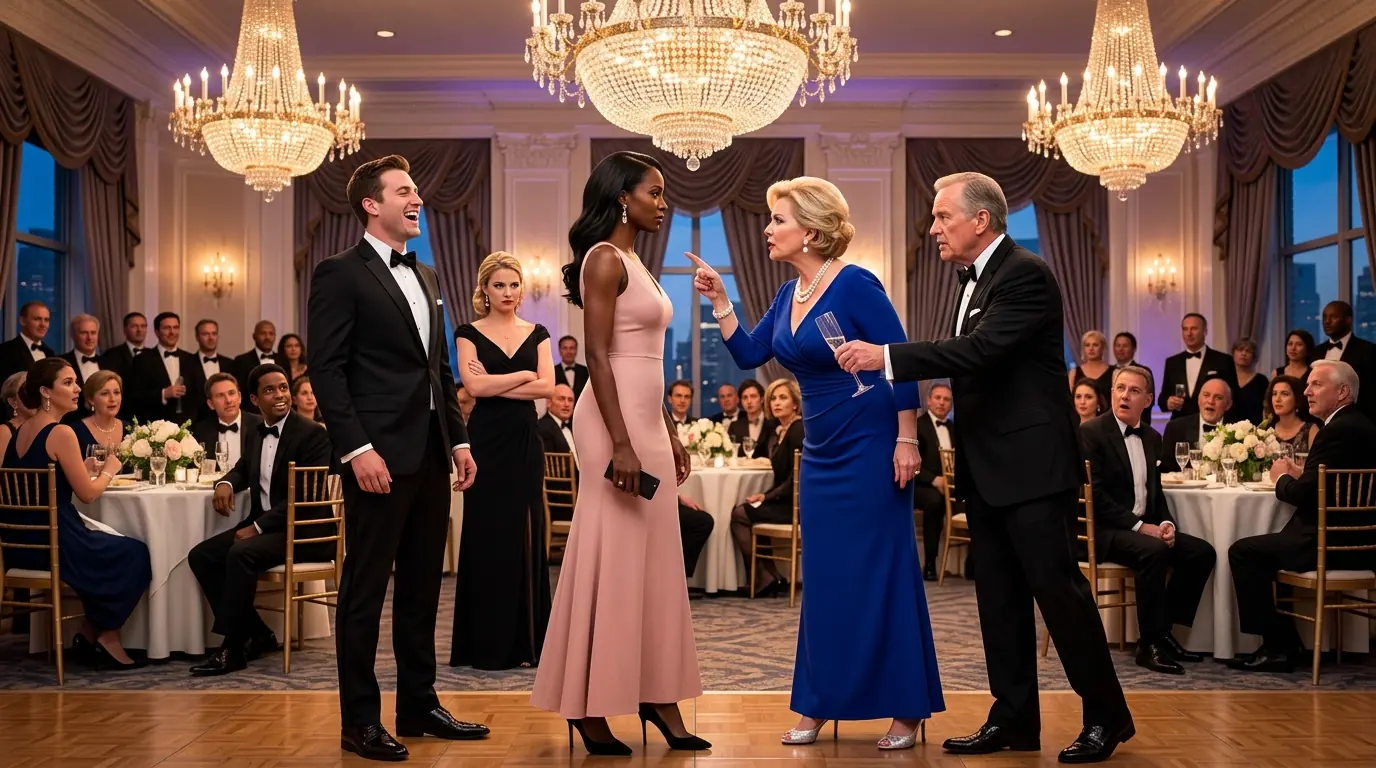
It was cruel.
At the edge of the room, a Black woman stood still in a blush-pink dress. No diamonds, no glitter, just calm. Her phone was pressed to her ear, and her eyes did not flicker, not even once.
The insult hung in the air like smoke.
The woman in blue smirked, nudging her husband. He chuckled, shaking his glass of champagne so hard that a drop spilled onto his cuff.
Around them, a semicircle of curious faces formed.
Socialites.
Heirs.
Investors.
All watching the spectacle.
The Black woman did not move.
She did not bow.
She did not answer.
She simply listened.
Her lips parted just enough to say into the phone, her voice steady, “Stay on the line. I’ll be brief.”
The older woman raised her voice, enjoying the stage she had created.
“What is the staff doing letting anyone walk around dressed like that?”
Her friends laughed harder, fingers pointed like daggers.
Someone muttered, “She must be lost. Wrong door.”
The ballroom was not warm anymore.
It was charged.
Guests who had been sipping wine now shifted uncomfortably. A young server, also Black, froze by the dessert tray, his jaw tight. A couple near the piano whispered, “She doesn’t look like staff, does she?”
But the mockery rolled on.
A man in a tuxedo, salt-and-pepper hair, cufflinks worth a car, extended his glass toward her.
“Since you’re standing there, sweetheart, top this up.”
The insult was not just words anymore.
It was action.
A demand.
A command issued in front of everyone.
Still, she did not flinch.
She set her gaze on the glass, then on the man’s hand, and then quietly shifted her phone closer to her lips.
“This deal is over,” she whispered.
But no one else heard.
Not yet.
The laughter rang again, higher this time, sharp with arrogance.
The woman in blue clapped her hands like a conductor.
“Come now, don’t be shy. Show us you belong here.”
That line hit harder than the others because it was not just an insult.
It was a verdict.
And yet the Black woman stood there, anchored, calm, deliberate.
Her silence said what her voice did not.
You will regret this moment.
The phone was still at her ear, her eyes still steady, and the crowd suddenly was not sure who was really out of place.
The ballroom glittered like a palace, but she stood apart from it.
No entourage.
No flashing jewelry.
Just a pale blush dress that skimmed the floor and a phone pressed against her ear.
In a sea of sequins and champagne, she looked understated, almost ordinary.
And that was exactly the point.
Her name was Maya Carter.
She was forty-one years old, the CEO of Carter Global Holdings, and the architect behind a deal so massive it was set to reshape three industries at once.
Nine hundred million dollars on the table.
Signatures pending.
The very family laughing at her tonight was the same family she had been negotiating with for months.
But no one in this room knew that.
Not yet.
They saw a woman with dark skin and no diamonds.
They saw a figure standing alone, not flanked by lawyers or PR teams.
They made a decision in seconds.
Not one of us.
Maya had expected it.
She had lived this scene before.
Different faces.
Different cities.
At twenty-three, she had walked into a New York boardroom with a real estate proposal, and the banker asked whose assistant she was. At thirty, after closing her first one-hundred-million-dollar acquisition, a competitor introduced her on stage as “the young lady from operations.”
She never forgot the smirk.
And now, at forty-one, dressed deliberately simple, she was testing the very people who claimed to value her partnership.
Testing whether respect came with the contract, or if prejudice would always speak first.
Across the ballroom, the billionaire family basked in attention.
They were old money and proud of it, their last name stitched into hospitals and foundations.
They did not see her as equal.
They saw her as background.
A servant.
An outsider.
But Maya was not rattled.
She leaned on the memory of nights when disrespect had nearly broken her resolve. The first time she was escorted out of a hotel lobby where she had a reservation. The time a loan officer laughed in her face while holding her application.
Those moments had carved something permanent into her.
An armor of calm.
Tonight, she wore that armor beneath the silk.
The guests who noticed her silence began to whisper.
“She hasn’t said a word,” one muttered near the piano.
“Why isn’t she leaving?” another asked, unsettled.
Phones hovered discreetly at chest height, recording fragments of the unfolding scene.
Maya’s eyes swept the room once.
Calm.
Calculated.
She had chosen to arrive alone. Chosen to blend in. Chosen to give them enough rope to reveal themselves.
What no one realized was that the rope was already tightening.
Her phone buzzed softly in her hand, the voice of her assistant clear and waiting.
“All systems ready. Do you want me to proceed?”
Maya did not answer yet.
She let her gaze rest on the chandelier above, on the sparkle that blinded so many people here into believing wealth gave them the right to humiliate others.
Then she lowered her eyes.
And in that stillness, her decision was already made.
The game they thought they were winning was about to collapse.
The music in the ballroom tried to reclaim the air, violins straining to smooth over the jagged laughter, but it could not.
The sound of mockery was louder.
It lived in the corners, in the whispers, in the eyes that darted toward Maya Carter as if she were out-of-place furniture in a curated gallery.
The matriarch of the billionaire clan, pearls swaying against her neckline, raised her voice again.
“Truly, who let staff mingle with guests?”
She said it not as a question, but as an announcement.
Her words carried like smoke over polished marble floors, reaching every ear in the room.
Her husband smirked, tugging at his bow tie.
“Standards are slipping. First the dress code, now the help.”
He lifted his glass in a mock toast, and several in their circle laughed with him.
Maya did not move.
Her stillness was deliberate, like an anchor against the current.
A young man near the dessert table paused mid-bite, his fork hanging in the air. His eyes narrowed, unsettled. Nearby, a couple in sleek black attire exchanged glances. The woman shook her head slowly, mouthing, “This isn’t right.”
But the laughter kept rising.
The billionaire’s son, barely thirty, leaned back in his chair, his voice dripping with arrogance.
“She’s standing like she owns the place. Someone tell her where the exit is.”
That line sent a ripple through the crowd.
Some chuckled nervously, unsure if they should join in. Others shifted in discomfort, sensing the cruelty sharpening.
Maya’s eyes lowered to her phone for just a moment.
A text notification blinked on the screen.
Everything is prepared. Just give the word.
She locked it again, her expression unchanged.
The matriarch clapped once, sharp as a gavel.
“Come now, dear. You’re blocking our view. Why don’t you be useful?”
She gestured to an empty glass on the table.
The implication was clear.
A murmur rose from the side of the room.
A guest whispered, “Is she really staff?”
Another replied, “No, look at her. She’s not dressed like them.”
Confusion bled into the atmosphere, mixing with unease.
Then the patriarch leaned forward, pointing with the stem of his champagne flute.
“If you’re not staff, then why are you even here?”
The question rang with the arrogance of ownership, as though their family name had been etched into the very walls of the ballroom.
Maya inhaled once.
Steady.
Quiet.
She did not answer.
She did not need to.
Not yet.
Phones began to tilt higher now.
A woman near the staircase tapped her screen twice.
Recording.
A man by the bar did the same.
What had begun as laughter was turning into a spectacle.
And a spectacle meant witnesses.
The youngest daughter of the clan rolled her eyes theatrically, her bracelets jingling.
“This is embarrassing. She should be escorted out before she ruins the evening.”
Her words were not whispered.
They were broadcast, designed to sting.
The air in the ballroom was not glittering anymore.
It was dense.
Electric.
Some guests shifted closer to Maya, not to protect, but to observe, to see how far the humiliation would go.
And Maya remained still, her gaze steady, as if she had measured every word, every sneer, every insult, and was letting them stack like bricks in a wall they would not be able to climb down from.
The rope was tightening.
And none of them saw it.
The laughter swelled, then broke apart into fragments.
Mocking chuckles here.
A cruel whisper there.
But Maya Carter did not move.
Her silence pressed against the noise like a hand on glass, steady and unyielding.
She lowered her phone from her ear, not hurriedly, but with calm precision, slipping it into a slim clutch at her side.
Then she folded her hands loosely in front of her, chin lifted, eyes steady.
To anyone watching closely, it was the posture of someone waiting.
Not begging.
Not serving.
Simply waiting for the storm to finish exhausting itself.
The matriarch smirked, misreading stillness as submission.
“Oh, she’s shy now. Perhaps she finally understands her place.”
Her friends tittered, clinking glasses.
But not everyone laughed.
Near the dessert table, the young server shifted uneasily, gripping the silver tray tighter. He had worked enough galas to know the difference between staff and guests.
This woman did not move like staff.
She carried herself differently.
Her calm was so deliberate it unsettled him.
By the piano, a couple whispered furiously.
“Why doesn’t she say something?” the man asked.
“Because she doesn’t have to,” the woman replied, eyes locked on Maya.
The patriarch, perhaps emboldened by the silence, leaned forward.
“You see? No protest. No denial. That tells you everything, doesn’t it?”
He sipped his champagne with satisfaction, convinced he had won the exchange.
But the cameras were telling a different story.
Phones glowed in pockets and purses, screens angled discreetly upward. One guest, pretending to check messages, was recording every word. Another had already whispered to her companion, “This is going viral if it continues.”
Maya’s breath was measured.
Even.
She had practiced this kind of stillness before, in boardrooms where she was the only Black woman at the table, in negotiations where silence was weaponized against her.
Tonight, she wielded it herself.
She remembered being twenty-six, standing outside a luxury hotel when a doorman told her she did not belong. She had held her tongue then, too, letting him speak long enough to reveal everything ugly inside him.
That memory steadied her now.
Silence was not weakness.
It was rope.
The longer they spoke, the more tightly they tied themselves.
The son of the family scoffed.
“Look at her. Not even defending herself. That’s guilt if I’ve ever seen it.”
He leaned back smugly while a few guests muttered uneasily.
The young server’s jaw tightened.
He whispered under his breath, almost to himself, “That’s not guilt. That’s strength.”
And he was not the only one noticing.
Two women near the bar stopped mid-conversation, eyes flicking toward Maya.
One murmured, “She doesn’t look afraid.”
The other replied, “No. She looks like she’s waiting for something.”
The matriarch clapped her hands again, eager to keep the spotlight.
“Enough games. Someone should escort her out.”
She smiled as if she had delivered the final blow.
But the ballroom did not laugh as easily this time.
The atmosphere had shifted, stretched taut. People were watching too closely now, their curiosity heavier than their amusement.
Maya stood anchored, hands still folded, gaze unbroken.
And in her silence, the room began to question who truly held the power.
The air in the ballroom had shifted.
What began as laughter was now something else.
Uneasy.
Fractured.
Full of eyes darting from Maya to the billionaire family and back again.
At the far corner, a young man in a tailored suit pulled out his phone. He angled it casually, screen glowing against his palm. The red dot blinked.
Recording.
He whispered to his companion, “If this blows up, people need to see it from the start.”
His friend nodded, eyes never leaving the scene.
By the staircase, a woman in her late twenties clutched her clutch tighter. She turned to the guest beside her, voice low but firm.
“This isn’t right. She hasn’t said a word, and they’re humiliating her.”
The other woman frowned.
“Then say something.”
Her lips trembled, but she stepped forward anyway, raising her voice enough for those nearby to hear.
“She’s not staff. Leave her alone.”
The words sliced through the laughter.
A ripple moved across the ballroom.
The matriarch blinked, surprised.
The son rolled his eyes, muttering, “Another sympathizer.”
But the atmosphere had changed.
The first crack had appeared in the chorus of mockery.
The young server by the dessert table finally set his tray down. His hands shook slightly, but his voice carried.
“I work here, and she’s not one of us.”
Gasps followed, sharp and scattered.
Guests turned their heads, murmuring, calculating.
The patriarch scoffed loudly.
“Oh, please. A waiter’s word means nothing here.”
But his voice wavered just enough for people to notice.
Near the bar, two men whispered fiercely.
“Are you filming?”
“Yeah, but should we?”
“If you don’t, this disappears.”
Their cameras lifted higher.
Screens glowed brighter.
What had been quiet documentation was becoming bold, visible.
Maya remained still, hands folded, gaze unwavering.
She did not speak, but her silence amplified the voices rising around her.
The room was no longer laughing.
It was listening.
The youngest daughter of the family sneered, trying to reclaim the stage.
“Don’t let her fool you. People fake their way into galas all the time.”
But her words rang thin, brittle against the growing current of doubt.
The woman by the staircase spoke again, louder this time.
“I saw her enter with an invitation.”
Heads turned sharply in her direction.
The matriarch’s jaw tightened.
“You saw nothing,” she snapped.
But the denial sounded less like confidence and more like fear.
The server took a step closer to Maya, not touching her, but standing just near enough to show where his loyalty lay.
“This is wrong,” he said again, louder.
His voice cracked, but it carried.
And in that moment, the ballroom changed shape.
It was no longer the family’s stage.
It was an arena of witnesses.
Phones hovered higher now.
Murmurs turned into open comments.
“She hasn’t raised her voice once.”
“They’re making fools of themselves.”
“This is going viral.”
The family tried to laugh it off, but their smiles were tighter now.
Forced.
For the first time, their control of the room was slipping.
And Maya stood silent at the center, the eye of the storm, letting every voice around her build the case.
She did not need to argue herself.
The truth was no longer hers alone.
It was in the mouths of strangers, in the lenses of phones, in the whispers turning into declarations.
The rope was tightening.
And the world was starting to notice.
The ballroom pulsed with unease.
The laughter that once echoed like a chorus was thinning, replaced by whispers, shifting stares, and the glow of phones held too high to ignore.
The matriarch felt it slipping, her grip on the room loosening like sand through jeweled fingers.
Her smile hardened into something sharper.
She raised her voice, cutting across the murmurs.
“Enough of this charade. Security should have removed her ten minutes ago.”
Gasps broke through the crowd.
A few guests flinched.
Others turned to see if guards would actually appear.
None moved yet.
The patriarch leaned forward in his chair, champagne flute still in hand. His tone was louder, more pointed, as if sheer volume could restore dominance.
“This is trespassing. Whoever allowed this woman inside will answer for it. She is not a guest. She is an intruder.”
Maya’s stillness was unbroken.
Her gaze swept briefly over the crowd, then settled again, steady as stone.
The billionaire son pushed his chair back with a scrape that carried across the marble floor. He strode toward her, a smirk curling his lips.
“Listen, sweetheart, you’ve had your fun. Now get out before someone drags you out.”
That word, drags, hung in the air like smoke from a match.
The room stiffened.
Several guests shifted closer, not to protect, but to witness more clearly, as if justice or injustice were about to play out live.
A woman near the bar muttered into her phone, “He just threatened her. Get this.”
Her camera light blinked red.
The daughter added her own venom, her voice pitched high to reach every corner.
“She’s making a scene. People like her always do. Always craving attention.”
The young server who had stood silently near Maya stepped forward now, voice shaking but firm.
“She hasn’t said a word. You’re the ones making the scene.”
The patriarch spun toward him, face flushing red.
“Silence. You’re staff. You don’t speak in this family’s affairs.”
But the reprimand cracked, brittle under the weight of so many watching eyes.
More phones tilted upward.
Screens shone like small spotlights against the family, not against Maya.
The matriarch snapped her fingers sharply, as if commanding obedience.
“Do not just stand there,” she barked toward the nearest guard by the door. “Remove her.”
The guard hesitated.
His eyes flicked toward Maya, then toward the glowing forest of phones now aimed at the family. His hand hovered near his earpiece, but did not move further.
Maya inhaled slowly, her composure unshaken.
She shifted her weight just enough to signal she was not going anywhere.
The son’s smirk faltered.
“What? You think standing there quiet makes you untouchable?”
He laughed, but it was thin, brittle.
“News flash. It doesn’t.”
From the crowd, a voice rang clear, female and sharp with conviction.
“Then why are you the only ones looking guilty?”
Heads turned.
The speaker, a guest in emerald satin, folded her arms, glaring openly at the family.
Her words landed heavily, echoed in the murmurs rising again.
The matriarch’s jaw tightened. She tried to smile, but it trembled.
“Don’t be ridiculous. She doesn’t belong here.”
Yet the room was not nodding anymore.
It was questioning.
Watching.
Recording.
And at the center, Maya Carter remained silent, still, steady, letting every accusation, every threat, every insult pile higher.
Each word, each gesture, each cruel command was a stone.
And soon, the wall they built would be too high to climb down from.
The ballroom had become a stage.
Every glittering chandelier now a spotlight.
Every glass of champagne a witness.
The air was heavy, charged, waiting for the next blow.
The patriarch slammed his flute onto the table, liquid spilling across the white cloth like a stain no one could wipe fast enough.
He rose, his voice booming.
“If she won’t leave, then make her useful. Pour.”
He thrust the empty glass toward Maya, his hand shaking, not with weakness, but with fury.
The son picked up the cue instantly. He grabbed another glass from the table, strutted forward, and shoved it in her direction.
“Go on,” he sneered. “Show us you know your place.”
Gasps erupted.
Someone muttered, “Did he just…”
Another voice answered, “Yes, he did.”
The matriarch’s pearls trembled with each laugh she forced.
“Well, don’t just stand there. Serve.”
The youngest daughter chimed in, cruel and loud.
“You wanted to stay in this room? Earn it.”
Phones shot higher into the air now, no longer discreet, but brazen.
Lights blinked red.
Guests leaned forward, drawn like moths to the blaze of injustice.
Through it all, Maya Carter did not move.
Her hands remained folded, her shoulders still, her gaze fixed on the glass hovering inches from her face.
The son jiggled it impatiently.
“What’s the matter? Too proud to pour?”
He tilted his head, lips curling.
“Or maybe you don’t know how. Figures.”
The young server by the dessert table stepped forward again, voice firmer now.
“Stop it. She’s not staff.”
The patriarch turned on him, face flushed crimson.
“One more word and you’re finished. Do you hear me?”
His shout cracked through the ballroom loud enough to freeze conversations at the far end.
But the silence that followed did not belong to him.
It belonged to the witnesses.
A woman in emerald satin said loudly enough for half the room to hear, “You’re humiliating yourselves, not her.”
The matriarch spun, eyes sharp as knives.
“Mind your tongue.”
But her command landed weak, brittle, swallowed by the growing tide of murmurs and gasps.
Then came the final insult.
The son, frustrated, tipped the glass forward.
A single drop of champagne splashed against the silk of Maya’s dress.
Not enough to stain, but enough to humiliate.
The crowd gasped in unison.
Someone near the back shouted, “That’s assault.”
Another whispered, “She hasn’t even spoken, and they’re doing this.”
Phones rose higher.
The red glow of recording lights filled the room like fireflies in a storm.
Maya’s eyes lowered to the droplet on her dress.
She exhaled once, slow and controlled.
Then she lifted her gaze, locking eyes with the son.
No anger.
No fear.
Just calm.
An unnerving calm that made him step back half a pace without realizing it.
The matriarch tried to laugh again, but it was hollow, thin.
“Well, if she won’t serve, then she will be removed.”
Her voice cracked on the last word.
She gestured sharply toward the guards by the double doors.
“Now. Get her out.”
The room stilled.
The guards hesitated, caught between the orders of wealth and the gaze of dozens of cameras.
The tension was unbearable now.
The cruelty had reached its peak.
And in the center, Maya stood as if anchored to the marble itself.
Untouchable.
Unbreakable.
Waiting.
The next move would not belong to them.
The silence after the matriarch’s command was thick enough to choke on.
Two guards hovered near the doors, their hands twitching, but their eyes darted nervously at the rows of phones aimed their way.
The weight of witnesses was heavier than any paycheck.
And then Maya Carter moved.
Not much.
Just one hand, sliding with deliberate calm into her clutch.
Every eye followed.
For a moment, some guests thought she might finally show an invitation, a pass, proof of her right to be there.
But what she drew out was nothing more than her phone.
Sleek.
Black.
Glinting under the chandelier light.
She pressed it to her ear, her voice quiet, unshaken.
“Nia, log this. Effective immediately.”
The matriarch blinked.
“What is she doing?” she whispered, though her voice still carried.
Maya’s assistant answered on the other end, crisp and ready.
“System standing by. Do you want me to initiate?”
Maya’s gaze swept the family, landing on each of them in turn.
She did not raise her voice.
She did not need to.
“Cancel the deal. Nine hundred million. Effective tonight.”
Gasps tore through the room.
A dozen phones jerked higher.
Whispers spread like sparks across dry wood.
“What deal?” someone hissed near the piano.
“Nine hundred million?” another repeated, stunned.
The patriarch’s face drained of color.
“What nonsense is this?”
He forced a laugh, but it rattled in his throat.
“She’s bluffing.”
The son stepped forward again, trying to recover the power slipping through his fingers.
“Oh, please. You expect us to believe you’re anyone important? You’re nothing.”
His words rang harsh, but his eyes flickered with uncertainty.
Maya turned slightly, phone still pressed to her ear.
Her lips parted once more, calm as ever.
“Send the termination notice. Make it public tonight.”
On the other end, Nia’s voice was sharp as a blade.
“Confirmed. Broadcasting to all stakeholders. Effective immediately.”
The matriarch’s smile faltered, trembling under the chandelier light.
“She’s lying. She has to be lying.”
But the words sounded less like certainty and more like desperation.
The crowd was shifting now.
Not just watching.
Choosing sides.
Murmurs rose.
“She said nine hundred million.”
“Wait, she’s not staff. She’s the deal.”
“Oh my God. They mocked the wrong woman.”
The guards by the door exchanged glances, then stepped back instead of forward.
No one ordered them, but the message was clear.
This was not theirs to touch.
Maya lowered the phone slightly, her gaze sweeping the family one last time.
Still calm.
Still steady.
She let the silence expand, forcing them to hear every beat of their own panic.
“You wanted me gone,” she said quietly, her voice carrying across the marble floor. “Now it’s your deal that’s gone.”
The room erupted, not with laughter, not with applause, but with the shocked intake of hundreds of breaths at once.
The tide had turned.
And everyone could feel it.
The room was no longer golden.
It was tense.
Electric.
Like a storm suspended midair.
Every chandelier sparkled too brightly, every polished surface reflecting not laughter, but disbelief.
Maya Carter lowered her phone, ending the call with a simple press of her finger.
She did not rush.
She did not flinch.
When she lifted her eyes again, they locked on the family that had mocked her minutes earlier.
Her voice was low, but sharp enough to cut through the marble air.
“You asked who I am? Let me be clear.”
The matriarch shifted in her chair, her pearls rattling faintly.
The patriarch frowned, gripping his glass too tightly.
The son folded his arms, his smirk fading, replaced by unease he could not hide.
Maya took one calm step forward.
“My name is Maya Carter. I am the chief executive officer of Carter Global Holdings. The deal you’ve spent nine months negotiating, the one worth nine hundred million dollars, runs through me.”
The gasp that followed was tidal.
Phones shot higher into the air.
Guests whispered fiercely to one another.
“She’s the CEO.”
“She owns the deal.”
“Wait, they mocked the CEO?”
The matriarch tried to laugh, but it came out brittle, hollow.
“That’s impossible. If you were the CEO, you wouldn’t be standing here alone in that dress.”
Maya’s lips curved into something colder than a smile.
“That’s exactly why you never saw me coming.”
The patriarch stumbled over his words.
“You… this is some kind of trick. A stunt.”
But his voice shook, and the crowd heard it.
The young server by the dessert table spoke louder now, emboldened.
“She told you she’s the CEO.”
Maya nodded slightly, acknowledging him, then turned back to the family.
“You mocked the wrong woman. You poured champagne on the partner who held your future in her hands, and now those hands are closed.”
Gasps turned into murmurs.
Murmurs into open declarations.
A woman in emerald satin said clearly, “They just killed their own deal.”
Another man muttered into his phone, “I’m recording this. It’s history.”
The son tried one last sneer.
“You expect us to believe anyone like you could be in charge of something that big?”
Maya’s eyes fixed on him.
Steady.
Unblinking.
“Believe it or not, I don’t need your validation. I own it. I decide it. And I just ended it.”
The words dropped like a gavel.
Final and absolute.
Around the room, applause began.
Hesitant at first, then building.
Not for spectacle, but for justice witnessed live.
Guests were not cheering her vengeance.
They were honoring her dignity.
The matriarch sank back in her chair, face pale, mouth tightening with the bitter taste of realization.
The patriarch rubbed his temples as if trying to erase what everyone had just heard.
The son stood frozen, glass still extended, but his hand trembled.
And at the center, Maya Carter remained still.
Anchored.
Radiant.
Unbroken.
The truth was no longer hidden.
Her power was no longer invisible.
The secret was gone.
The world now knew exactly who she was.
For a long second, the ballroom froze.
The chandeliers still shimmered. The quartet still played faintly in the corner, but the air was no longer alive with arrogance.
It was thick with shock.
Then the murmurs broke.
“She’s the CEO.”
“Did you hear that?”
“Oh my God. Nine hundred million.”
“They mocked their own partner.”
Guests leaned into each other, whispering in disbelief, their eyes darting between Maya and the billionaire family now sitting pale and shaken.
The matriarch, who minutes ago had barked orders like a queen, clutched her pearls with trembling fingers.
Her mouth opened, but no words came out.
The patriarch’s face was flushed, beads of sweat shining under the lights.
His hand shook so badly the champagne glass tipped, spilling onto the floor.
The son, once smug, now looked like a child caught in a lie.
His jaw was tight.
His bravado had evaporated.
The youngest daughter tried to speak, her voice high and sharp.
“This is… this is some stunt. You can’t…”
But she stopped when she saw the crowd.
She saw every phone pointed at her family. She saw the disbelief, the judgment, the quiet outrage etched into dozens of faces.
Her voice died before it could finish.
Across the ballroom, a woman in emerald satin shook her head slowly.
“Unbelievable,” she said loudly, ensuring half the room heard. “They tried to humiliate the CEO of their own deal.”
The applause that had begun hesitantly now grew louder, more certain.
Guests who had been silent started clapping openly, some cheering under their breath, some nodding in solidarity.
What began as a ripple was now a wave crashing against the family’s throne of arrogance.
And the cameras kept recording.
The cameras were everywhere.
Phones raised high.
Red lights blinking like fireflies.
A live stream caption appeared on one guest’s screen.
Billionaire family mocks Black CEO, loses $900M deal on the spot.
The numbers beside it surged higher.
Thousands watching in real time.
The patriarch reached out as if to steady himself on the table, his knuckles white.
“Stop recording this,” he barked.
But the demand only drew more lenses his way.
The matriarch tried to recover, her voice brittle.
“We… we didn’t know who she was.”
Maya’s calm gaze silenced her before the sentence could finish.
The young server stood taller now, his earlier hesitation gone.
He said firmly, for all to hear, “You didn’t care who she was. That’s the truth.”
Guests nearby murmured agreement.
The family was unraveling in front of everyone.
Status stripped.
Power mocked.
Cruelty immortalized in pixels.
Meanwhile, Maya did not move.
She did not clap back.
She did not need to.
The room itself had become her voice.
The matriarch slumped into her chair, her pearls rattling softly.
The son turned away, face burning, unable to meet the stares.
The patriarch rubbed his temple, muttering to himself, “This can’t be happening.”
But it was.
And the world beyond that ballroom was already watching it unfold, second by second, share by share.
The ballroom was not theirs anymore.
It belonged to the silence, the kind that follows revelation, the kind that makes every breath audible and every glance heavy.
All eyes remained fixed on Maya Carter, waiting to see if her words were final, or if the humiliation could somehow be undone.
Maya reached once more for her phone.
This time she did not whisper.
She pressed a single button.
Speakerphone.
The screen lit up.
Her assistant’s voice filled the ballroom, crisp and merciless.
“Carter Global Holdings confirms termination of the nine-hundred-million-dollar partnership. Effective immediately. Statement drafted. Distribution in progress. Stakeholders notified.”
Gasps detonated like fireworks.
Someone near the piano muttered, “It’s real. Oh my God, it’s real.”
Another whispered, “They’re done. She ended it.”
The patriarch staggered forward, palms outstretched as though he could stop the announcement with his bare hands.
“Wait. This can’t… Maya, listen. This deal is vital.”
His voice cracked under the weight of desperation.
But Maya’s gaze was iron.
“You poured champagne on me. You called me an intruder. And now you beg.”
The matriarch tried next, clutching her pearls so tightly the string threatened to snap.
“We… we were mistaken. Surely you can…”
Maya cut across her, her voice slicing like a blade.
“You weren’t mistaken. You were comfortable. Comfortable in your prejudice. Comfortable humiliating a woman you assumed had no power. That comfort just cost you nine hundred million dollars.”
The son stepped forward, anger sparking.
“You think you can blacklist us? We are legacy. We are…”
Maya did not blink.
“You were legacy. Now you are liability.”
A sharp murmur spread through the crowd.
Some clapped.
Some gasped.
Phones shook in trembling hands as people tried to capture every word.
Her assistant’s voice chimed again over the speaker.
“All contracts dissolved. All accounts frozen. Their access to Carter systems revoked. Statement timestamped and logged.”
The youngest daughter whispered, horrified, “She actually did it.”
The patriarch’s knees buckled into his chair, his face drained.
“Nine hundred million,” he muttered, as though repeating the number could reverse it.
Maya took a step closer, her presence cutting the space between them.
“This is not theater. This is accountability. Actions have consequences. Tonight, you learned that in public.”
Applause erupted from one side of the room, then another.
Guests clapped openly now, their voices rising above the trembling protests of the family.
The applause was not for vengeance.
It was for justice.
Swift.
Undeniable.
The matriarch buried her face in her hands.
The son slammed his glass onto the table so hard it shattered, shards scattering across the white cloth.
No one flinched.
Cameras caught it all.
And Maya Carter stood still in the center of it, her silence roaring louder than their downfall.
The deal was dead.
The humiliation reversed.
The power undeniable.
They had mocked a woman they thought was powerless, and in doing so, destroyed themselves.
The applause rolled through the ballroom like thunder, echoing off marble and glass.
Guests stood from their tables, some clapping, some recording, all bearing witness to a reversal so sharp it left the air electric.
Maya Carter did not bask in it.
She did not bow or gesture for more.
She simply stood calm and unbroken until the sound reached its peak and began to settle into silence again.
Her gaze swept the family one last time.
The matriarch hunched in her chair, pearls rattling.
The patriarch staring at the floor, lips moving soundlessly.
The son frozen amid shards of shattered glass.
The daughter pale, hands trembling.
They were no longer hosts.
They were defendants in a courtroom of their own making.
Maya’s voice rose, steady and controlled.
“Power is not the volume of your insults. It is the weight of your decisions. Tonight, you mocked me in public. Tonight, I ended you in public. Justice doesn’t shout. It doesn’t beg. It simply moves.”
The words landed like a verdict.
Phones captured every syllable, every pause.
The story was already blooming across screens.
She turned slightly, her dress catching the chandelier light, and began walking toward the doors.
Each step was measured, deliberate, the sound of her heels striking marble like a gavel on wood.
No one stopped her.
No one dared.
The guards by the door straightened, parting to make way.
Guests stepped aside, some nodding in respect, others murmuring, “That’s real power.”
Just before crossing the threshold, Maya paused.
She turned her head, her eyes sweeping once more over the stunned faces left behind.
“Remember this,” she said. “Silence is not weakness. Sometimes it is the countdown to consequence.”
And with that, she left the ballroom.
Behind her, chaos rippled.
The family scrambled to whisper excuses, to call lawyers, to salvage what could not be salvaged. But their voices were drowned out by applause, by the clicking of phones, by the certainty that the story was already out in the world and unstoppable.
The cameras did not follow them.
They followed her.
Maya Carter stepped into the corridor beyond, calm as ever.
She did not need to look back.
She had already rewritten the room, the deal, and the night.
The doors closed softly behind her, sealing the family inside their downfall.
And the world outside waited, ready to hear the story of the Black CEO who turned humiliation into judgment and judgment into justice without ever raising her voice.