The Four Seasons lobby gleamed with morning light.
Victoria Ashford stood near the windows in her pressed Chanel suit, laughing with two German investors. A Black man in a navy polo shirt approached, carrying a leather portfolio.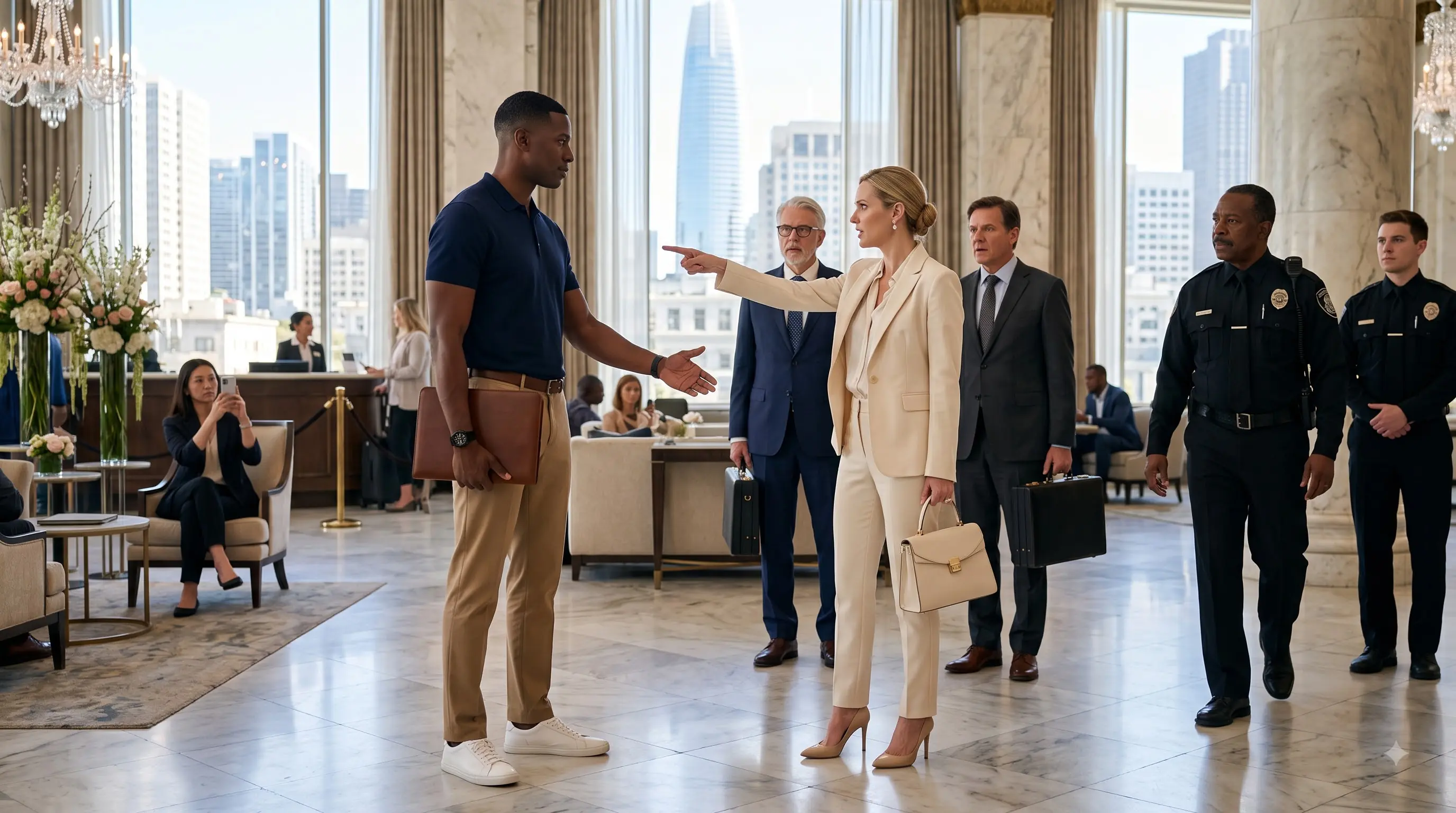
“Ms. Ashford, Darien Cole. We have a nine o’clock meeting about the Series C investment.”
He extended his hand.
Victoria stared at his outstretched hand like it was contaminated. She took a step back, keeping both hands in her pockets.
“Excuse me, who let you in here?”
Her voice dripped with disgust.
The German investors stopped talking.
“This is a private meeting for serious investors, not for people like you.”
She looked him up and down.
“Security, get this man out of here before I call the police.”
Darien lowered his hand slowly.
“Ms. Ashford, if you’d just check—”
“I said get out. Now. Before I have you arrested for trespassing.”
Two security guards rushed over. Phones emerged from purses. Someone started recording.
Within minutes, Darien walked out, head high.
Victoria turned back to her guests, brushing imaginary dirt from her sleeve.
She had no idea she had just destroyed the only investor willing to save her dying company.
Three months earlier, Ashford Technologies was worth $800 million.
Today, the number on the balance sheet made Victoria’s hands shake every time she looked at it. The company burned through $8 million every month. The bank account held enough cash for eleven more weeks.
After that, bankruptcy.
Victoria sat in her corner office on the forty-second floor. Through the floor-to-ceiling windows, San Francisco Bay stretched blue and indifferent.
She had made this view her entire identity.
Stanford MBA. Fortune “40 Under 40.” TechCrunch’s most promising founder, two years running. Her father had built a banking empire in the eighties. Her mother sat on four boards. Victoria grew up in Pacific Heights, summered in the Hamptons, and had never once worried about money until now.
She had pitched to twenty-three investors in eight months.
Every single one said no.
“Too arrogant,” one wrote in an email that got leaked.
“Doesn’t listen to feedback,” said another.
“Red flags about company culture,” said a third.
Victoria deleted those emails.
She told herself they did not understand vision.
But the cash kept draining, and there was only one name left on her list.
Across the country, in a penthouse apartment overlooking Manhattan, Darien Cole poured his morning coffee.
The apartment was minimalist. White walls, clean lines, a wall of screens showing global markets in real time.
He had grown up in South Chicago. His mother worked double shifts as a nurse. He wore secondhand clothes and studied by streetlight when the electricity got cut off.
Full scholarship to MIT. Computer science and economics.
At twenty-four, he built an algorithm that could predict financial risk better than any human analyst. Goldman Sachs bought his startup for $780 million when he was twenty-six.
Now, at thirty-eight, he ran Cole Ventures.
$3.8 billion in assets. Forty-seven investments. Forty-three succeeded. Four failed.
The Wall Street Journal called him the most successful investor most people had never heard of.
He did not wear suits.
Never had.
It was a test he ran on every potential partner. He wanted to see whether people respected his ideas or only his bank account.
This morning, his video screen showed three faces: his analyst Maya, his CFO James, and his assistant Priya.
“Boss, I finished the Ashford Technologies deep dive,” Maya said. Her voice crackled through the speakers. “The tech is solid. The financials are a disaster. And Victoria Ashford has a reputation problem.”
“Define reputation problem.”
Darien sipped his coffee. It was still too hot. He set it down.
“Difficult to work with is the nice version. I found three anonymous Glassdoor reviews from former employees. All people of color. All describing microaggressions and being passed over for promotions.”
James leaned into his camera.
“If you invest, we’re going all in. Five hundred million. That’s massive exposure for an unproven leader.”
“Which is why I need to meet her in person.”
Darien picked up his coffee again. It had cooled to the perfect temperature.
“Numbers can lie. People can’t. Not face to face.”
Priya checked her tablet.
“I confirmed the meeting three weeks ago. Nine a.m. Four Seasons lobby. Her assistant replied, quote, ‘Ms. Ashford looks forward to meeting Mr. Cole.’”
“Did you send my photo?”
“I sent your full bio. Forbes profile, company overview, everything.”
Darien nodded.
“Good. Then she knows who she’s meeting.”
But here was what he did not know.
Victoria never read her meeting briefs.
She had an assistant for that.
She just glanced at “9:00 a.m. investor meeting” and assumed they would be grateful for her time.
She definitely did not Google Darien Cole.
If she had, she would have found forty-seven articles. She would have seen his Forbes 400 ranking. She would have learned about his philosophy of casual dress.
She would have read his Fortune interview where he said, “I dress down on purpose. I want to see if people respect me for my ideas or judge me by my clothes.”
But Victoria did not Google.
Victoria assumed.
And that assumption was about to cost her everything.
At 8:45, Darien left his apartment. The morning air was crisp. His Uber was already waiting.
At 8:50, Victoria was in the Four Seasons lobby charming two German investors who had already told her no last week. She thought they might change their minds.
They would not.
But she was about to meet someone who could actually save her company, if only she recognized him when he walked through the door.
Darien’s Uber pulled up to the Four Seasons at 9:05. Traffic on Market Street had been worse than usual.
He texted Priya.
She replied immediately.
Already did. You’re good.
He stepped into the lobby.
The air conditioning hit him first, that particular hotel cold that smelled like expensive flowers and furniture polish.
His polo shirt was navy blue, freshly pressed. His khakis had a sharp crease. His white sneakers were spotless. He was dressed exactly how he always dressed for first meetings.
Comfortable. Authentic. Real.
Across the lobby, Victoria threw her head back, laughing at something one of the German investors had said. She wore a cream Chanel suit that probably cost $6,000. Her diamond earrings caught the light every time she moved. Her hair was pulled back so tight it looked painful.
The two Germans were not laughing with her.
They were checking their watches.
They had a flight to catch.
Darien walked toward them, his leather portfolio tucked under his arm. He had rehearsed this moment.
Firm handshake. Warm smile.
Thank you for taking the time to meet, Ms. Ashford.
She turned.
Her eyes landed on him.
Her smile did not just fade. It transformed into something else entirely.
She looked at his polo shirt, then his khakis, then his sneakers. Her gaze traveled back up to his face, and her lip actually curled.
“Can I help you?”
It was not a friendly question. It was the tone someone would use on a stranger knocking on the door to sell something they did not want.
“Darien Cole.”
He extended his hand, smiling.
“We have a nine o’clock meeting about the Series C investment for Ashford Technologies.”
Victoria looked at his outstretched hand.
She did not move.
Her hands stayed clasped in front of her designer purse.
“Cole Ventures,” he said, still trying to keep his voice warm. “My assistant Priya confirmed with your office three weeks ago.”
“Cole Ventures.”
Victoria repeated the name like she was tasting something spoiled.
“I’ve never heard of it.”
One of the German investors, a man with silver hair and wire-rimmed glasses, cleared his throat.
“Victoria, perhaps we should—”
She held up one manicured finger.
“Wait.”
Victoria took a step closer to Darien. Close enough that he could smell her perfume, something floral and expensive.
“I don’t know how you got the address for this meeting, but this is invitation only.”
“I was invited.”
Darien kept his hand extended.
“If there’s confusion, you can call your assistant. Jenny, right? She confirmed last Tuesday.”
“What I can see,” Victoria said, her voice growing louder, “is that you showed up to a business meeting dressed like you’re going to a barbecue.”
The German investors exchanged glances. The silver-haired man whispered something to his colleague in German.
“This is uncomfortable.”
“Ms. Ashford,” Darien said, lowering his hand slowly. “I understand this is unexpected, but—”
“Unexpected?”
Victoria laughed.
It was not a happy sound.
“What’s unexpected is someone like you thinking you can just walk into a meeting with serious investors.”
Someone like you.
The words hung in the air.
A woman sitting on a nearby couch looked up from her phone. A concierge behind the desk stopped typing.
Darien felt the familiar weight settle in his chest. He had felt it before at MIT when a professor assumed he was in the wrong classroom. At a restaurant in Boston when the host asked if he was there to apply for a kitchen job. At a conference last year when someone asked him to grab them coffee.
He kept his voice level.
“I flew in from New York specifically for this meeting. If you’d just let me show you my credentials—”
“Your credentials?”
Victoria’s voice dripped with contempt.
“You mean whatever fake business card you printed at Staples?”
She turned to the security desk.
“Excuse me, can someone help me here?”
Two guards started walking over.
One was an older Black man named Jerome. His face showed exactly how much he did not want to do this.
The other was younger, white, with a military haircut.
Darien tried one more time.
“Ms. Ashford, there’s clearly been a miscommunication. I’m the managing partner at Cole Ventures. We manage $3.8 billion in assets. We spoke with your CFO last month about potential investment terms.”
“Three-point-eight billion.”
Victoria actually laughed.
“Right. And I’m the Queen of England.”
She looked him up and down again, slow and deliberate, making sure everyone watching could see her judgment.
“Let me guess. You saw the article about our funding round in TechCrunch. You thought you’d show up, talk your way into a meeting, maybe network your way into something.”
The German investor tried again.
“Victoria, perhaps—”
“No.”
Victoria cut him off.
“This is exactly the kind of opportunist we have to watch out for in this industry.”
She finally looked directly at Darien’s face.
“I don’t know what you’re trying to pull, but I don’t shake hands with people who lie their way into private meetings. And I definitely don’t do business with people who can’t even dress appropriately.”
The security guards arrived.
Jerome looked at Darien with apologetic eyes. The younger guard put his hand near his belt, where his radio was clipped.
“Ma’am,” the young guard said, all business. “Is there a problem?”
“Yes.”
Victoria pointed at Darien like she was pointing at trash on the sidewalk.
“This man is disrupting a private business meeting. He’s not on any guest list. He’s not invited. And he needs to leave immediately.”
Darien took a slow breath.
He could pull out his phone right now. He could show her his Forbes profile. He could call his CFO and have James verify everything.
But he did not.
Because this moment told him everything he needed to know about Victoria Ashford.
She did not see a potential investor.
She did not see a businessman.
She did not even see a person who deserved basic courtesy.
She saw a Black man in casual clothes and decided instantly that he did not belong.
“I’ll leave,” Darien said quietly. “No need for an escort.”
He looked at Jerome.
“I can find my way out.”
But Victoria was not done.
“Oh, you’ll be escorted. I want to make sure you actually leave the premises and don’t try to sneak into other meetings.”
She turned to the young guard.
“Walk him all the way to the street. Make sure he doesn’t come back.”
The guard nodded.
“Yes, ma’am. Sir, if you’ll come with me.”
The walk to the door felt like a mile. Every eye in the lobby was watching. The woman on the couch was definitely recording on her phone. The concierge had stopped pretending to work.
Darien kept his head up. His steps were measured. Professional.
Jerome walked beside him, not touching him, giving him space.
At the door, Jerome leaned in close.
“Sir,” he whispered, “I’m real sorry about this. I’m just—”
“You’re doing your job,” Darien said, giving him a small nod. “I understand.”
Outside, the San Francisco morning was bright and cold. Darien stood on the sidewalk for a moment, letting his heart rate settle.
His phone buzzed.
Priya.
Boss, what happened? Victoria’s assistant just called saying you left.
“Change of plans,” Darien said. “Cancel the L.A. meeting this afternoon. Book me on the next flight back to New York.”
“But the five hundred million—”
“Priya,” he said gently but firmly, “I just got my answer. Book the flight.”
Inside the lobby, Victoria smoothed her suit jacket and turned back to the German investors with a brilliant smile.
“I am so sorry about that interruption. You would not believe how many scammers try to crash these events.”
The silver-haired German did not smile back.
“Victoria, that seemed harsh.”
“Harsh?”
Victoria waved her hand dismissively.
“Klaus, you have to be firm with these people. Otherwise they think they can take advantage.”
The other German was already standing, picking up his briefcase.
“We should go. Our flight.”
“But we haven’t finished.”
“We finished last week, Victoria,” Klaus said, his voice cold. “We told you no. We only stopped by to be polite.”
They shook her hand quickly, professionally, and left.
Victoria stood alone in the lobby, watching them go.
A small frown crossed her face.
Then she shrugged, pulled out her phone, and texted her assistant.
That investor who just left. Cole something. Make sure his information is deleted from our system. Don’t want his type thinking they can waste our time again.
She had no idea that his type was the only person who was actually going to save her company.
And in less than three hours, she was going to find out exactly who Darien Cole was.
At 10:30 in the morning, Victoria was back in her office on the forty-second floor. She had already forgotten about Darien Cole.
Her assistant, Jenny, knocked and entered holding a tablet. Her face looked pale.
“Ms. Ashford, I need to ask you something.”
Victoria did not look up from her laptop.
“Make it quick. I have a call with the board in twenty minutes.”
“The man at the Four Seasons this morning. The one security escorted out.”
“What about him?”
“You told me to delete his information from our system, but I wanted to confirm first. That was Darien Cole, right? From Cole Ventures?”
Victoria’s fingers stopped typing.
“So?”
“Ms. Ashford,” Jenny said, her voice shaking slightly. “Did you Google him?”
Something cold formed in Victoria’s stomach.
“Why would I need to Google some random guy trying to crash my meeting?”
Jenny set the tablet on Victoria’s desk.
The screen showed a Forbes article.
The headline read: Darien Cole, the Billionaire Investor You’ve Never Heard Of.
Victoria stared at the photo.
Same face. Same calm expression. Same person she had thrown out of the hotel an hour earlier.
Her eyes scanned the article. The words blurred together at first, then snapped into sharp focus.
Net worth: $3.8 billion.
Cole Ventures: $3.8 billion in assets under management.
Forbes 400 ranking: number 184.
Track record: forty-seven investments, forty-three successful exits.
Board member at Apple, Microsoft, Tesla, and six others.
Her hands started to shake. Actually shake, like she was holding something too heavy.
“Jenny,” she said, her voice coming out hoarse. “Tell me this is a different Darien Cole.”
Jenny reached over and scrolled down.
There was another photo. Darien at a tech conference standing next to Sundar Pichai. Darien shaking hands with Tim Cook. Darien on a panel at Davos.
In every photo, he was wearing casual clothes. Polos. Button-downs without ties. Never a suit.
Victoria’s throat closed up.
She tried to swallow.
Could not.
“The meeting was confirmed three weeks ago,” Jenny whispered. “I have the emails. He was coming to discuss Series C. Five hundred million dollars.”
Five hundred million.
The number echoed in Victoria’s head like a bell.
Without that money, the company died in eleven weeks.
“Oh my God.”
Victoria stood so fast her chair rolled backward and hit the window.
“Oh my God. Oh my God.”
She grabbed her phone and found Darien’s number in the deleted contacts folder. Her fingers were sweating so much she had to wipe them on her skirt before she could dial.
The phone rang once.
Twice.
Three times.
Voicemail.
“Mr. Cole, this is Victoria Ashford. I believe there was a terrible misunderstanding this morning. I would love to reschedule our meeting at your earliest convenience. Please call me back.”
She hung up immediately.
Called again.
Voicemail again.
“Jenny,” Victoria said, her voice getting higher. “Get Marcus in here now.”
Marcus Brooks, the CFO, arrived three minutes later. He was holding a coffee and a folder of quarterly reports.
“What’s the emergency?”
Victoria showed him the Forbes article.
“The investor we were supposed to meet this morning. The one I had security throw out.”
Marcus read.
His face went from confused to shocked to horrified in about ten seconds.
“Please tell me this is a joke.”
“Do I look like I’m joking?”
Marcus set down his coffee. Some of it sloshed over the rim onto the quarterly reports. He did not seem to notice.
“Victoria, please tell me you didn’t actually have Darien Cole removed from the hotel.”
“I didn’t know who he was. He showed up dressed like a college student.”
“He’s famous for that,” Marcus said, his voice rising. “He literally wrote an op-ed about it in The Wall Street Journal. It’s his whole thing. He doesn’t wear suits. Everyone knows this.”
Victoria sank into her chair. The leather squeaked. The sound made her flinch.
“Can we fix this?”
Marcus pulled out his phone and started scrolling. His jaw tightened.
“Cole Ventures was our only option. Victoria, we’ve been rejected by twenty-three other firms. Cole was interested because of our tech. He spent eight months researching us.”
“Eight months.”
“So we apologize. We explain. We—”
“He invests based on character.”
Marcus looked up from his phone.
“He said it in every interview. He doesn’t care about pitch decks. He cares about leadership. About how people treat others.”
The words landed like stones.
Victoria tried Darien’s number again.
Voicemail.
She did not leave a message this time.
She opened her laptop and typed an email with shaking fingers.
Dear Mr. Cole,
I want to sincerely apologize for the confusion this morning. It was a hectic day, and I failed to properly review my schedule. I would be honored to reschedule at your convenience. Our entire team is excited about the possibility of partnering with Cole Ventures.
Warmest regards,
Victoria Ashford.
She hit send.
The whoosh sound felt final.
Marcus was still scrolling on his phone.
“Oh no.”
“What?”
“Klaus posted something.”
He showed her the screen.
The German investor’s tweet did not name anyone, but it was obvious.
Witnessed a shocking display of unprofessionalism at an SF meeting today. How you treat people says everything about character. #BusinessEthics
It already had 240 reposts.
Victoria’s phone rang.
She jumped.
But it was not Darien.
It was Richard, the board chairman.
“Victoria, I just got off the phone with Klaus. He said you threw someone out of your meeting this morning.”
“There was a misunderstanding.”
“He said you refused to shake the man’s hand. That you called security on him. That the man was Darien Cole.”
Silence.
“Richard, I can explain.”
“Do you understand what you’ve done?” His voice was cold. Ice cold. “We need five hundred million to survive. Cole was our last option. Our only option. And you humiliated him in a hotel lobby.”
“It was a mistake. I’m trying to reach him.”
“Trying?”
Richard laughed, bitter and sharp.
“Victoria, I’ve worked with Cole before on another deal. When someone disrespects him, he doesn’t give second chances. Ever. It’s not about ego. It’s about values.”
The line went dead.
Victoria tried Darien again.
Voicemail.
She emailed again.
Mr. Cole,
I realize my behavior this morning was unacceptable. I would like the opportunity to apologize in person. Please give me a chance to explain.
At one o’clock, no response.
At two o’clock, no response.
At three, a tech blog called The Information posted an article.
Sources Say Victoria Ashford Kicked Out Billionaire Investor, Mistook Him for Meeting Crasher.
The article had no byline. It was sourced to someone familiar with the matter, but it had details.
Specific details.
Victoria’s phone started ringing. Other board members. Investors. Her PR firm.
By four, she had called Darien fifteen times. She had sent eight emails. She had tried messaging him on LinkedIn.
Nothing.
Marcus came back to her office at five.
“I reached out to James, Cole’s CFO. We worked together at Goldman years ago.”
“And?”
“He said Darien made his decision the moment he walked out of that hotel. The investment is dead.”
Victoria’s vision actually blurred for a second. She gripped the edge of her desk.
“But our employees. Three thousand people will lose their jobs.”
“Darien knows that,” Marcus said flatly. “He also knows it’s not his responsibility to save a company run by someone who treated him like that.”
At six, Victoria was still in her office. The sun was setting over the bay. The sky was orange and purple, beautiful in a way that felt insulting.
She pulled up Darien’s interviews and started reading.
Fortune magazine, two years ago:
I dress casually to meetings on purpose. I want to see if people respect me for my ideas or judge me by my appearance. It’s a filter. The ones who see past the polo shirt are the ones worth working with.
The Wall Street Journal, last year:
The worst thing about bias isn’t always the big obvious act. It’s the thousands of small moments where someone decides you don’t belong before you even open your mouth.
TechCrunch, six months ago:
I’ve been mistaken for catering staff, security guards, and janitorial workers. Each time, I learn something about the person making the assumption.
Victoria closed the laptop and put her head in her hands.
He had tested her.
And she had failed.
She had not just failed. She had failed spectacularly, publicly, with witnesses recording.
Her phone buzzed.
Not Darien.
A text from her PR person.
Bloomberg is calling. They want a comment on the incident. What should I tell them?
Victoria did not respond.
At eight, she tried calling Darien again.
The line did not even ring this time.
Straight to voicemail.
He had blocked her number.
She tried emailing from her personal account.
Mr. Cole,
I understand if you never want to speak to me again, but I’m begging you to consider the three thousand employees at Ashford Technologies who have nothing to do with my terrible judgment. Please.
No response.
At ten, she was still in her office. The janitor knocked and asked if she was working late.
She waved him away.
At eleven, she finally went home.
She did not sleep.
At two in the morning, she was on her laptop reading everything she could find about Darien Cole. His background. His mother working three jobs. His scholarship to MIT. The companies he had built. The founders he had mentored.
There was a video of him speaking at a conference for Black entrepreneurs. He wore jeans and a Stanford hoodie. He looked relaxed, happy.
“The system wants you to play by rules that weren’t written for you,” he said in the video. “Sometimes the most radical thing you can do is just be yourself. Show up as you are. If they respect you, great. If they don’t, you just saved yourself years of working with the wrong people.”
The audience applauded.
Darien smiled.
Victoria closed the laptop.
She sat in the dark of her Pacific Heights home, surrounded by expensive furniture and art she barely looked at.
She had ruined everything.
Not because she made a mistake.
Because she revealed exactly who she was.
And Darien Cole had seen it clearly.
Day two.
Seven in the morning.
Victoria stood in the lobby of Cole Ventures headquarters in Manhattan. She was wearing yesterday’s cream Chanel suit. It was wrinkled. There was a coffee stain on the sleeve she could not get out in the airplane bathroom.
The red-eye from San Francisco had been six hours of staring at the seat in front of her. No sleep. Just the flight tracker counting down miles.
Cole Ventures was forty stories of glass and steel. The lobby had white marble floors that echoed every footstep. Modern art hung on pristine walls. The receptionist desk looked like it cost more than most cars.
Victoria approached.
The receptionist was young, professional, with a name tag that read Lisa.
“Good morning. I need to see Darien Cole.”
Lisa’s fingers paused over her keyboard.
“Do you have an appointment?”
“No, but it’s urgent. I’m Victoria Ashford.”
“I’m sorry, Ms. Ashford. Mr. Cole only sees people by appointment.”
“Please just tell him I’m here. Five minutes. That’s all I need.”
Lisa looked uncomfortable. She picked up her phone and spoke quietly.
Victoria could not hear the words, but Lisa glanced at her twice.
Lisa hung up.
“I’m sorry. Mr. Cole is in meetings all day.”
Victoria’s stomach dropped.
“I’ll wait.”
“Ma’am, he could be in meetings until six or seven.”
“I’ll wait.”
Lisa hesitated, then nodded.
“There are chairs by the window.”
At nine in the morning, the chairs were expensive and uncomfortable.
Victoria sat anyway.
At 9:45, employees passed by. Some glanced at her. Some did double takes. She knew they recognized her.
At 10:30, Lisa brought coffee.
“Are you sure you want to keep waiting?”
“I’m sure.”
At eleven, Victoria’s back ached. She checked her phone. Forty-two missed calls. Thirty-seven emails.
She ignored them all.
At noon, she ordered flowers from across the street. Expensive roses. She wrote on hotel stationery.
Mr. Cole,
I made a terrible mistake. I judged you before knowing you. Please give me fifteen minutes to apologize in person.
Victoria.
She gave them to Lisa.
“Can you send these up?”
“I’ll make sure he gets them.”
At 12:30, every time the elevator opened, Victoria’s heart jumped. Every time it was not Darien, she sank lower.
At one o’clock, employees returned from lunch laughing. They saw Victoria. The laughter stopped. They whispered as they passed.
She was becoming a story.
The CEO sitting in a lobby for four and a half hours.
At 1:45, Lisa approached again.
“Ms. Ashford. Mr. Cole appreciates the flowers, but he’s not available today.”
“Please,” Victoria said, her voice cracking. “Please ask again. Tell him I flew from San Francisco. Tell him I’m not leaving until he gives me five minutes.”
Lisa looked pained.
She made another call.
This one was longer.
More glances at Victoria.
Finally, Lisa hung up.
“Mr. Cole will give you fifteen minutes. Conference Room B, fourth floor.”
Victoria stood so fast she got dizzy.
“Thank you.”
The elevator ride took forever.
Conference Room B was small. No windows. Just a table and six chairs.
Darien was already sitting there. Gray button-down. Jeans. He looked rested, calm.
He did not stand when she entered.
“Ms. Ashford. Please sit.”
Victoria sat. Her hands shook. She clasped them in her lap.
“Mr. Cole, I came here to—”
He held up one hand.
“Stop. Before you apologize, I want to make something clear.”
His voice was quiet. Controlled.
“You keep saying you didn’t know who I was. Like that’s the problem.”
Victoria opened her mouth.
He continued.
“The problem isn’t that you didn’t know my net worth. The problem is that you saw a Black man in casual clothes and instantly decided I didn’t belong.”
Each word landed like a hammer.
“You refused to shake my hand. You called security. You humiliated me in front of fifty people.”
Silence.
“If I had been a sixty-year-old white man in a suit, would you have done that?”
Pause.
“Would you?”
“No,” Victoria said, her voice barely carrying across the table. “No, I wouldn’t have.”
“That’s the problem, Ms. Ashford. Not mistaken identity. Bias.”
Tears filled Victoria’s eyes.
She did not wipe them.
“You’re right,” she said. “And I’m ashamed.”
Darien leaned back.
“You sat in my lobby for three and a half hours.”
“Yes.”
“Yesterday, you had me removed in three minutes.”
Victoria flinched.
“I know.”
“Interesting how perspectives change when you need something.”
The silence stretched.
Victoria heard her own heartbeat.
“I came to ask for a second chance,” she finally said. “For my company. For three thousand employees who will lose their jobs without funding. And if you say no, then I deserve that. But they don’t.”
Darien studied her.
Ten seconds.
Twenty.
Thirty.
“I’ll invest on conditions.”
Victoria’s breath caught.
“Anything.”
“Don’t agree until you hear them.”
He slid a paper across the table.
Victoria read it. Her hands shook harder with every line.
Public apology admitting racial profiling.
Independent cultural audit.
Board must be forty percent diverse within twelve months.
Five-million-dollar donation from her personal funds.
Six months of intensive bias coaching.
Quarterly progress reports.
“You agree to all of this, or I walk,” Darien said. “And this time, I don’t come back.”
Victoria looked at the list, then at him, then back at the list.
Her entire reputation. Her pride. Her position. Everything she had built her identity on.
Gone.
But three thousand jobs could be saved.
“I agree.”
“Forty-eight hours to schedule the press conference. My lawyers draft the formal agreement. If the audit finds systemic discrimination, I pull out immediately, and I make the reason public.”
Victoria nodded. She could barely breathe.
“One more thing.”
Darien stood.
Meeting over.
“This isn’t punishment. It’s about change. Real change. If you can’t commit to that, tell me now.”
“I commit.”
Victoria stood. Her legs felt weak.
“Thank you.”
Darien did not shake her hand.
Not yet.
“Don’t thank me. Thank the three thousand employees. They’re the only reason I’m doing this.”
He opened the door.
“Lisa will show you out.”
Victoria walked to the elevator.
Her reflection in the steel doors showed someone ten years older than yesterday.
But she could breathe again.
Forty-eight hours to do the hardest thing she had ever done.
Tell the truth.
Day three.
Ashford Technologies headquarters.
The press conference room was packed with journalists, cameras, and lights that made the air feel ten degrees hotter.
Victoria stood at the podium. No makeup artist had fixed her face that morning. No PR team had polished her statement.
This was raw.
Real.
Her hands gripped the edges of the podium. The wood was cool under her palms. She could feel sweat forming at her hairline.
Forty cameras pointed at her.
She saw her reflection in one of the lenses.
She looked small.
“Three days ago,” she said, her voice shaking, “I committed an act of racial profiling.”
Silence.
Someone’s camera flash went off.
Then another.
The room filled with clicking sounds.
“I refused to shake hands with Darien Cole, a Black investor who traveled across the country to meet with me. I judged him based on his appearance and the color of his skin, not his credentials, not his character. I called security on him. I humiliated him publicly.”
Her throat tightened.
She forced herself to continue.
“There is no excuse. This was not a misunderstanding. This was not a stressful day. This was bias, and I caused harm.”
A reporter in the front row typed furiously. Another had a phone out recording.
“I am committing to the following actions,” Victoria said, reading from the paper.
Her voice steadied slightly. Facts were easier than feelings.
“An independent audit of our company culture. Mandatory implicit bias training for all executives. Our board will be forty percent diverse within twelve months. I am personally donating five million dollars to organizations supporting Black entrepreneurs.”
She looked up from the paper and made herself meet the eyes of the journalists.
“I hope my failure can be a lesson. Success in business means nothing if we fail at basic human respect.”
The questions came fast and sharp.
“Will you resign as CEO?”
Victoria’s chest tightened.
“I will be transitioning out of the CEO role to make space for new leadership.”
“When?”
“Within thirty days.”
“Do you think this apology is enough?”
“No. Words are never enough. Action is what matters. I’ll spend the rest of my career proving I’ve learned from this.”
“What would you say to other executives who might have similar biases?”
Victoria paused and thought.
“Examine yourself before you destroy someone else. Your assumptions have consequences. Real consequences for real people.”
The press conference ended. Victoria walked off the stage. Her legs felt like water.
By five p.m., the headlines were everywhere.
Bloomberg: Victoria Ashford Admits Racial Profiling, Commits to Company Overhaul.
TechCrunch: Ashford Technologies CEO Takes Accountability After Viral Incident.
The New York Times: When a Billionaire Gets Mistaken for Staff, a Reckoning in Silicon Valley.
The board met that evening in an emergency session.
Victoria was not invited.
At eight p.m., her phone rang.
Richard, the chairman.
“The board voted. You’re removed as CEO effective immediately. You’ll stay on the board in a non-executive capacity for six months. After that, we’ll reassess.”
Victoria sat in her empty office.
“Who’s the new CEO?”
“Dr. Marcus Brooks. He’s been COO for three years. The board feels he has the leadership skills and vision we need.”
Marcus.
Brilliant. Thoughtful. Someone she had passed over twice for the CEO role because he was too quiet in board meetings.
“He’ll be good,” Victoria said quietly.
“He better be. You put us in an impossible position.”
The line went dead.
The next morning, Darien released a statement through his spokesperson.
I appreciate Ms. Ashford’s public acknowledgement. Real change requires more than words. We’ll be watching closely to ensure these commitments are honored. This is bigger than one incident. It’s about creating lasting systemic change.
Cole Ventures officially announced the five-hundred-million-dollar investment. The deal was approved.
The company was saved.
Within a week, Victoria’s world transformed.
The speaking invitations stopped. Conference organizers sent polite emails canceling her panels. Three other boards she sat on quietly asked her to resign.
Her LinkedIn profile was updated.
Former CEO, Ashford Technologies.
The word former felt like a scar.
She tried to join two other boards.
Both rejected her.
No explanations given.
None needed.
Silicon Valley circles buzzed with the story. At a fundraiser in Palo Alto, Victoria walked into a room and conversation stopped. People suddenly remembered they needed to be somewhere else.
She left early, driving home through streets she had driven a thousand times.
Everything looked the same.
But she was different now.
Not redeemed.
Not forgiven.
Just different.
The woman who had everything and lost it because she could not see past her own assumptions.
The consequences were just beginning.
Six months later, Ashford Technologies looked different from the inside.
The executive floor had new faces. The conference room where Victoria used to hold court now hosted employee resource group meetings. The diversity council met every Tuesday. Their recommendations went straight to the board.
Dr. Marcus Brooks stood at the front of the all-hands meeting. The auditorium was packed. Employees sat shoulder to shoulder, notebooks open, phones recording.
“Our independent audit is complete,” Marcus said. His voice was steady and clear. “The results are difficult, but necessary.”
He clicked to the first slide.
The numbers filled the screen.
Eighty-nine percent of executive positions had been held by white employees.
Black employees had been promoted at forty percent lower rates than white colleagues with identical qualifications.
Twenty-three HR complaints about microaggressions had been filed over three years.
Twenty-one had been dismissed without investigation.
The room was silent.
Someone coughed. Someone else shifted in their chair.
“This is what we were,” Marcus continued. “Now let me show you what we’re becoming.”
Next slide.
New numbers.
Diverse candidate interviews up sixty-seven percent.
Promotion disparity gap narrowed to eighteen percent.
Zero HR complaints dismissed.
Eighty-seven percent of employees said the culture had significantly improved.
Applause broke out. It started slow, then built.
In the back of the room, Victoria watched.
She was no longer CEO, just a non-executive board member. She attended these meetings, but she did not speak.
She watched Marcus lead. Watched employees who used to avoid eye contact with her now raise their hands eagerly to ask questions.
This was what good leadership looked like.
The documentary released in month two.
Mistaken Identity: Race and Power in Silicon Valley.
It opened with security camera footage from the Four Seasons. Grainy but clear. Victoria pointing at Darien. Her mouth moving.
You could read her lips.
Get this man out of here.
The documentary interviewed fifteen people. Former Ashford employees spoke with their faces in shadow, voices disguised.
“I was the only Black woman in engineering,” one said, her voice altered to a lower pitch. “At the company holiday party, three different people asked if I was someone’s guest. I worked there for two years.”
Another voice followed.
“I watched white colleagues with less experience get promoted over me. Every time I asked why, they said I wasn’t leadership material yet. Code for something else.”
A Latino manager said, “I was told I was too aggressive in meetings. My white colleagues, who acted exactly the same way, were called assertive leaders.”
The documentary showed Darien, too. He sat in his office, the Manhattan skyline behind him.
“This happens every day to people without my resources,” he said. “The difference is I had the power to demand accountability. Most people don’t. They just suffer in silence or leave.”
Victoria agreed to be interviewed.
The filmmaker asked hard questions.
“Do you understand that what you did was racial profiling?”
Victoria’s face filled the screen. She looked tired. Older.
“Yes. I saw a Black man dressed casually and made an instant judgment. I didn’t see a person. I saw a stereotype, and I treated him accordingly.”
“Some people say you only apologized because you got caught.”
“They’re probably right,” Victoria said. “If Darien hadn’t been a billionaire, I never would have faced consequences. That’s the problem. The system protects people like me, and it shouldn’t.”
The documentary went viral. Twelve million views in the first month. Business schools added it to their curricula. Harvard wrote a case study. Stanford hosted panel discussions.
Month three brought legal consequences.
Three former Black employees filed a discrimination lawsuit. They hired a top firm. The complaint was ninety pages long.
It included Victoria’s emails, with subject lines like “culture fit concerns” and “not quite right for us.” The language was coded but clear.
One email about a Black candidate said, “Great credentials, but doesn’t seem polished enough for our environment.”
Another about a Black employee up for promotion said, “Talented, but I’m not sure he projects the right image for leadership.”
The complaint included promotion data, charts showing disparate treatment, and timeline after timeline of qualified people of color being passed over.
The case settled out of court. The amount was undisclosed, but sources said seven figures, paid from Victoria’s personal funds.
Her lawyers released a statement.
Ms. Ashford acknowledges past failures in leadership and is committed to making amends.
The plaintiff’s attorney told reporters, “Money doesn’t erase harm, but accountability is a start.”
The industry responded.
Twelve major tech companies announced similar audits after Ashford’s report went public. Some did it voluntarily. Some did it because their employees demanded it.
VC firms started requiring DEI metrics in portfolio company reports.
Not suggestions.
Requirements.
Stanford GSB created a new case study: Ashford Technologies: When Bias Becomes a Business Crisis.
It became assigned reading in leadership courses.
A conference organizer in Austin canceled three speakers after discovering they had similar allegations in their past.
The letter said, “We can’t ignore these issues anymore. The Ashford case changed the standard.”
Victoria experienced this shift personally.
At a grocery store in Pacific Heights, a woman recognized her and walked right up to her cart.
“You’re Victoria Ashford. You should be ashamed of yourself.”
The woman walked away.
Other shoppers stared.
Victoria abandoned her cart and left.
At a restaurant, the hostess saw her name on the reservation.
“I’m sorry, Ms. Ashford. We’re actually fully booked tonight.”
The restaurant was half empty. Victoria could see empty tables from the door.
She walked out and ordered takeout instead.
These moments piled up.
Small rejections. Public recognition followed by judgment. The feeling of being evaluated and found wanting.
It was a tiny fraction of what people of color experienced daily, but it was enough to change her.
She started bias coaching. Six months of intensive sessions with Dr. Kesha Moore, a DEI consultant.
“You’ve been in tech twenty years,” Dr. Moore said during one session. “How is this the first time you’re confronting your biases?”
Victoria sat in the uncomfortable chair.
“I thought voting the right way was enough. Donating to social justice causes was enough.”
“That’s passive allyship,” Dr. Moore said. “What Darien experienced was active harm.”
Victoria’s voice cracked.
“How do I live with that?”
“You live with it by changing. Not performing change. Being changed.”
Darien expanded his mission.
The Black Founder Fund grew to $250 million. Forty-seven companies had been funded so far. Eighty-nine percent were still operating successfully. They had created 2,300 jobs.
His TED talk hit eighteen million views.
The title: Dignity Shouldn’t Require a Forbes Ranking.
One quote became a meme shared across social media.
Respect shouldn’t be conditional. You don’t earn the right to be treated like a human being. You’re born with it.
Universities invited him to speak. He accepted twelve engagements. He talked to business students about bias, power, and responsibility.
At Stanford, a student asked, “Do you regret investing in Ashford after what Victoria did?”
Darien paused.
Thought.
“I regret that it took public humiliation for change to happen. But I don’t regret giving them a chance to do better, because the three thousand employees deserved that chance.”
The student followed up.
“Do you think Victoria really changed?”
“I think she’s trying. And that’s more than most people in power ever do.”
The documentary ended with a split screen.
Left side, security footage of Victoria refusing to shake Darien’s hand.
Right side, recent footage of her at bias training, listening and taking notes.
The final text read:
Accountability is not a moment. It is practice.
Fade to black.
One year later.
Same Four Seasons Hotel.
Same lobby with crystal chandeliers throwing rainbow patterns across marble floors.
But everything else was different.
Ashford Technologies was hosting its annual investor summit. The room was packed. Two hundred people in business attire, casual clothes, and everything in between.
Darien Cole walked through the entrance at nine a.m. He wore a charcoal polo and pressed khakis. His portfolio was tucked under his arm.
Victoria was waiting at the door.
Not sitting with investors.
Not schmoozing.
Waiting specifically for him.
“Mr. Cole.”
She extended her hand.
“Thank you for being here.”
He shook it. Firm. Professional.
“Thank you for the invitation, Victoria.”
First names had been earned over twelve months of quarterly check-ins, audit reviews, and honest conversations.
Not given freely.
Earned.
They walked into the main conference room together.
The energy was different from last year. More diverse faces. More laughter. More ease.
Dr. Marcus Brooks took the stage as the new CEO. He had been leading for eleven months now.
“Welcome, everyone. This year has been transformational for Ashford Technologies.”
He clicked to the first slide.
Revenue up 127%.
The deal was successful.
The company was thriving.
Next slide.
Employee satisfaction: 4.2 out of five, up from 2.8 a year ago.
“But numbers only tell part of the story,” Marcus said.
He gestured to the audience.
“The real change is in this room. Look around. This is what Ashford looks like now.”
The executive team stood. Ten people. Four were people of color. Five were women. One used a wheelchair.
This was intentional.
Strategic.
Real.
Later, there was a panel discussion. Darien and Victoria both sat on stage. A moderator from Bloomberg asked questions.
“Mr. Cole, a year ago, you were kicked out of this hotel. Now you’re on stage with the person who did it. How is that possible?”
Darien leaned forward.
“Because Victoria did something rare. She took real accountability. Not a press release. Real, painful, sustained work.”
He looked at Victoria.
“That doesn’t erase what happened. But it creates something new.”
The moderator turned.
“Victoria, what would you say to the person you were a year ago?”
Victoria was quiet for a moment.
When she spoke, her voice was steady but emotional.
“I would say, ‘Your privilege blinded you. You harmed someone because you couldn’t see past your assumptions. It took losing everything to finally see.’”
She turned to Darien.
“I’m grateful you gave me and this company a second chance. But no one should need to be a billionaire to be treated with dignity.”
Applause filled the room.
Backstage afterward, Victoria and Darien stood alone briefly.
“Darien, I know I’ve said this before, but thank you for not just walking away.”
“I didn’t do it for you, Victoria,” he said, his voice kind but honest. “I did it for every Black person who gets judged before they speak. For every person of color who has to prove their humanity before their competence.”
“I know,” she said. “And that’s why it mattered.”
They shook hands again.
This time, it meant something different.
The Cole Ventures Black Founder Fund now managed $250 million. Forty-seven companies funded. Eighty-nine percent still operating. 2,300 jobs created.
Darien’s TED talk had eighteen million views. It was shown in business schools around the world.
Victoria was no longer CEO. She was board chair, non-executive. She taught one seminar per semester at Stanford: Unconscious Bias in Leadership.
She was not redeemed.
But she had changed.
And sometimes, that was all anyone could ask.
A year earlier, Victoria had judged Darien by his skin color and his clothes. She had refused to shake his hand. She had him removed from a building.
She was wrong.
But what mattered next was that she owned it.
She did not hide behind lawyers or PR statements. She did the hard, uncomfortable work of change.
This was not a story about one bad person becoming good.
It was about systems.
The systems in people’s heads, in companies, and in society that decide who matters and who does not.
Those systems do not change with one apology. They change with sustained action, accountability, and people in power using that power to build rather than exclude.
Dignity is not negotiable.
Respect is not conditional.
Change is possible, but only when people do the work.