“A diversity hire won’t touch my billion-dollar deal.”
Richard Sterling dropped Zara Williams’s résumé into the silver trash can beside his chair. The paper landed on top of a discarded financial report, faceup, with summa cum laude, international contract strategy, and nine languages still visible beneath the fluorescent boardroom lights. He leaned back in his leather chair as though throwing away her qualifications had settled the matter.
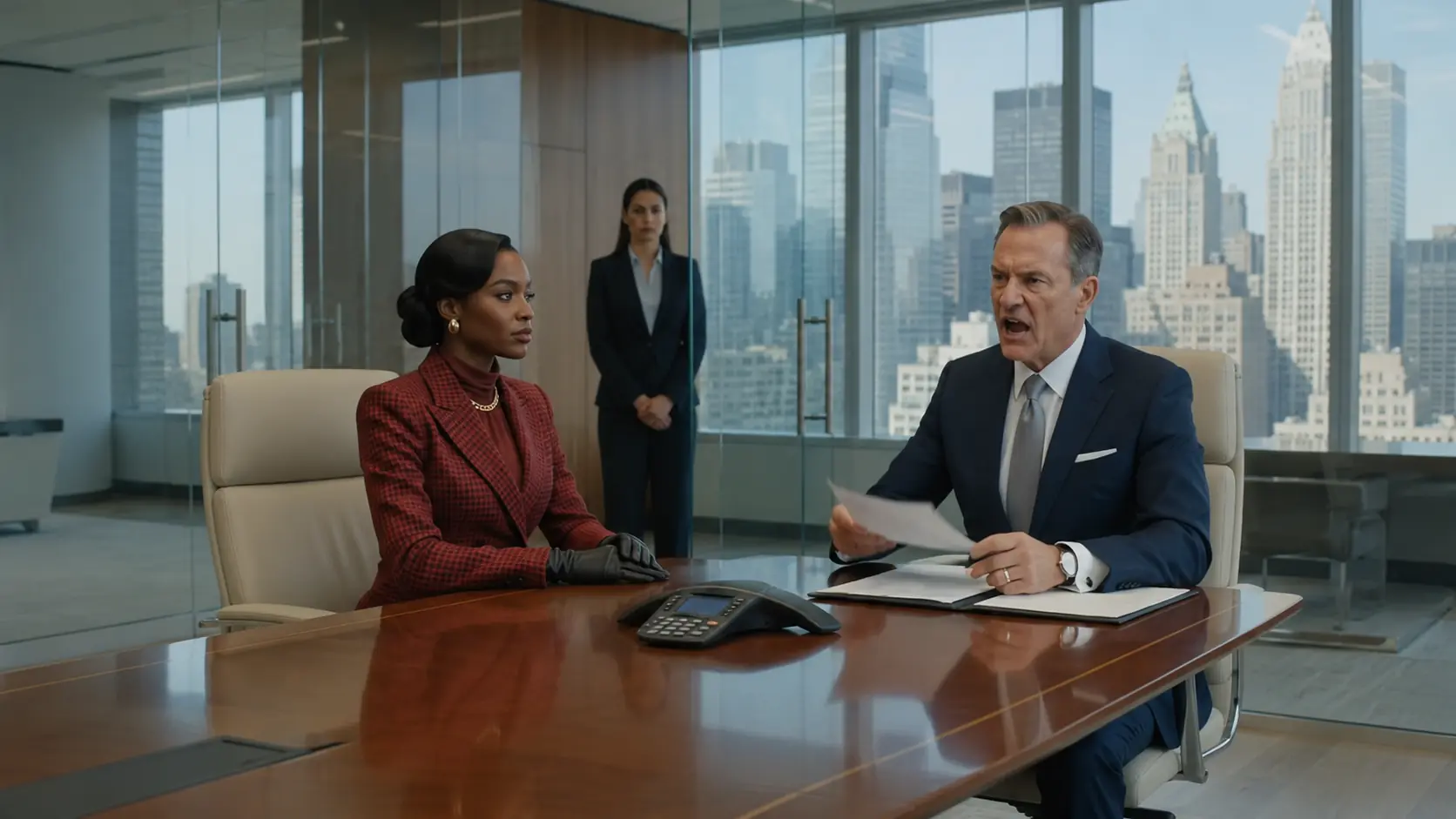
Zara remained seated across the polished mahogany table.
She was twenty-six years old, Black American, and strikingly beautiful, with smooth dark skin, intelligent brown eyes, and her black hair arranged in a flawless low bun. Her fitted red-and-black designer blazer dress, black leather gloves, gold earrings, and knee-high boots gave her the composed elegance of a woman who had entered the room knowing exactly what she was worth. A structured black handbag rested beside her chair, untouched.
“You judged my skin, not my skills,” she said.
Richard’s expression tightened.
He was sixty-two, silver-haired, wealthy, and accustomed to being treated like the most important person in every room he entered. As chief executive of Sterling Atlantic Holdings, he controlled shipping terminals, energy contracts, and logistics networks across three continents. Business publications described him as uncompromising, while former employees used harsher words when reporters were not recording.
“Nine languages?” he mocked. “Prove it—or leave.”
Before Zara could answer, the conference phone behind him began ringing.
She rose slowly and picked up her portfolio.
“Answer the call,” she said. “They asked for me.”
Richard gave a humorless laugh. “You expect me to believe an international consortium knows the name of an entry-level applicant?”
“I’m not entry-level.”
“You applied for director of global negotiations.”
“No. Your recruiter invited me to discuss that position after reviewing my work.”
“Same difference.”
“It is only the same to a man who never finished reading the first page.”
Zara turned toward the door.
Marcus Hale, Richard’s thirty-eight-year-old Black American security director, stood beside it with visible discomfort. He had been instructed to escort her out, but he had heard every word. He did not move to touch her.
The conference phone rang again.
Richard ignored it.
“Marcus, take her downstairs.”
Marcus glanced at Zara. “Ms. Williams, I’ll walk with you.”
“I know the way.”
The door opened before either could leave.
Claire Bennett, Sterling Atlantic’s forty-one-year-old white American general counsel, entered with a tablet pressed against her chest. Her normally controlled face carried an urgency that Richard rarely saw from senior executives.
“The Al-Nasir delegation moved the meeting forward,” she said. “They’re already connected from Dubai, Frankfurt, Geneva, and Singapore.”
Richard looked at the clock. “They were scheduled for eleven.”
“They changed it after their lead negotiator received another offer.”
“Then tell them I’ll join in fifteen minutes.”
“They said they will remain connected for five.”
The phone rang a third time.
Claire noticed Zara standing near the door.
“Why is she leaving?”
“The interview is over.”
Claire looked at the trash can and saw the résumé.
Her eyes returned to Richard.
“Did you read her credentials?”
“I read enough.”
“No, you didn’t.”
The direct challenge silenced the room.
Richard stood. “Be very careful.”
Claire placed the tablet on the table. “Zara Williams advised the State Department’s commercial-language team during the Aster Port dispute. Her translation analysis prevented a shipping consortium from signing a clause that would have transferred arbitration authority overseas.”
Richard glanced toward Zara.
Claire continued. “She also founded Williams Global Strategy. She is not an entry-level applicant. She is the chief executive of a multilingual negotiation consultancy.”
Zara watched the realization pass across his face.
Richard looked at the résumé in the trash.
“You own a company?”
“For four years.”
“Then why interview for a position here?”
“Your board asked whether I would consider building an internal division.”
“I never approved that.”
“That may explain why your board contacted me directly.”
Claire’s tablet chimed.
“The delegation is asking for the American team,” she said.
Richard recovered quickly. “Good. We’ll handle it.”
“You don’t have a lead interpreter.”
“Daniel can interpret.”
Claire shook her head. “Daniel speaks formal Arabic. The Al-Nasir team is bringing representatives from four regions, and their German financing partners joined unexpectedly.”
“Our people can manage.”
Zara reached for the door handle.
Claire looked at her. “Ms. Williams, please wait.”
Richard stepped between them.
“She is not part of this meeting.”
Claire lowered her voice. “The deal is valued at one billion dollars. We have spent eleven months negotiating it. This is not the moment to protect your pride.”
“My pride built this company.”
“No. Thousands of employees built it.”
The phone stopped ringing.
A red notification appeared on the conference display.
Connection terminating in sixty seconds.
Richard moved toward the head of the table. “Claire, sit down. Marcus, clear the room.”
Zara opened the door.
Then the conference speakers activated automatically.
A man’s voice filled the boardroom, speaking rapid Arabic.
Richard froze.
Zara stopped walking.
The voice continued, followed by another speaker in French and a third in German. Daniel Foster, Sterling Atlantic’s senior interpreter, rushed into the room holding a headset. He listened for several seconds, then looked helplessly toward Claire.
“They’re speaking over one another,” he said. “I caught something about exclusivity and breach.”
“What exactly?” Richard demanded.
“I need them to repeat it.”
Zara remained near the doorway.
The Arabic speaker said another sentence. His tone sharpened.
Zara answered him without hesitation.
Her Arabic was fluent, calm, and precise.
Every person in the room turned toward her.
The voice on the speaker stopped.
Then the man answered more slowly.
Zara responded again, this time switching into French when another delegate interrupted. When the German financier entered the exchange, she changed languages a third time without pausing.
Daniel lowered his headset.
Richard stared at her.
“What are they saying?”
Zara finished the exchange before turning toward him.
“They believe your legal team intentionally changed the territorial exclusivity clause after last Friday’s review.”
Claire frowned. “We changed nothing.”
“The English draft didn’t.”
“What does that mean?”
“The German version contains a different definition of ‘exclusive operating territory.’ It expands your control into two ports that were never part of the agreement.”
Richard looked at Claire. “Did our people prepare that version?”
“Our external translation vendor did.”
Zara walked back toward the table.
“They also inserted a sentence allowing Sterling Atlantic to suspend payment during any regulatory investigation, even one unrelated to this project.”
Claire pulled the German contract onto her tablet.
“That clause is not in the English draft.”
“I know.”
Richard’s face hardened. “So the translators made an error.”
“No,” Zara said. “Errors are inconsistent. This language is carefully structured to benefit your company.”
“You’re accusing someone of sabotage after hearing one conversation?”
“I’m identifying what they accused you of.”
The Arabic speaker addressed Zara again.
She listened, then asked Claire for the contract history.
Claire passed her the tablet.
Richard watched Zara scan the tracked changes. Her eyes moved rapidly across English, German, French, and Arabic versions. She compared dates, translator notes, and metadata without asking anyone to slow down.
“Here,” she said.
Claire leaned closer.
The altered documents had been uploaded at 2:14 that morning by an account registered to Sterling Atlantic’s vice president of international acquisitions, Grant Mercer.
Richard’s expression changed.
Grant was one of his most trusted executives.
“He wouldn’t alter a billion-dollar agreement without authorization.”
Zara looked at him evenly. “Someone did.”
“Grant has handled acquisitions for fifteen years.”
“And I have been in this room fifteen minutes. Only one of us found the changes.”
Richard said nothing.
The conference speaker crackled again. A woman spoke in Mandarin, introducing representatives from a Singaporean infrastructure fund.
Daniel stared at the ceiling as if hoping another interpreter might descend from it.
Zara answered in Mandarin.
The Singaporean representative switched to English after greeting her.
“Ms. Williams, we were told you would not be participating.”
Zara looked at Richard.
“So was I.”
A faint laugh came from the speaker.
Richard moved nearer. “They know you?”
“I assisted their legal team during a port mediation two years ago.”
The representative continued. “We requested Ms. Williams specifically because she identified the payment discrepancy in the Busan agreement. Without her independent review, our board will not authorize funding.”
No one in Sterling Atlantic’s boardroom spoke.
Richard’s billion-dollar deal did not merely benefit from Zara’s presence.
It depended on her.
He lowered his voice. “What do you need?”
Zara glanced at the trash can.
“Ninety-seven minutes ago, you didn’t believe I belonged in this building.”
“We do not have time for this.”
“You had time to insult me.”
Claire stepped between them. “Richard.”
Zara removed her gloves one finger at a time and placed them beside her portfolio.
“I need complete authority over language reconciliation for this meeting. No one interrupts a translation. No one paraphrases what a delegate says before I finish. I want Grant Mercer in this room, and I want the original vendor files sent to Claire.”
Richard’s jaw tightened.
“You’re giving orders in my boardroom.”
“I’m explaining the cost of my help.”
The Arabic delegation asked whether the American side intended to continue.
Zara did not answer.
Everyone waited for Richard.
Finally, he nodded. “Agreed.”
“Say it clearly.”
“You have authority over the language review.”
“And Grant?”
“Claire, call him.”
Claire sent the message.
Zara sat at the table.
Over the next thirty minutes, she moved through nine languages with a control that made the room feel smaller around her. She spoke Arabic with the Al-Nasir family’s legal adviser, French with the Geneva insurers, German with the banking group, Mandarin with the Singapore fund, Spanish with two port authorities, Italian with a shipping underwriter, Portuguese with a Brazilian fuel supplier, Japanese with a technology subcontractor, and English with Sterling Atlantic’s executives.
She did not merely translate words.
She identified intention.
When one delegate used a phrase in Arabic that could mean either “delay” or “strategic refusal,” Zara clarified the context before Richard reacted defensively. When the German financier described Sterling Atlantic’s conduct as “unzuverlässig,” she explained that the accusation implied institutional unreliability, not a simple mistake.
Every clarification lowered the temperature of the meeting.
Every accurate answer restored a fraction of the trust Richard’s company had lost.
Grant Mercer entered after twenty minutes.
He was fifty, white American, and impeccably dressed in a dark-blue suit. He looked irritated until he saw the multinational negotiation displayed across the boardroom screens.
“What happened?” he asked.
Claire showed him the altered files.
Grant glanced at Zara. “Who is she?”
“The woman saving the deal you nearly destroyed,” Claire said.
Grant laughed. “That’s dramatic.”
Zara spoke without looking away from the contract.
“Your login uploaded the modified German and Arabic versions at 2:14 this morning.”
Grant’s confidence slipped.
“My assistant uses my account.”
“Your assistant was in Boston last night.”
He looked toward Richard. “This is ridiculous.”
Richard remained silent.
Grant approached the table. “Those amendments were strategic protections. The other side was never supposed to compare versions line by line.”
Claire stared at him. “You altered executed negotiation drafts?”
“I strengthened our position.”
“You created fraudulent discrepancies.”
“I created leverage.”
The conference microphones were still active.
Zara’s eyes moved immediately to the screen.
The delegates had heard him.
The Arabic adviser began speaking angrily. The German bankers joined him, followed by the Singapore representative. Voices overlapped until the sound became almost impossible to separate.
Richard’s face drained of color.
“Cut the microphones.”
“No,” Zara said.
“They heard a private conversation.”
“They heard the truth.”
“Mute us.”
“If you mute now, they’ll assume the entire company approved what Grant did.”
Richard reached toward the controls.
Zara caught his wrist.
The room went completely still.
“Do not make this worse.”
For the first time in years, someone had physically stopped Richard Sterling from doing exactly what he wanted.
He looked down at her hand, then into her eyes.
Zara released him.
“Sit down,” she said. “Let me repair it.”
Richard sat.
Zara addressed the delegation first in Arabic, then repeated her statement in German, French, and Mandarin.
She told them the alterations had not been approved by Sterling Atlantic’s general counsel or board. She acknowledged that a senior executive had acted improperly and promised that every draft would be independently reconciled before further negotiations.
Then she did something Richard would never have done.
She apologized without qualification.
No excuses.
No blame directed at the vendor.
No claim that the changes had been misunderstood.
A senior Sterling Atlantic executive had violated the process, and the company accepted responsibility.
The anger on the call gradually softened.
The Singapore representative asked what protections would prevent another incident.
Zara proposed a multilingual master agreement controlled by an independent legal repository. Every translated version would receive equal legal authority, and any discrepancy would automatically trigger third-party arbitration.
Claire nodded. “That works.”
Richard whispered, “It limits our discretion.”
Zara continued addressing the delegates.
Claire turned toward him. “You no longer have discretion. Grant destroyed it.”
Grant stepped back from the table.
“This company has made billions because I know how to push negotiations.”
Richard looked at him.
“You risked a billion because you thought no one would read what you changed.”
Grant pointed toward Zara. “And now we’re letting an outsider dictate our contracts?”
Zara finally faced him.
“You hid behind languages you assumed the Americans wouldn’t understand.”
Grant sneered. “You’re enjoying this.”
“No. I’m billing for it.”
Claire almost smiled.
Richard did not.
“Marcus,” he said.
The security director stepped forward.
“Escort Grant to his office. Remove his system access and remain with him until the board’s investigation begins.”
Grant’s face hardened. “You’re choosing her over me?”
Richard looked toward the screens showing representatives from four continents waiting for proof that Sterling Atlantic could be trusted.
“I’m choosing the company you nearly cost me.”
Marcus led Grant from the boardroom.
Zara returned to the contract.
For the next hour, she rebuilt the agreement clause by clause. She removed the unauthorized language, corrected cultural ambiguities, and identified three additional phrases that were technically accurate but dangerous in translation.
One involved ownership.
Another involved regulatory jurisdiction.
The last involved the definition of a “material delay.”
Without correction, each could have caused years of litigation.
At one point, the Japanese subcontractor questioned the technology-transfer protections. Zara changed languages, explained the intellectual-property provision, and offered language that respected both American and Japanese legal expectations.
The representative accepted it immediately.
Richard watched her work.
He had built his career believing control came from speaking first, speaking loudest, and forcing other people to adjust. Zara controlled the room differently.
She listened until she understood what everyone feared.
Then she gave each person language strong enough to trust.
At 1:46 p.m., the Al-Nasir delegation accepted the reconciled agreement.
The German banks restored financing approval.
The Singapore fund released its billion-dollar commitment, subject only to final signatures.
The deal Richard had almost lost was alive again.
The screens began disconnecting one by one.
Before leaving, the lead Arabic negotiator addressed Zara in English.
“Ms. Williams, we would not have continued without you.”
“Thank you.”
“We hope Sterling Atlantic understands what it has.”
Zara glanced toward Richard.
“So do I.”
The final screen went dark.
Silence settled over the boardroom.
Richard remained seated at the head of the table, staring at the signed memorandum displayed on the wall. His company had survived, but the victory did not belong to him.
Claire closed her tablet.
“Grant’s access has been suspended. I’ll notify the board.”
Daniel removed his headset. “I have never heard anyone switch languages that fast.”
Zara gathered her gloves.
“Speed is less important than accuracy.”
Richard finally stood.
“Ms. Williams.”
She continued packing her portfolio.
“I owe you an apology.”
“You owe me several.”
His expression tightened, but he did not retreat.
“I treated you with disrespect. I made assumptions about your education, your experience, and why you were invited here.”
“You called me a diversity experiment.”
“I did.”
“You suggested Howard University handed me a degree because I’m Black.”
Richard lowered his eyes.
“I did.”
“You called me sweetheart after dismissing nine languages you couldn’t verify.”
“I did.”
Claire and Marcus remained near the door.
No one rescued him from the humiliation.
Zara stepped closer.
“You did not make one careless remark. You revealed exactly how you evaluate people when you think they have less power than you.”
Richard looked at her.
“I understand.”
“No. You understand that it cost you today. That isn’t the same as understanding what it has cost other people for years.”
The words landed harder than any accusation shouted in anger.
Richard glanced toward the trash can.
Her résumé was still there.
He walked across the room, bent down, and removed it. The paper had been creased, but not torn.
He placed it carefully on the table.
“I want you to lead our global negotiations division.”
Zara laughed once, without amusement.
“You think the reward for saving your company is working for the man who threw my résumé away?”
“I’m offering you authority, resources, and compensation.”
“You’re offering me a position your board already wanted me to consider.”
“Then name your terms.”
Claire looked toward Zara with interest.
Zara placed both gloved hands on the table.
“Williams Global Strategy remains independent.”
Richard started to object.
She raised one finger.
“Sterling Atlantic signs a five-year consulting agreement with my company. I report directly to the board, not to you. My team reviews every international contract before execution, and no executive may alter translated language outside our controlled process.”
“That is substantial authority.”
“You asked me to name my terms.”
“What compensation?”
Zara slid a document from her portfolio.
Richard stared at it.
“You prepared a proposal before arriving?”
“I prepare for meetings.”
Claire took the document and read the first page.
Her eyebrows rose.
Richard noticed. “How much?”
“Less than Grant’s failed acquisition strategy would have cost you this quarter.”
“That is not a number.”
“It is on page three.”
He turned to it.
The annual fee was enormous.
Richard looked up. “You expect me to approve this after one meeting?”
Zara put on her gloves.
“You were willing to reject me after half of one.”
Claire spoke quietly. “The board will approve it.”
Richard looked at her.
“She just protected a billion-dollar transaction and uncovered internal misconduct in under two hours,” Claire continued. “The fee is defensible.”
Zara picked up her handbag.
“There is one more condition.”
Richard exhaled. “Of course there is.”
“Every management candidate at Sterling Atlantic receives a standardized review before an executive sees their name, photograph, university, gender, or race.”
“You want blind hiring?”
“I want qualifications read before assumptions.”
“That requires rebuilding our recruitment system.”
“Yes.”
Richard looked at her résumé.
The first page listed achievements he had never reached because he had decided the woman carrying them did not belong.
He extended his hand.
“Agreed.”
Zara did not take it immediately.
“This agreement does not erase what happened.”
“I know.”
“It doesn’t make you a better man.”
“I know.”
“It gives you a chance to become one.”
Richard nodded.
Only then did she shake his hand.
Three weeks later, the billion-dollar partnership was signed in the same boardroom.
This time, Zara sat at the head of the table during the international language review. She wore an ivory double-breasted suit, gold jewelry, and her long black hair in soft waves over one shoulder. Richard sat two seats away, no longer controlling every exchange.
The board approved Williams Global Strategy’s contract unanimously.
Grant Mercer was terminated after investigators discovered that he had manipulated several previous translations to trigger bonuses tied to short-term contract advantages. Two former clients reopened disputes, and federal regulators began reviewing his conduct.
Sterling Atlantic’s recruitment system changed.
Résumés for management positions were stripped of identifying information during the first review. Interview panels became larger, decisions required written qualification-based explanations, and complaints could bypass Richard’s office entirely.
The results embarrassed him.
Within six months, the company hired experienced candidates who had previously been screened out despite stronger records than the people selected ahead of them.
Profits improved.
Contract disputes declined.
International partners began requesting Zara’s participation before major negotiations.
Richard kept the creased résumé inside the top drawer of his desk.
Not as a trophy.
As evidence.
One evening, nearly a year after their first meeting, he found Zara alone in the boardroom reviewing a Brazilian port agreement.
“You’re still here,” he said.
“So are you.”
“I wanted to tell you something.”
She continued reading.
“The board renewed our expansion plan today. The Al-Nasir project is now projected to exceed its original value by twenty percent.”
“I saw the numbers.”
“They asked me what changed.”
Zara looked up.
“What did you tell them?”
Richard glanced at the trash can beside his old chair. It had been removed months earlier, replaced by a closed cabinet no one could use for theatrical gestures.
“I told them the company stopped confusing authority with intelligence.”
Zara studied him.
“That almost sounds like growth.”
“Almost?”
“You still need practice.”
Richard smiled faintly.
“I also told them the most expensive mistake I ever made was deciding who you were before you spoke.”
Zara closed the contract.
“No. Your most expensive mistake would have been refusing to listen after I did.”
He accepted the correction.
When Richard left the room, Zara remained beside the windows, looking over Manhattan as evening lights appeared between the towers. She had entered the building as a woman he believed could be discarded before the interview began.
Now governments, banks, and international companies refused to sign without her review.
She had not proven that she deserved a seat at Richard Sterling’s table.
She had proved the table could not survive without people like her.
And the résumé he had once thrown into the trash became the document that changed a billion-dollar company forever.