Security dragged the bank owner toward the exit.
She smiled and whispered five words that destroyed careers instantly.
Tuesday, 2:47 p.m.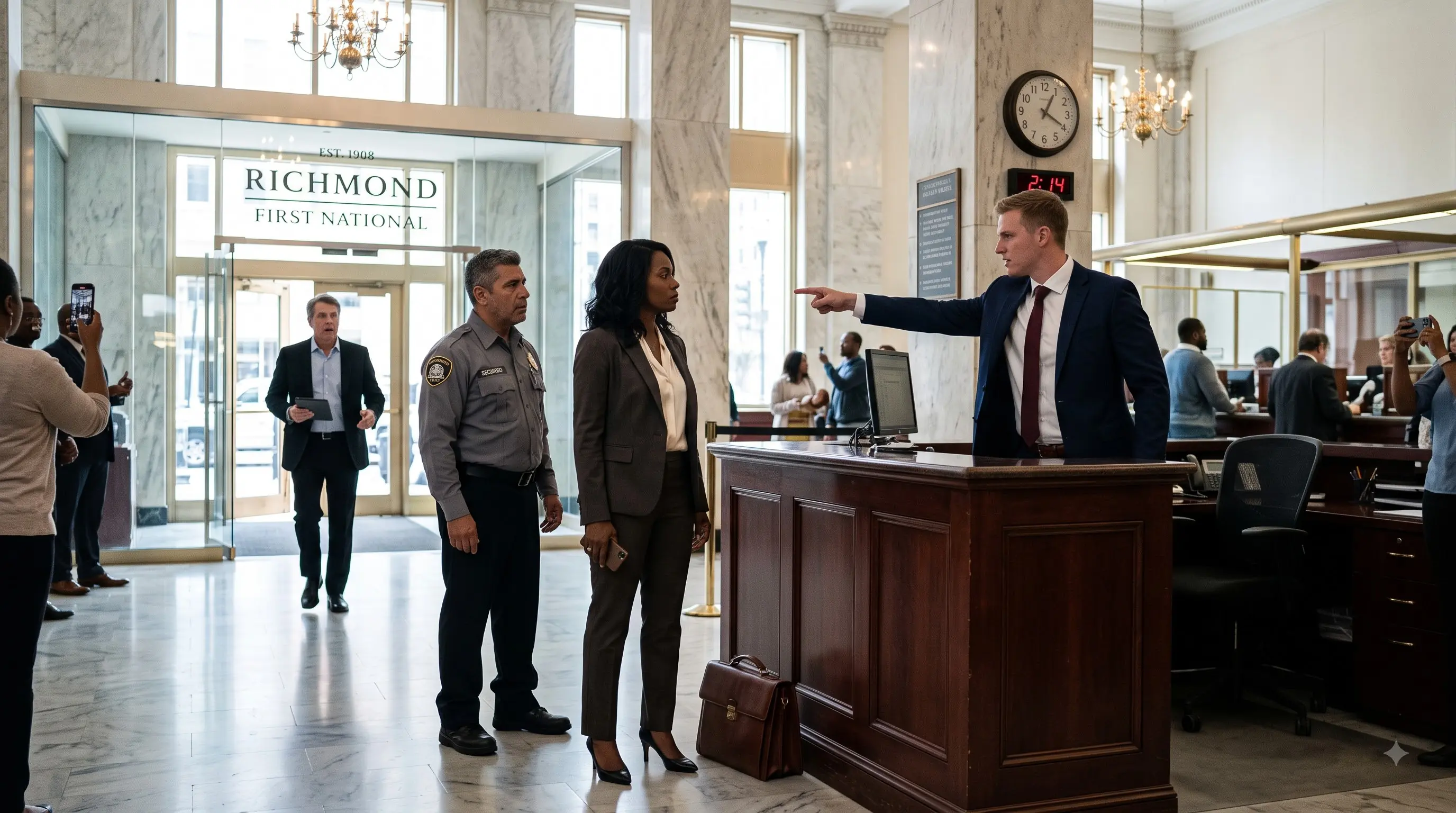
Dr. Evelyn Reed entered Sterling National Bank’s marble lobby wearing a charcoal blazer worth more than most monthly salaries.
At forty-two, she moved with quiet confidence earned through a Stanford MBA, years of financial strategy, and building an institution powerful enough to reshape entire markets.
Branch manager Jason Croft barely glanced up.
Twenty-eight years old. Fresh MBA. Three months on the job.
He saw a Black woman and made instant assumptions.
“Ma’am, this is a private institution,” he said. “You can’t just walk in here demanding things.”
Security stepped forward.
Customers pulled out phones.
The humiliation was deliberate, public, and recorded.
“People like you need to understand your place,” Croft announced, loud enough for everyone to hear.
The lobby fell silent except for the clicking of phone cameras.
Croft stood behind his mahogany desk with his arms crossed. At six foot one, he literally looked down at Evelyn’s five-foot-three frame. His voice carried that particular tone reserved for people he considered beneath his station.
“Listen, people like you come in here every day with complaints. This isn’t that kind of bank.”
Evelyn’s expression remained perfectly calm.
She placed her leather briefcase on the edge of the desk.
“I’m here to conduct routine business. Nothing more.”
“Routine business?”
Croft’s laugh held no warmth.
“Right. And I suppose you have an account here worth our attention.”
The security guard, Esposito, stepped closer.
Fifteen years on the job, he had seen every type of customer dispute. Something felt different about this one, but Croft was his supervisor.
Three customers now openly stared.
Maria Garcia, streaming live on her Justice Watch account, whispered into her phone, “Y’all are seeing this, right? This manager is tripping hard.”
Her viewer count jumped from two hundred to twelve hundred in thirty seconds.
Croft continued his performance.
“Ma’am, I’m going to need you to calm down before this escalates.”
“I haven’t raised my voice once,” Evelyn replied evenly.
“Your aggressive body language says otherwise.”
Assistant manager Karen Lee emerged from the back office, drawn by the commotion. Ambitious and hardworking, she had climbed from teller to management in three years. Her first instinct was to support her supervisor.
“Is there a problem here?” Lee asked.
“This woman claims she has business with us,” Croft explained. “No appointment. No documentation. Just walked in demanding special treatment.”
Lee studied Evelyn’s appearance.
The blazer was clearly expensive. The handbag was genuine leather, not a knockoff. Something did not add up, but Croft was her boss.
Evelyn reached into her purse and retrieved her wallet. The movement was deliberate and unhurried.
A Platinum American Express Centurion card caught the light briefly before she closed the wallet.
Croft missed it entirely.
“Ma’am, I’m going to ask you one more time to leave peacefully,” Croft announced loudly enough for everyone to hear, “before we call the real police.”
Maria’s live stream exploded with comments. Viewers jumped from twelve hundred to fifty-four hundred in minutes. The chat scrolled rapidly with outrage and disbelief.
“This is insane,” Maria whispered to her phone. “He’s literally treating her like a criminal for existing while Black in a bank.”
Other customers began recording, too.
Kevin Cho, a local blogger with forty thousand followers, had just entered the bank. He immediately recognized the brewing situation and started his own video.
The clock on the wall read 2:55 p.m.
Evelyn glanced at her watch, an understated Patek Philippe that cost more than Croft’s monthly salary.
She seemed to be counting down something.
“I’ll give you exactly two more minutes,” she said quietly.
Croft’s confidence soared.
“Two minutes for what? To call security on yourself?”
Esposito shifted uncomfortably.
The woman had not done anything threatening. She had not raised her voice, made demands, or caused any disturbance. His instincts told him to step back, but Croft’s authority was clear.
Lee pulled out her tablet, accessing the customer database.
“What’s your account number?” she asked, trying to de-escalate.
“That won’t be necessary.”
“See?” Croft turned to the growing crowd. “No account. No business here. Just another troublemaker looking for a payday.”
The word another hung in the air like smoke.
Everyone understood the implication.
Maria’s viewer count hit sixty-eight hundred.
Comments poured in from across the country. Screenshots were already spreading on Twitter and Instagram.
“Ma’am, you need to leave now,” Croft declared. “Security, please escort her out.”
Esposito hesitated.
“Sir, she hasn’t actually done anything.”
“She’s trespassing. Remove her.”
The moment crystallized.
Four separate phone cameras recorded from different angles. The bank security system captured everything in high definition.
Maria’s live stream reached eight thousand viewers.
Evelyn remained perfectly still in the center of the commotion. Surrounded by staff, security, and a growing crowd of customers, she showed no sign of stress or anger.
Instead, she reached into her purse again.
This time, she pulled out her phone. The device was sleek and expensive, with a custom case bearing discreet initials.
“A phone call will clarify everything,” she said calmly.
Croft’s smug expression faltered slightly.
Something in her tone suggested this was not an empty threat.
Lee watched nervously as Evelyn scrolled through her contacts. The name she selected was not visible to anyone else.
The phone rang once.
“Robert,” Evelyn said.
Her voice was quiet but carried absolute authority.
“Code 7 protocol. Sterling National Downtown Branch. Immediately.”
She ended the call after fifteen seconds.
Croft laughed nervously.
“Who exactly did you just call? Your lawyer?”
Evelyn slipped the phone back into her purse.
“Someone who actually works here.”
The clock showed 2:58 p.m.
Outside the bank’s floor-to-ceiling windows, downtown traffic continued its usual Tuesday rhythm.
Inside, tension built like pressure in a sealed container.
Croft looked around the room, suddenly aware that dozens of people were recording. His confidence wavered as he realized this incident was already going viral.
“Corporate security is probably laughing at your call right now,” he said, but his voice lacked conviction.
Evelyn checked her watch again.
“Nine seconds,” she said quietly.
The bank’s atmosphere shifted perceptibly.
What had started as a routine customer service dispute had transformed into something resembling a public spectacle.
Maria’s live stream viewer count climbed past ten thousand as word spread across social media platforms.
Croft paced behind his desk, phone pressed to his ear.
“Yes, I need corporate security to confirm something. We have a situation here.”
Lee pulled Esposito aside.
“This feels wrong,” she whispered. “Something’s off about this whole thing.”
“I know,” Esposito replied quietly. “She’s not acting like someone who’s lying.”
Kevin Cho positioned himself for the best camera angle. His forty thousand Instagram followers were about to witness something significant.
He could sense it the way experienced journalists smell a breaking story.
“Folks, this is Kevin Cho reporting live from Sterling National Bank downtown,” he whispered into his phone camera. “We’re watching what appears to be a case of banking while Black, but something tells me there’s more to this story.”
Croft finished his call, looking slightly less confident.
“Corporate confirms no VIP appointments scheduled today. No one by your description has authorization for special access.”
Evelyn’s smile was patient, almost maternal.
“Did you give them my name?”
“I don’t know your name. You refused to provide identification.”
“You never asked for identification,” she said. “You assumed I didn’t belong here.”
The distinction hit like a slap.
Several customers nodded, recognizing the truth in her words.
Maria’s chat exploded with observations. Viewers dissected every detail of the interaction, noting Croft’s assumptions and microaggressions. Screenshots circulated online with hashtags gaining momentum.
The clock read 2:59 p.m.
“Sixty seconds,” Evelyn announced.
Croft’s nervous energy increased.
“Sixty seconds until what? Until your imaginary friend arrives?”
“Until you understand who you’re speaking to.”
Lee’s tablet chimed with an incoming message.
She glanced at the screen and froze.
The message was from regional vice president Robert Maxwell.
Emergency situation. Downtown branch. En route immediately. Do not escalate further.
She looked up at Evelyn with dawning comprehension.
“Jason,” she said quietly. “We might want to…”
Her words were cut off by the sound of hurried footsteps in the marble lobby.
Robert Maxwell burst through the bank’s entrance, his usually perfect appearance disheveled from running.
Maxwell was a career banking executive with twenty-three years at Sterling National. He had climbed from loan officer to regional vice president through careful political maneuvering and absolute competence.
People did not see him run.
Ever.
His eyes swept the crowd until they found Evelyn. Relief and terror crossed his face simultaneously.
“Dr. Reed,” he said breathlessly. “I am so incredibly sorry.”
The name hit Croft like ice water.
Reed.
Lee’s tablet nearly slipped from her hands. She quickly accessed the corporate directory, typing with trembling fingers.
Maxwell approached Evelyn with the reverence reserved for visiting royalty.
“Please accept my profound apologies for this misunderstanding.”
Croft’s face drained of color.
“Miss Reed, I… I didn’t realize…”
“Dr. Reed,” Evelyn corrected gently. “And you still don’t realize.”
Maria’s live stream chat became a blur of activity. Thousands of viewers demanded explanations, theories, and updates. The viewer count surpassed fifteen thousand and kept climbing.
Lee found what she was looking for in the corporate directory.
Her face went white as she read the entry.
Dr. Evelyn Reed.
Founder and CEO.
Board chair.
Majority shareholder.
The woman they had just tried to remove from the bank owned the bank.
Maxwell turned to Croft with barely controlled fury.
“Mr. Croft, Dr. Reed founded this institution. She owns sixty-seven percent of Sterling National Bank.”
The words landed like physical blows.
Croft’s legs seemed to give out slightly. He gripped his desk for support.
Esposito stepped backward instinctively, distancing himself from the disaster he had nearly participated in.
“There’s a board meeting in two minutes,” Evelyn said calmly. “I suggest you attend.”
Kevin Cho’s camera captured every moment.
This was beyond viral content now.
This was career-defining journalism happening in real time.
The lobby fell silent except for whispered commentary from phone cameras and Maria’s live stream.
Customers stared in fascination and horror at Croft’s public humiliation.
Maxwell gestured toward the elevator bank.
“Dr. Reed, please. The board is waiting upstairs.”
Croft’s career flashed before his eyes.
Three months on the job.
MBA from a mid-tier school.
Student loans that would take fifteen years to repay.
All of it evaporating in real time.
“Dr. Reed, please,” he stammered. “I can explain.”
“There’s nothing to explain,” Evelyn interrupted. “Your actions speak clearly.”
Lee approached hesitantly.
“Dr. Reed, I… we had no idea. Mr. Croft handled the interaction.”
“And Ms. Lee, isn’t it?” Evelyn’s tone was professional but not unkind. “You’re not the problem here. We’ll discuss your role separately.”
Relief flooded Lee’s face.
She was not being lumped in with Croft’s career suicide.
Maria addressed her live stream audience.
“Y’all, I cannot believe what just happened. This man just tried to kick the actual owner out of her own bank. This is going to be everywhere by tonight.”
Her prediction was conservative.
Screenshots and video clips were already spreading across every major social platform. Banking while Black began trending nationally within minutes.
Maxwell looked physically ill.
As regional vice president, this incident had happened under his oversight. His own career prospects hung in the balance.
“Dr. Reed, how would you like to proceed?” he asked carefully.
Evelyn glanced at her watch.
“3:01 p.m. The board meeting started a minute ago. I don’t like being late.”
She moved toward the elevators with measured grace.
Maxwell followed like a nervous aide. The crowd parted automatically, phones still recording her every step.
Croft remained frozen behind his desk, watching his professional life end in real time.
Lee gathered her courage.
“Should I come upstairs?”
“Yes,” Evelyn replied without turning around. “Bring Mr. Croft.”
The elevator doors opened.
Evelyn stepped inside, followed by Maxwell.
They waited as Croft walked unsteadily across the marble floor, his confident swagger replaced by the stumble of a condemned man.
Lee joined them, tablet clutched against her chest like armor.
As the elevator doors closed, cutting off the view from the lobby, Maria addressed her audience one final time before following the story upstairs.
“Folks, this is just the beginning. We’re about to see what happens when you mess with the wrong person.”
Her viewer count hit twenty-two thousand.
The elevator began its ascent to the forty-seventh floor, carrying four people whose lives had just changed forever.
In the lobby below, customers and bystanders continued recording, knowing they had witnessed something extraordinary.
Outside downtown, traffic continued its Tuesday rhythm, oblivious to the corporate earthquake happening forty-seven floors above the street.
Kevin Cho posted his first social media update.
Breaking: Bank manager tries to kick out Black woman. Plot twist: she owns the bank. Full video coming.
Within minutes, his post had five thousand shares.
The story was no longer contained within Sterling National Bank’s marble walls.
It belonged to the internet now, and the internet never forgets.
The elevator climbed silently toward the forty-seventh floor.
Maxwell stood pressed against the back wall, sweat visible on his forehead despite the climate control.
Croft stared at the floor numbers ascending, each one marking another step toward professional doom.
Lee clutched her tablet, mind racing through the implications.
She had assisted in trying to remove the bank’s founder from her own building.
Career suicide by association.
Evelyn stood perfectly composed, hands folded, watching the numbers climb with mild interest.
“Dr. Reed,” Maxwell began carefully, “I want you to know that Mr. Croft’s actions don’t reflect our institutional values or training protocols.”
“Don’t they?” Evelyn asked.
The question was quiet but pointed.
The elevator chimed softly as they passed the thirtieth floor.
Croft finally found his voice.
“Dr. Reed, I had no idea who you were. If you’d just identified yourself…”
“Would that have mattered, Mr. Croft?”
Her question hung in the recycled air.
They all knew the answer.
Forty-third floor.
“I mean, yes, absolutely. Of course it would have mattered,” Croft stammered.
“So you treat people differently based on who they are, rather than treating everyone with basic respect.”
Forty-fifth floor.
Maxwell watched this masterclass in executive interrogation with horrified fascination.
Dr. Reed was not raising her voice or making threats. She was simply asking questions that dismantled Croft’s position with surgical precision.
Forty-sixth floor.
“That’s not what I meant,” Croft protested weakly.
“Then what did you mean?”
Forty-seventh floor.
The elevator doors opened to reveal Sterling National’s executive level.
Floor-to-ceiling windows offered panoramic views of the city. The reception area featured original artwork and furniture that cost more than most people’s annual salaries.
The board meeting was already in session.
Through glass conference room walls, twelve figures sat around a polished mahogany table.
Chairman William Price, seventy-one years old, had mentored Evelyn through her early investment banking career. His silver hair and tailored suits concealed a razor-sharp business mind.
Maxwell approached the conference room doors with visible reluctance.
Inside, the board members were reviewing quarterly reports, unaware of the crisis that had developed in their building’s lobby forty minutes earlier.
Price looked up as the doors opened. His face immediately registered concern at seeing Maxwell’s disheveled appearance and the unusual entourage.
“Robert, is everything all right?”
“Sir, we have a Code 7 situation,” Maxwell announced formally.
The room fell silent.
Code 7 indicated potential legal liability requiring immediate board attention.
Price’s eyes found Evelyn, and his expression shifted to confusion.
“Evelyn, what’s happening?”
She entered the conference room with the same measured confidence she had shown downstairs.
Croft and Lee followed like prisoners being led to sentencing.
“Good afternoon, everyone,” Evelyn said calmly. “I apologize for the disruption, but we need to address an incident that occurred in our downtown branch forty minutes ago.”
Board members exchanged glances.
Dr. Olivia Chen, the board’s only other Black member, sensed something significant brewing.
“Please sit,” Price said, gesturing to empty chairs.
Evelyn remained standing.
“Thank you, but I prefer to present the facts clearly.”
She opened her briefcase and retrieved a tablet.
With practiced efficiency, she connected it to the room’s presentation system.
Maria’s live stream appeared on the main screen.
“This footage was broadcast live on social media thirty minutes ago. It currently has forty-seven thousand viewers and climbing.”
The board watched in growing horror as the incident unfolded.
Croft’s voice filled the conference room.
“People like you come in here every day with complaints.”
Board member Peter Schmidt visibly cringed.
“Oh my God.”
The footage continued.
Croft’s dismissive attitude. His assumptions. His escalating hostility toward a customer who had done nothing wrong.
When Maxwell burst into the frame, calling her Dr. Reed, several board members gasped.
“Jesus Christ,” Price muttered.
The video paused at the moment Croft’s face showed recognition and terror.
“This incident was witnessed by approximately two hundred people in our lobby,” Evelyn continued. “It was live-streamed to over fifty thousand viewers across multiple platforms. Screenshots are currently trending on Twitter, Instagram, and TikTok.”
She clicked to the next slide, showing social media analytics in real time.
“Banking while Black is trending nationally. Sterling National is trending regionally. Local news stations have already picked up the story.”
Board member Jennifer Woo, the communications expert, looked physically ill.
“The PR implications are catastrophic.”
“Mr. Croft,” Evelyn said, addressing him directly for the first time since entering the boardroom. “Would you like to explain your actions to the board?”
Croft’s mouth opened and closed without sound.
Finally, he said, “I… I made a mistake.”
“What specifically was your mistake?”
“I didn’t recognize you.”
“Try again.”
The room waited.
Croft’s career hung on his next words.
“I… I made assumptions based on…”
He could not finish the sentence.
“Based on what, Mr. Croft?” Price asked, leaning forward.
Twenty-three years of banking experience told him this conversation was being recorded for legal purposes.
“I made assumptions about who belonged in our bank,” Croft finally admitted.
The confession hung in the air like a toxic cloud.
Dr. Chen spoke first.
“Mr. Croft, are you saying you determined Dr. Reed didn’t belong in our bank based on her race?”
“I… I know that’s not… I mean…”
“It’s a simple yes or no question.”
Croft’s career ended in that moment of silence.
Evelyn clicked to the next slide.
“Our corporate charter, which I personally drafted, contains explicit anti-discrimination clauses. Policy 847 establishes zero tolerance for bias-based customer service.”
She clicked again.
“The legal implications are significant. Mr. Croft’s actions exposed Sterling National to potential civil rights violations, discrimination lawsuits, and federal banking regulation violations.”
General Counsel Thomas Wright took notes frantically.
The legal exposure was enormous.
“However,” Evelyn continued, “I’m not here to destroy careers or seek monetary damages.”
Relief flickered across several faces.
“I’m here to ensure this never happens again.”
She clicked to a new slide showing policy proposals.
“I’m proposing comprehensive reforms. Mandatory bias training for all customer-facing employees. Monthly diversity audits for all branches. Customer interaction monitoring systems with bias-flagging capabilities.”
Board member Schmidt raised his hand.
“What about Mr. Croft?”
Evelyn looked at Croft directly.
“Mr. Croft has a choice. Immediate resignation with standard severance, or termination for cause with no benefits.”
Croft’s shoulders slumped.
“I’ll resign.”
“Ms. Lee,” Evelyn continued, “your response to the situation shows you can learn from this experience. You’ll receive bias training and a six-month probationary period.”
Lee nodded gratefully.
“Thank you, Dr. Reed.”
Price cleared his throat.
“Evelyn, what do you need from us?”
“Full board approval for the policy changes, implementation within thirty days, and a public statement reaffirming our commitment to serving all customers equally.”
The board voted unanimously.
As members began filing out, discussing implementation details, Croft approached Evelyn one final time.
“Dr. Reed, I’m sorry. I really am.”
She studied his face for a moment.
“Mr. Croft, I believe you’re sorry you got caught. Whether you’re sorry for your actions remains to be seen.”
Croft left the conference room a broken man.
Maxwell lingered behind.
“Dr. Reed, I take full responsibility for inadequate oversight.”
“Robert, this isn’t about you. But use this as a learning experience. Our managers need better training and better recognition of unconscious bias.”
“Absolutely. I’ll personally oversee the implementation.”
As the boardroom emptied, Price approached Evelyn.
“Forty-seven thousand viewers?”
“Last I checked, yes.”
“This could have been a disaster.”
“Instead, it’s an opportunity. We’re going to become the banking industry leader in bias prevention.”
Price smiled slightly.
“You always were three steps ahead of everyone else.”
Outside the conference room windows, the city continued its Tuesday rhythm.
But inside Sterling National Bank, everything had changed.
The incident that began with assumptions and prejudice had transformed into systemic reform.
Sometimes the most powerful response to discrimination is not anger or litigation.
Sometimes it is simply proving them wrong.
The boardroom had emptied except for Price, Evelyn, and Maxwell.
Through the floor-to-ceiling windows, late afternoon sunlight cast long shadows across downtown. The city looked peaceful from forty-seven floors up, oblivious to the corporate earthquake that had just reshaped Sterling National Bank.
Price poured himself coffee from the executive service station. His hands were steadier now, but the incident’s implications weighed heavily on his experienced shoulders.
“Sixty-seven percent controlling interest,” he said quietly. “Sometimes I forget you literally own this place.”
Evelyn smiled slightly.
“Most people do. That’s usually fine. But not today.”
“Not today.”
Maxwell checked his tablet, monitoring the social media storm developing around the incident.
“Dr. Reed, the footage has reached one hundred twenty thousand views. CNN’s business desk just called our communications department.”
Evelyn was not surprised.
“Expected timeline for national news coverage, six hours. Maybe less. The story has everything networks love. Clear villain. Shocking reversal. Social justice angle.”
Price set down his coffee cup.
“Talk to me about exposure. What are we looking at legally?”
Evelyn pulled up financial projections on the main screen.
Her preparation was thorough, as always.
“Potential civil rights lawsuit exposure: twelve million dollars in damages plus legal fees. Federal banking discrimination investigation could trigger comprehensive audits costing another eight million. Reputation damage to our brand value is harder to quantify, but comparable incidents have cost competitors fifteen to twenty percent of their customer base.”
The numbers sobered everyone in the room.
“However,” she continued, “proactive reform implementation reduces legal exposure significantly. Public commitment to change, documented policy improvements, and transparent accountability measures typically result in settlements under two million.”
Maxwell looked up from his tablet.
“You’ve already calculated the cost-benefit analysis.”
“I calculated it while riding the elevator upstairs.”
Price laughed despite the circumstances.
“Fifteen years I’ve watched you work, and you still amaze me.”
Evelyn clicked to the next slide showing detailed reform proposals.
“The Reed Protocol.”
“Yes, I’m naming it after myself.”
She continued.
“It addresses unconscious bias at every customer interaction level. Initial implementation cost: 4.7 million dollars. Annual maintenance cost: 2.1 million dollars.”
She paused, letting the numbers sink in.
“Current quarterly revenue: 847 million dollars. These reforms represent less than one percent of annual income while preventing potentially catastrophic legal and reputational costs.”
Maxwell was taking notes rapidly.
“Implementation timeline?”
“Thirty days for policy changes. Sixty days for technology deployment. Ninety days for comprehensive staff training. Full audit and compliance review after six months.”
Price studied the projections carefully.
“ROI projections?”
“Improved customer satisfaction typically increases account retention by twelve percent. Positive publicity from leading industry reform efforts could increase new account acquisition by eighteen percent. Conservative estimate: additional revenue of sixty-two million dollars annually.”
The business case was overwhelming.
“There’s more,” Evelyn continued.
She clicked to market analysis data.
“Our major competitors have faced similar discrimination incidents in the past eighteen months. None implemented comprehensive reforms. They’re vulnerable to customer defection if we position ourselves as the ethical alternative.”
She highlighted specific market opportunities.
“Minority-owned business banking represents forty-three billion dollars in untapped market potential in our region. Our current market share in that demographic is eight percent. Industry-leading bias prevention could triple our market share within two years.”
Maxwell whistled softly at the numbers.
“But this isn’t just about money,” Evelyn emphasized. “It’s about institutional integrity. I founded Sterling National to serve everyone equally. Today’s incident violated our core mission.”
Price nodded slowly.
“What do you need from leadership?”
“Full executive commitment to change. Zero tolerance for discrimination at any level. Public accountability for our progress.”
She clicked to the final slide.
“Specific accountability measures. Monthly diversity reports from every branch manager. Quarterly bias training assessments for all customer-facing employees. Annual independent audits of our discrimination prevention protocols.”
Maxwell raised a concern.
“Staff resistance. Some employees might view this as excessive oversight.”
“Employees who view bias prevention as excessive oversight probably shouldn’t work here,” Evelyn replied flatly.
The room fell silent as that truth settled.
Price’s phone buzzed with an urgent message. He glanced at the screen and frowned.
“Croft just posted a LinkedIn statement. ‘I deeply regret the misunderstanding that occurred today. I was simply following standard security protocols.’ End quote.”
Evelyn’s expression hardened.
“He’s not taking responsibility. He’s minimizing his actions.”
Maxwell pulled up Croft’s LinkedIn post on his tablet.
“He’s calling it a misunderstanding and claiming he followed protocols.”
“Screenshot that,” Evelyn instructed. “His failure to accept responsibility demonstrates exactly why systemic change is necessary.”
Price stood and walked to the windows, looking down at the street below.
“You know, in twenty-three years of banking, I’ve seen dozens of discrimination incidents. Most get buried with quiet settlements and gag orders.”
He turned back to face Evelyn.
“You’re doing something different. You’re making this public and using it to force industry-wide change.”
“Because quiet settlements don’t prevent the next incident,” Evelyn said. “They just hide the problem.”
Maxwell’s tablet chimed with another alert.
“Dr. Reed, the local NAACP chapter wants to meet with you. They’re offering to endorse our reform efforts publicly.”
“Schedule it. Community partnership will be crucial for credibility.”
Price returned to the table.
“Timeline for public announcement?”
“Tomorrow morning. Full press conference announcing the Reed Protocol implementation. We control the narrative by being proactive instead of reactive.”
She began packing her materials with the same efficiency she had shown throughout the crisis.
“Media strategy?” Maxwell asked.
“Complete transparency. We acknowledge the incident, take responsibility for institutional failures, and present comprehensive solutions. No defensiveness, no minimizing, no blame-shifting.”
Price smiled grimly.
“The opposite of Croft’s approach.”
“Exactly.”
Evelyn’s phone buzzed with a message from her assistant. She glanced at it and nodded.
“The mayor’s office wants to discuss making Sterling National the official banking partner for the city’s minority business development initiative.”
Maxwell looked impressed.
“You’ve turned a PR disaster into a business opportunity.”
“I’ve turned a teaching moment into systemic change,” Evelyn corrected. “The business benefits are secondary.”
She stood, gathering her briefcase and tablet.
“Gentlemen, I’ll see you at tomorrow’s press conference. Robert, I’ll need those implementation timelines by 8:00 a.m.”
“You’ll have them,” Maxwell promised.
As Evelyn moved toward the door, Price called after her.
“Evelyn, what you did today, handling that situation with such grace and turning it into positive change, that’s leadership.”
She paused at the door.
“William, what I did today was basic human dignity. The fact that it seems exceptional is exactly why we need these reforms.”
The elevator arrived quickly.
As the doors closed, Evelyn could see Price and Maxwell already deep in planning discussions.
Forty-seven floors below, the lobby had returned to normal banking operations.
But everything had changed.
Croft’s career was over.
Lee had learned a valuable lesson about enabling discrimination.
Maxwell faced the biggest professional challenge of his career.
The entire institution was about to undergo unprecedented transformation.
And in a few hours, the story would be national news.
The elevator descended smoothly, carrying the woman who had transformed humiliation into systemic reform.
Outside the bank’s glass facade, Tuesday afternoon traffic continued its usual rhythm.
But inside Sterling National Bank, history had just been made.
Sometimes the most powerful response to being underestimated is simply proving them wrong.
Sometimes changing the world starts with changing one institution.
Sometimes the best revenge is massive success paired with meaningful reform.
The elevator reached the lobby level.
The doors opened to reveal a space that looked exactly the same as it had two hours earlier.
But appearances could be deceiving.
Everything had changed.
Six weeks later, Sterling National Bank’s downtown branch hummed with a different energy.
The same marble floors reflected the same chandelier light, but everything else had transformed.
Isabella Reyes, the new branch manager, reviewed morning reports at what used to be Croft’s desk. Promoted from assistant manager at the suburban branch, she brought fifteen years of banking experience and a reputation for inclusive customer service.
The changes were immediately visible.
Bias prevention posters lined the walls. Digital monitors displayed the bank’s anti-discrimination policy in English, Spanish, and Vietnamese. Customer service representatives wore badges reading Respect for All.
Lee approached Reyes’s desk with her monthly diversity report.
Six weeks of intensive bias training had changed her perspective fundamentally.
“Monthly statistics,” Lee announced. “Customer satisfaction up eighteen percent. Complaint reports down sixty-three percent. Employee confidence in handling discrimination situations up forty-one percent.”
Reyes reviewed the numbers with satisfaction.
“Any concerning incidents?”
“Two minor situations. Both handled appropriately using the new protocols. Full documentation filed with corporate.”
The Reed Protocol had exceeded expectations.
Every customer interaction was now guided by bias prevention principles. Monthly training sessions kept discrimination awareness sharp. Anonymous reporting systems encouraged staff to identify problematic behavior before it escalated.
Esposito, the security guard, had become an unexpected advocate for the changes. His fifteen years of experience made him a valuable trainer for new policies.
“I’ve seen discrimination happen dozens of times,” he told new employees during orientation. “The Reed Protocol gives us tools to prevent it instead of just reacting after damage is done.”
The technology implementation had been remarkably smooth.
Customer interaction monitoring systems flagged potential bias incidents in real time. Managers received immediate alerts when conversations showed discriminatory patterns.
Lee’s tablet chimed with an alert.
A teller’s interaction with an elderly Asian customer had triggered the bias detection algorithm.
She reviewed the conversation transcript quickly. The teller had repeatedly asked the customer to speak more clearly despite the customer’s understandable English.
“Coaching opportunity,” Lee muttered, heading toward the teller stations.
This was exactly what the system was designed to catch.
Before the Reed Protocol, such microaggressions would have gone unnoticed and uncorrected.
Twenty minutes later, the teller had received gentle correction, and the customer had received exceptional service.
The incident became a learning moment rather than a lawsuit.
Croft’s replacement could not have been more different.
Reyes treated every customer with identical respect, regardless of appearance, accent, or account balance. Her branch led the bank system in customer satisfaction scores.
The public response had been overwhelmingly positive.
Sterling National’s stock price had risen twelve percent since implementing the reforms. New account openings increased thirty-one percent, particularly among minority customers.
Local business leader Kevin Cho published a follow-up article in Forbes titled How One CEO Turned Discrimination Into Industry Leadership. The piece highlighted Sterling National as a case study in proactive bias prevention.
Maria Garcia, the woman who live-streamed the original incident, became an unofficial spokesperson for the changes. Her follow-up videos documenting the bank’s transformation earned millions of views.
“Y’all, this is how you handle a situation,” she told her expanded audience. “Not with performative apologies. With real change that helps everybody.”
The ripple effects extended far beyond Sterling National.
Three competitor banks announced similar bias prevention initiatives. The American Banking Association requested Evelyn’s reform framework as a model for industry-wide adoption. Federal banking regulators praised the proactive approach.
Instead of facing investigation, Sterling National became a compliance model for other institutions.
Croft’s career trajectory had taken a predictable turn.
After three weeks of unemployment, he found work at a small credit union in a different state. His LinkedIn profile no longer mentioned the Sterling National incident, but internet searches told the complete story.
Reyes’s replacement interview had been thorough. She underwent extensive bias awareness testing before hiring. Her approach to customer service emphasized dignity and respect for all.
“Every person who walks through our doors deserves our best service,” became her signature phrase during staff meetings.
The cultural transformation was measurable.
Employee satisfaction surveys showed marked improvement. Staff reported feeling more confident in handling difficult situations. The bias reporting system had received zero complaints about discrimination in six weeks.
Community partnerships flourished.
The local NAACP chapter endorsed Sterling National publicly. The Hispanic Chamber of Commerce moved its business banking relationship to the downtown branch. The mayor’s minority business development initiative officially partnered with the bank.
Evelyn’s five-million-dollar minority business loan fund had already approved funding for twelve startup companies. The initiative generated positive publicity while serving underrepresented entrepreneurs.
Corporate headquarters tracked every metric obsessively.
The reforms had cost 4.7 million dollars to implement, but revenue increases already exceeded eight million dollars.
The return on investment was undeniable.
Price reviewed quarterly reports with genuine amazement.
Customer retention up fifteen percent.
New account acquisition up twenty-eight percent.
Employee turnover down forty-two percent.
The numbers told a story of institutional transformation that went beyond compliance.
Sterling National had become the regional leader in inclusive banking.
Maxwell emerged as a champion of the changes. His oversight of implementation had been flawless. Regional branches competed to achieve the best bias prevention scores.
“The Reed Protocol isn’t just policy,” he told other executives. “It’s competitive advantage. We’re attracting customers specifically because of our commitment to equality.”
The technology investment proved particularly valuable.
Bias detection algorithms continued learning from each interaction, becoming more sophisticated at identifying subtle discrimination patterns.
Lee was promoted to assistant regional manager, her probationary period ending early due to exceptional performance. She now trained other managers in bias prevention techniques.
“The incident that almost ended my career became the catalyst for my promotion,” she reflected during a company training video. “Change is possible when leadership commits to real reform.”
Industry recognition followed quickly.
Sterling National received the National Diversity in Banking Award. Evelyn was invited to speak at three major financial conferences about bias prevention.
The original viral video was viewed over two million times across all platforms. Comment sections became forums for sharing discrimination experiences and celebrating systemic change.
But the most meaningful transformation was cultural.
Bank employees genuinely believed in serving all customers equally. The change was not just policy compliance. It was authentic institutional evolution.
Croft’s departure had created space for authentic leadership.
Reyes’s approach demonstrated that excellent customer service and bias prevention were inseparable.
One year later, Dr. Evelyn Reed stood in the same marble lobby where everything had changed.
The annual diversity celebration filled the space with employees, community leaders, and customers whose lives had been touched by the transformation.
Isabella Reyes presented the branch’s achievements.
Highest customer satisfaction scores in the bank’s history.
Zero discrimination complaints.
Thirty-four percent increase in minority business accounts.
Maria Garcia, now a paid consultant for the bank’s community outreach program, documented the celebration on her social media channels. Her original live stream had become a case study in how viral moments could create positive change.
“One year ago, this lobby was a place of humiliation,” she told her audience. “Today, it’s a symbol of what’s possible when people commit to real change.”
Esposito, now head of security training for all Sterling National branches, addressed the crowd about the importance of intervention when discrimination occurs.
“Silence enables discrimination,” he emphasized. “Speaking up prevents it.”
The statistical transformation was remarkable.
Sterling National had become the fastest-growing bank in the region. Competitor institutions sent representatives to study their bias prevention protocols.
Croft’s story had taken an unexpected turn.
After eight months of unemployment and soul-searching, he enrolled in diversity and inclusion graduate studies. His thesis examined unconscious bias in financial services.
“I can’t undo what I did,” he wrote in a public Medium article. “But I can ensure others learn from my mistakes.”
Lee, now regional diversity officer, managed bias prevention training for twelve hundred employees across forty-seven branches. Her transformation from reluctant participant to passionate advocate inspired others.
The Reed Protocol was adopted by seventeen banks nationwide.
Federal regulators began considering making it mandatory for all financial institutions with over one billion dollars in assets.
Evelyn’s influence extended beyond banking.
She was appointed to the Federal Reserve’s Community Development Advisory Council. Her expertise in discrimination prevention was reshaping financial industry standards.
The original incident generated lasting change far beyond one bank.
Universities taught case studies about transforming discrimination into systemic reform. Business schools analyzed the leadership principles demonstrated during the crisis.
Community impact was equally significant.
The minority business loan fund provided over forty million dollars in startup capital. Unemployment in underserved neighborhoods decreased measurably. Corporate partnerships multiplied.
Sterling National became the preferred banking partner for minority-owned businesses throughout the region.
Account acquisition costs dropped while customer lifetime value increased.
The story continued inspiring people worldwide. Translations appeared in twelve languages. International banking conferences featured presentations about the Reed Protocol’s global applications.
But the most meaningful change was cultural.
Bank employees genuinely embraced inclusive service principles. Customers felt welcomed and respected regardless of their background or account balance.
Young professionals, particularly women of color, viewed Sterling National as an employer of choice.
Recruitment had never been easier.
The incident that began with assumptions and prejudice had transformed into a model for institutional change.
Discrimination had been met with dignity, wisdom, and systemic reform.
Evelyn Reed had not simply saved her own reputation.
She had changed the rules of the institution she built.
And in doing so, she proved something bigger than business success.
Power becomes meaningful only when it protects the people who were once powerless.