Patricia Whitman pointed toward the glass entrance of Luminous Designs and raised her voice until every customer in the Beverly Hills boutique could hear her.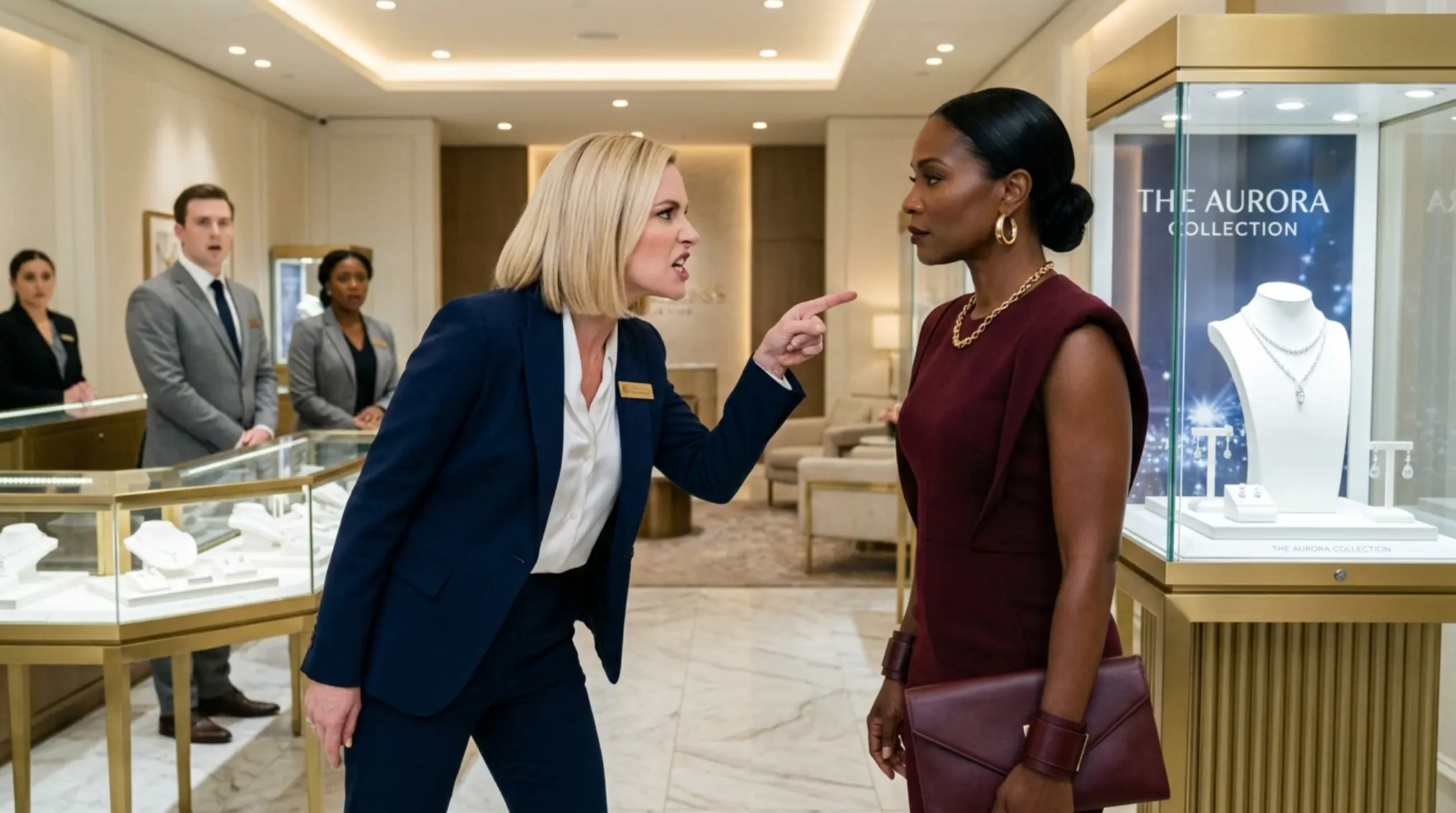
“Get out. You don’t look like someone who belongs anywhere near a three-hundred-fifty-thousand-dollar necklace.”
For several seconds, nobody moved.
The classical music continued softly from hidden ceiling speakers. Diamonds glittered beneath carefully positioned lights. Champagne rested untouched beside an elderly couple at the far display counter.
And directly in front of Patricia stood Diana Mitchell.
Forty-two years old.
Deep-brown skin.
Sculpted cheekbones.
Dark almond-shaped eyes.
Burgundy lipstick.
Her black hair was pulled into an immaculate low bun, and her structured burgundy dress fitted her with the understated precision of clothing designed by someone who understood luxury without needing to advertise it.
A thick gold chain rested around her neck.
Matching gold earrings framed her face.
A burgundy clutch hung from one hand.
Patricia had noticed all of that.
But somehow she had still decided Diana did not belong.
Diana glanced toward the elderly white couple Patricia had spent the previous fifteen minutes serving.
They sat comfortably with two glasses of champagne while several pieces from the premium collection rested on black velvet before them.
Nobody had asked them for bank statements.
Nobody had questioned why they wanted to see expensive jewelry.
Nobody had suggested they shop in a cheaper section.
Diana looked back at Patricia.
“Interesting.”
Patricia folded her arms.
“What?”
“You never asked the couple beside me to prove they could afford what they’re holding.”
Patricia’s mouth tightened.
“They are established clients.”
“You knew that before checking their account?”
“That is none of your concern.”
“It became my concern when you demanded financial verification from me.”
Patricia stepped closer.
“You walked in without an appointment and immediately asked to see one of the most expensive pieces in the store.”
“Yes.”
“Do you understand how many people come in here just to look?”
Diana’s eyes hardened.
“I thought jewelry stores were generally designed for people to look at jewelry.”
A young sales associate behind the counter lowered her face to hide a smile.
Patricia noticed.
“Ashley, back inventory. Now.”
Twenty-three-year-old Ashley Chen hesitated.
She had approached Diana earlier after realizing Patricia had abandoned her beside the Aurora display.
Ashley had been polite.
Warm.
Genuine.
She had asked whether Diana wanted water and had begun explaining the craftsmanship of the collection before Patricia immediately ordered her away.
Now Ashley remained where she was.
“Patricia, she asked to purchase the necklace.”
Patricia snapped her head toward her.
“I said back inventory.”
Ashley swallowed.
“Yes, ma’am.”
She walked away reluctantly.
Diana watched her leave.
Then she turned toward Patricia again.
“You seem very determined to prevent anyone else from helping me.”
“I’m the manager.”
“That doesn’t answer what I said.”
Patricia leaned forward.
“I run this store. I decide who gets served and who gets watched.”
Diana’s expression changed.
Only slightly.
But Kevin Torres, the twenty-six-year-old assistant manager standing behind the central counter, noticed.
So did Marcus Johnson, the forty-five-year-old security officer near the front entrance.
Diana had been calm since she entered.
Not passive.
Controlled.
Now the control seemed different.
Colder.
She slowly opened her burgundy clutch.
Patricia immediately tensed.
“What are you doing?”
“Getting something.”
“Keep your hands where I can see them.”
Diana stopped.
Marcus looked toward Patricia.
“Ma’am…”
Patricia raised one hand.
“Stay ready.”
Diana stared at her.
“You believe I’m stealing.”
“I believe your behavior is suspicious.”
“What behavior?”
“Refusing to leave.”
“You ordered me out after I asked to buy something.”
“You became confrontational.”
Diana almost laughed.
“No. I became inconvenient.”
Patricia’s face reddened.
Earlier that morning, Diana had driven to Rodeo Drive alone.
No assistant.
No corporate vehicle.
No security team.
She had even left the company’s executive parking credential at home.
Surprise visits were something she had done since opening the first Luminous Designs boutique.
The practice began when the company had only three stores.
Diana never trusted scheduled inspections.
Scheduled inspections produced polished counters, rehearsed smiles, perfectly aligned inventory, and employees suddenly remembering every corporate value printed in the handbook.
Unannounced visits revealed reality.
Diana cared deeply about that reality because Luminous Designs had not started with diamonds.
It started at her grandmother’s kitchen table.
Her grandmother, Louise Mitchell, repaired costume jewelry for women in their neighborhood in Atlanta.
Broken clasps.
Missing stones.
Bent bracelets.
Cheap rings carrying expensive memories.
Louise taught Diana something she remembered long after learning gemology, finance, manufacturing, and corporate strategy.
“Jewelry is rarely about metal,” Louise told her. “People bring you what they love.”
Diana built her company around that idea.
The first Luminous Designs store was less than nine hundred square feet.
She cleaned it herself.
Handled bookkeeping at night.
Designed pieces after closing.
Some months she barely made payroll.
Then one of her engagement-ring designs appeared in a regional bridal magazine.
Orders increased.
Another store opened.
Then another.
Twenty-three years later, Luminous Designs owned forty-seven locations across twelve states and generated roughly $180 million in annual revenue.
The Beverly Hills flagship was the most prestigious.
And the most personal.
Diana had chosen the lighting.
The display spacing.
The marble.
The furniture.
Even the slight curve of the main glass counters.
The Aurora Collection at the center of the store was her masterpiece.
Rare stones.
Hand-finished settings.
Almost two million dollars in total inventory.
Its centerpiece necklace was priced at $350,000.
Diana had helped design it.
She had come that morning partly because customer-satisfaction scores at Beverly Hills had begun fluctuating.
Revenue remained excellent.
Complaints did not.
That discrepancy bothered her.
Now she understood why.
Patricia pointed toward the entrance again.
“I’m giving you one last opportunity to leave without involving security.”
Marcus shifted uncomfortably.
Diana looked at him.
He looked back.
There was an apology in his expression.
He had not moved toward her.
Diana appreciated that.
She returned her attention to Patricia.
“I want to speak with your manager.”
Patricia laughed.
“I am the manager.”
“Then I want the person above you.”
“There is no one above me at this location.”
“Location.”
Patricia frowned.
“What?”
Diana said nothing.
The word mattered.
Patricia thought locally.
Her store.
Her rules.
Her customers.
She had forgotten that this store belonged to a company.
And companies had layers.
Kevin finally stepped forward.
“Patricia, maybe we should bring customer relations into this.”
“No.”
“She's asking to purchase something.”
“I’m aware.”
“Then perhaps we should simply process the request.”
Patricia rounded on him.
“Do you want to manage this store?”
Kevin paused.
“No.”
“Then stop trying.”
Diana watched carefully.
Kevin looked frustrated but did not retreat entirely.
“She hasn’t done anything that justifies removal.”
Patricia’s voice rose.
“Kevin.”
Marcus stepped forward now.
“Ma’am, I agree.”
Patricia turned.
“You too?”
“My responsibility is security.”
“Exactly.”
“And she has not threatened anyone or attempted to access restricted areas.”
Patricia stared.
“She’s refusing to leave.”
“Because she says she wants to make a purchase.”
“I gave you an order.”
Marcus remained calm.
“I understand.”
“Then follow it.”
He shook his head once.
“I can’t physically remove someone without a legitimate security reason.”
The entire boutique was silent now.
The elderly couple Patricia had treated so warmly sat stiffly in their chairs.
Another customer raised a phone.
Then another.
Patricia noticed.
“Put those phones away!”
Nobody did.
Her control was disappearing.
She turned back toward Diana.
“This is your fault.”
Diana’s eyebrows rose.
“My fault?”
“You came in here looking for confrontation.”
“I came in looking at jewelry.”
“You criticized our craftsmanship.”
Diana remembered.
She had pointed out that one prong on the Aurora necklace appeared slightly uneven.
Patricia had taken the observation personally.
“I mentioned a setting issue.”
“Our pieces are made by master jewelers.”
“I know.”
“You don’t know anything about our jewelers.”
Diana’s expression almost softened.
Actually, she knew most of them by name.
She knew which workshop had produced the necklace.
She knew who sourced its center stone.
She knew who approved the final mounting.
But she did not say any of it yet.
Patricia continued.
“You walk in here dressed like you understand luxury, start criticizing our inventory, demand access to premium pieces, and then accuse me of discrimination when I ask basic questions.”
Diana looked at her burgundy dress.
Then back up.
“Dressed like I understand luxury?”
Patricia realized she had stepped into another trap.
“That’s not what I meant.”
“What did you mean?”
“You know exactly what I mean.”
“No.”
Diana’s voice dropped.
“I’ve spent almost half an hour trying to understand exactly what you mean.”
Patricia lost the last of her composure.
“You don’t belong here!”
The sentence echoed.
Ashley reappeared from the back room at exactly the wrong moment.
She stopped.
Kevin closed his eyes.
Marcus looked toward the floor.
Diana remained completely still.
The words hurt.
That was what surprised her.
After decades in business, Diana thought she had built enough armor.
She had survived banks refusing credit when she had stronger numbers than competing applicants.
Suppliers assuming her male operations director owned the company.
Luxury-event hosts mistaking her for staff.
Investors asking whether her husband helped finance her growth.
She had learned how to compartmentalize.
But this was different.
This was her store.
Her employees.
Her name behind every paycheck.
Her philosophy in every training manual.
Her grandmother’s lessons translated into forty-seven physical locations.
And inside the flagship she designed herself, an employee looked directly at her and said she did not belong.
Diana slowly reached into her clutch.
Patricia stepped backward.
“Marcus.”
He did not move.
Diana removed her phone.
Patricia immediately said:
“Don’t record me.”
“I’m not.”
She unlocked it.
“I’m calling my board.”
Patricia stared.
“Your what?”
“My board of directors.”
Diana found a contact.
Patricia actually laughed.
“Of what?”
Diana lifted the phone.
“Luminous Designs.”
Ashley’s face changed instantly.
She knew the name.
Not yet the face.
But the voice, the confidence, the company terminology.
She pulled out her phone.
Kevin saw her searching.
“What?”
Ashley whispered:
“Diana Mitchell.”
Kevin stared.
“What?”
Ashley turned the screen.
The company website loaded.
Founder and Chief Executive Officer.
A corporate portrait.
Different hairstyle.
Different clothing.
Same face.
Kevin went pale.
“Oh my God.”
Patricia heard him.
“What?”
Kevin looked at her.
“Patricia…”
“What?”
“Stop talking.”
She stared.
“Excuse me?”
“Please.”
His voice had changed.
“You need to stop.”
Diana’s call connected.
“Sarah?”
Her tone transformed.
Still calm.
But unmistakably executive.
“It’s Diana.”
Patricia’s eyes flickered.
“Emergency board call. I’m at Beverly Hills.”
The words seemed to slow time.
Diana looked directly at Patricia.
“We have a serious leadership problem at the flagship.”
Patricia’s mouth opened.
No sound came.
Diana continued.
“I want HR, legal, retail operations, and compliance on the call.”
Ashley covered her mouth.
Marcus looked from Diana to Patricia.
The elderly couple rose slowly from their chairs.
Diana listened.
“Yes. Fifteen minutes.”
She ended the call.
Patricia whispered:
“Who are you?”
Diana looked at her.
“You know my name now.”
“No.”
The denial came automatically.
“You’re not…”
Diana reached inside her clutch again.
This time she removed a burgundy cardholder.
Then one card.
She held it out.
Patricia hesitated before taking it.
Her eyes moved across the gold lettering.
DIANA MITCHELL
FOUNDER & CHIEF EXECUTIVE OFFICER
LUMINOUS DESIGNS
The color disappeared from Patricia’s face.
“This…”
She flipped the card over.
As though another side might rescue her.
Diana waited.
Patricia looked toward Kevin.
He did not help.
Toward Ashley.
Ashley lowered her eyes.
Toward Marcus.
His expression remained professional.
Then Patricia looked back at Diana.
“You’re…”
“The woman you accused of stealing.”
Patricia’s fingers began shaking.
“I didn’t know.”
Diana’s face hardened.
“That is not a defense.”
“I thought…”
“Yes.”
Diana stepped closer.
“That is exactly the problem.”
Patricia’s breathing became shallow.
“I would never have…”
Diana interrupted.
“Would never have what? Treated the CEO that way?”
Patricia said nothing.
“What about someone who isn’t the CEO?”
“I treat all customers…”
“No.”
Diana shook her head.
“You don’t.”
She pointed toward the couple.
“They received champagne.”
The couple looked uncomfortable.
“You invited them to sit.”
Patricia swallowed.
“You opened multiple premium cases without asking for financial verification.”
Silence.
“Then I asked for one necklace and you demanded bank statements.”
“I was protecting inventory.”
“From me.”
Patricia closed her eyes.
Diana continued.
“You told Ashley not to serve me.”
“I needed her in back.”
“You threatened Kevin when he tried to intervene.”
Patricia’s eyes filled.
“You ordered Marcus to physically remove me even after he told you I posed no security threat.”
“I made a mistake.”
Diana’s expression sharpened.
“No.”
She remembered something Evelyn Carter had said in another context? No, don't cross stories. Keep self-contained.
“You made a series of decisions.”
Patricia’s first tear fell.
“I’m sorry.”
Diana watched her.
The apology might have been sincere.
But sincerity after consequences was difficult to separate from fear.
Kevin stepped forward carefully.
“Ms. Mitchell.”
Diana turned.
“You tried to de-escalate.”
He nodded.
“I should have stepped in sooner.”
“Yes.”
He seemed surprised by the direct answer.
Diana continued.
“But you did step in.”
Then she looked at Ashley.
“You approached me before anyone else.”
Ashley swallowed.
“Yes, ma’am.”
“You didn’t know who I was.”
“No.”
“Good.”
Ashley looked confused.
Diana explained.
“That’s why it matters.”
Then Marcus.
“You refused an order you believed was improper.”
Marcus nodded.
“I didn’t have grounds to remove you.”
“Would you have done the same for someone who couldn’t fire your manager?”
He answered immediately.
“Yes.”
Diana believed him.
Patricia sat down in one of the chairs she had earlier reserved for wealthy customers.
Her shoulders collapsed.
“What happens now?”
Diana looked toward her.
“First, we review the security footage.”
Patricia said nothing.
“Then customer complaints from this location.”
Her face changed.
That reaction interested Diana.
“What?”
Patricia shook her head.
“Nothing.”
Diana noticed.
Kevin noticed too.
“There are complaints,” he said quietly.
Patricia snapped:
“Kevin.”
Diana turned toward him.
“How many?”
“I don’t know exactly.”
“Estimate.”
He hesitated.
“Maybe twelve.”
Patricia stood.
“They were resolved.”
Kevin looked at her.
“Several involved similar concerns.”
Diana’s stomach tightened.
“Similar how?”
Ashley spoke now.
“Customers saying they were ignored or redirected based on how they looked.”
Patricia stared at her.
“Ashley.”
The young employee was frightened.
But she continued.
“There was a woman last month who asked to see an engagement ring and was told the fashion section was more realistic.”
Diana asked:
“Why?”
Ashley looked toward Patricia.
“She came in wearing medical scrubs.”
Diana’s expression went flat.
Another employee behind the counter raised her hand slightly.
“There was also a family from Brazil.”
Patricia shook her head.
“No.”
The employee continued.
“They spoke limited English. Patricia told us not to spend too much time because they probably wouldn’t purchase.”
Diana looked around the store.
One voice produced another.
Then another.
The confrontation was no longer about a single morning.
It was about a culture Patricia had created.
Five days later, the internal review concluded.
Patricia had repeatedly redirected customers based on appearance.
Complaints had been labeled misunderstandings.
Several employees reported being discouraged from assisting customers Patricia considered unlikely to purchase.
One performance note praised an associate for “protecting premium-client time.”
Diana read it twice.
It sounded exactly like what Patricia had done to her.
Patricia was terminated.
Not because she insulted the CEO.
Diana made that distinction clear.
She was terminated because the investigation documented repeated discriminatory customer treatment and retaliation toward employees who challenged it.
Kevin became interim manager.
Not permanent immediately.
Diana believed promotions should be earned through consistent performance, not awarded emotionally during a crisis.
Three months later, after completing leadership review, he received the position permanently.
Ashley became assistant manager six months afterward.
Marcus received formal recognition and a raise.
More importantly, Diana changed company procedures.
Premium jewelry could no longer require discretionary proof of funds before basic presentation.
If financial verification was necessary for a transaction, the requirement had to apply consistently according to written thresholds.
Customer complaints involving discrimination automatically bypassed local management.
Mystery-shopper audits expanded across all forty-seven stores.
And for the first time, executive bonuses included an independently measured customer-dignity metric.
Some directors complained that dignity could not be measured.
Diana disagreed.
“You already measure conversion rates, average ticket value, time per customer, return behavior, complaint frequency, and employee turnover.”
She looked around the boardroom.
“We measure whatever we decide matters.”
One year later, Diana returned to Beverly Hills.
Again unannounced.
Same location.
Different morning.
This time she wore jeans, a cream blouse, and simple flats.
Ashley greeted an elderly man wearing faded work clothes.
He asked to see an engagement ring.
Not for himself.
For his granddaughter.
Ashley smiled.
“Of course.”
She opened the premium case.
No hesitation.
No judgment.
The man looked nervous.
“My budget is only about four thousand.”
Ashley did not change her tone.
“Then let’s find the best ring we can within four thousand.”
Diana stood near the doorway listening.
The man relaxed.
That mattered more than the sale.
Kevin noticed Diana several minutes later.
His eyes widened.
She quietly lifted one finger to her lips.
He smiled and continued working.
Diana walked toward the Aurora Collection.
The famous necklace was gone.
Sold months earlier.
A new centerpiece rested in its place.
On the inside edge of the display case, almost invisible unless someone leaned close, was a small engraved sentence Diana had approved:
Luxury begins with dignity.
She touched her grandmother’s old bracelet beneath the wide burgundy cuff she still sometimes wore.
Louise Mitchell had repaired inexpensive jewelry at a kitchen table.
Her customers rarely had thousands of dollars.
Some had barely twenty.
Yet Louise handled every item as though it belonged in a museum.
Diana finally understood why.
Value and price were never the same thing.
Patricia had worked inside a room full of diamonds and somehow forgotten that.
She believed expensive customers deserved expensive respect.
Diana built Luminous Designs on the opposite idea.
Respect came first.
Before anyone knew the bank balance.
Before the clothes.
Before the job title.
Before the purchase.
Because the biggest mistake Patricia Whitman made was not failing to recognize her CEO.
It was believing recognition should have been necessary at all.