The moldy sandwich landed on Marcus Reynolds’s first-class tray with what felt like deliberate contempt.
Flight attendant Clare Wilson’s lips tightened into the faintest satisfied smirk before she turned away, apparently convinced the passenger in seat 2A could do nothing except accept whatever treatment she chose to give him.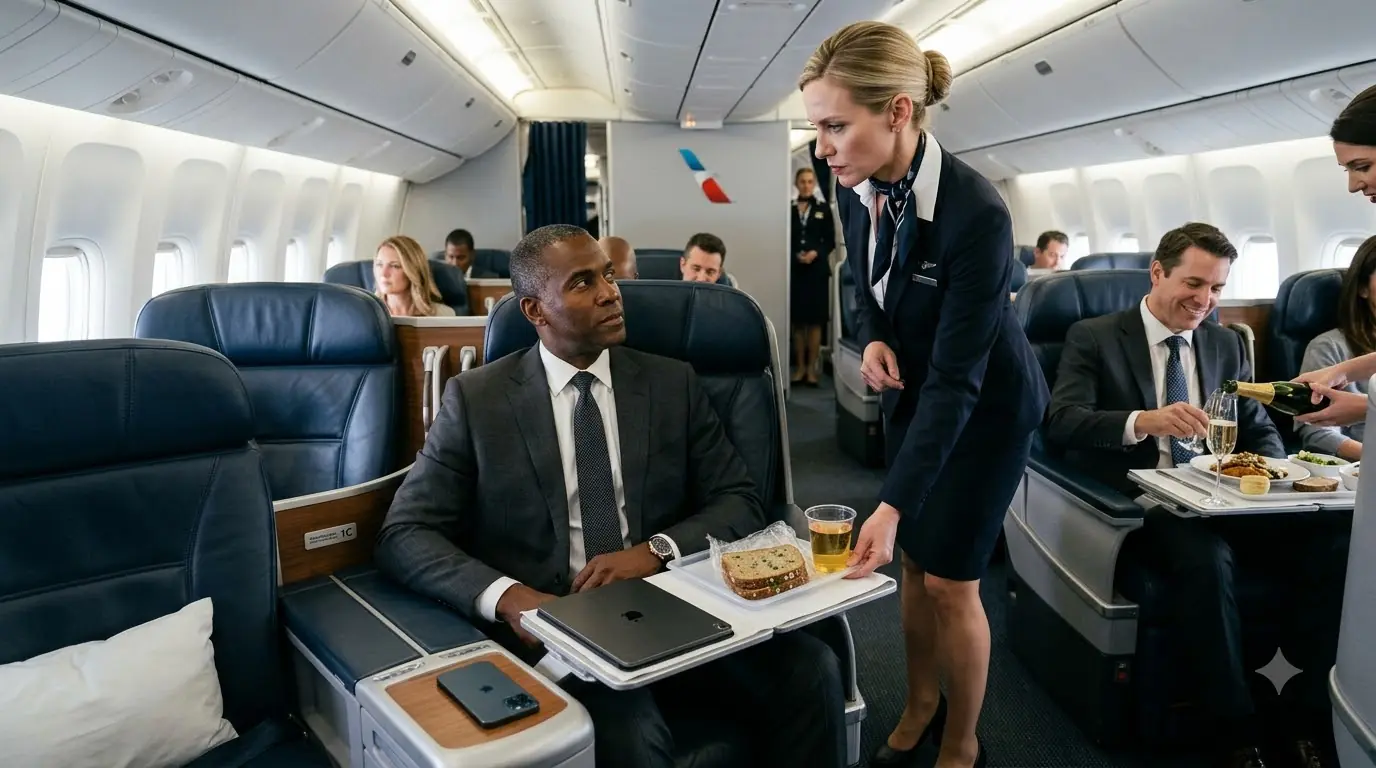
Marcus watched her leave with measured calm.
He did not raise his voice. He did not complain to the passenger beside him or create a scene. Instead, he discreetly opened the secure executive application on his tablet and confirmed that the cabin surveillance system he had helped authorize three months earlier was operating normally.
Behind the galley curtain, Clare’s whispered remarks about certain passengers not belonging in first class were being recorded with perfect clarity.
Every word was becoming evidence.
Marcus pressed the call button again.
His silence carried more weight than anger ever could.
Marcus Reynolds had boarded Elite Airways Flight 347 from New York to San Francisco expecting nothing more dramatic than six quiet hours in the air. At fifty-one, he had spent more than two decades building Reynolds Technologies from a small consulting firm into one of the country’s most respected technology and infrastructure companies.
His custom-tailored dark suit was understated but expensive. His graying hair was cut close, his shoes polished, and the tablet in his hand displayed the quarterly performance reports for Elite Airways.
Three years earlier, Marcus had become one of the airline’s most important silent investors.
Almost nobody working aboard Flight 347 knew that.
He preferred it that way.
Marcus believed customer surveys and executive presentations revealed only part of how a company truly operated. To understand an organization, he liked to experience it the way ordinary customers did.
No introductions.
No executive escorts.
No employees suddenly becoming more attentive because someone important had entered the room.
Seat 2A gave him exactly that opportunity.
Across the aisle, Clare greeted a silver-haired passenger warmly.
“Good afternoon, Mr. Wittmann. Welcome aboard. May I offer you a glass of our signature champagne before takeoff?”
“Thank you. That would be lovely.”
Her smile was effortless.
She moved through the cabin distributing hot towels and drinks, greeting passengers by name when possible.
When she reached Marcus, something changed.
Her eyes moved briefly over his face and dark complexion before settling somewhere above his shoulder.
“Towel?”
The warmth was gone.
“Yes, thank you.”
Marcus accepted it with a polite nod.
Clare immediately moved behind him.
“Welcome aboard, Mr. Sullivan. Champagne?”
Marcus noticed.
He always noticed.
Years of navigating executive offices where he was sometimes the only Black man at the table had made him sensitive to differences that were subtle enough for other people to dismiss.
A smile that disappeared.
A tone that cooled.
A question asked of everyone except him.
Individually, none proved much.
Patterns did.
Marcus reopened the Elite Airways performance dashboard.
Premium bookings were up fifteen percent.
Customer retention was improving.
Executive reports praised new hospitality standards.
He almost smiled at the irony as every other passenger in the first few rows received a pre-departure beverage while he continued waiting.
Ten minutes passed.
A couple who had boarded after him were already drinking champagne.
Marcus finally pressed the call button.
Clare returned.
“Yes, sir?”
“I believe I’m still waiting for my pre-departure beverage. I pre-ordered the Macallan 18 when I booked.”
Clare glanced toward the galley.
“I’m not seeing that in our system.”
“That’s strange. I received confirmation.”
“We’re running low on premium beverages. I can offer orange juice or water.”
Marcus looked beyond her.
The premium bar cart was fully stocked.
“I have the confirmation email.”
He opened it and turned the tablet toward her.
“There it is.”
Clare barely looked.
“As I said, sir, sometimes the system overbooks certain items. I’ll bring you orange juice.”
Before Marcus could reply, she turned away.
He watched her whisper something to another flight attendant.
The second attendant looked toward seat 2A.
A small smile appeared.
Marcus opened a secure messaging window.
Jessica, his executive assistant, answered quickly.
Marcus typed:
Experiencing some unusual service discrepancies on Elite Flight 347. Make a note to discuss with Diane in HR when I return.
The captain announced their departure.
Marcus stowed his tablet as Clare began distributing warm mixed nuts.
A porcelain ramekin went to Mr. Wittmann.
Another went to the couple nearby.
When Clare reached Marcus, she dropped a sealed packet of economy pretzels onto his tray.
“Here.”
Then she continued walking.
Marcus looked at the packet.
By itself, it could have been a mistake.
Combined with everything else, the pattern was becoming harder to ignore.
He took out his phone.
On second thought, please contact Diane now. Find out whether there have been service complaints from minority passengers in first class during the past year. Specifically check this crew if possible.
Then he added:
When did the premium cabin surveillance system become fully operational?
Jessica replied within minutes.
System went live across the fleet three months ago. Premium cabin audio/video retained thirty days. Diane is available. Should I be concerned?
Marcus watched Clare disappear behind the galley curtain with another crew member.
Not yet. But stay near your phone.
The aircraft lifted through the clouds.
What should have been an ordinary business trip was becoming an unexpected audit of the airline Marcus had invested millions of dollars in helping improve.
Once the seat-belt sign switched off, service resumed.
Marcus remembered the board meeting three years earlier when he had first argued for investing in Elite Airways.
Several colleagues at Reynolds Technologies had questioned the move.
Airlines were expensive.
Operational margins were narrow.
Customer satisfaction was declining across the industry.
Marcus saw opportunity in exactly that.
“If service has become mediocre everywhere,” he had told them, “then treating people well becomes a competitive advantage.”
Jessica had sent the information he requested.
HR records show seventeen formal complaints from minority passengers in premium cabins during the past twelve months. Five specifically mention Clare Wilson. Three were closed for insufficient evidence. Two resulted in travel vouchers. No disciplinary action.
Marcus read the message twice.
Five complaints.
No meaningful action.
He felt the familiar heaviness of discovering that the incident in front of him was not isolated.
The meal cart entered the cabin.
Clare stopped beside Mr. Wittmann.
“Your special order, sir. Seared salmon with truffle risotto. And the Montrachet you requested.”
She arranged the plate carefully.
“Would you like additional bread?”
“Yes, please.”
“Of course.”
Marcus watched Clare continue through the cabin.
Every passenger received attentive explanations.
Wine pairings.
Meal selections.
Requests remembered from earlier.
Then she reached Marcus.
Her expression flattened.
“Your meal.”
A covered plate appeared.
She immediately turned away.
Marcus lifted the lid.
A dry sandwich sat on a plain plate.
Beside it was a small container of lukewarm apple juice.
Nothing about it resembled the premium meal he had ordered.
Passengers nearby noticed.
Marcus raised his hand.
“Excuse me.”
Clare stopped.
“I believe there’s been another mistake.”
“What now?”
“I pre-ordered the chef’s special.”
“We don’t have a record of it.”
Marcus reopened the confirmation.
“The airline does.”
Clare barely glanced.
“As I explained with your beverage, our system occasionally overbooks premium selections.”
Marcus gestured toward the surrounding cabin.
“Everyone around me appears to have received the premium meal they ordered.”
Clare’s smile tightened.
“We prioritize certain guests based on loyalty level and availability.”
“I’m Platinum Elite.”
Clare paused.
Marcus continued.
“I’ve flown more than two hundred thousand miles with Elite during the past year.”
“I’ll check with my supervisor.”
Her tone suggested she had no intention of doing so.
She disappeared behind the curtain.
Marcus sat quietly.
Twenty years in corporate America had taught him the value of deciding when something was worth confronting.
This was.
Not merely because of his own sandwich.
Because seventeen people had already filed complaints.
Five had named Clare Wilson.
How many more had never complained because they believed nothing would happen?
Marcus pressed the call button.
Several minutes passed.
Eventually, another flight attendant arrived.
A younger man.
His name tag read MICHAEL BARTON.
“Can I help you?”
“I’d like to speak with the purser regarding my meal service.”
“Clare handles this section.”
“I understand. The issue involves Clare.”
Michael’s expression cooled.
“What’s the problem?”
“I pre-ordered the premium meal. Instead I received this sandwich. The same thing occurred earlier with my beverage and snack service.”
Michael looked at the plate.
“Sometimes adjustments have to be made.”
“I understand that. What I’m asking is why every other passenger near me received what they ordered.”
Michael folded his arms.
“I’m sure Clare already explained it.”
“She said passengers were being prioritized according to loyalty status. I am one of the highest-status passengers in the cabin.”
Several people were openly listening now.
Michael glanced around.
“Sir, I’m going to have to ask you to lower your voice.”
Marcus stared at him.
His voice had never risen above normal conversation.
“I haven’t raised my voice.”
“You’re disturbing the cabin.”
“No. I’m asking a question.”
Michael’s shoulders stiffened.
Marcus continued calmly.
“What criteria resulted in every passenger around me receiving premium service while I did not?”
Michael had no answer.
Clare reappeared behind him.
She whispered something.
Both retreated toward the galley.
Mr. Wittmann across the aisle watched them leave.
Marcus opened a direct email to Diane Chen, Elite Airways’ head of human resources.
He documented the sequence.
Beverage.
Snack.
Meal.
Crew responses.
Then he set the phone down and examined the sandwich more closely.
The bread looked worse than he had initially realized.
A faint green discoloration appeared near the edge.
Marcus lifted the top slice.
Dark mold spots were visible underneath.
He immediately replaced it.
Now his concern was no longer merely unequal service.
The food was spoiled.
Michael returned.
“Everything all right?”
“No.”
Marcus gestured toward the sandwich.
“There’s mold on the bread.”
Michael leaned down.
“I don’t see anything.”
Marcus lifted the bread slightly.
“It’s clearly visible.”
“Maybe it’s part of the grain.”
“It isn’t.”
Marcus pushed the plate away.
“I would like the captain informed.”
Clare appeared again.
“Is there a problem here again?”
“Yes.”
Marcus faced her.
“I was served visibly spoiled food while other passengers received fresh meals.”
Clare’s irritation became obvious.
“If you don’t like what we served you, you don’t have to eat it.”
Marcus paused.
“That is your response?”
“I’m saying we can’t make every passenger happy.”
“This is not about preference. The bread is spoiled.”
Clare’s eyes narrowed.
“Sir, I will not have you disrupting the flight with accusations.”
Marcus remained still.
“What accusation is baseless? The mold is physically on the plate.”
Clare leaned closer.
“Maybe some people should simply be grateful for what they’re given instead of constantly demanding special treatment.”
The implication landed immediately.
Passengers nearby stopped eating.
Marcus felt his pulse quicken.
He did not change his tone.
“I’m not asking for special treatment. I’m asking for equal treatment. The same meal service and respect provided to every other first-class passenger who paid for this cabin.”
Something in Clare’s expression hardened.
She lowered her voice.
“I don’t know how you ended up up here, but people like you don’t need to act like you own the place. You should be thankful you’re not sitting in the back.”
Michael visibly reacted.
“Clare.”
Several passengers stared.
One woman immediately lifted her phone.
Michael looked toward the recording devices.
“That’s enough. Come to the galley.”
They retreated.
Marcus sat motionless for several seconds.
There was no ambiguity left.
He opened the secure Elite Airways Executive application.
The system recognized his credentials.
Marcus selected Flight 347.
Cabin cameras: ACTIVE.
Audio recording: ACTIVE.
Data transmission: SECURE.
The cameras had captured everything.
Behind the curtain, voices carried into the cabin.
Clare was speaking.
“I cannot believe people like that. He probably used points or some program to get up here.”
Michael said something quieter.
Clare continued.
“Did you see how he’s acting? Like he owns the place.”
Marcus began typing to Diane.
Before he finished, the curtain opened.
The purser emerged.
“Mr. Reynolds?”
“Yes.”
“I understand there has been confusion involving your meal.”
“More than confusion.”
She gave a controlled smile.
“We take all concerns seriously.”
“Good.”
Marcus gestured toward the sandwich.
“I pre-ordered a premium meal. I received spoiled food. Your colleague also made a discriminatory comment explaining why she believes I shouldn’t be in this cabin.”
The purser’s expression shifted slightly.
“I’m sure there has been a misunderstanding. Clare is one of our most experienced attendants.”
“Experience does not prevent prejudice.”
“We can bring you something from business class.”
Marcus looked toward the untouched premium meals being cleared around him.
“That doesn’t answer the question.”
The purser stiffened.
“What question?”
“Why was I singled out?”
Before she could answer, the intercom sounded.
Captain Hoffman’s voice entered the cabin.
“Ladies and gentlemen, this is Captain Hoffman. I want to remind everyone that instructions from crew members must be followed at all times. Disruptive behavior will not be tolerated.”
Marcus understood immediately.
The narrative had changed.
He was no longer the passenger reporting mistreatment.
He was being presented as a threat to cabin order.
Several passengers looked toward him.
The purser straightened.
“Mr. Reynolds, I must ask you to accept the accommodations we’ve offered and stop escalating this matter.”
Marcus looked directly at her.
“What exactly have I done that is disruptive?”
“Your continued questioning is creating tension.”
“I haven’t shouted.”
“No.”
“I haven’t threatened anyone.”
“No.”
“I haven’t refused a safety instruction.”
The purser hesitated.
“No.”
“Then what exactly constitutes the disruption?”
Mr. Wittmann rose from his seat.
“Excuse me.”
The purser turned.
Her entire demeanor softened.
“Yes, sir?”
“I’ve been watching this since before takeoff.”
He pointed toward Marcus’s tray.
“This gentleman has been treated differently from everyone around him. He received the wrong beverage, economy snacks, then spoiled food, and your crew has spoken to him with extraordinary disrespect.”
“Sir, I appreciate your concern.”
“I’m not finished.”
Wittmann’s voice remained calm.
“He hasn’t disrupted anything. Your staff has.”
Several passengers murmured agreement.
The woman recording on her phone spoke.
“I heard the flight attendant tell him he didn’t belong up here.”
Another passenger nodded.
“So did I.”
The purser’s confidence weakened.
“We’ll bring Mr. Reynolds another meal.”
Marcus shook his head.
“This stopped being about food several minutes ago.”
The galley curtain opened again.
Captain Hoffman entered the first-class cabin.
He was tall, silver-haired, and carried himself with the unquestioned authority of a veteran pilot accustomed to having the final word aboard his aircraft.
His eyes went immediately to Marcus.
“Sir, I understand you’re creating a disturbance.”
Marcus remained seated.
“I’m questioning discriminatory service.”
“I’ve been informed that your behavior is making the crew and other passengers uncomfortable.”
Several passengers reacted.
Wittmann spoke immediately.
“That isn’t true.”
The captain ignored him.
“Mr. Reynolds, if the disruption continues, I may divert the aircraft.”
The cabin fell silent.
Marcus took out his tablet.
“Captain Hoffman, before you inconvenience several hundred passengers, I suggest you determine whether the information you were given is accurate.”
“I am the commander of this aircraft.”
“I understand.”
“My assessment regarding safety is final.”
Marcus nodded.
“What specific safety instruction have I violated?”
The captain’s jaw tightened.
“This is about maintaining order.”
“Then again, what did I do?”
“You continued challenging the crew.”
“Asking why I received spoiled food is a challenge to safety?”
The captain did not answer directly.
“Sir, this is your final warning.”
Marcus held his gaze.
“Final warning to do what?”
“To stop this behavior.”
“What behavior?”
The captain’s expression hardened.
Marcus continued.
“I was denied the service everyone around me received. Then I was served spoiled food. When I asked why, a crew member suggested that people like me do not belong in first class.”
Clare appeared behind the captain.
Mr. Wittmann stood.
“He is telling you the truth.”
The woman with the phone raised it.
“I recorded part of it.”
Other passengers began agreeing.
Captain Hoffman glanced around.
For the first time, uncertainty appeared.
Marcus spoke quietly.
“Captain, you have an opportunity right now to investigate what actually happened before taking action against the person reporting it.”
The captain’s eyes returned to him.
“I’ve already made my determination.”
Marcus felt something settle inside him.
Not anger.
Clarity.
He opened an email addressed to the Elite Airways board of directors.
“Then I believe there is something you should know.”
The captain interrupted.
“This is my aircraft.”
Marcus looked up.
“That is part of the problem.”
The cabin became still.
“You accepted your crew’s version without asking for mine. You were prepared to divert a flight before determining whether I had violated a single instruction.”
Captain Hoffman stepped closer.
“I will not have a passenger undermine the authority of my crew.”
“And I will not accept discrimination simply because the person engaging in it is wearing a uniform.”
The words hung between them.
Marcus pressed SEND.
A soft chime came from the tablet.
“I have just notified the executive leadership of Elite Airways and requested immediate review of this flight’s cabin surveillance.”
The captain frowned.
“Cabin surveillance?”
“Yes.”
“There are no cameras in this cabin.”
“Actually, there are.”
Something changed in Hoffman’s expression.
Marcus continued.
“The premium cabin surveillance system became operational throughout the fleet three months ago. Audio and video from the past hour have been recorded and stored on secure company servers.”
Clare went pale.
Behind her, Michael froze.
Marcus looked toward the galley.
“That includes conversations behind that curtain.”
Clare disappeared into the galley.
Her voice rose.
“Nobody told us about cameras.”
Michael responded urgently.
“We were told. It was in the training.”
Captain Hoffman’s hand moved toward his communication device.
Marcus remained calm.
“Captain, I understand you were given incomplete information. You can still correct the situation.”
The intercom suddenly activated.
The first officer spoke.
“Ladies and gentlemen, we are evaluating a minor operational concern. Please return to your seats and keep your seat belts fastened.”
Captain Hoffman returned toward the cockpit.
Several minutes later, another announcement came.
“We will be making an unscheduled landing at Denver International Airport to address an operational matter. We expect the delay to be brief.”
Marcus looked out the window.
The captain had chosen escalation.
His phone vibrated.
Jessica.
Denver diversion confirmed?
Marcus typed:
Confirmed. Full intervention. Notify Diane. Have HR and legal waiting at the gate. Preserve all surveillance. Captain appears to be using diversion to remove me.
Jessica responded almost immediately.
Already happening. Board notified. Legal downloading footage now.
Passengers throughout the aircraft became frustrated.
Business travelers checked watches.
Families began reviewing connections.
A few people openly asked why an entire aircraft was being diverted over a passenger who had never raised his voice.
Marcus sat back.
Unchecked discrimination had now inconvenienced everyone aboard.
His tablet chimed.
Jessica had another update.
Audio recovered from galley. Sending transcript.
Marcus opened the file.
The conversation was explicit.
Clare’s voice appeared first.
“Why should we keep rewarding people who come up here acting like they belong?”
Michael replied.
“We should have just given him his meal.”
“So he can complain and act like he owns the place?”
“Lower your voice.”
Clare continued making disparaging comments about passengers she believed did not belong in premium cabins.
Then Captain Hoffman entered the transcript.
“What’s happening?”
Clare told him Marcus was being disruptive.
“How?”
“He keeps complaining.”
“Has he threatened anyone?”
“No.”
“Refused instructions?”
“Not exactly.”
Michael added that Marcus had been “confrontational.”
Then Clare suggested removing him during a diversion and possibly reporting him as a problem passenger.
Marcus closed the file.
There it was.
The truth stripped of interpretation.
Mr. Wittmann leaned toward him.
“You’re remarkably calm.”
Marcus gave him a small smile.
“I’ve learned to prepare for contingencies.”
“What do you do?”
“Technology. Strategic consulting.”
Wittmann studied him.
“Reynolds Technologies?”
Marcus nodded.
Recognition spread across the older man’s face.
“You’re Marcus Reynolds.”
“Yes.”
Wittmann leaned back.
“Then I suspect the captain has made a very expensive mistake.”
The aircraft landed firmly in Denver.
Passengers were told to remain seated.
Marcus received a call from Jessica.
“Marcus, are you all right?”
“I’m fine. Who is at the gate?”
“Diane Chen. Legal. Two senior operations officers. Airport security has been told there is no active passenger threat. The board chairman has reviewed the preliminary footage.”
“And?”
“His words were, ‘Take whatever action is necessary.’”
Marcus looked toward the front of the cabin.
Captain Hoffman emerged.
“Mr. Reynolds, I need you to deplane first.”
Marcus remained seated.
“For what reason?”
“Representatives are waiting to speak with you.”
“I know.”
Hoffman’s expression tightened.
“Then please gather your belongings.”
“Before I leave, I’d like you to state the reason for the diversion.”
The captain glanced toward the passengers.
“As announced, we’re addressing an operational concern.”
“What concern?”
“This is not the place for this discussion.”
Marcus gestured around them.
“These people missed connections and had their schedules disrupted. I believe it is exactly the place.”
Hoffman’s jaw clenched.
“I made the decision based on the information available.”
“What information?”
Silence.
Marcus continued.
“That I calmly asked why I was given spoiled food? Or that your employee believed someone with my appearance did not belong in first class?”
Passengers murmured.
Captain Hoffman’s face flushed.
“This conversation is over. Security will escort you from the aircraft.”
The cabin door opened.
Hoffman turned toward it.
No security officers entered.
Instead, Diane Chen stepped aboard in a tailored navy suit.
Two Elite Airways senior operations executives followed her.
Diane walked directly toward them.
“Captain Hoffman.”
“Ms. Chen.”
“There will be no need for security.”
The captain looked confused.
“Mr. Reynolds is not being removed from this flight.”
“I made the determination—”
“Your determination has been overruled.”
One of the operations executives stepped forward.
“You and the assigned cabin crew are being removed from duty pending investigation. A replacement crew is already being positioned.”
Captain Hoffman stared at him.
“Removed?”
“Yes.”
The captain’s eyes shifted toward Marcus.
“Who exactly are you?”
Marcus stood slowly.
He did not smile.
“Someone who believed this airline could do better.”
Behind the captain, Clare and Michael appeared.
Diane addressed them.
“Ms. Wilson. Mr. Barton. Gather your belongings. Your company credentials are being temporarily suspended pending investigation.”
Clare stared at her.
“This is ridiculous. We didn’t do anything. He was difficult from the beginning.”
Diane held up a tablet.
“We have complete audio and video documentation of the incident.”
Clare stopped.
Her eyes moved toward the ceiling.
“You recorded us?”
“Premium cabins have been monitored for service quality and security for three months.”
“We were never told.”
“You acknowledged the updated employee handbook, completed mandatory training, and signed the notification.”
Clare’s face drained of color.
Marcus watched without satisfaction.
Accountability was necessary.
Enjoying humiliation was not.
Captain Hoffman turned toward Marcus.
“You planned this.”
“No.”
“You came aboard waiting for someone to make a mistake.”
“I came aboard because I had a meeting in San Francisco.”
Marcus gestured toward seat 2A.
“I ordered a drink and a meal. Everything after that was your crew’s choice.”
The captain had no response.
He turned and walked toward the exit.
Clare and Michael followed.
As they disappeared into the jetway, the cabin released a collective breath.
Diane approached Marcus.
“On behalf of the company, I apologize.”
Marcus nodded.
“This is bigger than one apology.”
“I know.”
“There have been seventeen complaints involving minority passengers in premium cabins in the past year.”
Diane’s expression tightened.
“I reviewed them on the way here.”
“Five mention Clare.”
“Yes.”
“Why did nothing happen?”
Diane was silent for a moment.
“Because our review process treated each complaint as a separate service dispute unless there was direct evidence.”
Marcus looked toward the surveillance camera.
“And now we have direct evidence.”
“Yes.”
“Then let’s find out how many people were telling the truth before we had cameras.”
Diane nodded.
“A complete review starts tonight.”
The replacement crew boarded within minutes.
Their captain was Sarah Lindström, an experienced pilot in her mid-fifties with silver streaks in her hair.
She addressed the cabin immediately.
“Ladies and gentlemen, my crew and I will be completing today’s flight to San Francisco. We expect to depart within approximately twenty minutes. Thank you for your patience.”
Scattered applause followed.
Sarah stopped beside Marcus.
“Mr. Reynolds.”
“Captain.”
“I’ve been briefed. I’m sorry for what happened aboard this aircraft.”
“Thank you.”
“I understand you want to speak to the passengers before departure.”
“They deserve to know why their day was disrupted.”
“I agree.”
Diane handed Marcus preliminary incident summaries.
The language was clinical.
Time stamps.
Statements.
Service actions.
Crew responses.
Bias reduced to bullet points and transcribed dialogue.
Marcus understood why systems required documentation.
He also understood what documentation could never communicate.
The feeling of watching every passenger receive a meal except you.
The humiliation of discovering mold on your tray.
The subtle shift when somebody looked at your skin and decided you did not belong.
When preparations were complete, Marcus walked to the front.
Diane handed him the intercom.
He paused.
Then spoke.
“Ladies and gentlemen, my name is Marcus Reynolds. I want to explain why your journey was interrupted today.”
The cabin became silent.
“What began as a service issue in first class became something more serious when I was treated differently from other passengers, served spoiled food, and subjected to discriminatory comments.”
People in economy listened closely.
“When I questioned that treatment, members of the original crew characterized my behavior as disruptive. Captain Hoffman then diverted this aircraft despite there being no actual safety violation on my part.”
Several first-class passengers nodded.
Marcus continued.
“There is another part of this story you should know. I am a significant investor and part owner of Elite Airways.”
A murmur passed through the aircraft.
“Three years ago, I invested in this company because I believed we could build an airline that treated every passenger with dignity.”
He glanced toward the ceiling.
“As part of that effort, we introduced monitoring in premium cabins for security and service-quality review.”
The cabin remained silent.
“That system recorded today’s incident, including conversations held away from passengers. The evidence has already been reviewed. The original crew has been removed from duty pending investigation.”
Marcus paused.
“This delay affected all of you.”
He looked down the aisle.
“Some of you will miss connections. Some had meetings, family commitments, or plans that mattered.”
He took a breath.
“That happened because discrimination against one passenger became an operational failure affecting an entire aircraft.”
He then announced that Elite Airways would refund the affected passengers and provide substantial compensation and travel benefits for the disruption.
The reaction was immediate.
People gasped.
Several applauded.
Marcus raised one hand gently.
“The compensation matters because your time matters. But money is not the main point.”
The applause faded.
“When unfair treatment goes unchallenged, its consequences rarely remain limited to the person being targeted.”
Marcus handed the microphone back.
As he returned to his seat, several passengers approached.
Some shook his hand.
Some shared stories.
One young Black woman from economy leaned close.
“Thank you for not letting them make you the problem.”
Marcus looked at her.
“I was fortunate enough to have leverage.”
She nodded.
“Most people don’t.”
Her words stayed with him.
That was the real responsibility.
Not proving that Marcus Reynolds could defend himself.
Making sure somebody without his wealth or corporate access would not need either.
Once airborne again, Mr. Wittmann leaned across the aisle.
“That compensation package had to hurt.”
“The airline can afford it.”
“That isn’t what I mean.”
Marcus looked at him.
Wittmann smiled.
“You wanted the company to feel the consequence.”
Marcus considered the wording.
“I wanted everybody involved to remember that ignoring discrimination has a cost.”
“That’s a long game.”
“It has to be.”
The replacement crew served the cabin with quiet professionalism.
Every passenger received the same attention.
Marcus finally received the meal he had ordered.
He barely touched it.
His phone rang.
Board chairman Robert Chen.
“Marcus.”
“Robert.”
“I’ve seen the footage.”
“And?”
“It’s worse than the initial report suggested.”
Marcus glanced toward the galley.
“We have seventeen complaints from the past year.”
“I know.”
“Five involving Clare.”
“Yes.”
“And no meaningful disciplinary response.”
Robert sighed.
“The board is going to ask about the compensation package.”
“They should ask about the cost of allowing this culture to continue.”
“That package will cost millions.”
“So would lawsuits. Lost customers. Regulatory scrutiny. Brand damage.”
Robert was quiet.
“More importantly, we should not need a financial justification to treat passengers fairly.”
“I agree.”
“I’m preparing a reform package for tomorrow.”
“Some board members will say this is one crew.”
“Then I’ll show them the numbers.”
Marcus opened the HR report.
“Seventeen complaints in one year is a pattern worth investigating.”
Robert exhaled.
“You have my support.”
When Flight 347 finally landed in San Francisco, an Elite Airways response team was waiting.
Chief Operating Officer James Peterson met Marcus inside the executive terminal.
“I reviewed everything.”
“Then you know what needs to happen.”
James nodded.
“Emergency board meeting at eight tomorrow.”
Screens inside the conference area displayed social-media activity and customer-service data.
A young data analyst enlarged a chart.
“We’ve identified measurable disparities in premium-cabin satisfaction scores between white passengers and passengers of color.”
Marcus studied the lines.
“Over what period?”
“Three years.”
“And nobody noticed?”
“We noticed overall variation, but the complaint system classified incidents individually.”
Marcus looked toward James.
“That may be the problem.”
Diane joined them.
“I’ve already ordered a five-year audit of discrimination complaints, including cases closed at intake.”
“Good.”
Marcus pointed toward the dashboard.
“I want complaint outcomes compared by route, crew rotation, passenger demographics, and reviewer.”
James hesitated.
“That is a substantial amount of data.”
“Yes.”
“It could take weeks.”
“Start tonight.”
News coverage was already accelerating.
Statements from Clare Wilson and Captain Hoffman appeared online.
Both characterized the incident as a misunderstanding.
Clare claimed Marcus had leveraged corporate influence to punish employees who were merely doing their jobs.
Captain Hoffman defended the diversion as an operational decision made in good faith.
Marcus read neither statement more than once.
“What does legal recommend?” he asked.
The lead counsel answered.
“Confirm the incident. Confirm the investigation. Avoid releasing employee details until the formal process is complete.”
“No personal retaliation language.”
“Agreed.”
“No dramatic statement from me.”
James looked surprised.
“You don’t want to respond?”
“No.”
Marcus glanced toward the screens.
“This should not become a story about one powerful CEO defeating three employees.”
Diane understood immediately.
“It should be about the system.”
“Exactly.”
A Black female executive who had worked at Elite for nearly two decades approached Marcus privately.
“What happened to you has happened to other passengers for years.”
Marcus listened.
“Most couldn’t force anyone to pay attention.”
“That changes now.”
“The board may resist.”
“Then we make the evidence impossible to ignore.”
Marcus turned toward James.
“I want complete records for every employee who received a discrimination-related complaint during the past five years.”
James looked overwhelmed.
“That could be hundreds of files.”
“Then we have hundreds of files to review.”
The following morning, the Elite Airways boardroom was silent.
Marcus stood before a wall-sized screen.
The final segment of surveillance footage ended.
Clare’s recorded comments disappeared from the display.
Marcus turned toward fourteen board members.
“What happened aboard Flight 347 was not simply poor customer service.”
A binder sat in front of every director.
“The preliminary audit has already identified seventy-eight discrimination-related complaints over the past three years that were closed without a meaningful investigation.”
Several directors looked down at the binders.
Marcus continued.
“That does not mean every allegation was proven. It means our system did not take them seriously enough to determine whether they were true.”
Charles Whitfield, one of the longest-serving board members, leaned forward.
“What happened to you was clearly unacceptable. Nobody disputes that.”
Marcus waited.
“But ten million dollars in passenger compensation is excessive.”
“It was not compensation for my experience.”
“It resulted from your experience.”
“It resulted from an unnecessary diversion that disrupted an entire aircraft.”
Charles shook his head.
“We’re still talking about a service failure. There was no physical harm.”
Marcus looked directly at him.
“A crew member deliberately gave a passenger spoiled food, made discriminatory comments, then helped characterize that passenger as a security problem when he objected.”
Nobody interrupted.
“A captain accepted that version without verifying it and diverted an aircraft.”
Marcus closed the binder in front of him.
“That is not simply bad hospitality. Bias affected an operational decision.”
Victoria Hayes, another board member, lifted the proposed reform package.
“The cost of these changes will also be significant.”
“So is the cost of doing nothing.”
“Enhanced training. New review teams. Expanded surveillance. Complaint-system redesign. Independent auditing.”
“Yes.”
“We could be spending tens of millions.”
Marcus nodded.
“And what does a nationwide discrimination lawsuit cost?”
Victoria looked away.
“What does regulatory investigation cost?”
Silence.
“What does losing the trust of travelers cost?”
Robert Chen spoke.
“Marcus is right about one thing regardless of the numbers. Status quo is no longer an option.”
The debate lasted nearly three hours.
Several board members insisted Flight 347 represented unusually bad behavior from one crew.
Marcus repeatedly returned to the records.
Seventeen recent complaints.
Seventy-eight previously closed cases.
Statistical disparities.
Repeated names.
Supervisory systems that required several nearly identical complaints within short periods before recognizing a pattern.
“You designed a process that makes patterns difficult to see,” Marcus said. “Then you point to the absence of visible patterns as proof that there is no problem.”
That argument shifted the room.
The reform package ultimately passed eleven votes to three.
Elite Airways committed to redesigning its complaint system, creating an independent discrimination review panel, strengthening employee training, auditing previously dismissed complaints, increasing executive accountability, and improving monitoring procedures while adding stronger privacy and access controls around recorded data.
Diane began implementation immediately.
“We can start the new training modules next week.”
“And the review committee?”
“I have candidates.”
“I don’t want a symbolic committee.”
“It won’t be.”
“Include frontline employees.”
“Yes.”
“Customer representatives.”
“Yes.”
“Legal and compliance.”
“Already included.”
Marcus nodded.
“And people who understand discrimination through lived experience.”
Diane smiled faintly.
“That was first on my list.”
The official investigation into Flight 347 concluded several weeks later.
The surveillance evidence left little uncertainty.
Clare Wilson’s discriminatory statements were confirmed.
So was the deliberate downgrade of Marcus’s service and her role in presenting him to the captain as a disruptive passenger.
Michael Barton’s involvement was also documented. Though he had shown moments of hesitation, he had supported the narrative rather than intervening when it mattered.
Captain Hoffman’s recorded conversation demonstrated that he knew Marcus had not threatened anyone or violated a safety instruction before choosing to escalate the matter.
All three were dismissed from Elite Airways after the company’s disciplinary process.
Their unions challenged the decisions.
Arbitration followed.
The surveillance recordings were played.
The dismissals were upheld.
Captain Hoffman also faced a separate aviation review concerning his use of operational authority during the diversion. Regulators examined whether a genuine safety basis had existed.
The investigation concluded that his decision had been poorly supported and influenced by inaccurate information he failed to verify.
His flying privileges were temporarily restricted while he underwent review and retraining.
Clare attempted to speak publicly about the incident.
She portrayed herself as a longtime employee destroyed by a single difficult interaction.
Then portions of the authenticated surveillance transcript became public through the formal proceedings.
Public sympathy faded.
The more important changes happened inside the airline.
Old complaints were reopened.
Several passengers were contacted personally.
Some had saved emails.
Others had photographs.
A few had written detailed accounts years earlier and never expected anyone to read them again.
The investigation discovered that not every complaint represented discrimination.
But enough did.
In several cases, multiple passengers had reported remarkably similar experiences involving the same crew members or routes.
What looked isolated when viewed individually became obvious when placed side by side.
Supervisors who had repeatedly dismissed complaints without sufficient review received additional training or disciplinary action depending on the findings.
The company changed how it collected customer information.
Complaints no longer disappeared simply because one event lacked definitive proof.
Patterns mattered.
Six months later, Marcus boarded Flight 347 again.
New York to San Francisco.
Seat 2A.
Morning sunlight poured through the windows.
The aircraft interior had been updated subtly.
Nothing extravagant.
Cleaner materials.
Improved lighting.
Better service equipment.
The more important changes could not be seen.
Sarah Johnson, the lead flight attendant, approached.
“Good morning, Mr. Reynolds.”
“Good morning.”
“Your Macallan 18 preference and meal selection are both confirmed.”
Marcus smiled.
“Just the hot towel for now.”
“Of course.”
She handed it to him.
Then she moved across the aisle.
“Good morning, Ms. Patel. Can I get you anything before departure?”
Her tone did not change.
She continued down the cabin.
Older passenger.
Younger passenger.
Black.
White.
Asian.
Latino.
Business traveler.
Family.
Every greeting carried the same professional warmth.
Sarah returned briefly and placed an envelope on Marcus’s tray.
“This is from the crew.”
He opened it.
The note had been signed by the full flight team.
Mr. Reynolds,
Six months ago, an incident aboard this route forced Elite Airways to confront failures that had been ignored for too long. The changes that followed affected our training, our complaint process, and the way we understand our responsibility to passengers.
We are proud to work in an airline that is trying to make first-class treatment mean dignity, professionalism, and consistency for everyone.
Thank you for demanding a higher standard.
The Crew of Flight 347.
Marcus read it twice.
Then folded it carefully and put it inside his jacket.
His tablet displayed the latest quarterly numbers.
Contrary to early predictions, Elite Airways had not been destroyed by admitting what happened.
Premium bookings were up.
Customer trust scores had improved.
Complaint resolution times had dropped sharply.
Employee surveys showed increased confidence in reporting inappropriate behavior without retaliation.
Several competing airlines had begun reviewing their own complaint systems and service-training procedures.
Marcus scrolled farther.
One figure interested him more than the revenue numbers.
The gap in satisfaction scores between demographic groups had narrowed significantly.
Not disappeared.
But narrowed.
Progress.
Captain Lisa Hernandez’s voice came over the intercom.
“Good morning, ladies and gentlemen. Welcome aboard Elite Airways Flight 347 to San Francisco.”
Marcus leaned back.
Six months earlier, he had occupied this exact seat while being treated like an intruder.
He remembered Clare’s expression.
The pretzels.
The spoiled sandwich.
The captain standing over him.
The Denver diversion.
He also remembered Mr. Wittmann standing up.
The passenger recording on her phone.
Diane walking through the aircraft door.
The boardroom.
The seventy-eight complaint files.
The passengers who had finally been called back and told somebody believed their experience was worth investigating.
That mattered more than seeing anyone fired.
Marcus had never wanted revenge.
He wanted proof that the system could recognize a failure and change itself because of it.
The aircraft began taxiing.
Sarah passed through the cabin completing final checks.
At the row behind Marcus, a young man appeared nervous about storing a medical device.
Sarah stopped.
“Take your time. We’ll find the safest place for it.”
“Sorry.”
“You don’t need to apologize.”
She helped him secure the equipment.
Then she moved on.
Small moment.
No board resolution.
No camera-worthy confrontation.
No executive intervention.
Exactly the kind of moment Marcus cared about most.
Culture did not reveal itself primarily during scandals.
It revealed itself when nobody expected a scandal.
The aircraft turned toward the runway.
Marcus touched the envelope inside his jacket.
The incident six months earlier had never truly been about whiskey, salmon, spoiled bread, or even seat 2A.
It was about an assumption.
The assumption that some spaces naturally belonged to certain people and that others should be grateful simply to be allowed inside.
It was about how easily that belief could enter customer service, management decisions, complaint systems, and eventually even operational authority if nobody interrupted it.
And it was about something else Marcus had spent his career learning.
Policies mattered.
Training mattered.
Evidence mattered.
But accountability was what gave all three meaning.
The engines surged.
Flight 347 accelerated.
As New York fell away beneath the clouds, Marcus looked around the cabin.
Nobody stared at him.
Nobody wondered aloud how he had gotten there.
Nobody seemed interested in deciding whether he belonged.
He was simply another passenger preparing for a long flight.
For once, that ordinary experience felt extraordinary.
Marcus closed his eyes.
Not because Elite Airways had become perfect.
It had not.
No organization ever became perfect because of one investigation, one policy change, or one executive with enough power to force a conversation.
But it had become more willing to look honestly at itself.
More willing to investigate patterns rather than explain them away.
More willing to believe that dignity was not an upgrade reserved for passengers with the right appearance, background, status, or connections.
And more willing to understand that first-class service meant very little if respect itself was being rationed.
The aircraft climbed above the clouds.
For Marcus Reynolds, the greatest outcome of Flight 347 was not that Clare Wilson, Michael Barton, or Captain Hoffman had faced consequences.
It was that the next passenger sitting in seat 2A would not need to be a billionaire, a CEO, or part owner of the airline to be heard.
They would only need to be a passenger.
That was the standard Marcus had wanted from the beginning.
And six months after the most humiliating flight of his life, it finally felt as though Elite Airways had begun to understand it.