“You don’t belong here.”
The words were not whispered.
They landed like a gavel, sharp and deliberate, cutting through the lobby of a company he had built from the ground up.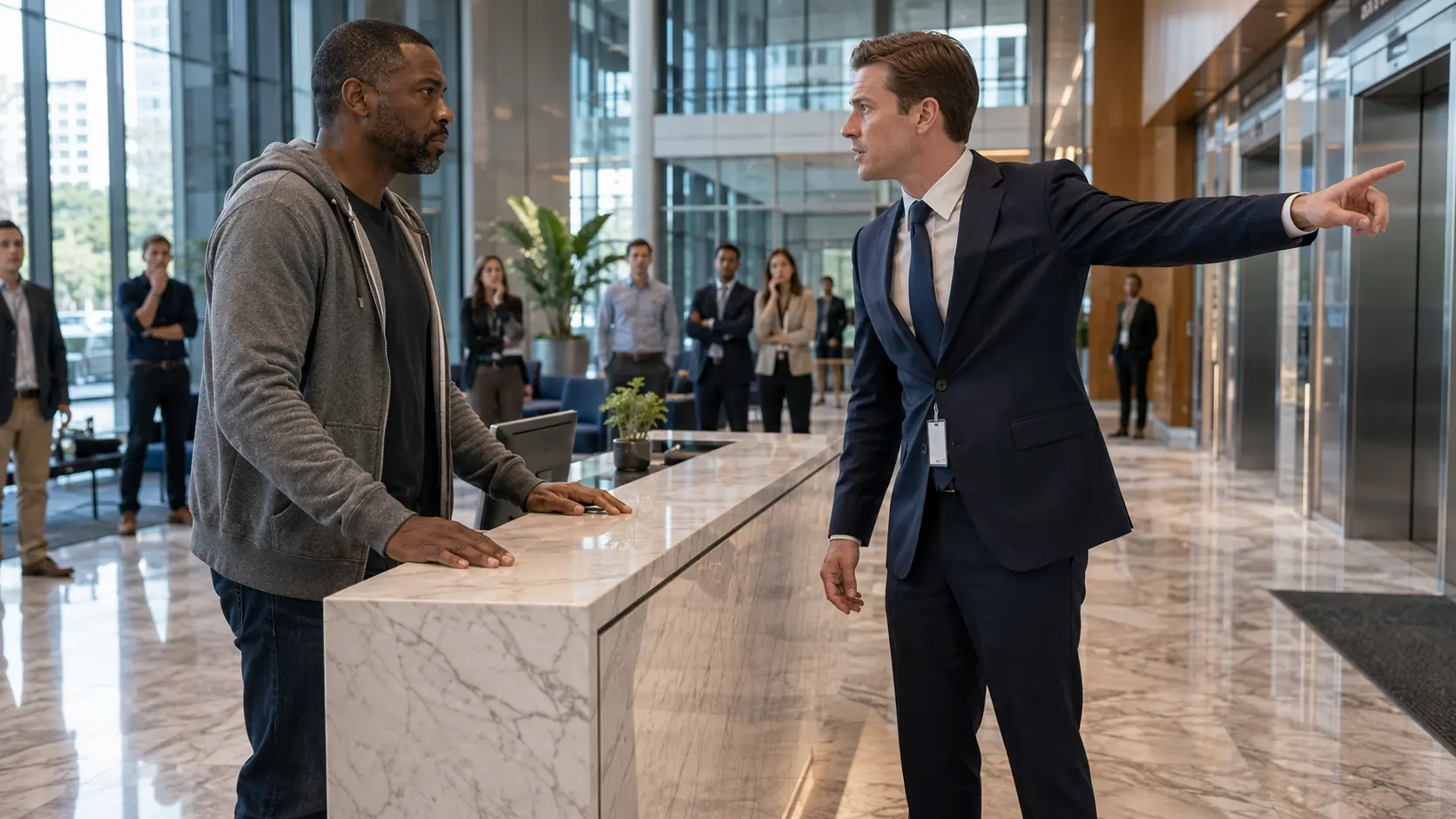
The man pointing stood rigid in his tailored suit, his finger raised like he was banishing an intruder. Beside him, the receptionist froze, headset tilted, eyes darting between authority and unease.
Across the counter stood a man dressed in jeans and a gray hoodie, his posture calm, his presence quiet but impossible to ignore.
He did not flinch.
He had heard that tone before.
At twenty-three, when he was mistaken for an intern in a firm he had already funded.
At thirty-one, when a banker told him executive accounts were not for his type.
And now, at forty-five, standing in the glass and marble lobby of his own headquarters, the same words tried to strip him down again.
The silence after that accusation pressed against the air.
Two employees by the elevators glanced over, curiosity shading into judgment.
One whispered, “Is he lost?”
Another smirked like he already knew the answer.
The manager in the blue suit leaned in, voice firmer now.
“This is a private facility. Our executives don’t just walk in unannounced. Security is on its way.”
He said it with the confidence of someone who believed power only came with a badge or a clipboard.
But the man across the counter did not raise his voice.
He did not beg.
He simply let the moment breathe, his stillness more unsettling than protest could ever be.
The receptionist tried to interject, her voice thin.
“Sir, if you don’t have an appointment—”
The manager cut her off, his finger still locked on the man in the hoodie.
“He doesn’t belong. Look at him. Wrong place, wrong time.”
The phrase clung to the walls, echoing off glass partitions like static.
And then, the first crack appeared.
A junior associate, barely thirty, clutching a tablet, paused nearby.
He recognized the face, though he could not quite place it.
His hand hovered near his phone, thumb ready to hit record.
Something about the scene felt wrong.
The man in the hoodie finally spoke.
“Before you decide where I belong, maybe you should ask yourself who gave you this job.”
His voice was even, low, deliberate.
It was not a question.
It was a mirror.
The manager scoffed.
“Don’t play games. Men like you wander in here all the time pretending they have business. But this company isn’t a playground. It’s not for everyone.”
That last line hit harder than he realized.
Not for everyone.
The receptionist’s lips tightened, as if she knew it had gone too far, but she stayed quiet.
The lobby was not silent anymore.
It was charged.
The young associate lowered his tablet slowly, his eyes fixed on the unfolding tension.
One woman near the seating area frowned and whispered, “This doesn’t feel right.”
But the man in the suit pressed harder, mistaking calm for weakness.
He took a step closer, voice sharp.
“You have one minute to leave before security escorts you out.”
The man in the hoodie did not move.
His hands rested lightly on the counter.
His posture carried the weight of someone who had weathered storms bigger than this moment, bigger than this lobby, bigger than this petty power trip.
He remembered the hotel lobby at sixteen, when a clerk told him the chairs were for paying guests only.
He remembered the bank at twenty-six, when a loan officer laughed at his business plan until the numbers turned into millions.
Every memory was not just pain.
It was fuel.
And right now, the fire behind his calm was invisible, but ready.
The receptionist swallowed hard, shifting in her chair.
“Maybe we should check the system,” she muttered.
But the manager waved her off.
“No need. I know his type. Doesn’t take much to see through the act.”
His type.
Two words that dropped the temperature of the lobby.
The young associate’s thumb finally pressed the record button.
A soft red light blinked in his hand.
The man in the hoodie raised his eyes, meeting the manager’s glare with a gaze steady enough to unsettle the air itself.
“You think I’m lost?” he said quietly. “But this is the one place I know better than anyone. Because it exists because of me.”
The manager chuckled, dismissive.
“Big claims. Empty words.”
He straightened his tie, already certain of his authority.
But authority built on arrogance has cracks.
And those cracks were starting to spread.
What no one in that lobby understood, not the manager, not the receptionist, not the employees sneaking glances, was that they were not pushing out a stranger.
They were about to push out the very man who signed their paychecks.
The architect of the building they were standing in.
The CEO who had walked into his own company only to be told he did not belong.
And the storm had only just begun.
Glass walls.
Polished floors.
A front desk positioned like a judge’s bench.
Everything about it screamed order, control, hierarchy.
And yet, in that ordered space, the chaos of prejudice was already unfolding.
He had not come with an entourage.
No assistants.
No security detail.
No expensive watch flashing under the lights.
Just him, alone, dressed down on purpose.
A quiet test.
A quiet reminder to himself of how quickly appearances still wrote the rules in rooms he built.
The receptionist, trying to mask her discomfort, pushed a clipboard toward him with a stiff smile.
“Sir, I need proof of appointment. Executives don’t just show up without clearance.”
Her voice was shaky, like she already sensed the mistake forming.
But the manager in the blue suit did not flinch.
He doubled down.
“Don’t waste our time,” the manager said. “This is a secure floor. If you’re not authorized, you’re trespassing. Security will handle it.”
He said the word trespassing louder than necessary.
It was not procedure.
It was performance, meant for the audience now gathering in subtle glances from nearby employees.
The man in the hoodie, the CEO they did not recognize, took a slow breath.
His stillness was unnerving, as if the storm had not yet touched him.
Across the lobby, a young woman in a navy dress whispered to her colleague, “Why are they treating him like that?”
Her colleague shrugged, smirking.
“Because he doesn’t belong. Look at him.”
The judgment was casual, but it sliced deep, echoing off glass like broken truth.
The receptionist leaned closer, her voice low.
“Maybe we should just run his name.”
The manager cut her off again, snapping, “I don’t need a database to spot a fraud.”
Then, with a sharp gesture, he swiped the clipboard off the counter.
Papers fluttered to the floor at the man’s feet.
Gasps rippled.
A small, unnecessary act, but enough to tilt the lobby’s mood from skepticism into spectacle.
The young associate, the one holding his tablet, stepped closer.
His voice was tentative.
“Sir, I think I’ve seen him before. Maybe we should check.”
The manager turned on him.
“Go back to work. Or do you want to be written up for entertaining scams?”
That word again.
Scam.
Fraud.
Impostor.
Each syllable thrown not as protocol, but as judgment.
The man in the hoodie did not stoop to pick up the scattered papers.
He stood firm, eyes steady on the manager.
His silence was louder than any defense.
He remembered another silence twenty years earlier, sitting in a bank chair while a loan officer pretended to verify his documents for two hours, knowing full well the stall was just disbelief.
He had waited then.
He was waiting now.
But waiting was not weakness.
It was strategy.
The receptionist shifted in her chair, cheeks pale, eyes flicking toward the entrance.
“He’s not causing trouble,” she murmured, almost pleading.
But the manager ignored her.
He pulled out his phone and dialed quickly.
“Security, now,” he barked. “We’ve got an intruder in the lobby refusing to leave.”
The words rang out like a siren, louder than the phone itself.
A few visitors near the seating area stiffened.
A mother pulled her child closer.
An older man raised his eyebrows and muttered, “All this for what? He’s just standing there.”
The junior associate’s thumb hovered again over his phone.
This time, he did not hesitate.
The red record light blinked alive.
He whispered under his breath, “This needs to be seen.”
The manager spotted him.
“Turn that off. You want a lawsuit?”
But the associate did not move.
The blinking light stayed on.
Then came the sound.
Heavy boots.
Fast steps.
Too fast.
Security arrived like a tactical unit when all they had been called for was a man in a hoodie standing at a desk.
Two guards appeared in seconds, their radios crackling, their presence oversized for the scene.
One of them rested a hand on his belt, as if this were more than a misunderstanding.
Drama, maybe.
But in that lobby, it was real enough to make bystanders hold their breath.
The man in the hoodie glanced at the guards, then back at the manager.
He did not move.
He did not argue.
He did not even blink.
His calm was infuriating.
The manager smirked as though victory were already his.
“See? This is how we deal with people like you.”
People like you.
The phrase landed heavier than anything else had.
The young associate’s jaw tightened.
The receptionist’s eyes widened.
The mother with the child whispered, “That’s not right.”
And still, he stood.
Silent.
Composed.
Immovable.
As if the entire weight of the lobby, the accusations, the guards closing in, meant nothing.
Because for him, it did not.
Because this was not just his company.
This was his test.
And they had just failed it.
The guards stepped closer, radios clicking, the tension in the air thick enough to choke.
But the man in the hoodie did not flinch.
He only looked at his watch, then lifted his phone slowly, calmly, deliberately.
“Carla,” he said when the line picked up, his voice steady as steel, “start the protocol.”
The receptionist’s breath caught.
The associate’s recording light flickered.
The manager frowned, suddenly less sure.
The storm was not coming.
It had already begun.
The security guards stood shoulder to shoulder, their uniforms casting shadows across the marble floor.
The lobby, once sterile and quiet, had transformed into a stage.
Phones were raised now, not just the associate’s.
A young woman near the seating area hit record.
Another guest whispered, “This is crazy.”
The manager in the blue suit folded his arms, lips curling into a smile that was not joy, but triumph.
“Finally,” he muttered. “Someone’s going to deal with this nonsense.”
One of the guards stepped forward.
“Sir, I’m going to need you to hand over your phone and step away from the counter.”
The man in the hoodie did not budge.
His hand rested lightly against the surface of the desk, as if it belonged there more than anyone else’s.
His voice was calm and steady.
“I have every right to be here.”
The manager barked a laugh, sharp and dismissive.
“You? You think you belong in this lobby? Look around. This isn’t some street corner. This is corporate property, and you’re wasting everyone’s time.”
His words rang out deliberately, meant to shame, meant to humiliate.
He gestured toward the guards.
“Escort him out. Now.”
The guards shifted.
But before they moved, the receptionist’s voice cracked through the tension.
“Wait. I think we should double-check his name first.”
The manager turned, eyes like ice.
“Don’t question me.”
Her hands trembled against the keyboard, but she stayed quiet.
And then, as if summoned by arrogance itself, a new figure strode in from the elevator bank.
A senior director, tall and polished, his gray suit gleaming under the lights.
He scanned the scene with irritation.
“What’s going on here? Why is the lobby a circus?”
The manager straightened like a soldier reporting for duty.
“Caught an intruder, sir. Refusing to leave. Claims he belongs here.”
The director’s eyes swept over the man in the hoodie, narrowing instantly.
His tone dropped, cold and contemptuous.
“Not another scam artist. We’ve had enough of those. Get him out before a client sees this mess.”
His words were louder, heavier.
They carried authority, but not wisdom.
They landed like stones, each syllable meant to crush.
The young associate clenched his jaw, recording everything now.
His whisper caught on camera.
“They don’t even know who he is.”
The man in the hoodie, the CEO, finally lifted his gaze to meet the director’s.
His voice was even, each word chosen with precision.
“You’re calling me a scam artist?”
The director sneered.
“If the shoe fits. No one walks into this building dressed like that unless they’re pretending.”
The sentence was met with a hush so sudden it felt like the air itself recoiled.
“Pretending?”
The crowd shifted uncomfortably.
One guest shook her head, muttering, “Unbelievable.”
The manager, emboldened, added fuel.
“We’ve seen this before. People like him trying to fake their way into high-level spaces. It’s pathetic.”
People like him.
The phrase struck like a whip.
The receptionist flinched, her lips pressing tight as if swallowing shame she could not voice.
The guards stiffened, sensing the line being crossed, but bound by orders.
The man in the hoodie did not shout.
He did not break.
His calm was unnerving, his silence deliberate.
He remembered another moment, twenty-six years old, standing in a bank office as a loan officer told him his collateral did not match his profile.
Back then, he had walked out and built his empire anyway.
Now, in this lobby, he stood in that same silence.
But this time, he was not leaving.
The director’s voice rose.
“This is harassment of my staff and disruption of our clients. You’ll leave, or the police will take you out.”
Gasps rippled through the onlookers.
Police?
Over a man standing calmly in a lobby, holding nothing but a phone and his own patience?
The young woman recording near the seating area whispered into her camera, “They’re calling the police on him for existing.”
Her voice shook with fury.
The manager pointed at the guards again.
“Do it. Put him out on the street.”
The guards stepped forward.
One reached for his arm.
And then the shift came, not in volume, but in power.
The man in the hoodie moved only slightly, his voice cutting through like steel.
“Touch me, and you’ll lose more than your job.”
The guard froze, not because of fear, but because of the certainty in his tone.
It was not a bluff.
It was not a threat.
It was truth dressed in calm.
The director scoffed, trying to mask the flicker of doubt crossing his face.
“Big words from a nobody.”
And that was when the young associate finally spoke louder, his voice trembling, but firm enough to be heard.
“He’s not a nobody. I recognize him. That’s—”
The manager snapped.
“Quiet, or you’ll regret it.”
The associate faltered, his voice caught in his throat.
But the truth had already leaked into the air.
The receptionist’s eyes darted between the manager, the director, and the man in the hoodie.
She knew, too.
She had seen his name flash across corporate bulletins before.
The guards looked uncertain.
The crowd whispered.
Phones stayed raised.
And the CEO, still silent, still anchored, lifted his phone back to his ear.
“Carla,” he said, his voice sharp enough to slice the room in two, “escalate the protocol. We’ve reached phase two.”
The manager frowned.
The director stiffened.
The guards glanced at each other.
For the first time, doubt cracked their arrogance.
This was not a stage anymore.
It was a courtroom, and their every word was on trial.
The word protocol seemed to hang in the lobby like smoke no one could clear.
The manager frowned.
The director stiffened.
The guards exchanged uneasy glances.
They did not understand what it meant, but they felt its weight.
The man in the hoodie, the CEO they had all dismissed, did not move.
He stayed anchored to the marble floor, hands steady, voice silent now, letting the room breathe in the tension it had created for itself.
The crowd of onlookers thickened.
Phones glowed red with recording lights.
A teenage boy whispered to his mother, “Why are they treating him like that?”
His mother’s jaw clenched.
“Because they think he doesn’t belong,” she whispered back.
The receptionist shifted uncomfortably in her chair, fingers fidgeting against the keyboard.
She had recognized his name minutes ago, but fear pinned her voice down.
The director’s presence was a cage.
Polished.
Rigid.
Merciless.
The manager barked again, his arrogance louder than his confidence.
“Don’t just stand there. Remove him.”
His voice cracked through the lobby, desperate now, but still trying to sound authoritative.
One guard stepped closer, lowering his hand to the CEO’s phone.
“Sir, I need to see what you just called in.”
The CEO raised his head, gaze steady.
His voice sliced through the space like a blade.
“If you touch this phone, you’ll answer to a boardroom, not a courtroom.”
The guard froze, fingers hovering midair.
Something about the certainty in those words made him hesitate.
The director’s tone sharpened.
“Enough of this. You’re embarrassing yourself. Leave now, or be detained.”
The CEO tilted his head slightly, his expression unreadable.
“Detained? For what crime? Standing in a building I own?”
The words were not shouted, but they hit like a hammer.
The receptionist’s eyes went wide.
The young associate’s jaw dropped.
Phones tilted higher.
But the director scoffed, doubling down.
“Delusions don’t scare me. Security, now.”
One of the guards reached again, this time bolder.
His hand shoved against the CEO’s shoulder.
Papers still scattered on the floor rustled underfoot.
That was when a voice broke through the silence.
Not his.
Hers.
A young woman, a visitor seated nearby, stood up.
Her voice shook with anger, but carried enough to echo.
“Stop. He hasn’t raised his voice once. He hasn’t moved, and you’re treating him like a criminal.”
The manager snapped his head toward her.
“Stay out of this.”
But she did not sit down.
“No. You’re out of line.”
Her defiance lit a spark.
The young associate stepped forward, too.
“She’s right. You don’t even know who you’re pushing out.”
The director’s eyes narrowed.
“And who exactly do you think he is? Some billionaire in disguise? Don’t be ridiculous.”
His laugh was brittle and hollow, meant to mask the crack forming in his authority.
The CEO finally spoke, voice steady and sharp.
“Run my name.”
The receptionist’s hands hovered over the keyboard.
She hesitated, glancing at the director.
He glared at her, his tone venomous.
“Don’t you dare.”
She froze again.
Silence.
The weight of complicity pressed her down.
The manager smirked.
“See? Nothing to check. He’s just playing you. A fraud with a phone and an attitude.”
The word fraud echoed across the marble like a curse.
The CEO’s eyes narrowed slightly, not in anger, but in memory.
He remembered being twenty-three, his first commission check deposited at a bank, frozen the next day because someone like him could not possibly have earned that much.
The memory was not weakness.
It was steel.
He straightened slowly, calm still radiating.
His voice dropped low and deliberate.
“Every word you’ve spoken since I walked in here has been logged. Every insult, every assumption, every threat. And it’s all already on its way to corporate compliance.”
Gasps broke out again.
The young associate’s camera trembled in his hands, still recording.
A guest whispered, “He’s not bluffing.”
The director scoffed louder, though his face had paled.
“Compliance isn’t going to save your little charade.”
The CEO did not blink.
“No, it won’t save me. It will end you.”
The silence that followed was not quiet.
It was charged, heavy, alive.
The manager, sweating now, lashed out with one last attempt at control.
He slammed his hand on the counter, pointing again.
“You’re done here. Get him out before this gets uglier.”
And the young associate finally found his courage.
His voice cracked but carried, ringing across the lobby.
“You don’t understand. That’s not just anyone. That’s—”
The director cut him off with a snarl.
“One more word and you’re finished here.”
But the word had already slipped free.
The air was different now.
The crowd knew something the director and manager refused to see.
The receptionist, trembling, whispered under her breath.
“Oh my God. It’s him.”
The CEO turned his phone slightly, his voice calm and cutting as ever.
“Carla, phase three.”
And with that, the walls of arrogance began to shake.
The moment the words phase three left his lips, the lobby seemed to change temperature.
Not physically, but atmospherically.
Like the very air had shifted allegiance.
The manager forced a laugh, desperate and brittle.
“Phase three? What is this, some kind of prank? You think making up fancy code words is going to scare us?”
But no one was laughing with him.
Not anymore.
The young woman who had spoken up earlier raised her phone higher, her voice stronger now.
“Everyone’s watching this. Every word, every shove. You’re done pretending this is policy.”
The crowd stirred, murmurs swelling into audible frustration.
A man in a business suit, standing near the lounge chairs, shook his head.
“This is unbelievable. He’s calm, and you’re treating him like a trespasser. That’s not security. That’s profiling.”
The word profiling dropped like a stone into the room.
Several guests nodded, whispering, eyes narrowing at the staff.
The manager’s face flushed red, veins taut in his neck.
“You don’t know what you’re talking about. This is our company, and we don’t let frauds stroll in and—”
But his voice was drowned out by another.
The young associate stepped forward, no longer whispering, no longer afraid.
“No. This isn’t your company, and you don’t get to erase who he is.”
His words cut through the tension like a crack in glass.
The director snapped toward him, venom sharp.
“Enough. You’re overstepping your place.”
But the associate did not back down.
He lifted his phone, the red light still glowing.
“So is this. It’s going online. Thousands are going to see what you just said.”
Gasps rippled.
The receptionist’s hands trembled harder against the desk.
For the first time, she looked at the man in the hoodie not with suspicion, but with recognition.
She had seen his name before.
Attached to emails.
Announcements.
Annual reports.
And she whispered it softly, but clear enough for those near her to hear.
“He’s the CEO.”
The room inhaled.
Phones tilted higher.
The guests shifted in their seats, no longer passive observers, but witnesses ready to testify.
The manager barked out a laugh again, hollow this time.
“The CEO? Dressed like that? Don’t make me laugh. Look at him. Jeans, hoodie, sneakers. That’s not a CEO. That’s a janitor on a lucky day.”
His words landed like poison.
But instead of agreement, the crowd recoiled.
A murmur of disgust rippled through the lobby.
A man near the elevators muttered, “This is disgusting.”
A woman, clutching her purse, pulled out her phone and whispered, “I’m streaming this live.”
The director, still clinging to control, stepped forward.
“We don’t owe explanations to outsiders. He doesn’t belong here.”
And then the unexpected happened.
A gray-haired woman, sitting quietly in the corner, rose to her feet.
She adjusted her scarf, eyes sharp, voice firm.
“I’ve been a shareholder in this company for fifteen years, and I know exactly who that man is.”
The lobby froze.
Every gaze turned to her as she lifted her phone, the screen glowing with a corporate press release she had pulled up in seconds.
The headline flashed bold and undeniable.
CEO Appointed Chairman of the Board
The crowd gasped.
The receptionist’s hand flew to her mouth.
The associate nearly dropped his tablet.
The man in the hoodie had not moved.
He had not spoken.
He had not raised his voice.
But the room had already begun to turn.
The gray-haired woman pointed at the manager, then the director.
“You just tried to humiliate your own CEO, on camera, in front of shareholders, clients, and guests. You think anyone’s going to forget this?”
Her words cracked through the lobby like a verdict.
The crowd stirred, voices rising.
“She’s right.”
“This is insane.”
“Fire them now.”
Phones were everywhere now, lenses like a wall closing in on the staff.
And through it all, the CEO stayed silent.
He did not need to shout.
The room was speaking for him.
The manager’s face drained of color.
The director’s jaw clenched.
For the first time, both looked less like authority and more like men on trial.
And the trial had only just begun.
The gray-haired woman’s words still echoed in the lobby.
“You just tried to humiliate your own CEO.”
The truth was out now, hanging heavy in the air, undeniable.
But instead of folding, the manager snapped.
His pride could not let go.
His voice rose, frantic, almost shouting.
“She’s lying. You all are being played. He’s not a CEO. He’s a con artist dressed down to trick you. This is what people do. They act like victims to worm their way into places they don’t belong.”
The words dripped venom.
Not just dismissal.
Dehumanization.
The crowd recoiled.
Someone muttered, “That’s enough.”
Another said, “He’s still doubling down?”
Phones captured every syllable.
The director stepped in, trying to salvage control, but only pouring gasoline on the fire.
“Don’t let theatrics fool you. Real executives don’t walk around in hoodies. They don’t come unannounced. Look at him. Does he look like a man running a billion-dollar company? Be serious.”
His voice dripped with smug certainty.
But the more he talked, the more the audience turned against him.
A man in a tailored suit near the coffee bar shook his head.
“I’ve worked with CEOs before. You think money always looks like Armani? That’s your ignorance, not reality.”
The receptionist finally broke.
Her voice cracked, but it was steady enough to carry.
“I saw his name in the system this morning. He’s listed as an executive override. He belongs here.”
The manager’s head whipped around, eyes furious.
“You’re finished,” he hissed at her. “You’ll regret that.”
But his threat was drowned out by another gasp from the crowd.
The CEO finally shifted.
Slowly, deliberately, he bent down, not to pick up the papers scattered at his feet, but to collect himself.
When he stood, his height, his posture, his silence filled the lobby like thunder before a storm.
The guard who had touched his shoulder earlier stepped back instinctively, sensing something unshakable in the man’s calm.
The manager, sweating now, still spat defiance.
“You’re nothing but a fraud. You’ll never belong in this building.”
The CEO’s eyes narrowed slightly, his tone dropping to something sharp, measured, and lethal.
“You called me a fraud in a company I built. You told me I don’t belong in a building that exists because of me.”
The words cut deeper than any raised voice could.
The lobby went dead silent, every phone capturing the moment.
The director tried to laugh, but it cracked under the weight of the silence.
“Empty words. No one believes you.”
But the truth was already everywhere.
On glowing screens.
In the whispers of shareholders.
In the defiance of staff who had finally spoken up.
The CEO lifted his phone again, calm and precise.
“Carla, timestamp every insult, every shove, every threat. Begin immediate documentation.”
“Logged,” came the reply, loud enough for those closest to hear.
The receptionist closed her eyes.
The associate nodded silently.
The crowd murmured louder.
And for the first time, the manager realized the tide had turned.
His voice, once loud and commanding, now sounded small and desperate.
“You’ll regret this,” he muttered.
But no one was listening to him anymore.
All eyes were fixed on the man in the hoodie.
The man they had tried to erase.
The man about to turn humiliation into justice.
The storm was seconds away from breaking.
The silence pressed heavy, as if the walls themselves were waiting for the verdict.
The manager’s face glistened with sweat, his arrogance cracking but not collapsing.
Pride can be louder than reason.
And his was screaming now.
“You think you can intimidate me?” he spat, his voice sharp and desperate. “You don’t belong here, hoodie or no hoodie. Security, remove him. By force if you have to.”
The guards hesitated.
The crowd shifted uneasily.
But the order had been given.
One of them stepped forward, reaching with both hands this time, not for the phone, but for the CEO’s arm, intent on dragging him out.
The gasp that followed echoed like a gunshot.
Guests rose from their seats, murmurs swelling into outrage.
The young woman recording shouted, “He hasn’t done anything. This is assault.”
The manager sneered, doubling down.
“Sometimes you have to put people in their place. He’s not one of us. Never was. Never will be.”
The cruelty of it, the casual violence, pushed the lobby past its breaking point.
The guard’s hand clamped down.
For the first time, the CEO moved.
Not fast.
Not violent.
Deliberate.
He pulled his arm free with a calm strength that was more commanding than resistance.
He did not shove.
He did not strike.
He simply reclaimed his space, his presence towering larger than the uniform in front of him.
His voice came low, steady, resonant.
“You mistook silence for submission. That was your last mistake.”
The words sliced through the lobby like a blade.
The crowd erupted.
Gasps.
Whispers.
The red glow of recording lights multiplying.
The director stepped forward now, his mask of authority slipping.
“Enough. This circus ends now.”
His voice cracked under its own weight.
“Call the police right now.”
The receptionist stood abruptly, her voice trembling but clear.
“No. This has gone too far. He’s the CEO.”
The manager turned on her, face contorted with rage.
“You’re finished here.”
But no one heard him anymore.
Because the young associate’s voice rose above the noise, firm and undeniable.
“She’s telling the truth. That’s our CEO.”
The crowd surged with energy.
Guests whispered.
Phones lifted.
Voices overlapped.
“Oh my God.”
“It really is him.”
“They tried to throw him out of his own building.”
The guards froze, caught between orders and truth.
The manager’s authority crumbled in real time.
And the CEO, still calm, still composed, lifted his phone once more.
“Carla,” he said, his voice steel. “Initiate phase four.”
The storm had finally broken.
The words phase four seemed to vibrate in the air, foreign to everyone except him.
The crowd leaned in, holding its breath, while the staff stiffened with unease they could not name.
The CEO did not raise his voice.
He did not need to.
His calm was its own weapon.
“Carla,” he said evenly into the phone, “initiate immediate verification protocols. Pull live feeds. Match my ID. Push system-wide alerts.”
“Confirmed,” came the reply, crisp and clinical.
Then, almost on cue, the company’s giant digital display mounted behind the reception desk flickered.
The corporate logo disappeared, replaced by a system notification.
Executive Override in Progress
The receptionist gasped, her hand flying to her mouth.
The young associate whispered, “Oh my God. It’s real.”
The manager stumbled back a step, his face paling.
“What is this? Some kind of hack?”
His voice cracked.
“Shut it off. Now.”
But the screen did not obey him.
It obeyed the man in the hoodie.
His credentials, his name, his authority began to populate across the display in real time.
CEO Access Verified
Chairman Override Activated
The crowd erupted in gasps and murmurs.
Phones zoomed in on the screen, capturing the undeniable proof.
Guests spoke over one another.
“He wasn’t lying.”
“They tried to throw out their own CEO.”
“This is going viral.”
The director tried to salvage what was left, his voice shaky but still arrogant.
“This doesn’t mean anything. It could be fabricated.”
But his protest was cut short when his own access badge buzzed red at his hip.
A shrill denial tone rang from the security panel near the elevator.
He froze, staring at it like it had betrayed him.
The receptionist’s console lit up with alerts.
The guards’ radios crackled with system errors.
The CEO’s voice, measured and precise, cut through the rising chaos.
“Effective immediately, revoke all access for those who violated protocol. Begin logging disciplinary action for management misconduct.”
The manager lunged forward, desperate.
“You can’t do this.”
But the words sounded hollow now.
The power had shifted.
Irrevocably.
Undeniably.
The authority he had clung to like armor dissolved in seconds.
The young associate turned his phone back to his own face, whispering into his live stream.
“This is happening right now. The CEO is dismantling them in real time.”
The lobby buzzed with awe, disbelief, and the thrill of justice unfolding.
The CEO stood firm, eyes steady, voice calm.
He had not shouted once.
He had not needed to.
His silence, his composure, his authority were louder than any insult hurled his way.
And for the first time, it was not him on trial anymore.
It was them.
The giant display behind the desk pulsed again, brighter this time.
A corporate headshot appeared.
His face unmistakable, crisp in high definition.
Next to it, bold letters scrolled across the screen.
CEO and Chairman
The lobby gasped as one.
The sound was visceral, a collective intake of breath that rattled the marble and glass.
Guests stared at the man in the hoodie, then at the screen, then back again, as if trying to reconcile the quiet figure before them with the title blazing in lights.
The manager staggered back a step, color draining from his cheeks.
“No. No, this can’t—”
His words withered into nothing.
The director’s jaw dropped open, but no words came.
His access badge buzzed again.
Another shrill denial tone.
Red.
Locked out.
Frozen.
His face went chalk white.
The receptionist whispered, tears threatening her eyes, “It’s really him.”
Phones captured every second.
Streams lit up with comments pouring in.
They threw out their own CEO.
This is insane.
Justice live.
The CEO did not gloat.
He did not smirk.
He simply lifted his gaze to the staff who had tried to erase him.
His voice was steady and cutting.
“You told me I didn’t belong here. You called me a fraud in front of my people, in front of shareholders, in front of guests. And now the world knows who you are, too.”
The crowd stirred.
Some clapped softly.
Others cheered outright.
The energy in the lobby shifted like a tide turning, sweeping the arrogance of the staff into its undertow.
The manager whispered, barely audible, “What have I done?”
The director’s hands shook.
The guards stood frozen, their authority gone.
And in the center of it all, the CEO remained calm.
His silence was more powerful than their noise.
His presence was more commanding than their titles.
The reveal was complete.
And the reckoning was just beginning.
The lobby no longer felt like neutral ground.
It had become a tribunal.
Every glowing phone was a witness stand.
Every guest was a juror.
And the verdict was already written on their faces.
The manager’s hands trembled as he fumbled for words.
“It was a mistake, sir. A misunderstanding.”
His voice cracked under the weight of his own desperation.
Sweat beaded on his forehead, the smug arrogance drained from him entirely.
The director, usually polished and composed, looked like a man watching his career crumble in real time.
“We didn’t know,” he stammered, eyes darting to the crowd, then back to the CEO. “If we had recognized you—”
The CEO cut him off, his voice like steel.
“Recognition shouldn’t determine dignity. You judged me before you knew my name. That judgment is who you really are.”
The crowd murmured in agreement.
A man in a navy suit called out, “He’s right.”
A woman added, “We all saw it. Every word. Every shove. It’s recorded.”
The manager turned to the guards, desperate.
“You saw nothing. Delete the footage.”
But the guards did not move.
They were not protecting him anymore.
The young associate stepped forward, voice trembling but resolute.
“The footage is already live. Thousands are watching.”
He turned his phone slightly, showing the stream count climbing by the second.
Gasps rippled again.
The manager’s knees seemed to buckle.
The director’s face went ashen, his authority dissolving in front of the very people he once commanded.
Meanwhile, the CEO stood unmoving, calm in the storm he had never needed to create.
His silence was no longer mistaken for weakness.
It was recognized as power.
And in that silence, the guilty unraveled.
The lobby buzzed with whispers, phones raised like lanterns catching every angle of truth.
The staff who had mocked him now stood pale and trembling, their authority evaporated.
The CEO finally lifted his phone again, his voice steady and precise.
“Carla. Terminate access for Gregory Vaughn, director of operations, effective immediately.”
A sharp beep echoed from the director’s badge.
It glowed red, then powered down with a final blink.
The crowd gasped as he stared at it in disbelief, clutching the useless card like it had betrayed him.
The CEO did not pause.
“Suspend manager Thomas Reed. Lock him out of all systems. Security credentials revoked.”
The manager’s badge buzzed violently.
The lockout tone screamed across the lobby like a siren.
He slapped at it, frantic, as if sheer willpower could bring it back to life.
It did not.
Phones zoomed in on his panic, capturing every second.
A woman near the entrance whispered, “That’s what justice looks like.”
The guards exchanged glances, stepping back not against the CEO, but away from the men whose power had just vanished.
They were not leaders anymore.
They were liabilities.
The CEO’s eyes swept the room once, calm and unshakable.
“Every action you took against me is logged. Every word, every insult. And your careers end here, today.”
The director opened his mouth, searching for words, but only a broken whisper escaped.
“Please.”
The manager tried to speak, too, but his voice was drowned out by the ripple of applause rising from the crowd.
First a handful of claps.
Then dozens.
Until the sound filled the lobby like a verdict handed down by the people themselves.
And through it all, the CEO remained still.
His silence was louder than their begging.
His authority was absolute.
Justice had been delivered not tomorrow, not in some distant boardroom, but here, now, in the very lobby where they had tried to erase him.
The applause rolled through the lobby, not wild, but steady, like the sound of a verdict sealed.
Phones stayed lifted, recording every frame, ensuring the world would not just hear this story, but see it.
The manager and director stood hollow, badges dead at their sides, stripped of the arrogance that had once carried them.
The guards had stepped back completely, silent witnesses now to justice unfolding.
The CEO lifted his eyes, scanning the room.
The staff who doubted him.
The guests who defended him.
The employees who finally spoke up.
His voice was calm, measured, heavy with truth.
“You tried to erase me with a look, with a word, with a shove. You thought silence meant weakness. You thought appearances defined worth. But you were wrong.”
The crowd hushed, leaning in.
“I don’t need to record a video to prove what happened here. I am the result of it. And I will always be the result, because this company exists because I refused to be erased.”
The words struck like a final gavel.
Some guests clapped again.
Others nodded, eyes wet, the weight of his dignity settling into them.
He did not raise his voice.
He did not need to.
He turned and walked toward the elevators.
With every step, the marble floor seemed to carry his authority louder than any insult had.
The last thing the lobby heard was his voice, quiet but absolute.
“Justice doesn’t need noise. It needs power.”
And with that, the doors closed behind him.