"You don't belong here."
The words weren't whispered. They landed like a gavel, sharp and deliberate, cutting through the lobby of a company he had built from the ground up. The man pointing stood rigid in his tailored suit, his finger raised as if he were banishing an intruder.
Beside him, the receptionist froze, headset tilted, eyes darting between authority and unease. Across the counter stood a Black man dressed in jeans and a gray hoodie, his posture calm, his presence quiet but impossible to ignore.
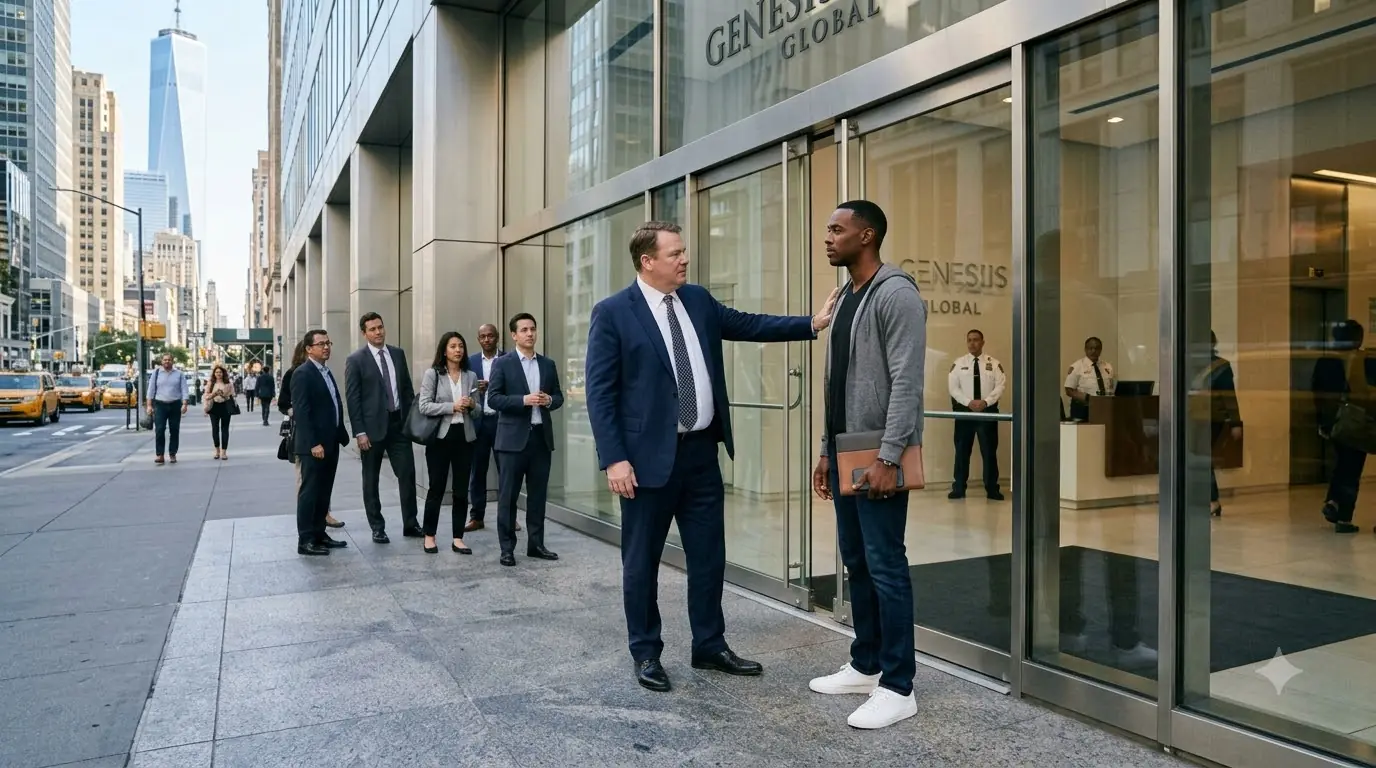
He didn't flinch. He had heard that tone before at twenty-three, when he was mistaken for an intern in a firm he had already funded, and again at thirty-one, when a banker told him executive accounts weren't for "his type." Now, at forty-five, he stood in the glass-and-marble lobby of his own headquarters while the same kind of words tried to strip him down again. The silence after the accusation pressed against the air.
Two employees by the elevators glanced over, curiosity shading into judgment. One whispered, "Is he lost?" Another smirked as if they already knew the answer. The manager in the blue suit leaned in, voice firmer now.
"This is a private facility. Our executives don't just walk in unannounced. Security is on its way."
He said it with the confidence of someone who believed power only came with a badge or a clipboard. But the man across the counter didn't raise his voice. He didn't beg. He simply let the moment breathe, his stillness more unsettling than a protest could ever be.
The receptionist tried to interject. "Sir, if you don't have an appointment..."
The manager cut her off, his finger still aimed at the man in the hoodie. "He doesn't belong. Look at him. Wrong place, wrong time."
The phrase clung to the walls, echoing off glass partitions like static. Then the first crack appeared. A junior associate, barely thirty and clutching a tablet, paused nearby. He recognized the face, though he couldn't quite place it. His hand hovered near his phone, thumb ready to hit record. Something about the scene felt wrong.
The man in the hoodie finally spoke. "Before you decide where I belong, maybe you should ask yourself who gave you this job."
His voice was even, low, deliberate. It wasn't really a question. It was a mirror.
The manager scoffed. "Don't play games. Men like you wander in here all the time pretending they have business. But this company isn't a playground. It's not for everyone."
That last line hit harder than he realized. Not for everyone. The receptionist's lips tightened as if she knew it had gone too far, but she stayed quiet.
The lobby was charged now. The young associate lowered his tablet slowly, his eyes fixed on the unfolding tension. A woman near the seating area frowned and whispered, "This doesn't feel right." But the man in the suit pressed harder, mistaking calm for weakness.
He took a step closer. "You have one minute to leave before security escorts you out."
The man in the hoodie didn't move. His hands rested lightly on the counter. His posture carried the weight of someone who had weathered storms bigger than this moment, bigger than this lobby, bigger than this petty power trip.
He remembered a hotel lobby at sixteen, when a clerk had told him the chairs were for paying guests only. He remembered a bank at twenty-six, when a loan officer laughed at his business plan until the numbers turned into millions. Every memory wasn't just pain. It was fuel. The fire behind his calm was invisible, but ready.
The receptionist swallowed hard and shifted in her chair. "Maybe we should check the system," she murmured.
The manager waved her off. "No need. I know his type. Doesn't take much to see through the act."
His type. Two words that dropped the temperature of the lobby. The young associate's thumb finally pressed the record button. A soft red light blinked in his hand.
The man in the hoodie raised his eyes, meeting the manager's glare with a gaze steady enough to unsettle the air itself. "You think I'm lost?" he said quietly. "But this is the one place I know better than anyone, because it exists because of me."
The manager chuckled dismissively. "Big claims, empty words."
He straightened his tie, already certain of his authority. But authority built on arrogance has cracks, and those cracks were starting to spread. What no one in that lobby understood, not the manager, not the receptionist, not the employees sneaking glances, was that they weren't pushing out a stranger. They were about to push out the very man who signed their paychecks, the architect of the building they were standing in, the CEO who had walked into his own company only to be told he didn't belong.
The marble lobby gleamed with sterile perfection: glass walls, polished floors, a front desk positioned like a judge's bench. Everything about it screamed order, control, hierarchy. Yet in that ordered space, the chaos of prejudice was already unfolding. He had not arrived with an entourage, assistants, security detail, or an expensive watch flashing under the lights. He had come alone, dressed down on purpose.
It was a quiet test, a reminder to himself of how quickly appearances still wrote the rules in rooms he had built. The receptionist, trying to mask her discomfort, pushed a clipboard toward him with a stiff smile. "Sir, I need proof of appointment. Executives don't just show up without clearance."
Her voice was shaky, as though she already sensed the mistake forming. But the manager in the blue suit did not flinch. He doubled down.
"Don't waste our time," the manager said. "This is a secure floor. If you're not authorized, you're trespassing. Security will handle it."
He said the word trespassing louder than necessary. It wasn't procedure. It was a performance meant for the audience now gathering in subtle glances from nearby employees.
The man in the hoodie took a slow breath. His stillness was unnerving, as if the storm hadn't yet touched him. Across the lobby, a young woman in a navy dress whispered to her colleague, "Why are they treating him like that?"
Her colleague shrugged and smirked. "Because he doesn't belong. Look at him."
The judgment was casual, but it sliced deep, echoing off the glass like broken truth. The receptionist leaned closer. "Maybe we should just run his name."
The manager cut her off again. "I don't need a database to spot a fraud."
With a sharp gesture, he swiped the clipboard off the counter. Papers fluttered to the floor at the man's feet. Gasps rippled through the lobby. It was a small, unnecessary act, but enough to tilt the mood from skepticism into spectacle.
The young associate holding the tablet stepped closer. "Sir, I think I've seen him before. Maybe we should check."
The manager turned on him. "Go back to work. Or do you want to be written up for entertaining scams?"
Scam. Fraud. Impostor. Each word was thrown not as protocol, but as judgment.
The man in the hoodie did not stoop to pick up the scattered papers. He stood firm, eyes steady on the manager. His silence was louder than any defense.
He remembered another silence twenty years earlier, sitting in a bank chair while a loan officer pretended to verify his documents for two hours, knowing full well the delay came from disbelief. He had waited then. He was waiting now. But waiting wasn't weakness. It was strategy.
The receptionist shifted in her chair, cheeks pale. "He's not causing trouble," she murmured, almost pleading.
The manager ignored her and pulled out his phone. "Security now," he barked. "We've got an intruder in the lobby refusing to leave."
The words rang out like a siren. A few visitors near the seating area stiffened. A mother pulled her child closer. An older man raised his eyebrows and muttered, "All this for what? He's just standing there."
The junior associate's thumb hovered again over his phone. This time, he didn't hesitate. The red recording light blinked alive. He whispered under his breath, "This needs to be seen."
The manager spotted him. "Turn that off. You want a lawsuit?"
But the associate didn't move. The blinking light stayed on.
Then came the sound of heavy boots and fast steps. Security arrived with an urgency far beyond what the scene required. Two guards appeared in seconds, radios crackling, their presence oversized for a man in a hoodie standing calmly at a desk. One of them even rested a hand near his belt as if this were more than a misunderstanding.
The man in the hoodie glanced at the guards and then back at the manager. He didn't move, argue, or even blink. His calm seemed to infuriate the manager.
The manager smirked as if victory were already his. "See? This is how we deal with people like you."
People like you. The phrase landed heavier than anything else had. The young associate's jaw tightened. The receptionist's eyes widened. The mother with the child whispered, "That's not right."
Still, he stood, silent, composed, immovable, as if the entire weight of the lobby, the accusations, and the guards closing in meant nothing. Because for him, this wasn't just his company. It was a test, and they had just failed it.
The guards stepped closer, radios clicking, the tension thick enough to choke. The man in the hoodie only looked at his watch, then lifted his phone slowly and deliberately.
"Carla," he said when the line picked up, his voice steady as steel. "Start the protocol."
The receptionist's breath caught. The associate's recording light flickered. The manager frowned, suddenly less sure. The storm wasn't coming. It had already begun.
The security guards stood shoulder to shoulder, their black uniforms stark against the marble floor. The lobby had transformed into a stage. Phones were raised now, not just the associate's. A young woman near the seating area hit record. Another guest whispered, "This is crazy," as the air thickened with anticipation.
The manager folded his arms, lips curling into a smile that wasn't joy but triumph. "Finally," he muttered. "Someone's going to deal with this nonsense."
One of the guards stepped forward. "Sir, I'm going to need you to hand over your phone and step away from the counter."
The man in the hoodie didn't budge. His hand rested lightly against the surface of the desk, as if it belonged there more than anyone else's. "I have every right to be here."
The manager barked a sharp, dismissive laugh. "You? You think you belong in this lobby? Look around. This isn't some street corner. This is corporate property, and you're wasting everyone's time."
His words rang out deliberately, meant to shame and humiliate. He gestured toward the guards. "Escort him out. Now."
The guards shifted, but before they moved, the receptionist's voice cracked through the tension. "Wait. I think we should double-check his name first."