The morning sun had barely cleared the hangars when Dr. Melissa Reynolds reached the boarding stairs of the white corporate jet. REYNOLDS TECHNOLOGIES appeared in dark blue letters across the tail, visible from nearly every corner of the private American executive airport. Melissa stopped beside the lowest step, her structured gray leather tote hanging from one arm and her boarding documents resting in her hand. She wore slim dark sunglasses, a crisp light-blue striped shirt with rolled sleeves, a matching tie, a long dark-brown pinstriped skirt, and pointed heels.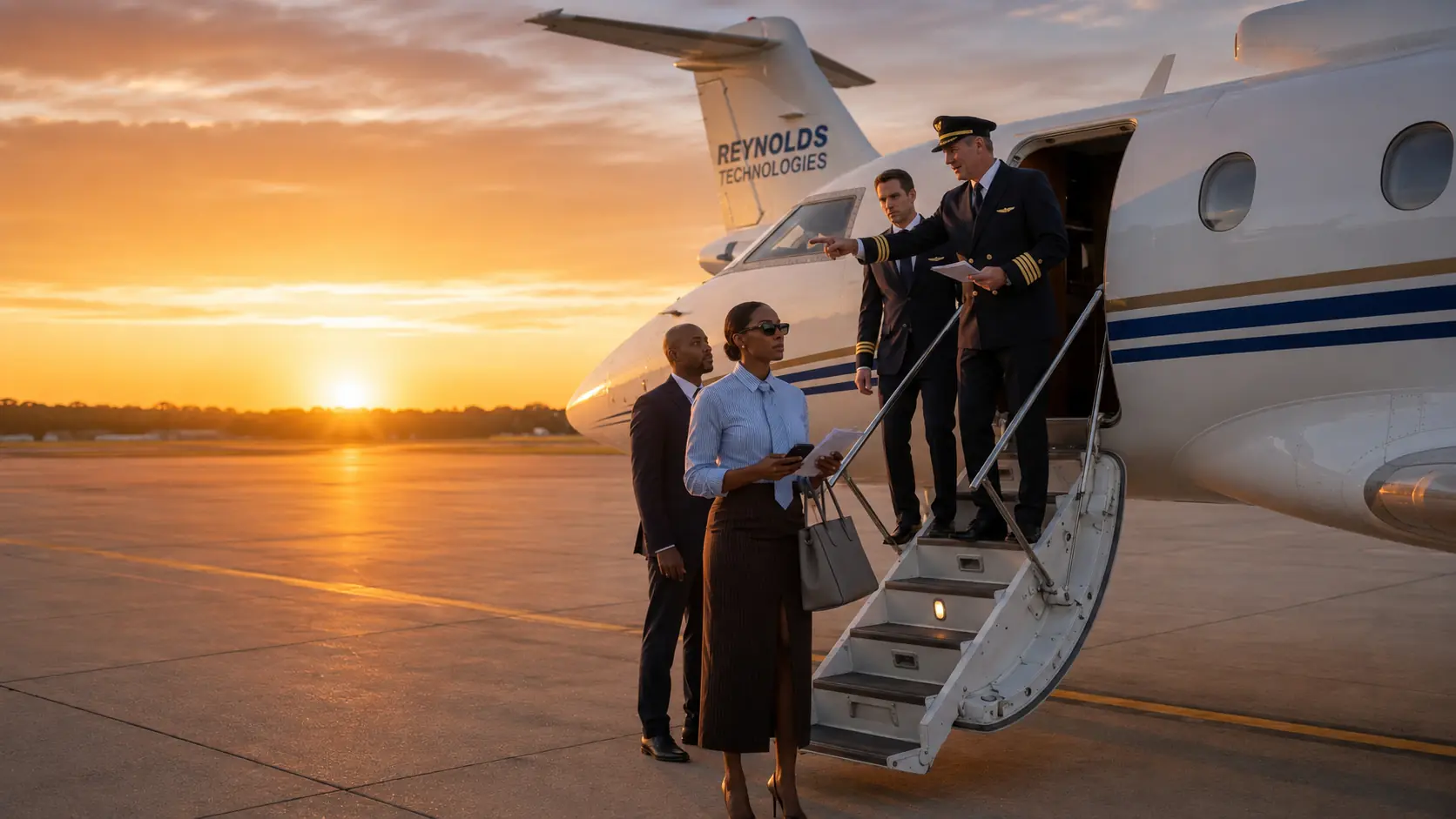
Captain Robert Harrison looked at her once and immediately decided she did not belong there.
The fifty-six-year-old white American pilot stepped across the entrance and extended one arm in front of the stairs. His navy uniform was immaculate, gold stripes shining at his cuffs, and the polished badge on his cap caught the morning light. He did not ask her name or inspect the papers she held. Instead, he looked from her clothes to the gray bag on her arm and gestured toward a service road behind the hangar.
“Step aside, ma’am,” Harrison said. “Cleaning staff use the service entrance, not the owner’s jet.”
Melissa did not move.
A few feet behind her stood Marcus Grant, the forty-two-year-old Black American chief legal officer of Reynolds Technologies. Marcus wore a fitted charcoal suit and had spent twelve years watching Melissa negotiate acquisitions, dismiss dishonest executives, and dismantle arguments without raising her voice. He recognized the stillness in her face.
It was the calm that arrived immediately before someone made the worst mistake of his career.
Melissa lowered her documents slightly. “Move that hand before I make sure you never touch this aircraft again.”
Harrison smirked. “Threatening the flight crew will not get you aboard.”
A younger white American co-pilot appeared in the open doorway above them. Daniel Price was thirty, newly assigned to the company flight division, and still buttoning one cuff when he heard Harrison’s voice. He glanced at Melissa, froze, and nearly missed the next step.
“Captain,” Daniel said carefully. “That’s Dr. Reynolds.”
Harrison’s hand dropped by several inches.
Melissa slowly removed her sunglasses. “Good. Then stand there and watch me fire him myself.”
For a moment, nobody moved.
Ground technicians in reflective vests watched from beside a fuel truck. A security employee near the hangar doors stopped pretending to check his radio. Harrison stared at Melissa’s face, searching for any sign that Daniel had made a mistake.
Melissa Reynolds was not merely a passenger.
She was the founder, chief executive, and controlling shareholder of Reynolds Technologies, a Boston-based American engineering company valued at more than eleven billion dollars. The jet behind Harrison had been purchased through her corporate aviation division, registered to one of her companies, and configured according to her specifications.
Her name appeared first on that morning’s flight manifest.
Harrison stepped away from the stairs. “Dr. Reynolds, I apologize. I was given incomplete information.”
“You were given my manifest,” Melissa said.
“I had not checked the final passenger list.”
“That is not the defense you think it is.”
He removed his cap and held it against his side. “There have been unauthorized people on the tarmac recently. I was protecting your aircraft.”
“You protected it from its owner without asking for identification.”
“The situation looked unusual.”
Marcus moved closer. “What looked unusual?”
Harrison’s eyes shifted toward him. “I did not mean anything inappropriate.”
Melissa held up her documents. “I approached with company credentials, government identification, and a verified boarding packet. You ignored all three.”
“I thought you were part of the service team.”
“Because of the luxury briefcase, tailored clothing, and corporate documents?”
Harrison said nothing.
Melissa stepped onto the first stair. He did not attempt to block her again. She stopped beside him and lowered her voice so only Harrison, Marcus, and Daniel could hear.
“You are relieved of flight duty effective immediately.”
His face tightened. “You cannot safely operate this flight without a captain.”
“I have already arranged another one.”
“You arranged a replacement before arriving?”
“No. I arranged one while you were explaining which entrance people like me should use.”
She held up her phone.
The screen displayed an active call with Reynolds Technologies Aviation Operations. Melissa had activated the line when Harrison first extended his arm. Every word of the confrontation had been heard and recorded by the division director.
Harrison looked toward Daniel. “You knew about this?”
Daniel shook his head. “No, sir.”
Melissa addressed the co-pilot. “Captain Laura Bennett is driving from Hangar Four. You will remain as second-in-command if operations confirms your qualifications.”
“Yes, Dr. Reynolds.”
Harrison’s surprise turned into anger. “You are firing me over one misunderstanding?”
“I am grounding you over an immediate safety and conduct concern. Your employment will be determined after the investigation.”
“You just said you were firing me.”
“I know what I said.”
Melissa walked up the stairs and disappeared into the cabin. Marcus remained outside long enough to hand Harrison a formal suspension notice that had been transmitted electronically from operations.
“Do not enter the aircraft,” Marcus said. “Do not access the flight systems, company devices, or aviation office without written authorization.”
Harrison took the document. “This is absurd.”
Marcus looked toward the jet. “The woman you just mistook for cleaning staff built the division paying your salary. I would choose my next sentence carefully.”
Harrison’s mouth closed.
Inside the aircraft, Melissa placed her tote on a cream leather seat and looked around the cabin. The jet had been prepared perfectly: conference documents were arranged on the table, bottled water stood beside each seat, and the communications systems were already active. She was due in New York that morning for negotiations that could determine the future of a medical robotics company.
She should have been reviewing contracts.
Instead, she opened her laptop and accessed the aviation compliance system.
Marcus joined her moments later.
“Do you want the meeting delayed?” he asked.
“No.”
“You have every right to take an hour.”
“I did not build a company so one pilot could control my schedule.”
Marcus sat across from her. “Operations has secured his access. Laura Bennett will arrive in nine minutes.”
Melissa opened the employee complaint archive. “Search Harrison’s name.”
Marcus did not ask why.
The results appeared almost immediately.
Three complaints had been filed against Captain Robert Harrison during the previous eighteen months. One came from a Black American software engineer who said Harrison questioned whether he was authorized to use the executive cabin despite appearing on the manifest. Another involved a Latina American board member whom Harrison repeatedly called an assistant even after being corrected.
The third report came from a white American flight attendant named Claire Donovan. She accused Harrison of changing crew assignments for personal reasons and making demeaning comments about women he believed had been hired to satisfy diversity targets.
All three cases had been closed at the local level.
Melissa looked at the name of the reviewing manager: Gerald Knox, Director of Corporate Aviation.
“Gerald told me Harrison had an excellent record,” she said.
“He signed every closure,” Marcus replied.
“Without escalating them to corporate compliance.”
Marcus opened the first report. “The engineer’s complaint was classified as a misunderstanding caused by heightened airport-security concerns.”
“That sounds familiar.”
“The board member’s case says Harrison confused her with an administrative employee because of a last-minute passenger change.”
“There was no last-minute change. She had been on the schedule for three weeks.”
Marcus read the final file. “Claire’s complaint was dismissed for insufficient corroboration after two other crew members declined interviews.”
Melissa leaned back slowly.
The tarmac confrontation had not created a new problem. It had exposed an old one.
Captain Laura Bennett entered the cabin twelve minutes later. She was a forty-eight-year-old white American pilot with twenty-three years of corporate and commercial flying experience. After confirming flight status with operations, she introduced herself, reviewed the manifest in front of Melissa, and checked each passenger’s identification according to the same written procedure.
No assumptions. No insults. No public performance.
The jet departed only twenty-six minutes behind schedule.
Melissa spent the flight reviewing Harrison’s personnel records instead of the acquisition presentation. His technical evaluations were consistently strong. He had logged thousands of safe flight hours and received praise for decision-making during severe weather.
Yet his customer-service evaluations showed an unusual pattern.
Senior white American male executives regularly rated him excellent. Women, younger employees, and passengers from minority backgrounds were far more likely to describe him as dismissive, controlling, or hostile. Gerald Knox repeatedly removed those comments from formal performance summaries, claiming they were subjective.
“Technical skill protected him,” Marcus said.
“No,” Melissa replied. “People protected him because technical skill made his behavior profitable to ignore.”
The jet landed in New York shortly before ten. Melissa completed the acquisition meeting, negotiated revised terms, and returned to her hotel after sunset with a signed letter of intent worth nearly six hundred million dollars.
Only then did she allow herself to think about the morning.
She remembered Harrison’s hand blocking the stairs. More than the insult, she remembered the certainty behind it. He had never doubted his right to decide who belonged beside the aircraft.
He apologized only after learning she possessed power over him.
That was not remorse.
It was fear of consequences.
The next morning, Melissa ordered an independent investigation of the entire aviation division. She placed Gerald Knox on administrative leave and retained an outside firm specializing in aviation compliance, employment practices, and financial auditing.
Every employee was offered confidential interviews.
Within four days, eleven current and former workers agreed to speak.
Claire Donovan had resigned six months after filing her complaint. Investigators contacted her in Denver, where she now worked for a charter company. She initially refused to participate.
“I already told Reynolds Technologies what happened,” Claire said during the call. “Your company decided his career mattered more than my safety.”
Melissa asked to speak with her personally.
Claire agreed only after learning the chief executive had also been targeted.
During their video meeting, Claire described Harrison’s pattern. He questioned the authority of women serving as flight commanders, assigned undesirable schedules to employees who challenged him, and treated certain passengers as potential security risks based on appearance rather than documentation.
The most serious incident occurred during a flight to San Francisco.
A Black American vice president named Malcolm Lewis arrived wearing jeans and a university sweatshirt. Harrison demanded additional identification even though Malcolm’s name, employee number, and photograph appeared on the manifest. When Malcolm objected, Harrison privately told the crew that “people like him became aggressive when embarrassed.”
Gerald Knox discouraged Malcolm from filing a formal complaint. He warned that accusations against a senior pilot could damage the executive’s professional reputation if the story became public.
Malcolm stayed silent.
Claire also revealed that Harrison occasionally transported unauthorized passengers on empty return flights. Friends, business associates, and wealthy clients were allowed aboard without proper corporate approval. Harrison entered some names as operational observers or maintenance consultants.
Those flights created insurance, safety, and legal risks.
Melissa asked why Claire had not included that allegation in her original report.
“I did,” Claire answered. “It disappeared from the final version.”
The investigators recovered the draft.
Claire was telling the truth.
Digital records showed that Gerald Knox edited the complaint before uploading it. He removed references to unauthorized passengers, discriminatory remarks, and possible flight-log manipulation. Harrison’s friends continued receiving unapproved access afterward.
The audit expanded.
Flight records showed fourteen questionable trips across two years. On several occasions, the jet changed destinations after the final corporate passenger disembarked. Fuel and landing charges were billed to Reynolds Technologies while Harrison entertained private contacts.
One trip included the chief executive of a supplier negotiating a contract with Reynolds Technologies. Harrison had accepted expensive event tickets from that executive shortly after the flight.
Another involved a real estate developer who later sold Gerald Knox a vacation property at a price far below market value.
The misconduct was no longer limited to discrimination.
It included falsified records, unauthorized aircraft use, undisclosed gifts, financial conflicts, and deliberate suppression of safety complaints.
Harrison requested a formal meeting with Melissa.
Marcus advised against it.
“He wants to reframe this as a personality dispute,” Marcus said. “The evidence is already clear.”
“I want to hear what he says when he can no longer control the information.”
The meeting took place at Reynolds Technologies headquarters in Boston. Harrison arrived with an attorney and wore a conservative gray suit instead of his pilot’s uniform. Gerald Knox attended separately with his own counsel.
Melissa sat at the end of a long conference table. Marcus, the outside investigators, and a human-resources executive joined her.
Harrison opened with an apology.
“I deeply regret the language I used at the airport,” he said. “It was careless and inconsistent with my values.”
Melissa’s expression did not change. “Why did you believe I was cleaning staff?”
“The service contractors had changed uniforms recently.”
Investigators had already obtained photographs of the cleaning team’s uniform. It consisted of navy work shirts, identification badges, and black utility pants.
Nothing remotely resembled Melissa’s striped blouse, tie, tailored skirt, heels, sunglasses, or luxury tote.
Marcus placed the photograph on the screen.
Harrison glanced at his attorney.
“I may have been confused by the bag she carried.”
“The structured leather tote?” Melissa asked.
“I thought it contained supplies.”
“It contained an eleven-billion-dollar company’s acquisition documents.”
Harrison’s attorney interrupted. “The point is that Captain Harrison acknowledges his assumption was incorrect.”
“The point,” Melissa replied, “is understanding why he made it.”
Harrison leaned forward. “You had never flown with me before. I did not recognize you.”
“Respect should not require recognition.”
He looked down.
Melissa continued. “Did you allow unauthorized passengers aboard company aircraft?”
“I occasionally approved industry observers when empty seats were available.”
“You had no authority to do that.”
“Gerald knew.”
Every person at the table turned toward Knox.
The former aviation director stiffened. “I knew of limited professional courtesies. I did not know records were inaccurate.”
Harrison laughed once. “You approved the coding.”
Knox’s attorney touched his arm, but he continued.
“Robert, stop.”
“You told me to use maintenance-consultant categories because executive hospitality was not in the software.”
The room became silent.
Melissa watched both men understand that their attempt to protect themselves had begun destroying the other.
Marcus displayed copies of flight records, messages, and expense reports. Harrison and Knox had discussed passenger names, destination changes, and billing codes repeatedly. Knox approved the practice as long as the unauthorized travel did not interfere with official company flights.
One message from Harrison read:
The aircraft sits empty too often. No reason relationships should go to waste.
Knox responded:
Keep the manifests clean and do not create questions for Boston.
Melissa looked at him. “Boston is asking questions now.”
Knox claimed the phrase referred only to administrative accuracy. Investigators then presented Claire’s original complaint and the edited version filed under his credentials.
His face turned pale.
“You removed the unauthorized-flight allegation,” Melissa said.
“I shortened an emotional report.”
“You erased evidence.”
“I believed she was retaliating against Captain Harrison.”
“Because?”
“She had difficulty accepting authority.”
Claire’s recorded interview appeared on the screen. She described being ordered to serve Harrison’s guests after questioning why they were aboard. When she refused to falsify a cabin-service report, he removed her from premium assignments.
Two other former crew members confirmed the account.
Harrison’s attorney requested a private break.
Melissa declined.
“You both had opportunities to explain your decisions during the investigation,” she said. “You denied the records, blamed employees, and described complaints as misunderstandings. There is nothing left to clarify.”
She turned toward Harrison.
“Your employment with Reynolds Technologies is terminated for discriminatory conduct, passenger-security violations, falsification of flight records, unauthorized use of company property, retaliation, and dishonesty during an investigation.”
His face hardened. “You planned to fire me from the moment you reached the tarmac.”
“No. I planned to fire you when you blocked the stairs. The investigation proved I should have done it sooner.”
She looked at Gerald Knox.
“Your employment is also terminated for concealing complaints, approving unauthorized travel, falsifying compliance records, undisclosed conflicts of interest, and failing your fiduciary responsibilities.”
Knox shook his head. “I built that aviation division.”
“You built a private privilege system inside my company and expected employees to finance it with their silence.”
Security waited outside the conference room, though neither man required physical removal. They surrendered company devices, identification cards, access badges, and aviation credentials connected to Reynolds Technologies.
The company referred the falsified records and financial matters to the appropriate authorities and aviation regulators. Melissa did not control whether criminal or professional penalties followed.
She controlled what happened inside her organization.
Claire Donovan received a formal apology, compensation for retaliation, and an invitation to help redesign the complaint system. She accepted the consulting role but refused an offer to return as an employee.
“You do not need to forgive the company to help us correct it,” Melissa told her.
“I appreciate that,” Claire replied.
Malcolm Lewis also gave a statement. He admitted that he had remained silent because he feared being labeled difficult.
“I was an executive vice president,” he said. “If I thought speaking could damage my career, imagine what the flight attendants felt.”
His words shaped the reforms.
The company created a confidential reporting channel outside aviation management. No local director could close a discrimination, safety, or record-integrity complaint without independent review. Flight manifests became electronically locked after approval, and all changes required documented authorization.
Passenger identity procedures were standardized. Every traveler, including Melissa, followed the same verification rules.
No one could be stopped because they looked unfamiliar.
Every employee could be stopped if their documentation was incorrect.
Captain Laura Bennett became interim aviation director. Daniel Price received no promotion for recognizing Melissa, because knowing the chief executive’s face was not treated as exceptional performance. However, investigators found that he had objected to one unauthorized passenger several weeks earlier.
Harrison overruled him and warned that junior pilots who asked too many questions did not advance.
Daniel’s concern was added to the record, and he was protected from retaliation.
Six months later, Melissa returned to the same airport before dawn. She wore the same striped shirt, brown skirt, sunglasses, and gray tote. This time, no one had been told what she would wear or when she would arrive.
A newly hired ground-security officer approached politely.
“Good morning, ma’am. May I verify your identification against the manifest?”
Melissa handed it over.
The officer checked the photograph, confirmed the flight, and returned the documents.
“Thank you, Dr. Reynolds. Captain Bennett is completing the preflight inspection.”
There was no panic after he recognized her name. No embarrassing apology. He had treated her correctly before knowing who she was.
Melissa climbed the stairs.
Inside, Daniel reviewed the emergency equipment while Laura checked weather reports. Both greeted her professionally and continued working. No one acted as though the owner required worship.
That was what she wanted.
Marcus joined her in the cabin and placed a thin folder on the conference table. The aviation division had completed its strongest safety quarter in company history. Operational costs fell after unauthorized flights ended, and employee-retention numbers improved.
“Turns out integrity is cheaper than corruption,” he said.
“It usually is.”
He glanced toward the window. “Do you ever think about what would have happened if Daniel had not recognized you?”
Melissa placed her sunglasses inside the tote.
“That is exactly why we changed the system.”
Harrison had believed his fatal mistake was insulting the owner of the jet.
It was not.
His fatal mistake was building a career around the belief that people deserved respect only after proving they possessed enough power to punish him.
Melissa Reynolds had owned the aircraft, the company logo, and the organization signing his paychecks.
Yet none of those things were the reason he should have moved his hand.
He should have moved it because she was a human being standing before him with valid documents, asking to board a flight.
The jet lifted into the morning sky several minutes later, carrying Melissa toward another corporate negotiation. From her window, the airport grew smaller beneath the wing.
For years, Harrison had decided who looked important enough to enter.
One quiet sentence on the tarmac finally taught him that the person he dismissed could own the stairs beneath his hand—and the future he believed belonged to him.