Dr. Angela Morgan sat in seat 2A of the private corporate jet with her legs crossed, her hands resting calmly over a sealed legal envelope, and her eyes fixed on the narrow aisle in front of her. The cabin was quiet in the way expensive places often were, soft leather seats, muted ceiling lights, polished wood trim, and the low hum of an aircraft waiting to leave the ground. Outside the oval windows, a gray New York morning pressed against the tarmac, where fuel trucks moved slowly through mist. Inside, twelve powerful people were pretending not to stare at the Black woman in the soft pink dress who had boarded before them and taken a seat no one expected her to occupy.
She had not arrived with an entourage. She had not worn a sharp suit or diamond jewelry or the kind of heels that announced authority on marble floors. Her dress was simple, her hair swept neatly away from her face, and her only visible accessory was a thin bracelet her mother had given her when she finished her doctorate. To the people in that cabin, her quietness looked like weakness, and her elegance looked like permission to underestimate her.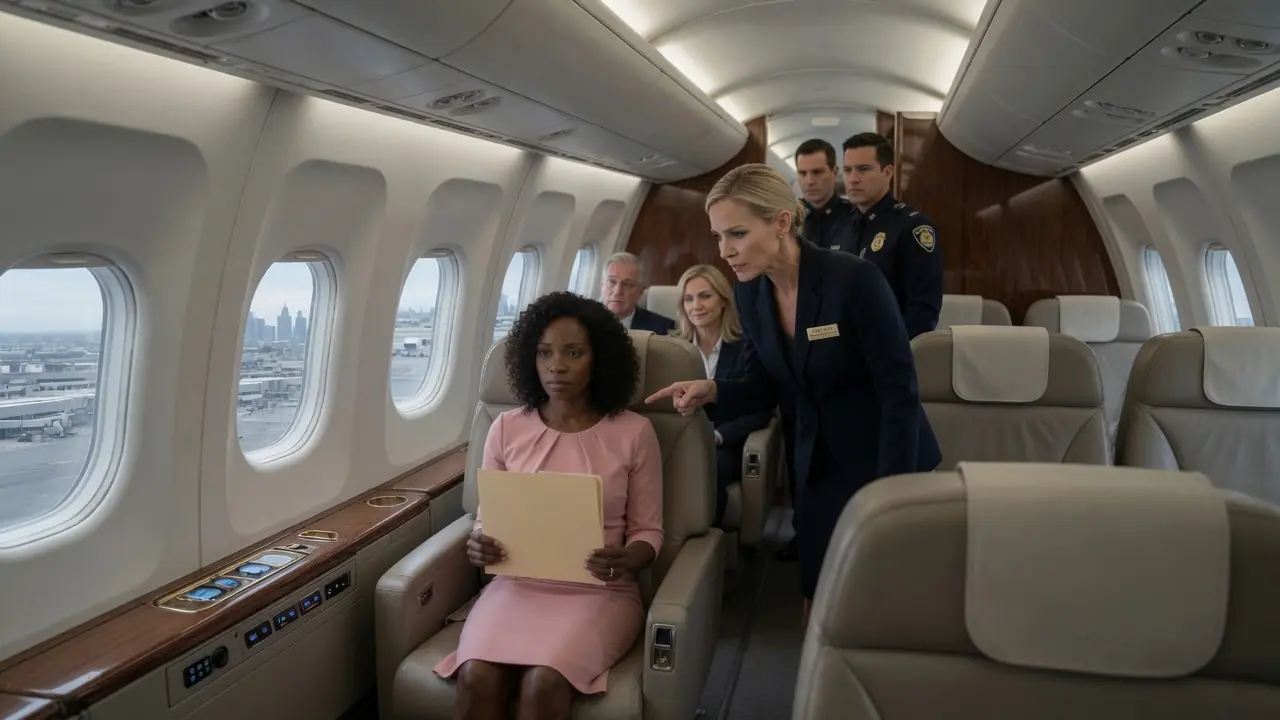
Richard Hawthorne sat four rows behind her, though everyone knew the aircraft belonged to Thornfield Industries, and everyone knew he was used to sitting wherever he pleased. He was the chairman of the board, sixty-two years old, silver-haired, perfectly dressed, and protected by a lifetime of money that had trained him to confuse comfort with intelligence. He had spent fifteen years running Thornfield like a private kingdom, rewarding loyal men, silencing difficult questions, and smiling whenever someone called his cruelty “discipline.” That morning, he was on his way to an emergency shareholder meeting that he believed would secure his control forever.
The meeting mattered because Thornfield Industries was about to finalize the Henderson acquisition, a global logistics deal worth billions. If the vote passed before Asian markets opened, Thornfield would control shipping corridors, data platforms, and warehouse automation contracts across three continents. Richard had told the board that hesitation would destroy the company’s future. He had not told them that the acquisition would also bury years of hidden debt, related-party contracts, and quiet financial decisions he never wanted examined.
Angela knew all of it. She knew because she had spent eleven months acquiring Thornfield shares through trusts, partnerships, pension funds, and private agreements no one in Richard’s circle had bothered to trace. She knew because three former executives had come to her with documents after being pushed out for refusing to lie. She knew because numbers always told the truth eventually, even when men paid lawyers to dress them in softer language. And now, inside Richard’s own jet, she held the proof in a sealed envelope on her lap.
Claire Voss entered from the front galley with a tablet in one hand and irritation already arranged across her face. She was Richard’s personal flight director, a blonde woman in a navy uniform whose posture suggested she believed proximity to power made her powerful too. Her eyes moved down the passenger list, then stopped on Angela. The pause was brief, but the contempt inside it was not.
“Excuse me,” Claire said, stepping into the aisle beside Angela’s seat. “This is a restricted executive flight.”
Angela looked up calmly. “I’m aware.”
Claire’s eyes narrowed. “Then you should also be aware that passengers are cleared by corporate authorization only.”
Angela held the sealed envelope lightly between her fingers. “I was cleared.”
Claire gave a short laugh, loud enough for the nearby seats to hear. Richard looked up from his phone. Harrison Webb, a board member with a red face and pale eyes, leaned slightly into the aisle, already entertained. Two security officers stood near the rear of the cabin, watching but not yet moving.
Claire bent closer. “You don’t belong on this executive flight,” she said coldly. “Mr. Hawthorne doesn’t need a diversity hire delaying a billion-dollar vote.”
The words landed in the cabin with sharp, ugly clarity. A woman near the back lowered her phone, pretending she had not been recording. One of the older board members shifted in his seat and looked toward the window. No one objected. The silence was not neutral; it was permission.
Angela did not flinch. She looked at Claire’s pointed finger, then at her face. “Is that your official reason for calling security?”
Claire smirked. “My official reason is that real executives are waiting, sweetheart. People like you don’t make decisions here.”
Richard smiled faintly from his seat, enjoying the scene the way some men enjoy watching a door close on someone else. “Claire,” he said, not stopping her, only polishing the humiliation, “let’s resolve this quickly. We have a schedule.”
Angela turned her gaze toward him. “Schedules are important.”
Richard’s smile thinned. “They are, yes. Especially when adults are doing business.”
A few board members chuckled. The laughter was small, nervous, and cowardly, but it was laughter all the same. Angela let it pass over her without reaction. She had heard worse in quieter rooms from better-dressed men, and she had learned long ago that anger was most useful after it had been disciplined into strategy.
Claire lifted her tablet. “I don’t see your name under approved executive personnel.”
“You’re reading the wrong authorization list,” Angela said.
Claire’s face hardened. “I am reading the flight manifest.”
“Exactly.”
That answer annoyed Claire because she did not understand it. She glanced toward the security officers and gave them a small nod. They stepped forward, broad-shouldered and expressionless, their black uniforms matching the forced seriousness of men who had been told authority was always standing, never seated. Angela remained still, one hand on the envelope, the other resting on the armrest.
One security officer stopped beside Claire. “Ma’am, we’ll need you to come with us.”
Angela looked at him. “Your name?”
He blinked. “Excuse me?”
“Your name and employee ID number,” Angela said. “Both of you.”
The second guard frowned. “For what?”
“For the record,” Angela replied.
Harrison Webb laughed again. “The record? She thinks this is a courtroom.”
Angela turned her head slightly. “No, Mr. Webb. I think this is evidence.”
The cabin grew quieter. Richard’s eyes sharpened for the first time, not with fear yet, but with irritation that had begun to meet resistance. He stood and buttoned his jacket, using the movement to reclaim attention. “Young lady,” he said, “this jet is carrying senior leadership to a binding vote. Whatever public relations initiative placed you here can be handled later.”
Angela looked at him. “Public relations initiative?”
Richard spread his hands. “Diversity consulting, internal optics, whatever department thought this would look good. I’m not interested.”
Claire folded her arms. “That is exactly the problem. People are getting seats now because of appearance, not competence.”
Angela’s eyes stayed steady. “And what appearance gave you yours?”
Claire’s mouth opened, but Richard spoke first. “Enough.”
That one word had probably ended conversations in boardrooms for decades. It had made assistants swallow tears, junior analysts rewrite honest reports, and executives pretend not to see the damage behind polished decisions. But Angela was not his assistant, his employee, his dependent, or his mistake to correct. She smiled just slightly, and the expression made Richard’s jaw tighten.
“Before you remove me,” Angela said, lifting the sealed envelope, “answer one question.”
Claire sighed theatrically. “Make it quick, sweetheart. Real executives are waiting.”
Angela stood then, slowly, with the calm of someone who had never needed to borrow authority from volume. The soft pink dress moved neatly around her knees. The sealed envelope caught the cabin light. Several people finally noticed the embossed seal on the front: Thornfield Industries Special Counsel.
Angela looked around the cabin. “Who controls fifty-two percent of the company you are standing in?”
No one answered. For two seconds, the question floated in the cabin like a harmless thing. Then Richard’s face changed. Not much, not enough for everyone to see, but Angela saw it because she had built her career on recognizing the first fracture in powerful men.
“What did you say?” Richard asked.
Angela opened the envelope and removed a stack of documents. “At 8:42 this morning, a Schedule 13D filing was submitted and accepted. Through Morgan Strategic Holdings and affiliated investment vehicles, I now control fifty-two percent of Thornfield Industries.”
The flight director’s smirk faded. Harrison Webb sat back hard in his seat. One board member whispered, “That’s impossible,” with the helplessness of a man who had just realized reality did not need his approval. The security officers stopped moving.
Richard forced a laugh. “This is absurd. Thornfield has poison pill protections.”
Angela nodded. “It did.”
His eyes flashed. “Did?”
“Your own compensation committee weakened them nine months ago to protect a private liquidity event for insiders,” Angela said. “You called it flexibility. I called it an opening.”
The CFO, Martin Greer, who had been silent near the front, went pale. He had approved that change after Richard pressured him behind closed doors. At the time, it had seemed like a technical adjustment buried in governance language no shareholder would read closely. Now it sounded like a trap they had built for themselves.
Richard stepped into the aisle. “I don’t know what game you’re playing.”
Angela handed the top document to the nearest board member. “No game. Ownership.”
Claire looked at Richard, waiting for him to laugh again, to dismiss it, to tell her this woman was lying. But Richard had stopped smiling. His eyes moved across the documents, then toward Martin Greer, who could not hold his gaze.
Angela lifted her phone and tapped the screen. “You are currently on a live line with outside counsel, the compliance monitor, and representatives from the acquisition bank. This conversation is being documented.”
Claire recoiled slightly. “You recorded me?”
Angela looked at her. “You chose to speak in front of witnesses.”
The cabin became painfully still. The woman in the back who had been filming lowered her phone into her lap, but Angela saw the screen was still active. She did not mind. Some truths traveled faster when people were embarrassed to have seen them.
Richard recovered enough to speak. “Even assuming this stunt is real, ownership does not give you authority to disrupt an active transaction vote.”
Angela tilted her head. “Have you read Section Twelve, Subsection C of the corporate charter?”
Martin Greer closed his eyes.
Richard looked at him. “Martin?”
Angela answered instead. “In the event of a controlling-interest transfer during a pending major acquisition, the majority owner may call an emergency governance review before any vote affecting more than twenty percent of enterprise value.”
Harrison Webb muttered, “Nobody uses that clause.”
“I know,” Angela said. “That’s why you forgot it existed.”
Richard’s face reddened. “This is hostile.”
“Yes,” Angela said. “It is.”
The word did not sound emotional. It sounded clean, precise, and earned. She had not come to flatter them into decency. She had come because the company’s pensioners, warehouse employees, minority shareholders, and dismissed whistleblowers had paid the price for too many comfortable lies. Thornfield did not need saving from the market; it needed saving from the men who had mistaken access for ownership.
Claire, desperate to regain control, pointed again toward the aisle. “Security, remove her.”
Neither officer moved.
Angela turned to them. “Before you follow that instruction, you should know that Claire Voss does not have authority over this aircraft. Thornfield Aviation Holdings does. As of this morning, I do.”
The first officer lowered his hand from his belt. “Ma’am,” he said carefully to Claire, “we need clarification.”
Claire looked humiliated. “I gave you an order.”
Angela corrected her quietly. “You gave them liability.”
That word did what kindness could not. The guards stepped back. Claire’s face flushed beneath her makeup, and for the first time, the confidence she had worn like a uniform began to look borrowed.
Richard turned on Angela. “What do you want?”
Angela looked at him for a long moment. “Accountability.”
He laughed once, bitterly. “People who say that usually want revenge.”
“Revenge is personal,” Angela said. “This is structural.”
She took another document from the envelope and held it up. “The Henderson acquisition is suspended pending independent review. The emergency shareholder meeting will proceed, but not under your agenda. A new agenda has already been filed with counsel.”
The board members began speaking at once. Harrison Webb demanded a recess. Another director asked whether the markets had been notified. Martin Greer wanted to know who had authorized the filing. Richard shouted over all of them, but the jet cabin made his voice sound trapped and smaller than it would have in a boardroom.
Angela waited. She had learned that men who were losing control often needed to hear themselves do it. When the noise finally dropped, she spoke again.
“All sitting board members are terminated effective immediately, subject to formal ratification at the emergency meeting.”
Harrison Webb shot to his feet. “You can’t terminate the entire board from an airplane.”
Angela looked at him. “No. I can begin the process from an airplane. The ratification packet is already with counsel, major shareholders, regulators, and the bank. Your access credentials are being suspended as we speak.”
Harrison reached for his phone. His screen flashed, then locked. Across the cabin, another board member cursed under his breath. Martin Greer stared at his own device as message after message disappeared behind revoked permissions. Richard did not check his phone. He did not need to. He could feel the walls moving.
Claire backed toward the galley. “I was just following Mr. Hawthorne’s instructions.”
Angela turned to her. “No, Ms. Voss. You were following your own contempt.”
Claire’s eyes glistened with anger. “I didn’t know who you were.”
“That was never the problem,” Angela said. “The problem is who you thought I had to be before you treated me with respect.”
No one laughed now. The sentence settled heavily over the cabin, touching more people than Claire. The board members who had smiled, looked away, or stayed silent suddenly found great interest in their shoes, their phones, the window, anything except Angela’s face.
Richard stepped closer, lowering his voice. “Angela, let’s be practical.”
She almost smiled at the first use of her name. “Dr. Morgan.”
His jaw tightened. “Dr. Morgan. Thornfield is too complex for public theater. You’ve made your point. We can negotiate.”
“You had eleven months to notice someone was buying your company,” Angela said. “You had fifteen years to govern it properly. And you had five minutes to stop your staff from humiliating me because of how I looked.”
Richard’s nostrils flared. “Don’t pretend this is about manners.”
“It is never only about manners,” Angela said. “Manners are where people reveal what they believe power protects.”
The pilot’s voice came over the speaker, cautious and uncertain. “Ladies and gentlemen, we are still awaiting final clearance. Please remain seated.”
Angela picked up the cabin phone. “Captain, this is Dr. Angela Morgan. Departure is delayed. No one leaves the aircraft until counsel confirms revised passenger authorization.”
There was a pause. “Understood, Dr. Morgan.”
Richard stared at her. That was the moment the full reality entered his eyes. The pilot had obeyed her. The guards had obeyed her. Counsel was on her line. The documents were real. Thornfield, the company his grandfather had helped build and he had treated like inheritance rather than responsibility, no longer moved when he snapped his fingers.
Angela returned to her seat and sat down. “Now,” she said, “we are going to review what the original agenda tried to hide.”
Martin Greer swallowed. “Angela—Dr. Morgan—I can explain the Henderson debt structure.”
“I know you can,” she said. “That is why you will do it on record.”
His face went gray.
For the next forty minutes, the corporate jet became the boardroom Richard had never wanted. Outside counsel confirmed Angela’s controlling interest. The acquisition bank acknowledged the emergency review. A compliance monitor asked Martin direct questions about debt exposure, undisclosed guarantees, and executive side agreements. Each answer pulled another thread from the expensive fabric Richard had wrapped around Thornfield.
Claire remained near the galley, silent and shaken. Angela did not look at her often, but when she did, Claire looked away. The security officers stood in the rear, no longer threatening, now witnesses to a reversal none of them had expected. The other passengers watched as Richard Hawthorne, who had begun the morning laughing at a woman’s clothes, ended it arguing over clauses he should have read.
By late morning, the jet stairs were lowered again. This time, Angela exited first. Cameras were waiting beyond the private terminal fence, though no one seemed to know who had alerted them. She walked down the steps calmly, legal envelope under one arm, phone in her hand, her pink dress moving lightly in the cold wind. Behind her, Richard emerged looking ten years older.
A reporter called out, “Dr. Morgan, are you taking control of Thornfield Industries?”
Angela stopped just long enough to answer. “I already have.”
Another shouted, “Is the board being removed?”
Angela looked back at the aircraft, where the men who had mocked her now stood in stunned silence. “The company deserves leadership that understands ownership is responsibility, not entitlement.”
She did not mention Claire. She did not repeat the insult. She did not need to. By noon, the story had already moved through financial media with video clips, leaked audio, and headlines sharper than anything Angela would have written herself. But the part people replayed most was not the ownership reveal. It was the moment Claire said people like you don’t make decisions here, followed by Angela asking who controlled fifty-two percent of the company.
That afternoon, the emergency shareholder meeting took place in Manhattan under a new agenda. Angela chaired it. She suspended the Henderson acquisition, appointed an interim independent board, ordered a forensic review of executive transactions, and created a whistleblower protection channel monitored outside Thornfield’s internal hierarchy. Martin Greer resigned before the meeting ended. Harrison Webb threatened litigation until counsel reminded him he had signed off on the governance changes that made Angela’s action possible.
Richard Hawthorne tried one final speech. He spoke of legacy, continuity, market confidence, and his family’s long relationship with Thornfield. He did not speak of warehouse injuries hidden under productivity metrics. He did not speak of the pension fund exposure buried in footnotes. He did not speak of the employees who had been told there was no money for raises while executive travel expenses tripled.
Angela let him finish. Then she said, “Legacy is not a shield for misconduct.”
The vote passed.
By evening, Richard Hawthorne was no longer chairman. His office access was suspended, his corporate cards were frozen, and his portrait was removed from the executive lobby pending review. Claire Voss was placed on administrative leave after multiple employees came forward describing years of discriminatory treatment toward staff, assistants, contractors, and junior executives who did not fit her picture of power. The company Richard believed he owned had begun answering to someone else.
Angela did not celebrate that night. She returned to a quiet hotel room, removed her bracelet, and called her mother. She listened while the older woman cried softly, not because Angela had become wealthy or powerful, but because she remembered every room where her daughter had been underestimated and had still walked in prepared. Angela told her mother she was tired. Her mother told her that tired women had changed history before.
The next morning, Angela entered Thornfield Tower through the front doors, not the private garage. Employees filled the lobby balconies, the reception area, and the edges of the marble hall. Some had phones out. Some stood with arms crossed, cautious after years of speeches that promised change and delivered slogans. Angela walked to the center of the lobby and faced them without a podium.
“My name is Dr. Angela Morgan,” she said. “As of yesterday, I am the majority owner of Thornfield Industries.”
The lobby went completely silent.
“I did not buy this company to decorate a title,” she continued. “I bought it because too many people inside it were punished for telling the truth, and too many people at the top were rewarded for ignoring it.”
A maintenance worker near the elevator lowered his eyes. A young analyst wiped her cheek quickly. Angela noticed both but did not point them out.
“There will be audits,” Angela said. “There will be uncomfortable conversations. There will be consequences. But there will also be a future here for people who build, repair, calculate, ship, design, clean, secure, and sustain this company every day without ever being invited onto a private jet.”
That line moved through the lobby like breath returning to a room. Not applause yet. Something deeper. Recognition.
Angela paused. “Respect will no longer depend on clothing, connections, accents, gender, race, age, or who someone assumes you are before checking the facts.”
Then the applause began. It started somewhere near the back, perhaps from a receptionist, perhaps from a warehouse supervisor visiting headquarters, perhaps from someone who had been silent too long. Soon it filled the lobby, rising against the marble and glass until even the security staff at the front desk joined in. Angela stood quietly and let them have the moment.
Weeks later, people would still argue about the takeover. Analysts debated whether Angela had moved too aggressively. Former board members gave anonymous interviews calling her ruthless. Business magazines wrote profiles about her strategy, her Harvard years, her Wharton fellowship, her doctorate, and the quiet brilliance of acquiring control through overlooked governance weaknesses. But inside Thornfield, employees remembered something simpler.
They remembered a woman in a pink dress sitting calmly while powerful people mistook their prejudice for judgment. They remembered the way she asked one question and changed the temperature of the room. They remembered that the people who looked most certain had been the least prepared. And they remembered that Dr. Angela Morgan did not need to look like their idea of power to possess it.
Months later, Angela visited a Thornfield warehouse in Newark where workers had once been forced into unpaid overtime through a scheduling loophole. She walked the floor in dark jeans, flats, and a black turtleneck, listening more than speaking. A forklift operator named Denise approached her during a break and said, “My daughter saw that video of you on the plane.”
Angela smiled. “I hope she learned something useful.”
Denise nodded. “She said, ‘Mom, she didn’t even yell.’”
Angela laughed softly. “No. I didn’t.”
Denise looked toward the busy warehouse floor. “She asked me why.”
Angela answered carefully. “Because when you know exactly who you are, you don’t have to waste your voice convincing people who never bothered to ask.”
Denise smiled, and for a moment Angela thought of Claire Voss pointing in her face, Richard Hawthorne smiling from behind her, and the silence of men who had believed cruelty was safer when shared. She thought of the sealed envelope, the live legal call, the old charter clause waiting like a loaded truth. Then she looked around the warehouse at people doing real work under bright industrial lights.
Power, she had learned, was not the loudest voice in the room. It was not the chairman’s seat, the private aircraft, the polished suit, or the person who decided who belonged. Real power was preparation meeting opportunity after arrogance had stopped paying attention. Real power was asking the one question no one had prepared to answer.
That was why Angela never regretted wearing the pink dress.
They had seen the dress before they saw the documents. They had seen her skin before they saw her credentials. They had seen what they wanted to dismiss before they saw what they had already lost. And by the time they finally looked closely, Dr. Angela Morgan had already taken the company out from under their feet.