Commander Marcus Hale tore the golden Trident from Lieutenant Evelyn Reynolds’s uniform in front of her entire unit. The metal pin struck the concrete training yard at Naval Base Coronado with a sharp sound that seemed to carry farther than his voice. Twenty operators stood beneath the hard California sun, their expressions rigid, while Hale kept one fist twisted in the front of Evelyn’s black dress jacket. He wanted every person present to see the exact moment he stripped her of the symbol she had sacrificed years to earn.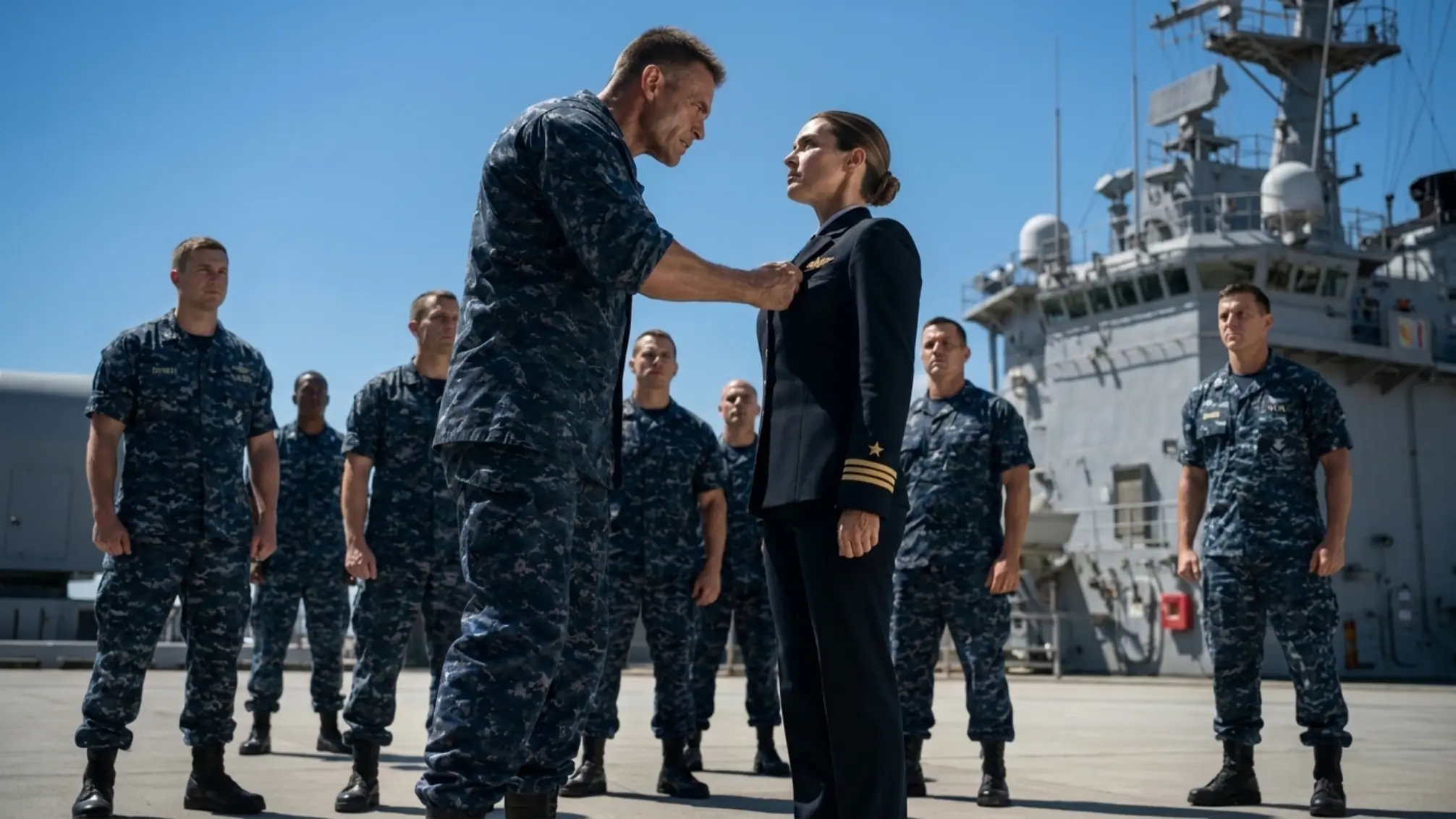
“Your reckless command wounded three men,” Hale declared. “Your career ends here.”
Evelyn’s hazel eyes remained fixed on his face. Her dark-brown hair was secured in a precise military bun, and her posture stayed rigid despite the torn fabric near her collar. She could hear boots shifting behind Hale, yet no one stepped forward. Every operator in the yard understood that challenging a commander during a public disciplinary action could destroy a career almost as quickly as the accusation itself.
“That report carries your fingerprints,” Evelyn said coldly.
Hale’s grip tightened. “You have no rank, witnesses, or protection left.”
Evelyn looked down at the Trident lying between their boots. Slowly, she bent, picked it up, and wiped a faint line of dust from its edge. Then she placed it carefully into her pocket.
“Wrong,” she said. “The evidence leaves this base before sunrise.”
For the first time, Hale’s expression changed.
Only slightly.
But Evelyn saw it.
Three weeks earlier, a mission in Afghanistan’s Kunar Province had nearly ended in catastrophe. Evelyn had been assigned to coordinate a joint reconnaissance team tasked with confirming the location of a weapons courier operating through the mountain villages near the border. The mission was supposed to be controlled, short, and based on intelligence verified through three separate channels.
Instead, the unit entered a narrow valley and found armed men waiting on elevated ground.
The first shots came less than thirty seconds after the team crossed the eastern ridge. Communications failed almost immediately, one of the vehicles became trapped behind a collapsed section of road, and three operators were injured before Evelyn redirected the team through a dry streambed that had not appeared on the official route plan. Her decision saved the remaining men, but it also made the failure impossible to hide.
Someone had known their exact route.
Not an approximation.
Not a probable approach.
The enemy knew the time of insertion, the direction of movement, the location of the rear vehicle, and the frequency window during which the team would temporarily lose aerial support. That level of preparation required access to the final operational package.
Only six people possessed it.
Commander Hale was one of them.
The official review began before the wounded men had left surgery. Hale personally submitted the first preliminary report, accusing Evelyn of abandoning the authorized route and ignoring updated intelligence warning of hostile movement near the valley.
Evelyn read the document twice.
The warning did not exist in the intelligence package she received before departure. Yet when investigators opened the mission archive, the altered warning appeared with her electronic acknowledgment attached.
It looked as though she had seen the danger and entered the valley anyway.
Hale’s story was clean, detailed, and supported by the official system.
It was also impossible.
Evelyn remembered every page she had reviewed before the mission. She had signed the package at 0420 hours, and the original route assessment listed no concentrated hostile activity within fifteen kilometers of the entry point. The language now displayed in the archive was different—not merely updated, but rewritten to create negligence.
She raised the discrepancy during the first closed review.
Hale sat at the far end of the conference table, his hands folded calmly before him.
“Are you claiming the intelligence system fabricated your acknowledgment?” he asked.
“I’m saying that document is not the one I signed.”
“The electronic signature belongs to you.”
“The timestamp does. The content does not.”
Hale leaned back. “That is a serious allegation.”
“So is blaming me for an ambush someone arranged.”
Several officers looked down.
Hale allowed the silence to stretch before speaking again. “Lieutenant, grief and guilt can distort memory. Three men were wounded under your command. It is natural to search for another explanation.”
“I don’t need another explanation. I need the original file.”
“You are looking at it.”
“No,” Evelyn replied. “I’m looking at what someone replaced it with.”
The review ended ten minutes later.
Her system access was restricted by evening.
The next morning, she was removed from active operational duties.
Hale expected her to protest publicly. Instead, Evelyn became quiet. She reported to every administrative assignment she was given, signed every temporary restriction, and allowed the command to believe she was preparing a legal defense against professional negligence.
In reality, she was reconstructing the final seventy-two hours before the mission.
Evelyn began with her own handwritten notes. She kept a small waterproof notebook during planning sessions because digital systems could fail, and because her first instructor had taught her that memory became unreliable whenever fear entered a room. The notebook included the original route coordinates, intelligence confidence levels, communication windows, and the names of every person who attended the final briefing.
The entries did not match Hale’s report.
That alone proved little. A defense attorney could argue that Evelyn altered her notes after the ambush. She needed evidence independent of her own testimony.
Her first break came from Petty Officer Daniel Mercer, one of the three wounded men. He was recovering at a military hospital with a fractured shoulder and shrapnel injuries along his left side. Evelyn visited him under the pretense of checking on his condition.
Daniel waited until the nurse closed the door before speaking.
“Someone changed the route file.”
Evelyn sat beside the bed. “What did you see?”
“Nothing before the mission. I heard something during it.”
“What?”
“When our primary communications died, the hostile radio traffic came through the emergency receiver for a few seconds. They used our internal route designation.”
Evelyn’s stomach tightened. “Which designation?”
“Silver Four.”
The phrase had never appeared outside the final command package. Even most of the operators knew only the coordinates, not the internal planning name.
“Did you tell the investigators?”
“I told Hale.”
“What did he say?”
Daniel’s jaw hardened. “He said the medication had confused me.”
“Would you testify?”
He looked toward the hospital window. “My retirement package is pending.”
“I understand.”
“No, you don’t.” His voice became sharper. “My wife already packed our house. My daughter starts college in August. If Hale labels me mentally compromised, he can delay everything.”
Evelyn wanted to tell him that truth mattered more than personal security. The words never came. She had spent enough years watching good people make impossible choices to know courage was easy to demand when someone else paid its price.
“I won’t use your name without permission,” she said.
Daniel closed his eyes. “I’m sorry.”
“Don’t be.”
As she stood to leave, he opened his eyes again.
“The emergency receiver records short bursts automatically,” he whispered. “Maintenance keeps the raw backups for ninety days.”
Evelyn found the archive two days later.
She no longer possessed authorization to access the operational network, but the emergency communication backups were stored on a separate maintenance system used to troubleshoot damaged equipment. That archive had not been included in Hale’s review because technically it belonged to aviation support, not mission intelligence.
Evelyn requested the files through Chief Warrant Officer Lucas Grant, an old communications specialist who had served with her during a rescue operation six years earlier.
Lucas studied the request. “You’re suspended from operational access.”
“This is maintenance data.”
“You know that’s not what I mean.”
“I need the raw receiver logs from Kunar.”
“Why?”
“Because someone knew our route designation.”
Lucas stared at her for several seconds. “If I help you and this fails, I lose everything.”
“If you don’t help me, Hale buries the truth and keeps command.”
“That isn’t evidence.”
“It’s a reason to find some.”
Lucas looked toward the closed office door. Then he inserted his credentials.
The relevant recording lasted eleven seconds.
Static filled most of it. Beneath the interference, two men spoke rapidly in Pashto. Evelyn understood only fragments, but the phrase Silver Four was unmistakable.
Lucas replayed it.
“Someone briefed them,” he said.
“Yes.”
He exported the raw file to an encrypted drive, generated a system verification report, and sealed both inside an evidence envelope.
“You did not receive this from me,” he said.
“I won’t forget who gave it.”
“That is exactly what I’m asking you to do.”
The second break came from the transmission log.
Every classified mission package generated a record whenever it was opened, copied, edited, or moved between secure systems. The official archive showed no suspicious activity. Hale’s report claimed Evelyn was the final person to access the route file before deployment.
Yet the emergency recording proved someone else had transmitted the information.
Evelyn searched the less-secure administrative systems surrounding the classified network. She could not see the protected file itself, but she could examine power usage, terminal activity, and security-door records around the command center.
At 0213 hours on the night before the mission, the operations wing recorded an unexplained eleven-minute increase in server load.
At 0211, Hale’s personal badge opened the secure planning room.
At 0225, it opened the eastern exit.
The official personnel log placed him at home.
Evelyn copied both records.
Still, badge access did not prove he transmitted the route. Hale could claim he returned for unrelated work. She needed the communication itself.
For seven nights, she compared satellite-system activity with base network reports. A hidden burst transmission had left the command center at 0218, routed through an old diplomatic relay, and reached a civilian account registered in Cyprus.
The account belonged to a security consultancy called Meridian Strategic Analysis.
Meridian had no visible connection to Hale.
Then Evelyn found a payment.
Six months earlier, a company owned by Hale’s brother received $240,000 from Meridian for “logistics advisory services.” The company had no employees, no office, and no previous clients.
The pattern became clear.
Hale was not selling intelligence randomly. He was manipulating operations to create crises, damage competing commanders, and increase the value of private security contracts offered by people connected to him. The Kunar ambush had been designed to discredit Evelyn before a promotion board where both of them supported different candidates for a regional command position.
Three injured men were collateral damage.
Evelyn copied everything.
She made three encrypted archives and sent each through a different path. One went to an attorney outside the military system. Another went to a retired admiral who had mentored her early in her career. The third was scheduled for delivery to Special Counsel Rebecca Sloan, a federal prosecutor overseeing defense corruption cases.
If Evelyn failed to cancel the transfer before 0430 the following morning, the evidence would release automatically.
Hale discovered part of her investigation before she finished.
Security officers searched her office and found no classified material, but the search itself told her he was afraid. He accelerated the disciplinary hearing, converted it into a public removal ceremony, and ordered the entire unit to attend.
He believed humiliation would isolate her.
He believed fear would silence anyone who might support her.
On the training yard, after tearing away the Trident, Hale dismissed the formation and ordered Evelyn escorted from the operational wing. Two security officers followed her toward administration, though neither touched her.
Before leaving the yard, Evelyn looked once over her shoulder.
Lucas Grant stood in the second row.
He met her eyes.
That small act mattered more than Hale understood.
Inside the administrative building, Evelyn surrendered her access card, government phone, and office keys. Hale entered carrying a prepared resignation agreement.
“Sign this,” he said, “and the command will characterize the matter as an early retirement rather than misconduct.”
Evelyn read the first page. The agreement required her to waive further appeals, surrender all claims involving the Kunar review, and remain silent about classified operational failures.
“You wrote this quickly.”
“I prepared for every outcome.”
“You prepared before the review began.”
Hale rested both hands on the table. “You made a bad decision. Men were injured. I am giving you a way to preserve part of your future.”
“You leaked the route.”
His expression remained calm. “Be careful.”
“You entered the planning room at 0211.”
“I command the facility.”
“A burst transmission left at 0218.”
“Networks create anomalies.”
“Your brother received $240,000 from the company that owned the receiving account.”
Hale’s calm finally cracked.
Only for a second.
Then he smiled.
“You have fragments,” he said. “No lawful access, no authenticated chain of custody, and no witness willing to support you.”
“I have more than you think.”
“If that were true, investigators would already be here.”
Evelyn glanced toward the wall clock.
2147 hours.
“They will be.”
Hale walked around the table until he stood directly behind her chair. “The people in this unit understand how power works. They watched me remove your Trident and did nothing. Do you know why?”
“Because you threatened their careers.”
“Because they know you are finished.”
“No,” Evelyn said. “They know you’re afraid.”
Hale struck the table with one palm. “Sign the agreement.”
She pushed it back toward him.
“At 0430, three copies of the evidence leave systems you cannot reach.”
His face became still.
“Cancel them.”
“I can’t.”
“You just said they were scheduled.”
“I said they leave at 0430. I didn’t say I still control them.”
That was not entirely true. Evelyn possessed one cancellation code memorized rather than written. But Hale did not need to know that.
He left the room without another word.
At 2210, the base entered restricted movement status. Security teams collected personal devices from several communications officers. Hale ordered the network isolated under the excuse of a possible foreign intrusion.
He searched for the evidence for four hours.
He found nothing.
At 0215, Lucas Grant was detained for questioning. Hale demanded to know whether he had provided Evelyn with the emergency receiver archive.
Lucas requested legal counsel.
At 0300, Hale ordered a vehicle prepared to move Evelyn to a temporary holding facility inland. He claimed her continued presence posed a security risk.
The transport never left the base.
At 0352, three black vehicles stopped outside the main command building. Special Counsel Rebecca Sloan stepped from the first, accompanied by investigators from the Naval Criminal Investigative Service and the Department of Defense Inspector General.
The retired admiral had opened Evelyn’s archive early.
He recognized the significance immediately and contacted Sloan rather than waiting for the automatic release.
Hale met them in the lobby.
“This base is under a communications-security emergency,” he announced. “Lieutenant Reynolds is being investigated for unauthorized possession of classified materials.”
Rebecca held up a federal preservation order. “Commander, nobody leaves, deletes a file, or touches a terminal.”
“You do not understand the operational sensitivity.”
“I understand that your badge entered the planning room six minutes before a hidden transmission disclosed a classified route.”
Hale’s face tightened. “That allegation comes from a disgraced officer.”
“It comes from an independent security record.”
He looked toward the investigators spreading through the hallway. “You need command authorization.”
Rebecca stepped closer. “We have it.”
At 0406, agents entered Hale’s office.
At 0412, they located a concealed communication device beneath a removable panel inside his desk. Its serial number matched the transmitter used for the Cyprus relay.
At 0418, they recovered encrypted messages between Hale and Meridian Strategic Analysis. One included the phrase Silver Four confirmed and a payment schedule linked to the Kunar operation.
At 0423, Rebecca entered the room where Evelyn had been held.
Evelyn stood when the door opened.
Rebecca looked at the torn section of her uniform. “Where is the Trident?”
Evelyn removed it from her pocket.
“Keep it,” Rebecca said. “You’ll need it when you walk back outside.”
At 0427, security officers escorted Hale to the training yard.
The same operators who had watched him strip Evelyn of her insignia were ordered back into formation. Dawn had not yet reached the horizon, and floodlights cast long lines across the concrete.
Hale stood without his command cover or identification badge. His hands were not cuffed, but two federal investigators remained beside him.
Evelyn approached from the opposite side of the yard.
Her uniform collar was still torn.
Rebecca walked beside her.
Hale stared at the Trident in Evelyn’s hand. “This changes nothing. The mission failed under your command.”
“The mission was betrayed before I entered the valley.”
“You altered evidence to save yourself.”
Lucas stepped from the formation.
“No, sir,” he said. “The emergency recording is authentic.”
Daniel Mercer appeared on a secure video monitor positioned near the reviewing stand. His injured shoulder was strapped against his chest.
“I heard the enemy use Silver Four,” he said. “I reported it to Commander Hale, and he ordered me to stay silent.”
One by one, other officers produced concerns they had buried out of fear. A logistics supervisor confirmed unusual payments. A cyber specialist identified deleted routing data. Hale’s executive assistant admitted he instructed her to falsify his location on the night of the transmission.
Hale looked toward the unit.
This time, they met his eyes.
Not one stood with him.
Rebecca read the arrest warrant aloud. The charges included conspiracy, unlawful transmission of classified defense information, obstruction, falsification of official records, fraud, and conduct leading to grave operational harm.
An investigator placed Hale in handcuffs.
He looked at Evelyn. “You destroyed this unit.”
“No,” she replied. “I removed the man selling it.”
The sun began rising beyond the buildings as they led him away.
Evelyn remained in the center of the yard holding the damaged insignia. Rear Admiral Thomas Mercer, the senior officer who had arrived with the federal team, stepped forward.
“Lieutenant Reynolds, your suspension is rescinded pending final administrative review. The preliminary findings clear you of responsibility for the intelligence compromise.”
He looked at the Trident in her hand.
“Would you like me to restore it?”
Evelyn considered the offer.
Then she shook her head.
She turned toward Daniel’s closest teammate, a young operator named Mason Cole who had been too frightened to meet her eyes during Hale’s ceremony.
“Do it,” she said.
Mason stepped from formation. His hands trembled slightly as he pinned the Trident back onto her torn uniform.
“I’m sorry,” he whispered.
“You were afraid.”
“That isn’t an excuse.”
“No,” Evelyn said. “But it can become a lesson.”
The investigation lasted six months.
Hale’s network extended beyond one compromised mission. He had manipulated intelligence assessments, redirected private contracts, and damaged the careers of officers who threatened his influence. Meridian Strategic Analysis had paid more than two million dollars through shell companies connected to his family.
The three operators wounded in Kunar recovered, though Daniel never regained full movement in his shoulder. He testified despite the risk to his retirement, and the Navy protected his benefits after investigators confirmed the pressure Hale placed on him.
Lucas received official recognition for preserving the emergency recording.
Evelyn refused an immediate promotion.
Instead, she accepted command of a new operational-integrity unit responsible for independently reviewing mission intelligence, access records, and whistleblower complaints. She required every report to exist in multiple protected archives so no commander could rewrite history through one system.
Months later, she returned alone to the Coronado training yard.
The concrete looked ordinary without a formation standing across it. She found the faint scratch where the Trident had struck the ground and remained there for several minutes.
The insignia on her uniform was no longer perfectly smooth. One point had bent slightly during the fall, and a narrow mark crossed its golden surface.
She had been offered a replacement.
She declined.
The damage reminded her that symbols did not create honor. They only represented choices made when surrender would have been easier.
Commander Marcus Hale believed he had ended Evelyn Reynolds’s career when he tore the Trident from her uniform before the entire unit.
He believed authority belonged to the person who could make everyone else remain silent.
But before sunrise, his command was gone, his secrets were exposed, and the officers who once feared him finally understood the truth.
Evelyn had never been powerless.
She had only been waiting for the evidence to arrive.