“Hands on the car. Now.”
Gloria Holloway turned slowly.
“Officer, this is my car. My keys are right here.”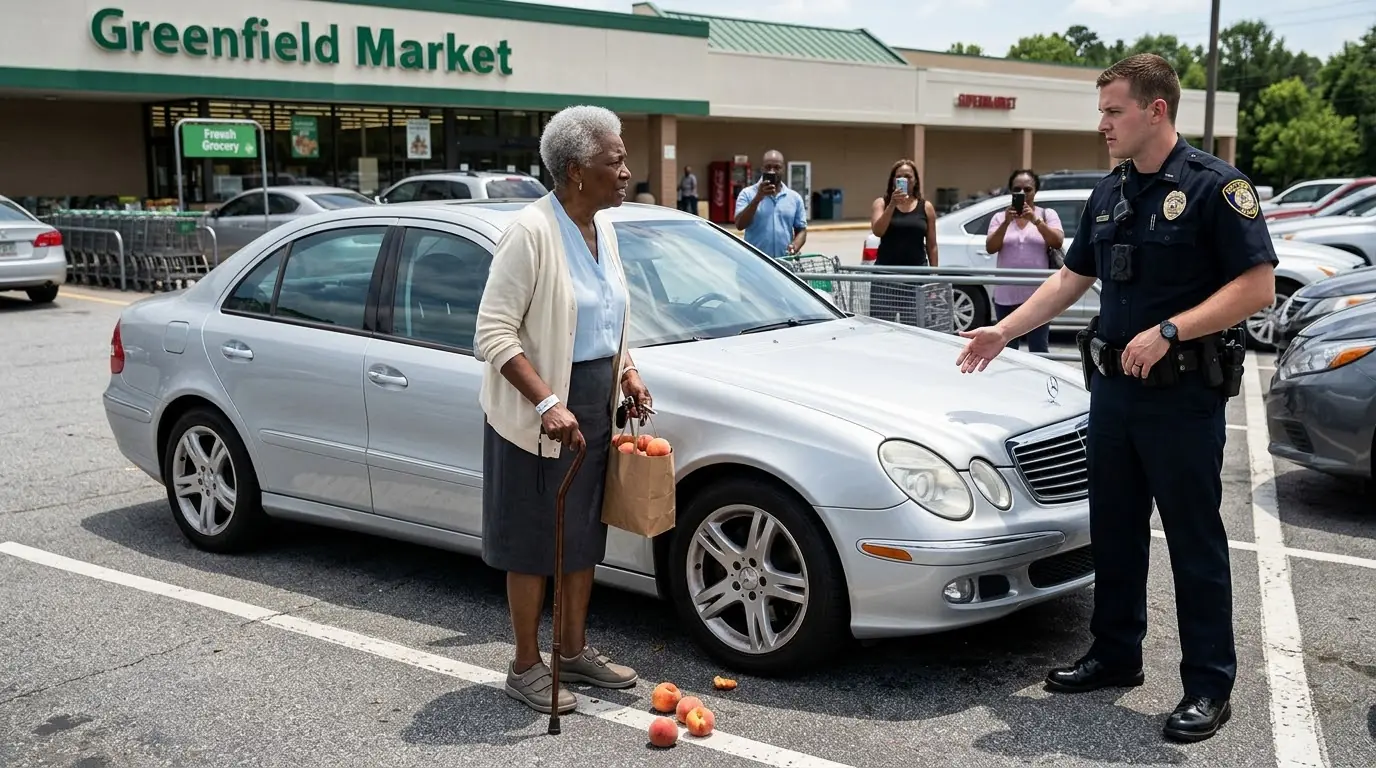
“People like you do not drive cars like this.”
“Please. I left the hospital this morning.”
“I said hands on the hood. Now.”
Phones rose all around them. A dozen glowing screens began recording, but nobody stepped forward.
Somewhere in the crowd, someone laughed.
Inside Gloria’s purse was a registration card bearing her name. She felt the car key biting into her closed fist.
One call.
That was all she would ask for.
Nobody watching knew the man who was about to step from the next vehicle. Nobody knew he would run toward the handcuffed woman and call her Mom.
Have you ever been judged guilty before you were allowed to say a word?
Three hours earlier, the morning had been gentle.
Gloria Holloway signed her discharge papers at Fairmont County Hospital. A nurse pushed her wheelchair to the entrance while the surgeon repeated the same instructions twice.
“Rest. Walk slowly. Do not place unnecessary stress on your heart.”
Gloria drove herself to Greenfield Market for one small thing.
Fresh peaches.
They had been her late husband’s favorite, and the following day would have been their anniversary.
Parking the silver Mercedes took her two careful minutes. She left it gleaming beneath the midday sun and walked into the store, leaning on her cane the entire way.
Across the parking lot, a woman watched from inside an SUV.
Karen Whitfield lived four houses away from Gloria and had never once said hello.
She had complained about Gloria’s garden. She had complained about Gloria’s visitors.
Now she watched an elderly Black American woman step away from a luxury vehicle, and something ugly stirred inside her.
Karen lifted her phone and called emergency services.
“Yes, I would like to report a vehicle theft in progress.”
Her voice was calm and rehearsed.
“There is a Black woman breaking into a Mercedes at Greenfield Market. She does not belong with a car like that.”
Karen paused before adding the lie that changed everything.
“She might be armed. Please hurry.”
Every word was false.
Gloria’s key was inside her purse. The title and registration were in her name.
The dispatcher heard the word armed, and the call immediately changed shape.
Two miles away, Officer Travis Boyd received the radio alert.
He was twenty-nine years old, had served on the force for three years, and was desperate to prove that he mattered.
A possible armed vehicle theft was the most important call he had received all week.
He activated his lights and accelerated without slowing down to question the information.
Inside his mind, the suspect was already guilty.
He had a description: Black, female, older.
He had a suspected crime: grand theft auto.
Soon, he would also have a stage and an audience.
What he did not have was the truth.
He did not know the woman’s full name. He did not know about the fresh surgical stitches over her heart.
He also did not know that Gloria Holloway, if pushed far enough, would make one telephone call.
It would be a call to someone powerful enough to end Boyd’s career in a single afternoon.
The patrol car entered the parking lot at high speed, its tires scraping sharply across the asphalt.
Boyd stopped at an angle and threw open the door before the engine had completely settled.
He stepped out with one hand already resting near his holster. His jaw was set like a man entering a dangerous confrontation rather than approaching an elderly shopper.
Gloria had just returned to her car.
She carried two grocery bags with a small paper sack of peaches resting on top.
She heard the siren and turned in confusion, squinting against the sunlight.
“Step away from the vehicle,” Boyd ordered. “Keep your hands where I can see them.”
Gloria blinked.
“Officer, is something wrong?”
“I said step away from the vehicle now.”
“This is my car. I was only loading my groceries.”
“Ma’am, I will not tell you again.”
Gloria slowly placed the grocery bags on the ground.
Her hands trembled, not because she was guilty, but because of the exhausting morning and the new stitches beneath her blouse.
She raised both palms.
“All right,” she said softly. “I am not doing anything.”
Boyd circled her with narrowed eyes.
He looked at the polished silver Mercedes, then at Gloria, and then back at the vehicle.
In his mind, an elderly Black American woman wearing a faded cardigan and orthopedic shoes did not belong beside a luxury car.
That gap between his assumptions and reality became all the evidence he believed he needed.
“Whose vehicle is this?”
“Mine. I have owned it for three years.”
“Right.”
Boyd nearly laughed.
“And I am the mayor.”
Several shoppers slowed near the market entrance.
One person raised a phone.
Then another.
Within moments, the parking lot began filling with silent witnesses.
They formed a loose semicircle, the way people gathered around an accident.
They stood close enough to watch but far enough away to avoid becoming involved.
“Officer,” Gloria tried again, keeping her voice patient, “my registration is inside my purse.”
“My key is there as well. If you allow me to show you—”
“Do not reach for anything.”
“I only want to show you.”
“I said do not reach.”
Gloria froze.
The peaches remained inside their paper sack, bright and strangely ordinary in the middle of everything happening around them.
Boyd pressed the button on his shoulder radio without taking his eyes from her.
“Dispatch, I have the suspect at the scene. Older female matching the description.”
He looked toward the Mercedes.
“Vehicle is present. Suspect is possibly armed. Standing by.”
“Suspect,” Gloria repeated.
The word sounded unfamiliar in her ears.
“Armed?”
She looked at him.
“Son, I am sixty-eight years old. I came from the hospital this morning.”
“The only things in my bag are peaches and my heart medication.”
“I am not your son.”
The words came sharply.
Boyd stepped closer and kicked Gloria’s cane away.
It clattered across the pavement and rolled beneath the vehicle parked beside hers, well beyond her reach.
Gloria swayed.
Without the cane, her balance was fragile.
She caught herself against the warm hood of the Mercedes and breathed through a sudden pain spreading across her chest and into her arm.
“Please,” she whispered. “I had heart surgery six days ago.”
“I cannot remain standing for long.”
“Hands on the hood. Spread your feet.”
“Officer, I am telling you the truth.”
“Everyone says that.”
A young man standing near the shopping carts took one step forward.
He wore a delivery uniform and had worried, compassionate eyes.
“Officer, she is an elderly woman,” he said. “Check her identification.”
“It will take ten seconds.”
Boyd slowly turned his head.
“Stay back, or you will be detained too.”
He pointed toward the young man.
“Mind your own business.”
The delivery driver stopped.
He did not leave, but he did not move closer either.
Instead, he raised his phone higher.
A small red light indicated that he had begun streaming the encounter live.
The number of viewers climbed from forty to more than one hundred.
Gloria placed both hands flat against the hood.
The heated metal pressed against her palms.
She lowered her head as a loose strand of gray hair fell across her face.
“My name is on the title,” she said quietly, speaking to the car, herself, and anyone willing to listen.
“Gloria Holloway.”
“Run the plate. It will tell you everything.”
Boyd did not run the plate.
He removed the handcuffs from his belt.
Their mechanical clicking cut through the parking lot, a sound recognizable from countless recordings.
The crowd leaned closer.
The phones became steadier.
“You are being detained on suspicion of vehicle theft,” Boyd announced. “Place your hands behind your back.”
“I have stitches.”
Gloria’s voice trembled.
“Please do not force my arms behind me.”
Boyd took her wrist anyway.
He pulled it down and backward, forcing her to bend forward over the hood.
Gloria gasped as pain moved through her chest and shoulder.
“Please,” she said. “You are hurting me.”
“Stop resisting.”
“I am not resisting. I cannot move that quickly.”
“Stop resisting.”
Boyd said it loudly enough for the cameras and crowd to hear.
It was a phrase capable of rewriting an entire scene.
Anyone watching the recording later would hear an officer command someone to stop resisting.
For one second, some of them might wonder whether she had.
She had not.
The first cuff closed around her wrist.
Boyd pulled her other arm backward until both hands met behind her.
The second cuff locked too tightly, cutting into the fragile skin around her wrist.
Gloria stopped making sounds.
She simply closed her eyes.
A second patrol vehicle entered the parking lot.
Officer Lisa Bennett stepped out.
She was younger and quieter than Boyd and had served on the force for only eight months.
She studied the scene with visible unease.
An elderly woman was bent over a car hood. Her cane lay abandoned beneath another vehicle, and the handcuffs had already injured one wrist.
Bennett opened her mouth.
Then she looked toward Boyd’s expression and remained silent.
She moved near the crowd, placed both hands on her belt, and became one more person watching.
During the struggle, Gloria’s purse slipped from her shoulder.
It struck the pavement and opened.
A tube of lipstick rolled away.
A bottle from the hospital pharmacy slid across the asphalt.
Then the laminated registration card landed faceup in plain view.
It displayed Gloria Holloway’s name, address, license plate number, and the exact make of the Mercedes beside her.
Every detail matched the handcuffed woman.
The delivery driver saw it first.
“Her name is right there,” he called. “The registration is on the ground.”
“You do not even have to search.”
Boyd looked down.
He saw the card.
For one long second, he had a choice.
He could pick it up and read it.
He could acknowledge the cold realization that he had made a terrible mistake.
Then he could begin, however imperfectly, to correct what he had done.
Instead, Boyd pushed the card aside with the toe of his boot.
It slid beneath the Mercedes into the shadows, just as Gloria’s cane had.
“That proves nothing,” he said. “The paperwork could have been stolen with the vehicle.”
A murmur moved through the crowd.
Some people sounded uncomfortable.
Others appeared entertained.
Someone laughed.
It was a bright, careless sound that transformed Gloria’s suffering into a show for their afternoon.
Gloria felt the laugh more deeply than the handcuffs.
As a ten-year-old girl in 1968, she had marched while holding her mother’s hand.
She had been refused service at lunch counters.
She had buried a husband and raised a son alone on wages earned cleaning office buildings after dark.
Gloria had mopped marble floors inside towers she could never afford to live near.
For six decades, she had endured a thousand quiet indignities while repeatedly proving that she belonged.
Now, inside a sunny parking lot with peaches scattered near her feet, a stranger had decided within ninety seconds that none of her life mattered.
“You believe a woman like me cannot own this car?” she asked quietly.
Boyd gave a dismissive laugh.
“I think this car costs more money than you will see during your entire life.”
“You know nothing about my life.”
“I know your type.”
“My type?”
Gloria considered the words.
“What type is that?”
Boyd did not answer.
He gripped her arm and turned her toward the crowd as though displaying something he had captured.
The phones recorded everything.
An elderly woman stood in handcuffs with an injured wrist, swaying without her cane and struggling to remain upright.
“Walk,” Boyd ordered.
Gloria attempted to move.
Her knees weakened.
“I cannot,” she said. “My heart.”
“Please, I need to sit down.”
“You may sit inside the patrol car. Walk.”
“I am going to fall.”
Then she did.
Gloria’s legs collapsed beneath her.
Because her hands were restrained behind her, she could not protect herself.
She landed painfully on her knees against the asphalt.
The impact moved through her body and forced a cry from her throat that echoed against the market windows.
Boyd did not help her.
He looked toward the crowd and shook his head as though Gloria had disappointed him.
“Typical,” he said. “They always do this.”
“They pretend to be injured and create a scene for the cameras.”
He crouched near Gloria’s ear and lowered his voice beyond the reach of most microphones.
“Get up.”
“Nobody here believes you.”
The cameras recorded enough.
They captured a sixty-eight-year-old woman kneeling inside a parking lot.
They captured the marks around her wrist, the spilled medication, the cane beneath a nearby vehicle, and the registration card visible in the shadow under the Mercedes.
They captured peaches rolling from the torn paper sack toward the storm drain.
What the cameras had not yet captured was the truth of who Gloria was.
Near the SUV at the edge of the parking lot, Karen Whitfield stood with her arms folded.
A small smile appeared at the corner of her mouth.
She had not expected her false call to work this well.
Karen had only wanted Gloria removed and embarrassed.
She did not understand what she had set in motion or how completely it would return to her.
A woman near the front of the crowd covered her mouth.
“Someone should do something,” she whispered.
She said it to her friend rather than to the officer.
She did not move.
That was how moments like this worked.
Everyone waited for somebody else.
As a result, nobody became that somebody.
Gloria remained on her knees and concentrated on breathing.
In.
Out.
The surgeon’s warning returned to her.
Do not place stress on the heart.
Gloria almost laughed.
She thought about her son, the boy she had raised while working those midnight cleaning shifts.
She remembered the promise she made to herself thirty years earlier while kneeling on a cold office floor.
Her son would grow up inside a world slightly fairer than the one she had inherited.
Gloria had believed it.
Most days, she still did.
“Officer,” she said.
Her voice was steadier than it had any right to be.
“I would like to make a telephone call.”
Boyd laughed.
“You will receive your call at the station.”
“No,” Gloria answered. “I want to make it now.”
“One call. That is all I am asking.”
Something in her tone caused several witnesses to look away from their screens and directly at her.
It was not the voice of someone confessing guilt.
It was no longer the voice of someone overwhelmed by fear.
It was calm.
Certain.
It was the voice of a person who knew exactly which number she intended to call and what would happen when somebody answered.
Boyd heard none of that.
He was already pulling Gloria to her feet and guiding her toward the patrol car.
Inside his mind, he had begun constructing a report that would make him appear cautious and courageous.
He did not know that the most important call of his career was about to be made about him.
The crowd continued recording.
Two miles away, on the highest floor of the county police building, behind a door marked with an official title and badge, a telephone was about to ring.
Boyd opened the rear door of the patrol car.
“Watch your head,” he said, although he gave Gloria no opportunity to do so.
He forced her into the rear seat with one hand against her shoulder and closed the door.
The patrol car had been baking beneath the sun throughout the morning.
The air inside was thick and hot.
It pressed against Gloria’s chest like another pair of hands.
“Please,” she called through the glass. “It is too hot.”
“My heart. I need air.”
Boyd did not respond.
He turned away and faced the crowd as though the matter had been resolved.
The delivery driver continued moving along the edge of the parking lot while keeping his phone aimed at the patrol car.
“I recorded all of it,” he said, addressing both Boyd and the thousands of strangers watching his livestream.
“Everybody saw the registration.”
“You kicked it beneath the vehicle.”
“Turn that off,” Boyd ordered.
“This is a public parking lot. I do not have to stop recording.”
“I will find a reason to take that phone.”
The young man’s jaw tightened.
His hand was shaking.
He lowered the device slightly before thinking about the elderly woman locked inside the hot car.
Then he raised it again.
It was the bravest action occurring in that parking lot.
Still, it was only a phone held by someone too far away to physically stop what was happening.
The crowd began to thin.
Whatever people had gathered to witness, many believed they had already seen it.
Some returned to the market.
Others kept filming, but the energy changed.
The anger and concern became something worse.
It became restless boredom, the behavior of people who recognized that something was wrong and had decided it was not their problem.
That was the cruelest part of moments like this.
Not the actions of one cruel person.
The silence of forty others.
Inside the patrol car, Gloria felt the temperature climbing.
Sweat formed across her forehead and moved into her eyes.
The pain inside her chest had stopped being temporary.
It settled and began spreading, tightening slowly like a hand closing into a fist.
Her breathing became shallow.
The edges of her vision turned soft and gray.
“Officer,” she called weakly.
“Officer, please.”
She struggled to remain conscious.
“My chest. Something is wrong.”
Boyd glanced through the window.
He saw a gray-faced elderly woman slumped against the seat.
Because he had already decided what he believed, he interpreted her distress as another performance.
“She is fine,” he told Bennett.
“They always do this.”
“The second they are restrained, they suddenly claim they are dying.”
“It is a routine. I have seen it twenty times.”
Officer Bennett looked through the glass.
She had not witnessed it twenty times.
She had been on the force for eight months.
What she saw did not resemble a performance.
It looked like a woman experiencing genuine medical distress.
“Travis,” Bennett said quietly, “she does not look well.”
“Her color is wrong. We should at least—”
“Bennett.”
Boyd spoke her name like a door closing.
“I have seniority at this scene.”
“Stand down.”
Bennett obeyed.
That was the decision she would remember for years while lying awake at night.
She had felt the wrongness inside her stomach.
When the moment came to act, she folded her hands and remained silent because a louder officer ordered her to do so.
Her silence joined all the other silences in the parking lot.
Together, they formed a wall around Gloria Holloway.
Her cane was beneath a vehicle.
Her registration was hidden in the shadows.
Her only defender stood twenty feet away behind a phone.
Her medicine was scattered across the asphalt.
The one officer who recognized the problem had been ordered to ignore it.
Gloria rested her cheek against the hot window and closed her eyes.
She did not pray for strangers to rescue her.
She had stopped expecting rescue from strangers a long time earlier.
Instead, inside the darkness behind her eyes, she performed the only act left to someone who had been stripped of everything else.
She remembered who she was.
She was Gloria Holloway.
She possessed a name, even if Boyd refused to read it.
She had a son who loved her.
She knew a ten-digit number better than her own birthday.
At the other end of those digits was the only person in the county who could enter almost any official room and be obeyed.
Gloria opened her eyes.
“I want my telephone call,” she said more loudly.
Her words were clear.
“I know my rights.”
“I am owed one call, and I want it now.”
“You will receive it at the station.”
“I might not survive until we reach the station.”
Gloria spoke plainly, without exaggeration.
That was what made the statement reach the witnesses.
“If you refuse to let me call, every person here will watch you deny medical assistance and a telephone call to a woman experiencing a heart emergency.”
She turned her head slightly.
“Look at the cameras, son.”
“Look at how many there are.”
For the first time, Boyd hesitated.
Not because he felt compassion.
Because he performed the calculation.
Several phones remained raised.
The livestream had passed eleven thousand viewers.
Officer Bennett moved before Boyd could stop her.
She opened the rear door and crouched beside Gloria.
At close range, the woman’s medical distress was undeniable.
Her skin had turned gray, her breathing was shallow, and sweat covered her face.
“Ma’am,” Bennett said gently, “is there someone we should call?”
“Family? An attorney?”
Gloria turned toward her.
Even then, her eyes remained steady and kind.
“Yes,” she whispered. “There is.”
“What is the number?”
Gloria recited ten digits slowly and carefully.
Because her hands were still restrained, Bennett entered the number into her own phone.
She did not recognize it.
Bennett pressed the call button and held the phone against Gloria’s ear.
It rang once.
Behind them, Boyd gave a dismissive laugh.
“Who is she calling? Her social worker?”
The phone rang a second time.
The delivery driver stepped closer, sensing without understanding that the atmosphere had changed.
It rang a third time.
Then someone answered.
A man’s voice came through the line.
It was warm but occupied, the voice of somebody carrying a hundred responsibilities that afternoon.
“Holloway.”
Gloria closed her eyes.
For the first time that day, her voice broke.
“Nathan,” she said. “Baby, it is your mother.”
“I need you to come.”
Officer Bennett’s expression changed.
She recognized the name.
Everyone inside the department knew that name.
It appeared on the letterhead of every official memorandum she received.
It was printed on the door of the office occupying the highest floor.
It was a name officers said while straightening their posture and lowering their voices.
Holloway.
Bennett slowly turned toward Boyd while keeping the phone near Gloria’s ear.
The color disappeared from her face.
“Travis,” she said softly.
“Travis, what is her last name?”
Boyd was not listening.
He was watching the far entrance of the parking lot.
Blue and red lights appeared beneath the afternoon sun.
Three official vehicles entered rapidly in formation.
They moved like a convoy transporting the most important official in the county.
The vehicles stopped in a tight arc, blocking the parking-lot exit.
Doors opened.
Several officers emerged, but they did not behave like people responding to a vehicle theft.
They spread across the parking lot like an escort, clearing space and searching for one person.
A man stepped from the lead vehicle.
He was tall and broad-shouldered, wearing a pressed ceremonial state police commissioner-style uniform with high-ranking insignia and silver details at the collar.
At first, his face displayed only the focused calm of a man who had received information he refused to believe until witnessing it himself.
The crowd separated without being instructed.
It was almost as though even the air moved aside.
The man surveyed the parking lot once.
He saw the spilled groceries, the cane beneath the neighboring car, and the patrol vehicle with its rear door open.
Then he saw Gloria.
For one second, Chief Nathan Holloway did not move.
His controlled expression broke slowly, like a wall cracking before collapse.
He saw the marks around his mother’s wrist.
He saw her gray skin.
He saw the handcuffs.
“Mom!”
The word emerged cracked and small, a sound nobody expected from a man carrying that level of authority.
Then he ran.
Nathan crossed the parking lot in several long strides and dropped to both knees beside the rear seat.
The silver details at his collar flashed beneath the sun.
He held Gloria’s face as though she were made of glass.
“Mom, I am here.”
“I am here. Look at me.”
“Nathan,” she breathed. “You came.”
“Of course I came.”
His voice shook.
“Who did this?”
“Who put these cuffs on you?”
Nathan reached behind her and found the handcuffs.
His hands stopped.
They had been tightened enough to injure her wrists.
A person never forgets the moment he sees his mother hurt by something another person deliberately chose to do.
“Key,” Nathan said.
His voice changed completely.
It became flat and cold, carrying through the silent parking lot like a blade.
“Whose detainee is this?”
“I want the key now.”
Nobody moved.
“The key,” he repeated.
Officer Bennett fumbled at her belt.
She hurried forward and unlocked the handcuffs with trembling hands.
When the restraints came away, deep red marks remained around Gloria’s wrists.
Nathan held her hands gently.
Every phone in the parking lot recorded the moment the county police chief pressed his mother’s injured wrists against his lips.
The parking lot became completely silent.
The eleven thousand people watching the livestream appeared to fall silent too.
Comments slowed before suddenly filling with the same dawning horror.
Boyd stood frozen ten feet away.
His mind worked rapidly and reached no favorable conclusion.
He had processed the woman through every biased assumption he possessed.
Not one of those assumptions included the possibility that she was the police chief’s mother.
Boyd opened his mouth.
“Sir, I was responding to a call.”
“Possible armed theft.”
“I did not know—”
Nathan stood.
He did it slowly.
The controlled movement was more intimidating than sudden anger would have been.
He turned toward Officer Travis Boyd and looked at him for several seconds without speaking.
It was the way someone examined something they could not understand.
“Her name,” Nathan said quietly, “is Gloria Holloway.”
Boyd swallowed.
“Sir—”
“She raised me alone inside a one-bedroom apartment on Crescent Street.”
Nathan moved one step closer.
“Do you know how she did that?”
Boyd said nothing.
“She cleaned offices at night after working another job during the day.”
“She mopped marble lobbies inside downtown buildings so I could have shoes that fitted and books for school.”
Nathan’s voice tightened.
“She came home at two in the morning with an aching back and hands damaged by years of work.”
“She never allowed me to see her cry.”
The crowd did not move.
“That car,” Nathan continued, “the one you decided she could not possibly own, was my gift to her.”
“I bought it two years ago after becoming chief.”
He looked toward the silver Mercedes.
“I wanted my mother to have a car nobody could use as another reason to look down on her.”
Nathan’s voice nearly broke.
“I told her, ‘You spent forty years being treated as invisible by people who never understood your worth. Never again.’”
He looked toward the registration card still lying under the car.
“Never again.”
Nathan faced Boyd.
“Today, she could not purchase peaches without a man deciding she was a criminal because of her skin and the price of her vehicle.”
“Sir, the description matched.”
Nathan’s eyes returned to him.
“An older Black woman.”
“That was the entire description, and it was enough for you.”
“You did not run the license plate.”
“You refused to read the registration lying beside your boot.”
Nathan gestured toward the delivery driver.
“A witness says you pushed it beneath the vehicle.”
Boyd’s face had become pale.
“There is a livestream,” Nathan continued. “Eleven thousand viewers.”
“There are also body cameras.”
“Yours and Officer Bennett’s.”
Nathan’s voice remained calm.
“Within an hour, I will watch every second of what happened here.”
“I will hear every word you said to my mother.”
“I believe you already know what I am going to see.”
“Nathan.”
Gloria said his name.
He turned immediately.
The chief disappeared, and the son returned within a single word.
Nathan dropped back to his knees beside her.
“Do not,” Gloria said softly.
“Do not let me watch you become like him.”
She drew a careful breath.
“Help me stand first.”
“My peaches are all over the ground.”
A sound moved through the crowd that was half laughter and half sobbing.
Nathan exhaled.
Some of the tension left his shoulders.
He placed one arm beneath Gloria’s and slowly lifted her, carrying most of her weight.
“Somebody retrieve her cane,” he ordered.
“Call paramedics.”
“She had heart surgery six days ago and has been restrained in this heat.”
His voice sharpened on the final words.
Three officers moved at once.
The delivery driver hurried beneath the neighboring vehicle, retrieved Gloria’s cane, and placed it inside her free hand.
“Here, ma’am.”
Gloria looked directly at him and squeezed his arm.
“You are the person who continued speaking,” she said.
“When everyone else became quiet, I heard you.”
“Thank you, baby.”
The young man’s eyes filled.
He nodded because he could not speak.
Nathan witnessed the exchange.
He turned toward the crowd and the raised phones.
“This young man was the only person in this parking lot who said something.”
He pointed toward the delivery driver.
“Dozens of you watched.”
“He spoke.”
Nathan looked across the faces.
“Remember that the next time you tell yourself there was nothing you could have done.”
Then he faced Boyd again.
His voice became almost gentle, which made it more frightening.
“Officer Boyd, surrender your weapon and badge to Officer Bennett.”
“You are relieved of duty effective immediately, pending a full investigation into excessive force, unlawful detention, discrimination, and the treatment of a sixty-eight-year-old woman recovering from heart surgery.”
Boyd’s hands shook as he unclipped his badge.
“Sir, please.”
“I have a family.”
“I made a mistake.”
Nathan held his gaze.
“My mother made a mistake once.”
“She believed that if she worked hard enough and lived honestly enough, the world would automatically treat her as a person.”
Nathan accepted the badge.
“You are evidence of what that mistake costs.”
He held the small piece of metal in his palm.
It had given one officer the authority to place an innocent elderly woman on her knees.
At the edge of the parking lot, Karen Whitfield quietly moved backward toward her SUV.
She hoped nobody remembered who had made the emergency call.
The delivery driver’s phone had recorded her too.
It had also captured her smile.
“Do not allow that woman to leave,” Nathan said without raising his voice.
He indicated the gray SUV.
“She placed the call.”
“I want to know exactly what she told dispatch about a neighbor she has never spoken to in her life.”
Two officers moved toward Karen.
Her expression collapsed.
At the center of everything, Gloria Holloway finally stood on her own feet.
She leaned against her cane and her son.
Peaches lay across the pavement.
The sunlight remained warm against her face.
Gloria looked toward the crowd that had watched her fall.
She said nothing.
She was not smiling.
But she was standing.
The paramedics arrived within four minutes.
They helped Gloria onto a gurney despite her protests, wrapped her injured wrist, and attached a monitoring device to her finger.
The readings concerned them.
Her blood pressure had risen dangerously, and her heart rhythm was unstable.
The lead paramedic examined the marks from the handcuffs.
“How long was she restrained this way?”
“Approximately twenty minutes,” Bennett answered quietly.
“Possibly longer.”
The paramedic looked toward Boyd.
He did not need to speak.
Nathan remained beside his mother with one hand around hers.
His attention shifted toward the parking lot, which had become a courtroom without walls.
Dozens of phones were recording.
The livestream had passed twenty thousand viewers.
Two body cameras had captured the event.
At the center stood the officer who caused it, pale and without his badge.
“Officer Boyd,” Nathan said, “before the paramedics transport my mother, I want you to hear something while the cameras are still operating.”
“Not because I am chief.”
“Because everyone here deserves to understand what happened.”
Nathan held up the registration card he had retrieved from beneath the Mercedes.
“This document was lying faceup on the ground.”
“It contains her name, address, license plate number, and the make of her car.”
“It took me three seconds to read.”
Nathan looked directly at Boyd.
“You stood above it for twenty minutes and called it false.”
“Why?”
Boyd struggled to answer.
“The call said armed theft.”
“I was following the information from dispatch.”
“The call?”
Nathan turned.
“Where is the woman who made it?”
Two officers escorted Karen Whitfield forward.
She had stopped trying to leave.
Her arms were folded tightly against her chest, and she raised her chin with the offended posture of someone who believed indignation was the best defense.
“I do not understand what I did wrong,” Karen said before anyone questioned her.
“I witnessed something suspicious and reported it.”
“That is my right.”
“You told dispatch that Gloria was armed,” Nathan said.
“Was she carrying a weapon?”
“I thought she might have been.”
“You said she was breaking into the vehicle.”
“Did you see her damage or force entry into anything?”
Karen opened her mouth but did not answer.
“You live four houses away from her,” Nathan continued, reading information another officer had handed him.
“You have filed three complaints against her within two years.”
“One involved her garden.”
“Another involved her visitors.”
Nathan looked at Karen.
“Today, you saw a neighbor you resented stepping from a vehicle more expensive than yours.”
“You called emergency services and falsely introduced a weapon into the report.”
“I did not. It was not like that.”
“Filing a knowingly false police report is a crime.”
Nathan’s voice remained controlled.
“It becomes especially serious when the report includes a false claim about a weapon and results in an innocent woman being injured and detained.”
“You will provide a complete statement at the station.”
“The recording of your emergency call will be examined.”
Karen’s defiant posture disappeared.
She began crying loudly.
It was the frightened reaction of someone who had never expected consequences.
Nathan returned his attention to Boyd.
His voice lost its public authority and became quieter, harder, and more personal.
“Here is what happens next.”
“Internal Affairs will examine every second of video recorded in this parking lot.”
“You will be investigated for excessive force, unlawful detention, discrimination, and denial of medical care.”
Nathan stepped closer.
“That is not me acting as your chief.”
“That is the law being applied.”
“The law you swore to serve.”
“Sir, please.”
Boyd’s voice cracked.
“I have two children.”
“This will destroy me.”
“You continue saying that.”
Nathan studied him.
“You said it to me.”
“You never said it to her.”
“You never apologized to the woman you left suffering on the ground.”
Nathan gestured toward Gloria.
“You are frightened now because of what this might cost you.”
“You have not shown that you understand what you did to her.”
He paused.
“That is the entire problem.”
The word son hung between them.
Nathan had taken Boyd’s earlier dismissal and returned it without shouting.
Everyone heard it.
For a moment, Boyd appeared prepared to defend himself again.
Then his shoulders lowered.
Whatever argument he had been building collapsed.
For the first time, he looked directly at the gurney.
He saw the elderly woman lying there with a bandage around her wrist and an oxygen line beneath her nose.
“Ma’am,” he said.
His voice was barely audible.
“I am sorry.”
Gloria turned her head.
The crowd remained still so they could hear her response.
She looked at Boyd for a long moment.
There was no hatred on her face.
That absence was more powerful than hatred might have been.
“I believe you are frightened,” Gloria said.
“I do not believe you are sorry yet.”
She breathed slowly through the oxygen.
“Sorry takes longer.”
“Sorry is something you do.”
“It is not something you say inside a parking lot because cameras are recording.”
Gloria paused.
“But I hope you reach it.”
“I truly do.”
“Because a man who never reaches it will do this again to someone who does not have a son with authority.”
The sentence reached the entire crowd.
That was the truth beneath everything.
Gloria Holloway had ultimately been protected because she knew which number to call.
Her son happened to be the most powerful police official in the county.
Everybody watching understood the cold question inside her words.
How many women like Gloria did not have that telephone number?
How many people were transported inside hot patrol cars while strangers recorded and remained silent because there was nobody powerful to call?
Nathan understood too.
He looked at his mother and nodded as though she had given him an assignment.
“You are right,” he said.
“I will do something about it.”
The paramedics began moving the gurney.
Gloria reached out and caught her son’s sleeve.
“The peaches.”
Nathan nearly laughed through the tightness inside his throat.
“I will collect your peaches, Mom.”
As the paramedics moved her toward the ambulance, the chief of county police bent down inside the crowded parking lot.
In front of twenty thousand strangers, he gathered the bruised peaches one by one.
Nathan placed each peach carefully back inside the paper sack.
Then he carried them behind his mother as though they were the most important evidence in the world.
Gloria remained in the hospital for three days.
The doctors said her heart had been placed under dangerous pressure, but it held.
She was stronger than her medical chart suggested.
She had always been.
The video spread rapidly.
By the second day, it had been watched nine million times.
News crews gathered outside the county police building.
Public demands arrived quickly.
Fire him.
Charge him.
Make an example of him.
Nathan visited Gloria on the third evening.
He remained in uniform but sat inside the plastic chair beside her bed as he had sat beside her when he was a child.
“People want me to punish him as severely as possible,” he said.
“Some want his career and reputation completely destroyed.”
Nathan looked at her.
“I could do it easily.”
“After what he did to you, almost nobody would object.”
Gloria remained quiet for a long time.
“What would that repair?” she finally asked.
“It would feel like justice.”
“Feeling like justice and being justice are not always the same.”
She reached for his hand.
“If you destroy that one man, the next Travis Boyd watches the news and learns only one lesson.”
Nathan waited.
“Do not get caught doing it to the wrong elderly woman,” Gloria said.
“He will not learn not to do it.”
“He will learn not to do it to someone who matters.”
Nathan looked at his mother.
“Then what do you want?”
Gloria told him.
She did not request money.
She did not ask Nathan to use his power for personal revenge.
Boyd would face the legal consequences of his actions and eventually lose his position through the proper process.
What Gloria requested was larger, more difficult, and slower than revenge.
She wanted body cameras that officers could not deactivate during public encounters.
She wanted a mandatory verification step requiring officers to check available identification, registration, and vehicle information before escalating a detention.
Gloria requested meaningful training.
She wanted officers placed in rooms with the communities they frequently misunderstood.
They needed to hear directly from people who had been treated as suspicious before speaking.
She wanted the reflex to assume the worst to be challenged until it could be unlearned.
Finally, she asked for a program.
“Give it whatever official name you need,” Gloria said.
“But I will tell you who it is truly for.”
“It is for every person who gets stopped and does not have a son with a badge to call.”
Gloria looked at Nathan.
“They are the people this must protect.”
“Not me.”
“I was fortunate.”
“I want to build something for the people who are not.”
Six weeks later, the county announced the Holloway Standard.
It required body cameras to remain active throughout every stop.
It established mandatory identification and registration verification before detention whenever circumstances allowed.
A community review board was created with ordinary residents empowered to examine recordings and demand answers.
Cole Hartman, the delivery driver who refused to stop recording, became the first civilian appointed to the board.
Travis Boyd was not sent to prison.
He pleaded to lesser charges and permanently lost his law-enforcement certification.
He would never wear a badge again.
Before the case closed, Gloria did something nobody expected.
She requested a private meeting with him.
They sat across from each other inside a quiet room.
There were no cameras.
Gloria did not lecture him.
She told him about Crescent Street, the marble office floors, and the shoes she bought for Nathan.
She described the son who grew into a man people listened to.
Gloria told Boyd she had been ten years old and holding her mother’s hand the first time a uniformed man looked at her as though she were a problem to remove.
“I have been afraid of that expression my entire life,” she said.
“You gave it to me inside a parking lot when I was sixty-eight years old.”
Gloria rested both hands over her cane.
“I am too old to remain afraid.”
“So I am going to tell you the truth.”
“You were not born seeing me that way.”
“Somebody taught you.”
She looked directly at him.
“Anything taught can be unlearned if you possess enough courage to sit inside the discomfort.”
Boyd began to cry.
It was not the frightened crying he displayed in the parking lot.
This was quieter and slower.
For the first time, it resembled the beginning of genuine remorse.
Gloria stood and collected her cane.
She paused at the door.
“My anniversary was the day you detained me,” she said.
“I never brought those peaches home.”
A faint smile touched her face.
“My son purchased new ones.”
“He brings me peaches every week now.”
Gloria opened the door.
“Strange things sometimes grow from terrible days.”
“Take care of yourself, Mr. Boyd.”
Then she walked out on her own two feet.
One year later, Gloria Holloway stood behind a podium inside a police training room.
She was not wearing handcuffs.
Every new officer in the county heard her story during the first day of training.
Gloria told it in her own voice.
She showed them a photograph of the registration card lying in the shadow beneath the Mercedes.
Then she asked one question.
“What would you have done?”
Four neighboring counties adopted versions of the Holloway Standard.
Cole Hartman continued serving on the community review board.
Karen Whitfield completed her sentence and moved away from Hadley Springs.
Travis Boyd wrote Gloria twice each year.
She answered every letter.
Gloria continued driving the silver Mercedes.
She continued purchasing peaches every week.
Nobody questioned whether the car belonged to her again.
The part of Gloria’s story that remained with people was not only the badge, the convoy, or the moment Nathan called her Mom.
It was the crowd.
Dozens of people stood there filming while waiting for somebody else to become brave.
Gloria received justice because she had a number she could call.
Most people do not.
The real work is not cheering after a powerful son finally arrives.
It is becoming the first voice inside the parking lot before he ever needs to come.
Somebody is always waiting for that voice.