“Hands on the car. Now.”
Gloria Holloway turned slowly. “Officer, this is my car. My keys are right here.”
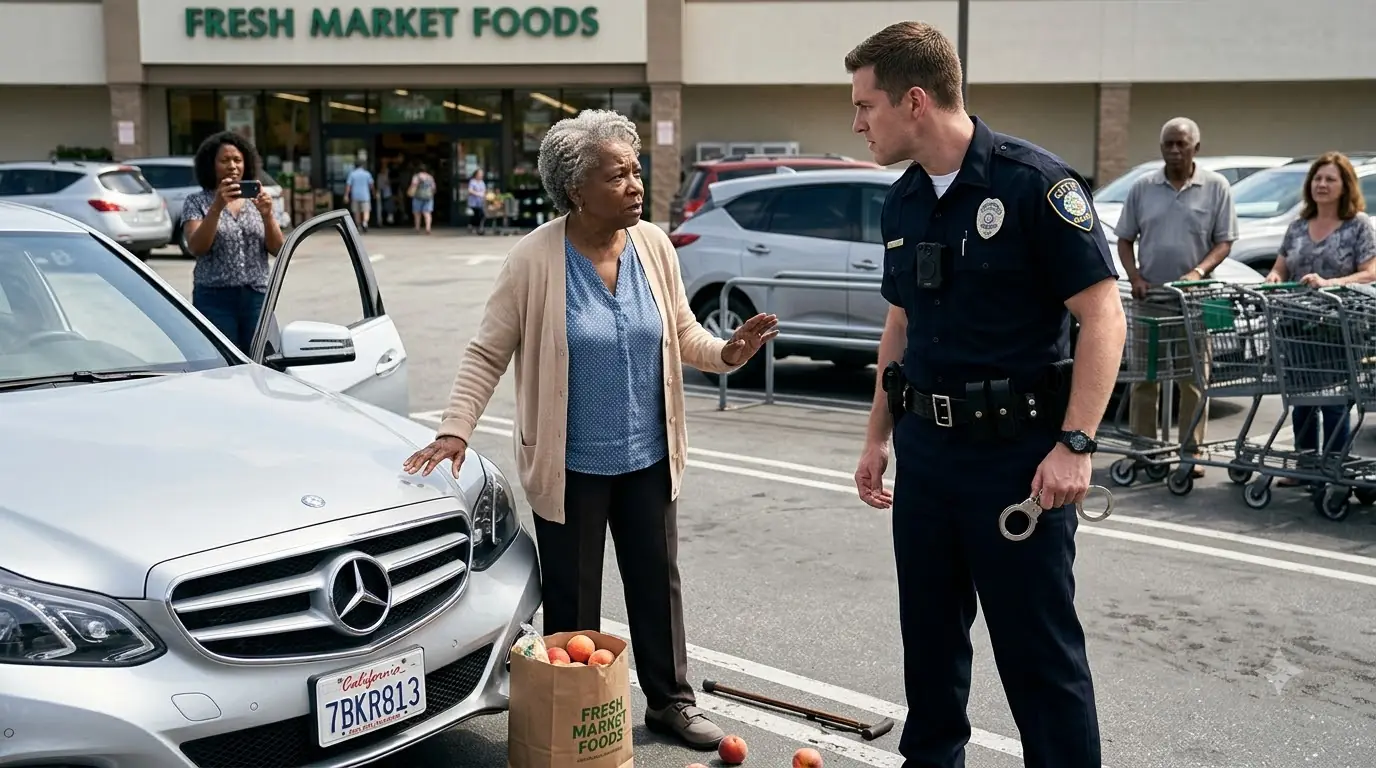
“People like you don’t drive cars like this.”
“Please. I left the hospital this morning.”
“I said, hands on the hood. Now.”
Phones rose all around them. A dozen glowing screens were recording, but nobody stepped forward.
Somewhere, someone laughed. Gloria had a registration card in her purse carrying her own name, and she felt the car key bite into her closed fist.
One call. That was all she would ask for.
None of them knew the man who would soon arrive. None of them knew he would reach this handcuffed woman and call her Mom.
Three hours earlier, the morning had been gentle. Gloria Holloway signed her discharge papers at Fairmont County Hospital.
A nurse wheeled her to the door. The surgeon had said the same thing twice: “Rest. Walk slowly. No stress on the heart.”
Gloria drove herself to Greenfield Market for one small thing. Fresh peaches.
They had been her late husband’s favorite, and tomorrow would have been their anniversary.
Parking the silver Mercedes took her two careful minutes. She left it gleaming under the noon sun and went inside, leaning on her cane the whole way.
Across the lot, a woman watched from a parked SUV. Karen Whitfield lived four houses down from Gloria and had never once said hello.
She had complained about Gloria’s garden. She had complained about Gloria’s visitors.
Now she stared at the older Black woman climbing out of a luxury car, and something ugly turned over in her chest.
Karen lifted her phone and dialed 911.
“Yes, I’d like to report a theft in progress,” she said, her voice calm and rehearsed. “There’s a Black woman breaking into a Mercedes at Greenfield Market. She doesn’t belong with a car like that. She might be armed. Please hurry.”
Every word was a lie.
Gloria’s key was in her purse. The title was in her name.
But the dispatcher heard the word armed, and the call changed shape.
Two miles away, Officer Travis Boyd took the radio call. He was 29 years old, three years on the force, and hungry to matter.
A possible armed vehicle theft was the most important thing that had happened to him all week. He flipped on his lights and did not slow down to ask questions.
In his mind, the suspect was already guilty.
He had a description: Black, female, older. He had a crime: grand theft auto.
He had a stage, and an audience would soon gather. Their phones were already in their pockets, waiting.
What he did not have was the truth. Not a single piece of it.
He did not know the woman’s full name. He did not know about the stitches over her heart.
And he did not know that this woman, if pushed far enough, would make one phone call to a number that could end his career in a single afternoon.
The patrol car came in fast, tires shrieking against the asphalt. Boyd stopped at an angle, his door flying open before the engine had fully settled.
He stepped out with one hand already resting on his holster, his jaw set like a man arriving at a war.
Gloria had just reached her car. She carried two bags of groceries with a small paper sack of peaches resting on top.
She heard the siren and turned, confused, squinting into the light.
“Step away from the vehicle,” Boyd called. “Hands where I can see them.”
She blinked. “Officer, is something wrong?”
“I said step away from the vehicle. Now.”
“This is my car. I was only loading my groceries.”
“Ma’am, I won’t tell you again.”
Gloria set the bags slowly on the ground. Her hands trembled, not from guilt, but from the long morning and the fresh stitches beneath her blouse.
She lifted both palms toward the sky. “All right,” she said softly. “All right. I’m not doing anything.”
Boyd circled her, eyes hard. He looked at the car, then at her, then at the car again.
A silver Mercedes, polished and gleaming. An older Black woman in a faded cardigan and orthopedic shoes.
In his mind, the two did not belong together, and that gap was all the evidence he thought he needed.
“Whose car is this?”
“Mine. I’ve owned it three years.”
“Right.” He almost laughed. “And I’m the mayor.”
A few shoppers had slowed near the store entrance. One of them lifted a phone, then another.
Within moments, the lot was filling with quiet witnesses, and not one of them moved closer.
They formed a loose half-circle, the way people gather around an accident. Close enough to see, far enough to stay clean.
“Officer,” Gloria tried again, her voice patient. “My registration is in my purse. My key is in my purse. If you would only let me show you.”
“Don’t reach for anything.”
“I only want to show you.”
“I said don’t reach.”
She froze. Her hand hovered near the strap of her bag, then dropped to her side.
The peaches sat in their paper sack, bright and absurd in the middle of all this.
Boyd keyed his shoulder radio without taking his eyes off her.
“Dispatch, I’ve got the suspect on scene. Older female matches the description. Vehicle present. Possibly armed. Standing by.”
“Suspect,” Gloria repeated.
The word landed strangely in her ears.
“Armed? Son, I’m 68 years old. I came from the hospital this morning. The only things in that bag are peaches and my heart medicine.”
“I’m not your son.”
The words came sharp, and something behind them was sharper still.
He stepped closer and kicked her cane.
It clattered across the pavement and spun beneath the car beside hers, far out of reach.
Gloria swayed. Without the cane, her balance was fragile.
She caught herself on the warm hood and breathed through a flash of pain that spread across her chest and down her left arm.
“Please,” she whispered. “I had heart surgery six days ago. I cannot stand long.”
“Hands on the hood. Spread your feet.”
“Officer, I am telling you the God’s honest truth.”
“Everybody says that.”
A young man near the carts took a step forward. He wore a delivery uniform and had kind, worried eyes.
“Hey, man, she’s old. Just check her ID. It’ll take you ten seconds.”
Boyd turned his head slowly. “Stay back or you’re next. Mind your business.”
The young man stopped. He did not leave, but he did not come closer either.
Instead, he lifted his phone higher, and the small red dot of a livestream blinked on. A counter beside it began to climb.
Forty viewers. Then a hundred. Then more.
Gloria placed her hands flat on the hood. The metal burned her palms.
She bowed her head, and a strand of gray hair fell loose across her face.
“My name is on the title,” she said to the car, to herself, to anyone who would listen. “Gloria Holloway. Look it up.”
“Please, just run the plate. It will tell you everything.”
Boyd did not run the plate.
He pulled the cuffs from his belt.
The ratcheting sound cut through the parking lot, that hard mechanical click everyone recognized from a hundred videos.
The crowd leaned in. The phones steadied.
“You’re being detained for suspected vehicle theft,” he said. “Hands behind your back.”
“I have stitches. Please, not behind my back.”
He took her wrist anyway. He pulled it down and back, and the motion bent her forward over the hood.
Gloria gasped as pain shot through her.
“Please,” she said. “Please, you’re hurting me.”
“Stop resisting.”
“I’m not resisting. I can’t move that fast.”
“Stop resisting.”
He said it loudly for the crowd, for the cameras.
It was a phrase that rewrote a scene. Anyone watching the footage later would hear an officer say, “Stop resisting,” and part of them might wonder, just for a second, whether she had.
She had not.
The first cuff closed. Then Boyd reached for her second wrist and drew it back to meet the first.
The steel snapped shut too tightly. It bit into the thin skin over the bone, leaving a small line of blood against the silver.
Gloria made no more sounds. She simply closed her eyes.
A second patrol car eased into the lot.
Officer Lisa Bennett stepped out, younger and quieter, and took in the scene with a flicker of unease across her face.
An older woman bent over a hood. Blood at her wrist. A cane lying abandoned beneath another vehicle.
Bennett opened her mouth, then glanced at Boyd’s expression and said nothing.
She took up a position near the crowd, hands on her belt, and became one more person who watched.
Gloria’s purse had slipped off her shoulder during the struggle. It hit the pavement and spilled open.
A lipstick rolled away. A pill bottle from the hospital pharmacy skittered across the asphalt.
And there, face up in plain view, lay the laminated registration card.
Gloria Holloway.
The make of the car. The plate. Her address.
Her name appeared in clear black letters, matching the woman in handcuffs in every possible way.
The young delivery driver saw it first.
“Yo, her name’s right there. The papers are right there, man. You don’t even have to look hard.”
Boyd glanced down.
He saw it, too.
For one long second, he had a choice.
He could pick up the card. He could read it.
He could feel that cold drop in the stomach that comes when a person realizes he has made a terrible mistake, and he could begin, even clumsily, to make it right.
Instead, Boyd nudged the card aside with the toe of his boot.
He slid it beneath the car into the shadow, the same way Gloria’s cane had disappeared.
“That doesn’t prove anything,” he said. “Could be stolen, too. People steal the paperwork right along with the car.”
A murmur moved through the crowd.
Some of it was discomfort. Some of it, sickeningly, was amusement.
Someone laughed.
It was a bright, careless sound that made the whole thing feel like a show put on for their afternoon.