The first thing Darius Bennett noticed was not the pain in his knee.
It was the phones.
There had been four when Officer Travis Cole first pushed his hands behind his back.
Then six.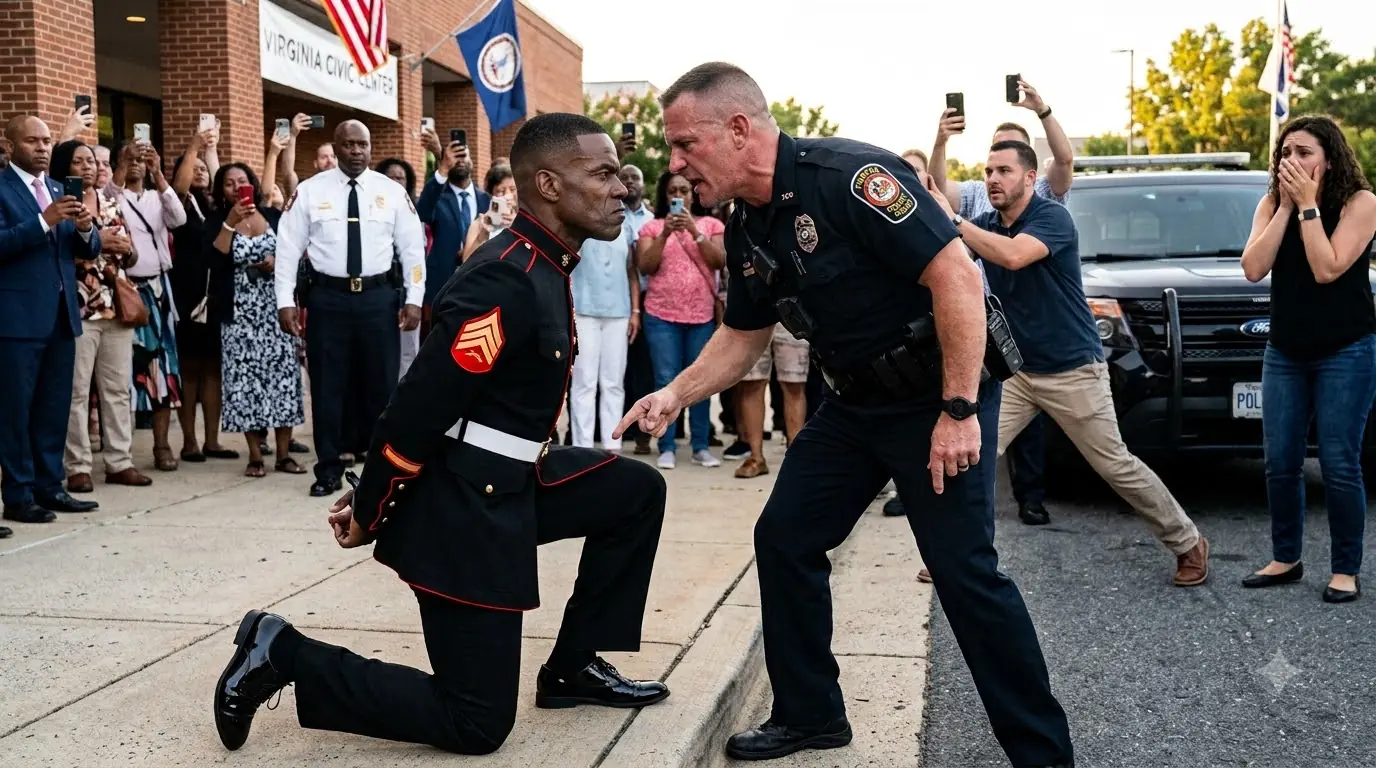
Then ten.
Now Darius could see at least fourteen people standing beyond the sidewalk outside the Westbrook Civic Center, every one of them holding a phone high enough to record what was happening.
Some looked frightened.
Some looked angry.
A few looked embarrassed, as though merely witnessing the scene had made them part of something they had not expected to see on an otherwise ordinary Saturday afternoon.
Darius remained on one knee.
His right knee pressed against warm concrete.
His wrists were cuffed behind his back.
His shoulder ached from the way Travis had pulled one arm upward when Darius tried to shift his balance.
He could hear children somewhere behind the crowd.
A dog barked twice.
Traffic moved along Willow Avenue as though none of this mattered.
Travis stood directly in front of him.
Forty-six years old, thick through the chest, close-cropped brown hair beginning to gray at the temples, hard blue eyes and a jaw that seemed permanently clenched, Travis looked less angry now than determined.
That bothered Darius more.
Anger could pass.
Determination meant the officer believed he had something to prove.
“Stay on that knee,” Travis said.
Darius looked up.
“You move when I tell you.”
His voice carried beyond the sidewalk.
A woman in the crowd inhaled sharply.
Darius could feel sweat gathering beneath the collar of his light blue button-up shirt. He had been dressed for the Westbrook Neighborhood Safety Forum, not for kneeling in the sun.
Thirty-eight years old, an electrical contractor, father of two, homeowner three streets away, Darius had come to the civic center because he had been invited.
That fact had somehow become irrelevant.
Twenty minutes earlier, he had been inside helping a volunteer fix a faulty extension cord running to the registration table.
Fifteen minutes earlier, he had been drinking bottled water with Councilwoman Erin Walsh.
Ten minutes earlier, somebody outside had shouted.
Seven minutes earlier, Darius had walked into the parking lot.
And five minutes earlier, Travis Cole had decided Darius was the problem.
Darius had spent those five minutes trying to understand why.
He still did not know.
“Officer,” Darius said, keeping his voice steady, “tell me what crime I committed.”
Travis leaned down.
“You don’t question me.”
Darius looked directly into his eyes.
“I’m in handcuffs.”
“Yes.”
“I’m asking why.”
Travis moved closer.
“Keep your mouth shut.”
Several people in the crowd reacted at once.
“Hey.”
“Come on.”
“He didn’t do anything.”
Travis turned sharply.
“Everybody back up.”
Nobody moved.
Darius noticed Megan Alvarez, a middle school teacher who lived on Birch Street, standing near a maple tree with her phone recording.
Beside her stood Caleb Monroe, a twenty-year-old college student who had been volunteering at the civic event.
Both had seen almost everything.
Darius knew that because Caleb had been the one who shouted first.
Not at Darius.
At somebody else.
That was where the entire afternoon had begun.
Westbrook was the kind of suburban Connecticut town that liked to describe itself as quiet.
Not wealthy enough to be exclusive.
Not poor enough to be ignored.
Tree-lined streets.
Old colonial houses.
Two coffee shops on Main.
A high school football team that had not won anything important in twelve years but still filled the bleachers every Friday.
The civic center sat between the library and a small municipal park.
That Saturday’s Safety Forum had been organized after several car break-ins and vandalism complaints.
Police officers were present.
Neighborhood association members.
A representative from the fire department.
Local contractors had volunteered to demonstrate door locks, motion lights, and home camera systems.
Darius had been invited because Bennett Electric installed exterior lighting and security wiring.
It should have been boring.
Darius liked boring.
He had spent most of his adult life building a stable life precisely because stability had not been guaranteed when he was younger.
His father disappeared when he was nine.
His mother, Lorraine Bennett, worked nights as a nursing assistant and mornings cleaning offices until Darius was old enough to help.
He had started pulling wire for an electrician at seventeen.
By twenty-four, he held his own license.
By twenty-nine, he had two employees.
By thirty-five, eight.
He married Tasha Greene when they were twenty-six.
Their daughter Nia was eleven.
Their son Marcus was eight.
Darius owned a modest two-story house on Beechwood Lane, a gray Ford truck, enough tools to fill a warehouse corner, and exactly one suit that fit properly.
He was not famous.
He was not politically important.
He did not hold a title that should have been necessary to be treated decently.
That mattered later.
At 2:14 that afternoon, Darius had been speaking with Councilwoman Erin Walsh when Caleb Monroe ran through the civic center doors.
“There’s a guy breaking into cars!”
The room shifted immediately.
People turned.
Travis Cole had been standing near the police information table.
He reacted first.
“Where?”
“South lot.”
Travis ran outside.
Another officer, twenty-nine-year-old Officer Lena Price, followed.
Darius remained inside.
At least for ten seconds.
Then Caleb shouted through the doorway.
“He’s running toward the playground.”
People began moving toward windows.
Darius stepped outside because his truck was parked in the south lot.
So were two of his employees’ vans.
The parking area behind the civic center held nearly forty cars.
At the far edge, a young white man in a gray hoodie was running between two vehicles.
Travis chased him.
Lena moved in from the side.
The man jumped a short hedge and disappeared toward Maple Court.
Then someone screamed.
Not from the suspect.
From a woman standing beside a silver SUV.
“My purse!”
Darius moved toward her.
The woman pointed at the ground.
“He dropped it.”
A black leather purse lay beneath the rear bumper of a sedan.
Darius picked it up.
That was the moment Travis turned back.
He had lost sight of the fleeing suspect.
He saw Darius standing between cars.
Black leather purse in one hand.
People running behind him.
And Travis made a decision.
“Drop it!”
Darius froze.
The woman beside the SUV immediately said, “No, officer, he just—”
“Drop the bag!”
Darius lowered it to the pavement.
“My name is Darius Bennett. I’m with the event.”
“Hands where I can see them.”
Darius raised both hands.
The woman tried again.
“He didn’t take it.”
Travis approached fast.
Darius saw adrenaline in his face.
That was understandable.
A suspect had just fled.
What happened next was not.
“Turn around.”
“Officer, the guy you’re looking for went over the hedge.”
“Turn around.”
Darius hesitated.
Not because he intended to resist.
Because he could not believe what he was hearing.
Lena Price arrived ten yards away.
She looked from Darius to the purse.
Then toward the woman.
“Travis, wait.”
Travis grabbed Darius’s left wrist.
“Turn around.”
Darius pulled his arm instinctively, not away exactly, but toward himself.
“Don’t grab me. I’m telling you, the guy—”
That was enough.
Travis twisted his arm behind him.
Darius stumbled into the side of a parked car.
People shouted.
Lena stepped closer.
“Cole, hold up. Witness says—”
“I have it.”
One cuff closed.
Darius felt cold metal tighten around his wrist.
“What are you arresting me for?”
“Stop resisting.”
“I’m standing still.”
Travis seized the other wrist.
Click.
The second cuff closed.
Darius looked toward Lena.
Her expression bothered him.
Not aggressive.
Concerned.
But uncertain.
She knew something was wrong.
She had not yet decided what to do about it.
That hesitation lasted perhaps three seconds.
It felt longer.
Megan Alvarez had already begun recording.
Caleb shouted from behind her.
“That’s not him!”
Travis turned.
“Back away.”
Caleb pointed toward the hedge.
“The guy was white, gray hoodie, baseball cap. That’s not him.”
Travis’s face changed.
Only slightly.
Darius saw it.
Recognition.
Not that he had the wrong person necessarily.
Recognition that the situation had become complicated.
This was where Darius later believed everything could have ended.
Travis could have stopped.
Checked.
Asked.
Removed the cuffs.
Instead, the watching crowd created another pressure.
Pride.
Travis had acted decisively in front of civilians.
Reversing himself immediately would mean admitting his first decision might have been wrong.
So he doubled down.
“Sit down.”
Darius stared.
“No.”
Travis stepped closer.
“Get on the ground.”
“I have done nothing.”
“You are being detained.”
“For what?”
“Investigation.”