“Get off my platform, you filthy street rat, before I break you.”
Officer Derek Sullivan twisted the handcuffs tighter around the Black woman’s wrists and shoved her toward the pavement outside Metro Central Station. Hundreds of morning commuters moved around them, some staring openly while others studied their phones and pretended not to notice. The woman’s torn charcoal sweater hung loosely from her lean frame, and tangled black hair covered part of her calm, exhausted face.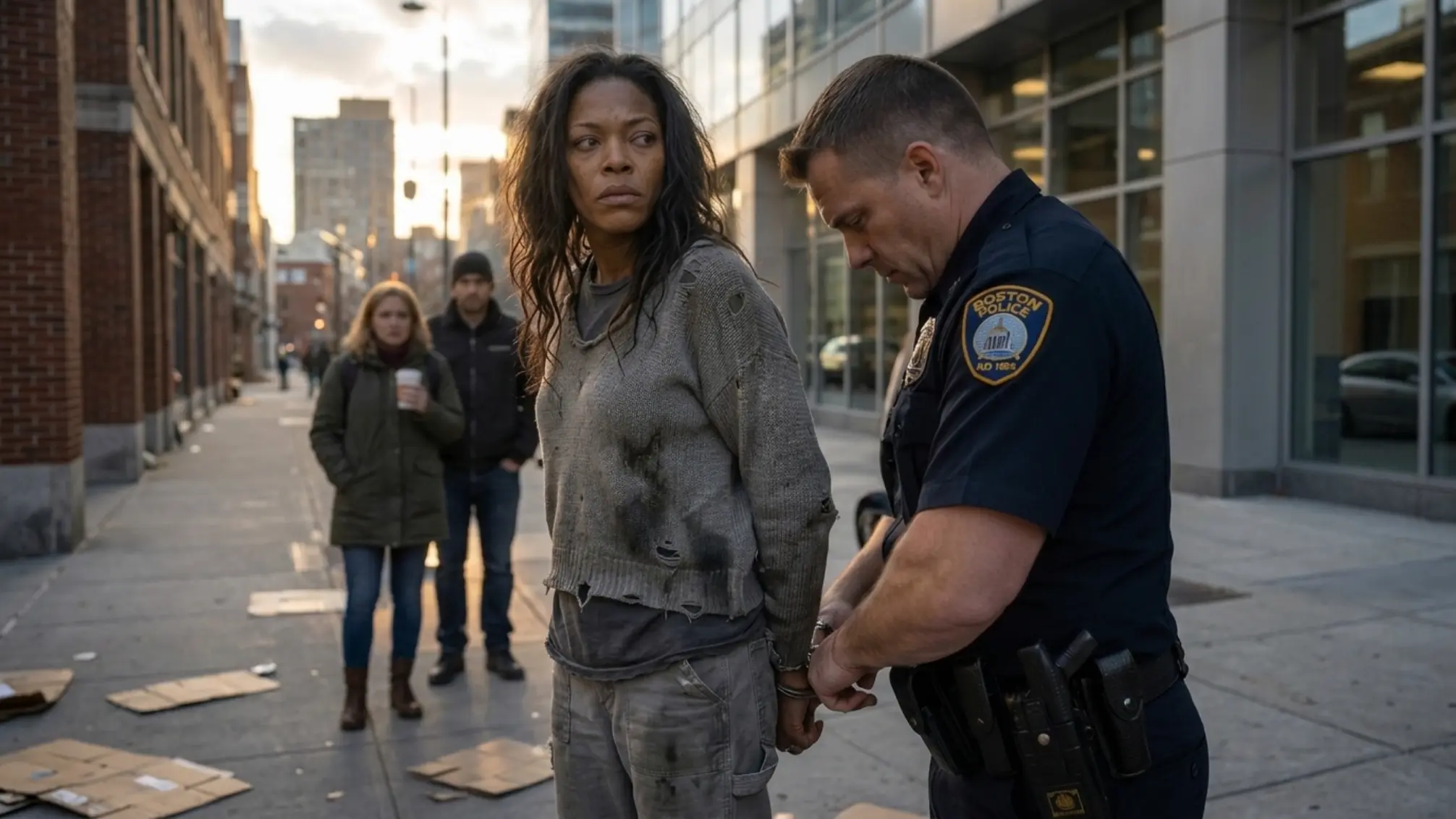
“Pull harder,” she said, turning slightly toward him. “You’re tightening the evidence around your own wrists.”
Derek raised his fist. “One more word, and I’ll smash your face into this pavement.”
The woman finally looked directly into his hard blue eyes. “Officer Derek Sullivan, badge 1847. Platform Three, Metro Central Station, 8:47 a.m., March seventeenth. Swing now and let the FBI hear it live.”
Derek’s fist stopped inches from her face.
For almost three weeks, commuters had seen the woman sitting beside a concrete pillar on Platform Three. She arrived before sunrise wearing the same dirty sweater, stained gray shirt, ripped cargo pants, and worn boots. A piece of flattened cardboard served as her seat, and a dented paper cup rested near one foot.
Most people stepped around her.
A few placed coins in the cup without speaking. Others complained to station employees that the homeless woman made the renovated terminal look dangerous. Nobody asked where she slept, why she watched the security cameras so carefully, or how she always seemed to know when transit officers were approaching before their radios became audible.
Officer Derek Sullivan noticed her on the first morning.
Derek had served with Metro Transit Police for nine years. He was forty-one, heavily muscular, and proud of the way people moved aside when they saw his dark uniform. His boots remained polished, his equipment was arranged perfectly, and his body camera was always attached in exactly the right place.
Whether it was recording depended on who stood in front of him.
On the woman’s second morning at the station, Derek kicked her paper cup across the platform. Coins scattered beneath benches and rolled toward the tracks while nearby passengers hurried away.
“Begging is prohibited,” he said.
“I didn’t ask anyone for money.”
“You put out a cup.”
“It holds water.”
Derek leaned down until his face was close to hers. “It holds whatever I say it holds.”
The woman collected the coins without arguing.
That silence encouraged him.
Over the next several days, he ordered her to move between platforms, then accused her of loitering when she obeyed. He searched her pockets without explaining why, confiscated a legal pocketknife, and took thirty-seven dollars folded inside an old sock.
He called the money suspected proceeds from illegal panhandling.
No property receipt was issued.
The woman remembered everything.
Her real name was Agent Naomi Carter.
At forty-two, Naomi worked for the Civil Rights Division of the Department of Justice and had spent fifteen years investigating police corruption, organized intimidation, and abuses committed beneath official authority. Before joining federal service, she had been an Army intelligence officer and later a criminal investigator in Baltimore.
Metro Central had come to federal attention after nineteen complaints vanished inside the transit-police review system.
The complainants included homeless passengers, Black commuters, immigrants, street vendors, and teenagers traveling alone. Several described illegal searches, stolen cash, unnecessary arrests, and assaults inside areas not clearly covered by public cameras.
Thirteen complaints named Derek Sullivan.
The transit authority dismissed every one.
Internal reports described the witnesses as intoxicated, confused, aggressive, or incapable of identifying the officers involved. Body-camera recordings repeatedly disappeared because of equipment failure, accidental deletion, or officers forgetting to activate them.
Naomi did not believe in that many accidents.
A federal judge approved a limited undercover operation. Naomi entered the station disguised as a homeless woman while agents monitored her through hidden microphones and cameras. Her torn sweater concealed a transmitter beneath one shoulder, and a second device inside her boot carried an emergency signal.
Two advertising panels facing Platform Three contained federal cameras.
Every encounter was being preserved.
The operation was supposed to remain observational. Naomi would document the officers’ behavior, identify patterns, and avoid provoking confrontation. Her team warned her not to resist unless she faced immediate danger.
Derek made remaining passive increasingly difficult.
On Naomi’s seventh morning, a sixteen-year-old boy named Luis Herrera entered the station carrying a toolbox. He had recently begun an electrical apprenticeship with his uncle and was traveling to his first paid job downtown.
Luis accidentally bumped Derek’s shoulder while checking the departure board.
He apologized immediately.
Derek grabbed the toolbox and emptied it across the floor. Wrenches, wire cutters, electrical tape, screwdrivers, and a voltage tester scattered beneath rushing feet.
“Burglary tools,” Derek announced.
“They’re for work,” Luis said, pointing toward the identification card clipped to his shirt.
Derek seized him by the collar. “You telling me how to do my job?”
From her place beside the pillar, Naomi spoke.
“Leave the boy alone.”
Derek turned.
It was the first time she had challenged him publicly.
“What did you say?”
“He apologized. His work identification is visible.”
Derek crossed the platform slowly. “You think because I haven’t arrested you yet, you get an opinion?”
“I think he’s going to miss his train.”
Derek kicked Naomi’s boot. “Stand up.”
She stayed seated.
He grabbed the front of her sweater and dragged her against the concrete pillar. Several passengers looked over, but most moved away when they recognized a police uniform.
“You want me to show this kid what happens to people who interfere?” Derek asked.
Naomi studied the angle of his body camera.
The recording light was off.
“Your camera isn’t running,” she said.
His expression changed.
Then he smiled.
“You worried nobody will see what happens?”
Naomi said nothing.
Derek released her and returned to Luis. He confiscated the boy’s wire cutters, threatened him with arrest, and ordered him onto the next train. Luis gathered the remaining tools with shaking hands.
Before leaving, he looked at Naomi.
She nodded once.
Keep moving.
That encounter became the first clear evidence connecting Derek’s abuse of homeless people to his treatment of other vulnerable passengers. Yet federal prosecutors wanted more than insults, questionable searches, and stolen cash.
They needed proof the misconduct extended through the department.
Naomi’s team reviewed internal reports connected to Derek’s arrests. The pattern appeared quickly. His supervisor, Lieutenant Raymond Cole, approved nearly every report without requesting video. Complaints were assigned to an internal investigator who had previously worked under Cole.
When money or property disappeared, records were corrected after the fact.
Derek was protected because others benefited from his behavior.
Naomi returned every morning.
By the second week, Derek no longer treated her like an unknown person. She had become a target he expected to remain available whenever he needed to demonstrate authority.
He called her “street trash,” “animal,” and “walking infection.”
He poured her water onto the platform.
Once, he stepped on the cardboard beneath her while she slept and tore it in half.
A station custodian named Maria Alvarez witnessed the incident. Maria waited until Derek left, then brought Naomi a clean piece of cardboard and a cup of coffee.
“You should use another station,” Maria whispered.
“Why?”
“He hates people who don’t fear him.”
Naomi accepted the coffee. “Have you reported him?”
Maria’s eyes moved toward the nearest camera.
“People who report him lose their jobs.”
That sentence changed the investigation.
Naomi asked no more questions, but federal agents began reviewing employee terminations connected to Metro Central. Three custodians, two security contractors, and one ticket clerk had been dismissed after submitting complaints about Derek.
The ticket clerk agreed to speak.
She described seeing Derek take cash from a homeless veteran before arresting him for trespassing. When she filed an internal report, Lieutenant Cole told her the officer had been conducting an undercover integrity test.
She was terminated two weeks later for alleged attendance problems.
Her time records showed perfect attendance.
By the third week, the federal team had enough evidence to request broader surveillance orders. Naomi was scheduled to leave the station after one final morning.
That was when Derek escalated.
The rush hour began normally. Commuters filled Platform Three while Naomi sat beside the pillar. A man in an expensive coat dropped a five-dollar bill into her cup without making eye contact.
Derek watched from the stairwell.
He approached with another officer named Kevin Price, a younger man who had assisted during several questionable searches. Kevin looked uncomfortable whenever Derek became aggressive, but he had never intervened.
Derek kicked the cup.
The five-dollar bill landed beneath his boot.
“You were warned about begging.”
Naomi looked up. “I didn’t ask him for anything.”
Derek picked up the money and placed it inside his shirt pocket. “Evidence.”
“Then issue a receipt.”
Kevin glanced toward him.
Derek’s eyes narrowed. “Stand up.”
“No.”
The word was quiet.
Dozens of people were close enough to hear it.
Derek grabbed her arm. Naomi remained loose, allowing him to pull her upright without revealing the strength hidden beneath the oversized clothing.
“You refusing a lawful order?”
“You haven’t stated a lawful reason.”
“I don’t need one.”
“You do.”
Derek shoved her into the pillar.
The hidden microphone captured the impact.
Kevin stepped closer. “Sergeant, maybe we should just move her outside.”
Derek ignored him. “Hands behind your back.”
“For what charge?”
“Disorderly conduct.”
“What conduct?”
“Interfering with police.”
“You approached me.”
Derek seized her wrist and twisted it behind her. Naomi offered no resistance as he applied the first handcuff.
Then he leaned close to her ear.
“Nobody here cares what happens to someone like you.”
Naomi’s expression remained empty.
Derek secured the second cuff and pushed her toward the stairs. When she moved too slowly for his satisfaction, he kicked the back of her leg.
She dropped to one knee.
A woman nearby gasped.
Several phones appeared.
Derek turned toward the crowd. “Keep moving. Police matter.”
Naomi rose without assistance.
Blood appeared where the rough pavement had torn through her cargo pants. Derek pulled her toward the glass entrance, twisting the cuffs upward until pain shot through her shoulders.
Outside the station, he shoved her toward the sidewalk.
“Get off my platform, you filthy street rat, before I break you.”
“Pull harder,” Naomi replied. “You’re tightening the evidence around your own wrists.”
He raised his fist.
“One more word, and I’ll smash your face into this pavement.”
Naomi finally activated the emergency phrase.
“Officer Derek Sullivan, badge 1847. Platform Three, Metro Central Station, 8:47 a.m., March seventeenth. Swing now and let the FBI hear it live.”
Derek froze.
Kevin stared at her.
The commuters behind them became silent.
Derek recovered first. “What kind of game are you playing?”
“No game.”
“You read my badge.”
“I haven’t looked at it today.”
He glanced down instinctively.
His badge was partly hidden beneath a folded strap from his body camera.
Naomi continued.
“Lieutenant Raymond Cole approved complaint 23-174 without reviewing video. Internal investigator Peter Lane closed seven reports within forty-eight hours. Three employees were fired after identifying you.”
Derek’s face changed with each sentence.
Kevin stepped away from him.
Naomi looked toward the officer’s silent body camera. “And you disabled that recorder fourteen minutes ago.”
Derek grabbed her shoulder and forced her against the side of a police vehicle.
“Who are you?”
“You already decided.”
He searched beneath her torn sweater and found the wire.
For one second, he merely stared at it.
Then panic replaced anger.
He ripped the transmitter free and threw it onto the pavement.
“You’re impersonating law enforcement.”
Naomi smiled faintly. “That microphone costs more than your patrol car.”
Kevin reached for his radio. “We need a supervisor.”
Derek slapped his hand away.
“No radio.”
“That’s federal equipment.”
“You don’t know that.”
“She knew Cole’s complaint number.”
Derek leaned close to Naomi. “Where are the others?”
She said nothing.
He pulled harder on the handcuffs. “Tell me.”
“Every direction.”
Black vehicles entered the street from both intersections.
At the station entrance, two commuters stepped aside as federal agents emerged from the crowd wearing ordinary clothing. Another team appeared from the parking structure across the road.
Derek released Naomi and reached toward his pistol.
Kevin grabbed his arm.
“Don’t.”
Derek shoved him away.
FBI Special Agent Lucas Grant moved first, drawing his weapon while issuing a clear command.
“Hands away from the gun!”
More agents surrounded them.
Derek looked from the vehicles to the federal badges, desperately searching for an exit that no longer existed.
Naomi remained handcuffed beside the cruiser.
“Remove these,” she said.
Derek looked at her.
“Now.”
His hands shook as he unlocked the cuffs.
Naomi rotated her wrists slowly. Red marks circled both arms, but her posture remained controlled.
Lucas approached. “You injured?”
“Knee abrasion, shoulder strain. Nothing serious.”
Derek stared at her clean, authoritative voice. The woman he had kicked, mocked, and treated as helpless had vanished without changing clothes.
“Who are you?” he asked again.
Naomi removed the torn sweater.
Beneath it, clipped inside a concealed support vest, was a federal identification wallet.
“Special Agent Naomi Carter, Department of Justice Civil Rights Division.”
Kevin lowered his head.
Derek’s face went pale.
Lucas ordered him to turn around.
Derek did not move. “This is entrapment.”
Naomi looked at him calmly. “We never asked you to kick me.”
“I was enforcing station policy.”
“You stole money, conducted illegal searches, disabled your camera, threatened assault, and arrested me without cause.”
“You disobeyed orders.”
“Unlawful orders.”
Derek glanced toward the commuters filming from behind the glass doors. He had humiliated vulnerable people before audiences for years.
Now the audience watched him lose control.
“You planned this,” he said.
“We documented you.”
Derek suddenly lunged toward Naomi.
He never reached her.
Lucas and another agent drove him against the cruiser, controlled both arms, and placed him in federal handcuffs. Derek shouted threats, demanded his union representative, and accused the FBI of attacking local law enforcement.
Naomi picked up the crushed transmitter from the pavement.
“The backup channel never stopped,” she said.
Derek went quiet.
Kevin Price was separated and interviewed inside an unmarked vehicle. At first, he claimed Derek was simply aggressive but effective. Then agents played recordings from previous mornings.
Kevin heard himself laughing when Derek kicked Naomi’s cup.
He heard his own silence during illegal searches.
He watched footage of the teenage apprentice’s tools being confiscated.
“I didn’t touch her,” Kevin said.
“No,” Naomi replied. “You watched.”
“I would have lost my job.”
“Others did lose theirs because they spoke.”
Kevin stared through the vehicle window toward Derek in custody.
“What happens if I tell you everything?”
“That depends on how much truth remains after we compare it with the recordings.”
Kevin began talking.
He revealed that Lieutenant Cole directed officers to target people unlikely to file credible complaints. Homeless passengers were searched for cash, medication, and identification documents. Officers sometimes sold confiscated phones through a repair shop owned by Cole’s cousin.
When passengers resisted, Derek created trespassing charges.
Cole approved the reports.
Internal investigator Peter Lane closed the complaints.
Several officers knew.
Some participated.
Others stayed silent.
Federal warrants were executed before noon.
Agents searched the transit-police administration office, Derek’s home, Cole’s office, the internal-investigations division, and the electronics shop connected to the stolen property. They recovered cash envelopes, confiscated phones, wallets, prescription medication, and identification documents belonging to people who had never been charged with crimes.
One evidence cabinet contained Maria Alvarez’s original written complaint.
It had never been reviewed.
The custodian was called into a private meeting that afternoon. She expected termination when federal agents arrived at her work area.
Instead, Naomi placed the complaint before her.
“You were telling the truth,” Naomi said.
Maria looked toward the torn sweater Naomi still carried.
“You were homeless?”
“Undercover.”
Maria covered her mouth. “I gave a federal agent cardboard.”
“You gave a woman sitting on the floor something clean because you thought she needed it.”
Maria’s eyes filled with tears.
“That matters more than the title,” Naomi said.
The public scandal spread quickly.
Videos of Derek kicking Naomi appeared online before the transit authority issued its first statement. The department initially described the encounter as an arrest involving a noncompliant suspect.
Then federal officials confirmed the suspect was an undercover investigator.
The statement disappeared.
Derek, Lieutenant Cole, Peter Lane, and four additional officers were charged with civil-rights violations, conspiracy, theft, evidence tampering, obstruction, and filing false reports. More than sixty previous arrests were reopened.
Charges against homeless passengers began collapsing.
Luis Herrera received his confiscated wire cutters from a federal evidence officer. His uncle had believed the teenager lost them through carelessness and nearly ended the apprenticeship.
Naomi visited the electrical shop personally.
Luis stared at her clean suit and neatly arranged hair.
“You were the woman at the station.”
“Yes.”
“You could have stopped him whenever you wanted.”
“I needed proof that would survive after I left.”
Luis considered that. “Were you scared?”
“Yes.”
“You didn’t look scared.”
“That was part of the job.”
At Derek’s trial, prosecutors played the recordings in chronological order.
The jury heard him kick away the cup, take money, threaten the teenage apprentice, and claim the station belonged to people like him. They watched him disable his body camera and twist Naomi’s handcuffs while threatening to break her face.
His attorney argued that Derek believed she was dangerous.
The video showed her seated quietly before every confrontation.
The defense claimed her disguise provoked distrust.
The prosecutor answered simply.
“Poverty is not probable cause.”
Kevin testified under a cooperation agreement. He admitted watching abuse because silence protected his career. His testimony helped convict Derek and expose the command structure, but it did not erase his role.
Naomi did not offer forgiveness.
Neither did the people whose money had been stolen.
Derek Sullivan was convicted on every major charge. Lieutenant Cole and Peter Lane accepted plea agreements after learning several officers had agreed to testify.
Metro Transit Police entered federal oversight.
Body-camera footage was transferred automatically to an independent server. Officers could no longer access or delete recordings. Civilian complaints required external review, and confiscated property had to be documented immediately through a digital system.
The station changed more slowly.
New procedures could not repair years of fear overnight. Homeless passengers still expected harassment, employees still worried about retaliation, and commuters still looked away when discomfort entered their path.
Naomi returned to Platform Three six months later.
She wore a dark business suit and carried no disguise. The concrete pillar looked smaller than she remembered, while the station’s restored lights made every corner visible.
Maria recognized her immediately.
“You look different.”
“I smell better.”
Maria laughed.
Near the wall sat another homeless woman wrapped in a thin blanket. Commuters moved around her as they had once moved around Naomi.
Naomi bought two coffees.
She placed one beside the woman and sat on the floor without asking questions.
The woman looked suspiciously at the expensive suit. “You police?”
“Federal investigator.”
“That supposed to make me feel safe?”
“No.”
Naomi opened her coffee.
“Then why are you sitting here?”
“Because people kept walking past me once too.”
They remained beside the pillar for several minutes.
No cameras surrounded them.
No arrest followed.
Nobody saluted or announced Naomi’s title.
That ordinary moment reminded her why the operation mattered.
The story spread because a corrupt officer unknowingly handcuffed a federal agent. People enjoyed the reversal: the helpless homeless woman reciting his badge number, the black vehicles arriving, and the officer being placed in the same cuffs he had tightened around her wrists.
Yet Derek’s greatest crime was not choosing the wrong woman.
It was believing any homeless woman was the right one.
Naomi’s badge did not make the kick illegal.
The wire did not create her dignity.
The federal agents listening nearby did not transform her from a human being into someone worthy of protection.
She had possessed those rights while sitting on cardboard, before anyone knew her name.
Derek Sullivan believed nobody cared what happened to a woman who looked poor, dirty, and alone. For years, the station confirmed his belief by allowing complaints to disappear and witnesses to remain silent.
Then Naomi Carter sat on Platform Three for twenty-one mornings and recorded what authority sounded like when it believed its victim had no power.
Derek kicked her, handcuffed her, and raised his fist before a crowd.
She calmly recited his full name and badge number.
His smile vanished because he finally understood that someone had been watching.
But the people he abused before Naomi had mattered just as much.
The investigation did not end merely because one corrupt officer went to prison. It ended only when the station was forced to recognize the truth it had ignored for years:
A torn sweater was not evidence of guilt.
Homelessness was not permission for cruelty.
And dignity did not begin when a federal badge appeared beneath the clothes.