At 3:17 on a Tuesday afternoon, Nathaniel Brooks rolled his wheelchair out of the Savage Creek Pharmacy with a small white paper bag resting across his lap and stopped beneath the awning because the sun was brighter than he expected.
He was seventy-eight years old.
His shoulders were thinner than they had been ten years earlier. His hands carried dark veins beneath deeply lined skin. His face had the still, controlled expression of a man who had spent decades listening carefully before deciding whether another person’s words deserved an answer.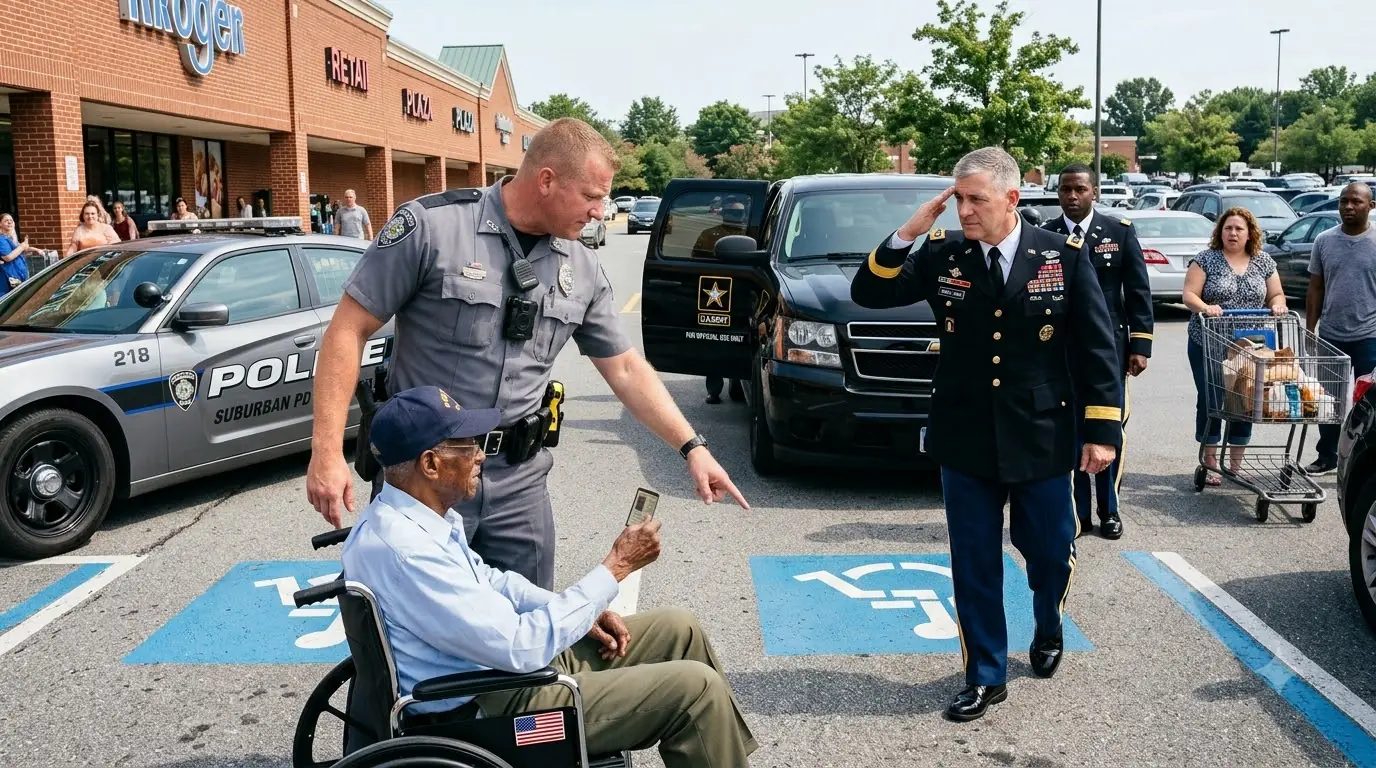
He wore olive trousers, a pale blue short-sleeve button-up shirt, dark loafers, and a navy baseball cap his granddaughter had bought him because she said the older brown one made him look “like somebody’s stubborn uncle.”
Nathaniel had told her that he was somebody’s stubborn uncle.
She had replied that this proved her point.
He smiled at the memory while adjusting the paper bag.
The pharmacy sat at one end of the Briarwood Shopping Plaza outside Richmond, Virginia, between a grocery store and a small restaurant that served breakfast until two in the afternoon.
Nathaniel had come for blood pressure medication and a refill for the anti-inflammatory tablets he took when the pain in his lower back became difficult.
Nothing dramatic.
Nothing urgent.
He had driven himself.
People were often surprised by that.
Nathaniel’s legs had lost much of their strength after complications from spinal surgery four years earlier, but his hands were steady, his eyesight remained excellent with glasses, and his gray sedan had been professionally fitted with hand controls.
He did not enjoy explaining any of that.
Most days he did not have to.
His car was parked in the first accessible space outside the pharmacy.
A blue placard hung visibly from the rearview mirror.
The license plate was registered to him.
His folded wheelchair lift sat inside the modified rear passenger area.
Everything about the arrangement was legal, documented, and ordinary.
Nathaniel rolled toward the car.
He had reached the painted blue access aisle when a voice behind him said, “Hold up.”
Nathaniel stopped.
He turned the chair slightly.
A police officer was walking toward him from beside a black patrol SUV.
Tall.
Broad.
Blond hair cut close.
Mid-forties.
Gray uniform shirt stretched tightly across his shoulders.
The officer moved with the easy confidence of someone who had already decided what he expected to find.
Nathaniel watched him approach.
The nameplate read:
MERCER.
Officer Travis Mercer looked first at Nathaniel.
Then the sedan.
Then the accessible parking sign.
Then back at Nathaniel.
“You with this car?”
Nathaniel answered, “Yes.”
Mercer stopped beside the front fender.
“This your vehicle?”
“Yes.”
“You driving it?”
Nathaniel looked at him.
“I just answered that.”
Mercer’s expression tightened slightly.
Nathaniel had spent most of his professional life observing exactly that kind of change in people.
Not anger yet.
More like surprise that the conversation was not following the expected script.
Mercer pointed toward the windshield.
“Where’s the permit?”
Nathaniel glanced at the large blue placard hanging clearly from the mirror.
“There.”
Mercer stepped closer to inspect it.
Nathaniel waited.
Behind them, a woman pushing a grocery cart slowed.
A man near the restaurant entrance looked over.
Mercer reached toward the placard through the closed windshield as though touching the glass might make the permit easier to understand.
Then he looked at Nathaniel again.
“Whose name is it under?”
“Mine.”
“Identification.”
Nathaniel’s expression remained neutral.
“Why?”
Mercer straightened.
“Because I’m asking.”
“That explains who is making the request.”
Nathaniel rested one hand on the wheelchair arm.
“It does not explain the reason.”
The woman with the grocery cart stopped completely.
Mercer glanced toward her.
Then back at Nathaniel.
“You want to make this difficult?”
“No.”
“Then show me your ID.”
Nathaniel considered.
He had identification in his wallet.
He also knew exactly what the officer could and could not require under the circumstances.
There had been no traffic stop.
No reported crime.
No observable parking violation.
Nothing suggesting the placard was counterfeit beyond Mercer’s apparent suspicion that the man in the wheelchair beside the modified sedan might somehow not be entitled to use the accessible parking space.
Nathaniel said calmly, “Did someone report this vehicle?”
Mercer’s jaw shifted.
“I noticed it.”
“And?”
“And I’m checking.”
“Checking what?”
Mercer took one step closer.
“Whether you’re authorized to park here.”
Nathaniel looked at the wheelchair beneath him.
Then at the permit.
Then deliberately back at Mercer.
Something almost like embarrassment flashed across the officer’s face.
It disappeared beneath irritation.
“Don’t get smart with me.”
Nathaniel’s voice remained level.
“I asked a question.”
Mercer pointed toward the sedan.
“That’s a nice car.”
Nathaniel waited.
Mercer continued.
“We get people using family members’ disability tags all the time.”
Nathaniel understood now.
Not because the explanation made sense.
Because Mercer had finally provided the story he had already built in his head.
Nice car.
Older Black man.
Wheelchair.
Permit.
Something did not fit the officer’s assumptions, although Nathaniel could not say which detail bothered him most.
“This is my car,” Nathaniel said.
“Then ID shouldn’t be a problem.”
Nathaniel looked toward the pharmacy doors.
Two customers were watching now.
He did not enjoy audiences.
He especially did not enjoy becoming one.
“Officer Mercer, is that correct?”
The officer’s eyes sharpened.
“You reading my name now?”
“It’s on your chest.”
“What’s your point?”
Nathaniel inhaled slowly.
“My point is that I’m trying to determine whether you have a lawful reason to detain me.”
The atmosphere changed.
Mercer looked at Nathaniel more carefully.
“You a lawyer?”
Nathaniel said, “That is not relevant.”
Mercer smiled without humor.
“It might be.”
“No.”
“It isn’t.”
Mercer stepped beside the wheelchair.
“Stand by.”
Nathaniel almost laughed.
Instead he said, “I’m already sitting.”
The woman with the grocery cart covered her mouth.
A young man near the restaurant looked down quickly, hiding a grin.
Mercer heard.
His face hardened.
“Everybody move along.”
Nobody moved.
Nathaniel felt the first real warning inside himself.
Not fear.
Recognition.
The encounter was no longer about a parking permit.
It had become about Mercer’s authority in front of witnesses.
That was dangerous in a different way.
Nathaniel had seen it many times.
People often behaved reasonably when nobody was watching.
The moment pride entered the room, logic became expensive.
Mercer said, “Give me your driver’s license.”
Nathaniel replied, “Am I being detained?”
“I’m conducting an investigation.”
“Into what violation?”
“Possible misuse of a disabled parking placard.”
“What fact supports that suspicion?”
Mercer leaned forward.
“The fact that I’m standing here investigating it.”
Nathaniel’s eyes changed.
Only slightly.
But the patience in them cooled.
“That is circular reasoning.”
Mercer pointed one finger toward Nathaniel’s chest.
“I don’t need a lecture from you.”
“No.”
Nathaniel looked at the finger.
“You need a reason.”
The young man by the restaurant raised his phone.
Mercer noticed.
“Put that away.”
The young man said, “I’m on public property.”
Mercer turned.
“I said move along.”
Nathaniel spoke before the argument could shift.
“Officer.”
Mercer snapped back toward him.
“What?”
“Leave him alone.”
The officer stared.
Nathaniel realized the words had come out more sharply than intended.
Mercer moved closer until he stood beside the front wheel of the chair.
“You don’t give orders here.”
Nathaniel replied, “Neither do you without legal authority.”
For three seconds, neither spoke.
Then Mercer reached down and locked one of the wheelchair brakes.
Nathaniel looked at his hand.
The movement was small.
That made it worse.
Nathaniel had not tried to move.
The officer had simply decided to control whether he could.
“Remove your hand from my chair.”
Mercer looked down at him.
“You’re staying right here until I verify who you are.”
Nathaniel’s voice dropped.
“My wheelchair is part of my personal mobility.”
“I know what a wheelchair is.”
“Then take your hand off it.”
Mercer released the brake lever but did not unlock it.
Nathaniel reached down himself.
Mercer caught his wrist.