The first thing Officer Darren Cole said after pulling the clear plastic bag from Camille Brooks’s car was almost cheerful.
“Wow, look what I just found inside.”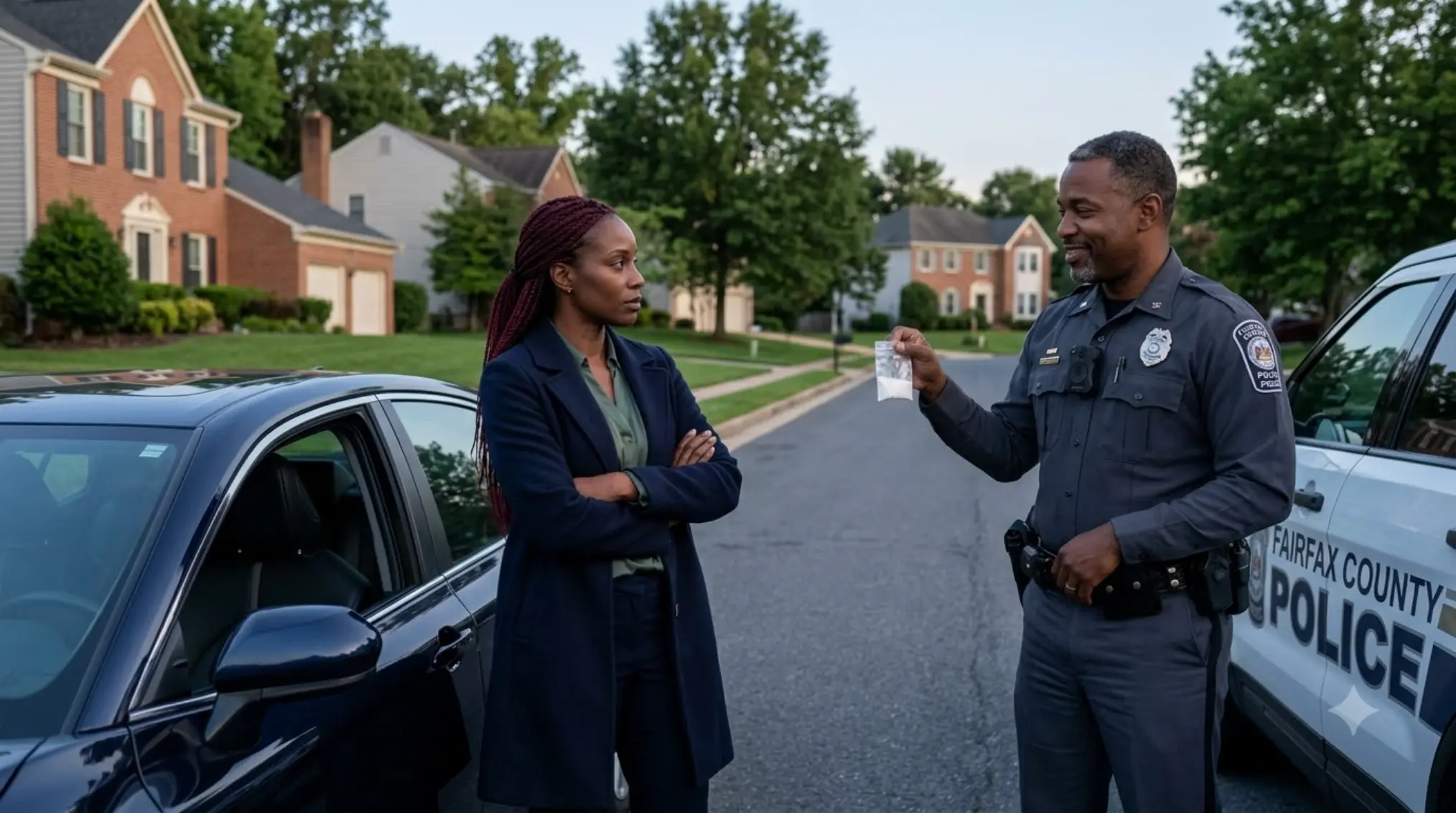
Camille stood beside the open driver’s door with her arms folded across the front of her navy coat. Her burgundy braids had been pulled neatly away from her face, and beneath the coat she wore the muted green blouse she had chosen that morning for a closed conference at the federal courthouse in Alexandria. She did not look at the bag first.
She looked at his hand.
Cole held the plastic between two fingers as though he were presenting a prize. Inside was a quantity of white powder large enough to be obvious beneath the evening streetlights. His body camera faced forward from the center of his uniform, and a satisfied smile had spread across his face.
Camille’s expression did not change.
“You mean the evidence you planted in my car when you thought no one important was watching?”
Cole’s smile disappeared.
For half a second, he simply stared at her.
Then he stepped closer.
“Careful.”
Camille remained still.
“One more word,” he said, lowering his voice, “and I write this up like you were begging to get caught.”
Camille met his eyes.
“Then finish your lie, Officer, and be ready to explain it to the federal bench in the morning.”
That sentence bothered him.
She saw it immediately.
Not enough to frighten him.
Enough to irritate him.
Cole had stopped Camille nine minutes earlier on a residential road less than four miles from her home. He claimed one of her rear lights had failed, although Camille had seen both lights reflected clearly in the window of a parked SUV while she waited for him to approach.
The stop should have been simple.
License.
Registration.
Possible warning.
Instead, Officer Cole had studied Camille longer than he studied her identification.
He looked at her suit.
Her watch.
The clean sedan.
Then the name on her driver’s license.
Camille Brooks.
Nothing on that card said United States District Judge.
Camille preferred it that way.
Her position was not a shield against ordinary traffic laws.
If she had committed a violation, she expected to be treated like anyone else.
But Cole had not behaved like someone investigating a traffic violation.
He behaved like someone looking for an opportunity.
“You live around here?” he had asked.
“Yes.”
“Where?”
“The address is on the license.”
Cole smiled.
“Just making conversation.”
Camille said nothing.
He looked through the passenger window.
“What are you carrying tonight?”
“My work bag.”
“What kind of work?”
“Legal.”
“Lawyer?”
“Something like that.”
The smile became broader.
“You people always answer questions with questions.”
Camille had almost asked what he meant by you people.
She decided against it.
Instead, she watched.
That was what years on the bench had taught her.
People revealed far more when they believed silence meant weakness.
Cole asked her to step out.
“Why?”
“For officer safety.”
“Is there a particular safety concern?”
“You challenging me?”
“No. I’m asking you to state the reason.”
His expression hardened.
“You can step out voluntarily or I can order you out.”
Camille unbuckled her seat belt.
She knew what lawful authority could look like.
She also knew what people sometimes hid behind it.
She stepped out.
Cole positioned her near the rear of the sedan.
“Hands where I can see them.”
Her hands remained visible.
“Do you have anything illegal in the vehicle?”
“No.”
“Weapons?”
“No.”
“Drugs?”
“No.”
“You mind if I take a look?”
“Yes.”
Cole blinked.
“Yes, you have drugs?”
“Yes, I mind if you search my vehicle.”
His face changed.
Camille saw the annoyance immediately.
Most people interpreted a request from a uniformed officer as an order.
Camille did not.
Cole tilted his head.
“Why would an innocent person care?”
“Innocence does not require me to waive anything.”
That answer irritated him even more.
He walked around the sedan.
Camille watched him.
“Stay there.”
She did.
His body camera faced away from her when he moved toward the open driver’s door.
The door had been opened because Cole had told her to leave it open after she stepped out.
Camille could see only part of his right arm.
Then his shoulder blocked the view.
His left hand disappeared briefly near his uniform.
A second later, his right hand entered the car.
Too quickly.
Too smoothly.
He bent inside.
Then straightened.
And produced the bag.
“Wow, look what I just found inside.”
Camille had spent fourteen years as a federal prosecutor before becoming a judge.
She had seen honest police work.
Excellent police work.
Sloppy police work.
Arrogant police work.
And, occasionally, criminal police work.
She knew the difference between discovery and theater.
Cole was performing.
“What exactly are you alleging?” she asked.
He held the bag higher.
“You know exactly what this is.”
“I’m asking you to identify what you believe it is.”
“Cocaine.”
“You tested it?”
His jaw tightened.
“I know what drugs look like.”
Camille looked at the bag.
Then his body camera.
“Where precisely did you locate it?”
“Driver’s side.”
“That is not precise.”
Cole laughed.
“You trying to lawyer me?”
“I’m trying to make sure your account is clear.”
That bothered him too.
He stepped closer.
“You should be worried about yourself.”
“I am.”
“Doesn’t look like it.”
“I’ve learned fear rarely improves documentation.”
Cole stared.
He had expected tears.
Panic.
Perhaps pleading.
Instead, Camille was building a record.
He did not yet understand why.
That gave her an advantage.
“Turn around,” he said.
Camille’s eyes narrowed.
“Am I under arrest?”
“You’re being detained.”
“For what?”
“Possession of a controlled substance.”
“You have not established what the substance is.”
Cole reached toward his handcuffs.
Camille did not move.
“Are you arresting me?”
“I said turn around.”
“Your camera is running?”
He glanced down involuntarily.
Camille noticed.
“Yes.”
“Good.”
Cole’s expression darkened.
“Good?”
“Very.”
That was when he grabbed her wrist.
Not violently.
Firmly.
Enough to establish control.
Camille allowed him to turn her.
The first cuff closed.
Then the second.
Metal settled around her wrists.
Cole leaned closer to her ear.
“You’re not as smart as you think.”
Camille looked toward the quiet houses.
Somebody across the street had opened a curtain.
“You would be surprised how often I hear that.”
Cole guided her toward the patrol car.
Then her phone rang inside the sedan.
He stopped.
The screen illuminated on the center console.
CHIEF MARSHAL ELLIS.
Cole looked at it.
“Who’s Ellis?”
Camille smiled slightly.
“Someone you probably don’t want wondering why I stopped answering.”
He stared at her.
“Federal?”
She did not respond.