The traffic stop began with a broken taillight that was not broken.
The Black Woman noticed that immediately. She was thirty-two, composed, sharply observant, and driving home through a quiet suburban stretch outside Atlanta, Georgia, after spending the afternoon visiting her mother. Her dark-blue sedan was clean, registered, insured, and recently inspected, yet the patrol cruiser behind her suddenly flashed red and blue lights as she passed a nearly empty strip mall.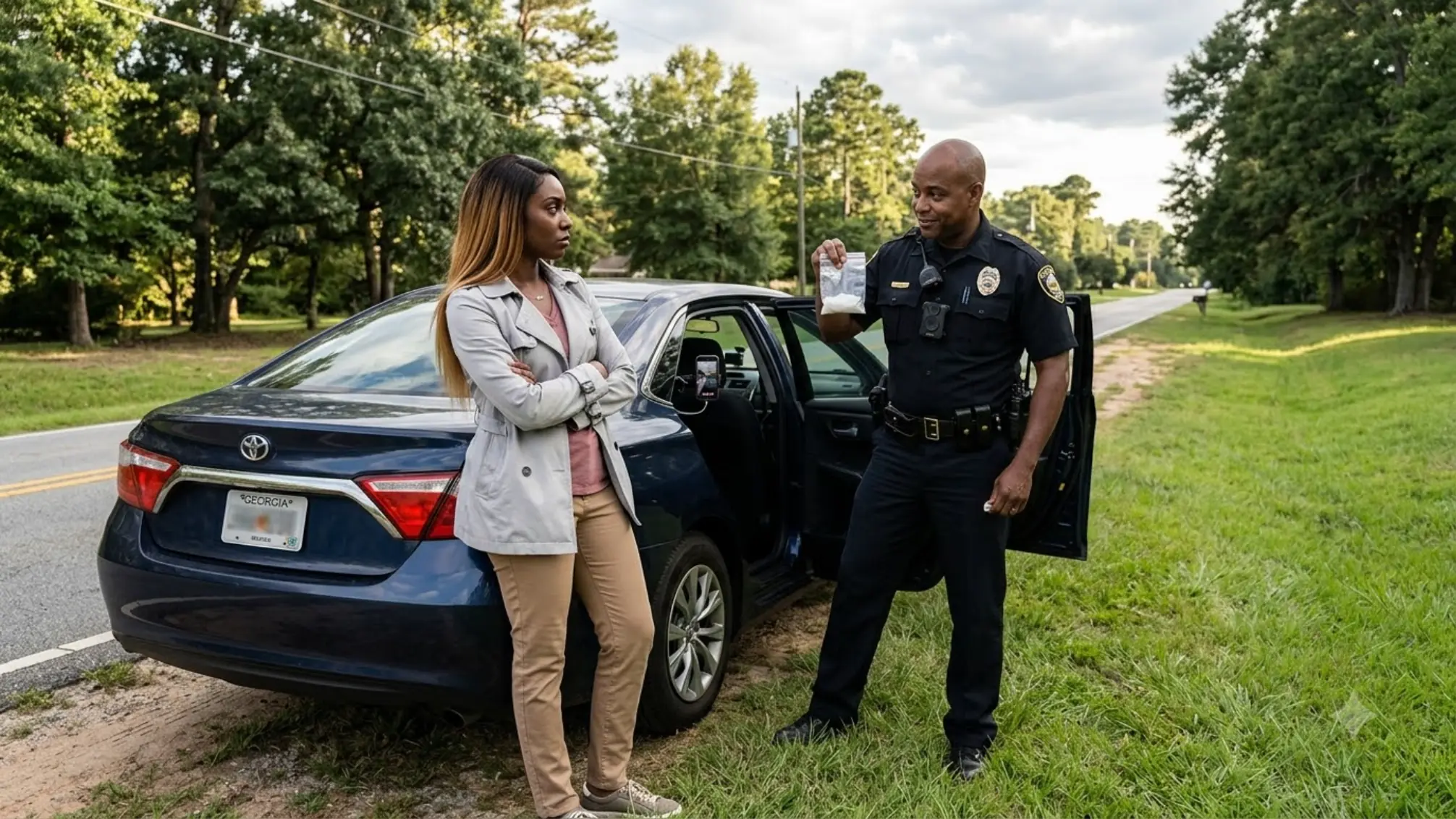
She signaled, slowed, and pulled safely onto the shoulder.
Before the officer even stepped from his cruiser, she reached for her phone.
Not because she expected trouble.
Because three years working as an insurance-fraud investigator had taught her that memory was unreliable, but recordings were not.
She placed the phone inside a narrow compartment between the passenger seat and center console, positioning the camera toward the rear passenger area. The screen remained dark enough to be nearly invisible, but the lens had a clear view of the open doorway.
Then she lowered her window.
The officer approached.
He was a bald Black man in his early fifties with a heavy build, broad shoulders, and a patrol uniform stretched tightly across his chest. His badge reflected sunlight. A body camera sat on the front of his uniform, but the small indicator light appeared dark.
“License.”
No greeting.
No explanation.
The woman looked at him.
“May I ask why you stopped me?”
“License first.”
She handed it over.
The officer studied it far longer than necessary.
Then he looked at her registration.
“You know your left brake light is out?”
The woman glanced toward the side mirror.
“It was working when I left ten minutes ago.”
“It isn’t now.”
“All right.”
The officer stared at her.
“You nervous?”
“No.”
“You sure?”
“Yes.”
That answer seemed to irritate him.
He leaned slightly toward the window.
“Where are you coming from?”
“My mother’s house.”
“Where does she live?”
The woman paused.
“Is that related to the taillight?”
The officer smiled without warmth.
“Just making conversation.”
She said nothing.
The silence stretched.
Finally he returned her license.
“Step out.”
Her eyes narrowed.
“Why?”
“I smell something.”
“What?”
The officer tilted his head.
“You know what.”
“No, I don’t.”
He stepped back.
“Out of the car.”
She remained calm.
“I don’t have drugs in my vehicle.”
“Didn’t say you did.”
“You said you smelled something.”
“Correct.”
“What exactly?”
His patience disappeared.
“Ma’am, get out of the vehicle.”
She looked at his body camera.
“Is your camera recording?”
His eyes changed slightly.
“It activates automatically.”
That was not an answer.
Still, she did not argue.
She opened the door and stepped onto the shoulder.
Her phone remained recording inside.
The officer directed her toward the rear of the sedan and asked her to stand beside the trunk.
She crossed her arms.
“What happens now?”
“I’m checking the vehicle.”
“I haven’t given you permission.”
“I don’t need it.”
The woman looked directly at him.
“Then please state the legal basis for the search.”
The officer laughed once.
“You a lawyer?”
“No.”
“Then let me do my job.”
He opened the driver’s door.
She watched.
At first, the search seemed almost legitimate.
He checked beneath the front seat.
Opened the glove compartment.
Looked inside the center console.
Then he moved toward the rear passenger door.
The woman shifted slightly so she could still see his shoulders and arms.
The officer bent inside.
For several seconds, almost his entire upper body disappeared behind the door frame.
Then something caught her attention.
His right hand moved toward his belt before disappearing into the vehicle.
Not toward his flashlight.
Not toward his radio.
Toward a small utility pouch.
The woman’s expression changed.
She said nothing.
The officer remained inside the car for several more seconds.
Then he rose.
Something was pinched between his fingers.
A tiny clear plastic bag.
White powder sat inside.
His face changed instantly.
Not surprise.
Satisfaction.
He turned toward her, raising the bag.
“Well, look what I just found inside.”
The woman stared at him.
She did not gasp.
She did not plead.
She did not ask what it was.
Instead, her eyes dropped toward his hand.
Then back to his face.
“Good.”
The officer frowned.
She nodded toward the bag.
“Hold it higher.”
“What?”
“So my camera gets your fingerprints.”
The smile disappeared from his face.
“What camera?”
The woman looked toward the open rear door.
“The one that watched you put it there.”
For the first time since the stop began, the officer looked afraid.
He glanced inside the vehicle.
Then toward her.
“You need to be very careful what you’re accusing me of.”
“I didn’t accuse you.”
She uncrossed her arms.
“I said the camera recorded you.”
The officer moved toward the open door.
The woman immediately stepped sideways.
“Don’t touch my phone.”
“I’m securing evidence.”
“My phone isn’t evidence against me.”
“It is now.”
She stared at him.
“Then wait for your supervisor.”
The officer stopped.
“Supervisor?”
“Yes.”
“You don’t get to decide that.”
“No.”
She pulled a second phone from her jacket pocket.
“But dispatch does.”
The officer’s face tightened.
She had already started the call.
“911. What is your emergency?”
The woman kept her eyes locked on the officer.
“I’m on the shoulder of Cedar Ridge Parkway near the old pharmacy. I was stopped by an officer who just searched my vehicle. I believe the search was recorded by my interior camera, and I want a supervisor present before anybody touches the recording device.”
The officer stepped toward her.
“Hang up.”
She moved backward.
The dispatcher heard him.
“Ma’am, is the officer ordering you to disconnect?”
“Yes.”
“Do not interfere with the officer, but remain on the line if it is safe.”
The officer pointed toward her phone.
“End the call.”
“No.”
His voice hardened.
“You’re making this worse.”
The woman looked at him.
“For who?”
Thirty seconds later, the officer walked toward his cruiser.
He spoke rapidly into his radio.
The woman could not hear everything, but one phrase was clear.
“Uncooperative subject.”
She almost laughed.
She was standing exactly where he had told her.
Hands visible.
Voice controlled.
No aggression.
But now she was “uncooperative.”
Ten minutes later, another patrol cruiser arrived.
Then another.
The first person to approach was a female lieutenant in her forties.
She looked from the officer to the woman.
“What happened?”
The officer answered first.
“Traffic stop. Probable cause search. Located suspected narcotics in the rear compartment. Driver became argumentative and claimed I planted it.”
The lieutenant looked at the woman.
“Is that accurate?”
“Almost.”
The officer glared.
The woman continued.
“He searched the car. Then he came out holding that bag. I told him my interior camera recorded the search.”
The lieutenant immediately looked at the sedan.
“You have a camera inside?”
“Yes.”
“Where?”
“Between the passenger seat and console.”
The officer interrupted.
“She could have recorded anything before the stop.”
The lieutenant looked at him.
“That’s why we check the timestamp.”
Silence.
The lieutenant turned toward another officer.
“Body camera status?”
The first officer answered quickly.
“Technical issue.”
The lieutenant looked at his chest.
“You didn’t activate?”
“It failed.”
“Before or after the stop?”
The officer hesitated.
The lieutenant’s expression changed.
She held out her hand.
“Give me the evidence bag.”
He did.
She did not open it.
She placed it into a larger temporary evidence envelope.
Then she looked toward the woman.
“Can you retrieve the recording without disturbing anything else?”
“Yes.”
The woman approached the car carefully.
The phone was still recording.
She stopped the video.
Then she held the screen where the lieutenant could see.
The first frame showed the empty rear compartment.
The officer stood several feet away.
Nobody spoke.
The woman dragged the playback bar forward.
The officer entered the frame.
His upper body leaned into the rear seat.
His right hand disappeared.
Then came back.
The angle was imperfect.
But clear enough.
His hand moved from his belt area.
Then toward the gap beside the rear seat.
Seconds later, he reached into the exact same location.
And removed the plastic bag.
The lieutenant watched the clip twice.
The officer interrupted.
“That proves nothing.”
Nobody answered.
“It doesn’t show what was in my hand.”
The lieutenant looked at him.
“Why did your hand go to your utility pouch?”
“I was adjusting equipment.”
“Inside somebody’s vehicle?”
The officer’s voice rose.
“This is ridiculous.”
The lieutenant turned toward another patrolman.
“Call Internal Affairs.”
The first officer stepped forward.
“For what?”
“Now.”
The atmosphere changed.
The officer who had controlled the entire encounter was suddenly surrounded by people who were no longer treating his version as unquestioned fact.
He pointed toward the woman.
“She’s manipulating this.”
The woman said nothing.
The lieutenant looked at the supposed narcotics.
Then toward the car.
“Was the bag photographed in place before removal?”
The officer stopped.
“No.”
“Why?”
“I located it and secured it.”
“Did anyone else see it inside the vehicle?”
“No.”
“Did you wear gloves?”
“No.”
The lieutenant stared at him.
“Did you call for a witness before collecting suspected narcotics from a contested search?”
“No.”
One word at a time, his story collapsed.
But the woman was not celebrating.
Something bothered her.
The officer had looked far too comfortable.
He had not hesitated before producing the bag.
He had not behaved like a man making an impulsive mistake.
He had behaved like someone following a routine.
She looked toward the lieutenant.
“Can I ask something?”
“What?”
“How many traffic stops has he made where narcotics were found exactly like this?”
The lieutenant froze.
The officer’s face changed.
That was enough.
The woman saw it.
“So this isn’t the first time.”
The officer snapped.
“You don’t know anything.”
“No.”
She looked directly at him.
“But you just answered the question.”
Internal Affairs arrived forty minutes later.
The roadside became a controlled scene.
The sedan was photographed.
The bag was separately documented.
The woman’s video was copied without surrendering the original device.
The officer was ordered to remain away from both the vehicle and the evidence.
Then an investigator asked the question that made everything larger.
“Have you ever encountered this officer before?”
The woman shook her head.
“No.”
“Any reason he would target you?”
“None.”
That was worse.
A personal grudge could explain one fabricated stop.
No connection suggested something else.
Routine.
The Internal Affairs investigator requested the officer’s recent arrest history before leaving the scene.
By midnight, five cases had attracted attention.
By the following afternoon, there were eleven.
Within a week, the number reached twenty-three.
Different drivers.
Different neighborhoods.
Different circumstances.
But patterns repeated.
A traffic violation initiated the stop.
The officer claimed to smell narcotics.
A vehicle search followed.
A small quantity of white powder appeared in an easily accessible location.
Body-camera footage was frequently incomplete.
Sometimes the alleged equipment had “malfunctioned.”
Other times recordings began only after evidence had supposedly been found.
Three defendants had pleaded guilty rather than risk harsher sentences.
Two had lost jobs after arrests.
One woman had lost temporary custody of her child.
A college student had withdrawn from school.
And suddenly the tiny bag held beside the Black Woman’s car was no longer just about one traffic stop.
It became a question about every case the officer had touched.
The district attorney’s office opened an independent review.
Evidence logs were pulled.
Dash-camera footage was requested.
GPS records were compared with written reports.
Then investigators discovered something else.
On six occasions, the officer reported finding narcotics during stops at locations where his cruiser’s GPS showed he had remained at the driver’s side for less time than his report claimed.
One report described an eight-minute vehicle search.
The cruiser data suggested less than three.
Another report claimed a second officer witnessed the recovery.
That officer had been four miles away.
Then laboratory records exposed an even stranger pattern.
Multiple evidence bags supposedly collected months apart had been packaged in nearly identical small plastic sleeves uncommon among street-level drug sales in that area.
Investigators began examining the bags themselves.
Fingerprints.
Packaging.
Storage.
Chain of custody.
The officer was placed on administrative leave.
Red Hollow-style public judgment did not happen here.
No crowd gathered in a dusty street.
Instead, consequences arrived quietly through locked offices, subpoenas, digital records, and people reopening files everyone had assumed were finished.
The Black Woman was asked to come to the district attorney’s office.
She sat across from three investigators.
One placed a folder on the table.
“We believe your recording prevented a wrongful arrest.”
She looked at the folder.
“What about the others?”
Nobody answered immediately.
Finally, an assistant district attorney said, “We’re reviewing every case.”
“That isn’t what I asked.”
He looked at her.
She leaned forward.
“What happens to the people who didn’t have cameras?”
The question hung there.
Two months later, charges were dismissed against four former defendants.
Then three more.
One man had already served six months.
His conviction was vacated.
The woman who lost custody received a new family-court hearing after prosecutors formally informed the court that the drug case underpinning the ruling was unreliable.
The college student was contacted by an innocence clinic that helped clear his record.
The story reached local news.
Reporters called the Black Woman repeatedly.
She declined almost every interview.
Finally, she agreed to one condition.
No dramatic recreation.
No headline calling her lucky.
She sat before the camera and said something simple.
“I wasn’t lucky.”
The reporter waited.
“I had a camera.”
She continued.
“The people before me may have told the truth too. They just didn’t have video strong enough to make anyone listen.”
That line spread farther than any sensational headline.
Three months after the traffic stop, the officer was indicted on multiple charges connected to falsified evidence, false statements, and misconduct.
The investigation remained ongoing.
Additional cases were reviewed.
Supervisors were questioned about repeated body-camera failures.
Policies changed.
Officers were required to document body-camera malfunctions immediately before initiating discretionary searches whenever possible.
Evidence discovered during contested vehicle searches required additional photographic documentation before removal except where safety made that impossible.
Supervisory audits became automatic when repeated technical failures appeared in one officer’s record.
But the Black Woman cared most about one particular meeting.
A man in his twenties came to see her outside the courthouse.
He stood awkwardly near the steps holding a folder.
“You don’t know me.”
She shook her head.
“My case was one of his.”
She became still.
The man looked down.
“He said he found cocaine beneath my passenger seat.”
“What happened?”
“I took a plea.”
His voice tightened.
“My attorney said nobody would believe me over a cop.”
The woman looked at the folder.
“My conviction got vacated last week.”
He smiled slightly.
“I’m going back to school.”
She did not know what to say.
He held out his hand.
“Thank you.”
She shook it.
“You don’t owe me thanks.”
“I think I do.”
“No.”
She looked toward the courthouse.
“You deserved somebody to listen the first time.”
The man nodded.
Then walked away.
Months later, the Black Woman finally repaired the original reason supposedly behind the stop.
Except when the mechanic inspected the taillights, he discovered something unsurprising.
Neither bulb was damaged.
The wiring was good.
Everything worked normally.
She stood behind the sedan while the mechanic pressed the brake pedal.
Two bright red lights appeared.
“Looks fine to me.”
She smiled without humor.
“So do I.”
She drove home.
The small interior camera remained mounted beside the center console.
She considered removing it.
Instead, she upgraded it.
Front camera.
Rear camera.
Automatic cloud backup.
Not because she expected every officer to behave like the man who stopped her.
Most never would.
But that afternoon had taught her something deeper than distrust.
Power without documentation depended heavily on whose story was believed.
And sometimes a tiny lens could shift that balance.
Nearly a year after the stop, she received a final letter from the district attorney.
Seventeen convictions had been vacated or dismissed.
Several pending prosecutions were terminated.
Civil claims were underway.
The former officer was awaiting trial.
Two supervisors had resigned after investigators concluded warning signs had been overlooked.
The department had adopted new evidence-search procedures.
The woman read the letter twice.
Then placed it inside a drawer.
Her mother called later.
“You finally done with all that?”
The woman looked through her apartment window toward the city.
“I think so.”
“You okay?”
She considered the question.
“Yes.”
Then she smiled.
“Mostly.”
Her mother laughed softly.
“That sounds like you.”
The woman looked toward the phone that had recorded everything.
The original video remained backed up in three places.
She had watched it dozens of times during the investigation.
Eventually she stopped.
There was one moment she could remember without seeing it.
The officer emerging from her car.
That smug expression.
The plastic bag raised between his fingers.
Well, look what I just found inside.
He had believed that sentence ended the story.
Instead, it began one.
Because for once, the person standing on the roadside had something stronger than an accusation.
She had the seconds before the “discovery.”
The movement of his hand.
The empty seat.
The hidden camera.
And a record that refused to change its story.
The officer had thought he had found evidence.
He never realized she already had the evidence that mattered.