The black Range Rover rolled through Pine Creek, Alabama, at exactly thirty-five miles per hour, obeying every posted sign along the quiet stretch of Main Street. Behind the wheel sat Kendrick Voss, a forty-two-year-old Black man with a broad athletic build, close-cropped hair, and the calm expression of someone accustomed to noticing danger before danger noticed him. Beside him sat his sister Serena Voss, an elegant Black woman in a cream pinstripe blazer, checking directions on her phone while the air conditioner fought the brutal summer heat. Neither of them knew that Officer Bryce Callahan had already decided what they were before he ever activated his lights.
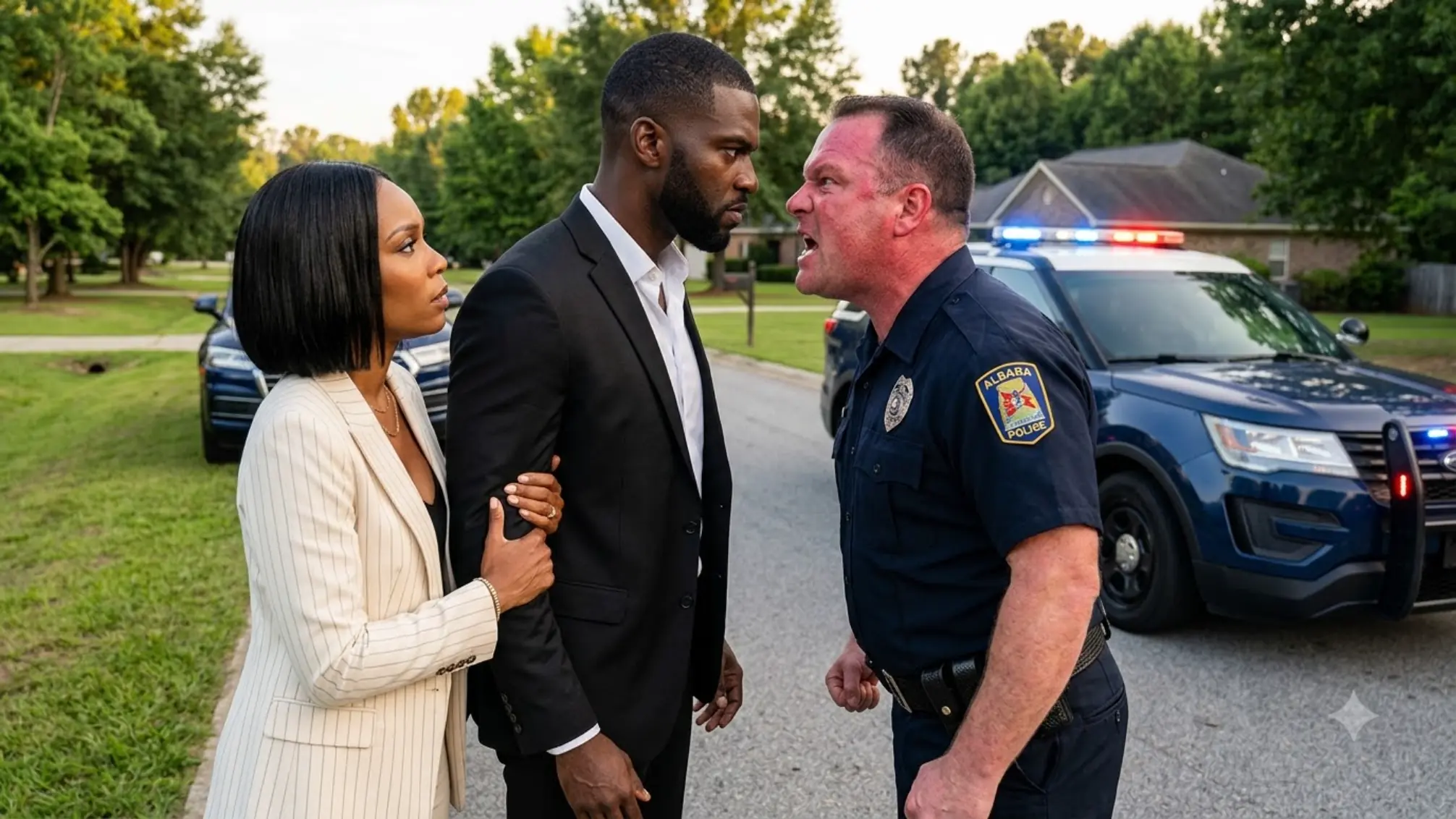
Bryce had been sitting beneath an old roadside billboard for almost forty minutes, bored enough that every passing vehicle had started looking like an excuse to do something. He was forty-five, thick through the middle, with a retreating buzz cut and the swagger of a man who had spent twenty years learning exactly how much authority a small town would let him abuse. When the expensive SUV passed, he saw Kendrick first, then Serena, and something ugly settled immediately in his mind. They were Black, the vehicle looked expensive, and that was enough for Bryce to manufacture suspicion before a single law had been broken.
He pulled out behind them without checking the registration. Kendrick noticed the cruiser instantly and watched it in the mirror, but he did not change speed or direction. Serena looked up from her phone when the red and blue lights appeared behind them. Kendrick activated his signal, slowed carefully, and pulled onto the shoulder near a small church.
“Here we go,” Serena said quietly.
Kendrick switched off the engine. “Let him talk first.”
They had not come to Pine Creek by accident. For almost five months, Kendrick’s federal task force had been tracing suspicious financial transfers involving a local attorney, towing companies, municipal contracts, and law enforcement officers. Serena, a senior civil-rights prosecutor, had joined the operation after several complaints suggested that motorists were being targeted, detained, charged, and then directed toward the same local legal network. Their identities were known to only a handful of officials, because somebody inside Pine Creek had already leaked information during an earlier attempt to investigate the town.
Bryce approached the passenger side and struck the window three times with his knuckles. Serena lowered the glass halfway and looked directly at him. His uniform was dark with sweat, and his hand rested far too comfortably near his belt.
“License and registration.”
Serena did not move.
“Why did you stop us?”
Bryce’s expression hardened immediately. He did not like being questioned, especially by someone who showed no fear.
“I asked for documents.”
Kendrick turned slightly toward him. “We were doing the speed limit.”
Bryce leaned toward the open window.
“Do you know why I pulled you over?”
“No,” Kendrick said. “That’s why she asked.”
Bryce looked at the windshield and invented the first explanation that came to him.
“Obstructed view.”
Serena glanced toward the mirror.
“Nothing is hanging from it.”
Bryce’s face tightened.
“Don’t get smart with me.”
Kendrick had seen enough stops go wrong to understand what was happening. The officer was not investigating anything. He was trying to provoke resistance, searching for behavior he could later describe as threatening or suspicious. Kendrick kept his hands visible on the steering wheel.
“Officer, you asked for identification. I’m going to reach for my wallet.”
The moment Kendrick moved toward the center console, Bryce jumped backward.
“Hands! Keep your hands where I can see them!”
Kendrick froze.
“You told me to get my ID.”
“I don’t know what you’re reaching for.”
Serena’s eyes narrowed.
“This is unnecessary.”
Bryce snapped toward her.
“Both of you, out of the car.”
“Are we being detained?” Serena asked.
“You are now.”
“For what?”
Bryce pointed toward the door.
“Get out before I drag you out.”
Kendrick looked at Serena.
One glance passed between them.
Not fear.
Protocol.
They stepped from the vehicle and stood beside the hood with their hands visible. Bryce ordered Kendrick to spread his feet, then performed an aggressive pat-down while continuing to talk as though he had already discovered a crime. His hands found Kendrick’s wallet and tossed it onto the hood without opening it.
“There,” Kendrick said. “That contains the identification you demanded.”
Bryce ignored him.
He moved toward Serena.
She turned slightly.
“I do not consent to a search.”
“You’re acting nervous.”
“No, I’m objecting.”
“Same thing.”
“No, Officer. It isn’t.”
Bryce leaned closer.
“You’re in Pine Creek now. The Constitution ends at the county line. I can do whatever I want.”
For a second Serena thought she had misheard him.
Then she remembered the body camera.
Her expression became almost peaceful.
“Say that again.”
Bryce did not understand why.
He grabbed her arm and turned her toward the SUV.
Kendrick’s voice dropped.
“Take your hand off her.”
Bryce turned.
“You threatening me?”
“No.”
Kendrick’s eyes were hard now.
“I’m telling you to follow the law.”
Bryce smiled.
“I am the law here.”
Serena closed her eyes briefly.
The investigation had just stopped being theoretical.
Bryce walked toward the Range Rover.
“You cannot search the vehicle without legal justification,” Serena called.
Bryce opened the driver’s door anyway.
“I smell marijuana.”
Kendrick laughed once.
It was not amusement.
“You’re lying.”
“Tell it to the judge.”
Bryce searched the console, glove box, floor compartments, and seat pockets. He found charging cables, sunglasses, rental documents, bottled water, and nothing else. Frustration grew until he reached beneath the driver’s seat and felt cold metal.
His expression changed.
He pulled out a legally secured handgun.
“Gun!”
He turned toward Kendrick and raised his service weapon.
“On the ground!”
Kendrick did not move suddenly.
“That firearm is legal.”
“Get down!”
“Check my wallet.”
“I don’t care about your fake IDs.”
Serena spoke carefully.
“Officer, open the wallet you threw onto the hood.”
Bryce ignored her.
He called for backup instead.
Within minutes, two more patrol cars arrived. Officer Riley and Deputy Ellis rushed toward Kendrick and Serena, responding to Bryce’s description of two armed suspects who had resisted detention. Kendrick remained completely still while Riley twisted his arm behind his back.
“I’m a federal agent,” Kendrick said loudly.
Riley paused.
Bryce shouted from behind him.
“He’s lying. Cuff him.”
Kendrick continued.
“My credentials are inside the wallet on that hood.”
Riley looked toward Bryce.
“You checked them?”
“They’re fake.”
“You checked?”
Bryce’s face reddened.
“Do your job.”
Riley hesitated, then closed the cuffs around Kendrick’s wrists.
Serena allowed Ellis to cuff her without fighting.
Her eyes never left Bryce.
“Open the wallet,” she said.
Something in her tone finally unsettled Riley.
“Bryce, maybe we should verify.”
Bryce grabbed the wallet angrily.
“Fine.”
He flipped it open.
The change in his face was immediate.
The gold shield reflected sunlight directly into his eyes.
Bryce blinked.
He looked at the identification beside it.
Then again.
Kendrick Voss. Federal Bureau of Investigation. Special Agent in Charge.
His fingers began shaking.
Kendrick watched him.
“Now check Serena.”
Bryce looked toward her.
She said nothing.
He walked to the Range Rover, found her credentials, and opened them.
The words seemed heavier than the badge itself.
United States Department of Justice. Civil Rights Division. Senior Prosecutor.
Riley slowly released his grip on Kendrick’s arm.
“Bryce?”
Bryce closed the badge case.
His mind raced.
Apologize.
Uncuff them.
End the stop.
Those were the obvious choices.
But accepting the truth meant admitting everything before it had been wrong.
And men like Bryce often preferred doubling down to backing down.
“They’re fake.”
Riley stared at him.
“What?”
“Good counterfeits.”
Kendrick almost smiled.
Serena did not.
Bryce pointed toward the cruiser.
“Take them in.”
Riley’s face had gone pale.
“Bryce—”
“I said take them in.”
Kendrick looked at the cameras mounted on the cruisers.
Then at Bryce.
“You're making a mistake that will cost you everything.”
Bryce stepped toward him.
“I’m tired of threats.”
“That wasn’t a threat.”
Kendrick’s voice remained calm.
“It was notice.”
The drive to the Pine Creek Police Department took less than ten minutes. Kendrick and Serena sat cuffed in the back of Riley’s cruiser while Riley repeatedly checked them in the rearview mirror. Kendrick was too large for the cramped seat and had to angle his knees awkwardly against the partition.
Riley finally spoke.
“You really federal?”
“Yes.”
“Bryce says those badges are counterfeit.”
“Then verify the number.”
Riley swallowed.
“You could be lying.”
“You could call Atlanta before you reach the station.”
Riley said nothing.
Serena looked toward him.
“Officer Riley, there’s a difference between making an initial mistake and choosing to protect it after the facts change.”
Riley’s hands tightened around the steering wheel.
“That’s not how this works.”
“That is exactly how this works.”
By the time they arrived, Bryce was already inside controlling the story. He stood beside the booking counter describing Kendrick and Serena as suspected drug traffickers carrying counterfeit federal credentials and an illegal firearm. Sergeant Frank, an older desk officer with reading glasses and a permanent expression of exhaustion, picked up Kendrick’s badge and immediately frowned.
“You verify this?”
Bryce waved dismissively.
“Look at them.”
Frank looked at Kendrick.
Then Serena.
“That doesn’t answer me.”
Bryce slammed his palm against the counter.
“They’re sophisticated criminals.”
Serena stepped forward despite the cuffs.
“My name is Serena Voss. Verify my credentials through the Department of Justice.”
Bryce laughed.
“I’m booking you as Jane Doe.”
“You already know my name.”
“You gave me a name.”
Serena leaned slightly toward him.
“Every second you refuse verification becomes additional evidence.”
Bryce’s expression hardened.
“Strip search them.”
The booking room became silent.
Officer Tara, who had been completing paperwork near the back wall, looked up sharply.
“I’m not doing that.”
Bryce turned.
“What?”
“I said no.”
“They may be carrying narcotics.”
Tara stared at Serena’s tailored blazer, handcuffs, and federal credentials sitting on the counter.
“You have nothing supporting that.”
“This is insubordination.”
Serena watched the room.
The corruption she and Kendrick had come to investigate was beginning to separate people into two categories.
Those who followed Bryce because challenging him was inconvenient.
And those finally deciding the inconvenience was worth it.
Before the argument could continue, Police Chief Wade Garrick entered the booking room.
“What is all this noise?”
Bryce hurried toward him.
“Chief, I caught two serious suspects. Armed. Fake badges. Possible trafficking.”
Garrick picked up Kendrick’s credentials.
He studied the weight, security features, embedded identification elements, and engraving.
His expression changed.
“Callahan.”
“Yes, Chief.”
“Did you run this?”
“It’s fake.”
“That wasn’t my question.”
Bryce said nothing.
Garrick looked toward Kendrick.
“Who are you?”
“Special Agent in Charge Kendrick Voss, Atlanta Field Office.”
Garrick’s eyes moved toward Serena.
“And you?”
“Senior prosecutor, Civil Rights Division.”
The chief looked again at their cuffs.
Then toward Bryce.
“Take those off.”
Bryce stepped forward.
“No.”
Everybody turned.
Garrick’s eyebrows rose.
“Excuse me?”
“They’re mine.”
“Your what?”
“My arrests.”
Kendrick finally smiled.
Not because the situation was funny.
Because Bryce had just said something revealing.
Garrick pointed toward Riley.
“Uncuff them.”
Riley immediately moved.
Bryce’s hand went toward his taser.
“Don’t.”
Riley froze.
Bryce pulled the device free.
“Nobody touches them until I say.”
The station seemed to hold its breath.
Kendrick looked directly at him.
“This is the moment you decide how much worse this becomes.”
Bryce’s hand trembled.
“Shut up.”
“You already have illegal detention, unlawful search, false arrest, interference with federal officers, and potentially deprivation of civil rights.”
“Stop talking!”
Kendrick continued.
“You use that weapon now, you add another line.”
Chief Garrick stepped sideways.
“Bryce, put it down.”
For the first time, Bryce realized nobody in the room stood beside him.
Tara had backed away.
Frank stared at him with disgust.
Riley’s hand hovered uncertainly near his own belt.
Even Garrick, a man who had protected Bryce through years of complaints, was now looking at him like a liability.
Bryce lowered the taser.
“Uncuff them,” Garrick said again.
The restraints came off.
Kendrick rubbed his wrists.
Serena immediately reached for her phone.
Bryce watched her.
“What are you doing?”
“Documenting the scene.”
“You’re not allowed—”
Serena looked at him.
The sentence died.
Kendrick retrieved his own phone.
He dialed one number.
“Director’s office.”
“This is Kendrick Voss. Pine Creek. Code Red.”
The voice on the other end changed instantly.
“Status?”
“We're secure for the moment. Local officers intercepted us. Illegal search, firearm seizure, false imprisonment.”
“Team is staged nearby.”
Kendrick looked toward Bryce.
“Bring them.”
He ended the call.
Bryce’s face lost the remaining color.
“Team?”
Kendrick slipped the phone into his pocket.
“You think Serena and I drove alone into a town under federal investigation?”
Nobody spoke.
Then Kendrick said the sentence that finally broke the room open.
“We weren't passing through Pine Creek.”
Bryce stared.
“You pulled over the people investigating you.”
The first sirens arrived minutes later.
Then more.
Black SUVs filled the parking lot.
Federal agents entered alongside state investigators and prosecutors already assigned to the corruption task force. They did not come because one officer made a terrible traffic stop.
They came because Bryce had accidentally triggered an operation that had been waiting for enough verified evidence to move.
Computers were secured.
Evidence rooms were sealed.
Financial records were collected.
Chief Garrick was separated from the officers.
Bryce stood near the booking counter in stunned silence while Kendrick spoke with the arriving task-force commander.
Then Serena approached him.
“You said the Constitution ended at the county line.”
Bryce swallowed.
“I was angry.”
“You also claimed you smelled marijuana.”
“I thought I did.”
“You found nothing.”
“That happens.”
“You refused to verify federal credentials.”
“They looked suspicious.”
Serena stared.
“Based on what?”
Bryce had no answer that would survive being spoken aloud.
Agents placed him in cuffs.
For the first time in his career, Bryce felt what it was like to have authority exercised against him by people who did not care whether he felt embarrassed.
Kendrick stopped one agent.
“Easy.”
Bryce looked confused.
Kendrick continued.
“He gets procedure.”
That hurt Bryce more than rough treatment would have.
The investigation expanded rapidly.
The traffic stop alone would have created serious consequences, but Bryce’s records opened another door. Investigators found unexplained payments linked to attorney Arthur Langley, the same lawyer whose billboard stood above Bryce’s preferred speed trap.
Langley had been paying local officers for years.
The system was simple.
Certain motorists, particularly outsiders driving expensive vehicles, were stopped under questionable circumstances.
Some received inflated towing bills.
Others were arrested on shaky charges.
Langley’s associates contacted them quickly, offering legal representation.
Civil claims were later settled with the city or insurance carriers.
Money moved.
Everyone took a piece.
Bryce was one of the most aggressive participants.
Once Langley realized federal investigators had the banking records, he cooperated.
His testimony changed everything.
Bryce had not merely developed bad habits.
He had monetized them.
Months later, inside the federal courthouse in Birmingham, Bryce sat beside a public defender while prosecutors played his own dashcam footage before the court.
The stop began innocently enough.
A Range Rover driving legally.
Bryce pulling behind it.
No traffic violation.
Then the audio.
“Don’t get smart with me.”
Then the invented obstruction.
Then the invented smell.
Then:
“The Constitution ends at the county line.”
Bryce stared at the table.
He had forgotten saying it.
Everyone else remembered.
Langley testified next.
He described payments.
Names.
Targeting patterns.
Officers who participated.
Officials who ignored complaints.
Then came the question Bryce feared.
“Did Officer Callahan prefer particular motorists?”
Langley hesitated.
“Yes.”
“Who?”
“Black drivers.”
The courtroom became silent.
Langley continued.
“Bryce believed they were easier to intimidate and less likely to win credibility disputes in local court.”
Kendrick sat beside Serena in the gallery.
Neither celebrated.
The testimony confirmed exactly why their task force had existed.
Bryce was convicted on multiple federal counts relating to civil-rights violations, corruption, false reporting, and the broader scheme.
His career ended.
His pension became part of a separate legal dispute.
His property was examined for proceeds connected to corrupt payments.
But the larger investigation did not stop with him.
Bryce eventually cooperated.
His information implicated officials who had spent years believing the patrolman would absorb every consequence alone.
A judge who routinely approved questionable warrants came under investigation.
A towing-company owner was charged.
Langley faced prosecution despite cooperating.
Chief Garrick’s conduct was examined.
Several officers kept their jobs only after providing complete testimony and accepting discipline.
Pine Creek’s entire enforcement structure was reorganized.
Traffic-stop audits became mandatory.
Bodycam failures triggered automatic review.
Searches required clearer documentation.
Complaints could bypass local command and go directly to an outside oversight office.
The reforms were not dramatic.
They were paperwork.
Training.
Audits.
Supervision.
Exactly the boring things Bryce had learned to manipulate because nobody had been paying close attention.
Six months after the trial, Kendrick and Serena drove through Pine Creek again.
Not in the Range Rover.
A dark blue government SUV carried them along the same stretch of Main Street where Bryce had first seen them.
Serena looked toward the old billboard.
Langley’s advertisement was gone.
“What’s replacing it?”
Kendrick looked.
A blank frame stood against the Alabama sky.
“Hopefully nothing.”
Serena smiled.
“You really hated that billboard.”
“I hated the lawyer.”
They passed the church where the stop had begun.
Kendrick slowed slightly.
Serena noticed.
“Thinking about it?”
“Yes.”
“You stayed calmer than I expected.”
Kendrick glanced toward her.
“You didn’t.”
“I was perfectly calm.”
“You told him exactly which federal statute he was violating.”
“That was educational.”
Kendrick laughed.
Then Serena became serious.
“You know what bothers me?”
“What?”
“We had badges.”
He understood immediately.
Kendrick looked toward the road ahead.
“We had people waiting ten minutes away.”
“Yes.”
“We had lawyers.”
“Yes.”
“And if we hadn’t?”
Serena looked out the window.
“How many people before us did everything right and still had nobody coming?”
Neither spoke for a while.
That question became the part of the case Kendrick remembered longest.
People loved the badge reveal.
The shocked officer.
The federal convoy.
The corrupt network collapsing.
Those details made good headlines.
But the badge was never supposed to be the reason Kendrick deserved lawful treatment.
He deserved it before Bryce opened the wallet.
Serena deserved it before he saw her credentials.
Any driver would have.
That became the central message of their final report.
Rights do not become stronger because the person holding them has power.
Years later, Pine Creek still talked about the day Bryce Callahan stopped the wrong SUV.
Some people called it karma.
Others called it justice.
Kendrick disliked both descriptions.
Karma sounded accidental.
Justice sounded cleaner than the reality.
What actually happened was simpler.
A man with authority became so accustomed to nobody challenging his assumptions that he stopped checking whether they were true.
Then one afternoon, he encountered two people with enough evidence, enough preparation, and enough institutional power to force everyone else to look.
Bryce thought the badge on his chest made him untouchable.
He learned that badges were supposed to represent responsibility, not permission.
And Kendrick never forgot the look on Bryce’s face when the gold federal shield opened on the hood of that Range Rover.
Not because it proved Kendrick was important.
Because it revealed something much worse.
Bryce had been perfectly comfortable abusing someone he believed was not.