Brett Kellen pushed open the door of Magnolia Road Diner and walked straight to the register. He unclipped the police badge from his belt and put it down hard on the wooden counter. Property belonging to the police department is inside this diner.
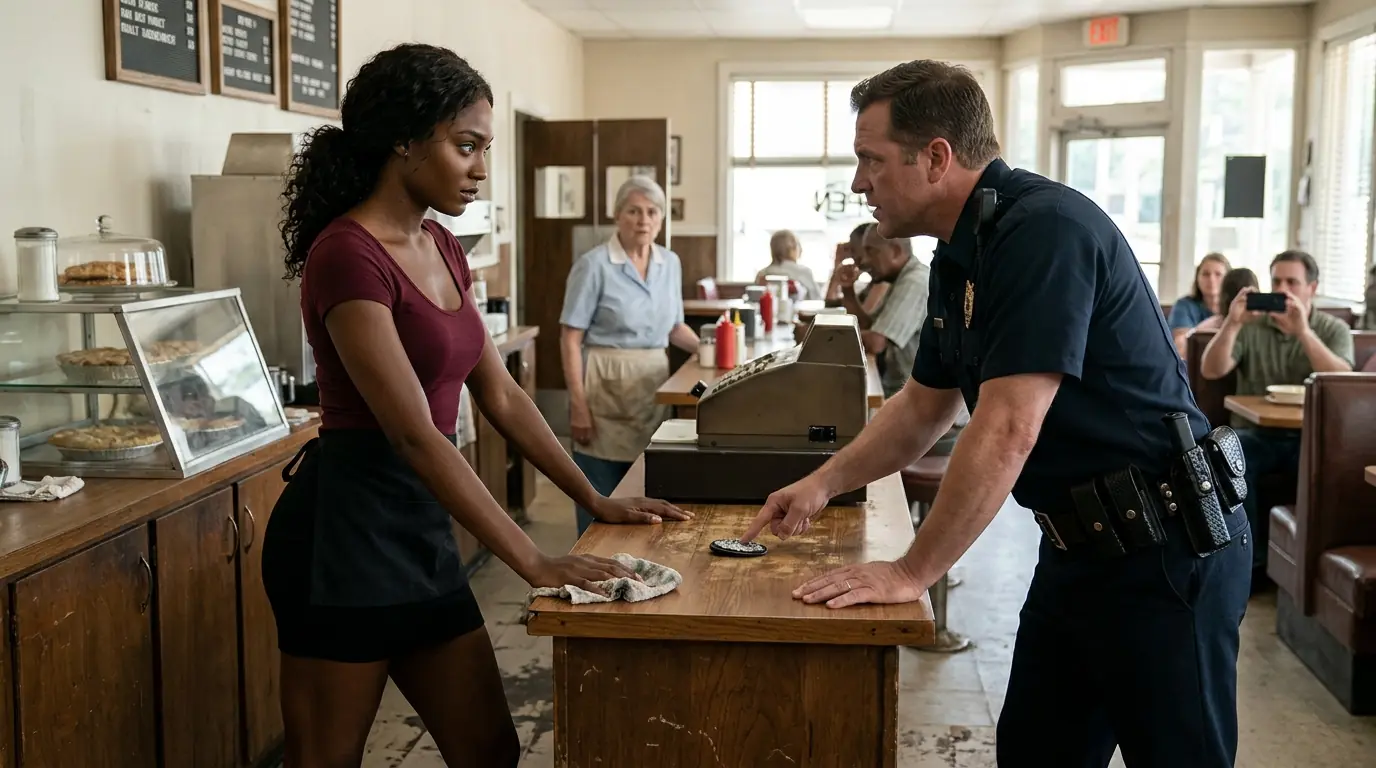
Hand it over now. Daniel Ruiz lowered his water glass. Eli Barnes shifted deeper into his booth.
At the rear of the diner, Caleb Ross placed both hands on his table and watched Brett carefully. Maya Williams dropped the cleaning rag onto the counter and faced him. There is nothing in this diner that belongs to the police department.
Brett leaned closer. "You know exactly why I'm here." Maya pointed toward the rules sign on the wall. "You don't have a search warrant." Brett turned toward the front door.
"Anyone who walks out that door gets their name added to the suspect list in my report." Daniel pulled his hand away from the counter, but no one stood up. Brett came around the end of the counter, grabbed the edge of Maya's apron, and pulled it toward him. "Empty every pocket onto the counter." Maya pushed his hand away and stepped back without lowering her eyes.
You are unlawfully interfering with my shift." Brett moved closer. "I'm giving you a chance to handle this problem yourself." Maya remained where she was. "Put the badge back on your belt and leave the diner." Brett did not respond immediately.
The badge hitting the counter was the moment everyone else realized the evening had changed. For Maya, the change had begun hours earlier, when her phone vibrated during the lull before the dinner rush and displayed a message from a number she did not recognize. The message was short enough to read twice without moving her thumb: information connected to the old record would be left at Magnolia Road Diner that night.
She had stared at the screen until it dimmed. No name. No explanation. No demand that she reply. The message did not tell her who had the information, how it had been obtained, or what form it would take. It only told her where something would appear and tied it to a record she had spent months trying not to think about.
Maya had almost shown Ruth. She had even walked halfway toward the kitchen with the phone in her hand, then stopped because every version of the conversation sounded reckless. Ruth had hired her months earlier because Maya needed ordinary work, ordinary hours, and a place where nobody cared that she once knew how an evidence-management system stored revision history. Dragging Ruth into a police records dispute because of an anonymous message would have been the opposite of ordinary.
So Maya did what she had trained herself to do when information arrived without context: she preserved the message, noted the time, and changed nothing else. She did not reply. She did not call Brett. She did not contact anyone at the department. She came to work because she actually worked there, tied on the same apron she wore every week, wiped the same counter, carried the same plates, and tried to decide whether the safest choice was to pretend the message had never arrived.