“I told you to sit down and shut up.”
Officer Grant Morrison’s open palm struck Representative Sarah Williams across the face before the federal judge could finish raising his gavel. The sharp crack echoed through the oak-paneled courtroom, silencing lawyers, reporters, police officers, and community activists at once. Sarah’s head turned from the impact, but her body remained upright beside the witness rail.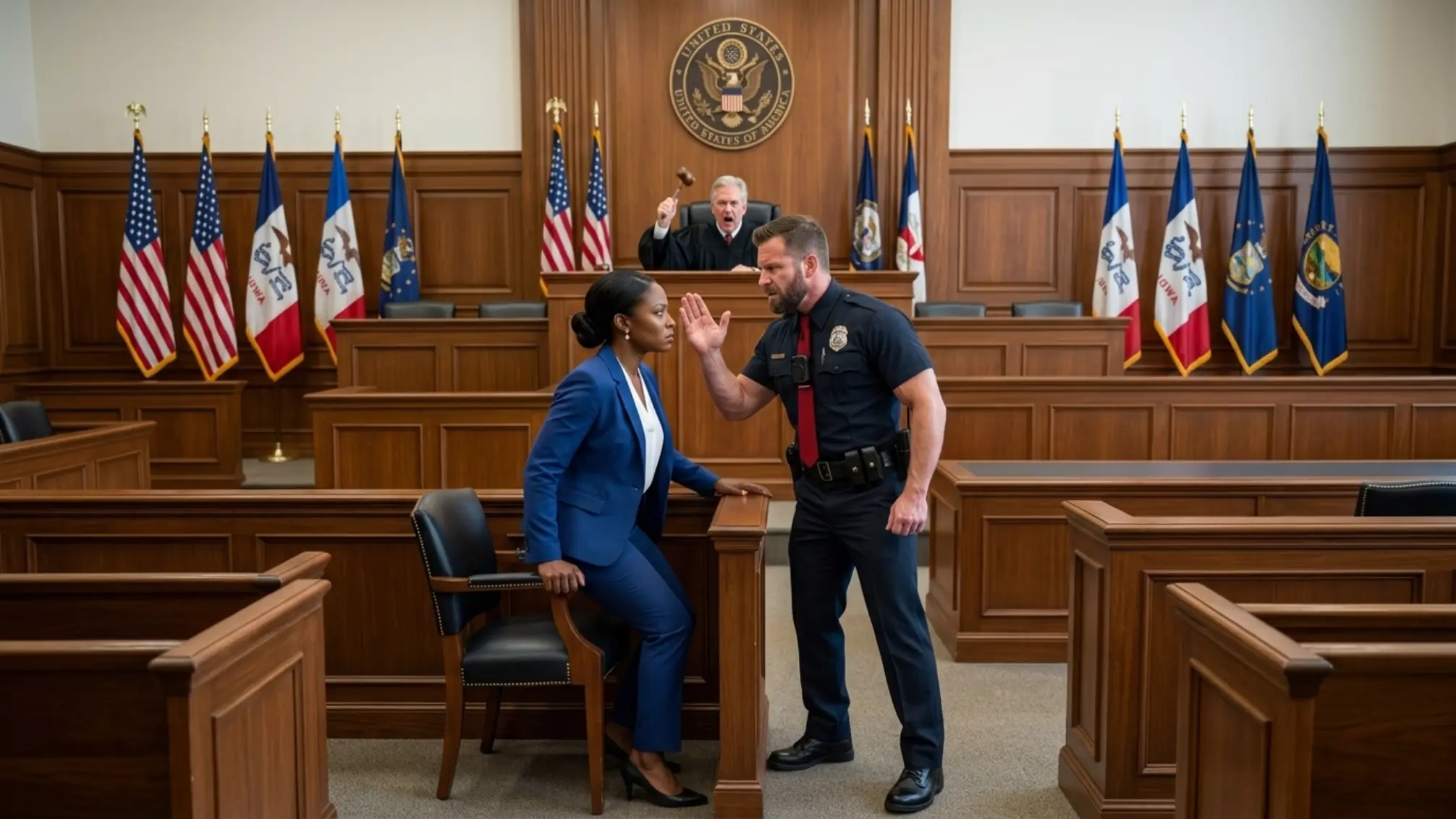
Grant leaned closer, his broad frame towering over her. “One more word, and I’ll drag you out myself.”
Sarah slowly faced him again. A red mark spread across her left cheek, but her dark-brown eyes remained steady. “Touch me twice, and that badge becomes evidence.”
Grant lifted his hand again.
He never completed the second strike.
Sarah caught his wrist, stepped inside his reach, and rotated his arm downward with the clean precision of someone who had practiced the movement thousands of times. Grant tried to overpower her, but his momentum carried him forward as she shifted her hips and swept his leg. The two-hundred-forty-pound officer crashed across the courtroom floor, his head striking the carpeted step beneath the witness stand.
He went still.
Judge Robert Halstead slammed his gavel against the bench. “Nobody move!”
Sarah released Grant’s wrist immediately and stepped backward with both hands visible. Two court marshals rushed forward, one checking the unconscious officer while the other positioned himself between Sarah and the line of police officers seated in the gallery. Every camera in the courtroom had captured the slap, the attempted second strike, and Sarah’s controlled response.
Judge Halstead stared down at the scene in disbelief. “Representative Williams, remain exactly where you are.”
“I intend to, Your Honor.”
The hearing had begun as the most politically charged proceeding the Metropolitan Federal Courthouse had hosted in years. Congress was considering the Marcus Williams Police Reform Act, legislation named after Sarah’s younger brother, who had died during a traffic stop eighteen months earlier. The hearing was intended to preserve testimony, examine disputed police records, and determine whether federal investigators had concealed evidence connected to Marcus’s death.
Instead, a uniformed officer had assaulted the bill’s sponsor in open court.
Grant Morrison was not an ordinary patrol officer. He was president of the Metropolitan Police Brotherhood, a powerful union representing more than four thousand officers across the region. He had spent months describing Sarah as anti-police, dishonest, and dangerous, though they had never spoken directly before that morning.
He had also supervised one of the officers involved in Marcus’s final traffic stop.
That connection was the reason Sarah had demanded access to the department’s internal communications. She believed Grant had pressured investigators to classify Marcus as an armed aggressor before the evidence had been fully reviewed. The department insisted its conclusions were lawful and complete.
Sarah believed someone was lying.
She had not entered politics because she enjoyed speeches, television cameras, or expensive offices. Before becoming a state representative, she had served twelve years in the United States Marine Corps, including two overseas deployments as a logistics officer attached to an expeditionary unit. She later earned a law degree, worked as a public defender, and won election after building a reputation for questioning powerful institutions without raising her voice.
Her younger brother had chosen a different path.
Marcus Williams taught eighth-grade science at Roosevelt Academy. He coached basketball on weekends, repaired old radios for fun, and called Sarah whenever he encountered a household problem he believed military training should somehow solve. He had never been arrested and had no history of violence.
He died beside his car on a rainy Thursday night.
Police initially reported that Marcus reached beneath his seat after refusing repeated commands. An officer fired four times, claiming he saw the handle of a weapon. The department announced twenty minutes later that a handgun had been recovered from the vehicle.
The body-camera footage told a more complicated story.
Marcus repeatedly said he was reaching for his registration. His hands disappeared below the dashboard for less than two seconds before gunfire erupted. The weapon police claimed to recover was found beneath a blanket in the rear cargo area, not beneath the driver’s seat.
It was also registered to the previous owner of the used vehicle.
Sarah discovered those facts only after filing multiple public-records requests. The department delayed, redacted, and denied documents until a whistleblower delivered an unedited incident log to her office. That log showed Grant Morrison entered the evidence area before the handgun was officially documented.
The timestamp made no sense.
Neither did the missing eleven minutes from the primary officer’s body camera.
Sarah introduced the Marcus Williams Police Reform Act six months later. The legislation required independent investigation of police killings, stronger evidence-preservation rules, automatic federal review when body-camera footage disappeared, and criminal penalties for knowingly altering official reports. Police unions immediately organized against it.
Grant became the loudest opponent.
He appeared on television calling Sarah a grieving opportunist who wanted to imprison officers for doing their jobs. He claimed Marcus had been a drug user, though toxicology reports showed no illegal substances. He called the proposed law an attack on public safety.
Sarah never responded personally.
She focused on records.
That restraint seemed to infuriate Grant more than any insult could have.
On the morning of the hearing, Sarah arrived wearing a royal-blue suit and carrying two thick binders. Her legal team advised her to avoid confrontation because dozens of uniformed officers planned to attend. Grant sat in the first row behind department attorneys, his muscular arms crossed and his expression openly hostile.
The hearing remained controlled for the first hour.
Federal attorneys reviewed the traffic-stop timeline, while Sarah answered questions about the proposed legislation. Community members listened from one side of the gallery, holding small photographs of people killed during police encounters. The opposite side was filled with officers wearing union pins.
Tension sharpened when Sarah’s attorney introduced an internal email.
The message had been sent by Grant fourteen minutes after Marcus died. It instructed supervisors to “lock the narrative before civilian footage creates confusion.” Another message directed officers to refer to Marcus as an armed suspect in all written communication, even though the weapon had not yet been processed.
Grant stood from his seat.
“That email is being misrepresented.”
Judge Halstead ordered him to sit.
Sarah’s attorney continued reading.
Grant interrupted again, accusing Sarah of exploiting her brother’s death. The judge warned him a second time. When Sarah rose to identify discrepancies in the evidence log, Grant walked through the gallery gate and approached the witness area without permission.
A marshal attempted to stop him.
Grant brushed past.
“You are not turning this courtroom into a circus,” he told Sarah.
Judge Halstead ordered him away from the witness rail. Sarah remained standing because the judge had not instructed her to sit and because Grant was now blocking the path to her chair.
That was when he struck her.
Now Grant lay unconscious on the floor as paramedics entered the courtroom. One examined his breathing while another stabilized his neck. After less than a minute, Grant groaned and opened his eyes.
He attempted to sit up.
The marshal pushed him gently back. “Stay down.”
Grant’s confused gaze found Sarah. “She attacked me.”
A murmur moved through the gallery.
Judge Halstead’s expression hardened. “Officer Morrison, this courtroom recording shows precisely what occurred.”
“She broke my arm.”
“You attempted to strike her a second time.”
“She resisted a lawful order.”
Judge Halstead leaned forward. “You possess no authority to issue orders in my courtroom.”
Grant tried to rise again, but the paramedics held him still. His face reddened as he realized dozens of witnesses had watched his control disappear in seconds. The same officers who had laughed at his earlier remarks now stared toward the floor.
Sarah touched her swollen cheek.
Her attorney whispered, “Do not say anything else.”
“I know.”
Grant was transported to the hospital under court-marshal supervision. Judge Halstead ordered the courtroom sealed temporarily and directed federal officers to preserve every camera recording. He also requested immediate statements from Sarah, the marshals, counsel, and witnesses seated near the confrontation.
The hearing was suspended until the afternoon.
Reporters flooded the courthouse steps within minutes.
Early headlines claimed a lawmaker had knocked out a police officer during a federal hearing. Several outlets ran the story before obtaining video, presenting the incident as a mutual fight. Police-union social-media accounts accused Sarah of staging the confrontation to generate support for her bill.
Then the courtroom footage was released.
The video began with Grant moving toward Sarah while the judge ordered him to stop. It showed his first slap clearly. It captured the raised second hand, Sarah’s warning, and the brief defensive movement that placed him on the floor.
Public reaction changed almost immediately.
Legal analysts described Sarah’s response as proportionate self-defense. Former police trainers noted that she disengaged as soon as the threat ended and never struck Grant after he fell. Veterans recognized the joint-control technique as a standard defensive maneuver rather than a retaliatory attack.
Grant’s own words caused the greatest damage.
“I told you to sit down and shut up.”
The sentence spread across television, radio, and social media. It sounded less like law enforcement and more like a man who believed his uniform permitted him to punish a Black woman for challenging him.
Sarah refused to celebrate.
At the hospital, doctors confirmed she had a split inner lip, swelling around the cheekbone, and no fracture. Her staff expected her to leave through a private exit and return home.
Instead, she returned to the courthouse.
Judge Halstead resumed the hearing at four in the afternoon. Grant’s seat remained empty, while several union representatives had quietly departed. Sarah walked back to the witness table with visible swelling on her face and placed both binders before her.
The judge addressed her directly.
“Representative Williams, are you physically capable of continuing?”
“Yes, Your Honor.”
“You are not required to.”
“I understand.”
Judge Halstead looked across the courtroom. “Then let the record show that this hearing will proceed without interruption or intimidation.”
Sarah opened the first binder.
She did not mention the slap.
She returned to Marcus.
Her testimony lasted nearly two hours. She explained the inconsistent timestamps, missing footage, premature armed-suspect classification, and messages Grant sent before the evidence had been processed. She spoke without theatrical anger, allowing documents to carry the weight.
The federal attorney asked whether she believed Grant personally planted the handgun.
“I do not have evidence sufficient to make that accusation,” Sarah replied.
“Then what are you alleging?”
“That he interfered with the integrity of the investigation and pressured others to establish a conclusion before the facts were known.”
“Why does that matter?”
“Because once an institution decides what happened, every later fact is forced to fit that decision.”
The courtroom became quiet again.
That evening, federal investigators obtained a warrant for Grant’s department-issued phone and email account. They also seized records from the police union office after learning that evidence related to Marcus’s case had been copied onto a union server.
The discoveries expanded quickly.
Messages showed Grant instructing officers to review their body-camera footage together before submitting statements, despite department rules requiring independent reports. He suggested language describing Marcus’s movements as “aggressive and deliberate,” though the video showed confusion rather than aggression.
Another message concerned the missing eleven minutes.
Grant wrote that the footage had been “handled” and would not complicate the administrative review.
Investigators located the original recording on a retired server.
The restored video showed Grant arriving at the traffic-stop scene thirty-seven minutes after the shooting. He opened Marcus’s rear cargo area, removed the handgun from beneath the blanket, and carried it toward the front seat before noticing another officer’s camera.
Grant stopped.
He then returned the weapon to the cargo area.
The action did not prove he planted it, but it proved he touched and moved evidence before crime-scene technicians arrived. His report claimed he never entered the vehicle.
That was a felony-level false statement.
The original shooting investigation reopened.
Officer Daniel Mercer, the man who fired the shots, had maintained that he saw a weapon beneath the driver’s seat. Confronted with the restored footage and evidence records, he changed his statement.
Mercer admitted he never saw a gun.
He said Grant instructed him at the scene to describe the object in Marcus’s hand as a possible weapon. The object recovered near the driver’s seat was a black phone case.
Grant had promised the union would protect him if everyone remained consistent.
Mercer’s confession shattered that consistency.
Within three weeks, Grant was arrested for evidence tampering, obstruction of justice, falsifying official records, witness intimidation, and assaulting Sarah in court. Federal marshals took him into custody outside the same courthouse where he had tried to humiliate her.
He did not resist.
Cameras captured him without his uniform, wearing a gray suit and keeping his head lowered as he entered the transport vehicle. The man who had once filled hallways with his voice said nothing.
The police union immediately distanced itself from him.
Its executive board claimed Grant acted independently, though several members had received copies of his messages. Federal investigators expanded subpoenas to include union communications and political spending connected to opposition against Sarah’s reform bill.
The department placed six supervisors on administrative leave.
Community anger intensified, but Sarah repeatedly asked protesters to remain peaceful. She understood that chaos would allow Grant’s defenders to change the subject from evidence to unrest.
“This is not about revenge,” she said outside the state capitol. “It is about whether a badge can survive after the truth behind it has been destroyed.”
The Marcus Williams Police Reform Act gained national support.
Lawmakers who had previously avoided the proposal requested meetings with Sarah. Some were genuinely disturbed by the evidence. Others recognized that opposing the bill after a police officer slapped its sponsor in open court had become politically dangerous.
Sarah accepted their support without pretending courage had arrived early.
The bill passed the state legislature first.
Its provisions required independent prosecutors in deaths involving police, automatic backup of body-camera footage, criminal penalties for intentional deletion, and public disclosure when officers moved evidence before investigators arrived. A companion federal measure followed months later.
Marcus’s name became attached to protections he had never lived to see.
Sarah struggled with that.
People called the legislation a victory, but victory did not answer late-night phone calls that no longer came. It did not restore her brother’s classroom, repair her mother’s grief, or remove the memory of Marcus’s body beneath rain-soaked emergency blankets.
One evening, Sarah visited Roosevelt Academy after the building had emptied.
Marcus’s classroom remained almost unchanged. A solar-system model hung above the desks, and a faded basketball schedule remained taped beside the door. The new teacher had kept Marcus’s handwritten message on the whiteboard:
Ask better questions. Easy answers are often wrong.
Sarah stood beneath those words for a long time.
The criminal trial began fourteen months after the courtroom assault.
Grant entered under heavy security because threats had been made against witnesses. His attorneys argued that he acted under extreme stress and believed Sarah’s testimony endangered police officers. They described the slap as an impulsive mistake unrelated to the evidence case.
Prosecutors disagreed.
They presented the assault as part of a broader pattern: Grant responded to challenges with intimidation, manipulated officers beneath him, controlled language, altered records, and expected institutions to protect him. Sarah had not merely angered him by speaking.
She threatened the story he had built.
The courtroom video was played for the jury.
Grant’s raised hand filled the screen. Sarah’s cheek turned from the impact. His voice echoed again:
“I told you to sit down and shut up.”
Then the jury watched him raise his hand a second time.
Sarah’s response lasted seconds.
On cross-examination, Grant’s attorney asked whether her Marine training made her eager to use force.
“No,” Sarah said. “Training made me aware of how much force was necessary and when to stop.”
“You knocked him unconscious.”
“I stopped an immediate second assault.”
“You could have retreated.”
“The witness rail was behind me, and he blocked the path to my seat.”
“You wanted to humiliate him.”
Sarah looked toward Grant. “I wanted him to stop touching me.”
The attorney changed subjects.
Officer Mercer testified next. He admitted lying in his original statement and described Grant’s pressure after Marcus’s death. Other officers confirmed Grant ordered them to coordinate reports and discouraged anyone from describing Marcus as unarmed.
A forensic analyst explained the recovered body-camera footage.
The final witness was a records technician who authenticated Grant’s message claiming the footage had been “handled.” The words appeared on a courtroom screen beside the exact timestamp when the video disappeared from active storage.
The jury deliberated for eleven hours.
Grant was convicted of obstruction, evidence tampering, false statements, witness intimidation, and courtroom assault. The judge revoked bail immediately.
At sentencing, Grant finally addressed Sarah.
He did not apologize.
He accused her of destroying public trust in law enforcement and claimed reform would cause officers to hesitate in dangerous situations. He said Marcus’s death had become a political weapon.
Sarah listened without reacting.
When her turn came, she stood.
“You still believe this is about protecting police,” she said. “It is about protecting truth. An honest officer does not need missing footage, coordinated stories, moved evidence, or a raised hand in a courtroom.”
Grant stared forward.
“You slapped me because you believed humiliation would make me quiet,” Sarah continued. “My brother died because men beneath you believed your version of events mattered more than what the cameras showed. That culture ends here.”
The court sentenced Grant to a lengthy federal prison term.
Officer Mercer received a reduced sentence in exchange for cooperation. Other supervisors faced disciplinary action, and the Metropolitan Police Department entered a federal oversight agreement requiring independent audits and new evidence controls.
Not every problem disappeared.
Reform moved slowly, resistance remained strong, and some officers treated new rules as personal insults. Sarah received threats severe enough to require temporary security. Commentators continued accusing her of hating police despite her repeated work with officers who supported accountability.
She kept going.
Two years later, Sarah returned to the Metropolitan Federal Courthouse for the first public report on reforms created under Marcus’s law. She entered the same courtroom wearing another blue suit, though the bruise had long vanished.
Judge Halstead had retired.
The new judge welcomed Sarah to the witness table and asked whether she wished to make an opening statement.
Sarah looked toward the gallery.
Several police officers sat among community activists rather than on an opposing side. Young cadets occupied the back row, while Marcus’s former students filled two benches near the aisle.
She placed one hand on the binder before her.
“Authority is strongest when it can survive the truth,” she began.
No one interrupted.
After the hearing, a young Black woman wearing a police-academy uniform approached Sarah in the hallway. She said Marcus had been her science teacher and had encouraged her to apply for college.
“I almost quit the academy after what happened,” she admitted.
“What changed your mind?”
“I decided people like him needed officers who wouldn’t lie.”
Sarah smiled. “Then become one.”
The cadet glanced toward the courtroom doors. “Were you scared when Morrison hit you?”
“Yes.”
“You didn’t look scared.”
“I had more important things to do than show him.”
Outside, news cameras waited along the marble steps. Sarah paused beneath the courthouse columns, remembering the morning Grant had treated the building like his territory and the uniform like permission.
He had believed one slap could restore control.
Instead, it exposed him before a judge, a courtroom, and the entire country.
The story was often reduced to the most dramatic seconds: a powerful officer struck a Black woman, and the former Marine dropped him to the floor. Yet Sarah understood that the takedown had never been the real reversal.
The real reversal came afterward.
It came when cameras contradicted authority, when frightened officers testified, when deleted footage returned, and when a community refused to accept an easy answer simply because a uniform delivered it.
Grant Morrison told Sarah Williams to sit down and shut up.
She remained standing.
Her brother’s name became law, his stolen truth returned to the record, and the officer who tried to silence her finally faced a courtroom where intimidation could no longer decide what happened.