Mason Reed entered the downtown café at 7:42 on a Wednesday morning with grease beneath his fingernails and a folded repair invoice in his jacket pocket. At thirty-eight, he looked like an ordinary maintenance technician finishing an overnight emergency call: short dark hair, tired gray eyes, light stubble, and a worn work jacket stained near one sleeve. He ordered black coffee, checked the time, and chose the only open space near the end of the counter. Nothing about him suggested that twelve years earlier, soldiers had trusted him to lead them through places most people would never see.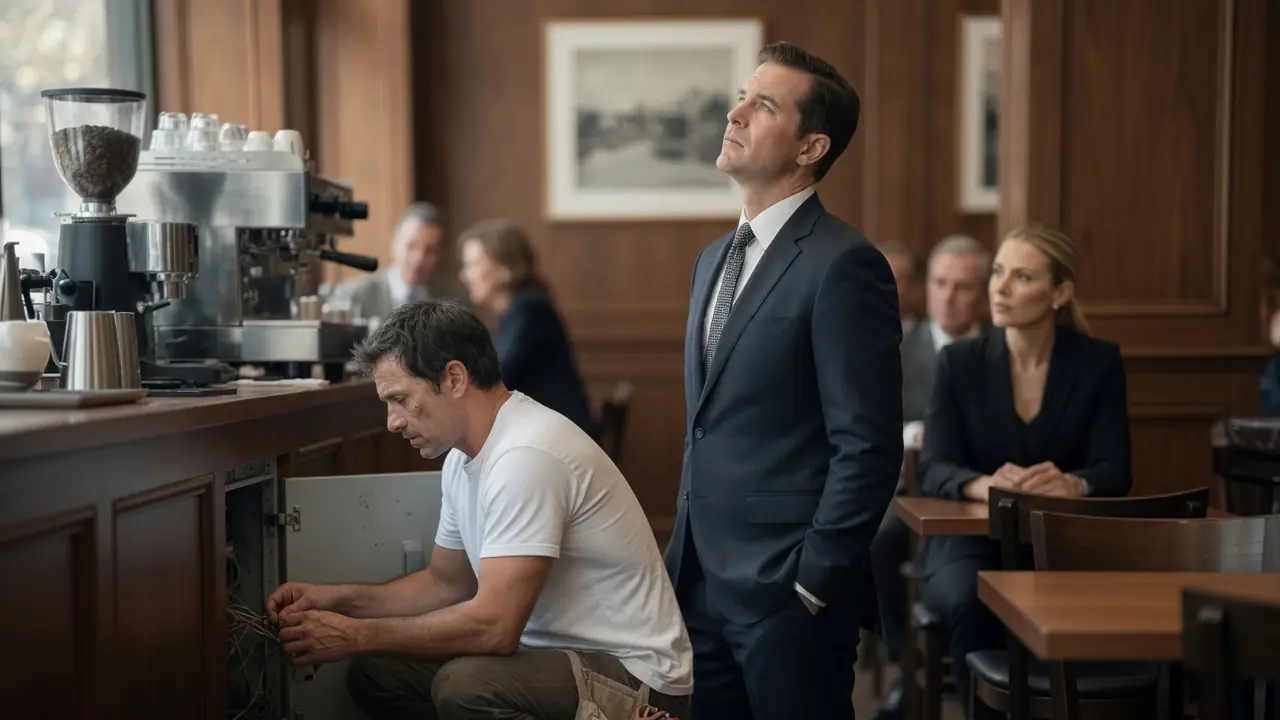
Mason’s seven-year-old daughter, Emily, was waiting at home with his older sister. Before he left for work the previous evening, Emily had made him promise to attend her school presentation at ten that morning. She had spent two weeks building a cardboard model of a rescue helicopter, though she knew almost nothing about the years her father had spent around real ones. Mason never told her about those missions because he wanted her childhood to contain fewer nightmares than his memories did.
The emergency repair that brought him downtown had taken longer than expected. A refrigeration unit beneath a financial company’s cafeteria had failed just after midnight, and Mason’s supervisor sent him because no one else could identify the electrical problem. By sunrise, he had repaired the unit, saved thousands of dollars in inventory, and received no thanks beyond an unsigned work order. He did not care. He had enough time to drink one coffee, drive home, change his clothes, and reach Emily’s school before her name was called.
The café was more crowded than usual because Hartwell Dynamics had reserved several tables for an executive breakfast. Men and women in expensive suits sat beneath polished wood panels discussing acquisitions, budgets, and a new logistics division. Near the center table sat Grace Bennett, Hartwell’s thirty-five-year-old chief executive officer. Grace wore a fitted black business suit and listened quietly while her senior leadership team competed for her attention.
Connor Blake was the loudest person in the room.
At forty-three, Connor served as Hartwell’s vice president of corporate development. He was tall, immaculately dressed, and skilled at making humiliation sound like humor. He interrupted junior employees, dismissed servers with impatient gestures, and turned every conversation into proof that he belonged closest to power. People tolerated him because he brought in large contracts and because Grace’s late father had hired him years earlier.
Mason knew none of this.
He stood near the espresso machine waiting for the barista to hand him his coffee. The counter had become crowded with executives collecting drinks, so Mason moved slightly to avoid blocking a server carrying a tray. In doing so, his shoulder passed close to Grace’s table.
Connor noticed him immediately.
“Watch where you’re going,” Connor said.
Mason looked over. “I didn’t touch anyone.”
“You’re standing in the middle of a private company meeting.”
“The café is open to the public.”
Several executives glanced up. Connor was accustomed to employees apologizing before he finished criticizing them, and Mason’s calm answer irritated him.
Connor rose from his chair. “Then take your coffee somewhere else.”
Mason looked toward the crowded entrance. “I’ll leave when the order is ready.”
Grace turned slightly in her seat. She had heard Connor’s tone, but before she could speak, another executive asked her a question about a pending merger. Connor took her distraction as permission.
The barista placed Mason’s coffee on the counter.
As Mason reached for it, Connor stepped closer and shoved him hard between the shoulders.
The movement appeared careless enough that someone across the room might have mistaken it for an accidental collision. Mason stumbled forward, catching the edge of the counter before the hot coffee spilled. A few people laughed nervously, expecting Mason to apologize and retreat.
He did neither.
Mason slowly set the cup down.
Grace stopped speaking.
Connor straightened his tie. “Move. You’re blocking the CEO’s table, and men like you don’t belong here.”
The café fell quieter.
Mason turned around and looked directly at him. He did not curse, threaten, or raise his voice. His expression carried none of the anger Connor wanted to provoke.
“Do not touch me again.”
Connor laughed and stepped closer until only a few inches separated them. “What are you going to do?”
Grace pushed back her chair.
“Connor,” she said sharply. “Step away from him.”
Connor glanced at her, embarrassed that she had interrupted. “I’m handling a disturbance.”
“You caused the disturbance.”
“He was crowding your table.”
“I did not ask you to protect me from a customer holding coffee.”
A few executives looked down, but Connor refused to retreat in front of them. His authority depended on never appearing corrected, especially by the woman whose position he privately believed should have become his after her father’s death.
Connor turned back toward Mason. “You heard her. Take your drink and get out.”
Mason lifted the cup. “That was already my plan.”
He moved to pass, but Connor reached out and grabbed the front of his jacket.
Everything changed in less than two seconds.
Mason caught Connor’s wrist with one hand, rotated his arm, and stepped behind him. Connor’s body turned before his mind understood what was happening. Mason guided him against the counter and held him there with precise pressure, using enough force to stop the attack but not enough to injure him.
Coffee cups rattled.
A woman near the window gasped.
Connor struggled, but every movement tightened Mason’s control. The difference between them was not strength. It was discipline.
“I warned you,” Mason said.
“Let go of me!” Connor shouted.
“Stop fighting.”
“I’ll destroy your life!”
Mason’s voice remained low. “You don’t know anything about my life.”
Grace stood only a few feet away, studying Mason’s movements. She had seen something similar before—not in person, but in old training footage her brother had once shown her. The wrist control, the balanced stance, and the way Mason positioned himself between Connor and the rest of the room were not the reactions of an ordinary maintenance worker.
Grace turned toward the café manager. “Call building security.”
Connor twisted again. “Grace, tell this animal to release me!”
Her expression hardened.
“Do not speak about him that way.”
Security officers entered through the front door less than a minute later. Mason released Connor immediately and stepped back with his hands visible. Connor spun around, red-faced and furious, pointing toward Mason as though demanding an arrest.
“He attacked me!”
Grace moved between them. “I watched you shove him and grab his clothing after he warned you not to touch him.”
Connor stared at her. “You’re taking his side?”
“I’m stating what happened.”
“He could have broken my arm.”
“He chose not to.”
One of the security officers asked Mason to explain. Mason described the sequence without exaggeration, then nodded toward several cameras mounted above the counter.
“You won’t need my version,” he said. “The recording will show it.”
Connor’s face changed when he noticed the cameras.
Grace looked toward the executives who had witnessed the confrontation. “Did anyone see Mr. Reed strike Connor?”
No one answered.
“Did anyone see Connor initiate physical contact?”
A junior manager raised her hand hesitantly. Then the barista did the same. Within seconds, six people confirmed what they had seen.
Connor’s voice became cold. “You are all making a serious professional mistake.”
Grace faced him. “Threatening witnesses makes yours worse.”
She instructed security to escort Connor to an empty meeting room inside the adjoining office tower. He attempted to argue, but the officers positioned themselves on either side of him. As he was led away, he turned toward Mason.
“This isn’t over.”
Mason picked up his coffee. “It was over when you ignored the warning.”
Grace watched Mason head toward the exit.
“Mr. Reed,” she called.
He stopped.
“Don’t leave. I saw him attack you first.”
Mason looked at the clock above the counter. “I’m not here to cause trouble.”
“You didn’t. He did.”
“Then security has what it needs.”
Grace stepped closer. “Connor Blake works for me.”
Mason glanced toward the door through which Connor had disappeared. “You may want to reconsider that.”
Several executives exchanged uneasy looks.
Grace did not take offense. “I already am.”
Mason lifted his coffee. “Then why are you still stopping me?”
“Because everyone else froze, but you showed me exactly what kind of man my company needs.”
Mason studied her face, unsure whether she was making a joke. Grace Bennett did not appear like someone who joked often during a crisis.
“I repair commercial equipment,” he said.
“And apparently corporate behavior.”
“That wasn’t a repair. It was a warning.”
Grace extended her hand. “Grace Bennett.”
“I know who you are.”
“You do?”
“Your photograph is displayed in the lobby of the building whose refrigeration system I spent all night fixing.”
Grace’s eyes narrowed. “The cafeteria unit failed?”
“At eleven forty-three.”
“No one informed me.”
“They may have preferred that you never learned how close the food inventory came to being lost.”
Grace looked toward one of her executives. “Who oversees facilities?”
A man at the nearest table shifted uncomfortably. “That falls under operations.”
Mason checked the time again. “I have to go.”
Grace noticed his urgency. “Are you late for work?”
“My daughter’s school presentation.”
The answer changed her tone. “Then I won’t keep you.”
Mason nodded and walked toward the exit.
Before he reached it, Grace asked, “Where did you learn that restraint?”
He stopped but did not turn around.
“Somewhere people couldn’t afford second warnings.”
Then he left.
The executives remained silent until the door closed.
Grace turned toward her chief of staff, Natalie Price. “Get the security footage from the café and a complete file on Connor’s conduct.”
Natalie lowered her voice. “Employment complaints?”
“All of them.”
“There may be quite a few.”
“Then start with the ones someone marked resolved.”
Grace then faced the operations director. “Find out who repaired our refrigeration unit last night and why the failure was not reported to executive management.”
The director nodded quickly.
Within thirty minutes, the café footage confirmed every detail. Connor had moved toward Mason deliberately, shoved him, mocked his clothing, and grabbed him after being warned. The recording also captured the threats he made after security arrived.
The employment file was worse.
Three assistants had accused Connor of intimidation. Two junior managers claimed he took credit for their work and threatened to damage their careers when they protested. A server from a previous company event reported that Connor had grabbed his arm after being asked to wait for a table.
Each complaint had been reduced to a misunderstanding.
The person responsible for closing most of them was Connor’s longtime ally in human resources.
Grace called an emergency meeting at headquarters.
Connor entered the boardroom accompanied by an attorney. He had regained his confidence and now described himself as the victim of a violent stranger.
“That man used military techniques on me,” he said. “He is dangerous.”
Grace placed the café footage on the screen. “He released you the moment you stopped attacking.”
Connor watched himself shove Mason.
“He provoked me.”
“By standing near a coffee counter?”
“He was deliberately disrespectful.”
“He told you not to touch him.”
Connor looked toward the other executives. “You cannot terminate a vice president over a moment of frustration.”
Grace opened the complaint file. “It is not one moment.”
His attorney requested time to review the documents. Grace granted access but not delay.
By noon, Connor Blake’s employment was terminated for physical misconduct, retaliation, witness intimidation, and repeated violations of company policy. The human-resources director who buried the complaints was suspended pending investigation. Two senior managers who had protected Connor were removed from supervisory positions.
Connor left the building through a side entrance to avoid reporters.
Mason knew none of this.
He reached Emily’s classroom three minutes before her presentation. He had no time to change, so he sat in the back wearing his worn work jacket while the other parents glanced at the grease on his hands.
Emily stood beside her cardboard helicopter.
“My project is about rescue teams,” she announced. “They help people even when they are scared.”
Her eyes found Mason.
He smiled.
She described pilots, medics, and firefighters, then pointed toward a small figure she had drawn near the helicopter door.
“This is the person who goes back for someone when everybody else is leaving.”
Mason’s expression tightened.
After the presentation, Emily ran into his arms. “You came.”
“I promised.”
“You look tired.”
“I had a long morning.”
“Did you fix the refrigerator?”
“Yes.”
“Was that all?”
Mason looked at her suspiciously. “Why?”
“You have the face you make when adults behave badly.”
He laughed despite himself. “One adult behaved very badly.”
“Did you use your serious voice?”
“I did.”
Emily nodded with satisfaction. “That usually works.”
That afternoon, Mason received a call from Hartwell Dynamics. He nearly ignored it, assuming the company wanted another statement about the café. Grace’s chief of staff asked whether he could visit headquarters the following morning.
“Am I being sued?” Mason asked.
“No.”
“Is Connor suing?”
“His attorney may advise against that after watching the footage.”
“Then what does Ms. Bennett want?”
“She would prefer to explain personally.”
Mason agreed only after confirming the meeting would not interfere with Emily’s school schedule.
The next morning, he entered Hartwell’s glass headquarters wearing a clean shirt and the same old jacket. Natalie escorted him to a conference room where Grace waited beside the chief operating officer and the director of security.
Grace began without small talk.
“Connor was terminated yesterday.”
Mason sat across from her. “I didn’t ask for that.”
“You did not cause it.”
“He may disagree.”
“He was removed because of his conduct toward you and several employees before you.”
Mason nodded once. “Good.”
Grace slid a report across the table. It described the failed refrigeration unit and the repairs Mason completed overnight. His temporary fix had prevented a compressor failure that could have damaged part of the building’s electrical system.
“Our contracted maintenance provider told us the problem was minor,” Grace said.
“It wasn’t.”
“They also charged us for three previous repairs that did not address the cause.”
“That sounds accurate.”
The chief operating officer leaned forward. “How did you identify the fault so quickly?”
“I listened to the workers who used the equipment. One of the kitchen employees told me exactly when the temperature changed and what sound the unit made beforehand.”
“The previous technicians replaced parts based on error codes.”
“Machines don’t always explain themselves clearly. People usually know more than reports show.”
Grace exchanged a glance with the operations officer.
“What position do you hold at your company?” she asked.
“Senior field technician.”
“How many people do you supervise?”
“None officially.”
“Unofficially?”
Mason hesitated. “The younger technicians call me when they get stuck.”
“Why have you never moved into management?”
“I’m a single father. Promotions usually required travel or unpredictable hours.”
Grace opened another file. “You were also in the military.”
Mason’s expression changed immediately.
“That is not relevant to repairing your building.”
“It may be relevant to what happened in the café.”
“I controlled a man’s wrist. That does not require a biography.”
Grace closed the file. “My brother served in a special operations unit twelve years ago.”
Mason looked at her.
“His name is Daniel Bennett.”
For the first time since entering the room, Mason lost his composure.
Grace noticed.
Daniel Bennett had been one of twelve soldiers trapped after an extraction mission collapsed in a remote mountain region. Their communications failed, their aircraft could not land, and hostile forces closed in from two directions. Mason, then a team sergeant, ignored an order to abandon disabled equipment and led the group through a ravine during the night.
Daniel had been injured.
Mason carried him for nearly four miles.
The mission report never became public, but every soldier on the team knew who had brought them home.
“My brother keeps a photograph,” Grace said. “You are standing beside him.”
Mason looked toward the window. “That was a long time ago.”
“He said you went back twice.”
“We don’t need to discuss it.”
“He believed he would die there.”
“So did I.”
The room fell quiet.
Grace softened her voice. “Why did you leave?”
Mason folded his hands. “My wife became ill after Emily was born. I had already missed too much. I chose my family.”
“Daniel said you could have built a career training teams.”
“My daughter needed a father more than the government needed another instructor.”
Grace studied him for several seconds.
“I am not offering you a security position.”
“Good.”
“I want you to lead a new operational response department.”
Mason almost smiled. “That sounds invented.”
“It became necessary after yesterday.”
Grace explained that Hartwell managed factories, research buildings, data facilities, and distribution centers across four states. Each site handled technical failures through separate contractors, causing delays, hidden costs, and incomplete reporting. She wanted one department capable of assessing urgent problems, coordinating repairs, and preventing managers from burying risks.
“You would build the team,” she said. “Technicians, safety specialists, and site coordinators.”
“I have never run a corporate department.”
“You led people through circumstances more complicated than broken equipment.”
“That is not the same.”
“No,” Grace replied. “Here, no one should be shooting at you.”
The security director looked away to hide a smile.
Mason examined the proposed salary. It was more than double his current income, with stable hours, health coverage, and a schedule allowing him to remain near Emily.
“This is not payment for what happened in the café?” he asked.
“No. That incident showed me how you respond under pressure. The maintenance report showed me how you solve problems. My brother’s account showed me what you do when people depend on you.”
“What if I say no?”
“Then I will thank you for stopping Connor and hire someone less qualified.”
Mason returned the papers. “I need time.”
Grace nodded. “Take the afternoon.”
“I need to speak with my daughter.”
The chief operating officer appeared surprised, but Grace understood.
“Of course.”
That evening, Mason placed the offer beside Emily’s homework.
She read the title slowly. “Director of Operational Response.”
“That’s a lot of words.”
“Does it mean you’re the boss?”
“Of a small department.”
“Will you travel?”
“Sometimes, but not often.”
“Will you miss school presentations?”
“No.”
“Will you help people?”
“That’s the idea.”
Emily pushed the papers toward him. “Then why are you asking me?”
“Because my work changes your life too.”
She thought carefully. “Will the angry café man work there?”
“No.”
“Then take it.”
Mason laughed. “Decision made.”
He accepted the position the following morning.
The department began with six people and a converted conference room. Mason selected employees based on judgment rather than polished résumés. He hired an electrician who had been overlooked because she lacked a college degree, a former paramedic seeking stable hours, two experienced maintenance technicians, and a logistics coordinator who had repeatedly warned Hartwell about unsafe warehouse practices.
Within six months, the team prevented three major shutdowns.
Mason insisted that every report include statements from the people closest to the problem. He visited night-shift workers, loading crews, cleaners, and kitchen staff because they often noticed failures before managers did. He refused to allow titles to determine whose voice mattered.
Grace watched the department improve from a distance.
Their professional conversations gradually became more personal. She learned that Mason drank terrible coffee because he had forgotten how to enjoy anything more complicated. He learned that Grace often remained at the office long after her staff left because running the company had isolated her from nearly everyone she trusted.
Daniel visited headquarters during Mason’s first year.
The two men stood silently for several seconds before Daniel embraced him.
“You disappeared,” Daniel said.
“I went home.”
“You could have called.”
“I didn’t want to spend my life being thanked for the worst night of yours.”
Daniel looked toward Grace. “He always hated attention.”
“I noticed,” she replied.
Connor attempted to rebuild his career elsewhere, but the café footage followed him. He later sent Hartwell a letter blaming Grace, Mason, and the witnesses for destroying his reputation. Grace kept it inside the investigation file without responding.
Mason read only one line.
What gave him the right to humiliate me in front of everyone?
He returned the letter.
Connor never understood that no one had humiliated him. The room had merely stopped protecting him from the consequences of his own behavior.
Two years after the café incident, Hartwell held an employee leadership meeting in the same downtown location. Grace reserved the room intentionally, though she did not tell Mason until he arrived.
He looked toward the counter where Connor had shoved him.
“You enjoy symbolic locations,” he said.
“I enjoy corrected memories.”
The café manager approached with two coffees. Mason noticed that the staff now had a clear policy allowing them to report harassment from corporate customers without risking their jobs. Grace had required Hartwell to compensate the café workers who testified during the investigation.
They sat near the window.
“Do you regret stopping me that morning?” Mason asked.
“From leaving?”
“Yes.”
Grace looked at him. “No.”
“You hired a difficult employee.”
“I hired one who argues with vice presidents.”
“Only when they are wrong.”
“That is often enough.”
Mason smiled.
Grace’s expression softened. “The whole café went silent because everyone expected violence. What frightened Connor was that you did not give him any. You showed control when he had none.”
“I had reasons to learn control.”
“And now hundreds of employees trust you because of it.”
Mason looked around the café. The place no longer felt like the scene of a confrontation. It was simply a room where a bad decision had exposed one man and introduced another.
Grace reached across the table and touched his hand.
Their relationship had changed slowly during the previous year, careful enough to protect the company and honest enough to include Emily from the beginning. Grace was not interested in being rescued, and Mason had no desire to become anyone’s legend. They simply understood each other’s burdens.
“Emily asked whether you’re coming to dinner,” Mason said.
“What did you tell her?”
“That CEOs have demanding schedules.”
Grace raised an eyebrow. “Coward.”
“I also said you would probably come.”
“Better.”
At that moment, a young employee near the counter accidentally bumped into a senior executive and spilled part of a drink. The executive turned sharply, ready to criticize him.
Mason watched.
Before the man could speak, Grace’s eyes met his from across the room.
He stopped, took a napkin, and said, “It’s all right. Accidents happen.”
The young employee exhaled with relief.
Mason lifted his coffee. “Your company is learning.”
Grace looked toward him. “So am I.”
Years earlier, Connor Blake had shoved a quiet single father because worn clothing made him believe Mason was powerless. He expected anger, fear, or submission. Instead, Mason set down his coffee, delivered one warning, and ended the attack without throwing a punch.
The café went silent because everyone saw the truth at the same moment.
Connor’s expensive title had never made him strong.
Mason’s quietness had never made him weak.