“Move that rust heap, hillbilly. This entrance is for company vehicles, not museum junk.”
Caleb Turner shut off the engine of his faded red tractor and let the sudden silence settle over the gate of North Ridge Agricultural Terminal. He was thirty-four, broad-shouldered from years of farm labor, with short dark-brown hair, light stubble, a tan cowboy hat, a blue-and-white plaid shirt beneath dark denim overalls, and worn brown boots planted firmly on the tractor’s running board. The machine beside him looked almost as old as the surrounding wheat country, its paint faded by decades of sun and its steel hood marked by rust. Yet Caleb did not look embarrassed as he faced the uniformed security supervisor blocking his path.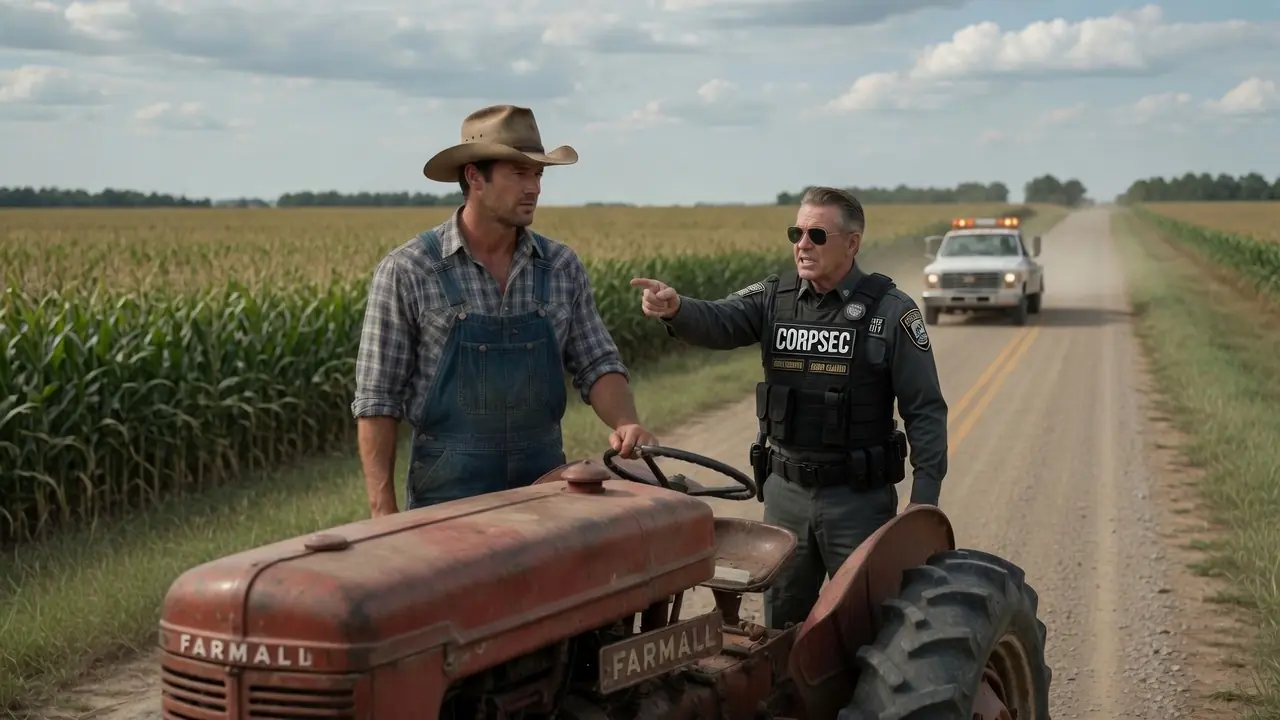
Gavin Rourke wore a spotless gray security uniform, mirrored glasses, and a black jacket carrying the silver emblem of North Ridge Agribusiness. The private company had purchased four thousand acres outside Millstone during the previous year and built a grain terminal, fertilizer warehouse, and automated loading station behind twelve-foot fencing. Gavin treated the entrance as though he personally owned every field visible beyond it. To him, Caleb was not a neighboring farmer attempting to reach his land; he was a reminder of the stubborn families who had refused to sell.
Caleb rested one hand on the tractor’s steering wheel. “Your gate is sitting across the access road my family has used since 1958.”
“North Ridge bought this property.”
“You bought the warehouse parcel. You didn’t buy my right-of-way.”
Gavin smiled. “That sounds like something poor farmers say when they can’t afford attorneys.”
Caleb’s jaw tightened, but he did not raise his voice. His grandfather Arthur had taught him that angry men often revealed more when they believed the other person was afraid. Caleb had come to cross the terminal road because his north irrigation pump had failed, and the old tractor was carrying a replacement motor on a small trailer behind it. If he could not reach the pump before nightfall, two hundred acres of young corn would sit without water during the hottest week of July.
“I called the terminal office yesterday,” Caleb said. “Your manager approved passage between two and three.”
Gavin glanced at the clock inside the guard booth. “It’s two seventeen.”
“Exactly.”
“The authorization was canceled.”
“By whom?”
“By me.”
Caleb looked past him toward the newly paved road stretching through the corporate property. North Ridge trucks moved freely between silver silos, while his cornfields waited less than a mile beyond them. Before the company arrived, the old farm road ran directly from Turner land to the county canal. North Ridge had fenced it, paved over part of it, and placed Gavin’s checkpoint in the center.
“You don’t have the authority to cancel a recorded easement,” Caleb said.
Gavin walked around the tractor, dragging his fingers across the faded hood. Rust dust stained his glove. “This thing leaks oil, lacks proper commercial markings, and looks like it could die in the middle of our loading lane.”
“It doesn’t leak.”
“It’s dripping beneath the axle.”
“That’s water from the cooling line.”
“You expect me to trust a farmer who still drives something his grandfather probably bought with war bonds?”
Caleb looked down at the machine. His grandfather had called the tractor Ruth, though the name was never painted anywhere on it. Arthur had driven it through droughts, floods, and seasons when the bank threatened to take everything. A week before his death, he made Caleb promise never to sell it and never to allow anyone to remove a steel plate mounted beneath the rear axle.
Caleb had assumed the promise was sentimental.
Then he discovered the envelope.
It had been hidden inside a narrow compartment beneath the tractor’s seat, wrapped in waxed canvas and sealed with Arthur’s initials. Inside were a yellowed federal certificate, a map of Millstone Valley, and a handwritten instruction.
If North Ridge ever blocks the old canal road, show them the tractor’s serial number. Do not explain it. Let their own system tell them what they bought.
At the time, North Ridge had not yet started construction.
Caleb thought his dying grandfather had become confused.
Now Gavin slapped the tractor’s hood and laughed. “I’m having this junk towed.”
Caleb raised his eyes. “You touch it, you log the serial number.”
“I log everything I remove.”
“Good.”
Gavin’s smile faded slightly. “What is that supposed to mean?”
“It means your company will finally learn what my grandfather tried to warn them about.”
The security supervisor stepped closer. “You think a secret number on this scrap pile frightens me?”
“No.”
“Then say what it does.”
Caleb climbed down from the tractor. He stood nearly as tall as Gavin, though his calm manner made him seem harder to provoke. “Scan it. Then watch your company decide whether humiliating one farmer was worth freezing every dollar tied to this land.”
Gavin stared at him for several seconds before reaching for his radio.
“Gate One to vehicle control,” he said. “Send the contract tow operator. I have an unauthorized agricultural vehicle obstructing restricted property.”
Caleb looked at the empty lane around them. “I’m not obstructing anything.”
“You refused an order to leave.”
“I’m standing on a recorded agricultural easement.”
“You’re standing on North Ridge property.”
“That’s what your executives told you.”
Gavin removed his glasses. His eyes were pale and impatient. “Men like you always cling to old papers because the future scares you.”
“The future doesn’t scare me.”
“Then sell your farm. North Ridge offered you more money than that dirt will ever earn.”
“My daughter is buried there.”
The answer stopped Gavin for less than a second.
Caleb’s wife, Emily, had given birth to their daughter six years earlier. The baby lived only three days. They buried her beneath a young maple tree near the Turner farmhouse, where Emily visited every morning until an illness took her life two years later.
North Ridge’s first development proposal placed a truck route less than fifty yards from both graves.
Caleb rejected every offer after that.
Gavin replaced his glasses. “Personal feelings don’t determine land value.”
“No,” Caleb said. “But they determine what a man refuses to sell.”
The tow truck arrived twenty minutes later. It belonged to a private contractor paid by North Ridge, and its driver, Frank Miller, had repaired farm machinery throughout Millstone County for nearly thirty years. Frank slowed when he recognized Caleb and the old red tractor beside the gate.
“You sure about this?” Frank asked Gavin.
“I ordered a tow, not an opinion.”
Frank looked at Caleb. “You authorize me to move Ruth?”
“No.”
Gavin pointed toward the tractor. “It’s on restricted company property.”
Caleb removed the federal certificate from beneath the seat and handed it to Frank instead of Gavin. “Read the line near the bottom.”
Frank unfolded the document carefully.
His expression changed.
“What?” Gavin demanded.
Frank turned the paper so the security supervisor could see it. “It identifies the tractor as Federal Agricultural Survey Unit Fourteen and lists a permanent transit covenant through the Millstone canal corridor.”
“That department hasn’t existed in decades.”
“The document says all successor agencies inherit the agreement.”
Gavin snatched it. The seal was faded but visible, and beneath it was a typed serial number matching the steel plate under the tractor’s rear axle.
“Probably fake,” he said.
Caleb put his hat back on. “Then scan it.”
Gavin had spent eight years in corporate security and believed documents were only as powerful as the database confirming them. He crouched beside the rear wheel, wiped dirt from the metal plate, and entered the serial number into his company tablet.
USDA-FASU-14-MV-1958.
The screen loaded for several seconds.
A warning appeared.
RESTRICTED LAND COVENANT IDENTIFIER DETECTED. AUTOMATIC LEGAL PRESERVATION REQUIRED. DO NOT IMPOUND, DISASSEMBLE, RELOCATE, OR ALTER THE REGISTERED UNIT.
Gavin read the message twice.
Then another notice appeared.
THIS IDENTIFIER IS CONNECTED TO ACTIVE FEDERAL WATER, SOIL, AND ACCESS RIGHTS. ALL DEVELOPMENT ACTIVITY WITHIN THE ASSOCIATED SURVEY ZONE MUST BE SUSPENDED PENDING REVIEW.
Frank let out a slow breath.
Caleb said nothing.
Gavin closed the warning. “It’s an outdated record.”
The screen immediately reopened it.
His radio crackled.
“Gate One, this is compliance,” a woman said. “Did you enter a restricted federal survey identifier?”
Gavin hesitated. “I’m verifying an old tractor.”
“Do not move it.”
“It is blocking a controlled entrance.”
“Do not move it,” she repeated. “Our property system has automatically frozen all permits connected to the Millstone terminal.”
Gavin glanced toward the silos. “For a tractor?”
“For the land covenant attached to it.”
Caleb leaned against the rear tire.
The compliance officer continued. “Federal records indicate North Ridge may have constructed facilities inside a protected agricultural monitoring corridor. Senior counsel has been notified.”
Gavin lowered his voice. “Can I clear the alert?”
“No.”
“Who can?”
“The federal office that issued the successor order.”
“And how long will that take?”
“I don’t know. A preservation team is already requesting entry.”
The radio went silent.
Gavin looked at Caleb with the first trace of uncertainty. “What is this?”
“Exactly what the document says.”
“Your grandfather used that tractor as a federal survey unit?”
“He told me it measured soil and water after a chemical spill.”
“What spill?”
Caleb glanced toward the terminal’s enormous fertilizer warehouse. “The one your company’s environmental report claimed never happened.”
Gavin’s face tightened.
In 1957, a military contractor stored experimental agricultural chemicals near Millstone’s canal system. A containment failure polluted groundwater across several farms, but federal officials feared panic would destroy the regional economy. Rather than publicly condemn the land, they installed monitoring equipment inside ordinary tractors operated by trusted farmers.
Arthur Turner was one of them.
The government compensated the families, granted them permanent canal access, and prohibited industrial development inside the testing corridor until the soil and water could be declared safe. Most records remained sealed after the agency was reorganized. Over time, local officials treated the restrictions as obsolete and quietly removed them from newer property maps.
Arthur kept the tractor running because its sealed compartments contained original soil samples, survey logs, and mechanical monitoring equipment.
The serial number was the key connecting those records to the land.
North Ridge had purchased the property after receiving an environmental report claiming no federal restrictions existed. The consultant who prepared that report was partly owned by one of the company’s senior vice presidents.
Caleb had not known every detail.
His grandfather did.
Gavin folded the certificate. “You brought this here deliberately.”
“I brought a replacement irrigation motor to my field.”
“You knew scanning the number would freeze the terminal.”
“I knew my grandfather told me to let your system read it.”
“You set me up.”
Caleb shook his head. “You could have honored the access approval.”
“You challenged my authority in front of my staff.”
“No. I tried to cross a road.”
Gavin looked toward the tow truck, the security cameras, and the terminal employees watching from behind the fence. He understood what the footage would show: a farmer presenting legal documentation, a security supervisor insulting him, and the tractor being prepared for unauthorized removal.
He handed the certificate back.
“Take your tractor and leave.”
Caleb did not move. “Your compliance officer ordered you not to relocate it.”
Gavin’s mouth tightened.
Frank leaned against the tow truck. “He’s right.”
“Stay out of this.”
“I’m the man you ordered to tow federally protected equipment. I’m already in it.”
A black SUV sped toward the gate from the terminal offices. It stopped hard beside the booth, and three executives climbed out. The first was Malcolm Vane, North Ridge’s regional development director, a silver-haired man who had personally negotiated with Caleb during every failed attempt to purchase the Turner farm.
He looked at the tractor and immediately lost color.
“Who scanned that serial number?” Malcolm demanded.
Gavin straightened. “I did.”
“You idiot.”
“You told security to block Turner from the canal road.”
“I told you to delay him.”
“You said no farm vehicles were permitted through the terminal.”
“I did not tell you to enter federal equipment into the compliance system.”
Gavin stared at him. “You knew what it was.”
Malcolm ignored the question and approached Caleb.
“Mr. Turner, this misunderstanding can be resolved privately.”
“You called my tractor scrap three months ago.”
“I did not understand its historical status.”
“My grandfather sent you copies of that certificate before construction began.”
Malcolm’s eyes shifted toward the watching workers.
Caleb reached into his overall pocket and removed a folded letter. It was a copy of the final notice Arthur sent to North Ridge’s legal office. The return receipt carried Malcolm’s signature.
“You understood,” Caleb said. “You just believed he would die before anyone listened.”
The other executives moved away from Malcolm.
Gavin looked between them. “You told us Turner invented the easement.”
Malcolm faced him sharply. “This is not the time.”
“You ordered me to block him because you knew the tractor would trigger a review.”
“I ordered you to protect company property.”
“You used me.”
Caleb watched the security supervisor’s confidence fracture. Gavin had enjoyed humiliating farmers because North Ridge made him feel powerful. Now he realized the executives above him had selected him precisely because his aggression would keep difficult questions away from them.
Sirens sounded in the distance, though they belonged to federal environmental vehicles rather than police.
Within an hour, the terminal stopped operating.
Inspectors sealed the fertilizer warehouse, copied security footage, and took custody of North Ridge’s property records. The tractor remained beside the gate while specialists photographed every marking without removing a single part.
Caleb finally crossed the road in a federal utility vehicle carrying his irrigation motor. By sunset, water was moving through the north field again.
Gavin stayed at the gate.
He had been ordered not to leave until investigators completed their interviews. His company access card stopped working before dinner, and Malcolm refused to answer his calls. The authority Gavin had worn so proudly vanished with one administrative command.
Caleb returned after dark.
The old tractor remained beneath portable inspection lights, its faded red steel surrounded by technicians. Gavin sat inside the guard booth without his mirrored glasses. He looked smaller without them.
“You came to celebrate?” he asked.
“I came for Ruth.”
“They’re not releasing it yet.”
“I know.”
Gavin looked toward the tractor. “I didn’t know about the graves.”
Caleb remained silent.
“I heard one of the investigators talking,” Gavin continued. “Your wife and daughter.”
“You mocked the reason I refused to sell before you knew what it was.”
“I was doing my job.”
“No. Your job was checking authorization. The humiliation was something you added for yourself.”
Gavin lowered his eyes.
Caleb stepped closer to the booth. “A uniform can make a weak man feel important. It can also show everyone exactly what he does when someone beneath him cannot fight back.”
“You think I’m weak?”
“I think you needed me to feel small.”
Gavin did not answer.
The federal review continued for four months.
Investigators discovered that North Ridge executives had known about the agricultural monitoring corridor before purchasing the land. They paid a consulting firm to omit the restriction, pressured county staff to issue permits, and attempted to buy the Turner farm so the last surviving original records could disappear into corporate ownership.
The soil beneath part of the fertilizer warehouse still contained dangerous chemical residue.
North Ridge had unknowingly disturbed it during construction.
The company was ordered to close the terminal, fund environmental cleanup, and compensate neighboring farmers for water contamination. Malcolm Vane and two consultants faced fraud charges. County officials who altered property maps were removed from office.
Gavin lost his position.
He expected Caleb to feel satisfied, but the farmer never attended the public hearings unless his testimony was required. Caleb spent his days repairing irrigation lines, harvesting corn, and restoring Ruth after federal archivists completed their examination.
The tractor contained no futuristic machinery or hidden treasure.
Its secret was more powerful because it was ordinary.
Behind the engine housing were sealed metal tubes holding soil samples from 1958, handwritten contamination readings, and photographs showing the original spill site. Beneath the seat was a mechanical recorder that Arthur had maintained for sixty-six years, documenting groundwater changes each season.
His work proved the contamination never fully disappeared.
The federal government offered to place Ruth in a museum.
Caleb refused.
“She still runs,” he said.
Instead, they installed a small historical plaque on the Turner farm and provided funds to preserve the original records. The permanent easement remained active, reopening the canal road for every local farmer, not only Caleb.
North Ridge eventually sold the uncontaminated sections of its property to a farmer-owned cooperative.
The cooperative hired local workers, restored independent grain storage, and placed elected farmers on its board. Caleb accepted no ownership gift, but he earned a paid position advising the cooperative on land access and equipment maintenance.
One autumn afternoon, he saw Gavin near the reopened gate.
The former security supervisor wore jeans, work boots, and a plain canvas jacket. He was repairing a section of fence for a contractor hired by the cooperative. His hands were dirty, and no emblem gave him authority over anyone.
Caleb slowed Ruth beside him.
Gavin looked at the tractor. “Still blocking roads?”
“Only the ones that belong to me.”
A faint smile crossed Gavin’s face, then disappeared. “I owe you an apology.”
“Yes.”
“I kept expecting you to say it was unnecessary.”
“It’s necessary. That doesn’t mean I owe you forgiveness immediately.”
Gavin nodded. “Fair.”
He set down the fence tool. “I treated you like poverty made you stupid. I enjoyed having power over people who couldn’t threaten my job.”
“Until your bosses threatened it for them.”
“Yes.”
Caleb studied him. “What are you doing now?”
“Working.”
“That’s not what I asked.”
Gavin looked across the fields. “Trying to become someone who doesn’t need a uniform to feel like a man.”
Caleb started the tractor.
Before driving away, he said, “Then keep doing the work.”
The following spring, Millstone held a public reopening ceremony at the canal road. Local farmers drove tractors through the old entrance, from modern machines with computerized controls to weathered equipment held together by welding and patience.
Caleb led them in Ruth.
He wore the same tan hat, plaid shirt, denim overalls, and brown boots he had worn the day Gavin stopped him. The tractor’s red paint remained faded because Caleb refused to hide its age beneath a perfect restoration.
Near the rear axle, the federal serial plate had been cleaned.
Children gathered around it while Caleb explained that history often survived in objects powerful people dismissed as worthless. He told them the tractor mattered not because it belonged to the government, but because one farmer kept records when corporations and officials depended on everyone forgetting.
Gavin stood at the edge of the crowd.
He did not expect recognition, but Caleb saw him.
After the ceremony, Gavin approached the tractor and rested his hand near the hood without touching it.
“I called it a rust heap,” he said.
“It is a rust heap.”
Gavin laughed quietly.
Caleb looked across the open canal road toward the Turner farm. Water moved through the fields, the maple tree near the house lifted its new leaves into the wind, and no truck route threatened the graves beneath it.
“The rust was never the problem,” Caleb said.
“What was?”
“The men who thought anything old, poor, or quiet could be erased without consequence.”
He climbed onto the tractor.
Ruth’s engine turned slowly, coughed once, and came alive with the familiar metallic rhythm that had carried four generations through the valley. Gavin stepped aside as Caleb drove onto the reopened road, not because a uniform ordered him to move, but because he had finally learned to respect the man behind the wheel.
North Ridge had arrived believing money allowed it to rewrite Millstone’s history.
A security guard had stood at its gate believing borrowed authority made him master of the land.
Both were defeated by a farmer, an old tractor, and one serial number no one powerful had expected anyone to preserve.
Ruth continued toward the fields, red steel gleaming beneath the afternoon sun.
She was not fast.
She was not beautiful in the way new machines were beautiful.
But every turn of her wheels carried the truth over ground that had nearly been stolen.
And this time, no one dared stand in her way.