“You’re done, fed,” Officer Daniel Rusk whispered as he pushed a small plastic packet deeper into the stranger’s back pocket. “I just found enough drugs to bury you.”
The towering bald man in the cream knit shirt continued walking for two more steps before stopping on the crowded Manhattan sidewalk. His tattooed forearms hung loosely beside his powerful frame, and nothing in his posture suggested fear. “You planted it too fast.”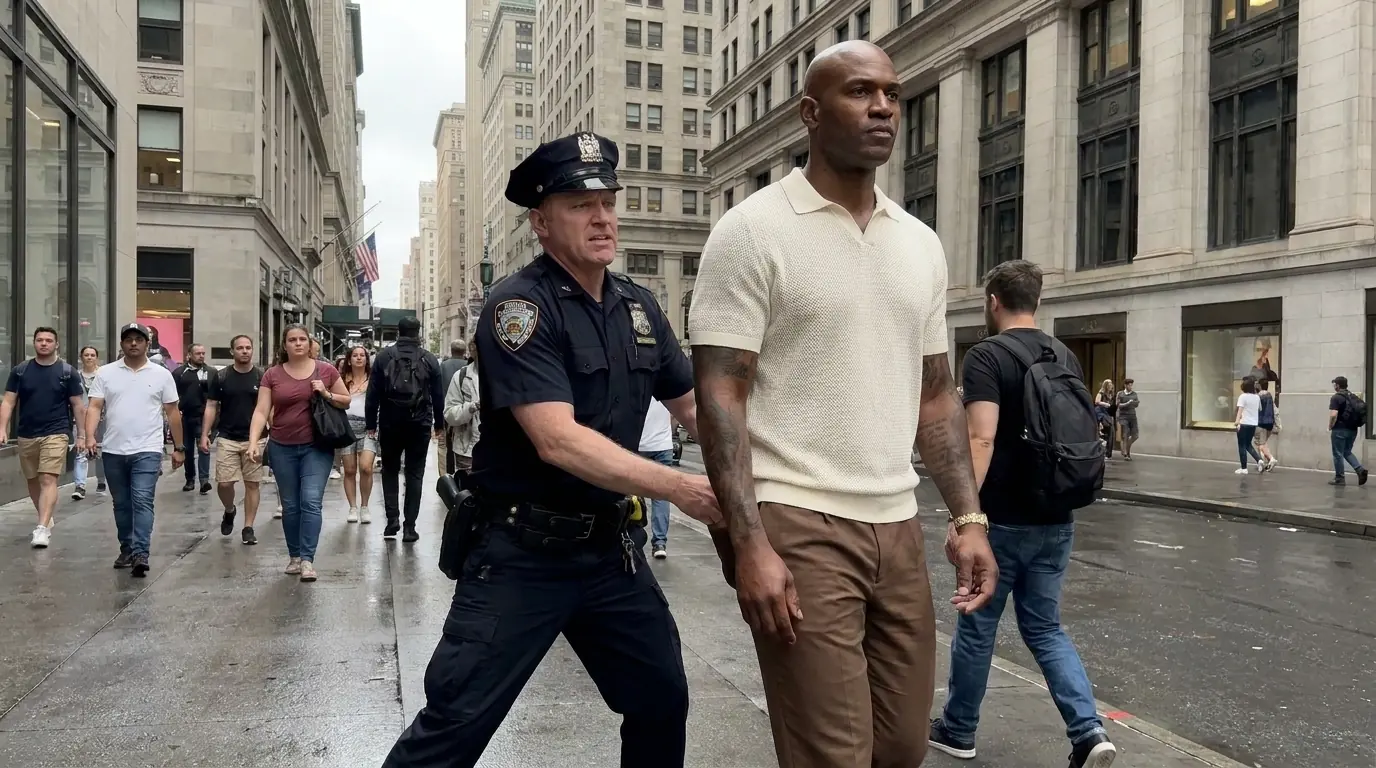
Daniel smirked and reached toward the pocket he had just touched. “One word from me, and nobody cares what you say.”
The man turned slightly, his voice calm enough to make Daniel’s smile falter. “Good. Now say that again when my team steps out.”
For one suspended second, traffic continued moving, pedestrians crossed the intersection, and a delivery cyclist rang his bell behind them. Then three parked vehicles opened almost simultaneously. Men and women in plain clothes emerged from a black SUV, a plumbing van, and a taxi waiting beside the curb.
Every one of them carried a federal badge.
Daniel froze with his hand still inches from the planted packet.
The man in the cream shirt turned fully toward him. At forty-three, Special Agent Nathan Cross stood six feet four inches tall, with tanned skin, a muscular build, a shaved head, and the controlled expression of someone who had spent months waiting for this exact mistake.
“Federal Bureau of Investigation,” Nathan said. “Step away from my pocket.”
Daniel’s face drained of color. “This is a misunderstanding.”
“No,” Nathan replied. “This is the clearest part of the investigation.”
Two FBI agents approached from behind. One secured Daniel’s right arm while another removed his service weapon. A third agent lifted the planted packet with gloved fingers and placed it inside an evidence bag.
Daniel looked rapidly along the sidewalk, searching for someone from his precinct who might still recognize his authority. Instead, he saw cameras. One was attached to a storefront awning. Another protruded from the side mirror of the plumbing van. Nathan wore a concealed camera beneath one button of his shirt.
Daniel had planted drugs beneath four separate recording angles.
“You set me up,” he said.
Nathan’s eyes hardened. “You chose the drugs. You chose the pocket. You chose the lie.”
The arrest began long before that afternoon.
For eighteen months, residents of Manhattan’s Lower East Side had complained about officers stopping pedestrians without cause, claiming to discover narcotics, and demanding money to prevent arrest. The victims rarely received citations, receipts, or formal paperwork. Those who paid were released. Those who resisted were taken to precinct holding cells and charged with possession.
Some cases collapsed because laboratory tests revealed strange inconsistencies. Packets allegedly taken from different defendants contained cocaine with identical cutting agents, identical packaging, and even matching fingerprints from unknown handlers.
The district attorney’s office initially blamed sloppy evidence procedures.
Then a public defender named Maria Bennett noticed a pattern.
Seven of her clients had been arrested by the same small group of officers. In every case, Daniel Rusk claimed he saw suspicious behavior before stopping the person. In every report, he described reaching into a rear pocket and recovering a small packet of narcotics.
None of the arrests appeared on nearby business cameras.
That alone was suspicious. Manhattan contained thousands of cameras, but Daniel seemed unusually skilled at conducting stops inside blind spots, beneath broken lights, or beside vehicles that blocked the view.
Maria began comparing statements.
Her clients were different ages, races, and professions. One worked as a restaurant dishwasher, another delivered medical supplies, and a third was a graduate student walking home from the library. What connected them was not criminal history.
It was vulnerability.
Daniel targeted people he believed would lack money, influence, or credibility. Several spoke limited English. Two were experiencing homelessness. One was a recently released inmate whose prior conviction made him an easy person to disbelieve.
The graduate student, twenty-four-year-old Samuel Cho, became the first person to refuse a cash demand and fight the charge publicly.
Samuel had been carrying nine hundred dollars collected from classmates for a community housing project. Daniel stopped him near Stanton Street, accused him of buying narcotics, and claimed to find cocaine inside his jacket.
Samuel insisted the packet was planted.
Daniel offered him a choice in a quiet voice: surrender the cash and walk away, or enter the system as a drug offender.
Samuel refused.
He spent two nights in custody before Maria secured his release. The money was listed as suspected drug proceeds and placed in a property locker. When Maria later requested it, only six hundred dollars remained.
Three hundred had disappeared.
The precinct blamed a counting error.
Maria did not.
She sent her findings to the Department of Justice Civil Rights Division, which forwarded them to the FBI’s Public Corruption Task Force. Special Agent Nathan Cross received the file because he had spent eleven years investigating police extortion, evidence tampering, and organized theft.
Nathan did not assume every officer named in a complaint was guilty. He had worked beside honest police throughout his career and understood how easily a confusing encounter could appear abusive when viewed without context.
Daniel’s records were different.
His reports were almost too clean. The same phrases appeared repeatedly. Suspects always made the same “furtive movement.” Drugs were nearly always found in the same type of pocket. Cash was frequently seized but rarely connected to a larger investigation.
Nathan requested body-camera footage.
Daniel had reported thirty-one equipment failures in two years.
No other officer in the precinct had reported more than six.
When footage did exist, the recordings often began after Daniel claimed to discover the drugs. The camera would activate only once the suspect was already handcuffed and the packet was visible in Daniel’s hand.
Nathan’s team reviewed property records and found more discrepancies. Small amounts of seized cash vanished regularly. Narcotics entered the evidence system without clear photographs showing their original recovery location.
Then the laboratory identified something decisive.
A technician discovered fibers trapped beneath the tape of five packets from separate arrests. The fibers came from navy-blue uniform fabric, not from the suspects’ clothing. Someone wearing a police uniform had handled and prepared the packets before the stops.
The task force began surveillance.
Daniel worked with three other officers: Lieutenant Raymond Holt, Officer Kyle Benton, and Officer Louis Grant. Raymond selected targets based on patrol observations and information gathered from local informants. Kyle and Louis helped block cameras, distract partners, and create false radio traffic.
Daniel performed most of the planting.
The group called the packets “insurance.”
If a person paid, the drugs disappeared.
If a person resisted, the packet became evidence supporting an arrest.
The cash was divided weekly inside a closed storage room beneath the precinct garage. Raymond took the largest share because he altered schedules and protected the officers from internal complaints.
The scheme had lasted at least four years.
Nathan’s team obtained wiretaps, bank records, and surveillance footage, but they still needed a clear controlled incident showing Daniel physically planting narcotics. The officers rarely used the same method twice once they suspected cameras nearby.
Nathan volunteered to become the target.
His appearance made him useful. He looked wealthy enough to carry cash but unconventional enough for Daniel to treat with suspicion. His muscular frame, tattoos, and restrained manner allowed corrupt officers to build their own assumptions without Nathan saying much.
The operation began with a rumor.
A cooperating informant told Daniel that a man matching Nathan’s description moved illegal gambling money through private gyms. The man supposedly carried cash and avoided banks.
Daniel took the bait.
Nathan entered the neighborhood wearing a fitted cream shirt, brown trousers, a gold watch, and a concealed transmitter. He carried eight thousand dollars in marked bills inside a thin envelope.
The money was real.
The criminal story was not.
Federal agents occupied four positions around the route. One sat inside a parked taxi. Two posed as city utility workers. Another team monitored from an apartment window above the street.
Nathan walked slowly enough to be noticed.
Daniel and Kyle followed in an unmarked sedan for two blocks. Their radio remained silent because they did not want the stop recorded through official dispatch channels.
Daniel eventually parked beside the curb and approached alone.
“You,” he called. “Stop walking.”
Nathan turned. “Am I being detained?”
Daniel looked him up and down. “Depends how difficult you plan to be.”
“That isn’t an answer.”
“It’s the only one you’re getting.”
Nathan asked for Daniel’s badge number. The officer stepped closer instead of providing it. He accused Nathan of matching the description of a robbery suspect, though no such robbery had been reported.
Nathan kept both hands visible.
Daniel ordered him to face the street.
This was the most dangerous stage of the operation. Nathan could not react too early or Daniel might abandon the attempt. He also could not allow Daniel to control his hands completely because the officer carried a firearm and had already demonstrated a willingness to falsify evidence.
Nathan turned slowly.
Daniel patted his waistband, front pockets, and ankles. He found the envelope containing cash.
“Eight thousand dollars?” Daniel asked. “That’s a lot for an afternoon walk.”
“It’s legal.”
“Everyone says that.”
Daniel slipped the envelope into his own jacket rather than placing it on the sidewalk. The concealed cameras captured the movement clearly.
Nathan glanced over his shoulder. “You should count it where the cameras can see.”
Daniel looked toward a store entrance.
The visible security camera above it had been turned slightly away earlier that morning by Kyle. Daniel believed the blind spot still existed.
He did not know the FBI had installed another camera inside a delivery box across the street.
“Face forward,” Daniel ordered.
Nathan obeyed.
That was when Daniel removed the narcotics packet from beneath his duty belt.
He held it between two fingers, shielded by his body, and pushed it into Nathan’s rear pocket. His experience made the movement fast and practiced.
But he became overconfident.
Instead of immediately pretending to discover the drugs, Daniel paused to whisper the threat.
“You’re done, fed. I just found enough drugs to bury you.”
The word “fed” was not a recognition of Nathan’s identity. It was street slang Daniel used for anyone he believed transported money.
Nathan answered, “You planted it too fast.”
Daniel believed the warning was fear.
“One word from me, and nobody cares what you say.”
Nathan gave the signal.
“Good. Now say that again when my team steps out.”
The federal agents moved.
Daniel was handcuffed before Kyle could reach the corner. Kyle saw the arrest from inside the sedan and attempted to drive away. A government vehicle blocked the street, forcing him to stop.
Agents recovered three additional narcotics packets beneath Kyle’s passenger seat.
The marked cash remained inside Daniel’s jacket.
He had not even completed the false arrest before keeping the money.
At the FBI field office, Daniel refused to answer questions. He demanded a union attorney and insisted the packet had been in Nathan’s pocket before the stop.
Investigators played the first recording.
It showed Daniel removing the packet from his belt.
They played the second.
It showed his hand entering Nathan’s empty pocket.
Then they played the audio.
“You’re done, fed—I just found enough drugs to bury you.”
Daniel stopped speaking entirely.
The task force executed search warrants at the homes of Daniel, Raymond, Kyle, and Louis. Agents recovered narcotics, cash, false police reports, stolen property, and photographs of potential targets.
At Raymond’s home, they found a notebook containing names, dates, amounts, and coded results.
A letter P meant the victim paid.
An A meant arrest.
An R meant the person resisted strongly enough that the officers abandoned the attempt.
Samuel Cho’s name appeared beside nine hundred dollars.
The notebook showed that three hundred dollars had been divided between Daniel and Raymond. The remaining six hundred entered the property system to make the seizure appear legitimate.
Investigators identified eighty-seven incidents.
Thirty-two people had been arrested with planted narcotics. Twenty-one accepted plea deals because they feared harsher sentences. Four lost jobs after their arrests became public. Two immigration cases were affected by false drug charges.
One father temporarily lost custody of his children.
The discovery transformed the investigation from a corruption case into a crisis for the entire city.
Prosecutors moved to dismiss every conviction connected to the officers. Judges ordered records sealed, fines refunded, and outstanding warrants canceled.
Maria Bennett contacted former clients one by one.
Samuel received the call while working at a community legal clinic. He listened silently as Maria explained that Daniel had been arrested during a controlled FBI operation.
“So they finally caught him planting it?” Samuel asked.
“Yes.”
“On who?”
“An FBI agent.”
Samuel laughed once, though no amusement entered his voice. “It took him doing it to an FBI agent before everyone believed us.”
Maria understood his anger.
“The investigation began because you refused to stop talking,” she said.
“But nobody stepped out of cars when he did it to me.”
“No.”
That truth followed Nathan throughout the case.
The dramatic arrest attracted national attention. News outlets replayed footage of federal agents surrounding Daniel on the sidewalk. Commentators described the “instant regret” of a corrupt officer choosing the wrong target.
Nathan disliked that framing.
Daniel had not become corrupt because he targeted an FBI agent. He had been corrupt when he targeted Samuel, the delivery driver, the homeless veteran, and every frightened person who lacked hidden cameras nearby.
Nathan’s badge did not make the planting worse.
It made the proof easier.
At a press conference, a reporter asked Nathan whether Daniel had looked shocked when he learned the truth.
“He did,” Nathan replied.
“Did that feel satisfying?”
“No.”
The room quieted.
Nathan continued, “The satisfying moment will be when every person falsely charged by these officers has their name cleared. My arrest was never the point.”
The four officers were indicted on federal charges including conspiracy, extortion under color of law, deprivation of civil rights, evidence tampering, narcotics distribution, theft, and obstruction of justice.
Raymond initially denied everything.
Then prosecutors showed him the notebook recovered from his house, surveillance footage from the garage, and bank deposits inconsistent with his salary. He accepted a plea deal and agreed to testify.
Kyle cooperated shortly afterward.
Louis remained silent until investigators recovered a video from his old phone showing the officers preparing packets inside the precinct storage room. He had recorded it years earlier as protection against betrayal.
The video became devastating evidence.
Daniel chose trial.
His attorney argued that Nathan had entered the neighborhood intending to provoke an arrest and that federal agents manipulated the circumstances. The defense claimed Daniel carried the narcotics because he had recovered them earlier and temporarily stored them near his belt.
The prosecutor asked why he pushed the packet into Nathan’s pocket.
Daniel said he did not.
Four camera angles showed otherwise.
The prosecutor played his threat.
Daniel claimed the audio had been misunderstood.
Then Raymond testified.
He described the system, the division of money, the false reports, and Daniel’s pride in being able to plant evidence without detection.
“He used to say pockets don’t have memories,” Raymond told the jury.
The prosecutor looked toward Nathan. “Did Agent Cross’s pocket remember?”
Raymond lowered his eyes. “The cameras did.”
The jury deliberated for less than six hours.
Daniel was convicted on every major count.
At sentencing, several victims spoke.
Samuel described the two nights he spent in custody and the shame of telling his parents he had been arrested for drugs he had never touched. A restaurant worker explained losing his job because his manager believed the police report.
A mother described watching officers take her son away while Daniel smiled at her questions.
Daniel sat at the defense table without looking back.
Nathan spoke last.
He did not describe the risk of the operation or the moment Daniel touched his pocket. Instead, he spoke about authority.
“A police officer can stop a person’s movement, seize property, place someone in handcuffs, and begin a process capable of destroying a life,” Nathan said. “That power depends on trust. Daniel Rusk did not merely steal money. He weaponized that trust against people he believed no one would defend.”
The judge sentenced Daniel to twenty-four years in federal prison.
Raymond received fifteen years after cooperation. Kyle received eleven, and Louis received nine.
The precinct commander resigned after an independent report found that supervisors ignored repeated body-camera failures and dismissed civilian complaints without meaningful review. The department introduced stronger auditing of narcotics evidence, automatic alerts for camera deactivations, and outside review whenever an officer repeatedly recovered identical packaging from different suspects.
Those reforms could not erase the damage.
They could prevent some of it from happening again.
Samuel eventually received compensation from the city, though he said money could not return the months spent proving he was not who Daniel claimed. He used part of the settlement to expand the legal clinic where he worked.
Maria became director of a new conviction-review unit focused on misconduct cases.
Nathan returned to federal investigations.
The cream shirt remained inside an evidence bag for nearly two years because the fabric contained residue from the planted narcotics packet. When the appeals ended, it was returned to him.
He considered throwing it away.
Instead, he kept it folded inside a locked office cabinet beside a copy of Samuel’s dismissed charge.
One afternoon, a new agent noticed the bag.
“That’s from the Rusk operation?” she asked.
“Yes.”
“The famous shirt.”
Nathan looked at her. “There was nothing famous about it before the cameras came out.”
“You knew he would plant drugs?”
“I believed he might.”
“Were you afraid?”
“Yes.”
She seemed surprised.
Nathan continued, “Anyone who isn’t afraid when an armed officer stands behind them and controls the story is not paying attention.”
“But your team was there.”
“So was his weapon.”
The new agent nodded slowly.
Nathan closed the cabinet. “Never confuse preparation with invulnerability.”
Years later, pedestrians still crossed the same Manhattan block without knowing what had happened there. The storefront camera had been replaced, the plumbing van was gone, and none of the pavement carried evidence of the confrontation.
But the consequences remained.
Thirty-two false cases were erased.
Eighty-seven victims were formally notified.
Four corrupt officers lost the power they had abused.
And one sentence remained preserved across recordings, transcripts, and courtroom evidence.
“One word from me, and nobody cares what you say.”
Daniel had believed it because, for years, experience had supported him. His uniform spoke first, his reports became official truth, and frightened people entered court already carrying the weight of his accusation.
Then he chose Nathan Cross.
He pushed drugs into the FBI agent’s pocket, repeated the same threat he had used against people he considered powerless, and reached forward to manufacture another arrest.
Nathan turned.
The federal team stepped onto the sidewalk.
And for the first time, Daniel’s badge could no longer protect him from the truth he had planted with his own hand.