“Your Honor, I’ve been a deputy for fifteen years. I know a drug dealer when I see one.”
Deputy Kyle Brennan pointed across the courtroom at Iris Spencer with a smugness that suggested the verdict had already been written. He stood beside the witness box in a fitted navy uniform, his badge polished brightly enough to catch the overhead lights. “This woman came into our county carrying narcotics, unexplained cash, and tools commonly used by traffickers,” he continued. “People like her think they can come here, live off the system, and do whatever they want—but not on my watch.”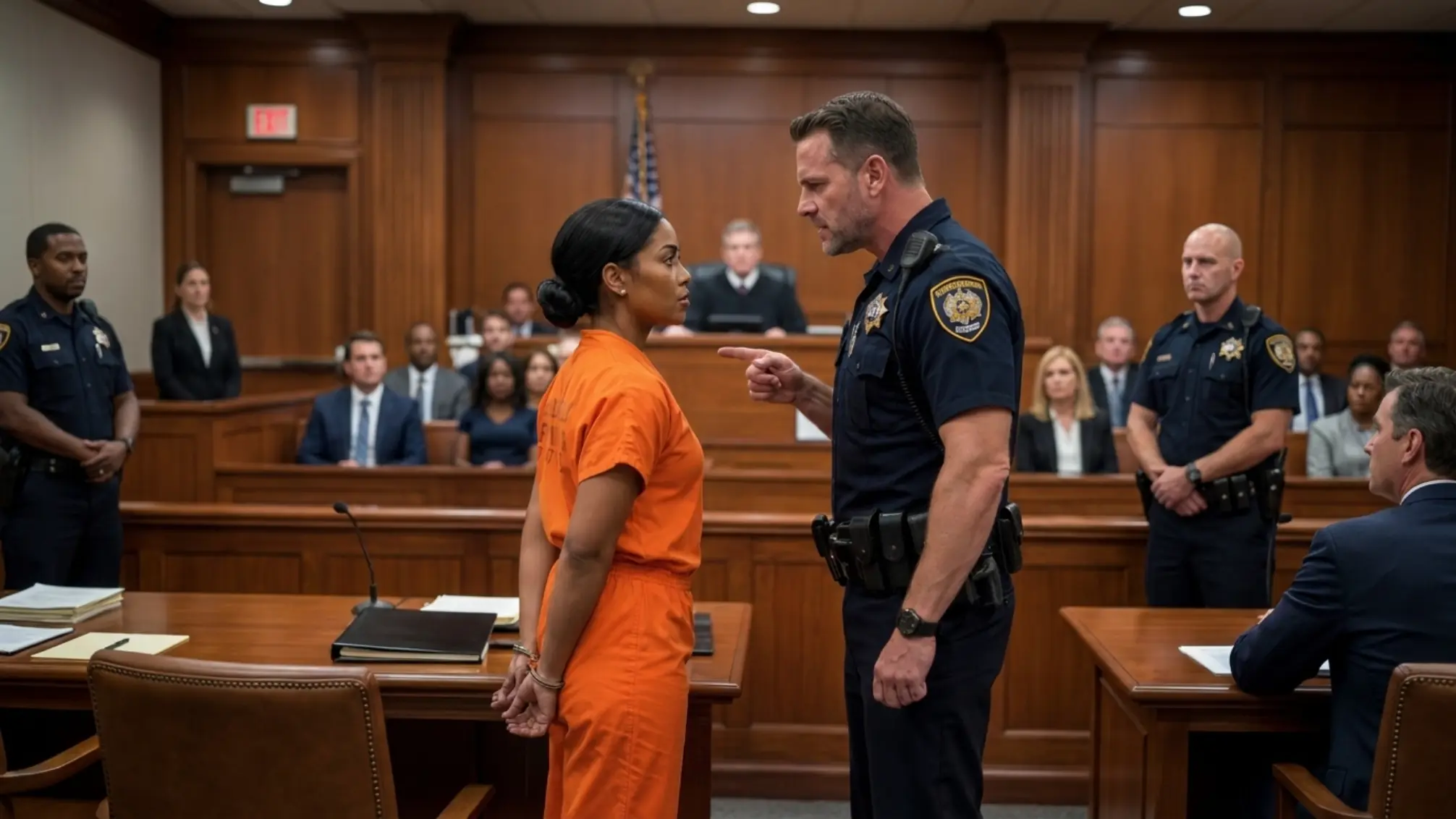
The prosecutor nodded as if Brennan’s opinion were evidence. Several jurors looked toward Iris, taking in the orange jail uniform, steel handcuffs, and lack of a private attorney beside her. The court-appointed lawyer assigned to the case had spent less than twenty minutes speaking with her before trial. Iris remained silent, her dark eyes fixed on Brennan with an unsettling patience.
He mistook her calmness for defeat.
Three months earlier, Special Agent Iris Spencer had arrived in Whitmore County under the name Iris Bell. At thirty-six, she had spent eleven years investigating public corruption, civil-rights violations, evidence tampering, and organized drug networks protected by law enforcement. She had been selected for the operation because she could disappear into environments where outsiders attracted immediate attention. Her assignment was to determine why Black motorists were being arrested at nearly six times the county average and why seized cash repeatedly vanished before reaching the evidence room.
Whitmore County looked harmless from the highway. Flat farmland stretched around small towns where church steeples rose above grain silos and football fields. Families waved from porches, business owners knew customers by name, and the sheriff’s department sponsored charity cookouts every summer. Yet beneath that familiar surface, complaints had accumulated for nearly a decade.
Drivers described being stopped without cause on isolated county roads. Deputies claimed to smell marijuana, ordered searches, and discovered drugs hidden in nearly identical locations beneath seats or inside spare-tire compartments. Cash was seized under civil-forfeiture rules, even when no conviction followed. Most victims lacked the money to challenge the department and quietly left the county after accepting reduced charges.
One deputy’s name appeared repeatedly.
Kyle Brennan.
He had joined the Whitmore County Sheriff’s Department fifteen years earlier and built a reputation as an aggressive narcotics officer. Local newspapers praised his record-breaking seizures, while the sheriff publicly called him the department’s “first line of defense” against outside criminals. Brennan’s arrests helped secure grants, new vehicles, and increased funding for the county task force.
The numbers looked extraordinary.
Too extraordinary.
Federal analysts reviewed more than four hundred traffic stops connected to Brennan and found patterns no honest officer could explain. His body camera frequently malfunctioned during searches. Evidence bags were logged hours after arrests instead of immediately. Nearly seventy percent of his suspects were Black or Latino, despite the county’s population being overwhelmingly white.
Several defendants claimed Brennan had planted drugs.
Three disappeared before investigators could locate them.
One died in prison.
Iris entered the county posing as a freelance insurance investigator relocating after a divorce. She rented a small house near the edge of town, purchased an older sedan, and spent several weeks establishing a routine. She visited the same grocery store, attended a local church twice, and worked from a laptop inside the Whitmore Diner where deputies frequently ate breakfast.
Brennan noticed her during the second week.
He stared longer than politeness allowed when she entered the diner. The following afternoon, his patrol vehicle followed her for six miles before turning away. Three days later, he stopped beside her at a gas station and asked whether she was “passing through or planning to stay.”
“I haven’t decided,” Iris answered.
“People usually decide before moving somewhere.”
“I like keeping options open.”
Brennan smiled without warmth. “Whitmore County isn’t the kind of place where strangers stay unnoticed.”
“That sounds like a warning.”
“Just neighborly advice.”
Iris thanked him and drove away.
The hidden recorder inside her handbag captured every word.
The first traffic stop occurred eleven days later. Brennan claimed Iris had crossed the center line, though her dashboard camera showed the car remained within its lane. He leaned into her open window and asked where she was coming from, where she was going, and why she had taken a rural road instead of the state highway.
“I’m going home.”
“Whose home?”
“Mine.”
“You bought property here?”
“I rent.”
Brennan glanced around the interior. “Step out of the vehicle.”
“Why?”
“You appear nervous.”
“I’m being questioned by an armed man who followed me last week.”
His expression hardened. “Refusing cooperation creates problems.”
Iris exited without resistance. She allowed him to conduct a limited search because the operation required more than suspicion; investigators needed direct evidence of his method. Brennan opened the trunk, examined the spare tire, and spent several seconds with his body blocking the roadside camera.
When he stepped away, a plastic bag containing white powder rested beside the jack.
Iris pretended not to notice his hand leaving the compartment.
Brennan lifted the bag theatrically. “Want to explain this?”
“It isn’t mine.”
“That’s what everyone says.”
“Your fingerprints may disagree.”
For one instant, fear crossed his face. Then he recovered and handcuffed her.
At the county jail, Iris declined to reveal her identity. Her arrest had triggered a prearranged federal protocol, but she instructed her team not to intervene immediately. The operation had finally reached the point where investigators could observe the entire system—Brennan, prosecutors, evidence technicians, and anyone else protecting him.
She was processed under the alias.
The bag was logged as methamphetamine weighing ninety-two grams. Brennan’s report stated that he discovered it in plain view after Iris voluntarily consented to a search. He also claimed she possessed $8,400 in suspicious cash, though federal agents had placed only $1,200 inside her locked travel case.
The remaining money appeared from nowhere.
At least, that was what Brennan believed.
Every bill had been marked.
The county prosecutor, Owen Talbot, filed trafficking charges within hours. Talbot had worked closely with Brennan for seven years and relied heavily on his arrest statistics during election campaigns. He declined to examine the roadside footage supplied by Iris’s court-appointed attorney, claiming the recording lacked proper verification.
Judge Harold Crane denied bail.
Iris spent seventeen days inside Whitmore County Jail while federal agents watched from outside. Her cell was searched four times. A jail supervisor attempted to pressure her into signing a confession in exchange for a reduced sentence. When she refused, prosecutors increased the charges and added resisting arrest, despite Brennan’s own report saying she cooperated physically.
Every act created another piece of evidence.
Iris memorized names, times, conversations, and procedures. A tiny recording device embedded beneath the seam of her legal folder captured meetings with attorneys and jail staff. Her federal team preserved copies remotely through a receiver placed by an undercover technician during a routine systems repair.
The most important witness appeared during her second week in custody.
A young evidence clerk named Melissa Grant entered the holding room carrying documents for Iris to sign. Melissa’s hands shook as she placed the forms on the table. She kept glancing toward the security camera above the door.
“These papers say the drugs were sealed at 9:42 p.m.,” Iris said.
Melissa swallowed. “That’s what the log shows.”
“I was arrested before six.”
“Sometimes evidence arrives late.”
“Was the bag sealed when Deputy Brennan brought it in?”
Melissa looked toward the camera again.
Iris lowered her voice. “You aren’t responsible for what he did. But protecting it makes you part of it.”
Melissa’s eyes filled with fear. “I can’t help you.”
“You already did.”
She left without answering.
That evening, an anonymous message reached the federal task force. It contained photographs of the evidence room, copies of altered logs, and a spreadsheet documenting missing cash from twenty-three seizures. Melissa had been keeping private records for nearly two years.
Brennan was not working alone.
Talbot had dismissed cases whenever defendants obtained credible legal representation, preventing planted evidence from receiving serious examination. Sheriff Leon Hargrove approved asset seizures and redirected portions into unofficial department accounts. A laboratory technician named Arthur Pike falsified testing dates and sometimes reported narcotics before samples even arrived.
Together, they had built a machine.
Brennan created arrests.
Talbot converted them into guilty pleas.
Hargrove controlled the money.
Pike made the evidence appear scientific.
The system depended on choosing victims who lacked power.
Iris remained the perfect target because they believed she was poor, isolated, and frightened.
Her trial began six weeks after the arrest. The speed itself was suspicious, but Talbot wanted a conviction before any outside lawyer examined the case. He selected jurors who openly described police officers as inherently trustworthy and challenged two candidates who expressed concern about racial profiling.
Iris’s court-appointed attorney objected weakly.
Judge Crane overruled him.
During opening statements, Talbot described Iris as a sophisticated trafficker who used claims of discrimination to avoid responsibility. He displayed the bag of methamphetamine, the manufactured cash total, and photographs of tools taken from her trunk.
The “trafficking tools” were a flashlight, work gloves, and a small digital scale used for luggage.
Brennan took the stand shortly before noon.
He described Iris as hostile from the moment he approached her vehicle. He claimed she refused lawful commands, attempted to block the search, and threatened his career. Every statement contradicted the dashboard recording, yet Talbot had persuaded the court to exclude the video temporarily because its source had not been authenticated.
Then Brennan stopped discussing actions and began discussing character.
“I’ve dealt with people like her my whole career,” he said. “They come into rural counties because they think we’re easy. They exploit government benefits, carry drugs, and accuse officers of racism when they get caught.”
Talbot did not object.
The judge wrote notes.
Some jurors nodded.
Brennan pointed directly at Iris. “She is exactly the type.”
Iris finally spoke.
“Fifteen years taught you how to lie under oath.”
Talbot objected immediately.
Judge Crane struck the statement and warned Iris to remain silent unless questioned. Brennan smiled, believing the rebuke confirmed his control.
“You have no lawyer, no money, and no one who will believe you,” he said as deputies escorted her past him during recess.
Iris lifted her cuffed hands slightly. “Good. Because the FBI recorded every word.”
Brennan’s smile disappeared.
At 1:37 p.m., the courtroom doors opened.
Four people entered wearing dark suits. Two carried sealed evidence cases. A woman at the front displayed federal credentials to the bailiff, who turned pale and approached the judge.
Judge Crane called an immediate recess.
Talbot demanded to know what was happening.
The woman in front introduced herself as Assistant Special Agent in Charge Rebecca Cole of the Federal Bureau of Investigation. She handed the judge a sealed warrant authorizing the seizure of courtroom evidence, sheriff’s records, and electronic devices connected to Brennan, Talbot, Hargrove, and Pike.
“The defendant’s true identity must be placed under seal until this room is secured,” Rebecca said.
Brennan stepped away from the witness box. “This is a local prosecution.”
“No longer.”
Sheriff Hargrove rose from the gallery and moved toward the exit.
Two agents blocked him.
Talbot’s voice became sharp. “You cannot interrupt an active criminal trial without cause.”
Rebecca turned toward Iris. “Special Agent Spencer, please confirm your credentials.”
The entire courtroom looked at the woman in the orange jumpsuit.
Iris stood.
A federal agent approached, unlocked her handcuffs, and handed her a small leather case. Iris opened it and displayed her FBI identification beneath the courtroom lights.
The silence became absolute.
One juror covered her mouth.
Another stared at Brennan.
Judge Crane slowly removed his glasses.
Brennan looked toward Talbot as if expecting the prosecutor to explain how the powerless woman at the defense table had transformed into a federal agent. Talbot had no answer.
Iris removed the orange jail shirt, revealing a fitted black blouse beneath it. She placed the garment across the defense chair and faced Brennan.
“You planted narcotics in my trunk at 5:48 p.m. on April nineteenth,” she said. “Your body camera was disabled thirty-one seconds before the search. Your fingerprint remained beneath the evidence tape because you resealed the bag after adding powder from case number 22-184.”
Brennan shook his head. “That’s impossible.”
“The powder was federally tagged.”
Talbot turned toward him. “Tagged?”
“The methamphetamine came from an FBI-controlled evidence sample,” Iris explained. “The moment you planted it, you connected yourself to a substance that could not legally exist outside federal custody.”
Rebecca opened the first evidence case.
Inside were marked bills, copies of altered reports, recordings, and photographs supplied by Melissa Grant. Another agent displayed synchronized footage from Iris’s dashboard camera, a hidden rear camera, and a federal surveillance vehicle parked half a mile away.
The screen showed Brennan opening Iris’s trunk.
It showed him reaching beneath his uniform shirt.
It showed the plastic bag in his hand before it appeared beside the spare tire.
The jury watched in horror.
Brennan’s face became gray.
“That footage has been altered,” he said.
Iris answered calmly. “Three cameras, independent timestamps, and a federal satellite log disagree.”
Talbot stepped toward the judge. “Your Honor, I was unaware of any misconduct.”
“Then why did you suppress the footage?” Iris asked.
“I challenged its authentication.”
“You also contacted Brennan seven minutes after my arrest, before the evidence was logged.”
Talbot stopped moving.
Rebecca produced telephone records.
“The call lasted eleven minutes,” she said. “During that conversation, Deputy Brennan sent you a photograph of the planted bag before writing his report. You then instructed him to increase the listed cash total above the state trafficking threshold.”
Talbot looked toward the jury.
Several members now watched him with open disgust.
Sheriff Hargrove attempted to speak, but Rebecca raised another document. “Your unofficial forfeiture account received $613,000 over five years. More than half originated from motorists never convicted of a crime.”
Hargrove’s shoulders dropped.
Arthur Pike was arrested inside the county laboratory at the same moment. Agents found prewritten drug-test certificates, unlogged samples, and text messages discussing which results Talbot required before hearings.
The machine collapsed in less than twenty minutes.
Judge Crane dismissed the jury and ordered the courtroom cleared except for attorneys and federal personnel. Before leaving, one juror approached Iris.
“I believed him,” the woman whispered.
“That was what the uniform was designed to make you do,” Iris replied.
Brennan was taken into custody in the same courtroom where he expected to destroy her. The arresting agent instructed him to place his hands behind his back.
He stared at Iris. “You set me up.”
“No,” she said. “I gave you an opportunity to behave exactly as you always had.”
“You lied about who you were.”
“You lied about people who had no badge to save them.”
Agents escorted him through the side door.
The investigation expanded across the next eleven months. Federal teams reopened 146 cases connected to Brennan. Forty-two convictions were vacated after evidence logs proved unreliable. Twenty-seven former defendants received compensation for wrongful imprisonment, unlawful searches, or seized property.
Three families learned that relatives who died carrying felony records had been innocent.
Melissa Grant became a protected witness. She admitted falsifying several logs under threats from Hargrove but provided enough documentation to reconstruct years of misconduct. Prosecutors recommended leniency because she preserved evidence and eventually exposed the scheme.
Judge Crane faced a judicial review for repeatedly accepting unsupported police testimony and silencing defense objections. Investigators found no direct payments connecting him to the conspiracy, but his conduct revealed something nearly as dangerous: a willingness to treat authority as proof.
He resigned before removal proceedings concluded.
Talbot was convicted of conspiracy, obstruction, deprivation of civil rights, and falsifying records. Sheriff Hargrove pleaded guilty after financial records connected him to diverted forfeiture funds. Pike cooperated in exchange for a reduced sentence and testified about the false laboratory reports he produced.
Brennan refused every deal.
At trial, he claimed the county expected aggressive enforcement and that his methods had protected residents from criminals. Prosecutors played his courtroom testimony, including the moment he described Iris as “exactly the type.”
Then they showed photographs of the people he framed.
Teachers.
Truck drivers.
College students.
Veterans.
Parents traveling with children.
A jury convicted him on all major counts.
At sentencing, Brennan finally looked toward Iris.
“You ruined my life,” he said.
Iris remained seated behind the prosecution table. “You ruined lives for fifteen years. I only stopped you.”
The judge sentenced him to federal prison.
Whitmore County changed slowly afterward. New leadership installed independent evidence audits, automatic body-camera alerts, and outside review for traffic stops involving searches or asset seizure. Every deputy received civil-rights training, though Iris knew training alone could not repair a culture built on silence.
The deeper change came from the people who had once believed resistance was useless.
Residents began filing complaints.
Jurors questioned unsupported testimony.
Public defenders demanded video before accepting plea agreements.
Young deputies reported misconduct instead of protecting senior officers.
Sixteen months after the courtroom arrest, Iris returned to Whitmore County without an alias. She wore a dark suit, carried her federal credentials openly, and entered the same courthouse through the front doors.
Melissa waited near the hallway.
“They replaced the evidence-room system,” she said.
“Good.”
“They also put your photograph in the sheriff’s training room.”
Iris raised an eyebrow. “That seems unnecessary.”
“The caption says, ‘Assume every person deserves the truth.’”
“That part can stay.”
Inside the courtroom, new hearings were underway for people seeking to clear records connected to Brennan. A Black father stood beside his attorney while the prosecutor formally withdrew charges filed seven years earlier.
His daughter cried in the gallery.
Iris watched quietly from the back row.
Brennan had believed he was destroying another nobody when he pointed at her from the witness stand. He had assumed an orange uniform erased her credibility and that poverty, race, and isolation would make any lie believable.
He was wrong about Iris.
More importantly, the investigation proved he had been wrong about every person he treated as powerless.
A badge could command a room.
A uniform could influence a jury.
A confident lie could survive for years when repeated by people protected from scrutiny.
But none of those things changed the truth.
They only delayed the moment it finally entered the courtroom carrying evidence.