At 8:41 on a rainy Tuesday morning, Officer Dean Carver stood in front of the Franklin County Courthouse assignment board and took a photograph.
He did it every morning.
The board hung on the marble wall beside the employee entrance, framed in dark brass and updated before the first hearings of the day.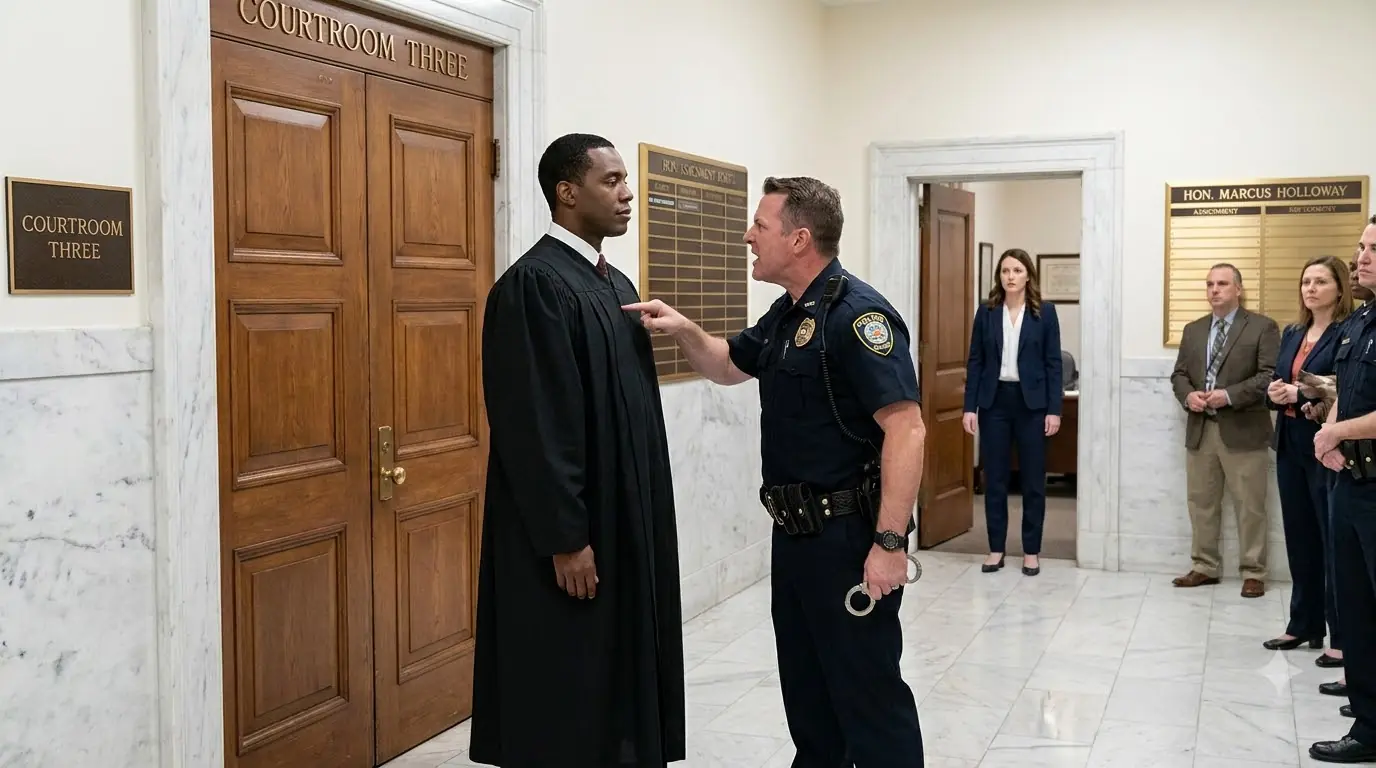
Courtroom One.
Judge Lillian Carter.
Courtroom Two.
Judge Andrew Whitfield.
Courtroom Three.
Hon. Marcus Holloway.
Courtroom Four.
Judge Eleanor Daniels.
Courtroom Five.
Judge Samuel Park.
Carver held his phone vertically, made sure all five assignments were visible, and tapped the screen.
Click.
The photograph went into a folder on his phone labeled DAILY COURTS.
He had started taking those pictures three years earlier after an attorney complained that he had sent two witnesses to the wrong floor.
Carver never made that mistake again.
He liked systems that prevented embarrassment.
He liked knowing who belonged where.
He liked having an answer before anyone asked him a question.
That morning, he looked at the board for maybe four seconds.
Then he slipped the phone into his uniform pocket and headed toward Courtroom Three.
Six minutes later, he would stand inches from the very judge whose name he had just photographed and tell him to take off his costume.
The Franklin County Courthouse in Richmond, Virginia, looked more imposing from inside than it did from the street.
The building had been renovated twice, but the architects had preserved the original marble corridors, dark wooden courtroom doors, brass wall lamps, and carved stone columns that made every footstep sound more important than it was.
People instinctively lowered their voices inside.
Attorneys carried files close to their chests.
Defendants stared at floor markings.
Families sat on benches beneath old framed portraits of judges who had died decades earlier.
Security officers occupied almost every intersection.
Dean Carver had worked there for eleven years.
Before that, he had spent fourteen years with the Richmond Metropolitan Police Department.
He was forty-six, broad through the shoulders, physically strong, and proud of being the kind of officer who could control a room without asking anyone twice.
His supervisors used the phrase command presence.
Carver preferred experience.
He believed he could look at a person and know whether something was wrong.
Maybe not exactly what.
But something.
He trusted that instinct more than most forms.
More than most explanations.
Sometimes even more than identification.
That would become important.
At 8:43, Carver received a radio message from the courthouse security desk.
“Unit Three, we have a possible access issue near judicial corridor.”
Carver pressed his shoulder microphone.
“What kind?”
“Unknown. Male individual passed secondary screening near east stairwell. Security says he has judicial clothing but they didn’t see chamber credentials.”
Carver immediately changed direction.
“Description?”
“Black male, very tall, black robe, carrying brown portfolio.”
“How tall?”
“Security says maybe six-six.”
Carver frowned.
“Six-six?”
“Maybe taller.”
“Copy.”
He moved quickly through the corridor.
The courthouse had several entrances.
Public visitors went through main security screening.
Attorneys with active bar credentials had a separate line.
Judges and senior court staff could enter through controlled east-side access using electronic cards.
That morning, heavy rain had caused a small problem.
The east entrance card reader failed intermittently.
Maintenance had propped an interior service door open while replacing a damaged sensor.
A deputy clerk had been assigned to visually verify people passing through.
At 8:38, that clerk was temporarily pulled away to help a witness who had collapsed near the elevators.
For approximately four minutes, the corridor had become less controlled than usual.
Nobody entered unlawfully.
But security staff did not know that yet.
Marcus Holloway entered during that four-minute window.
He had driven himself.
No security detail.
No judicial assistant.
No clerk beside him.
That was normal for Marcus.
At forty-eight, he had spent fifteen years on the bench and had developed a deep dislike for ceremonial fuss.
He was exactly two meters tall, a little over six-foot-six.
Broad shoulders.
Shaved head.
Deep-brown skin.
Dark eyes that could appear intimidating from a distance and unexpectedly warm when he smiled.
He wore a black judicial robe over a white shirt and black tie because his first matter began at nine.
A slim brown case folder rested beneath his arm.
He carried his access card in an inside pocket.
Marcus had entered through east corridor, nodded to maintenance worker, and walked toward Courtroom Three.
He had no idea anyone was looking for him.
At 8:47, he reached the heavy wooden doors.
A brass plaque read:
COURTROOM THREE
He stopped.
Rachel Bennett, his courtroom clerk, was not there yet.
Usually she arrived before him.
Marcus checked his watch.
8:47.
Still early.
He stood beside the door and opened the brown folder.
Inside were two motions for the morning calendar, handwritten notes, and a transcript he had reviewed at home.
The first case concerned a commercial contract dispute.
The second involved a complicated suppression hearing that had already been delayed twice.
Nothing dramatic.
Marcus preferred that.
He read one line.
Then heard fast footsteps behind him.
“Sir.”
Marcus looked up.
Dean Carver approached from the other end of the marble hallway.
Dark navy courthouse uniform.
Badge.
Radio.
Duty belt.
Handcuffs clipped near his right hip.
His expression was already severe.
Marcus closed the folder.
“Yes?”
Carver stopped six feet away.
“Where are you going?”
Marcus glanced at the courtroom door.
“Inside.”
“Inside where?”
Marcus looked at the plaque.
“Courtroom Three.”
Carver’s eyes moved to the black robe.
Then Marcus’s face.
Then the brown folder.
“Who are you?”
Marcus paused.
He assumed the officer was checking access after the card-reader problem.
Reasonable.
“Marcus Holloway.”
Carver’s expression did not change.
“Identification.”
Marcus looked at him.
“My court credential is in my inside pocket.”
“Don’t reach.”
Marcus stopped.
Both hands visible.
“All right.”
Carver stepped closer.
“You came through east corridor?”
“Yes.”
“That entrance is restricted.”
“I know.”
“Who let you through?”
“The service door was open.”
Carver’s eyes sharpened.
“So nobody checked you.”
“A maintenance employee saw me.”
“That’s not what I asked.”
Marcus remained calm.
“The electronic reader appears to be down.”
Carver folded his arms.
“That does not mean you get to walk through.”
Marcus looked toward the officer’s name tag.
CARVER
Then back to his face.
“I have authorized access.”
“Prove it.”
“I just told you my credential is in my jacket.”
“You’re wearing a robe.”
Marcus almost smiled.
“Yes.”
“What’s underneath it?”
Marcus stared.
“A suit.”
Carver did not appreciate tone.
“You think this is funny?”
“No.”
“Take the robe off.”
Marcus’s expression changed.
Only slightly.
“Excuse me?”
“Take it off.”
“Why?”
Carver stepped closer.
“Because I need to see what you’re carrying under it.”
Marcus looked at him carefully.
“You can inspect my court credential without requiring me to remove my robe.”
Carver pointed toward the black fabric.
“You don’t tell me how security works.”
Marcus’s eyes narrowed.
“I am familiar with courthouse security.”
“I’m sure you think you are.”
Marcus heard the sentence.
Not hostile enough yet to trigger alarm.
But wrong.
He had spent thousands of mornings in courthouses.
He recognized the shift from verification to authority contest.
“Officer Carver.”
Carver’s jaw tightened.
“How do you know my name?”
“It is on your uniform.”
“Don’t use it like we know each other.”
Marcus took one slow breath.
“All right.”
Carver pointed toward the wall.
“Step away from the courtroom door.”
Marcus did not move.
“Why?”
“Because I told you.”
“That is not an explanation.”
Carver laughed once.
“Here we go.”
Marcus tilted his head.
“What?”
“Everybody who wants to get somewhere they’re not supposed to be suddenly becomes a lawyer.”
Marcus looked down at his robe.
Then at Carver.
“That would be ironic.”