“I’ll take them all.”
The young pie seller stared at the tall cowboy across her wooden counter, certain she had misunderstood him. Fifteen pies remained—apple, cherry, peach, and three blackberry pies made from her late mother’s private recipe. The stranger placed a thick stack of bills beside the flour tin without asking the price.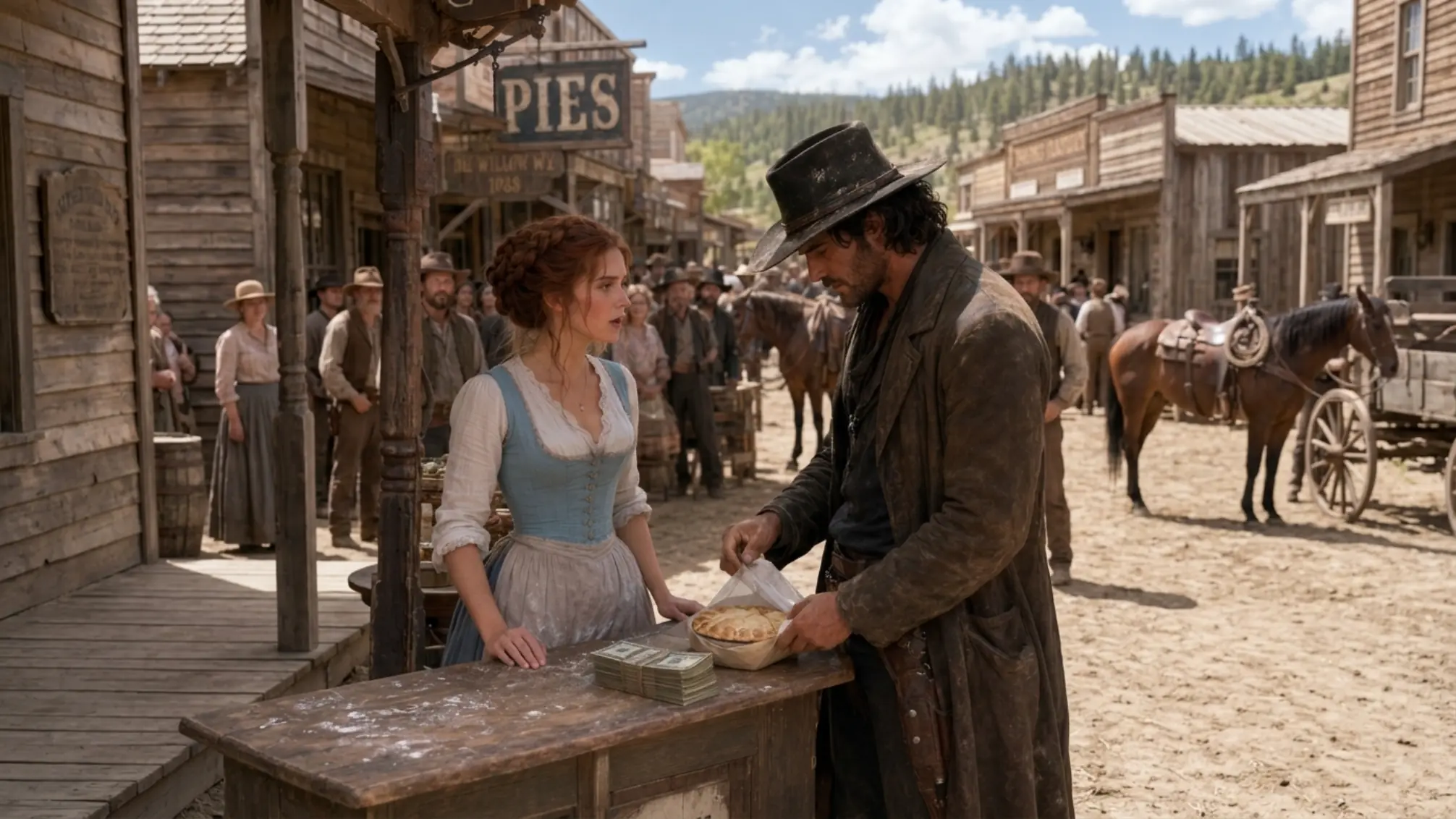
“Every pie?” she asked.
The cowboy nodded once beneath the shadow of his black hat. “Every last one.”
The marketplace of Red Willow slowly grew quiet around them. Wagon wheels still rolled through the dust, horses stamped beside the hitching posts, and merchants continued calling their final offers of the afternoon, but nearby townspeople had begun watching. No one bought fifteen pies unless there was a wedding, a funeral, or a celebration large enough to feed half the town.
There was no celebration.
The pie seller brushed flour from her pale-blue bodice and studied the man more carefully. He was broad-shouldered and tall, with trail dust covering his dark clothes and a weathered brown duster hanging nearly to his boots. Thick black hair curled beneath his hat, rugged stubble darkened his jaw, and a faint scar ran from the corner of his mouth toward his cheek.
“You haven’t even asked what they cost,” she said.
“I have enough.”
“That isn’t what I asked.”
For the first time, something almost like amusement touched his eyes. “You always question customers who offer too much money?”
“Only customers who behave like they’re purchasing more than supper.”
The faint amusement vanished.
He carefully lifted the nearest apple pie and wrapped it in clean cloth. His large hands moved with unexpected gentleness, supporting the tin from beneath as though one careless touch might destroy something precious. He placed it inside a burlap-lined crate, then reached for the next.
The pie seller watched him in growing confusion.
Most men rushing through the marketplace treated her work like a convenient meal. They argued over pennies, squeezed crusts with dirty fingers, or demanded discounts because the afternoon was nearly over. This cowboy handled every pie as though he understood the hours required to peel fruit, knead dough, regulate the stove, and carry the finished tins three miles into town.
“Who are they for?” she asked.
“People who need them.”
“That could mean anyone.”
“It does.”
He continued packing.
Two women carrying baskets stopped beside the neighboring produce stall. The blacksmith’s apprentice abandoned his broom and leaned against the shop doorway. Even the elderly rancher who normally complained about everything removed his hat and watched the mysterious stranger empty the counter.
The pie seller folded her arms. “You’re causing a scene.”
“I’m buying pies.”
“You’re buying all of them.”
“That appears to be the number you made.”
She almost smiled despite herself.
The last three pies were blackberry. The cowboy’s hand stopped above them before touching the first tin. His expression changed so subtly that anyone else might have missed it, but the pie seller saw recognition move across his face.
He lifted his eyes toward her.
“Who taught you this recipe?”
“My mother.”
His fingers tightened around the edge of the counter. “What was her name?”
The pie seller hesitated.
Something in his voice had changed. The question no longer sounded curious. It sounded like a man standing before a grave he had spent years searching for.
“Why?”
“Please.”
She looked into his dark eyes and saw no threat there, only a grief so carefully controlled that it frightened her more than anger would have. Slowly, she answered.
“Margaret Whitmore.”
The marketplace disappeared from the cowboy’s face.
He lowered his head and rested one hand against the wooden counter. For several breaths, he said nothing. Dust drifted around his boots while the afternoon wind carried cinnamon and berries between them.
“You knew her,” the pie seller whispered.
“Yes.”
“How?”
The cowboy looked toward the blackberry pie.
“She saved my life.”
The young woman forgot the people watching them. Her name was Clara Whitmore, and for six years she had sold pies from that same weathered stand. Her mother had been dead for three of those years, leaving behind a small cabin, several recipes, mounting debts, and one unopened letter Clara had never understood.
No one had ever mentioned a wounded cowboy.
“My mother never spoke about you.”
“She had reasons not to.”
“What reasons?”
The man wrapped the first blackberry pie and placed it in the crate. “Will you be here tomorrow?”
Clara’s suspicion returned immediately. “I’m here every afternoon.”
“No.” He met her gaze. “Tomorrow, I would like to meet you.”
“You’re standing in front of me now.”
“Not with half the town listening.”
Several observers suddenly looked away, pretending they had not heard.
Clara stepped closer to the counter. “You arrive without a name, buy every pie I own, ask about my dead mother, and expect me to meet you again without explaining anything.”
The cowboy considered her words.
“My name is Elias Hart.”
The name struck something buried inside her memory.
Clara had seen it before.
Not recently, and not on any town ledger or market account. The name belonged to the unopened letter hidden inside a cedar box beneath her bed.
Her breath caught.
Elias noticed.
“You know the name.”
Clara backed away from the counter. “Leave.”
His face hardened with concern rather than anger. “Miss Whitmore—”
“I said leave.”
“I never meant to frighten you.”
“You should have thought of that before speaking my mother’s secrets in the middle of the street.”
Elias reached for the crate containing the pies, but Clara placed one hand over the final blackberry tin.
“Not this one.”
“I paid for it.”
“I’m returning the money.”
“Keep the money.”
Her eyes flashed. “I don’t accept charity.”
“Neither did your mother.”
Clara became completely still.
Elias immediately realized he had said too much. Pain moved through his expression, and he looked toward the road as if part of him considered walking away forever. Instead, he released the pie.
“Sunrise,” he said quietly. “Meet me at Saint Matthew’s cemetery.”
Clara’s anger sharpened. “You expect me to follow a strange man into a cemetery before dawn?”
“Your mother’s grave is there.”
“I know where my own mother is buried.”
“There is something beneath the stone that belongs to you.”
He lifted the crate and turned away.
Clara called after him. “What did she give you?”
Elias stopped without looking back.
“A reason to become someone worth finding.”
Then he carried the pies down the crowded street.
Clara remained behind the empty counter while whispers moved around her. She ignored every curious face, folded the money into her apron, and packed the final blackberry pie beneath a cloth. Her hands trembled so badly that she nearly dropped the tin.
By sunset, she had returned to the small cabin outside town.
The house sat near an abandoned orchard where six apple trees still produced more fruit than Clara could use. Its roof leaked over the kitchen, the porch leaned toward the east, and the winter woodpile had already become dangerously low. It was not much, but it was the only home she remembered.
She locked the door behind her and pulled the cedar box from beneath her bed.
Inside lay her mother’s wedding ring, two faded photographs, several unpaid notes from merchant Silas Crowe, and the sealed letter. Clara had discovered it among Margaret’s belongings after the funeral.
The front carried only one name.
Elias Hart.
Clara had never opened it because it did not belong to her. She tried locating the man through the sheriff, stagecoach office, and church records, but no one in Red Willow knew him. Eventually, the letter returned to the cedar box, becoming another unanswered question among everything Margaret took to the grave.
Now the man named on the envelope had appeared at Clara’s counter.
She sat beside the cold fireplace and studied the seal.
Her mother had pressed a tiny blackberry branch into the wax.
Clara’s fingers moved toward it, then stopped. Opening the letter felt like stealing words never intended for her. Yet if Elias truly knew Margaret, why had he never received it?
A knock struck the front door.
Clara hid the letter beneath her shawl and reached for the iron poker beside the fireplace.
“Who is it?”
“Silas Crowe.”
Her stomach tightened.
Silas was the wealthiest merchant in Red Willow and the man who held every remaining note against the cabin. He had extended Margaret credit during her illness, though his generosity became less generous after her death. Each missed payment increased the interest, and every visit brought another suggestion that Clara surrender the cabin and work inside his boardinghouse kitchen.
She opened the door only a few inches.
Silas stood beneath the porch lantern in an expensive black coat. He was forty-eight, silver-haired, clean-shaven, and polished in the manner of a man who never performed work capable of dirtying his hands. His smile always arrived before warmth and disappeared before reaching his eyes.
“I heard you had an unusual customer today.”
“News travels quickly.”
“A stranger buying fifteen pies attracts attention.”
“He paid.”
“That is what concerns me.”
Clara tightened her grip on the door. “Why would my sales concern you?”
“Because Elias Hart is dangerous.”
Her heart struck hard against her ribs.
“You know him.”
Silas’s smile faded. “I know enough.”
“Then tell me.”
“He rode with thieves and killers. Years ago, his gang robbed payroll wagons across three territories. Men died wherever they traveled.”
Clara remembered the sorrow in Elias’s eyes when he heard Margaret’s name.
“He said my mother saved his life.”
Silas looked toward the darkness beyond the porch. “Your mother possessed a weakness for wounded things.”
“What happened?”
“Elias was found half dead near the orchard. Margaret hid him inside this cabin while federal marshals searched the county.”
“Why would she protect an outlaw?”
“Because she believed his story.”
“What story?”
Silas stepped closer. “That he wanted to leave the gang. That he had evidence against its leader. That he only needed time to recover.”
“Was he lying?”
“Men like Elias always lie when survival requires it.”
Clara studied him. “You still haven’t answered.”
Silas’s patience thinned. “He vanished before the marshals arrived. Your mother waited for months, believing he would return. He never did.”
Clara felt anger rise, not toward Elias alone but toward the years of silence surrounding Margaret’s life.
“Why didn’t anyone tell me?”
“Your mother asked us not to.”
“Us?”
Silas looked away too quickly.
Clara understood. “You were there.”
“I helped her.”
“How?”
“I arranged medicine. Protected the cabin from searches. Sent messages on her behalf.”
“To Elias?”
Silas hesitated.
The sealed letter felt suddenly heavy beneath Clara’s shawl.
“What did you do with her messages?”
“I delivered what I could.”
“That is not an answer.”
Silas stepped back. “Stay away from him. Your debt comes due in twelve days, and the last thing you need is an outlaw filling your head with old lies.”
He turned toward his horse.
Clara called after him. “Did my mother trust you?”
Silas paused.
“She should have.”
Then he rode away.
Clara locked the door and pressed her back against it.
She understood two things before the sound of his horse disappeared. Silas had known Elias would eventually return, and he feared whatever the cowboy planned to reveal.
Before dawn, Clara put on her heaviest shawl and slipped the letter into her dress pocket. She carried the final blackberry pie in a covered basket and walked toward Saint Matthew’s cemetery.
Mist covered the low fields.
Elias waited beside Margaret’s grave, his black hat held against his chest. The fifteen pies had disappeared, though the empty crate rested beside his horse. He did not move toward Clara when she approached.
“You came.”
“I haven’t decided whether that was wise.”
“It probably wasn’t.”
She stopped several feet away. “Where are the pies?”
“The orphanage received six. The miners’ infirmary took four. The widow east of town accepted three, and two went to a family whose barn burned last week.”
“You bought them for strangers.”
“I bought them because your mother once fed a starving man without asking whether he deserved it.”
Clara placed the basket beside the grave.
“Silas says you were an outlaw.”
“I was.”
The direct answer unsettled her more than denial.
“How many people did you hurt?”
“Too many.”
“Did you kill anyone?”
Elias looked toward Margaret’s name carved into the stone. “Yes.”
Clara’s breath became shallow.
He did not excuse himself. He did not describe self-defense, bad circumstances, or orders from crueler men. He simply allowed the truth to stand between them.
“Why did my mother save you?”
“Because I carried evidence against the gang leader. I had decided to testify, but the other riders discovered it. They shot me near the orchard and left me to die.”
“My mother found you.”
“She dragged me into your cabin during a storm. For nine days, she cleaned the wound, fed me, and hid me from men who would have killed us both.”
“Then you left.”
“Federal marshals moved me before sunrise. I was supposed to return after the trial.”
“But you didn’t.”
Elias reached inside his coat and removed a folded federal document.
“The gang leader escaped. He sent men after every witness. The marshals placed me in another territory under a different name.”
“For how long?”
“Seven years.”
Clara’s anger broke through. “My mother waited.”
“I wrote.”
“She never received anything.”
Elias closed his eyes briefly. “I sent twenty-three letters.”
Clara pulled the unopened envelope from her pocket.
“She wrote too.”
He stared at his name in Margaret’s handwriting.
“Where did you find that?”
“Among her belongings.”
Elias reached toward it, then stopped. “Why was it never sent?”
Clara thought of Silas’s hesitation.
“I believe someone prevented it.”
They looked toward the grave.
Elias knelt and removed a small folding knife. Clara stepped backward, alarmed, until he began cutting through the packed earth beside the stone.
“What are you doing?”
“Your mother told me where she would hide something if letters became unsafe.”
Several inches beneath the soil, his knife struck metal.
Together, they uncovered a rusted tin box wrapped in oilcloth. Elias handed it to Clara without opening it. The lock had decayed enough to break beneath the knife.
Inside were twenty-three letters.
Every envelope carried Elias’s handwriting.
None had been opened.
Beneath them lay a ledger containing dates, signatures, and payments made during Margaret’s illness. Clara recognized Silas Crowe’s name throughout the pages, but the figures did not match the debts he claimed she owed.
Her mother had paid almost everything before dying.
The final page held a written statement.
Silas intercepts the post. He knows Elias survived and fears what Elias can prove. If anything happens to me, the cabin and orchard belong free of debt to Clara. The original deed is hidden beneath the blackberry tree.
Clara lowered herself beside the grave.
All the years of shame and struggle changed inside one rusted box. Her mother had not died abandoned by the man she saved. Elias had not forgotten her. Silas had separated them, stolen the payments, and kept Clara trapped beneath a fraudulent debt.
Elias remained on one knee.
“I came back as soon as I learned she was gone.”
“You waited three years.”
“I didn’t learn until last month. The marshal who protected my identity finally died, and his records were released.”
Clara wiped tears from her cheek. “Why buy every pie?”
“The recipe.”
“What about it?”
“Your mother made blackberry pie with black pepper in the crust. She said the pepper made the berries taste sweeter.”
Clara laughed through her tears. “Everyone tells me it’s strange.”
“It kept me alive when fever made everything else taste like dust.”
Elias looked toward the basket.
“When I smelled it across the marketplace, I knew Margaret had left someone behind.”
“You chose me because of a pie?”
“No.”
His gaze lifted to hers.
“I found you because of the pie. I chose to return today because you looked at a frightening stranger and demanded the truth instead of accepting his money.”
Clara’s heartbeat changed.
Before she could answer, hoofbeats thundered beyond the cemetery gate.
Silas Crowe arrived with two armed deputies.
He pointed toward Elias. “Sheriff’s warrant. Elias Hart, you are under arrest for armed robbery and murder.”
Elias stood slowly.
Clara moved between them. “The charges were settled through federal testimony.”
Silas looked at the open tin box.
Fear crossed his face.
“Give me those papers.”
“They prove you stole from my mother.”
“They prove nothing.”
“They prove the cabin debt is false.”
One deputy shifted uncomfortably. “Mr. Crowe, you said the stranger threatened her.”
“He has confused her with forged documents.”
Elias opened his duster enough to reveal no weapon in his hands. “Read the federal order.”
Silas drew his revolver.
The deputies froze.
Clara understood instantly that they had not expected violence.
Silas aimed past her toward Elias. “You should have stayed gone.”
Elias moved, but Clara was closer.
She threw the covered pie basket into Silas’s arm.
The revolver fired into the air.
Elias crossed the distance before Silas could recover, struck the gun from his hand, and forced him facedown beside the cemetery gate. One deputy collected the weapon while the other stared at the scattered blackberry pie covering Silas’s expensive coat.
Clara looked at the ruined dessert.
“That was my last pie.”
Elias kept one knee against Silas’s back. “I’ll buy another tomorrow.”
Silas was taken before the territorial judge that afternoon.
The tin box, ledger, intercepted letters, false debt notes, and original deed beneath the blackberry tree created more evidence than he could explain. Investigators found bags of undelivered mail inside a locked storeroom beneath his business.
He had controlled Red Willow’s correspondence for years.
Silas used private letters to gather secrets, manipulate property transfers, and pressure widows who believed their distant relatives had forgotten them. Margaret discovered the scheme while helping Elias, so Silas isolated her and prevented every message from reaching its destination.
The judge erased Clara’s debt before sunset.
Her cabin and orchard belonged entirely to her.
Elias returned to the marketplace the following afternoon.
Clara’s counter held only one pie.
Blackberry.
He stopped before it and placed a coin on the wood.
Clara pushed the money back.
“This one isn’t for sale.”
“What must a man do to earn it?”
“Tell me why he asked to meet me instead of simply delivering the papers.”
Elias looked toward the townspeople pretending not to listen.
“I came to repay your mother.”
“That explains the money.”
“I wanted to protect her daughter.”
“That explains the evidence.”
He hesitated.
Clara leaned closer. “You faced armed outlaws more easily than one question.”
“They were less dangerous.”
“To whom?”
“To the parts of me I know how to defend.”
The answer softened her.
Elias removed his hat.
“Your mother’s last letter said she hoped I would someday build a life instead of spending every year repaying a death I escaped. When I saw you behind this counter, carrying her courage and arguing with strangers exactly as she did, I wondered whether finding you was the first part of that life.”
Clara’s breath caught.
“You didn’t know me.”
“No.”
“You still don’t.”
“I know you refuse charity, protect your mother’s name, throw pies at armed men, and make blackberry crust better than anyone alive.”
“That is not enough for a lifetime.”
“No.”
Elias looked directly into her eyes.
“But it is enough for tomorrow.”
Clara placed the pie between them.
“Sit down.”
They shared it behind the market stand while Red Willow watched.
Elias remained in town through autumn.
He repaired the cabin roof, restored the abandoned orchard, and never once attempted to take control of Clara’s work. When she decided to open a permanent bakery inside an empty storefront, he offered money only after she wrote a partnership agreement giving herself final authority over every recipe.
The bakery opened before the first snow.
A sign above the door read:
MARGARET’S PIES — NO ONE LEAVES HUNGRY
Every evening, Clara reserved several unsold pies for families who could not pay. Elias delivered them after dark, following the same roads where he once rode for violent men. The townspeople gradually stopped seeing him as the outlaw from old posters and began recognizing the quiet cowboy who repaired fences, transported medicine, and carried warm food through winter.
He never demanded forgiveness for his past.
Clara never pretended it had not happened.
They built trust through ordinary days: flour on the floor, broken wagon wheels, burned crusts, disagreements over money, and quiet walks toward Margaret’s grave. Love arrived without the sudden thunder Clara expected.
It grew through repetition.
One spring morning, Elias placed a small wooden box on the bakery counter. Inside lay Margaret’s unopened letter, carefully preserved beneath glass, beside the first coin he had offered for Clara’s blackberry pie.
Clara looked at him. “What is this?”
“A reminder.”
“Of what?”
“That one letter can be stolen, but truth keeps searching for another road.”
He took her hand.
“I spent years believing I had returned too late to repay your mother. Then I learned kindness isn’t always a debt meant to be repaid to the person who gave it.”
Clara’s eyes filled.
“What do you want, Elias?”
“Tomorrow.”
She smiled. “Only tomorrow?”
“Every one you’re willing to give me.”
They married beneath the orchard trees that summer.
At the reception, Clara baked twenty-three blackberry pies—one for every letter Silas had hidden. Elias bought all of them before the guests arrived, paying with a single silver dollar and promising to distribute the pies freely.
Clara objected until he kissed her.
By midnight, every pie tin was empty.
The people of Red Willow believed Elias Hart had chosen Clara because she resembled the woman who once saved his life. Some thought he married her from gratitude, guilt, or a desire to repay an old promise.
They were wrong.
Margaret’s recipe led him to the pie stand.
Her letter brought him back the next morning.
But Clara’s courage, honesty, and refusal to be purchased made him stay.
The mysterious cowboy had bought every pie before sunset because he recognized the taste of mercy.
By midnight, Clara finally understood why he had chosen her.
She carried the same kindness as her mother—but she was never merely the woman’s daughter.
She was the first future Elias had ever believed he deserved.